 Connexion
Copilot agentic AI in Outlook: automating inbox and calendar management
.png)

Coup dur pour DNS4EU. Le résolveur DNS public co-financé par la Commission européenne, présenté il y a moins d'un an comme l'alternative souveraine à Google et Cloudflare, doit désormais bloquer une trentaine de domaines de streaming pirate, sur ordre du tribunal judiciaire de Paris.
La décision date du 17 avril, après deux ordonnances réclamées par Canal+ et restées sans réponse côté défense.
Concrètement, l'ordonnance vise 37 domaines au total, répartis entre 16 sites qui diffusaient illégalement le MotoGP et 21 autres qui faisaient pareil avec la Formule 1. On y retrouve des grands classiques de l'IPTV pirate comme daddylive3.com, iptvsupra.com ou king365tv.me.
Whalebone, la société tchèque qui opère DNS4EU pour le compte de l'Union européenne, doit donc rentrer ces noms de domaine dans son moteur de blocage et empêcher leur résolution depuis la France.
Sauf que la mesure déborde déjà du territoire français. Le blocage est appliqué même pour des utilisateurs basés hors de France, ce qui pose une vraie question de juridiction et de portée extraterritoriale d'une décision parisienne sur un service censé desservir 450 millions d'Européens.
Bref, le DNS public européen finit par être plus restrictif que prévu, et pas vraiment dans le sens où Bruxelles l'avait vendu.
L'autre détail gênant : Whalebone n'a même pas comparu à l'audience du 19 février. Le tribunal a donc statué par défaut, en faveur de Canal+, sans le moindre argument contradictoire. Difficile de mieux perdre un procès.
La société tchèque, qui s'est vendue auprès de Bruxelles comme un acteur clé de la souveraineté numérique européenne, va devoir s'expliquer sur cette absence.
En pratique, ce genre de blocage DNS reste contournable en quelques minutes par n'importe quel utilisateur un peu débrouillard, qui n'a qu'à changer son résolveur dans les paramètres système pour pointer ailleurs. Mais la portée symbolique est assez moche, parce qu'elle inscrit DNS4EU dans la même logique de contrôle que les services qu'il prétendait justement remplacer.
Et ce n'est pas la première fois que la justice française élargit le périmètre. Depuis 2024, les ordonnances de blocage anti-piratage ont visé successivement les FAI, puis les résolveurs DNS de Google, Cloudflare et Cisco, puis les VPN comme NordVPN ou ExpressVPN, et désormais le DNS souverain européen lui-même.
Canal+ s'appuie à chaque fois sur l'article L.333-10 du Code du sport, qui permet de viser "toute personne susceptible de contribuer" à remédier au piratage.
Bref, un DNS public financé par l'UE pour protéger les Européens, qui finit forcé de filtrer hors de ses frontières par un tribunal national. C'est un peu n'importe quoi.
Source : TorrentFreak


Le procès très médiatisé entre Elon Musk et Sam Altman débute le 27 avril 2026 aux États-Unis. Elon Musk reproche à OpenAI, qu'il a cofondée, d'avoir trahi sa mission originelle en devenant une entreprise obsédée par les profits et un partenaire de Microsoft. Le milliardaire a abandonné ses accusations de fraude, mais espère toujours faire dérailler l'entreprise derrière ChatGPT.
Si vous voyagez avec un Macbook qui contient des trucs trèèèès sensibles, faut absolument que vous alliez tester cet outil.
PanicLock est le bouton "panique" qu'Apple n'a jamais voulu faire. Grâce à cela, en un clic, Touch ID se désactive totalement.
Plus de biométrie, et retour au mot de passe obligatoire pour rouvrir la session. Parce que oui, Touch ID, c'est ultra pratique au quotidien, sauf quand un agent à la frontière ou un flic un peu trop curieux vous demande gentiment (ou de force) de poser votre doigt sur le capteur de votre machine.
Sur iPhone, Apple a prévu quand même une astuce (5 pressions sur le bouton latéral et la biométrie se désactive). Mais sur Mac, rien !
Le principe de PanicLock, c'est tout simplement de cliquer sur l'icône dans la barre de menu ou d'appeler un raccourci clavier de votre choix et voilà ! Votre Mac se verrouille alors en désactivant Touch ID au passage.

Les devs ont aussi prévu une option "Lock on Close" qui déclenche le panic mode automatiquement lorsqu'on referme l'écran du Macbook, ce qui est la fonctionnalité la plus utile de tout le pack ! Vous fermez l'écran, et c'est mort, faut le mot de passe !
Sous le capot, ça fonctionne grâce à des fonctions natives de macOS qui sont tout simplement détournées pour permettre de désactiver la biométrie en 2 secondes. Notez que le code de PanicLock est sous licence MIT, et fonctionne 100% en offline.

Alors pourquoi c'est utile au-delà de la paranoïa que vous vous trimballez depuis que vos parents vous ont appris que vous aviez un frère adoptif secret ?
Hé bien y'a une vraie distinction juridique en jeu que j'évoquais d'ailleurs récemment dans mon article sur les cartes bancaires biométriques . En effet, aux États-Unis, la justice est divisée car en janvier 2025, la cour d'appel fédérale du District of Columbia a tranché dans US v. Brown que forcer quelqu'un à déverrouiller son téléphone violait le 5e amendement, parce que ça revient à témoigner contre soi-même.
Alors que la cour d'appel fédérale de l'Ouest Américain, elle, considère qu'un déverrouillage biométrique reste un acte physique qui n'est pas un témoignage, donc forçable. Et là, désactiver Touch ID avant un contrôle change donc tout puisque grâce à ça, on bascule dans le cas "mot de passe obligatoire", qui est mieux protégé légalement dans plusieurs juridictions. C'est exactement la même logique que la fonction iOS 18 qui affole la police , transposée côté Mac.
Je ne suis pas expert, mais je crois qu'en France, c'est un petit peu la même chose avec notre droit à ne pas nous auto-incriminer.
Côté limites, PanicLock désactive Touch ID, et c'est tout, donc si vous avez l'unlock par Apple Watch ou via une clé de sécurité, votre Mac restera quand même "ouvrable" autrement. Il faut donc penser à désactiver ces méthodes en parallèle si vous êtes vraiment dans une situation à risque.
Pour l'installer, c'est:
brew install paniclock/tap/paniclock
ou téléchargement du DMG depuis la page releases.
Et sur iPhone, la même philosophie existe via le pair locking qui bloque les ports USB, si vous voulez aller encore plus loin.
Bref, c'est petit, c'est simple, et c'est gratuit !!


Certains départements en France métropolitaine vont connaître un durcissement des règles du Code de la route. À partir du 1er mai 2026, le simple fait d'utiliser son smartphone entraînera la suspension immédiate du permis de conduire pour l'automobiliste pris sur le fait.
At the 2026 NAB Show 2026, Seagate Technology formally introduced its latest generation of high-capacity enterprise hard drives built on the Mozaic 4+ platform. These drives, (model ID ST4400NM002M) reaching up to 44TB, represent the current peak of commercially deployed hard disk capacity and are already being shipped to select hyperscale cloud providers. The announcement reflects ongoing demand for higher-density storage as data generation continues to accelerate, particularly in artificial intelligence and large-scale cloud environments.
Rather than targeting general consumers, these drives are designed specifically for hyperscale data centres where efficiency, density, and cost per terabyte are critical considerations. The Mozaic 4+ platform is also notable for its reliance on heat-assisted magnetic recording (HAMR), a technology that has moved from experimental development into production-scale deployment. With broader qualification underway, the 44TB model serves as both a milestone in current storage capabilities and a step toward projected capacities approaching 100TB in future generations.

The 44TB drives are built on Seagate’s Mozaic 4+ platform, which represents the company’s production-ready implementation of heat-assisted magnetic recording (HAMR). Unlike earlier perpendicular magnetic recording approaches, HAMR uses localized heating via a nanophotonic laser to temporarily reduce the coercivity of the disk surface, allowing data to be written at much higher densities. This enables significantly greater areal density without requiring a complete redesign of the underlying hard drive architecture, allowing Seagate to scale capacity incrementally across generations.
At a physical level, the drives use a multi-platter design, widely understood to consist of 10 platters, each delivering over 4TB of capacity. This results in the total 44TB figure within a standard 3.5-inch enterprise form factor. The spindle speed is expected to remain at 7200 RPM, consistent with other enterprise-capacity drives, balancing throughput, reliability, and power consumption. Early estimates suggest sustained transfer rates in the region of 300 MB/s, though final performance characteristics depend on deployment conditions and firmware tuning. I think we are likely much more liekly to hit 280MB/s or so, such as you find in the 30TBs.

A key aspect of the Mozaic 4+ design is its vertically integrated photonics system. Seagate has developed its own laser components in-house, embedding them directly into the recording head. This allows precise, nanosecond-scale heating during write operations, which is critical for maintaining data integrity at such high densities. Vertical integration also gives Seagate tighter control over manufacturing consistency, yield, and long-term reliability, all of which are essential when deploying drives at hyperscale volumes.
The recording stack itself incorporates several advanced components. These include a Gen 2 superlattice platinum-alloy media designed for improved magnetic stability, a Gen 2 plasmonic writer responsible for delivering the heat-assisted write process, and a Gen 8 spintronic reader that improves read accuracy from increasingly smaller data bits. Together, these components enable higher density while maintaining error rates and durability within enterprise requirements.

Supporting these physical advancements is a 7nm integrated controller, which manages drive operations with improved precision. This controller enhances servo control, allowing the read/write heads to maintain accurate positioning over narrower tracks. It also contributes to improved power efficiency, reducing watts per terabyte and helping data centres optimize energy usage at scale. These gains are particularly relevant in large deployments where power and cooling costs scale with capacity.
From a manufacturing perspective, the Mozaic platform is designed to scale without requiring disruptive architectural changes between generations. Each iteration builds on existing processes, allowing Seagate to increase per-platter capacity over time. The company has indicated a roadmap toward 10TB per platter, which would enable drives approaching 100TB within a similar physical footprint. This approach prioritizes continuity in deployment while steadily increasing storage density.
| Specification | Details |
|---|---|
| Platform | Mozaic 4+ |
| Recording Technology | HAMR (Heat-Assisted Magnetic Recording) |
| Maximum Capacity | 44TB |
| Form Factor | 3.5-inch |
| Number of Platters | 10 |
| Capacity per Platter | 4TB+ |
| Spindle Speed | 7200 RPM (expected) |
| Recording Method | CMR |
| Estimated Throughput | ~300 MB/s (speculative) |
| Target Market | Hyperscale data centres |
| Controller | 7nm integrated SoC |

Despite the push toward higher capacities, the 44TB drives based on the Mozaic 4+ platform use conventional magnetic recording (CMR) rather than shingled magnetic recording (SMR). This distinction is relevant because SMR typically achieves higher capacities by overlapping data tracks, which can negatively impact rewrite performance and latency in certain workloads. By retaining CMR, Seagate is prioritising predictable performance characteristics, particularly for enterprise environments where consistent throughput and low latency are required.
This approach also differentiates Seagate’s offering from competing high-capacity drives, such as those being developed by Western Digital, which have explored SMR and related technologies like UltraSMR to reach similar capacity points. While SMR can be effective for archival or sequential workloads, CMR remains better suited to mixed or write-intensive applications commonly found in hyperscale deployments. In this context, the use of HAMR allows Seagate to increase density without relying on SMR trade-offs, maintaining compatibility with existing data centre workloads and software stacks.

The introduction of 44TB hard drives based on the Mozaic 4+ platform reflects a continued focus on increasing storage density within the constraints of existing data centre infrastructure. By combining HAMR with incremental architectural improvements, Seagate Technology has demonstrated that higher capacities can be achieved without fundamental changes to form factor or deployment models. The emphasis remains on scaling capacity per rack and per watt, which aligns with the operational priorities of hyperscale environments.
At the same time, these drives remain firmly positioned within enterprise and cloud use cases, with limited relevance to consumer or small-scale storage in the near term. Factors such as cost, workload requirements, and integration complexity restrict their adoption outside large data centres. However, as with previous generations, advancements at this level are likely to influence broader storage markets over time, particularly as manufacturing scales and newer technologies mature.

 SUBSCRIBE TO OUR NEWSLETTER
 Join Inner Circle Subscribe
This description contains links to Amazon. These links will take you to some of the products mentioned in today's content. As an Amazon Associate, I earn from qualifying purchases. Visit the NASCompares Deal Finder to find the best place to buy this device in your region, based on Service, Support and Reputation - Just Search for your NAS Drive in the Box Below
 Need Help?
Where possible (and where appropriate) please provide as much information about your requirements, as then I can arrange the best answer and solution to your needs. Do not worry about your e-mail address being required, it will NOT be used in a mailing list and will NOT be used in any way other than to respond to your enquiry.
[contact-form-7]
Need Help?
Where possible (and where appropriate) please provide as much information about your requirements, as then I can arrange the best answer and solution to your needs. Do not worry about your e-mail address being required, it will NOT be used in a mailing list and will NOT be used in any way other than to respond to your enquiry.
[contact-form-7]
 TRY CHAT
Terms and Conditions
TRY CHAT
Terms and Conditions
 Ko-fi or old school Paypal. Thanks!To find out more about how to support this advice service check HEREIf you need to fix or configure a NAS, check Fiver
Have you thought about helping others with your knowledge? Find Instructions Here
Ko-fi or old school Paypal. Thanks!To find out more about how to support this advice service check HEREIf you need to fix or configure a NAS, check Fiver
Have you thought about helping others with your knowledge? Find Instructions Here





|
 |

The Synology BeeStation BST151-4T is a 4 TB single drive personal cloud device that sits somewhere between an external hard drive and a traditional NAS, targeting users who want centralized storage, photo backup, file syncing, and remote access without dealing with a conventional multi bay server setup. It follows the original BST150-4T BeeStation, first released in February 2024, and appears to be a light refresh of that earlier model rather than a full redesign. As with the first version, the focus is on quick deployment, simple management, and a more consumer friendly software experience, using Synology’s BeeStation platform instead of the broader and more configurable DSM system found on the company’s standard NAS lineup.
At a hardware level, the BST151-4T remains a very compact single bay network storage appliance with a fixed 4 TB hard drive, built around the Realtek RTD1619B platform and a 1GbE network connection. Physical connectivity is unchanged from the earlier BeeStation, with 1 x USB-A 3.2 Gen 1 port, 1 x USB-C 3.2 Gen 1 port, and 1 x RJ-45 LAN port, all housed in the same 148.0 x 62.6 x 196.3 mm enclosure weighing 820 g.

That hardware profile makes clear where the BeeStation sits in Synology’s lineup. This is not a flexible NAS chassis with room for drive upgrades, SSD cache, multi bay expansion, or faster networking. The internal disk is part of the appliance design, so there is no meaningful path to RAID redundancy, easier drive level recovery, or long term capacity scaling in the way there is on a conventional 2 bay or 4 bay NAS.

Power and thermals are also modest, which is consistent with a low power, always on personal cloud device. Synology lists power consumption at about 7.85 W during access and 1.65 W in HDD hibernation, with a 36 W external power adapter. The system continues to use a single HAT3300-4T drive, and Synology’s current 4 TB HAT3300 model is a 5400 RPM class disk rather than a faster 7200 RPM unit.

The one specification that requires care is memory. Synology’s March 30, 2026 product specification PDF and the current BeeStation comparison page both list the BST151-4T with 1 GB DDR4, but Synology’s newer BST151-4T datasheet, published later in March 2026 and mirrored across multiple regional versions, lists 2 GB DDR4 instead. On balance, the later datasheet appears to reflect the intended refresh specification, but Synology’s own published material is not yet fully consistent. (UPDATE – RAM on the BST151-4T is CONFIRMED as 2GB)
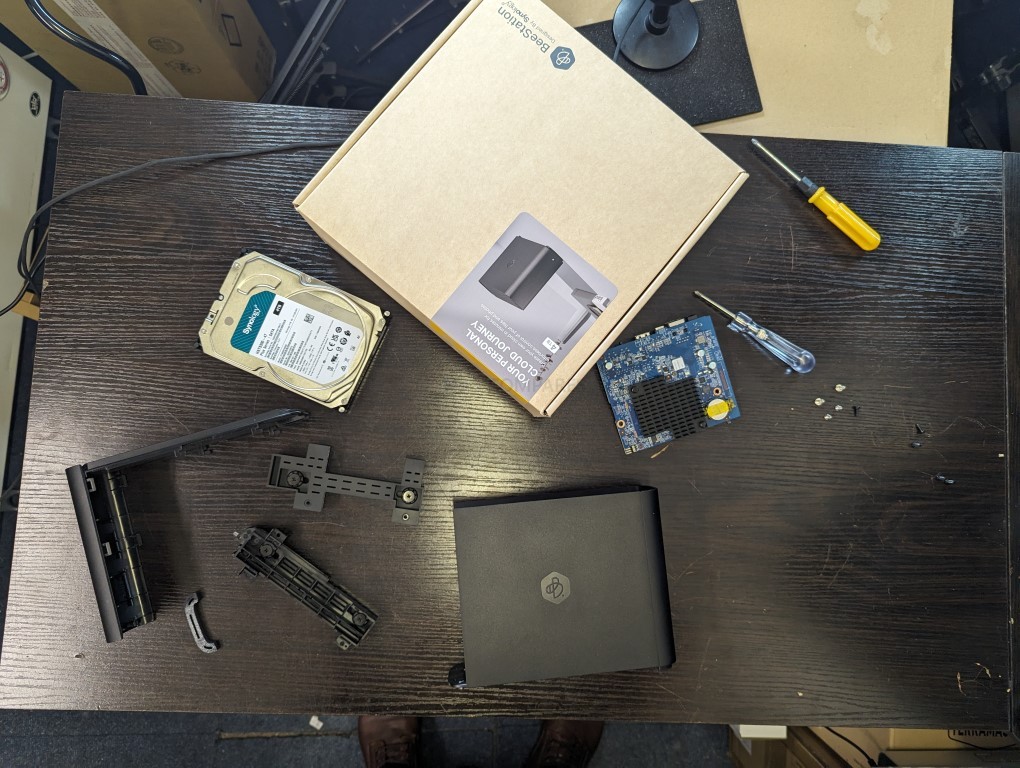
Assuming the 2 GB figure in the later datasheet is the correct final spec, the BST151-4T is best understood as a minimal revision of the BST150-4T rather than a new hardware generation. The enclosure, CPU, ports, networking, and drive class are effectively the same, while the main change is the move from the predecessor’s 1 GB memory configuration to 2 GB. That could simply reflect practical component economics as much as performance tuning, since lower density memory packages can become less cost effective over time as supply shifts. In either case, this still appears to be fixed onboard memory, not a user upgradeable SO-DIMM arrangement, so the platform remains closed in the same way as the original model.

| Specification | Synology BeeStation BST151-4T |
|---|---|
| Capacity | 4 TB |
| Drive type | Synology HAT3300-4T |
| Processor | Realtek RTD1619B |
| Memory | 2 GB DDR4 listed in the newer datasheet; 1 GB DDR4 still appears on some Synology product spec pages |
| LAN | 1 x 1GbE RJ-45 |
| USB | 1 x USB-A 3.2 Gen 1, 1 x USB-C 3.2 Gen 1 |
| Dimensions | 148.0 x 62.6 x 196.3 mm |
| Weight | 820 g |
| Power adapter | 36 W |
| Power consumption | 7.85 W access, 1.65 W HDD hibernation |
| Operating temperature | 0°C to 35°C |
| Warranty | 3 years |

In 2026, the BeeStation platform is no longer limited to basic remote file access. Synology positions it as a consumer focused private cloud for storing, syncing, and sharing files and photos, with web, desktop, and mobile access, support for sign in via Google Account, Apple ID, or Synology Account, and shared access for up to 8 users on a single device. It is designed to pull together data from phones, computers, external drives, and selected cloud services into one managed location rather than acting only as a simple networked hard drive.
 |
 |
 |
 |
Photo handling is one of the more developed parts of the platform. Synology states that BeeStation can back up mobile photos, import content from sources such as Google Photos and iCloud Photos, and organize images with local AI based recognition for people, subjects, and places. The software also supports timeline and map based browsing, album creation, and controlled photo sharing, which places the BST151-4T closer to a private cloud photo hub than to a basic USB backup box.
 |
 |
 |
 |
Its data protection features have also expanded since launch. BeeStation now supports internal restore points based on snapshots, backups to BeeProtect, Synology NAS, and external drives, plus a 3 year Acronis True Image Essentials license for 1 computer. BeeStation OS 1.5 also added BeeCamera support, but Synology limits that feature to BeeStation Plus models rather than the standard 4 TB unit, so the BST151-4T does not currently gain the surveillance role that the higher tier model has started to take on.
 |
 |
 |
 |
Where the BeeStation still differs from a DSM based NAS such as the DS124 or DS223 is in breadth and flexibility. Synology’s DS124 and DS223 product pages explicitly advertise broader DSM functions including Synology Drive based private cloud workflows, Btrfs snapshot features, ShareSync between Synology systems, full Surveillance Station support, and the wider DSM application platform. By contrast, BeeStation remains a curated appliance with a narrower software stack, no general DSM Package Center environment, no broad package driven expansion path, and on the standard 4 TB model no BeeCamera surveillance support either. In other words, it can cover the main personal cloud tasks, but it still does not replace the wider role of even Synology’s entry level DSM NAS systems.
The BST151-4T looks like a modest revision of the original BeeStation rather than a substantially new product. Its appeal remains the same: a preconfigured, low friction private cloud for users who want basic file storage, photo backup, syncing, sharing, and remote access without moving into a full DSM based NAS environment. The hardware envelope is still narrow, with a fixed internal 4 TB drive, 1GbE networking, and no real upgrade path for storage expansion or RAID style redundancy, but that is consistent with its role as an entry level turnkey appliance rather than a general purpose NAS. Synology’s own later datasheet points to 2 GB of RAM on the new model, which would make the BST151-4T a small but practical refresh of the BST150-4T rather than a platform shift. Pricing is the main unknown at the time of writing. Synology’s support status page already lists the BST151-4T as generally available, but public retail pricing is still not clearly established. On that basis, the safest expectation is that it will land close to the earlier 4 TB BeeStation, which launched around $199 in the US and about £209 in the UK, while more recent BST150-4T retail listings have also appeared higher depending on seller and region, sat around $309 without TAX. That likely places the BST151-4T will land in excess of $300 and maybe closer to $350 when factoring the RAM increase.
|
Check Amazon in Your Region for the Synology Beestation BST151-4T
|
Check B&H for the Synology 4TB BST151-4T
|
SUBSCRIBE TO OUR NEWSLETTER
[contact-form-7]
Join Inner Circle
Subscribe
This description contains links to Amazon. These links will take you to some of the products mentioned in today's content. As an Amazon Associate, I earn from qualifying purchases. Visit the NASCompares Deal Finder to find the best place to buy this device in your region, based on Service, Support and Reputation - Just Search for your NAS Drive in the Box Below
Need Help?
Where possible (and where appropriate) please provide as much information about your requirements, as then I can arrange the best answer and solution to your needs. Do not worry about your e-mail address being required, it will NOT be used in a mailing list and will NOT be used in any way other than to respond to your enquiry.
[contact-form-7]
TRY CHAT
Terms and Conditions
Ko-fi or old school Paypal. Thanks!To find out more about how to support this advice service check HEREIf you need to fix or configure a NAS, check Fiver
Have you thought about helping others with your knowledge? Find Instructions Here
|
|
|
xAI vient de déposer plainte devant un tribunal fédéral du Colorado pour faire annuler le SB 24-205, une loi qui doit entrer en vigueur le 30 juin prochain. Ce texte impose aux développeurs de systèmes d'IA "à haut risque" de mettre en place des garde-fous contre les discriminations algorithmiques.
Sont concernés les outils utilisés pour prendre des décisions dans l'emploi, le logement, l'éducation, la santé et les services financiers. En clair, si votre IA aide à trier des CV ou à accorder un prêt, elle doit prouver qu'elle ne discrimine personne.
Le problème pour xAI, c'est que Grok, son modèle phare, tomberait pile dans cette catégorie. L'entreprise d'Elon Musk estime que la loi l'obligerait à modifier le fonctionnement de son IA pour "refléter les opinions de l'État du Colorado sur la diversité et la discrimination" plutôt que de rester objective.
L'argument principal de xAI tient en un mot : liberté d'expression. Dans sa plainte, l'entreprise affirme que la loi du Colorado viole le premier amendement de la Constitution américaine.
Elle reproche au texte d'interdire aux développeurs de créer des systèmes d'IA qui produisent "un discours que l'État du Colorado n'aime pas", tout en les forçant à aligner leur travail sur les préférences de l'État.
C'est un angle juridique assez audacieux. Considérer qu'un modèle d'IA produit du "discours" protégé par la Constitution, ça revient à dire que le code et les réponses générées par une machine sont une forme d'expression. xAI demande au tribunal de déclarer la loi inconstitutionnelle et d'empêcher son application.
Derrière cette plainte, il y a un bras de fer plus large entre régulation fédérale et régulation locale. xAI cite des décrets de la Maison Blanche qui critiquent la multiplication des lois étatiques sur l'IA.
L'administration Trump pousse pour un cadre national unique, estimant qu'un patchwork de réglementations état par état freinerait la compétitivité américaine et poserait des problèmes de sécurité nationale.
Le Colorado fait figure de pionnier sur le sujet. Le SB 24-205 est l'une des lois les plus complètes du pays en matière de régulation de l'IA. Elle oblige les développeurs à fournir une documentation détaillée sur les risques de leurs systèmes, à publier un site web résumant leurs pratiques, et à signaler toute discrimination algorithmique découverte au procureur général dans les 90 jours.
xAI, qui a récemment fusionné avec SpaceX, attaque moins de trois mois avant l'entrée en vigueur du texte. Si le tribunal donne raison à Musk, ça pourrait décourager d'autres États de légiférer sur le sujet. À l'inverse, un rejet de la plainte renforcerait la légitimité de ce type de régulation locale.
En tout cas, utiliser le premier amendement pour protéger une IA de toute obligation anti-discrimination, c'est un précédent que beaucoup de juristes vont suivre de près.
Source : Bloomberg Law

Following the original ZimaCube and ZimaCube Pro, IceWhale is now preparing the ZimaCube 2 range as a more mature follow-up to its first desktop NAS platform, combining the same broad idea of a compact, open, software-defined personal cloud with clearer attention paid to refinement, validation, and retail readiness. Based on the specifications revealed so far, the standard $799 ZimaCube 2, the $1,299 ZimaCube 2 Pro, and the $2,499 Creator Pack continue to target users who want a turnkey system that still leaves room for alternative operating systems, PCIe expansion, direct Thunderbolt 4 or USB4 connectivity, and mixed storage workloads, but the second generation also arrives in the shadow of the first model’s early issues around cooling, power handling, and hardware compatibility, all of which IceWhale now says informed the redesign. Rather than presenting the ZimaCube 2 as a radically different product category, the company appears to be positioning it as a more stable and better validated version of the same formula, with a stronger base model, revised cooling, closer hardware and software integration, and a retail launch path instead of another crowdfunding campaign.
Remember to use the NASCompares Channel Discount Code: ‘NASCOMPARES50’

In physical terms, the ZimaCube 2 remains very close to the original system. The listed chassis dimensions are still 240 x 221 x 220 mm, and the overall layout continues to center on a compact desktop enclosure with 6 front-facing drive bays, a removable front panel, and a secondary internal sled for the 7th-bay M.2 storage section. That means this is not a major departure in footprint or format, but rather a continuation of the same small-tower NAS concept that IceWhale introduced with the first ZimaCube generation.

The external build also keeps the same broad industrial approach, with an all-metal enclosure and a design that is intended to be visible on a desk rather than hidden away. Based on the Shenzhen hands-on material, the finish has been revised to a silver tone rather than the darker look associated with earlier models, and there are still decorative touches such as copper-coloured screws and RGB lighting. The magnetic front cover also remains part of the design language, although the hands-on notes suggest that removability is still not especially refined, with no obvious front handle to make access easier.

Internally, the most significant design revision appears to be in thermals rather than structure. The original ZimaCube family drew recurring criticism over cooling behaviour and fan noise, and IceWhale itself later issued optimisation guidance and revised cooling components for early units. On the ZimaCube 2, the cooling assembly appears to have been reworked substantially, with a much larger vapor-chamber style module, extended heatpipe routing, and a direct airflow path toward a rear-mounted fan. In practical terms, this is one of the clearest visible signs that the company is treating thermal control as a first-order design issue rather than a secondary adjustment.

The storage layout remains one of the most recognisable elements of the platform. At the front are 6 SATA bays for 3.5-inch and 2.5-inch drives, while the separate 7th-bay board carries 4 M.2 slots. What has changed is the clarification around performance tiers. Following the post-video corrections, both the standard and Pro use PCIe Gen 4 for the 7th-bay architecture, but the actual throughput differs because of the ASMedia bridge hardware: the standard model is rated for 800MB/s R/W, while the Pro and Creator Pack are rated for 3200MB/s R/W. So although the physical design remains familiar, the storage subsystem is now segmented more clearly by model.

Taken together, the ZimaCube 2’s design changes are best understood as a revision rather than a clean-sheet rethink. The enclosure, bay structure, general scale, and visual concept are all recognisably derived from the earlier ZimaCube, but the thermal hardware, finish, and some of the internal implementation details suggest a product that has been adjusted in response to first-generation feedback. From a design perspective, the main story is not reinvention. It is that IceWhale appears to have revisited the same chassis idea with greater emphasis on cooling headroom, validation, and long-term use as a retail product rather than a first-wave crowdfunded device.

The internal hardware changes are more substantial than the exterior suggests, particularly at the lower end of the range. The standard ZimaCube 2 now moves from the original ZimaCube’s Intel N100 to a 12th Gen Intel Core i3-1215U, giving the base model 6 cores, 8 threads, and a much stronger starting point for mixed storage and application workloads.

The ZimaCube 2 Pro and Creator Pack both use the 12th Gen Intel Core i5-1235U with 10 cores and 12 threads, which keeps the Pro class in the same broad processor tier as the earlier ZimaCube Pro, but still gives the second-generation lineup a more balanced split between entry and higher-tier models. Memory has also shifted upward in platform terms, with DDR5 SODIMM support and upgradeable slots rather than fixed memory, allowing the standard model to start at 8GB, the Pro at 16GB, and the Creator Pack at 64GB.

One of the more important details here is that IceWhale is not presenting the hardware purely as a NAS board with attached storage, but as a compact compute platform that also happens to handle large-scale local storage. The system still uses an internal NVMe SSD for the operating system, with 256GB on the standard and Pro and 1TB on the Creator Pack, while retaining dual PCIe slots on a Mini-ITX based custom board. That means the core platform is still built around expandability, and not just in a theoretical sense. IceWhale continues to point toward GPU cards, AI accelerators, network cards, and SSD-focused upgrades as intended use cases, which places the ZimaCube 2 somewhere between a traditional NAS, a compact home server, and a turnkey prosumer workstation-style storage appliance.

At the same time, the scale of the internal upgrade depends on which earlier model is being used as the reference point. Against the original non-Pro ZimaCube, the jump is obvious: newer CPU class, higher memory ceiling, improved internal segmentation, and a platform that appears better prepared for virtualization, media handling, and direct-attached workloads. Against the original ZimaCube Pro, however, the advance is more limited, because the Pro remains on the same Core i5-1235U family and much of the underlying capability was already present in some form. So while the internal hardware is clearly stronger overall, especially in the standard model, this still reads more as a focused revision of the existing architecture than a complete hardware reset.

Externally, the ZimaCube 2 continues to position itself as something broader than a conventional NAS, and the port layout reflects that. On the rear, the standard model includes 2 x 2.5GbE network ports alongside 2 x Thunderbolt 4 or USB4-capable USB-C connections, which gives it both networked and direct-attached workflow options. That matters because IceWhale is still treating direct host connection as one of the platform’s defining features, particularly for users who want local high-speed access without routing everything through standard Ethernet alone. It also keeps the ZimaCube 2 distinct from many turnkey NAS systems that rely almost entirely on network connectivity as the primary access path.

The separation between the standard and Pro models is more visible in networking than in external appearance. The standard ZimaCube 2 is limited to 2 x 2.5GbE, while the ZimaCube 2 Pro adds an additional 10GbE port. That makes the Pro the more complete option for users intending to deploy the system as shared high-speed network storage, while the standard model leans more heavily on its direct-connect Thunderbolt 4 or USB4 story to offset the absence of 10GbE. In practical terms, this is an important distinction, because although both systems look closely related on paper, the network capabilities create a clear difference in how they are likely to be used in creative or multi-user environments.

The rest of the I/O remains relatively conventional but still useful for a system of this class. IceWhale lists 4 x USB-A 3.0 ports, 1 x USB-C 3.0 port, DisplayPort 1.4, HDMI 2.0, and a 3.5mm audio jack, while the internal platform also keeps 2 PCIe expansion slots available for broader configuration. None of these ports alone are unusual, but taken together they reinforce the same point as the rest of the hardware: this is not being framed as a sealed appliance. It is being framed as a turnkey system with room for local expansion, direct attachment, and mixed workload deployment, even if the actual value of that depends on whether the buyer is choosing the standard model’s lower-cost balance or the Pro model’s more complete network specification.

Next, I spent some time with the founder of Icewhale (the company behind the Zimacube and ZimaOS, as well as the popular Zimaboard and Zimablade) and put forward a few questions about the current development of Zimacube 2 and their recent pricing changes to ZimaOS.

Based on the hands-on session and Lauren Pan’s comments, IceWhale is not presenting the ZimaCube 2 as a completely new product category, but rather as a more refined and better balanced version of the same idea. The biggest practical difference is that the standard model is no longer a clearly compromised entry point in the way the original N100-based ZimaCube often appeared next to the first Pro. The move to a Core i3-1215U, DDR5 memory, dual Thunderbolt 4 or USB4, 6 SATA bays, 4 M.2 slots, 2 PCIe slots, and upgradeable SODIMM memory means the base model now looks much closer to the wider prosumer NAS and compact server market, instead of acting mainly as the cheaper route into the ecosystem. That gives the range a stronger starting point and makes the standard unit a more serious option in its own right.

The second major difference is maturity rather than raw specification. IceWhale is tying the ZimaCube 2 more directly to the lessons learned from the first generation, especially around cooling, stability, hardware validation, and closer coordination between hardware and software development. The revised thermal module, the stronger emphasis on compatibility testing, the claim of more OS-level control over system parameters such as fans, and the move away from crowdfunding toward direct retail all suggest that the ZimaCube 2 is intended to arrive as a more settled product. So while the overall concept remains familiar, what IceWhale appears to be bringing to market this time is a more fully developed turnkey platform, not just in hardware terms, but in how the product is being prepared, sold, and supported.

The clearest lesson appears to have been that the original ZimaCube needed tighter coordination between hardware and software from the outset. According to Lauren Pan, one of the main internal changes for the second generation is that both teams now work far more closely together, discussing hardware and software details in the same development cycle rather than treating them as separate tracks. In practical terms, that matters because the first-generation platform showed that a NAS or personal cloud product is not defined by hardware alone. It also depends heavily on how well thermals, fan control, storage behaviour, connectivity, and OS-level management are integrated into a single system.
 |
 |
A second lesson concerns validation and first-batch readiness. The original ZimaCube attracted feedback around cooling, fan behaviour, drive compatibility, and power-related issues, and IceWhale now appears to be treating those areas much more seriously in the ZimaCube 2. Pan specifically pointed to a redesigned thermal module, more extensive compatibility testing, and additional work with drive manufacturers such as Seagate and Western Digital after earlier issues emerged. The broader implication is that ZimaCube 2 is being developed less like an experimental first-generation product and more like a revision intended to reduce the kind of early hardware and integration problems that affected the first release.

According to Lauren Pan, the biggest challenge in developing the ZimaCube 2 was production cost. That answer fits the wider context of the current hardware market, where CPU, memory, SSD, and other component pricing has remained a significant pressure on system builders. In the case of the ZimaCube 2, IceWhale appears to have been trying to hold onto several features that are often reduced or removed in competing products at this price level, including upgradeable SODIMM memory, bundled system storage, dual Thunderbolt 4 or USB4 connectivity, PCIe expansion, and a more substantial cooling solution. So the challenge was not simply making a new box, but doing so while keeping the product within a price band that still looked competitive against other turnkey and semi-DIY NAS systems in 2026.
That issue appears especially relevant to the standard model. IceWhale is trying to position the $799 ZimaCube 2 as a stronger base platform than the original non-Pro unit, while still including a Core i3-1215U, 8GB of DDR5, 256GB of NVMe storage, 6 SATA bays, 4 M.2 slots, and full ZimaOS licensing as part of the package. In that respect, the development challenge seems to have been balancing specification, manufacturability, and margin without moving the product out of reach of the same buyers it is trying to attract. The result is that cost control appears to have shaped not just pricing, but also the way IceWhale talks about the ZimaCube 2 as a price versus performance compromise rather than an attempt to maximise specifications at any cost.

According to Lauren Pan, the response to the move from a fully free model to the current free tier plus $29 lifetime ZimaOS+ model has been mixed, but not unexpected. Some community members were confused by the change or felt the software should have remained fully free, while others accepted that the platform needed a sustainable business model if development was going to continue over the long term.
 |
 |
That split is fairly typical for software that begins as a no-cost offering and later introduces paid licensing, particularly when it has built much of its reputation through community use, testing, and feedback. In IceWhale’s case, the company’s position is that the low-cost lifetime fee is intended to make the software commercially sustainable without undermining its accessibility.
 |
 |
IceWhale has also tried to frame the pricing change as part of a broader community model rather than just a revenue switch. Pan said the company had explained the reasoning publicly in late 2025 and described a plan under which 33% of license revenue would be directed back toward community contributors, including moderators, app maintainers, and users helping support the wider ZimaOS and CasaOS ecosystem.
 |
 |
Whether that model proves sustainable over time remains to be seen, but the immediate point is that IceWhale does not appear to be treating the $29 fee as a traditional software upsell. Instead, it is presenting it as a low-cost, lifetime contribution intended to keep development active while maintaining a relatively low barrier to entry compared with other paid NAS software platforms.
 |
 |
IceWhale says the ZimaCube 2 is going direct to traditional retail rather than returning to crowdfunding. In Lauren Pan’s explanation, Kickstarter is something the company now sees as useful in 2 specific cases: either when a product concept still needs market validation, or when production costs are high enough that outside funding is needed to get the first batch built. IceWhale’s position is that the original ZimaCube fit that earlier stage of the company, when the product was more expensive to bring to market and the business itself was still proving demand for this kind of home server and personal cloud hardware. With the ZimaCube 2, the company appears to believe it no longer needs crowdfunding for either of those reasons.

That change is also part of the wider message around the second generation. Moving straight to store-based pre-orders gives the impression that IceWhale wants the ZimaCube 2 to be seen less as an experimental or community-funded device and more as a normal retail product. Pan also described the early response as active, with roughly 200 to 300 community applications tied to testing and usage scenarios, suggesting that demand discovery is now happening around a product that already exists, rather than one still needing crowdfunding to justify its creation. In practical terms, the retail-first approach supports IceWhale’s broader attempt to position the ZimaCube 2 as a more mature follow-up to the first generation.

Taken as a whole, the ZimaCube 2 looks less like a dramatic reinvention of the original platform and more like a deliberate correction and refinement of it. The overall chassis concept, storage layout, and broader product identity remain familiar, but IceWhale appears to have focused this second generation on the areas that mattered most after the first release: a stronger base model, revised thermals, closer hardware and software coordination, more validation around compatibility, and a direct retail launch rather than another crowdfunding cycle. That means the scale of change is uneven depending on which earlier model it is compared against, but the direction is clear enough. The ZimaCube 2 does not appear to be trying to replace the original with a wholly different vision. Instead, it looks like IceWhale is trying to turn the ZimaCube formula into a more complete and commercially mature turnkey platform, with ZimaOS, direct Thunderbolt 4 or USB4 connectivity, PCIe expansion, and hybrid storage still forming the core of its appeal.
Remember to use the NASCompares Channel Discount Code: ‘NASCOMPARES50’
SUBSCRIBE TO OUR NEWSLETTER Join Inner Circle Subscribe
This description contains links to Amazon. These links will take you to some of the products mentioned in today's content. As an Amazon Associate, I earn from qualifying purchases. Visit the NASCompares Deal Finder to find the best place to buy this device in your region, based on Service, Support and Reputation - Just Search for your NAS Drive in the Box Below
Need Help?
Where possible (and where appropriate) please provide as much information about your requirements, as then I can arrange the best answer and solution to your needs. Do not worry about your e-mail address being required, it will NOT be used in a mailing list and will NOT be used in any way other than to respond to your enquiry.
[contact-form-7]
TRY CHAT
Terms and Conditions
Ko-fi or old school Paypal. Thanks!To find out more about how to support this advice service check HEREIf you need to fix or configure a NAS, check Fiver
Have you thought about helping others with your knowledge? Find Instructions Here
|
|
|

The TP-Link TL-WR3602BE is a Wi-Fi 7 travel router built for situations where you want your own network layer on top of whatever internet you can get at the time, such as hotel Ethernet, public Wi-Fi with a captive portal, or a phone acting as a tether. The basic appeal is practical rather than flashy: it aims to reduce friction when you are carrying multiple devices, sharing a single connection, or switching between different uplinks while keeping the same SSID and settings for your own gear. It is a dual band BE3600 model limited to 2.4 GHz and 5 GHz, so it does not add a 6 GHz option, but it does support Wi-Fi 7 features like Multi-Link Operation when paired with compatible clients, which matters more for stability and real-world throughput than headline speeds. On the wired side it pairs a 2.5 Gbps WAN port with a 1 Gbps LAN port, and it can repurpose ports depending on how you set it up, which helps when the “internet source” is not always a standard WAN feed. The USB layout also fits the travel focus: USB-C for power from a wall adapter, laptop, or power bank, plus a USB 3.0 Type-A port that can be used for tethering or basic file sharing from attached storage. VPN support is another key part of the pitch, with WireGuard and OpenVPN available in client and server roles, and a physical button that can be mapped to VPN on and off or other functions, which is useful when you want a quick change without digging through menus. This review looks at what the device actually does in common travel scenarios, including setup flow, captive portal onboarding, mode switching, failover between uplinks, power draw, heat, and the way the web UI and mobile app handle day-to-day control at a price that has moved from its initial launch range down to around the 99 level depending on retailer and promotions.

f you want a travel router that can take hotel Ethernet, public Wi-Fi, or phone tethering and turn it into a single private network for all your devices, the TP-Link TL-WR3602BE largely does that job without much fuss: it is small enough to live in a bag, runs off USB-C power with low wattage draw, stays relatively cool during longer use, and it supports the common travel modes plus VPN features that let you protect traffic across multiple devices from one place, including a physical button you can map to VPN on and off. The wired setup is sensible for travel, with a 2.5 Gbps port plus a 1 Gbps port that can be reassigned depending on how you configure it, and the USB 3.0 port is genuinely useful because it can handle tethering, some USB modem scenarios, or basic file sharing from attached storage. The main downsides are straightforward: there is no 6 GHz band, so you lose the cleanest spectrum option and the widest Wi-Fi 7 channel widths, it has no internal battery so you always need an external power source, and while Multi-Link Operation is supported, it is not “free” on the hardware side and can push CPU and RAM usage higher, which matters if you are stacking MLO with VPN and other features at the same time. The interface and management tools cover most settings people would expect, but the web UI can feel less polished than the mobile app, and switching between operating modes can take a short while to settle. At a street price around the 99 level depending on retailer promotions, it reads as a budget-friendly way into Wi-Fi 7 travel routing with a good set of real-world travel features, as long as you are comfortable with dual-band Wi-Fi 7 and the limits of a USB-powered, small-hardware platform.
 SOFTWARE - 7/10
HARDWARE - 7/10PERFORMANCE - 7/10PRICE - 9/10VALUE - 8/10
SOFTWARE - 7/10
HARDWARE - 7/10PERFORMANCE - 7/10PRICE - 9/10VALUE - 8/10

7.6
PROS
 Dual-band Wi-Fi 7 (2.4 GHz and 5 GHz) with Multi-Link Operation support for compatible clientsWide set of travel-focused modes: Router, Hotspot (WISP), USB Tethering, USB Modem, Access Point, Range Extender, Client2.5 Gbps Ethernet plus 1 Gbps Ethernet, with flexible port role assignment depending on setupUSB-C power input makes it easy to run from a wall adapter, laptop, or power bankLow measured power draw in multi-device use, making portable power practicalGood sustained thermals in longer sessions, helped by extensive chassis ventilationVPN support in client and server roles, including WireGuard and OpenVPN, with a configurable physical button for quick actionsUSB 3.0 port can be used for tethering or basic network file sharing from external storage
CONS
Dual-band Wi-Fi 7 (2.4 GHz and 5 GHz) with Multi-Link Operation support for compatible clientsWide set of travel-focused modes: Router, Hotspot (WISP), USB Tethering, USB Modem, Access Point, Range Extender, Client2.5 Gbps Ethernet plus 1 Gbps Ethernet, with flexible port role assignment depending on setupUSB-C power input makes it easy to run from a wall adapter, laptop, or power bankLow measured power draw in multi-device use, making portable power practicalGood sustained thermals in longer sessions, helped by extensive chassis ventilationVPN support in client and server roles, including WireGuard and OpenVPN, with a configurable physical button for quick actionsUSB 3.0 port can be used for tethering or basic network file sharing from external storage
CONS
 No 6 GHz band, which limits spectrum options and rules out 320 MHz channel operationNo internal battery, so it always depends on an external power source and cableHigher CPU and RAM load observed with Multi-Link Operation, which can reduce headroom for stacked featuresWeb interface can feel dated compared with the mobile app, and mode switching may take 30 to 45 secondsThe MLO architecture is currently E-MLSR MLO (Enhanced Multi-Link Single Radio Operation Mode), which lacks the true aggregation of Sync MLMR (Synchronous Multi-Link Multi-Radio) MLO
| Buy the TP-Link TL-WR3602BE for $99 on Amazon | Buy the TP-Link TL-WR3602BE for $99 on B&H |
 |
 |

The TL-WR3602BE is built around a pocketable, rounded plastic shell that is meant to survive being thrown into a bag without snagging on other gear. It is not the smallest travel router in this category, but it stays within the same general footprint and avoids sharp edges, which makes it easier to pack alongside cables, adapters, and power banks. In day-to-day use, it feels closer to a compact accessory than a “mini home router,” which fits the travel intent.

A noticeable design choice is ventilation. In addition to the usual venting on the base, it has venting around the sides and a vented front panel, which is not always present on small travel models. The external chassis is still plastic, but the amount and placement of venting suggests the device is built with sustained operation in mind, not just short sessions in a hotel room.

The overall finish is smooth and practical, with no gloss surfaces that look good on a product page but show scuffs quickly.

The antennas are mounted on either side and fold with up to 180 degrees of articulation, letting you flatten them for packing or angle them for a better signal path when the router is sitting behind a TV or on a desk.

This style of antenna hinge is common on travel routers, but the travel benefit is straightforward: the unit stores flatter, then quickly shifts into a more usable orientation once powered. There is also a physical toggle button on the body, which adds to the “quick control” feel without relying entirely on an app or web UI.

For storage and carry, the main practical detail is that the router has no internal battery, so it always travels with at least a USB-C power source. That slightly changes what “portable” means here: the router is easy to pack, but the full setup is the router plus a short cable and either the included adapter, a laptop port, or a power bank. If you already carry USB-C power for other devices, it fits into that routine cleanly, but it is not a self-contained unit you can pull out and run without accessories.

The TL-WR3602BE uses a simple physical layout: 1× 2.5 Gbps Ethernet port, 1× 1 Gbps Ethernet port, 1× USB-C power input, and 1× USB 3.0 Type-A port. The Ethernet ports are labeled WAN and LAN, but the router can be configured so the roles are swapped, and in some setups you can treat both as LAN-facing ports if you want a small wired pocket network. The 2.5 Gbps port is mainly there to avoid bottlenecking faster hotel or office uplinks and to give headroom for local wired transfers, while the 1 Gbps port covers the typical “plug a laptop in” use case. As with any multi-gig device, you only see 2.5 Gbps link rates if the upstream gear, cabling, and the connected device all support it.

The USB 3.0 Type-A port is intended as a multi-purpose expansion point rather than a “nice to have.” It supports USB tethering from a phone, USB modem internet in the supported modem mode, and external storage sharing across the local network. On storage, the router can expose attached drives to other devices using common network file methods such as SMB and FTP, which is enough for basic file drop and backup tasks without needing a separate NAS on the road. The trade-off is that storage performance and feature depth tend to be limited by the router’s processor and memory, and it is not positioned as an app-driven platform where you add services on demand. Compatibility is also a real consideration with USB modems and phone tethering, since support can vary by device and carrier behavior.

Power is delivered only through USB-C and the router has no internal battery, so stability depends on the power source you provide. TP-Link specifies 5V/3A, and in normal terms that means it is designed to run from a decent USB-C wall adapter, a laptop USB port, or a power bank that can hold 5V output without sagging under load. In practical use, its low wattage draw makes it easier to keep running from portable power, but it also means you need to plan around power availability in the environment. If the power source is shared, switched off, or flaky, the router will reboot and you lose the session, which can matter if you are mid-meeting or relying on it to stay logged into a captive portal.

Inside the TL-WR3602BE, TP-Link uses a dual-core MediaTek platform (MediaTek 981B) clocked at 1.3 GHz, paired with 512 MB of memory. In plain terms, this is a midrange setup for a travel router: enough to run a full router feature set, basic QoS, VPN, and multi-mode operation without the device feeling underpowered in light to moderate use.

It is not the kind of hardware you see in newer, higher-priced models that use faster quad-core chips, and that difference tends to show up when you stack heavier features at the same time, such as high-throughput VPN, multiple clients, and Wi-Fi 7 Multi-Link Operation. The upside of the more modest platform is that it helps keep power draw down, which matters more on a travel router than it does on a mains-powered home unit.

On the wireless side, it is a dual-band Wi-Fi 7 design offering 2.4 GHz and 5 GHz service, with rated speeds of 688 Mbps on 2.4 GHz and 2882 Mbps on 5 GHz under ideal conditions. It supports Wi-Fi 7 features like Multi-Link Operation, 4K-QAM, and Multi-RU behavior, but real benefit depends on client support because those features require Wi-Fi 7-capable devices to negotiate them. The lack of a 6 GHz radio is a meaningful design constraint because it removes the cleanest spectrum option and the ability to use 320 MHz channels, so the top-end “Wi-Fi 7 showcase” configurations are off the table. In return, the 160 MHz support on 5 GHz still gives it room for high practical throughput in environments that are not too congested, and dual-band keeps the radio design simpler and typically easier on thermals.

The hardware also includes a physical button that can be mapped to functions such as VPN activation, which is a small feature but relevant to how the device is used on the move. Under feature load, the limiting factors tend to be CPU cycles and memory headroom rather than raw link rates. In testing with Multi-Link Operation enabled, the device showed sustained CPU and RAM utilization in the 50% to 60% range with a single MLO client connected over a sustained period, which is a useful indicator that Wi-Fi 7 aggregation is not “free” on the router side. That does not automatically translate into a problem, but it does explain why performance and responsiveness can dip if you combine MLO, VPN, and heavier management features at the same time.

Management is available through a web-based admin interface and the TP-Link Tether mobile app, with the app generally feeling like the more streamlined option for quick changes. The feature set is closer to what you would expect from a small home router than a minimal travel gadget, including guest networks, client management, IPv4 and IPv6 options, port forwarding and related routing controls, plus basic QoS by device. It also supports multiple working modes, so the same unit can act as a router, access point, range extender, client, hotspot (WISP), USB tethering router, or USB modem router depending on what the environment provides. Remote access through a TP-Link ID is optional, and the core configuration does not depend on subscribing to anything.
 |
 |
For VPN use, the router supports both client and server roles across several protocols, including WireGuard and OpenVPN, and it also lists PPTP and L2TP options. The practical angle here is that you can run a VPN for specific situations without changing settings on every connected device, and the physical button can be used as a quick on-off for VPN rather than hunting through menus. TP-Link’s own performance ratings list WireGuard up to 450 Mbps and OpenVPN up to 350 Mbps, which helps set expectations that encrypted throughput will be lower than a direct connection. In normal use, that means it is suitable for typical travel workloads like browsing, work apps, and streaming, but it is not aimed at sustaining multi-gig speeds through a VPN tunnel.
 |
 |
In basic travel workflow, two timings stood out. From a cold boot, measured from connecting USB power through to a laptop joining the router Wi-Fi and reaching the admin dashboard, the process took 1 minute and 43 seconds. With the router already powered and a laptop already connected to its Wi-Fi, joining a public Wi-Fi network and reaching the captive portal login page took 42 seconds using the built-in connection tools. Put together, that places the “out of the bag to captive portal page” path at a little over 2 minutes and 30 seconds in that scenario, which is relevant because travel routers are often judged by how quickly they become usable rather than by peak throughput claims.
|
 |
Mode switching was more variable than initial boot. The router tends to retain the last operating mode used, which helps if your routine is consistent, but switching between modes on the fly could require roughly 30 to 45 seconds to reconfigure and settle.
 |
 |
Failover behavior between uplinks was generally quick: in a setup where the router had both a public Wi-Fi uplink and a tethered phone connection available, removing the tethered phone did not drop the active session, and reintroducing tethering was followed by about a 5 second delay before the router picked it back up. The practical takeaway is that dual-uplink travel setups can work without long interruptions, but the device may make its own decisions about which uplink is preferred at a given moment.
 |
|
Power draw and heat behavior were both measured under a multi-device load. With 3 Wi-Fi 7 clients connected and 2 wired clients connected, observed power use ranged from about 2.84 W to about 4.12 W, which keeps it within easy range for laptop power or a modest power bank. Under Multi-Link Operation, the internal platform showed sustained CPU and memory use around 50% to 60% with 1 MLO client over a 10 minute window, suggesting the feature has a real processing cost even at low client counts.


Thermals stayed controlled over several hours of mixed use, with readings around 32°C on the top, 33°C to 34°C around ports, about 34°C on the side panels, and about 29°C to 30°C on the vented front panel, which aligns with the heavy venting built into the chassis. There is also an eco mode system that lets you shift between boost, balanced, and eco behavior, which is not essential for most users but does provide a manual lever for trading responsiveness for lower power use.
|
|

The TL-WR3602BE lands as a practical travel router with a modern headline feature set, but it is clearly built around a few deliberate trade-offs. You get Wi-Fi 7 support in a dual-band design, plus the flexibility of multiple operating modes, a usable mix of wired and wireless connectivity, and VPN options that can be controlled without much friction. The constraints are easy to define up front: there is no 6 GHz band, so you are not getting the cleanest spectrum option or the wider 320 MHz channels that some people associate with “full” Wi-Fi 7 setups. It also has no internal battery, so the travel setup always includes a power source, and under Multi-Link Operation the device can show noticeably higher CPU and memory load, which is worth keeping in mind if you plan to run MLO alongside VPN and other services at the same time.
On balance, it comes across as a router that prioritizes travel usability over chasing the highest spec sheet ceiling. The measured behavior supports that, with reasonable boot and captive-portal onboarding times, quick recovery when a tethering source is removed and reintroduced, low wattage draw that fits typical USB power situations, and controlled temperatures during longer sessions. The main “con” side is less about any single flaw and more about expectations: if you are buying specifically for 6 GHz, or you want more processing headroom for heavier, always-on features, this is not the most future-proof option even if it is labeled Wi-Fi 7. At a street price around the 99 level depending on retailer and promotions, it makes sense as a cost-focused way into Wi-Fi 7 travel routing, especially for people who want a consistent personal network when moving between hotels, cafés, and tethering, and who are comfortable with the limits of a dual-band, USB-powered design.
| Buy the TP-Link TL-WR3602BE for $99 on Amazon | Buy the TP-Link TL-WR3602BE for $99 on B&H |
|
|
| PROs of the TP-Link BE3600 Travel Router | CONs of the TP-Link BE3600 Travel Router |
|
|
SUBSCRIBE TO OUR NEWSLETTER Join Inner Circle Subscribe
This description contains links to Amazon. These links will take you to some of the products mentioned in today's content. As an Amazon Associate, I earn from qualifying purchases. Visit the NASCompares Deal Finder to find the best place to buy this device in your region, based on Service, Support and Reputation - Just Search for your NAS Drive in the Box Below
Need Help?
Where possible (and where appropriate) please provide as much information about your requirements, as then I can arrange the best answer and solution to your needs. Do not worry about your e-mail address being required, it will NOT be used in a mailing list and will NOT be used in any way other than to respond to your enquiry.
[contact-form-7]
TRY CHAT
Terms and Conditions
Ko-fi or old school Paypal. Thanks!To find out more about how to support this advice service check HEREIf you need to fix or configure a NAS, check Fiver
Have you thought about helping others with your knowledge? Find Instructions Here
|
|
|
The Synology RS1626xs+ is a 1U 4 bay rackmount NAS aimed at business and enterprise environments that need high performance in a short-depth footprint. It succeeds the RS1619xs+ after a notably long refresh gap and introduces a more modern hardware platform, including a newer Intel Xeon D processor, 16 GB of ECC memory as standard, dual 10GbE networking, integrated M.2 NVMe slots, and PCIe Gen4 expansion. On paper, this is a more substantial update than some recent Synology refreshes, particularly in areas that affect throughput, caching, and expansion flexibility. At the same time, the RS1626xs+ arrives within the current Synology enterprise strategy, which places tighter control around validated components and supported media. That means the hardware changes need to be considered alongside platform restrictions, expected pricing movement, and the wider value proposition of DSM in the business rackmount market. As a result, the RS1626xs+ looks positioned as a compact but capable SMB and enterprise rack NAS, though its appeal will likely depend as much on Synology’s ecosystem policies as on the hardware itself.

At the core of the RS1626xs+ is an Intel Xeon D-1726 processor, a 6-core, 12-thread CPU with a 2.9 GHz base clock and up to 3.5 GHz turbo. This is a clear step up from the previous generation Xeon D-1527 found in the RS1619xs+, increasing both core count and clock speed. Although it is not the newest server CPU architecture available in 2026, it is a more current platform than its predecessor and brings PCIe Gen4 support, which has a direct effect on overall system bandwidth for expansions and attached components.
 |
|
|---|---|
| Category | Specification |
| Model | Synology RackStation RS1626xs+ |
| Form Factor | 1U rackmount |
| Processor | Intel Xeon D-1726 |
| CPU Count | 1 |
| CPU Cores | 6 |
| CPU Threads | 12 |
| Architecture | 64-bit |
| CPU Frequency | 2.9 GHz base / 3.5 GHz max turbo |
| Hardware Encryption Engine | Yes |
| Memory (Default) | 16 GB DDR4 ECC RDIMM |
| Memory Slots | 4 |
| Maximum Memory | 64 GB (4 x 16 GB) |
| Drive Bays | 4 |
| Maximum Bays with Expansion | 16 |
| Expansion Unit | RX1225RP x1 |
| M.2 Slots | 2 x M.2 2280 NVMe |
| Supported Drive Types | 3.5″ SATA HDD, 2.5″ SATA SSD, M.2 2280 NVMe SSD |
| Hot Swap Support | Yes, for main drive bays |
 |
|
| 10GbE Ports | 2 x RJ-45 |
| Management Port | 1 x out-of-band management/data transmission port |
| USB Ports | 2 x USB 3.2 Gen 1 |
| Expansion Port | 1 |
| Expansion Port Type | Mini-SAS HD |
| PCIe Slot | 1 x PCIe Gen4 x8 |
| Dimensions | 44 x 481.9 x 668.5 mm |
| Weight | 9.5 kg |
| Rack Support | 4-post 19″ rack |
| Rail Kit | Synology RKS-04 |
| System Fans | 4 x 40 mm x 40 mm |
| Fan Modes | Full speed, low temperature, silent |
| Replaceable System Fan | Yes |
| Auto Power Recovery | Yes |
| Noise Level | 52.6 dB(A) |
| Scheduled Power On/Off | Yes |
| Wake Support | Yes |
| Power Supply | 250 W |
| Redundant PSU | Yes |
| AC Input Voltage | 100V to 240V AC |
| Frequency | 50/60 Hz |
| Power Consumption | 97.59 W (access), 56.19 W (HDD hibernation) |
| BTU | 332.78 BTU/hr (access), 191.61 BTU/hr (HDD hibernation) |
| Warranty | 5 years |
Memory has also been increased, with the RS1626xs+ arriving with 16 GB of DDR4 ECC RDIMM as standard across 4 memory slots, with support for up to 64 GB total. That doubles the default memory provision of the older model and should better align with virtualization, backup indexing, active collaboration workloads, and larger multi-service deployments in DSM. Synology continues to recommend its own validated memory for upgrades, and as with other current business systems in its portfolio, warranty and support are tied closely to approved components.

In terms of storage, the system retains a 4 bay SATA drive architecture and supports expansion up to 16 total bays through the RX1225RP expansion unit. Alongside the main bays, Synology has included 2 internal M.2 2280 NVMe slots for SSD caching without consuming the PCIe expansion slot or front storage bays. This allows the RS1626xs+ to support flash-assisted performance acceleration out of the box, while preserving the rear PCIe slot for network or storage upgrades. Official support covers 3.5-inch SATA HDDs, 2.5-inch SATA SSDs, and M.2 NVMe SSDs, though deployment flexibility will still depend on Synology’s compatibility policies.

Networking is one of the more significant changes in this generation. The RS1626xs+ includes 2 built-in 10GbE RJ-45 ports, compared with the 4 x 1GbE arrangement of the RS1619xs+. There is also a dedicated out-of-band management port, 2 USB 3.2 Gen 1 ports, and a Mini-SAS HD expansion connector for the external shelf. For additional connectivity, the system includes 1 PCIe Gen4 x8 slot that can be used for 10GbE, 25GbE, or Fibre Channel upgrades, giving it more flexibility for storage networks and higher-bandwidth business environments than the previous model’s Gen3 slot.

Physically, the RS1626xs+ remains a 1U rack system but is notably deeper and heavier than the older unit, measuring 44 x 481.9 x 668.5 mm and weighing 9.5 kg. It also moves to a 250 W redundant power design, compared with the earlier 150 W arrangement, which reflects the higher performance profile and expanded integrated feature set. Synology rates the unit at 97.59 W during access and 56.19 W during HDD hibernation, with a quoted noise level of 52.6 dB(A). Cooling is handled by 4 x 40 mm fans, and the system includes standard enterprise features such as dual hot-swappable PSUs, scheduled power controls, auto-restart after power loss, and a 5-year warranty.

On the software side, the RS1626xs+ is positioned as a full DSM business platform rather than a storage-only rackmount. It supports up to 32 storage pools, a maximum single volume size of 108 TB by default, 200 TB with at least 32 GB of memory, and up to 1 PB in specific RAID 6 configurations with 64 GB of memory. Supported RAID modes include Basic, JBOD, RAID 0, RAID 1, RAID 5, RAID 6, RAID 10, and RAID F1, with SSD read/write cache and SSD TRIM also supported. File system support includes Btrfs internally, with a broad range of external file systems and network protocols including SMB, NFS, FTP, WebDAV, Rsync, iSCSI, and Fibre Channel.
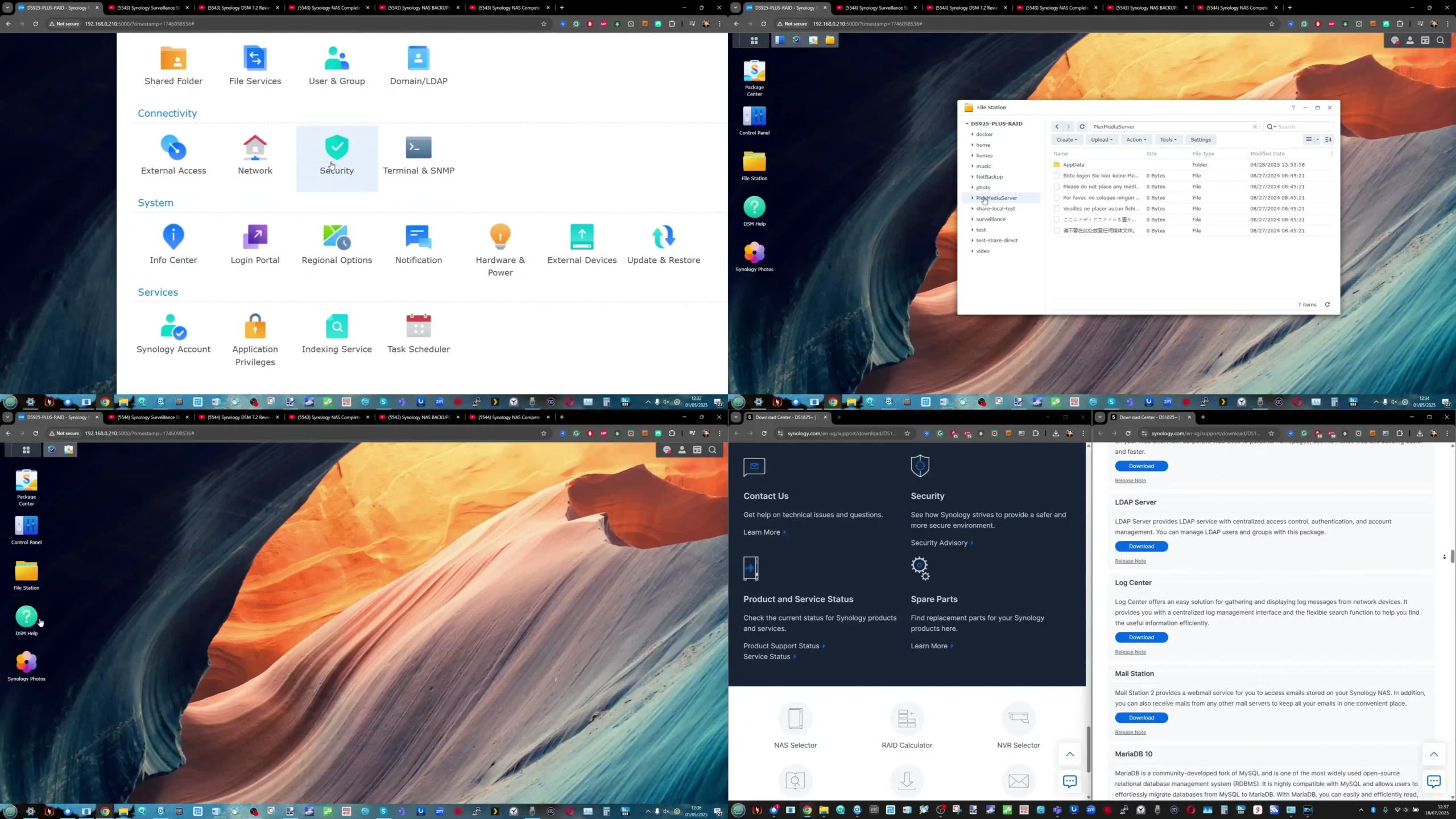
DSM on this platform is also designed to support heavier service consolidation. Synology rates the RS1626xs+ for up to 1,900 SMB connections, 2,048 local user accounts, 512 shared folders, and 12 shared folder sync tasks. In application terms, the system is listed with support for up to 3,100 Synology Drive users, 3,000 Synology Office users, 3,600 MailPlus users, and 400 Synology Chat users, depending on memory configuration and workload type. Virtualization support includes VMware vSphere, Microsoft Hyper-V, Citrix XenServer, and OpenStack, while Virtual Machine Manager is rated for 12 virtual machines and 12 Virtual DSM instances.
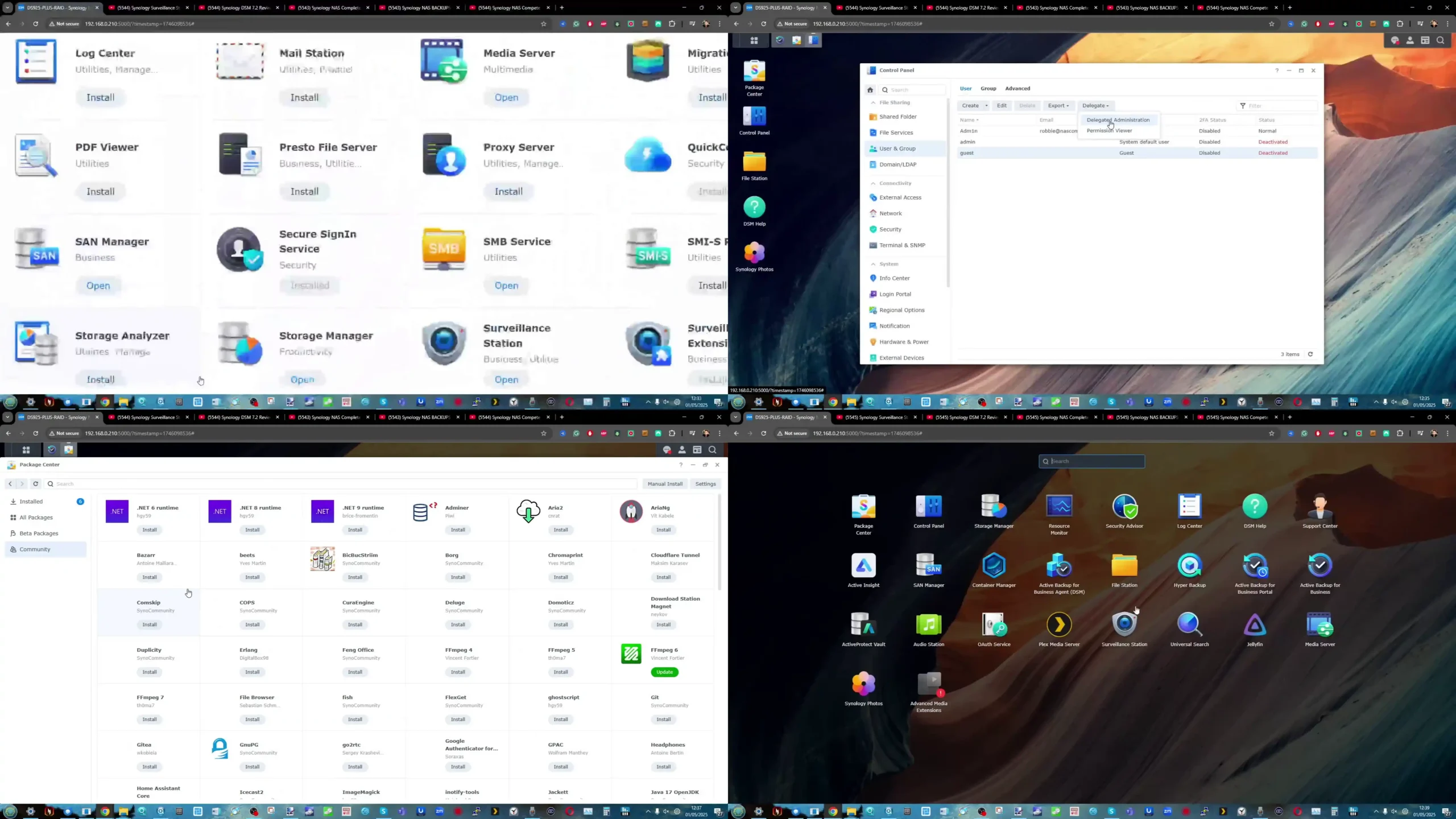
Beyond file serving, the RS1626xs+ includes Synology’s wider business software stack for backup, surveillance, synchronization, and centralized administration. It supports Synology High Availability, Hyper Backup, Active Backup workloads, Snapshot Replication with up to 4,096 system snapshots, SAN Manager with up to 256 iSCSI targets and 512 LUNs, and Surveillance Station with 2 camera licenses included and support for up to 75 IP cameras at 1080p. Synology also positions the platform for hybrid cloud workflows, centralized fleet management through CMS and Active Insight, and newer AI-assisted functions within its collaboration suite, making the RS1626xs+ a software-heavy platform where DSM remains a major part of the system’s overall value.
| Category | Specification |
|---|---|
| OS | DSM |
| Max Volume Size | 108 TB, 200 TB with 32 GB RAM, up to 1 PB with 64 GB RAM and RAID 6 |
| Max Storage Pools / Volumes | 32 |
| RAID Support | Basic, JBOD, RAID 0, 1, 5, 6, 10, F1 |
| SSD Features | Read/write cache, TRIM |
| Internal File System | Btrfs |
| External File Systems | Btrfs, ext4, ext3, FAT32, NTFS, HFS+, exFAT |
| File Protocols | SMB, AFP, NFS, FTP, WebDAV, Rsync |
| Max SMB Connections | 1,900 |
| User / Folder Limits | 2,048 users, 512 groups, 512 shared folders |
| Shared Folder Sync Tasks | 12 |
| Hybrid Share Folder Limit | 15 |
| High Availability | Yes |
| Hyper Backup | Yes |
| Snapshot Replication | 256 snapshots per shared folder, 64 per LUN, 4,096 per system |
| SAN Manager | 256 iSCSI targets, 512 LUNs |
| Virtualization Support | VMware vSphere, Hyper-V, Citrix XenServer, OpenStack |
| Virtual Machine Manager | 12 VMs, 12 Virtual DSM instances |
| Synology Drive | 3,100 users, 25,000,000 files |
| Synology Office | 3,000 users |
| Synology Chat | 400 users |
| MailPlus | 5 free accounts, up to 3,600 users |
| Surveillance Station | 2 licenses included, up to 75 IP cameras |
| Synology Photos | Facial recognition, object identification |
| Download Station | 80 tasks |
| VPN Server | 12 connections |
| AI Features | Third-party AI model integration, de-identification up to 1,700 words |
Compared with the RS1619xs+, the RS1626xs+ is a more substantial hardware refresh than the model gap alone might suggest. The older system used an Intel Xeon D-1527, a 4-core, 8-thread processor running at 2.2 GHz base and 2.7 GHz turbo, whereas the RS1626xs+ moves to a Xeon D-1726 with 6 cores, 12 threads, 2.9 GHz base, and 3.5 GHz turbo. The newer model also doubles the default memory from 8 GB DDR4 ECC UDIMM to 16 GB DDR4 ECC RDIMM, while retaining the same 64 GB maximum ceiling across 4 slots. At the platform level, the move from PCIe Gen3 x8 to PCIe Gen4 x8 is also relevant, as it increases available expansion bandwidth for modern network or storage upgrades.
The networking and storage configuration also show a clearer shift in priorities. The RS1619xs+ arrived with 4 x 1GbE ports and required expansion for faster networking, whereas the RS1626xs+ includes 2 x 10GbE RJ-45 ports as standard, alongside a dedicated management port. Both systems support expansion to 16 bays with a 1 unit expansion shelf and both include 2 M.2 slots, but the RS1626xs+ is more focused on NVMe caching with integrated flash support alongside newer expansion options such as 10GbE, 25GbE, and Fibre Channel via the Gen4 slot. In practical terms, the newer system is much better aligned with modern high-throughput business environments straight out of the box.
That said, the RS1626xs+ is not an across-the-board improvement in every operational metric. It is larger, deeper, heavier, and significantly noisier on paper, moving from 518.6 mm depth and 39.3 dB(A) on the RS1619xs+ to 668.5 mm depth and 52.6 dB(A) on the newer model. Power consumption is also higher, rising from 68.68 W active usage on the older unit to 97.59 W on the newer platform. So while the RS1626xs+ is clearly the more capable and modern system in CPU, networking, memory, and expansion, it also reflects a more demanding enterprise profile in acoustics, power draw, and likely total deployment cost.
| Category | Synology RS1626xs+ | Synology RS1619xs+ |
|---|---|---|
| CPU | Intel Xeon D-1726 | Intel Xeon D-1527 |
| CPU Cores / Threads | 6 cores / 12 threads | 4 cores / 8 threads |
| CPU Clock Speed | 2.9 GHz base / 3.5 GHz turbo | 2.2 GHz base / 2.7 GHz turbo |
| Architecture | 64-bit | 64-bit |
| Hardware Encryption | Yes | Yes |
| Default Memory | 16 GB DDR4 ECC RDIMM | 8 GB DDR4 ECC UDIMM |
| Memory Slots | 4 | 4 |
| Maximum Memory | 64 GB | 64 GB |
| Drive Bays | 4 | 4 |
| Maximum Bays with Expansion | 16 | 16 |
| Expansion Unit | RX1225RP | RX1217 / RX1217RP |
| M.2 Slots | 2 x NVMe | 2 x NVMe / SATA |
| Supported Drives | 3.5″ SATA HDD, 2.5″ SATA SSD, M.2 NVMe SSD | 3.5″ SATA HDD, 2.5″ SATA HDD, 2.5″ SATA SSD, M.2 NVMe / SATA SSD |
| Hot Swap Support | Yes | Yes |
| Built-in Network Ports | 2 x 10GbE RJ-45 | 4 x 1GbE RJ-45 |
| Management Port | 1 x out-of-band management port | No dedicated management port listed |
| USB Ports | 2 x USB 3.2 Gen 1 | 2 x USB 3.2 Gen 1 |
| Expansion Port | 1 x Mini-SAS HD | 1 x Infiniband |
| PCIe Slot | 1 x PCIe Gen4 x8 | 1 x PCIe Gen3 x8 |
| Form Factor | 1U rackmount | 1U rackmount |
| Dimensions | 44 x 481.9 x 668.5 mm | 44 x 480 x 518.6 mm |
| Weight | 9.5 kg | 8.16 kg |
| System Fans | 4 x 40 mm | 2 x 40 mm |
| Fan Modes | Full speed, low temperature, silent | Full-speed, cool, quiet |
| Noise Level | 52.6 dB(A) | 39.3 dB(A) |
| Power Supply | 250 W | 150 W |
| Redundant PSU | Yes | Yes |
| Power Consumption | 97.59 W access / 56.19 W hibernation | 68.68 W access / 34.78 W hibernation |
| Operating Temperature | 5°C to 35°C | 5°C to 35°C |
| Warranty | 5 years | 5 years |

At the time of writing, Synology has revealed the RS1626xs+ on regional product pages, but wider global availability still appears to be pending. The system has already appeared in official marketing materials and product specification pages, indicating that the hardware and software position are now largely defined, even if retail rollout is not yet universal across all regions. Based on that, the RS1626xs+ should be treated as officially revealed, but not yet fully launched in every market. Release timing is notable because the RS1626xs+ arrives after a long gap following the RS1619xs+, which was introduced in the 2018 to 2019 period. That makes this a delayed but more meaningful refresh than some of Synology’s shorter product cycles, particularly given the changes to CPU generation, default memory, built-in networking, PCIe bandwidth, and integrated NVMe support. It is therefore not simply a minor refresh of the previous 1U 4 bay platform, even if the overall product class remains the same.
Pricing has not yet been formally confirmed in the materials provided, so any figure at this stage remains estimate rather than specification. The earlier RS1619xs+ was commonly seen around the $2,400 range earlier in its lifecycle, but later pricing in some regions moved closer to or above $3,000. Given the RS1626xs+ includes 16 GB ECC memory as standard, dual 10GbE onboard, a newer Xeon D platform, PCIe Gen4, and redundant 250 W power supplies, it would be reasonable to expect a higher launch price than its predecessor rather than price parity. The main issue for buyers will likely be total platform cost rather than base chassis cost alone. This system is aimed at business and enterprise deployment, and that means the final spend may also include validated Synology drives, NVMe media, memory upgrades, rail kits, network cards, and the RX1225RP expansion shelf where needed. Until Synology confirms full regional rollout and channel pricing, the RS1626xs+ should be viewed as a higher-tier compact rackmount NAS with an expected premium position in the current RackStation portfolio.
|
Synology RS1626xs+ NAS
|
|
|
Check Amazon in Your Region for the Synology RS1626xs+ NAS
|
Check B&H for the Synology RS1626xs+ NAS
|
SUBSCRIBE TO OUR NEWSLETTER Join Inner Circle Subscribe
This description contains links to Amazon. These links will take you to some of the products mentioned in today's content. As an Amazon Associate, I earn from qualifying purchases. Visit the NASCompares Deal Finder to find the best place to buy this device in your region, based on Service, Support and Reputation - Just Search for your NAS Drive in the Box Below
Need Help?
Where possible (and where appropriate) please provide as much information about your requirements, as then I can arrange the best answer and solution to your needs. Do not worry about your e-mail address being required, it will NOT be used in a mailing list and will NOT be used in any way other than to respond to your enquiry.
[contact-form-7]
TRY CHAT
Terms and Conditions
Ko-fi or old school Paypal. Thanks!To find out more about how to support this advice service check HEREIf you need to fix or configure a NAS, check Fiver
Have you thought about helping others with your knowledge? Find Instructions Here
|
|
|
Une coalition d'entreprises européennes vient de lancer Euro-Office, une suite bureautique open source qui ambitionne de concurrencer Microsoft 365. Le problème, c'est que le projet est un fork d'OnlyOffice, et ce dernier accuse Nextcloud et IONOS de violer sa licence.
Euro-Office a été dévoilé le 27 mars à Berlin, directement au Bundestag. Derrière le projet, on retrouve huit organisations européennes : IONOS, Nextcloud, Eurostack, XWiki, OpenProject, Soverin, Abilian et BTactic.
L'idée est de proposer une suite bureautique capable d'éditer documents, tableurs et présentations, avec une compatibilité Microsoft complète, le tout sous contrôle européen.
Plutôt que de repartir de zéro, la coalition a choisi de forker le code open source d'OnlyOffice, jugé plus moderne et performant dans un navigateur que les alternatives dérivées de LibreOffice. Une préversion est d'ailleurs déjà proposée sur GitHub, et la première version stable est annoncée pour cet été.
Et voilà que ça se complique. Deux jours après l'annonce, OnlyOffice a publié un billet de blog accusant Nextcloud et IONOS de violer les conditions de sa licence AGPL v3.
Le reproche est précis : Euro-Office aurait supprimé toutes les références à la marque OnlyOffice, alors que la licence impose de conserver le logo et les attributions dans les travaux dérivés. Ces conditions supplémentaires ont été ajoutées en mai 2021 via la section 7 du fichier LICENSE.txt.
Côté Nextcloud, on se défend en affirmant que les forks font partie de l'ADN de l'open source. L'entreprise dit avoir consulté Bradley M. Kuhn, le créateur de la licence AGPL, qui soutiendrait leur position "à 100 %".
La Free Software Foundation serait aussi de leur côté. Nextcloud avance par ailleurs que la collaboration directe avec OnlyOffice était compliquée, pointant les origines russes de l'équipe fondatrice. OnlyOffice rétorque que sa propriété intellectuelle est détenue en Lettonie (Ascensio System SIA) depuis 2009, que sa holding est à Singapour, et que l'activité russe a été cédée à des investisseurs locaux en 2019.
Le timing n'est pas anodin. Partout en Europe, des administrations et des entreprises cherchent à réduire leur dépendance aux outils américains.
Euro-Office arrive avec un argument fort : une suite bureautique développée et hébergée en Europe, sans dépendance vis-à-vis d'acteurs non européens. C'est exactement ce que réclament plusieurs gouvernements depuis des années.
C'est quand même un drôle de démarrage pour un projet censé incarner la souveraineté numérique européenne. On lance une alternative à Microsoft en forkant le code d'une société enregistrée en Lettonie mais aux racines russes, et trois jours plus tard on se retrouve avec une accusation de violation de licence sur les bras.
Le fond du débat juridique est intéressant : est-ce qu'on peut forker un logiciel AGPL et retirer les mentions de la marque originale ?
Source : OnlyOffice.com

Europol vient de coordonner un coup de filet massif contre le dark web. En dix jours, 23 pays ont fermé plus de 373 000 sites frauduleux qui proposaient des contenus pédocriminels.
Le plus ironique : l'opérateur n'a jamais livré la moindre donnée, il arnaquait ses propres clients. Et ces clients sont désormais dans le viseur de la police.
L'opération Alice a été lancée le 9 mars et a duré dix jours. Sous la direction des autorités allemandes et avec le soutien d'Europol, des policiers de 23 pays ont participé à ce coup de filet, de la France aux États-Unis en passant par la Suisse, l'Australie et le Royaume-Uni.
L'enquête avait démarré en 2021 autour d'une plateforme baptisée "Alice with Violence CP", qui proposait des contenus pédocriminels à la vente sur le dark web. Au total, 105 serveurs ont été saisis, tous hébergés en Allemagne, et l'opérateur a été identifié : un homme de 35 ans basé en Chine, visé par un mandat d'arrêt international.
Le détail qui rend cette affaire si particulière : le suspect n'a jamais livré les contenus qu'il vendait. Il gérait environ 90 000 sites sur le réseau Tor qui proposaient des "packs" de 17 à 215 euros, payables en Bitcoin. Les acheteurs recevaient en échange... rien du tout.
En cinq ans d'activité, il a encaissé 345 000 euros auprès de 10 000 clients qui pensaient acheter des contenus pédocriminels. Un escroc qui arnaque des criminels, en somme.
Sauf que ces clients, même s'ils n'ont rien reçu, ont quand même tenté d'acheter des contenus illégaux. Europol a donc remonté les paiements en cryptomonnaies et identifié 440 personnes à travers le monde.
Plus de 100 d'entre elles font l'objet d'enquêtes actives. En Suisse, cinq personnes ont été placées en détention. En Allemagne, 14 suspects sont visés par des procédures. La France a mobilisé l'Office de protection des mineurs pour sa part de l'enquête.
On a quand même un type qui a monté 373 000 faux sites depuis la Chine et qui a encaissé 345 000 euros en arnaquant des gens qui voulaient acheter les pires contenus imaginables. Et grâce à lui, la police a maintenant une liste de 440 noms.
Source : Techspot


Ou comment Orange et l'Agence nationale des fréquences (ANFR) ont traqué à partir de la fin de l'été 2022 ces machines sensibles utilisées par des escrocs pour envoyer des SMS de hameçonnage.
Des documents obtenus par la presse révèlent que les douanes américaines ont utilisé les données de localisation issues du système publicitaire en ligne pour pister des téléphones. Et ce, sans mandat.
Le mécanisme repose sur les enchères publicitaires en temps réel, qui diffusent vos coordonnées GPS à des milliers d'entreprises chaque jour. Apple a limité la casse sur iPhone, mais ça ne suffit pas.
Le système est assez redoutable dans sa simplicité. À chaque fois qu'une publicité s'affiche dans une application sur votre smartphone, une enchère se joue en quelques millisecondes.
Votre téléphone envoie ce qu'on appelle une requête d'enchère, qui contient votre identifiant publicitaire, vos coordonnées GPS, votre adresse IP, le type d'appareil utilisé, et même vos centres d'intérêt supposés. Ces informations sont envoyées simultanément à des milliers d'annonceurs potentiels, et tous les participants reçoivent ces données, qu'ils remportent ou non l'enchère.
Des courtiers en données se font passer pour des acheteurs publicitaires et récoltent ces informations à grande échelle. Mobilewalla, par exemple, a collecté les données de plus d'un milliard de personnes, dont 60 % provenaient de ces enchères publicitaires selon la FTC (le gendarme du commerce américain).
Gravy Analytics, un autre courtier, a vu fuiter des données qui référençaient des milliers d'applications : Candy Crush, Tinder, Grindr, MyFitnessPal, des applications de grossesse ou religieuses. Beaucoup de développeurs ne savaient même pas que leurs applications alimentaient cette collecte.
Entre 2019 et 2021, les douanes américaines ont mené un programme pilote pour tester si ces identifiants publicitaires pouvaient servir à reconstituer les déplacements de personnes sur le territoire. Le service de l'immigration (la célèbre ICE) et le FBI ont aussi acheté de la donnée de localisation auprès du courtier Venntel, et s'en sont servis pour identifier des immigrés ensuite arrêtés.
L'ICE a aussi acquis un outil appelé Webloc, qui collecte la position de millions de téléphones chaque jour et permet de lancer des recherches par zone géographique.
En mars 2026, 70 parlementaires américains ont demandé l'ouverture d'une enquête par l'inspecteur général du département de la sécurité intérieure. Le Montana est devenu le premier État à interdire aux autorités l'achat de données sensibles qui nécessiteraient normalement un mandat. Au niveau fédéral, une loi portée par le sénateur Ron Wyden a été votée par la Chambre en 2024, mais n'a pas passé le Sénat.
Bonne nouvelle quand même pour les utilisateurs d'iPhone : depuis 2021, Apple demande systématiquement si vous autorisez le suivi publicitaire via la fonction "Demander à l'app de ne pas me suivre".
Résultat : 96 % des utilisateurs américains ont refusé le suivi, ce qui désactive l'identifiant publicitaire sur la plupart des iPhone. Une étude a même montré que les utilisateurs d'iPhone avaient subi moins de fraudes financières après cette mesure.
Côté Android, il est aussi possible de désactiver l'identifiant publicitaire, mais la démarche est bien moins visible. L'EFF (Electronic Frontier Foundation) recommande dans tous les cas de vérifier les permissions de localisation accordées à vos applications et de les limiter au strict minimum.
On savait que la publicité en ligne aspirait pas mal de données, mais là on parle quand même d'agences gouvernementales qui achètent tranquillement votre position GPS sans passer par un juge. Pour protéger sa vie privée , il ne suffit plus de refuser les cookies.
Le fait que par exemple, Apple, ait mis en place la transparence du suivi publicitaire sur iOS en 2021, et que 96 % des gens aient dit non, montre bien que personne ne souhaite être pisté. On ne peut pas vraiment conclure que le problème est réglé pour autant, car tout le système d'enchères publicitaires continue de fonctionner en arrière-plan, avec ou sans identifiant.
Source : Gizmodo

