Vue lecture

Il y a de nouveaux articles disponibles, cliquez pour rafraîchir la page.

UniFi UNAS Pro 4 NAS Review

Review of the UniFi UNAS Pro 4 NAS – Possibly the Best Value 1U Rack Ever?

Over the last 18-24 months, Ubiquiti has shifted the ‘UniFi’ label from being a networking and bridging ecosystem into a wider storage hardware and software platform that now includes a steadily expanding NAS line under UniFi Drive. Early UniFi UNAS storage products leaned heavily on simple file sharing and basic backup, but the pace of updates and the broader product rollout in 2025/2026 pushed the range closer to what small business buyers expect from an entry level NAS platform: clearer storage management, stronger snapshot and backup tooling, and tighter integration with the UniFi account and identity layer for remote access and user control (with the recent Drive 4.0 Update really uping their game considerably). The UniFi UNAS Pro 4 sits within that context as a compact 1U, 4 bay rack mount system designed mainly for file storage and sharing over SMB and NFS, rather than running third party applications, containers, or virtual machines. At $499, it is priced noticeably lower than many competing 1U rack NAS products at broadly comparable “headline” hardware, particularly where dual 10Gb networking and NVMe caching are concerned, which makes it hard to ignore if the goal is simple, high bandwidth storage in a rack footprint without moving into significantly higher spend.

UniFi UNAS Pro 4 Review – Quick Conclusion

The UniFi UNAS Pro 4 is a 1U, 4 bay rack mount NAS aimed at straightforward SMB and NFS file storage, and its main differentiator is value: at $499 it undercuts many comparable 1U rack units while still offering 2x 10Gb SFP+ plus a separate 1GbE management port, 4 hot swap bays for 3.5 inch or 2.5 inch drives, and 2 M.2 NVMe slots for read and write caching. In testing with 4 HDDs in RAID 5 over 10GbE, it delivered strong real-world file transfer results for a small SATA array, with synthetic benchmarks showing high peak throughput but some variability depending on the tool used, and the platform’s power draw and noise profile were heavily influenced by drive choice and fan mode, including very loud output if maximum cooling is forced. UniFi Drive covers the core fundamentals expected at this level, including snapshots, encrypted volumes, and a wide range of backup targets (NAS, SMB, and multiple cloud services, with Microsoft 365 direction evident in recent updates), but the interface still limits deeper tuning in places and the feature set remains focused on storage rather than apps. The main downsides are structural and easy to identify up front: NVMe can only be used for cache rather than storage pools, the NVMe carriers are an extra purchase, there are no USB ports for local copy tasks, the PSU is internal and not a hot swap module, and missing features like iSCSI, ECC, and RAM upgradability place a clear ceiling on more advanced workloads, though those trade-offs are broadly consistent with a $499 ‘turnkey’ NAS appliance in 2026 though and hard to criticise!


BUILD QUALITY - 9/10
HARDWARE - 7/10
PERFORMANCE - 7/10
PRICE - 9/10
VALUE - 10/10


8.4
PROS
👍🏻Dual 10Gb SFP+ networking is unusual in a 1U 4 bay NAS at this price point + failover will not result in bandwidth throttle
👍🏻A separate 1GbE port is useful for management or fallback connectivity
👍🏻1U chassis with relatively short depth is easier to fit in smaller racks and cabinets
👍🏻Rails and rack hardware included, reducing extra setup cost and friction
👍🏻Ubiquiti and UniFi online/brand services are optional (i.e pure offline/LAN is possible)+ no need for a Ubiquiti/UniFi network setup to use
👍🏻NVMe read and write caching support can improve responsiveness in mixed workloads
👍🏻UniFi Drive provides snapshots, encryption, and a broad set of backup targets (NAS, SMB, and multiple cloud providers)
👍🏻Setup and management are streamlined, especially for users already running UniFi infrastructure
👍🏻Drive 4.0 Update scales up the Business Utilities notably
CONS
👎🏻NVMe is cache only, with no option to use M.2 drives as primary storage pools
👎🏻NVMe trays or carriers are not included, adding extra cost and an extra purchase step
👎🏻Single PSU (no redundency) and non-slide removable SFX/ATX PSU (relies on propriatary UniFi Battery Backup rack module or external UPS)
👎🏻No NAS Expansion Support, so 4 HDDs are your limit

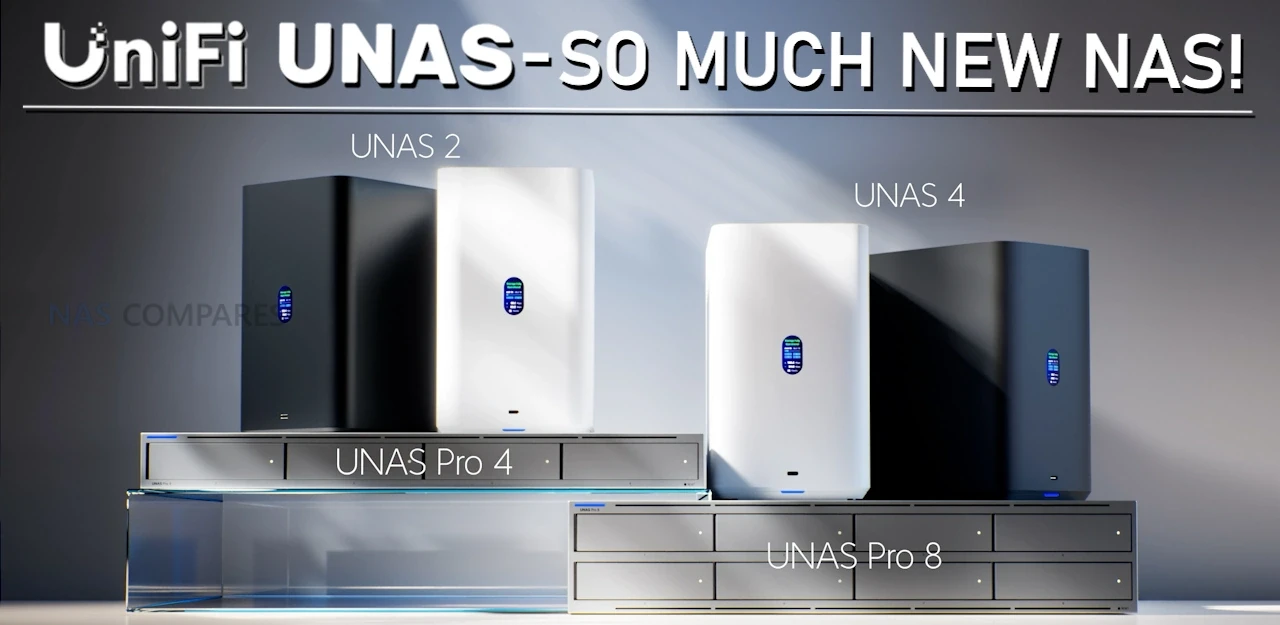
Here are all the current UniFi NAS Solutions & Prices:
  • UniFi UNAS Pro 4 (4 Bay + 2x M.2, $499) – HERE
  • UniFi UNAS 2 (2 Bay, $199) – HERE
  • UniFi UNAS 4  (4 Bay + 2x M2, $379) – HERE
  • UniFi UNAS Pro (7 Bay, $499) – HERE
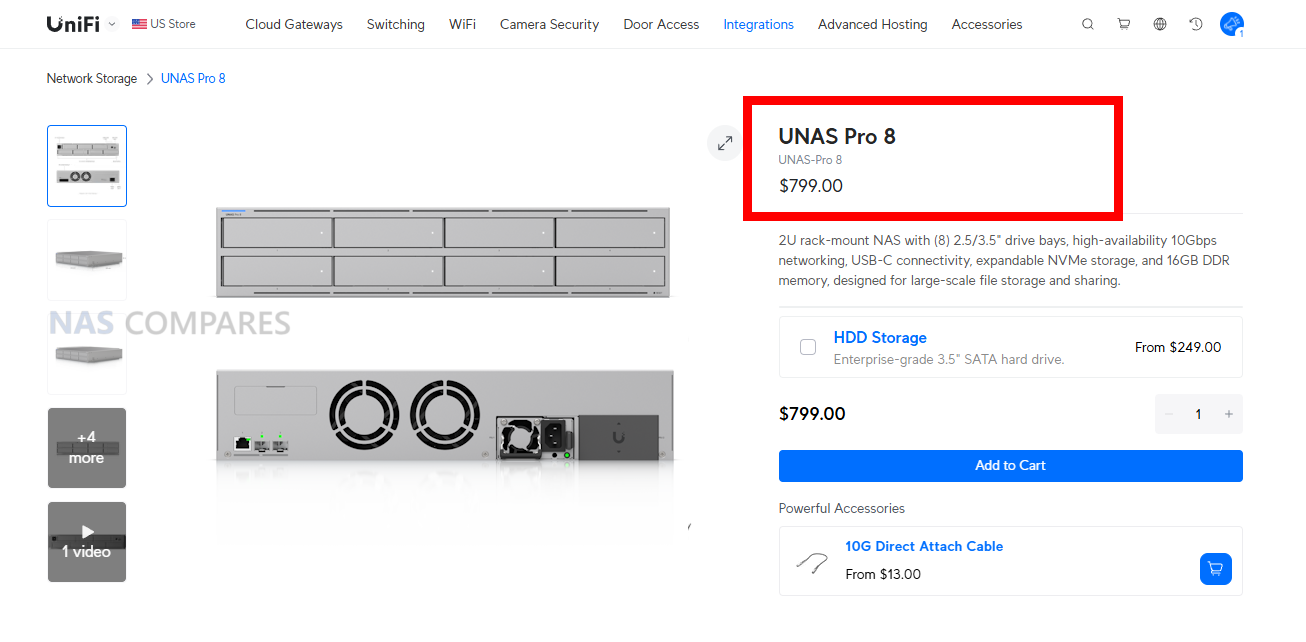
  • UniFi UNAS Pro 8 (8-Bay + 2x M.2, $799) HERE

You can buy the UniFi UNAS Pro 4 NAS via the link below – doing so will result in a small commission coming to me and Eddie at NASCompares, and allows us to keep doing what we do! 

 

UniFi UNAS Pro 4 Review – Design & Storage

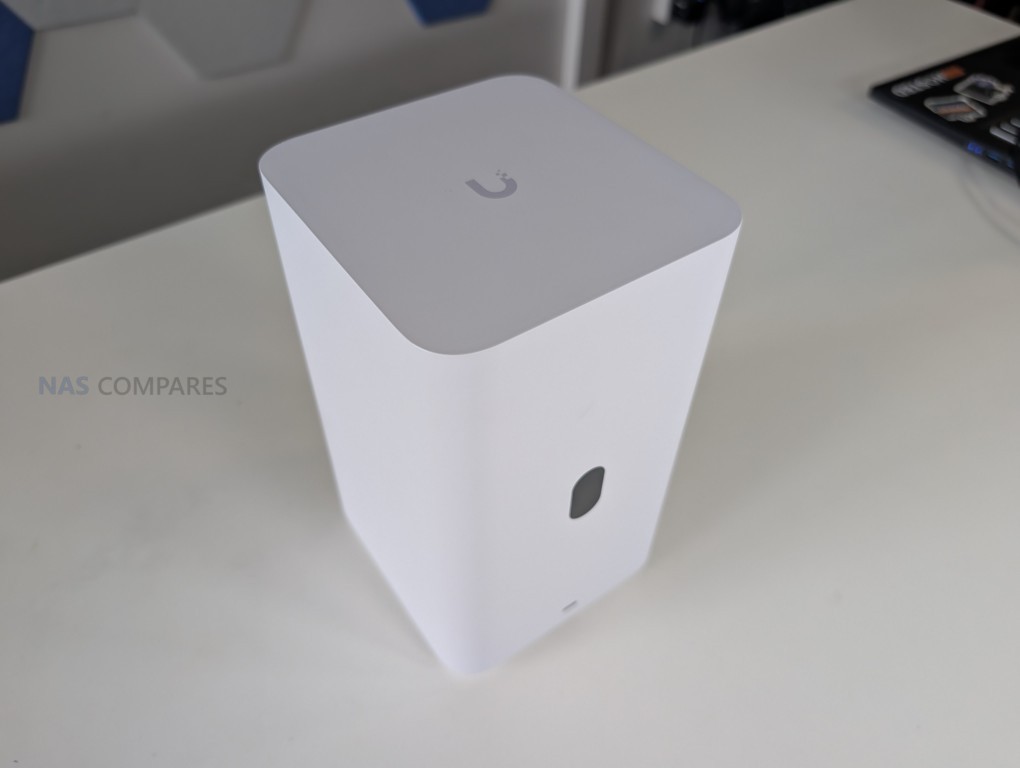
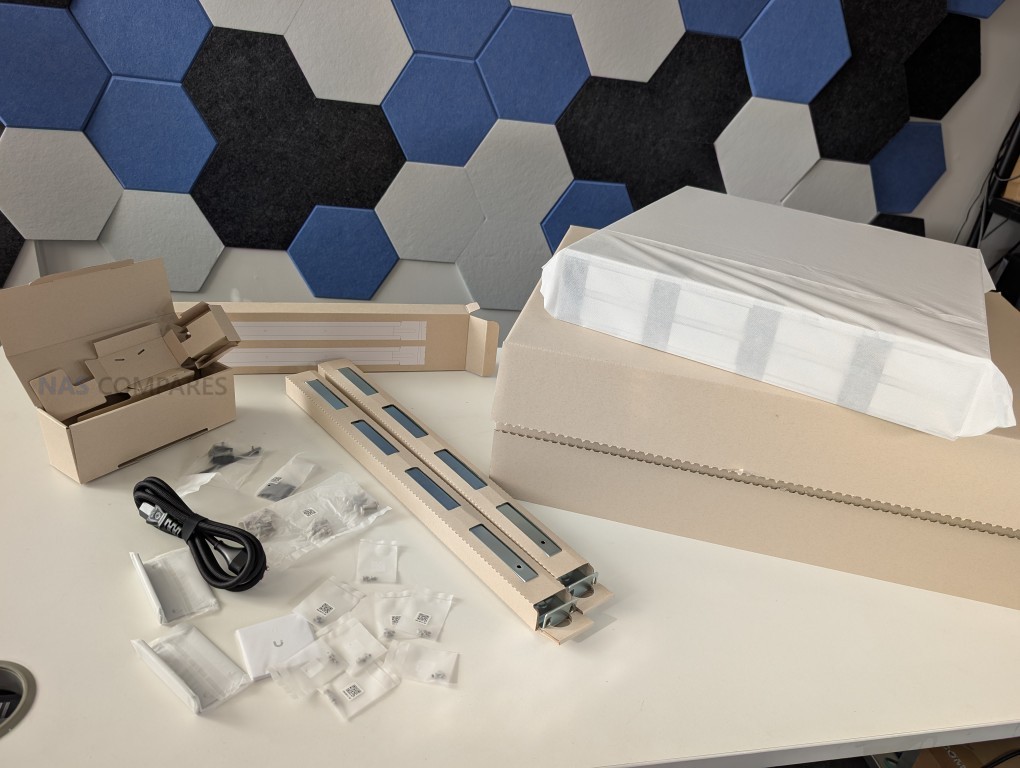
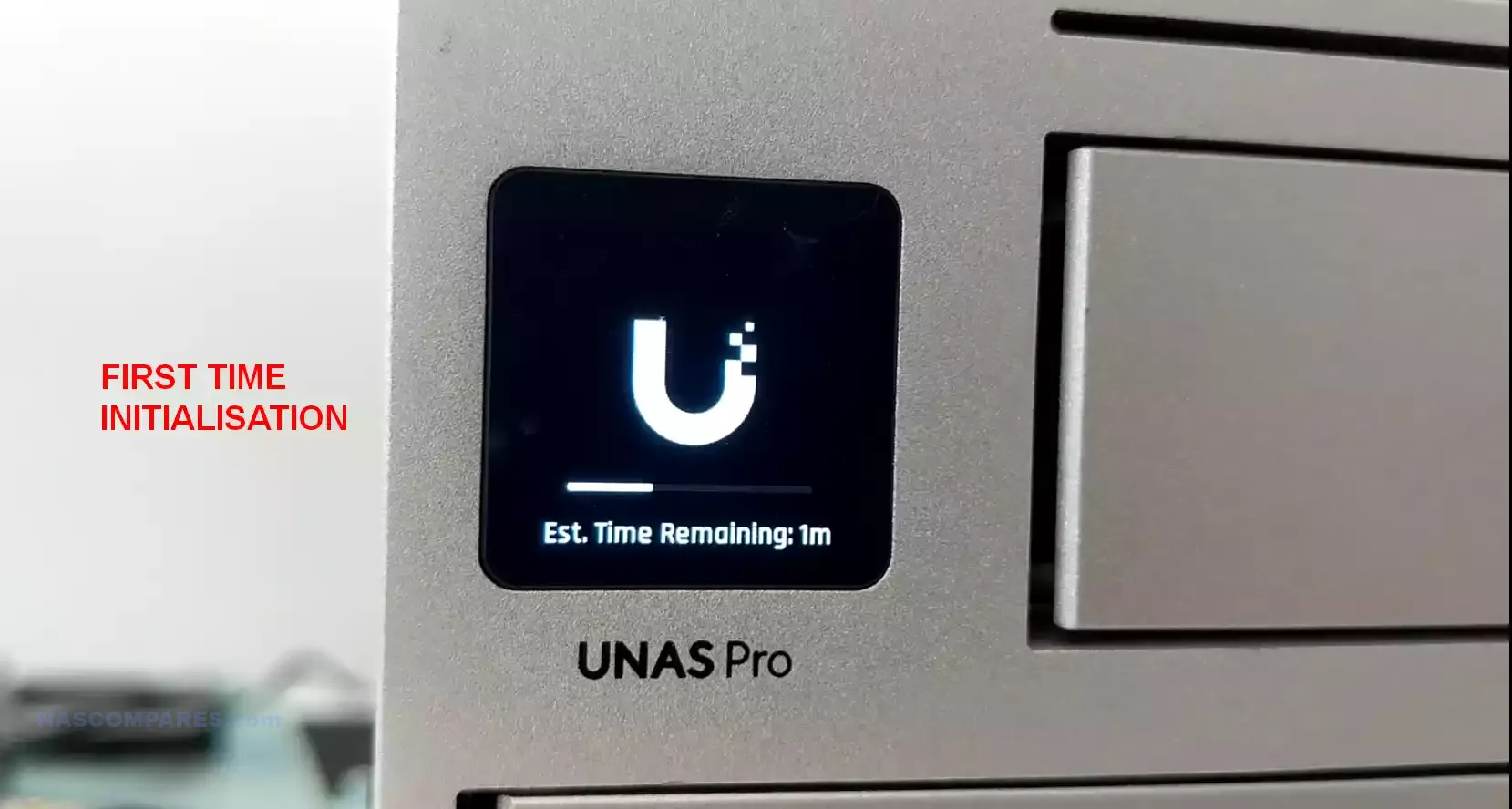
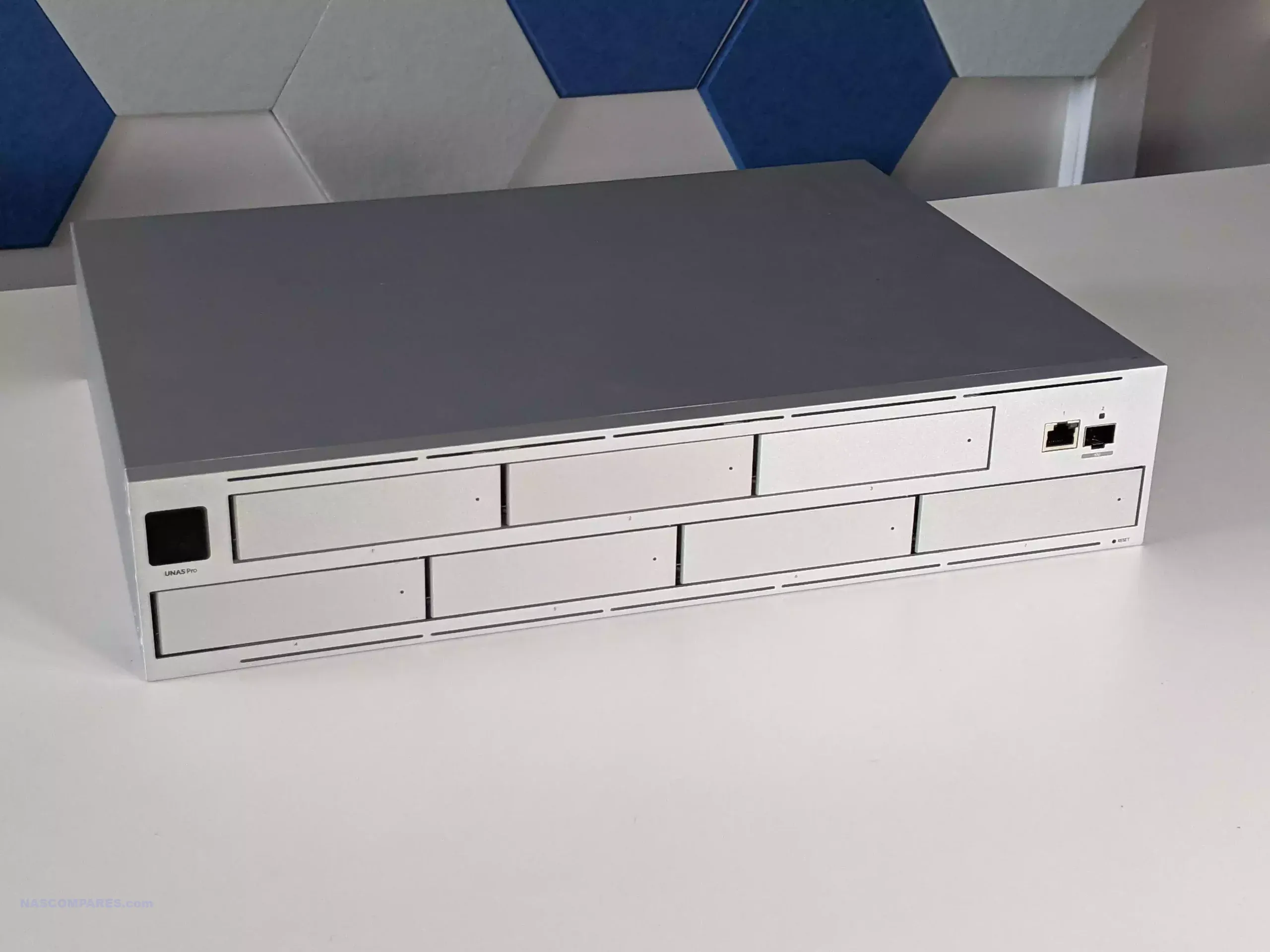
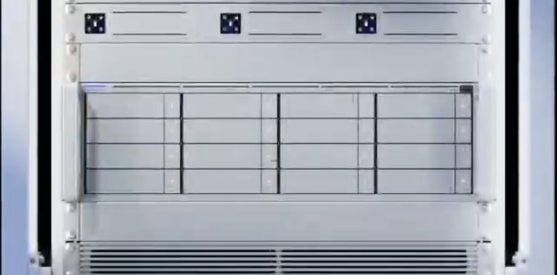
The UNAS Pro 4 uses a conventional 1U rack mount layout, with a plain, functional front panel and an all metal enclosure intended for permanent installation rather than desktop use. It ships with rails and rack handles, which removes the usual extra step of sourcing mounting hardware separately. The chassis depth is about 400 mm, so it is not in the “full depth server” category, and that helps in smaller cabinets where rear clearance and cable management space can be limited.

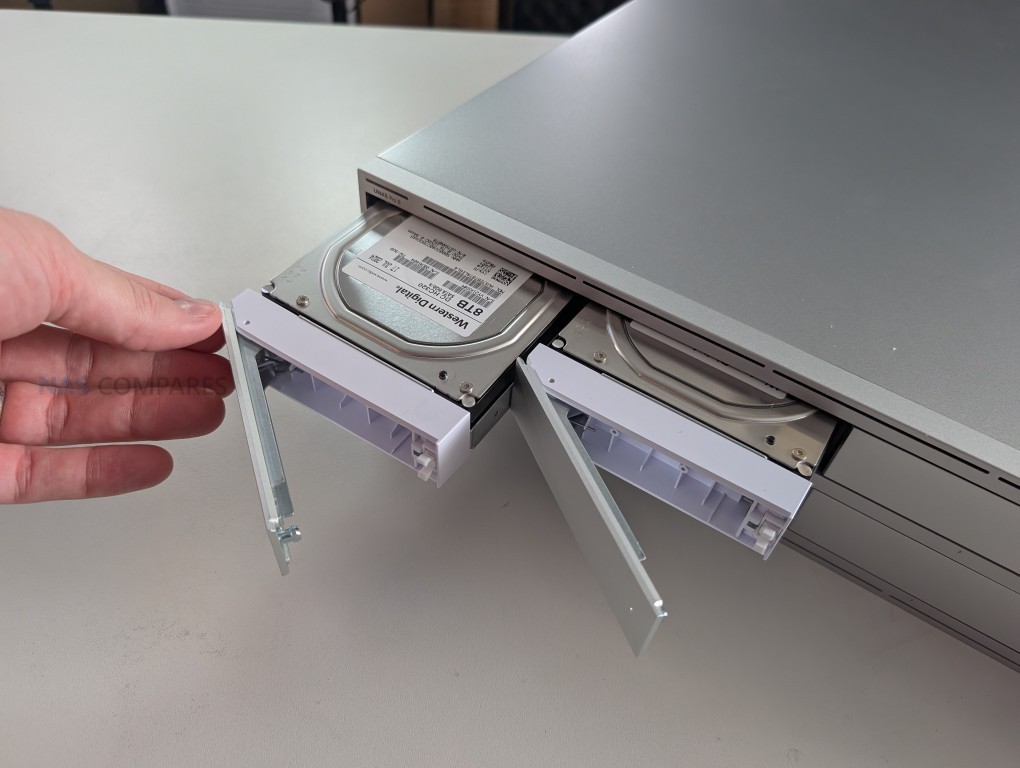
Across the front are 4 hot swap bays supporting both 3.5 inch and 2.5 inch SATA drives. The trays are set up for tool-less 3.5 inch HDD installation with a click-in fit, while 2.5 inch SSDs still require screws to secure them properly. Each bay has status lighting, and the front panel also provides system level indicators so you can identify basic state and drive activity at a glance without logging into the interface. The trays feel rigid and spring-loaded, but they are not lockable, which is a practical consideration if the unit is placed in a shared rack or anywhere physical access is not strictly controlled.

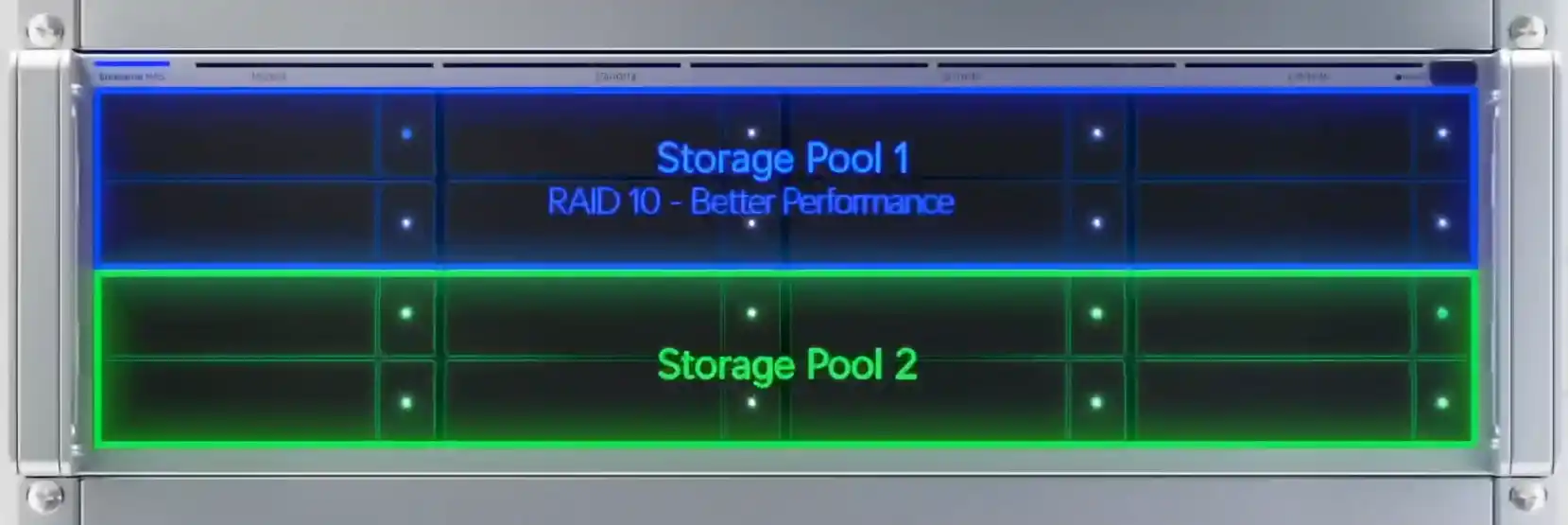
From a capacity and planning perspective, this system is defined by its fixed 4 bay layout. You can configure a conventional RAID group within those bays, but there is no built-in path to scale beyond the internal slots, and there is no supported external expansion shelf option to push the same chassis further later on. That means the decision on drive sizes and redundancy level matters upfront, because the ceiling is reached quickly compared with higher bay count rack units. In a small rack deployment, it also means the unit is either a compact standalone store or part of a broader multi-NAS approach rather than a single box that grows over time.

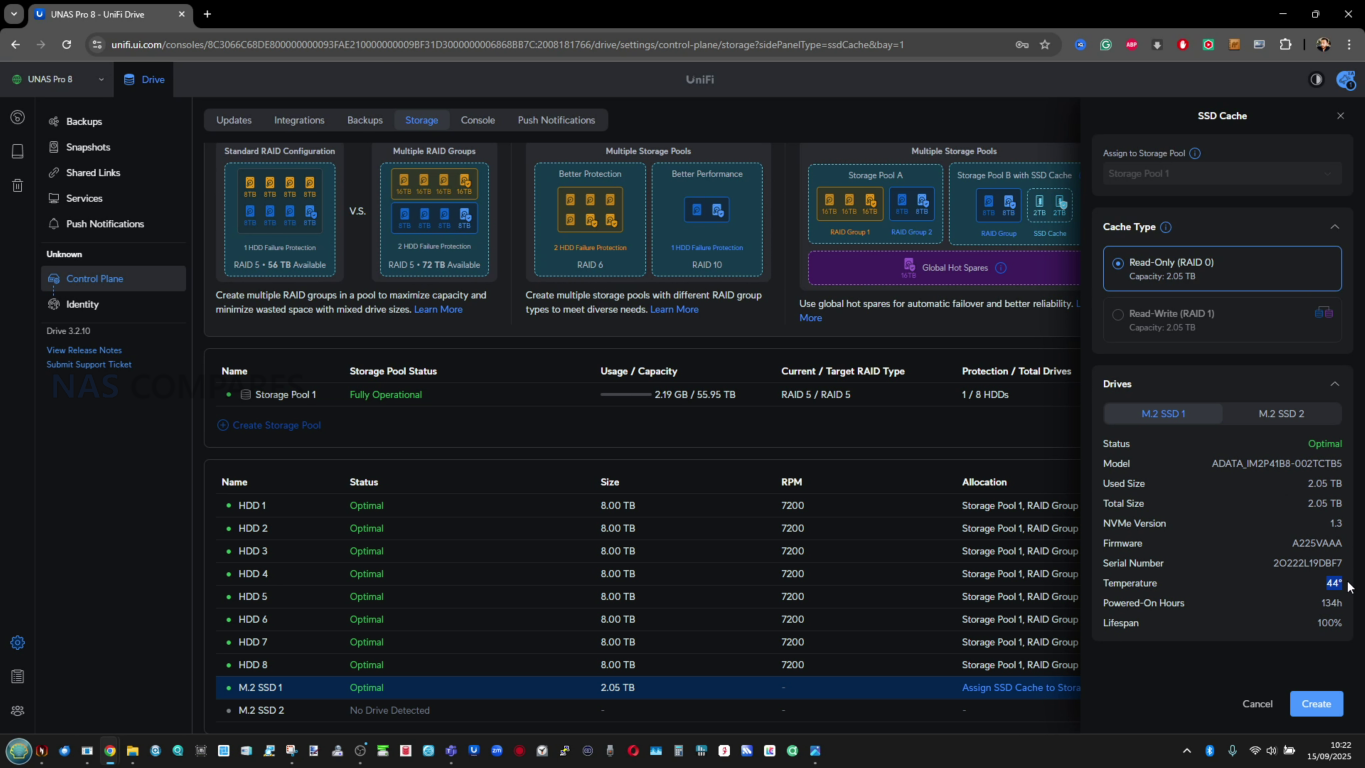
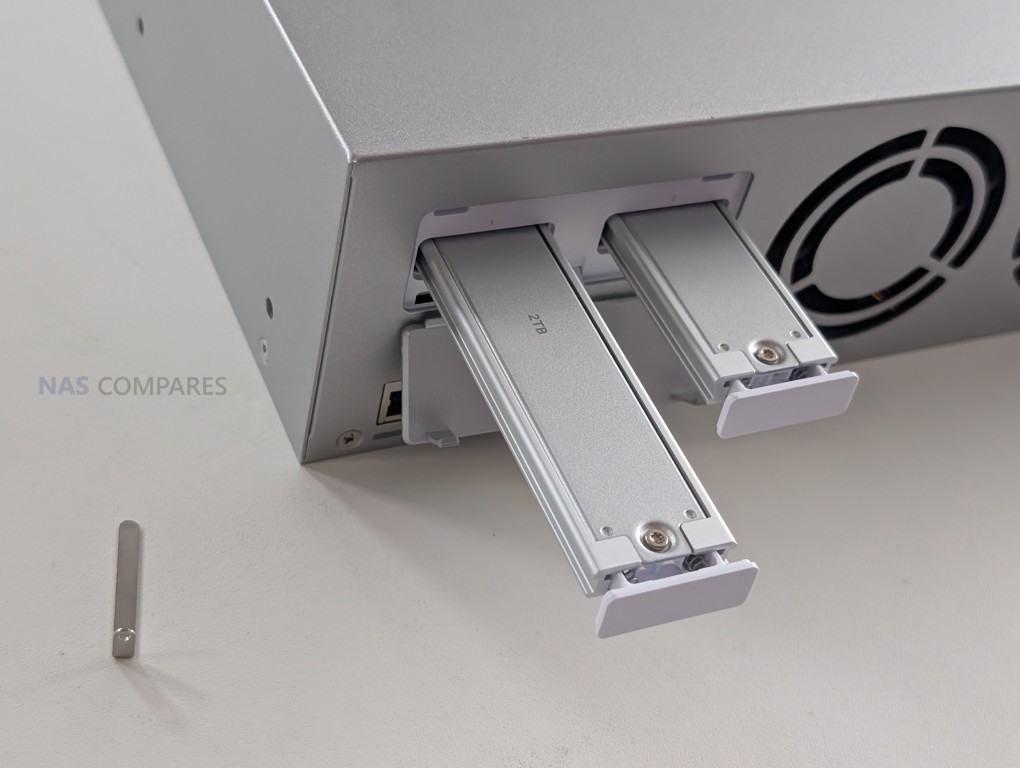
In addition to the SATA bays, the chassis supports 2 M.2 NVMe slots intended specifically for SSD caching. The caching model is designed to accelerate HDD-based storage by using SSDs as a performance layer, rather than allowing NVMe drives to become their own primary pool for general file storage. Practically, that positions the NVMe feature as a supplement for mixed workloads, such as improving responsiveness for frequently accessed data and smoothing write behavior, rather than a route to running the system as a small all flash NAS.

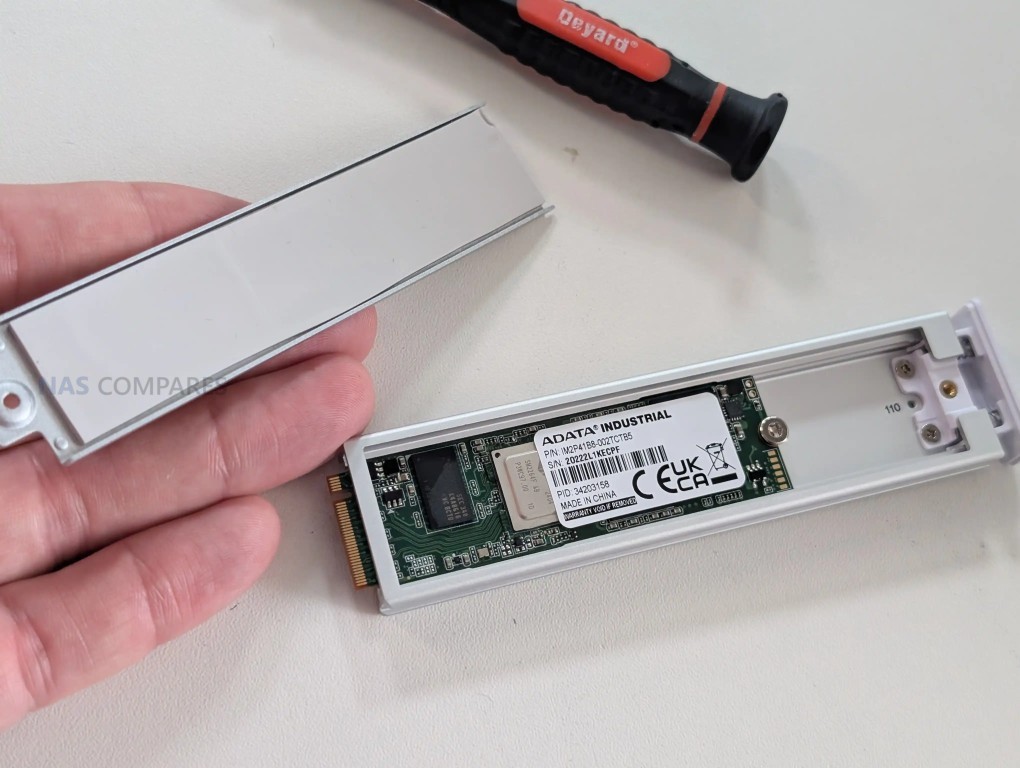
A design detail that affects the storage experience is the physical NVMe mounting method. Instead of a simple screw-down slot on a board, the NVMe drives are installed via a tray or carrier mechanism, and that carrier is not included with the base unit. The carrier itself is neatly engineered with a clip-in style insertion and thermal padding, and it supports common M.2 lengths including 2280 and 22110, but requiring an additional part adds friction if caching is part of the plan from day 1. It is a small issue, but it is the kind of detail that can slow down an otherwise straightforward deployment.

UniFi UNAS Pro 4 Review – Internal Hardware

The UNAS Pro 4 is built around a quad core ARM Cortex-A57 CPU clocked at 2.0 GHz and paired with 8 GB of memory, which sets expectations for the type of workloads it is designed to handle. This is not a platform aimed at heavyweight compute tasks, but for file services and scheduled backup activity it has enough headroom to keep the system responsive, particularly when multiple users are accessing shared folders and snapshots are being taken in the background.

The CPU choice also reflects a focus on predictable appliance behavior and lower overall platform complexity rather than maximum expandable performance.

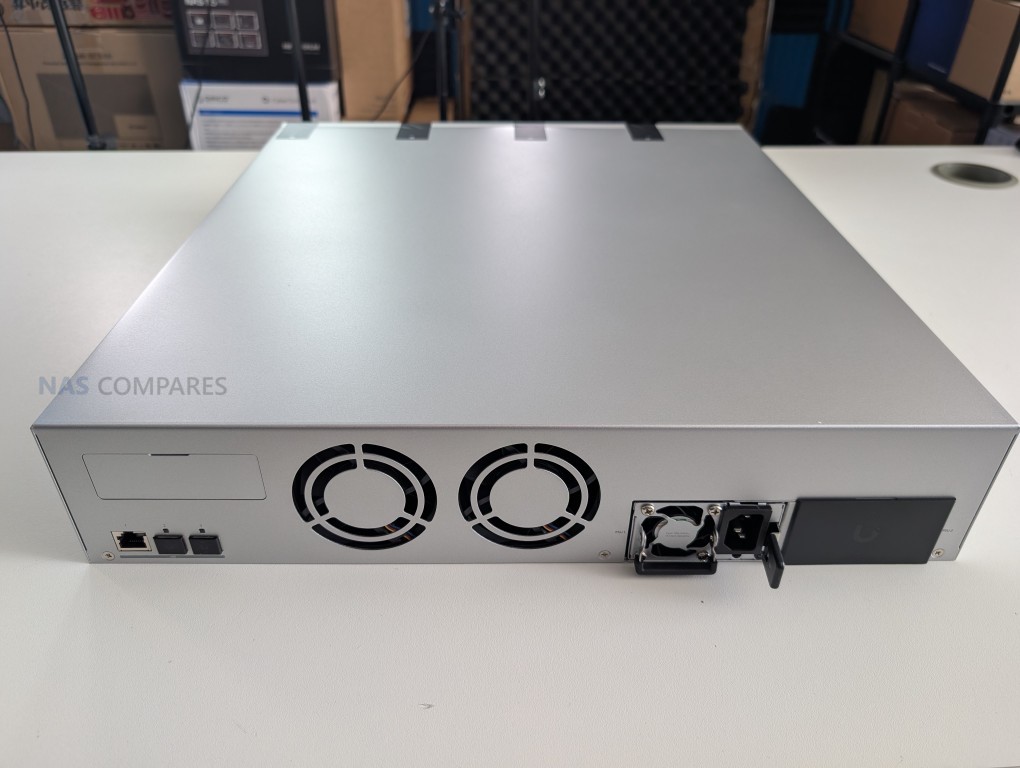
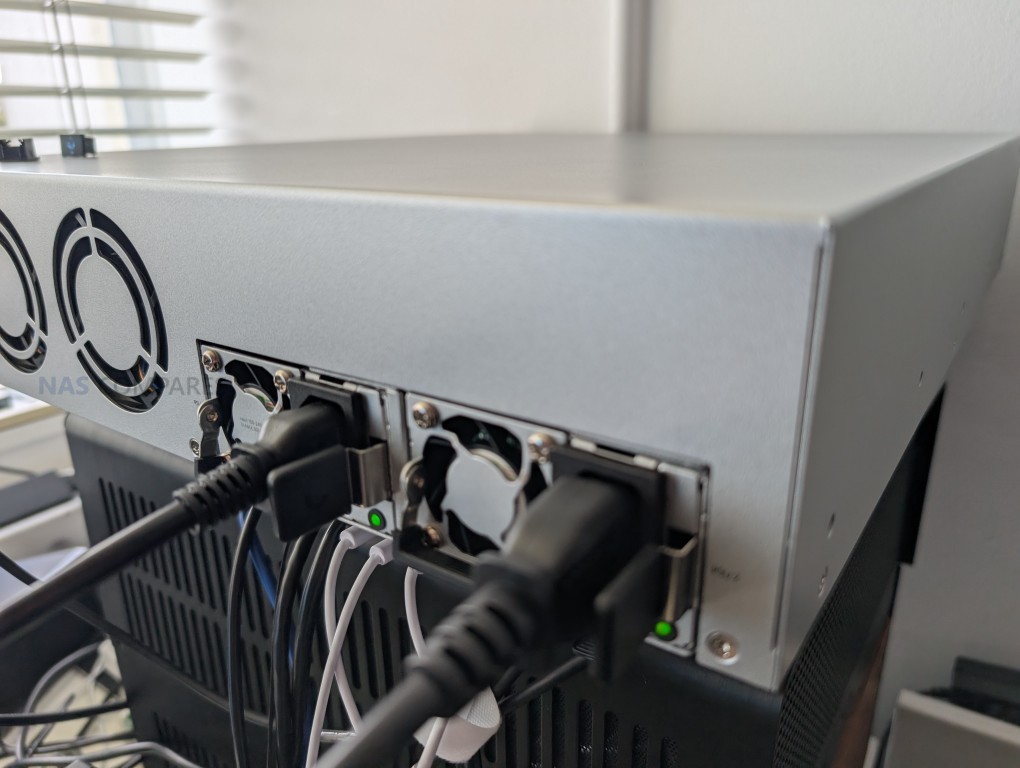
Internally, the power system is a single 150 W unit mounted inside the chassis rather than a hot swap module, which influences servicing and downtime planning. If the PSU fails, replacement is more involved than swapping an external canister, and that is a meaningful difference compared with rack systems that use easily replaceable redundant modules.

The unit does, however, support UniFi’s USP-RPS DC input as an alternative redundancy method, which changes the redundancy approach from “dual PSU in the chassis” to “centralized redundant supply for multiple devices,” with different trade-offs in cost, cabling, and rack layout.

A further internal design choice is how the system treats its software environment as a dedicated appliance rather than an OS sharing space with user storage. The system software runs on its own internal storage rather than living on the same disks that hold your data. In practical terms, that reduces the chance of the OS being affected by changes to the main array, and it can make maintenance tasks like drive replacement or pool rebuilds feel more self-contained, because the unit remains manageable even while the primary storage is under stress.

ARM-based NAS platforms typically bring some efficiency advantages, and this model follows that general pattern. The CPU class and memory configuration are aligned with lower baseline overhead than many x86 NAS designs, which can help keep idle draw and sustained power use in check relative to equivalent rack hardware, though drive choice still dominates the total. The trade-off is a lower performance ceiling compared with modern x86 systems for certain workloads, plus the usual limitations seen in this category: no practical RAM upgrade path, no ECC support, and fewer options for buyers who want to push beyond file services into heavier compute. At $499, those omissions are consistent with the target price bracket in 2026 rather than being unexpected corner cutting.

UniFi UNAS Pro 4 Review – Ports and Connections

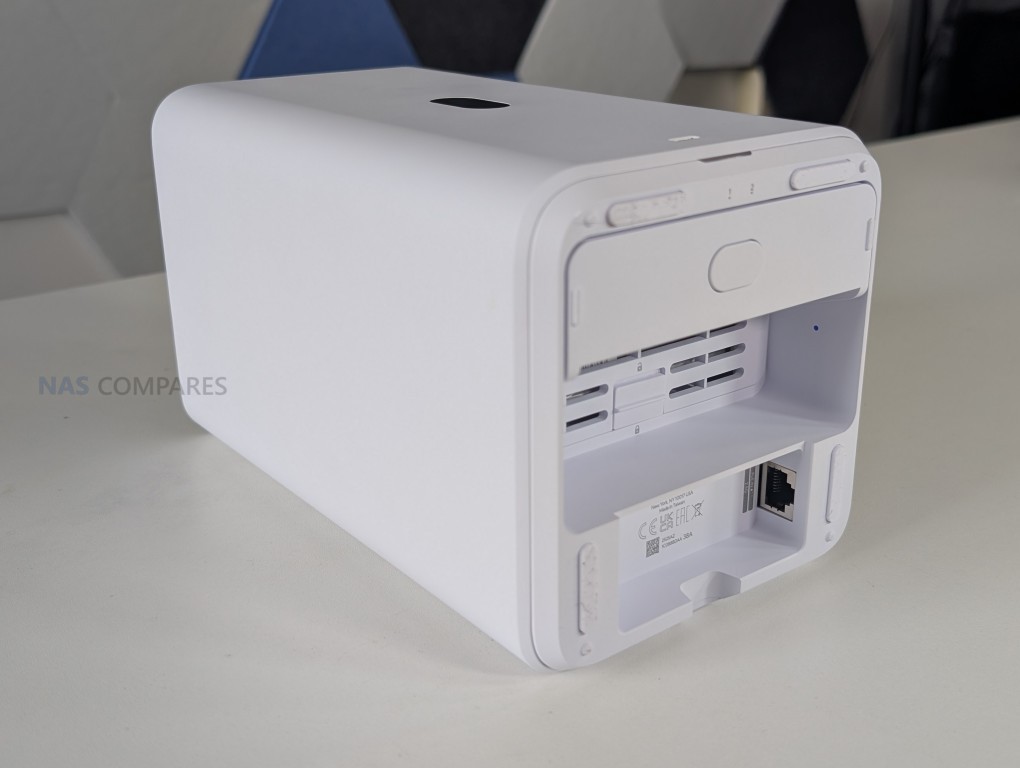
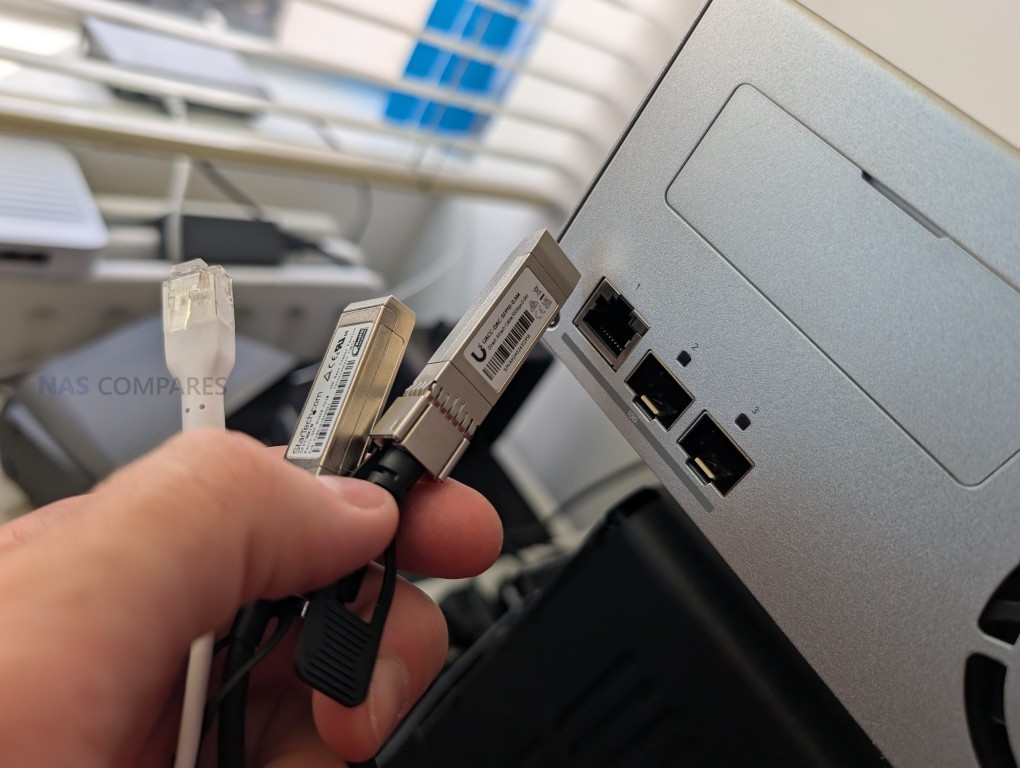
The rear connectivity is centered on 2x 10Gb SFP+ ports, and that is the defining hardware choice for this NAS in a 1U, 4 bay format. It allows the unit to be placed into a 10Gb environment without adapters, and it also opens up practical options beyond raw throughput, such as separating traffic types, connecting into different switches, or keeping a second path available for failover. The choice of SFP+ over 10GBase-T will suit users already running fiber or DAC links in a rack, but it can be less convenient for small setups built around copper RJ45.

Alongside the 10Gb ports is a separate 1GbE RJ45 port that can be used for management or for general connectivity in networks where 10Gb is not available everywhere. In a mixed UniFi environment, this is useful because it avoids tying basic onboarding and administration to a 10Gb port that might be better reserved for file traffic. It also gives a simple fallback path for access and troubleshooting if the 10Gb side is being reconfigured, moved between switches, or temporarily taken offline.

What is missing is just as relevant as what is included. There are no USB ports for quick ingest, offline copy tasks, or attaching temporary media, which some rack NAS platforms still provide for convenience even in 1U designs. Wireless is not a focus here, though Bluetooth is present for initial setup workflows, which fits the product’s “appliance onboarding” approach more than it does ongoing connectivity. The result is a port layout that prioritizes network-first storage and rack integration, while leaving out local expansion and quick-access I/O features that some users expect on a NAS.

However, (and I am sounding like a broken record at this point) at $499, these ports and connections are a notable degree more than most other turn-key NAS solutions from Synology, QNAP and even Terramaster (the more budget end of the NAS market already) are offering at under 500! So, what is presented here is a great value Day 1 solution in terms of base connectivity, but there is no denying that it might well feel the pinch in 5 years down the road when your storage is filling and your storage speeds begin to bottleneck vs your other equipment bandwidth.

UniFi UNAS Pro 4 Review – Testing Noise, Temps, Power Consumption & Speed

Performance here needs to be framed around the physical limits of 4 SATA bays and the role of SSD caching. Even with dual 10Gb networking available, a 4 drive HDD array has a throughput ceiling that will be reached long before the network becomes the bottleneck in most single-client scenarios. The value of 10Gb in this context is less about hitting theoretical maximums and more about maintaining higher transfer rates consistently, handling multiple simultaneous users, and keeping latency lower when lots of smaller operations are happening alongside big file moves.

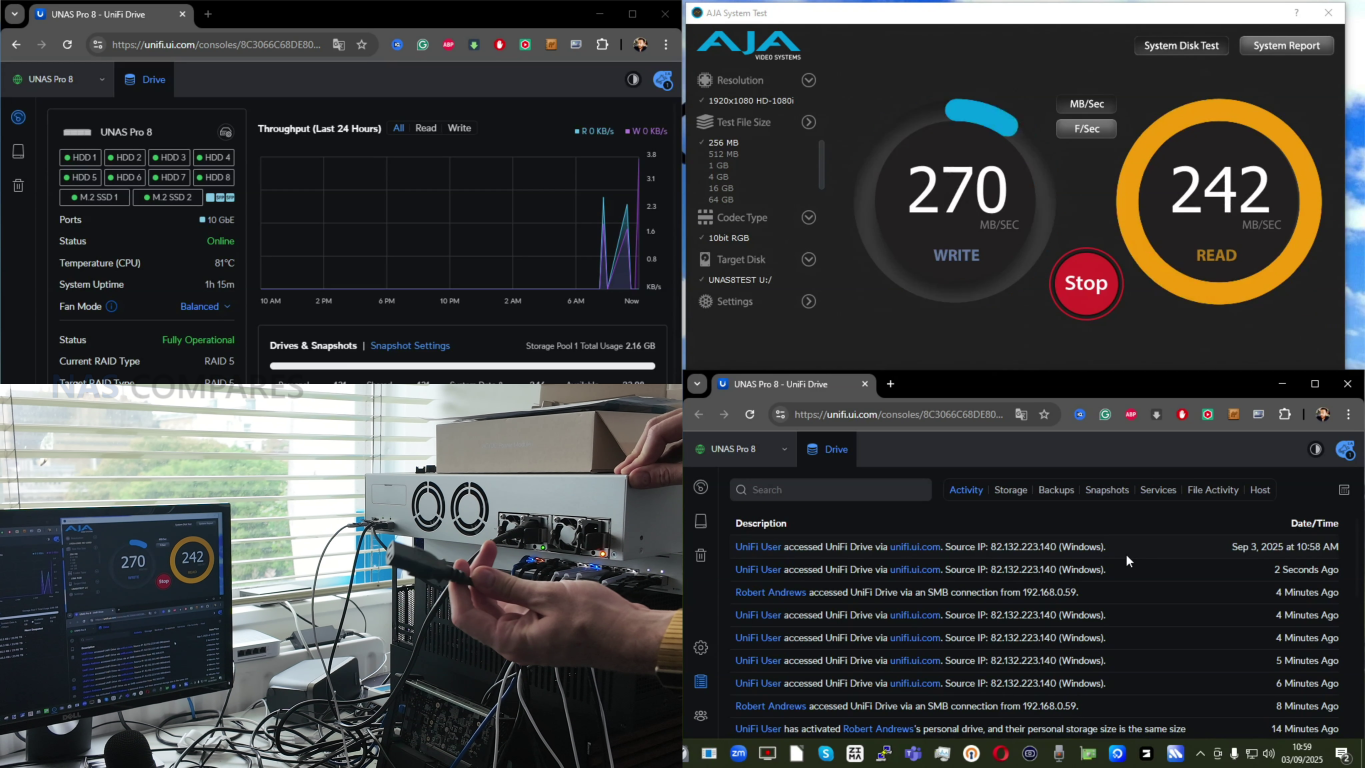
In testing with 4 HDDs in a RAID 5 configuration over a 10Gb link to a Windows 11 client, measured throughput landed in the range expected of a well-tuned 4 disk array. Using AJA with a repeated 1 GB test file, results sat around 680 to 730 MB/s for download and 520 to 600 MB/s for upload. A real-world Windows file transfer of 101 GB made up of 1,231 mixed files completed in 3 minutes and 57 seconds, which works out at an average of about 426 MB/s across the transfer, reflecting the usual drop from synthetic peak results when file variety and filesystem overhead are introduced.

Synthetic benchmarking results varied depending on the tool used, which is not unusual when caching behavior and test patterns differ. CrystalDiskMark with a 1 GB test file reported 353 MB/s read and 429 MB/s write in this run, with write coming out higher than read, which is atypical enough to treat as an outlier pending further retesting. ATTO produced stronger peak figures of 860 MB/s read and 570 MB/s write at the top end, which aligns more closely with the best-case behavior seen in sequential-focused tests on multi-drive arrays.

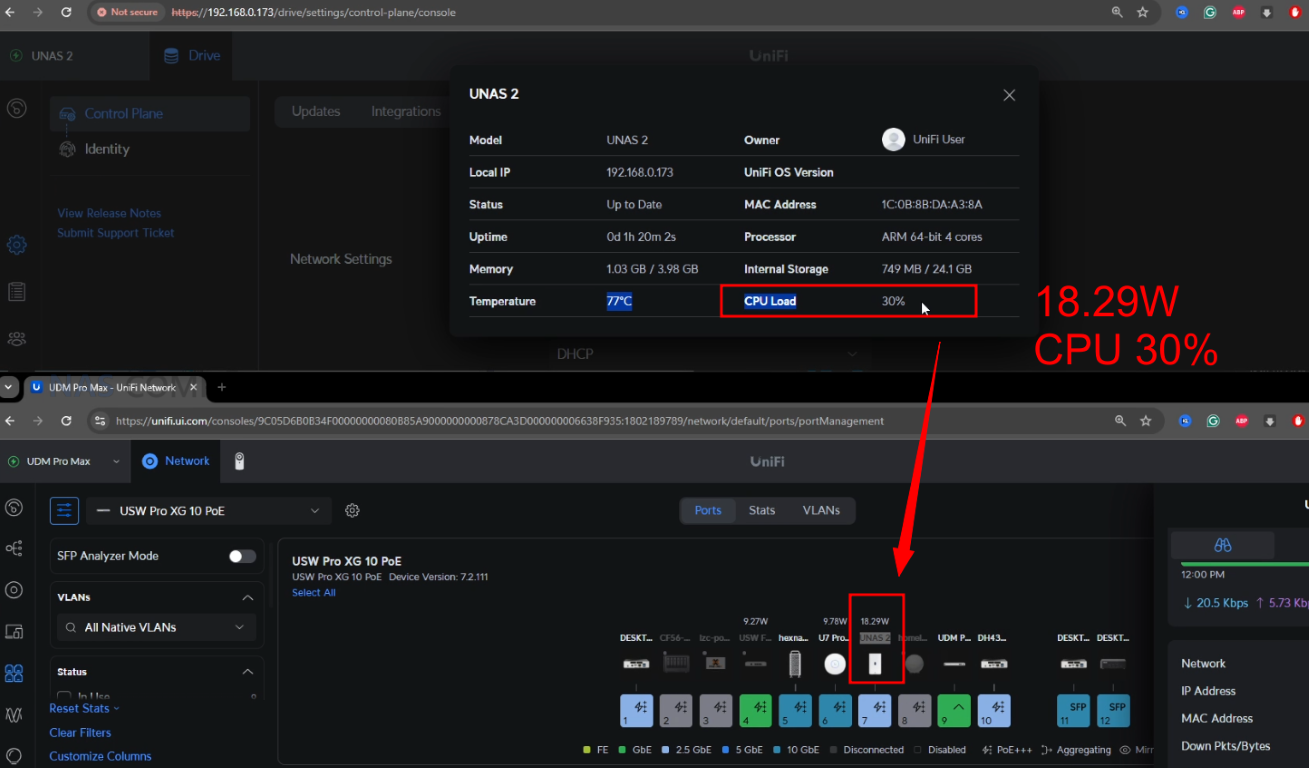
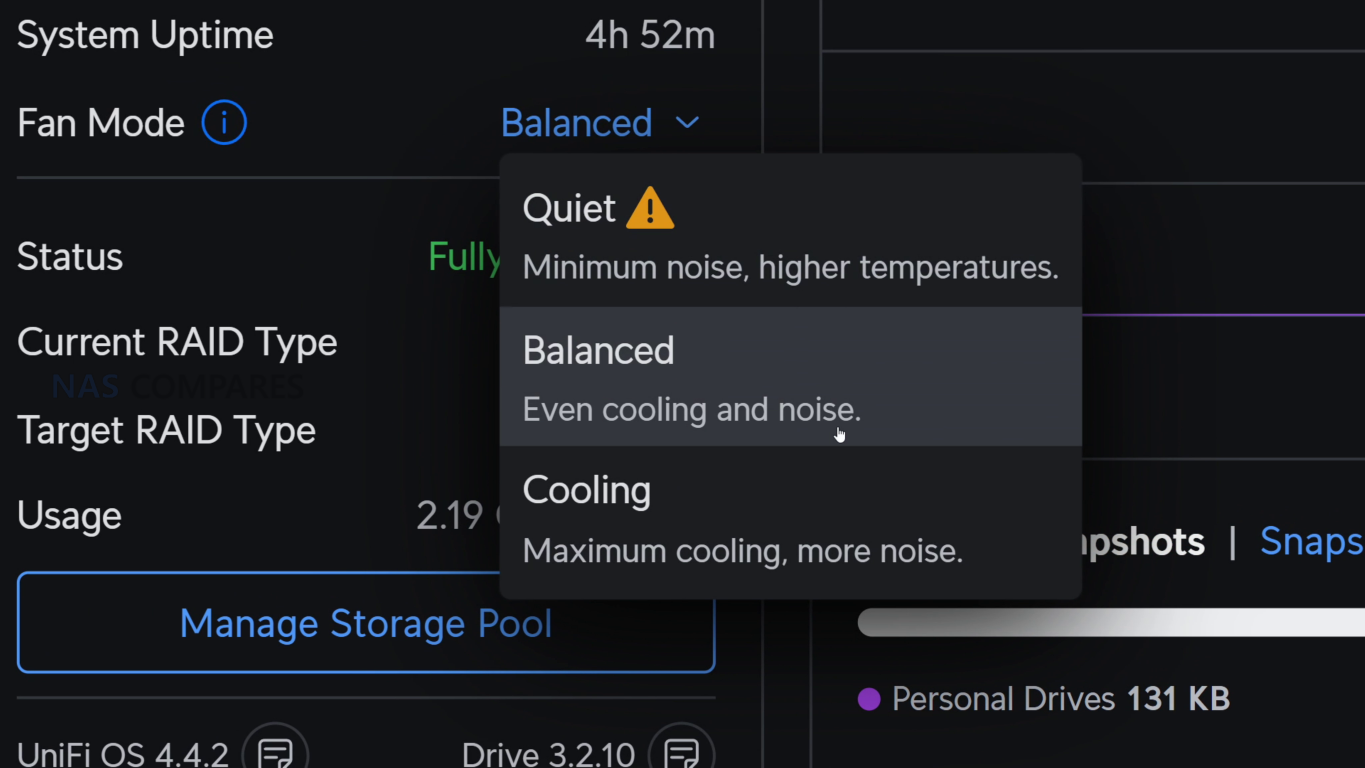
Noise, power draw, and thermal behavior were also measured because they affect rack placement and operating cost. With the fan profile set to auto and drives idle, noise sat around 42 to 44 dBA, dropping to roughly 38 to 40 dBA in the lowest RPM mode. Manually forcing maximum cooling pushed noise to around 56 to 57 dBA, and that level remained dominant even when drive activity increased, suggesting the cooling system prioritizes aggressive airflow when pushed. Power consumption with 4 enterprise HDDs measured roughly 49 to 50 W at idle and 60 to 62 W under activity, while swapping to 4 SATA SSDs reduced that to around 32 W during synchronization, underlining how drive choice can change the overall profile as much as the base platform.

UniFi UNAS Pro 4 Review – Software and Services

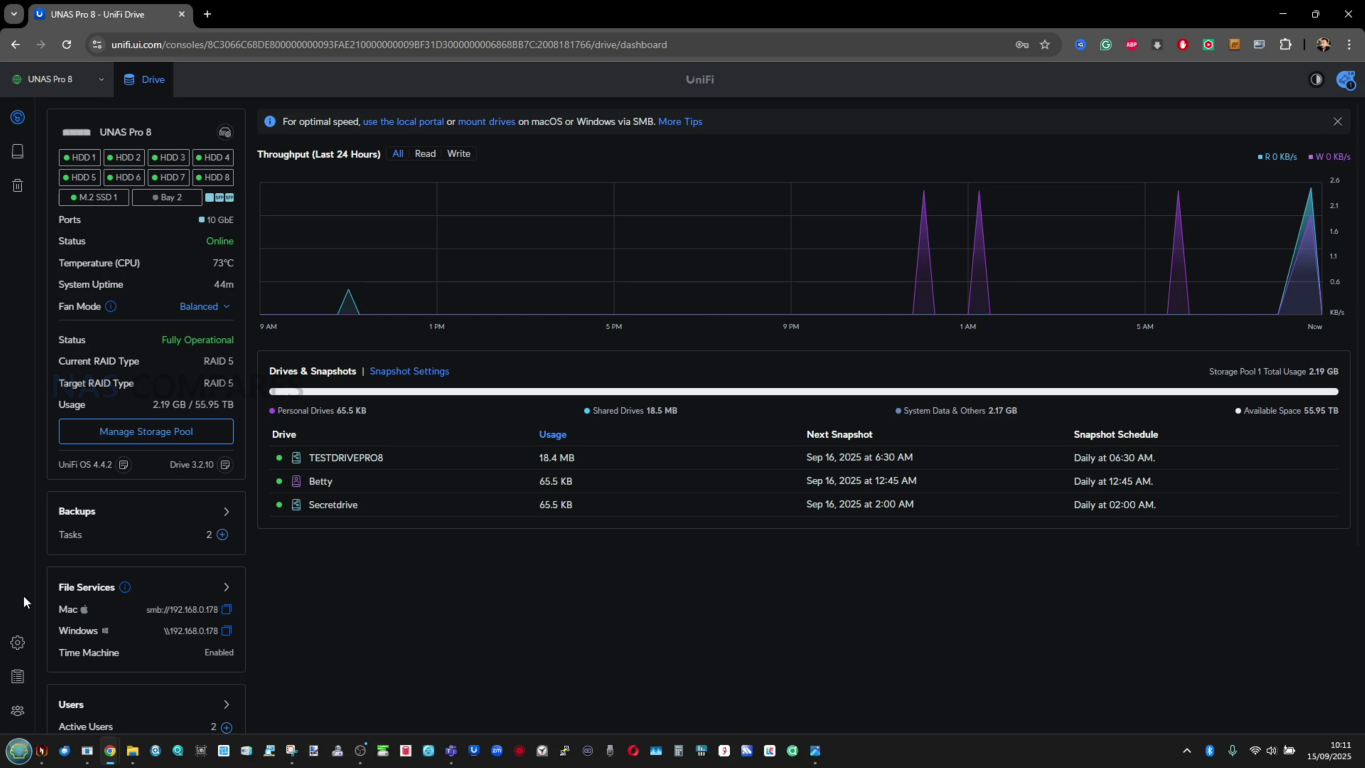
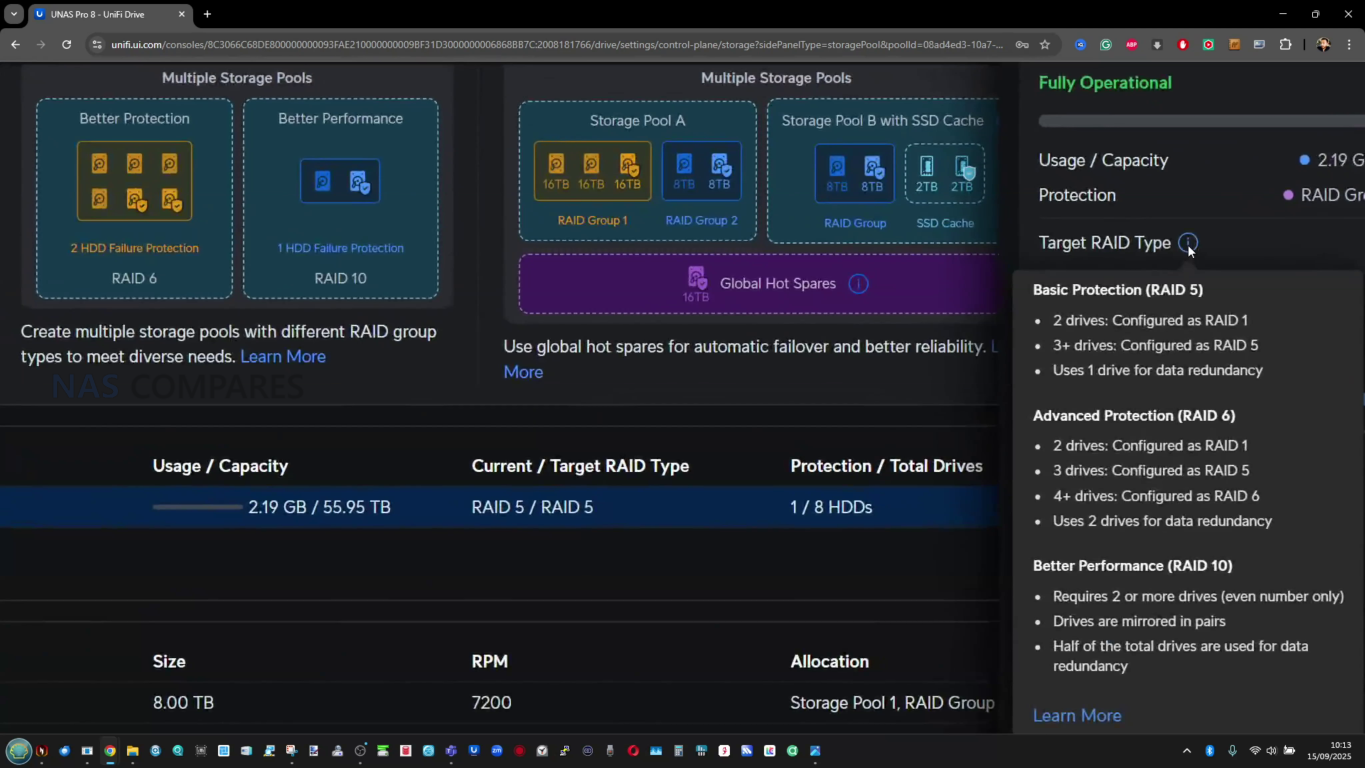
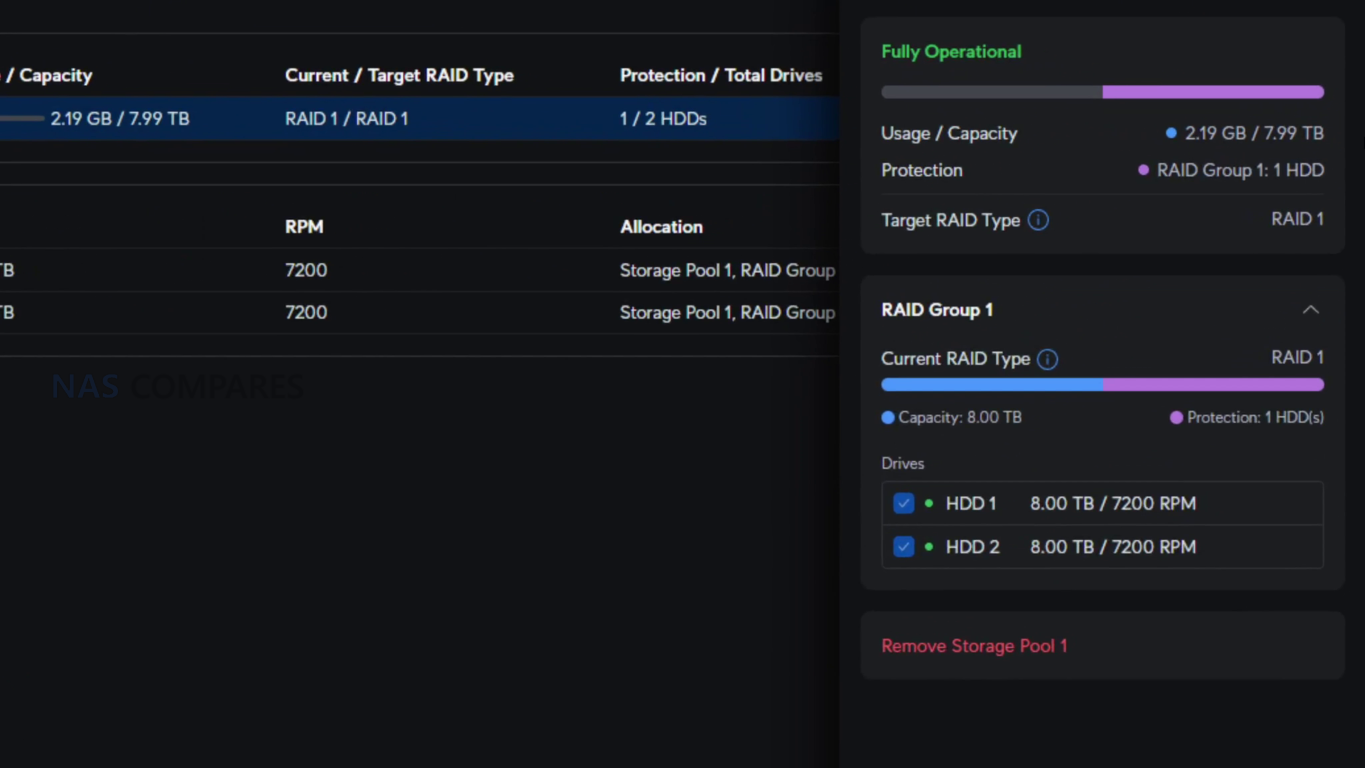
The UNAS Pro 4 runs UniFi Drive and is managed through the same style of web interface used across the broader UniFi portfolio, with system status, storage, backups, and user access presented in a single dashboard. For basic NAS use, the core functions are in place: creating storage pools, managing shares, enabling file services, and monitoring drive health. The interface is generally structured around doing common tasks quickly rather than exposing every possible tuning option, which keeps setup approachable but also limits deeper control in areas that some experienced NAS users look for.

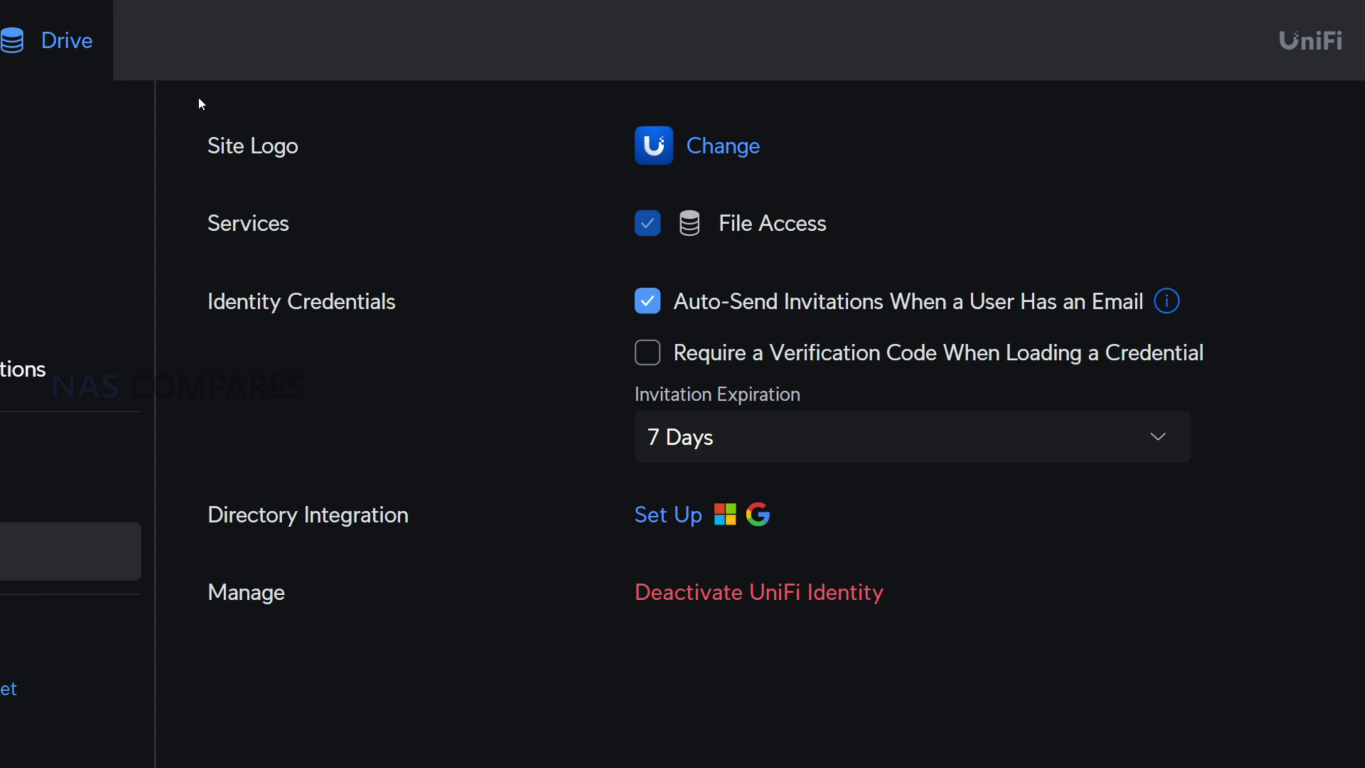
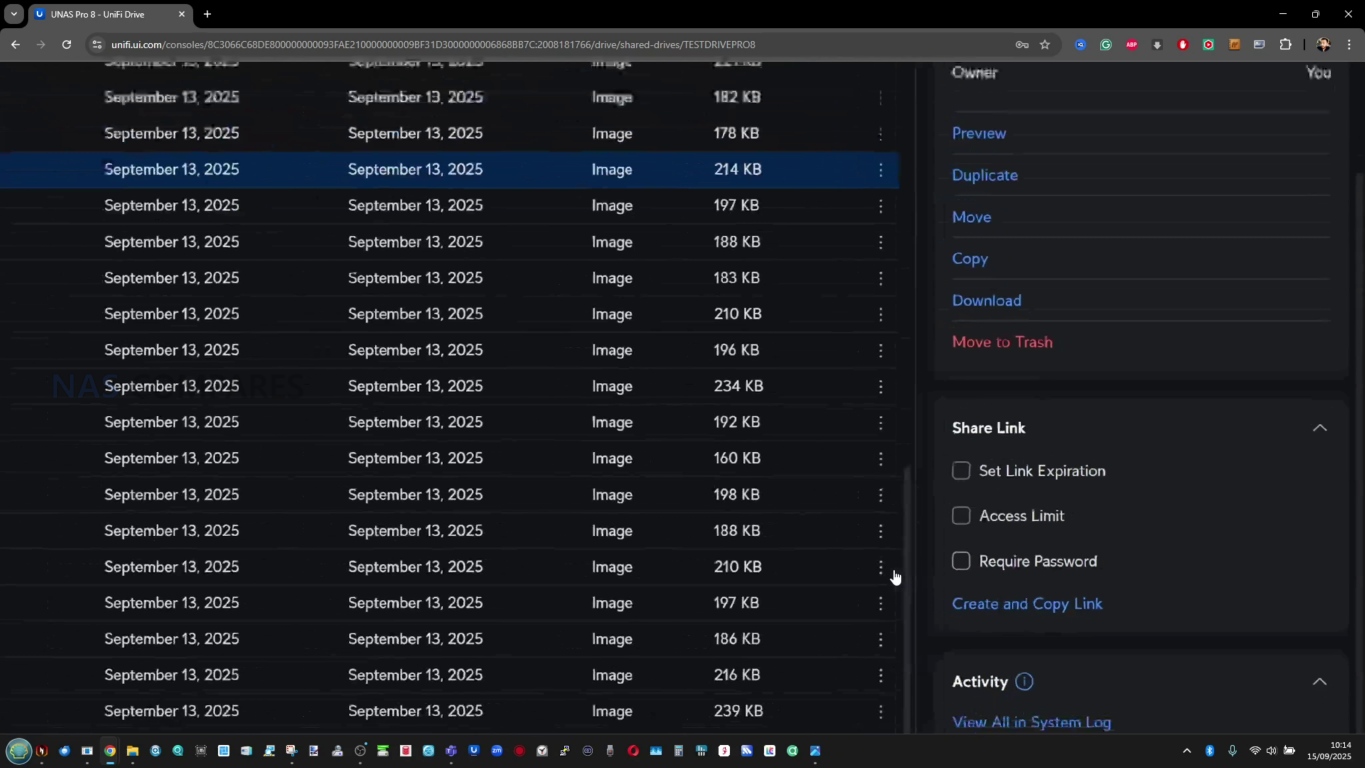
File access is centered on SMB and NFS, with browser-based file management available for basic upload, download, and folder navigation. The browser file manager covers the essentials and includes sharing link creation, but it is not positioned as a full productivity layer with advanced file handling or rich collaboration features. Remote access and identity-based access tools are tied into UniFi’s account and identity layer, and while local-only deployment is possible, the most integrated remote workflow is clearly designed around UniFi’s own services rather than third party remote networking tools.

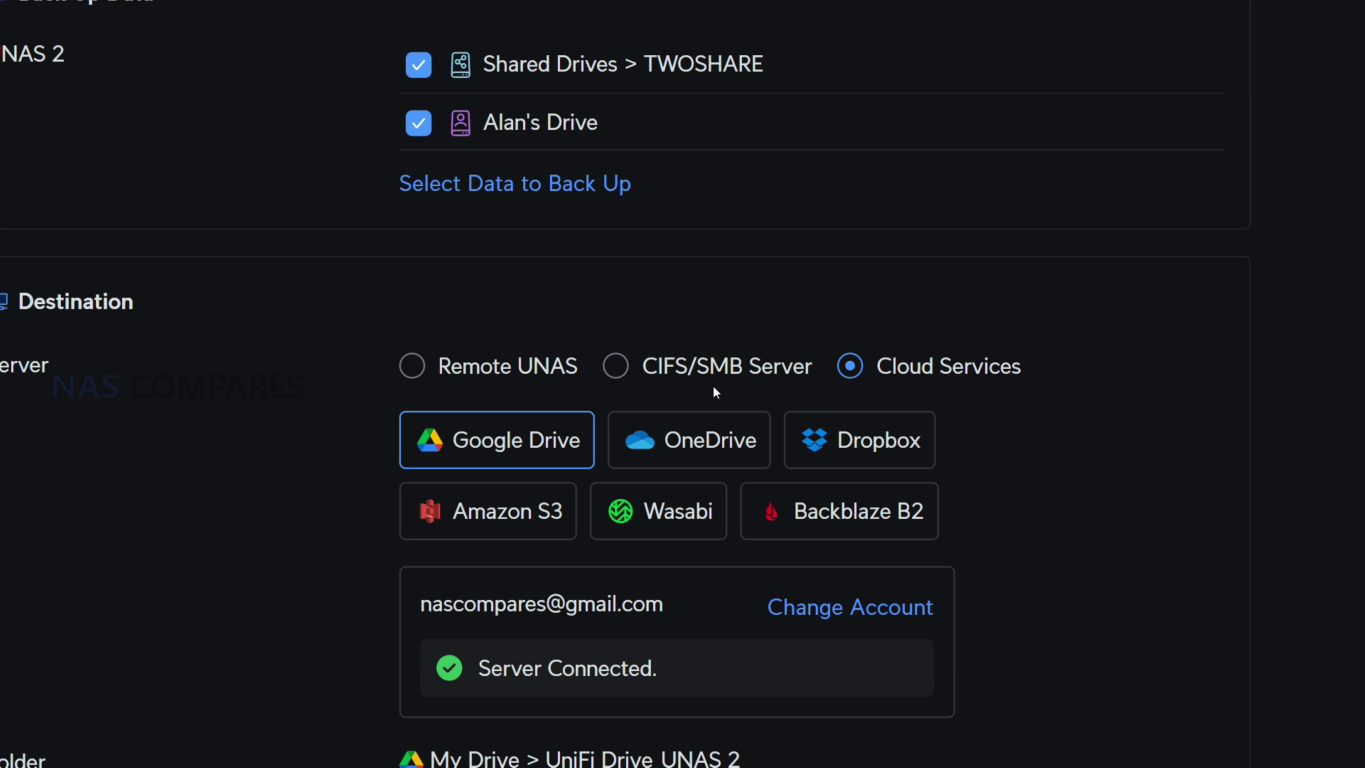
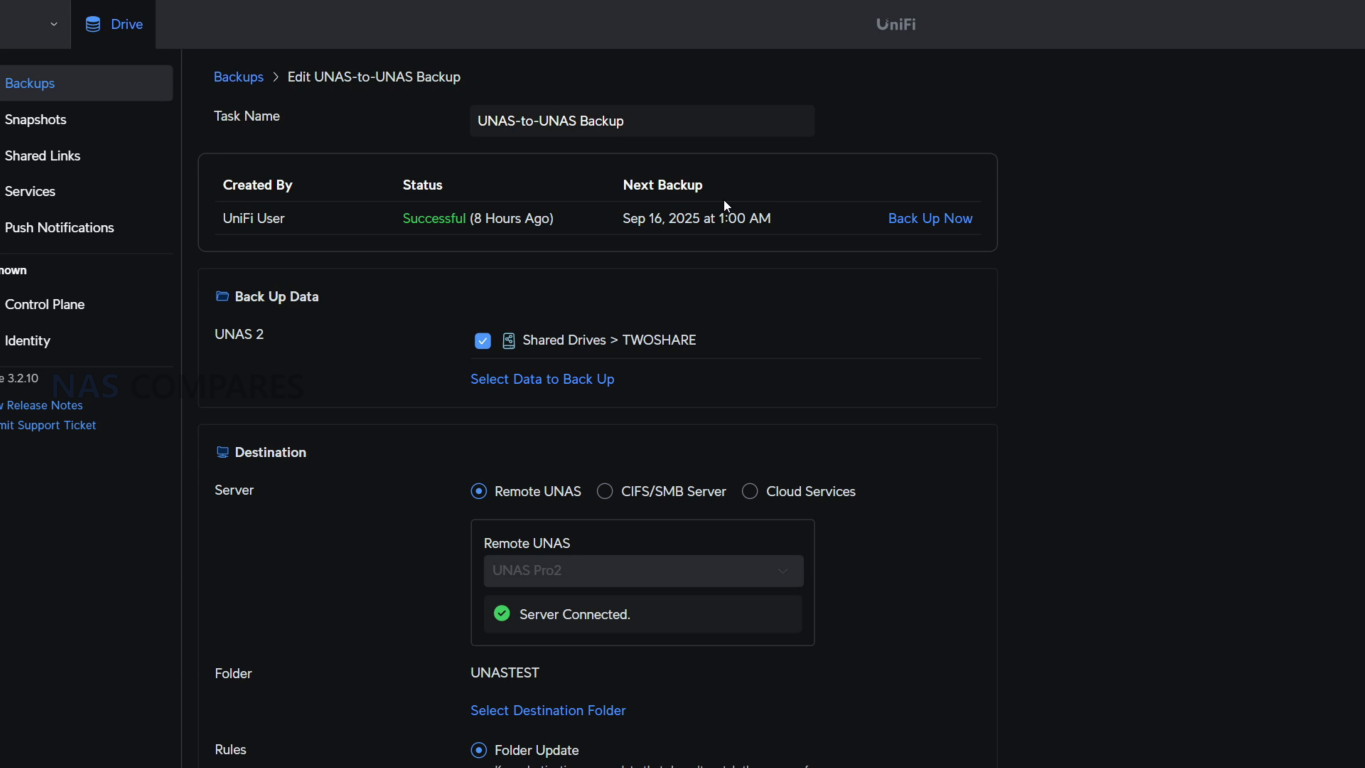
Storage protection features include snapshot support, encrypted volumes, and configurable retention policies, which addresses most common rollback and recovery needs for file storage. Backup tooling covers several targets, including backing up to another UniFi NAS, to SMB targets, and to cloud services such as Google Drive, OneDrive, Dropbox, Amazon S3, Backblaze B2, and Wasabi, with Microsoft 365 backup support also part of the broader UniFi Drive direction. These features reflect the brand’s recent focus on strengthening data protection rather than expanding into application hosting or media server style functionality.

The gaps are consistent with the product’s current scope. There is no iSCSI target support, which limits certain virtualization and block-storage workflows, and there is no container or VM layer for running third party services directly on the NAS. NVMe usage remains limited to caching rather than becoming its own storage pool, which narrows the performance paths available if the goal is to build a small all-flash volume.

Client-side tooling is also still limited compared with platforms that provide a dedicated sync-and-pin application, with access leaning on standard network shares and UniFi’s identity-driven access methods rather than a full drive-style client experience.

UniFi UNAS Pro 4 Review – Conclusion & Verdict

The UNAS Pro 4 is a focused 1U, 4 bay NAS that prioritizes networked file storage and straightforward deployment over broader application support. The hardware choices align with that goal: dual 10Gb SFP+ connectivity, 4 hot swap bays, and optional NVMe caching provide a platform that can deliver strong file transfer rates for a small array, while the ARM-based design keeps the system positioned as an appliance rather than a general-purpose server. Its main compromises are largely structural rather than hidden: fixed bay count with no expansion path, NVMe limited to cache, no USB I/O for local tasks, and a single internal PSU rather than a hot swap redundant design.

At $499, the value case is driven by how much rack-oriented networking is included at a price that undercuts many comparable 1U NAS systems, especially those offering 10Gb as standard. The software is usable for core storage tasks and has clearly improved over the last year in areas like snapshots and backup targets, but it still leaves out features that matter to some buyers, including iSCSI and a fuller client sync experience. For users who want a compact rack NAS primarily for SMB or NFS file storage with modern backup and snapshot features, it fits its role well; for users expecting a broader NAS app ecosystem or more hardware serviceability, the limitations are likely to be decisive. But, as Delboy once said, at this price, “what do you want? Jam on it?”. This system is giving more at this price than anyone else right now and for its limitations, for many these will be paletable in the grand scheme of things. 1U 4Bay rackmounts has always been something that most turnkey NAS brands treat poorly, due to the low saturation point of four SATA drives and why waste more capable hardware on that? In that sense, Ubiquiti is really piling on the hardware here at this price – and I for one applaud this.

Here are all the current UniFi NAS Solutions & Prices:
  • UniFi UNAS Pro 4 (4 Bay + 2x M.2, $499) – HERE
  • UniFi UNAS 2 (2 Bay, $199) – HERE
  • UniFi UNAS 4  (4 Bay + 2x M2, $379) – HERE
  • UniFi UNAS Pro (7 Bay, $499) – HERE
  • UniFi UNAS Pro 8 (8-Bay + 2x M.2, $799) HERE

You can buy the UniFi UNAS Pro 4 NAS via the link below – doing so will result in a small commission coming to me and Eddie at NASCompares, and allows us to keep doing what we do! 

PROs of the UniFi UNAS Pro 4 NAS PROs of the UniFi UNAS Pro 4 NAS
  • Dual 10Gb SFP+ networking is unusual in a 1U 4 bay NAS at this price point + failover will not result in bandwidth throttle

  • A separate 1GbE port is useful for management or fallback connectivity

  • 1U chassis with relatively short depth is easier to fit in smaller racks and cabinets

  • Rails and rack hardware included, reducing extra setup cost and friction

  • Ubiquiti and UniFi online/brand services are optional (i.e pure offline/LAN is possible)+ no need for a Ubiquiti/UniFi network setup to use

  • NVMe read and write caching support can improve responsiveness in mixed workloads

  • UniFi Drive provides snapshots, encryption, and a broad set of backup targets (NAS, SMB, and multiple cloud providers)

  • Setup and management are streamlined, especially for users already running UniFi infrastructure

  • Drive 4.0 Update scales up the Business Utilities notably
  • NVMe is cache only, with no option to use M.2 drives as primary storage pools

  • NVMe trays or carriers are not included, adding extra cost and an extra purchase step

  • Single PSU (no redundency) and non-slide removable SFX/ATX PSU (relies on propriatary UniFi Battery Backup rack module or external UPS)

  • No NAS Expansion Support, so 4 HDDs are your limit


📧 SUBSCRIBE TO OUR NEWSLETTER 🔔
[contact-form-7]
🔒 Join Inner Circle

Get an alert every time something gets added to this specific article!


Want to follow specific category? 📧 Subscribe

This description contains links to Amazon. These links will take you to some of the products mentioned in today's content. As an Amazon Associate, I earn from qualifying purchases. Visit the NASCompares Deal Finder to find the best place to buy this device in your region, based on Service, Support and Reputation - Just Search for your NAS Drive in the Box Below

Need Advice on Data Storage from an Expert?

Finally, for free advice about your setup, just leave a message in the comments below here at NASCompares.com and we will get back to you. Need Help? Where possible (and where appropriate) please provide as much information about your requirements, as then I can arrange the best answer and solution to your needs. Do not worry about your e-mail address being required, it will NOT be used in a mailing list and will NOT be used in any way other than to respond to your enquiry. [contact-form-7] TRY CHAT Terms and Conditions

If you like this service, please consider supporting us. We use affiliate links on the blog allowing NAScompares information and advice service to be free of charge to you.Anything you purchase on the day you click on our links will generate a small commission which isused to run the website. Here is a link for Amazon and B&H.You can also get me a ☕ Ko-fi or old school Paypal. Thanks!To find out more about how to support this advice service check HEREIf you need to fix or configure a NAS, check Fiver Have you thought about helping others with your knowledge? Find Instructions Here  

 
Or support us by using our affiliate links on Amazon UK and Amazon US
    
 
Alternatively, why not ask me on the ASK NASCompares forum, by clicking the button below. This is a community hub that serves as a place that I can answer your question, chew the fat, share new release information and even get corrections posted. I will always get around to answering ALL queries, but as a one-man operation, I cannot promise speed! So by sharing your query in the ASK NASCompares section below, you can get a better range of solutions and suggestions, alongside my own.

☕ WE LOVE COFFEE ☕


UniFi UNAS Series of NAS Devices – 12 Months Later, Should You Buy One?

UniFi UNAS – 1 Year Later. Should You Buy Now?

It has now been one full year since Ubiquiti made its formal debut in the NAS market with the launch of the UniFi UNAS Pro, a 7-bay rackmount storage system designed to integrate seamlessly within the existing UniFi ecosystem. At launch, the device was seen as a bold but limited step into a space traditionally dominated by established brands such as Synology and QNAP, focusing more on straightforward network storage than application-heavy server functions. Over the following twelve months, the company has steadily expanded the UNAS lineup and rolled out numerous firmware and software updates, refining its NAS operating system, UniFi Drive, and addressing user feedback gathered through real-world testing. From introducing multiple new RAID configurations, encryption, fan control, and USB backup capabilities, to expanding cloud backup support and improving system responsiveness, UniFi has demonstrated a consistent approach to building out the platform incrementally rather than replacing hardware prematurely. Today, the UNAS family includes five systems spanning both desktop and rackmount designs, with capacity options ranging from 2-bay PoE-powered units to 8-bay multi-10GbE solutions. Taken together, these changes illustrate a deliberate evolution of UniFi’s NAS portfolio from a proof of concept into a structured, multi-tier ecosystem with increasing competitiveness in the storage market.

Here are all the current UniFi NAS Solutions & Prices:
  • UniFi UNAS 2 (2 Bay, $199) – HERE
  • UniFi UNAS 4  (4 Bay + 2x M2, $379) – HERE
  • UniFi UNAS Pro 4 (4 Bay + 2x M.2, $499) – HERE
  • UniFi UNAS Pro (7 Bay, $499) – HERE
  • UniFi UNAS Pro 8 (8-Bay + 2x M.2, $799) HERE

Unifi UNAS, 1 Year Later – THE TL;DR:

In a rush and just want the cold facts? Here’s a clear TL;DR breakdown of all major UniFi UNAS product and software changes over the past 12 months, based entirely on your three video transcripts (3 months, 6 months, 1 year). It captures both software and hardware evolution, along with remaining limitations and future signals.

Initial Launch (UNAS Pro, Oct 2024)

  • First UniFi NAS, priced at $499, 7-bay rackmount, ARM CPU, 10GbE networking.

  • Marketed as “pure storage” for UniFi ecosystem integration, not an app-rich NAS.

  • Praised for value, build quality, and easy setup.

  • Criticized for missing features: iSCSI, RAID 6, multiple pools, containerization, USB ports, UniFi Protect integration, and limited cloud backup (Google Drive only).

  • Early software lacked advanced admin control, backup management, and multi-user oversight.

  • SMB performance and file integrity inconsistencies appeared during large data transfers.

  • Frequent backend updates released in first quarter, addressing GUI layout, alignment, and minor stability fixes.


3-Month Mark (Jan 2025)

  • Rapid patching cycle began: RAID 6 added, marking UniFi’s first major new feature.

  • Ongoing bugs fixed in the Drive OS interface and file manager.

  • Still missing key functionality like iSCSI and multiple pools.

  • Admin-level restrictions persisted; super admins could not manage user backups.

  • File browser inconsistencies fixed only partially (e.g., trash handling, SMB sync).

  • Backups limited to other UNAS or Google Drive, no AWS or S3 options yet.

  • Users frustrated by Safari bug (incomplete file downloads on iPhone, later acknowledged by UniFi).

  • Performance still below expectations on large SMB transfers; memory leaks and “skipped file” issues noted.

  • Despite flaws, praised for value and ongoing support rather than abandonment.


6-Month Mark (Apr 2025)

  • Software maturity improving, most updates focused on stability rather than new features.

  • RAID 6 officially released across all devices, with migration tools from RAID 5 + hot spare.

  • New cloud backup options: Dropbox and OneDrive added.

  • Admin control improved: super admins could now manage user backups and shared drives.

  • File sharing responsiveness and accuracy improved significantly in the GUI.

  • New file activity monitor added, showing per-folder change history.

  • Apple Time Machine backups now officially supported.

  • Fixed .exe execution issue when accessed via SMB.

  • Ongoing quality-of-life improvements: faster interface, better consistency, fewer sync issues.

  • Remaining issues:

    • Still no iSCSI, no fan control, no scheduled power management, and occasional temperature irregularities.

    • GUI bug showed 20,000 days uptime (fixed later).

  • System temperatures remained high (~68–72°C CPU under light load), highlighting poor thermal automation.

  • No new NAS hardware yet announced at this point.


1-Year Mark (Oct 2025)

  • Major expansion: full UNAS lineup introduced.

    • UNAS 2: 2-bay PoE++ desktop ($199).

    • UNAS 4: 4-bay desktop with M.2 slots.

    • UNAS Pro 4: 1U rackmount, 4-bay, dual PSU support.

    • UNAS Pro 8: 8-bay, 3x10GbE ports, 2x M.2 slots ($799).

  • Core software improvements across all models:

    • Multiple RAID levels and hot-spare support expanded.

    • Multiple pools and clustered RAID pools introduced (first time UniFi allowed split or mixed pools).

    • M.2 NVMe caching added on larger models (read/write caching only).

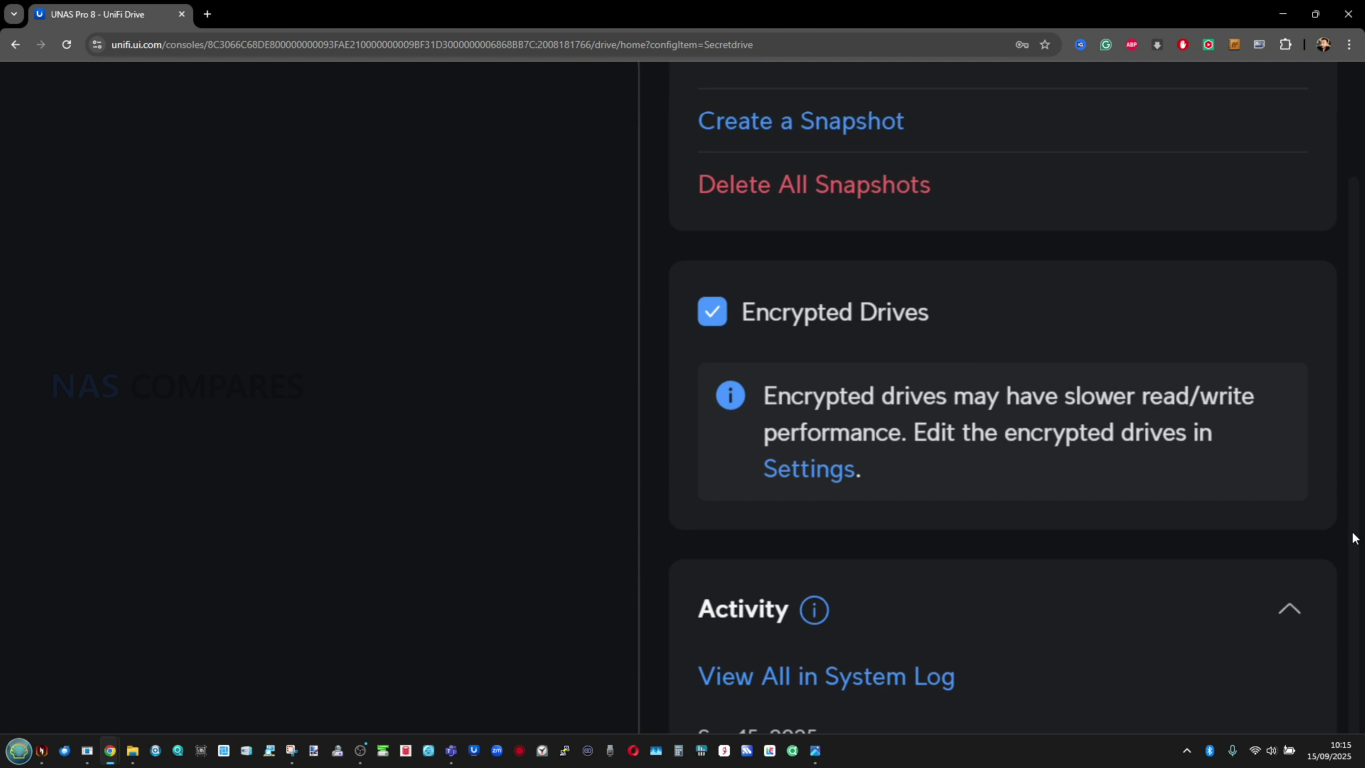
    • Encrypted volumes now supported and integrated into backup routines.

    • Fan control added, both manual and automatic.

    • USB-C mounting and backup support for desktop models (UNAS 2, UNAS 4).

    • Expanded cloud backup integration (Google Drive, Dropbox, OneDrive).

    • Snapshot performance improved, faster rollback and lower latency.

    • SMB and NFS protocols optimized for better throughput and reduced latency.

    • Improved admin tools for shared drives and user management.


Software Features Added/Improved in UniFi UNAS in 12 Months

In the twelve months since the release of the original UNAS Pro, UniFi Drive OS has developed from a relatively simple file server interface into a more complete NAS management platform. Early releases of the Drive software offered only basic storage creation and sharing options, limited to single-pool RAID 5 or mirror configurations with few administrative tools. Over time, multiple key features have been introduced, including support for RAID 6, multiple storage pools, clustered RAID pools, and hot spare functionality, each of which was implemented through system firmware updates and confirmed through beta and public release candidates. The platform now supports encrypted volumes, user-defined snapshots, and restoration features, offering greater resilience and improved recovery options after system events or accidental deletions. These updates collectively mark a notable improvement in fault tolerance and customization, allowing the UNAS range to better serve both small business and advanced home deployments that require multiple storage tiers or redundancy strategies.

Beyond storage structure, UniFi Drive has also introduced new tools for day-to-day administration and external connectivity. Cloud backup support has expanded to include Dropbox, OneDrive, and Google Drive, replacing the early limitation to only local or UNAS-to-UNAS replication. Shared drive management now includes central administrative oversight, allowing super admins to configure and monitor user-level backup routines across all profiles. The graphical interface itself has become more responsive, adding a file activity monitor that provides timeline-based access logs for folders and files. Support for Apple Time Machine has been added, as well as improved handling of executable files via SMB, and overall network protocol efficiency has increased through back-end adjustments to Samba and NFS. With these refinements, UniFi Drive OS now feels less like an experimental branch and more like a unified part of the broader UniFi management ecosystem, with greater parity across its networking, surveillance, and storage products.

Feature Category Initial State (Oct 2024) Current State (Oct 2025) Improvement Summary
RAID Configurations Single RAID 5 / 1 RAID 0, 1, 5, 6, clustered pools Major redundancy and performance improvements
Storage Pools Single unified pool only Multiple pools with clustering Hot/cold data separation, flexible tiering
Encryption None Volume encryption supported Improved data protection and compliance
Snapshots Basic rollback Full timeline management Faster recovery and rollback precision
Backup Options Local & Google Drive Google Drive, Dropbox, OneDrive Wider offsite backup compatibility
Admin Control User-limited backups Central admin management Full oversight of shared and user drives
File Monitoring Absent Folder-based activity tracking Improved audit trail visibility
Time Machine Support Absent Full support Expanded Mac OS compatibility
SMB/NFS Performance Unoptimized Tuned with caching improvements Higher throughput, lower latency

Hardware Products Added/Improved in UniFi UNAS in 12 Months

Since the launch of the original UniFi UNAS Pro in late 2024, Ubiquiti has expanded the UNAS product line into a full hardware family, each model tailored for different deployment scales and power requirements. The first expansion arrived with the compact UNAS 2, a two-bay desktop NAS powered by PoE++, marking the brand’s first use of Power-over-Ethernet as a primary power source for network storage. This device, built around a quad-core ARM Cortex-A55 CPU and 4 GB of LPDDR4 memory, aimed to serve as a lightweight edge storage unit for small offices or UniFi network environments that rely on central power distribution. Its 2.5GbE connection and USB-C port (5 Gbps) provided moderate performance for local transfers and basic backup operations, while its non-hot-swappable dual-drive cage emphasized affordability over convenience. This smaller system demonstrated UniFi’s intent to create entry-level options that could still operate within their ecosystem while maintaining core integration with UniFi Drive OS and cloud management via ui.com.

The next step up in the product family is the UNAS 4, a four-bay desktop NAS that builds directly on the UNAS 2’s design but adds more flexibility. It retains the same ARM Cortex-A55 processor and 4 GB RAM, but introduces dual M.2 NVMe slots for SSD caching or storage expansion and four 3.5-inch SATA bays for larger arrays. It still uses 2.5GbE with PoE+++ as its main power and data input, though at the time of writing, UniFi has not confirmed if the final retail version will include a secondary Ethernet port for redundancy or faster link aggregation. This model brings the UniFi storage ecosystem closer to small business-level performance, allowing for RAID 6 redundancy and improved cooling through a refined chassis design. While compact, the inclusion of NVMe caching and full integration into UniFi Drive 3.3 makes it a practical choice for users who want local storage with minimal cabling and higher data throughput.

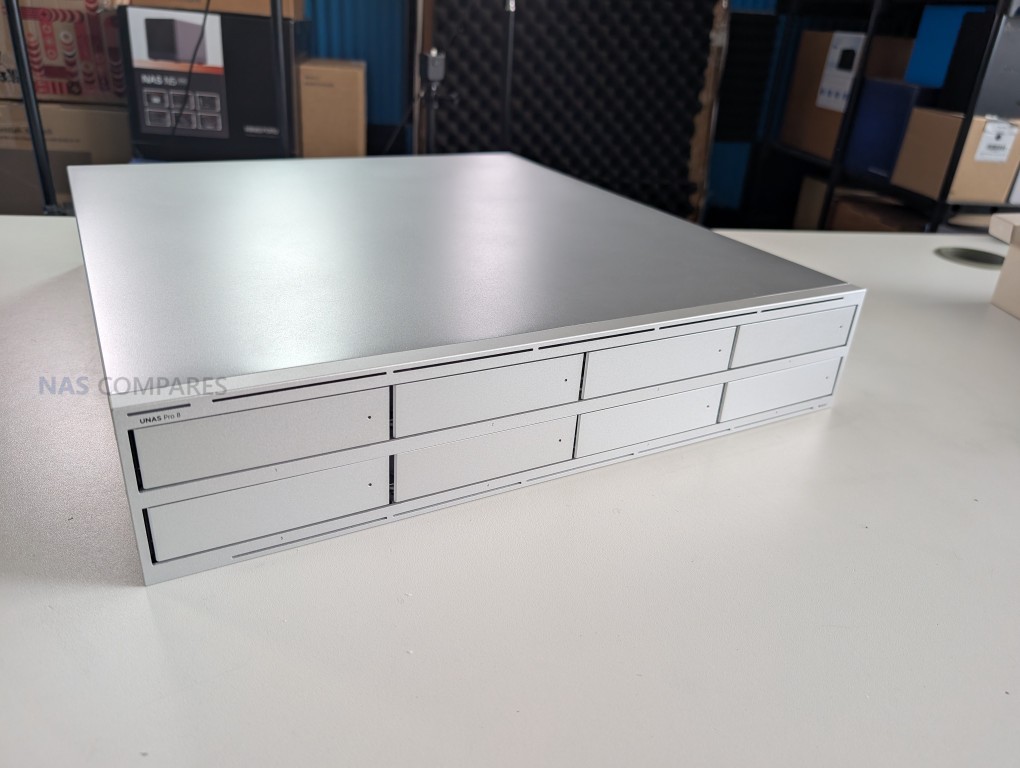
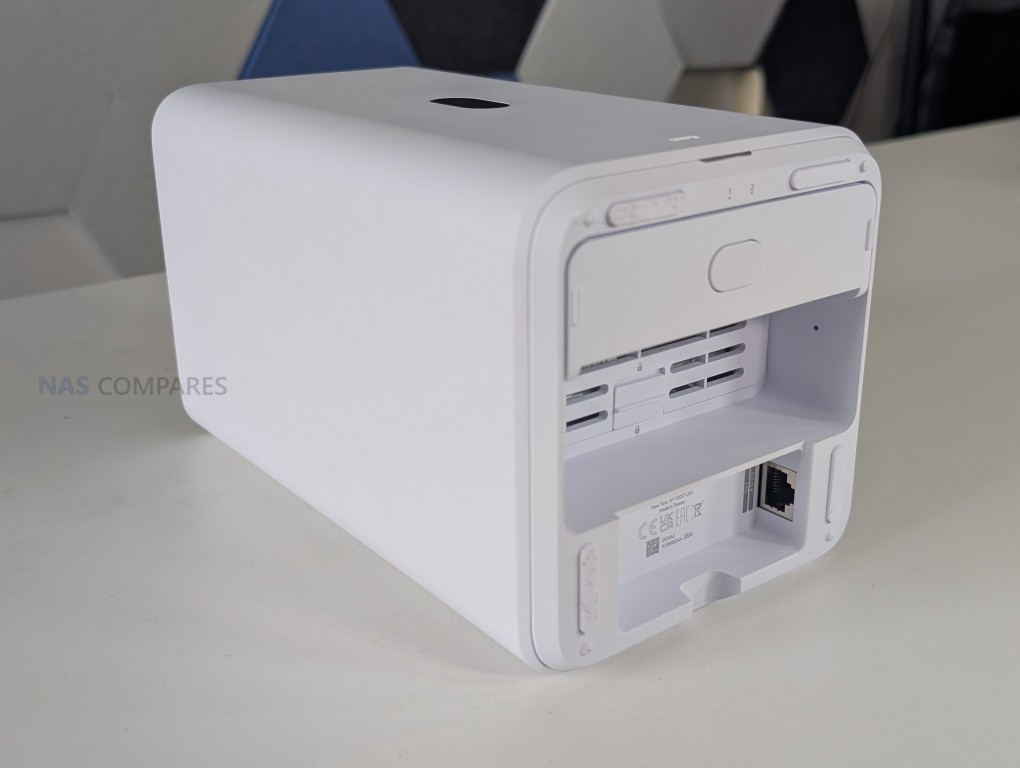
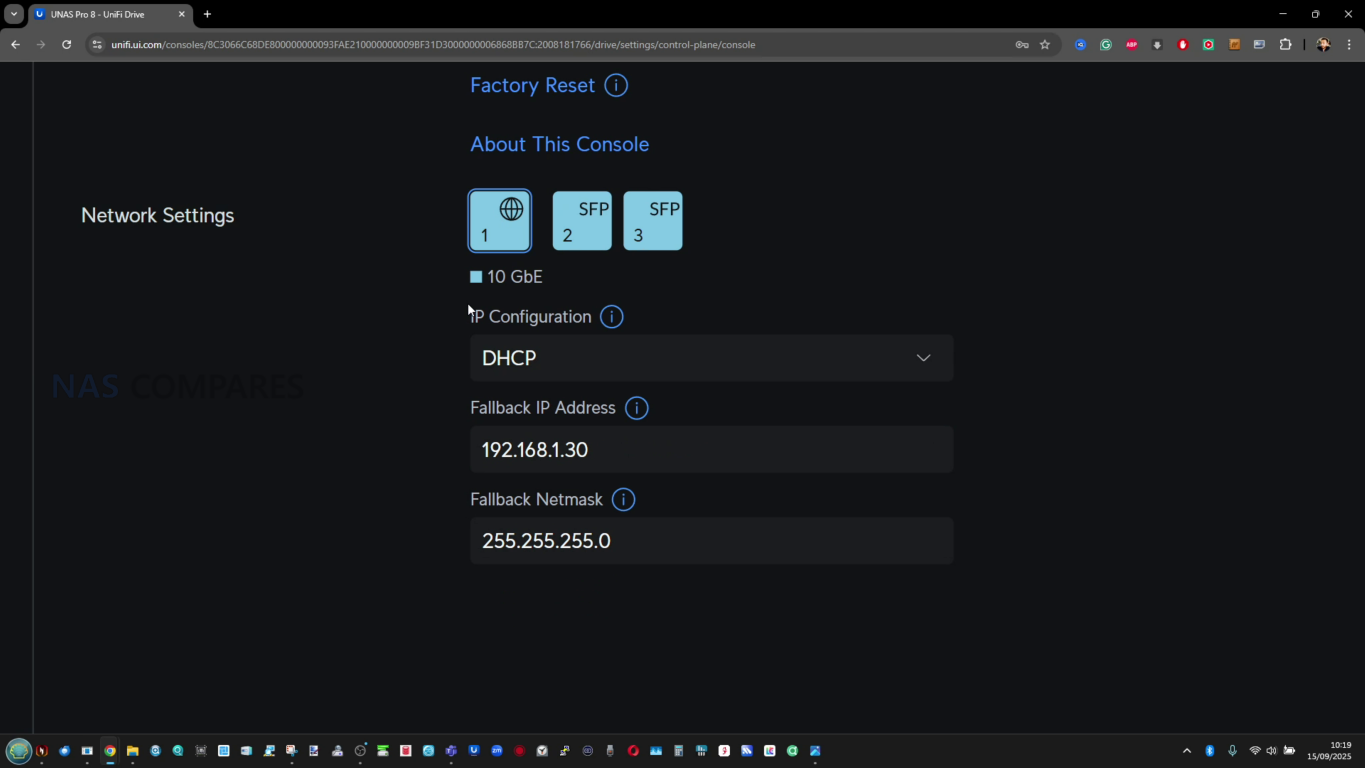
At the higher end, the UNAS Pro 4 and UNAS Pro 8 extend the lineup into the rackmount segment, reinforcing UniFi’s move toward professional and enterprise environments. The UNAS Pro 4 adopts a 1U form factor, supporting four 3.5-inch SATA drives and two M.2 NVMe slots, while maintaining the same ARM Cortex-A57 CPU and 16 GB LPDDR4 memory as its larger sibling. It also supports dual hot-swappable PSUs for redundancy and arrives with improved thermal airflow optimized for data center racks. The flagship UNAS Pro 8 offers eight 3.5-inch bays, two rear M.2 NVMe bays, and three 10GbE ports (one RJ45 and two SFP+), making it the highest-performing UniFi NAS to date. The system consumes up to 200W under load, uses Btrfs as the primary file system, and integrates the most comprehensive cooling and failover options in the UniFi NAS lineup. Together, these models illustrate UniFi’s full-tier hardware strategy: from PoE-powered desktop storage to rackmount systems supporting multi-gigabit networking and dual redundant power.

Model Form Factor Drive Bays CPU Memory Network Interface NVMe Support Power Method Key Features
UNAS 2 Desktop 2 x SATA (3.5″) Quad-Core ARM Cortex-A55, 1.7 GHz 4 GB LPDDR4 1 x 2.5GbE (PoE++) None PoE++ / 60W Compact PoE NAS, USB-C 5Gbps, LCD panel
UNAS 4 Desktop 4 x SATA (3.5″) Quad-Core ARM Cortex-A55, 1.7 GHz 4 GB LPDDR4 1 x 2.5GbE (PoE+++) 2 x M.2 NVMe PoE+++ Dual M.2, compact 4-bay, UniFi Drive 3.3 ready
UNAS Pro 4 1U Rackmount 4 x SATA (3.5″) Quad-Core ARM Cortex-A57, 1.7 GHz 16 GB LPDDR4 2 x 10GbE (RJ45 + SFP+) 2 x M.2 NVMe Dual PSU Redundant PSU, RAID 6, enterprise airflow
UNAS Pro 8 2U Rackmount 8 x SATA (3.5″) Quad-Core ARM Cortex-A57, 1.7 GHz 16 GB LPDDR4 3 x 10GbE (1 RJ45, 2 SFP+) 2 x M.2 NVMe Dual PSU 8-bay, clustered RAID, high throughput
UNAS Pro (2024) 2U Rackmount 7 x SATA (3.5″) Quad-Core ARM Cortex-A57, 1.7 GHz 16 GB LPDDR4 2 x 10GbE None Single PSU

Fixes, Changes and Improvements in UniFi UNAS in 12 Months

Over the past year, UniFi has steadily refined the UNAS operating environment, addressing a number of software and usability issues identified by early adopters of the original UNAS Pro. Many of these improvements were released through incremental firmware updates across both the Drive OS and UniFi Controller platforms. Among the most significant early fixes was the resolution of file handling inconsistencies between the built-in web file manager and SMB-based network access, which previously caused discrepancies when deleting or restoring data.

This issue, which affected synchronization between the NAS GUI and mapped network shares, has now been corrected. Similarly, early memory leak and permission errors during large-scale SMB transfers have been resolved through back-end optimization, reducing skipped files and improving overall data reliability. Updates to the system logs and storage integrity checks also brought clearer reporting of failed transfers and RAID rebuild activity, ensuring that users now receive consistent system notifications and warnings.

Another key focus for UniFi’s development team over the last twelve months has been user management, network integration, and environmental control. Earlier versions of Drive OS restricted backup operations to individual users, preventing the super admin from managing backups or schedules across the system. This has since been rectified, allowing full central backup management, while user permission hierarchies have been expanded to distinguish between local-only accounts, remote accounts, and enterprise identity-linked users.

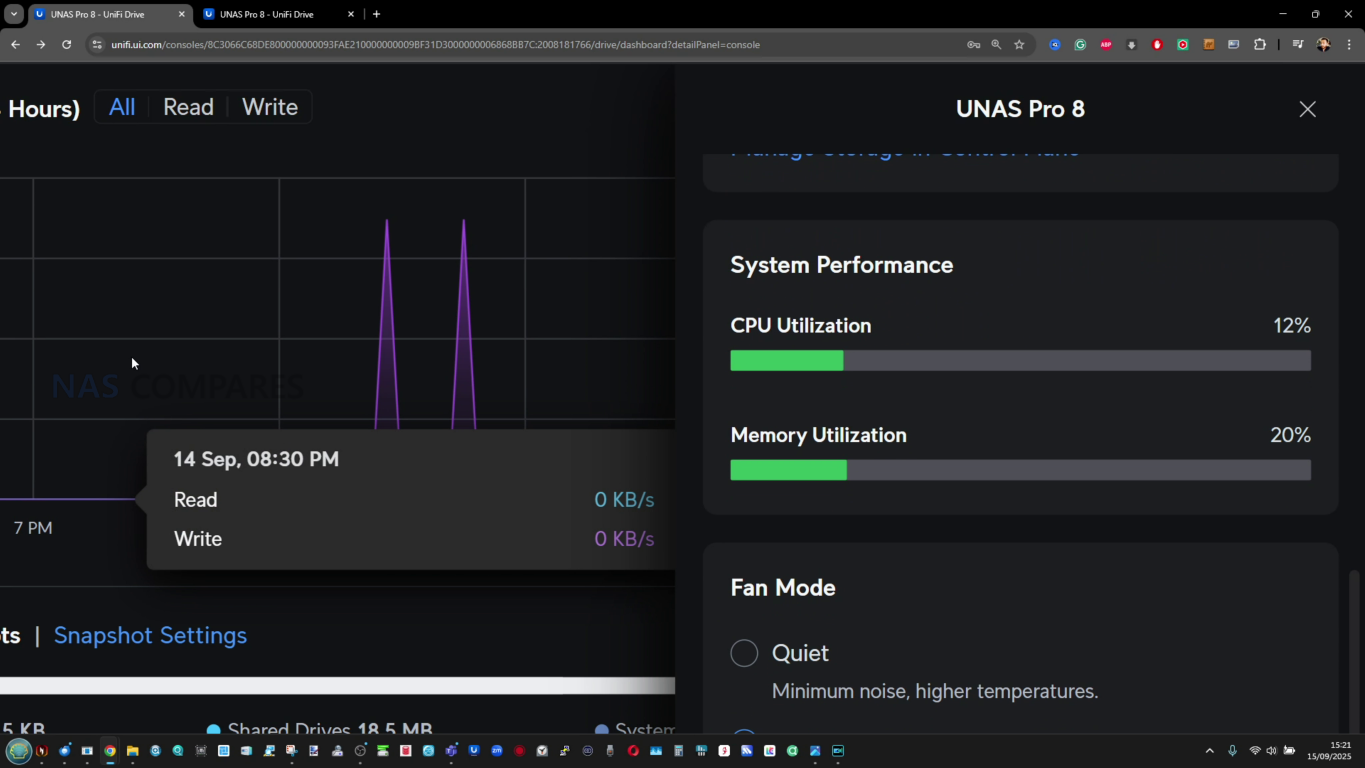
Environmental improvements include the long-requested fan control interface, which gives users the option to manually adjust fan speeds or keep automatic control active depending on temperature thresholds. The addition of real-time thermal monitoring, more accurate CPU and drive temperature reporting, and improved resource graphs now make it easier to track system health. The Drive 3.3 release also introduced a refined GUI with more responsive dashboard elements, consistent data updates in the system console, and a correction to the long-standing uptime reporting bug that falsely displayed “20,000 days active.”

Area of Improvement Previous Limitation Current Status / Fix Impact
File Handling (SMB vs GUI) Files deleted via GUI not matching SMB state Unified file operations between interfaces Consistent data management
Memory & Transfer Errors Large SMB jobs skipped files, memory overflow Memory optimization and error logging fixes Improved reliability in large transfers
Admin Backup Control Admins could not manage user-level backups Centralized backup control added Easier global administration
Thermal & Fan Controls No manual fan speed control Manual and auto fan profiles integrated Better system cooling management
Temperature Accuracy Inconsistent CPU and drive readings Updated sensors and calibration More reliable thermal data
GUI Responsiveness Lag when creating shares or users Streamlined front-end caching Faster configuration changes
Uptime Reporting Displayed exaggerated uptime values Corrected uptime counter logic Accurate monitoring metrics
System Logs Limited data visibility Extended log detail for transfers and RAID rebuilds Clearer diagnostic insights


Missing Features and Planned Features in UniFi UNAS in the Next 12 Months

Despite significant progress since the launch of the original UNAS Pro, several key features are still missing from the UniFi Drive OS ecosystem. The most frequently requested addition from users continues to be iSCSI target and initiator support, a capability that would allow direct block-level storage mapping for virtual machines and professional applications. Its absence limits the UNAS series to traditional network file protocols such as SMB and NFS, which are less efficient for tasks requiring raw storage access or integration with virtualization platforms. Equally, the continued lack of RAID 0 support restricts high-performance users who are willing to trade redundancy for speed. While RAID 6 and clustered pools have been introduced, there is still no configuration option that prioritizes sequential throughput over redundancy. Another omission is a native UniFi Drive client tool for Windows, macOS, or Linux that would allow direct desktop synchronization, local file pinning, and on-demand streaming similar to Synology Drive or Dropbox. At present, users must rely on the web interface or manually mapped drives, which limits productivity and offline access.

Looking forward, UniFi has hinted through developer notes and recent firmware structure that the ENAS (Enterprise NAS) line will introduce ZFS file system support, marking a major shift toward high-end storage with data integrity and snapshot efficiency beyond Btrfs. This aligns with the observed trend of UniFi testing ZFS integration within their enterprise roadmap, possibly extending limited functionality to future revisions of the Pro 4 and Pro 8. The upcoming UniFi Drive 3.3 and 3.4 updates are also expected to expand fan and power scheduling, allowing users to define specific system on/off cycles and control Ethernet port activation schedules, effectively creating customizable air-gap routines. Additionally, UniFi’s roadmap includes exploring expansion connectivity, potentially leveraging unused 10GbE interfaces for network-based expansion enclosures or storage clustering between UNAS units. This would mirror the high-availability (HA) or expansion behavior of established NAS brands, though implemented entirely over the UniFi network layer.

UniFi is also expected to refine NVMe handling, particularly the ability to use installed M.2 drives as standalone storage pools rather than just as cache devices. The introduction of pool-level tiering and dynamic storage balancing could allow users to automatically assign workloads between SSD and HDD pools, improving I/O efficiency without manual adjustment. Beyond hardware-level improvements, there is ongoing demand for the integration of UniFi Protect within the NAS family, allowing video surveillance to run on the same physical storage units rather than on separate NVRs. Although UniFi has historically separated its Protect and Drive ecosystems, internal hardware similarities between the UNAS Pro and UNVR Pro systems suggest eventual compatibility is possible. Finally, more advanced backup filters, bandwidth scheduling, and automated snapshot policies are likely to appear in the next major OS iteration as part of UniFi’s effort to close the gap with traditional NAS brands while maintaining its minimalist network-first design approach.

Feature / Function Current Status Planned / Proposed Update Expected Benefit
iSCSI Support Not available Under evaluation for enterprise roadmap Block-level access for VMs and servers
RAID 0 Unsupported Potential inclusion in Drive 3.4+ High-speed sequential workloads
UniFi Drive Client App Not available Planned for 2026 Desktop sync and offline access
ZFS File System (ENAS) In development Expected on ENAS and future Pro models Greater data integrity and snapshot efficiency
Fan & Power Scheduling Manual control only Scheduled automation (Drive 3.3+) Energy savings, thermal management
10GbE Expansion Support Not implemented Proposed network-based expansion option Scale-out storage via UniFi network
NVMe as Storage Pool Cache-only Drive 3.4+ feature under testing SSD-only pools and tiering
UniFi Protect Integration Not supported Possible future overlap Unified surveillance and storage system
Backup Filters & Scheduling Basic inclusion/exclusion Enhanced filters and timed backups Greater control and efficiency

Conclusion and Verdict – Is the UniFi UNAS Good Now?

One year after the launch of the original UniFi UNAS Pro, the UniFi NAS platform has evolved from a single experimental product into a diversified ecosystem that spans both desktop and rackmount storage. The introduction of the UNAS 2, UNAS 4, UNAS Pro 4, and UNAS Pro 8 demonstrates that Ubiquiti is committed to building a scalable product range capable of serving both home users and small business environments. On the software side, the development of UniFi Drive OS has been steady and deliberate, with a focus on improving reliability, expanding RAID options, and tightening cloud and local backup integration. These changes, combined with improved temperature management, admin-level control, and performance tuning for SMB and NFS, have resulted in a more mature and dependable NAS experience than the early versions from 2024. However, the range remains deliberately streamlined, prioritizing simplicity and ecosystem integration over third-party app support or virtualization features.

Looking ahead, the next phase of the UniFi NAS roadmap appears to focus on deeper enterprise integration and feature parity with long-standing NAS brands. The likely addition of iSCSI, ZFS, and network-based expansion options will determine how far UniFi can move beyond entry and mid-range use cases. The hardware continues to rely on ARM processors rather than x86, which reinforces UniFi’s focus on efficiency and security but limits advanced workloads such as containerization and VM hosting. Even so, the value proposition remains strong, particularly given the aggressive pricing across the entire UNAS range and its seamless compatibility with the existing UniFi infrastructure. Overall, UniFi’s NAS systems are no longer a novelty—they represent a serious and rapidly developing branch of the company’s portfolio that has gained stability, utility, and confidence within just one year.

You can buy the UniFi UNAS Pro 8 NAS via the link below – doing so will result in a small commission coming to me and Eddie at NASCompares, and allows us to keep doing what we do! 

Here are all the current UniFi NAS Solutions & Prices:
  • UniFi UNAS 2 (2 Bay, $199) – HERE
  • UniFi UNAS 4  (4 Bay + 2x M2, $379) – HERE
  • UniFi UNAS Pro 4 (4 Bay + 2x M.2, $499) – HERE
  • UniFi UNAS Pro (7 Bay, $499) – HERE
  • UniFi UNAS Pro 8 (8-Bay + 2x M.2, $799) HERE


📧 SUBSCRIBE TO OUR NEWSLETTER 🔔
[contact-form-7]
🔒 Join Inner Circle

Get an alert every time something gets added to this specific article!


Want to follow specific category? 📧 Subscribe

This description contains links to Amazon. These links will take you to some of the products mentioned in today's content. As an Amazon Associate, I earn from qualifying purchases. Visit the NASCompares Deal Finder to find the best place to buy this device in your region, based on Service, Support and Reputation - Just Search for your NAS Drive in the Box Below

Need Advice on Data Storage from an Expert?

Finally, for free advice about your setup, just leave a message in the comments below here at NASCompares.com and we will get back to you. Need Help? Where possible (and where appropriate) please provide as much information about your requirements, as then I can arrange the best answer and solution to your needs. Do not worry about your e-mail address being required, it will NOT be used in a mailing list and will NOT be used in any way other than to respond to your enquiry. [contact-form-7] TRY CHAT Terms and Conditions
If you like this service, please consider supporting us. We use affiliate links on the blog allowing NAScompares information and advice service to be free of charge to you.Anything you purchase on the day you click on our links will generate a small commission which isused to run the website. Here is a link for Amazon and B&H.You can also get me a ☕ Ko-fi or old school Paypal. Thanks!To find out more about how to support this advice service check HEREIf you need to fix or configure a NAS, check Fiver Have you thought about helping others with your knowledge? Find Instructions Here  

 
Or support us by using our affiliate links on Amazon UK and Amazon US
    
 
Alternatively, why not ask me on the ASK NASCompares forum, by clicking the button below. This is a community hub that serves as a place that I can answer your question, chew the fat, share new release information and even get corrections posted. I will always get around to answering ALL queries, but as a one-man operation, I cannot promise speed! So by sharing your query in the ASK NASCompares section below, you can get a better range of solutions and suggestions, alongside my own.

☕ WE LOVE COFFEE ☕

 
❌