Vue lecture

Il y a de nouveaux articles disponibles, cliquez pour rafraîchir la page.

Gl.iNet Beryl 7 Travel Router GL-MT3600BE Review

Gl.iNet Beryl 7 Review – Best Budget WiFi 7 Travel Router

The Beryl 7 (GL-MT3600BE) is a compact dual band Wi Fi 7 travel router developed by GL.iNet as the successor to the Beryl AX (GL-MT3000), positioned as a mid range portable networking solution that introduces Wi Fi 7 support, dual 2.5GbE ports, and substantially higher VPN throughput while remaining priced at 139.99 dollars. Unlike traditional home routers designed for fixed installations and wide coverage, the Beryl 7 is intended for temporary and mobile deployments such as hotel rooms, shared offices, dorm setups, and remote work environments where portability and flexibility are priorities. Within the travel router segment, the Beryl series has focused on balancing price, control, and performance, and this model shifts further toward higher throughput networking, particularly in wired connectivity and encrypted traffic handling. With advertised VPN speeds of up to 1100Mbps via WireGuard and 1000Mbps via OpenVPN DCO, it exceeds many similarly sized travel routers that remain limited to 1GbE and lower VPN acceleration, yet it does not attempt to compete with higher cost tri band Wi Fi 7 devices that include 6GHz radios. Instead, it sits between entry-level Wi-Fi 6 travel routers and more expensive portable options such as the Slate 7, offering newer wireless standards without entering premium desktop router pricing from brands like Netgear or ASUS. Although branded as Wi Fi 7, it operates on 2.4GHz and 5GHz only, without 6GHz support, limiting full spectrum capability but still enabling features such as Multi Link Operation across its two bands. The device is aimed at technically aware users and frequent travelers who require advanced routing controls, VPN flexibility, and OpenWrt-based customisation in a compact chassis measuring 120 x 83 x 34mm and weighing 205g, modernizing the travel router category without moving into high end pricing tiers.

Category Specification
Model GL-MT3600BE
Wi Fi Standard IEEE 802.11a/b/g/n/ac/ax/be
Wi Fi Speed 688Mbps (2.4GHz) + 2882Mbps (5GHz)
Ethernet Ports 1 x 2.5GbE WAN, 1 x 2.5GbE LAN
USB 1 x USB 3.0
CPU MediaTek Quad core @2.0GHz
Memory 512MB DDR4
Storage 512MB NAND Flash
VPN Speed Up to 1100Mbps WireGuard, 1000Mbps OpenVPN DCO
Power Input USB C (5V/3A, 9V/3A, 12V/2.5A)
Dimensions 120 x 83 x 34mm
Weight 205g

Gl.iNet Beryl 7 Review – Quick Conclusion

The Beryl 7 (GL-MT3600BE) is a compact dual band Wi Fi 7 travel router from GL.iNet that builds on the Beryl AX by adding dual 2.5GbE ports, a quad core 2.0GHz MediaTek CPU, 512MB DDR4 memory, 512MB flash storage, and substantially higher VPN throughput of up to 1100Mbps via WireGuard and 1000Mbps via OpenVPN DCO, while maintaining a portable near pocket sized scale and just 205g in weight. It supports Wi Fi 7 features such as Multi Link Operation across 2.4GHz and 5GHz, but omits 6GHz and 320MHz channel width, limiting full spectrum Wi Fi 7 capability. Design priorities include silent passive cooling, foldable antennas, minimal LEDs, and a programmable hardware toggle for VPN control, alongside flexible connectivity through wired WAN, LAN, repeater mode, and USB tethering with automatic failover. Boot time is approximately 51 seconds, captive portal access is typically achieved in around 35 seconds, power draw ranges from roughly 3.7W to 6.7W depending on load, and thermals remain stable under sustained use. The OpenWrt based firmware provides both simplified management and full LuCI access, plus an app ecosystem and GoodCloud remote management, though USB storage performance remains limited to around 50MB/s to 70MB/s and only a single USB port is available. Positioned between entry level Wi Fi 6 travel routers and higher priced portable Wi Fi 7 models such as the Slate 7, it does not include integrated battery, SIM, or 6GHz support, but offers strong wired flexibility, fast VPN acceleration, and granular configuration control at 139.99 dollars, making it a technically capable and competitively placed option for travel and temporary network deployments.


SOFTWARE - 10/10
HARDWARE - 7/10
PERFORMANCE - 8/10
PRICE - 8/10
VALUE - 8/10


8.2
PROS
👍🏻Dual 2.5GbE WAN and LAN ports enable multi gig wired connectivity
👍🏻WireGuard performance up to 1100Mbps with strong OpenVPN DCO throughput
👍🏻Wi Fi 7 support with Multi Link Operation across 2.4GHz and 5GHz
👍🏻Compact 120 x 83 x 34mm chassis with 205g weight for travel deployment
👍🏻Low power consumption between ~3.7W and ~6.7W under typical loads
👍🏻Fast boot time of approximately 51 seconds from cold start
👍🏻Robust OpenWrt based firmware with full LuCI access and app ecosystem
👍🏻Multi WAN failover across wired, repeater, and USB tethering sources
CONS
👎🏻No 6GHz band support, limiting full Wi Fi 7 capability
👎🏻USB storage performance limited to approximately 50MB/s to 70MB/s
👎🏻Only 1 USB 3.0 port, restricting simultaneous tethering and storage use
👎🏻The MLO architecture is currently E-MLSR MLO (Enhanced Multi-Link Single Radio Operation Mode), which lacks the true aggregation of Sync MLMR (Synchronous Multi-Link Multi-Radio) MLO

Buy the Gl.iNet Beryl 7 from Amazon Below: Buy the Gl.iNet Beryl 7 from the Official Store Below:

Gl.iNet Beryl 7 Review – Design and Connectivity

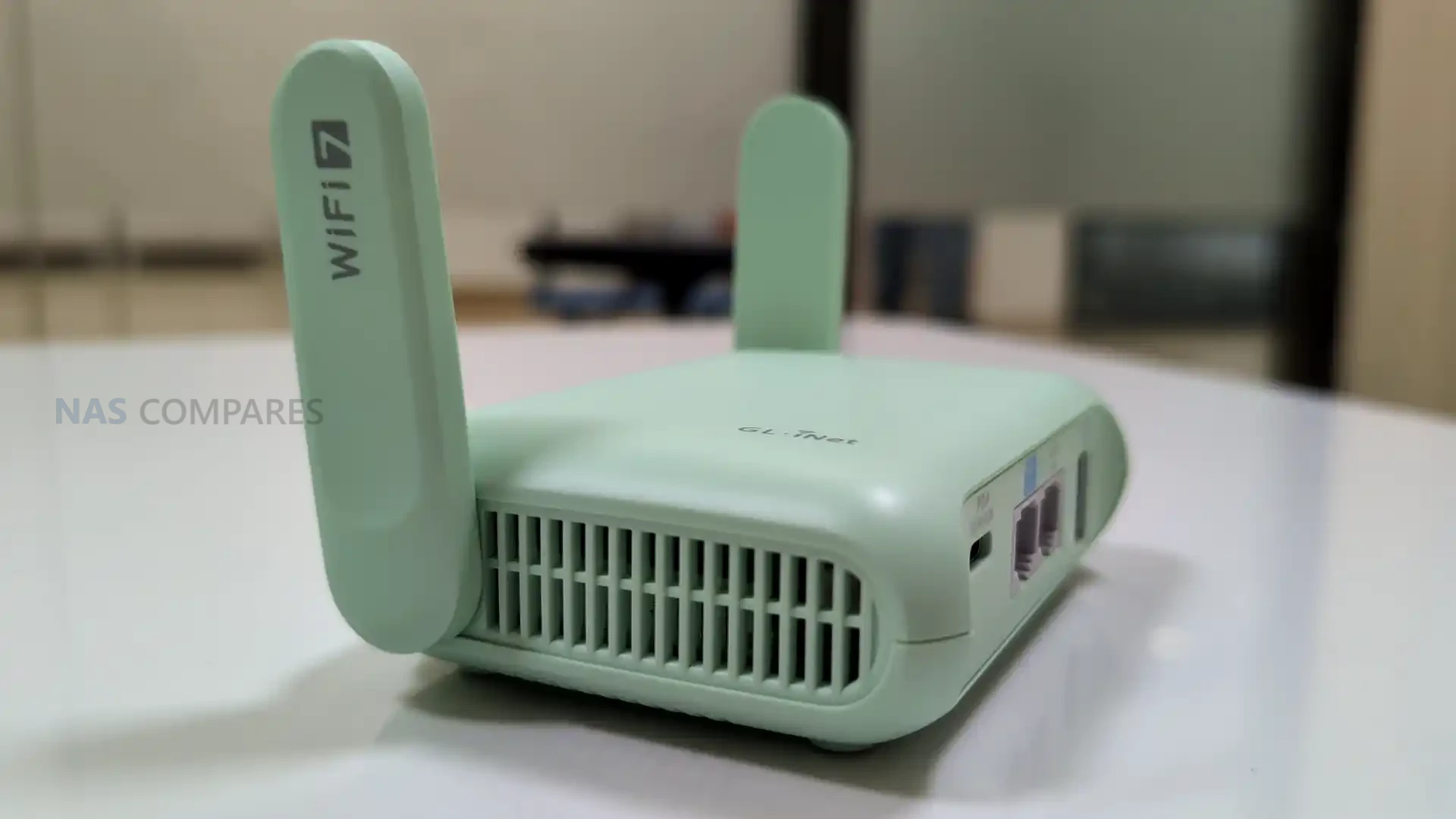
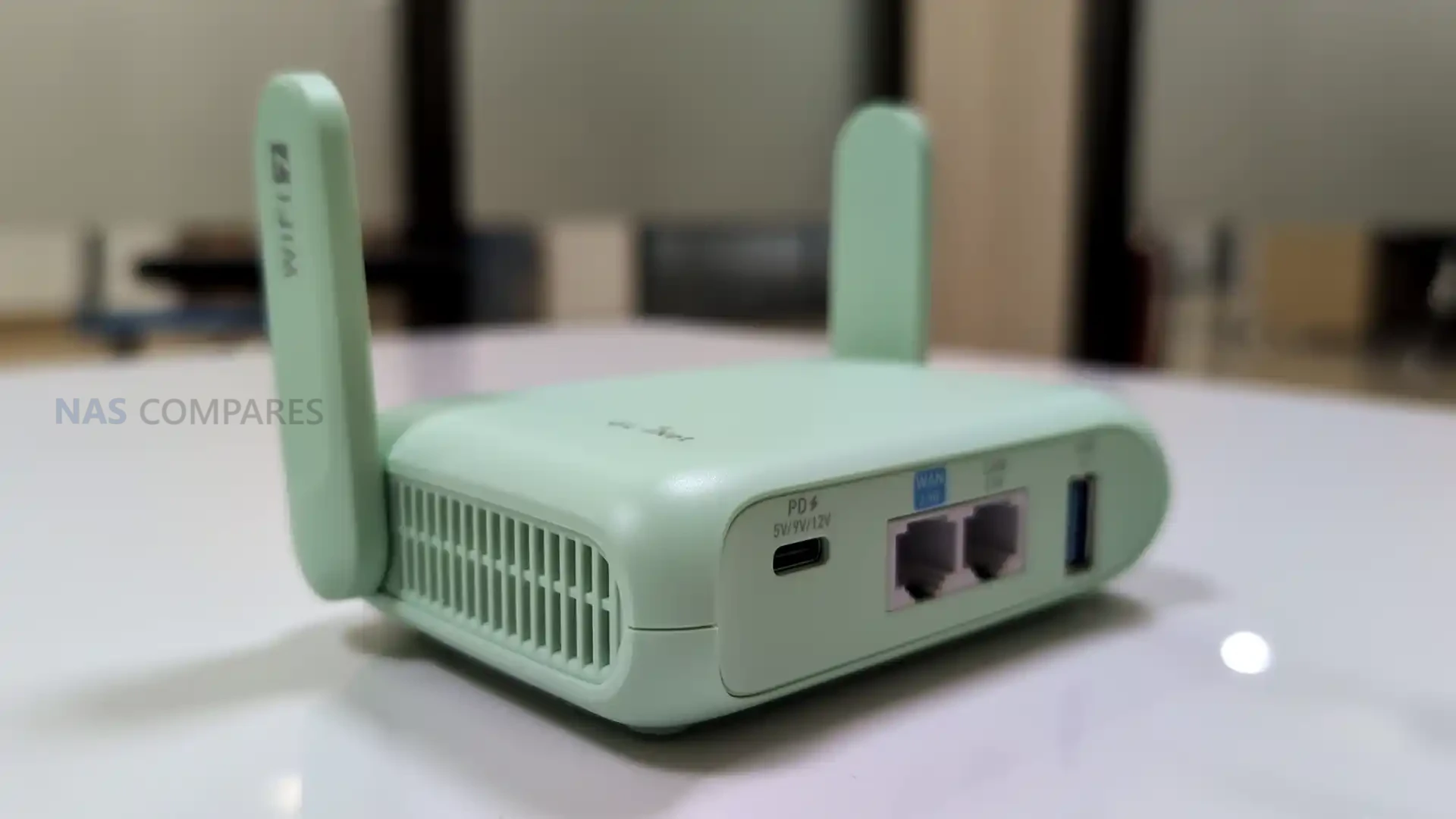
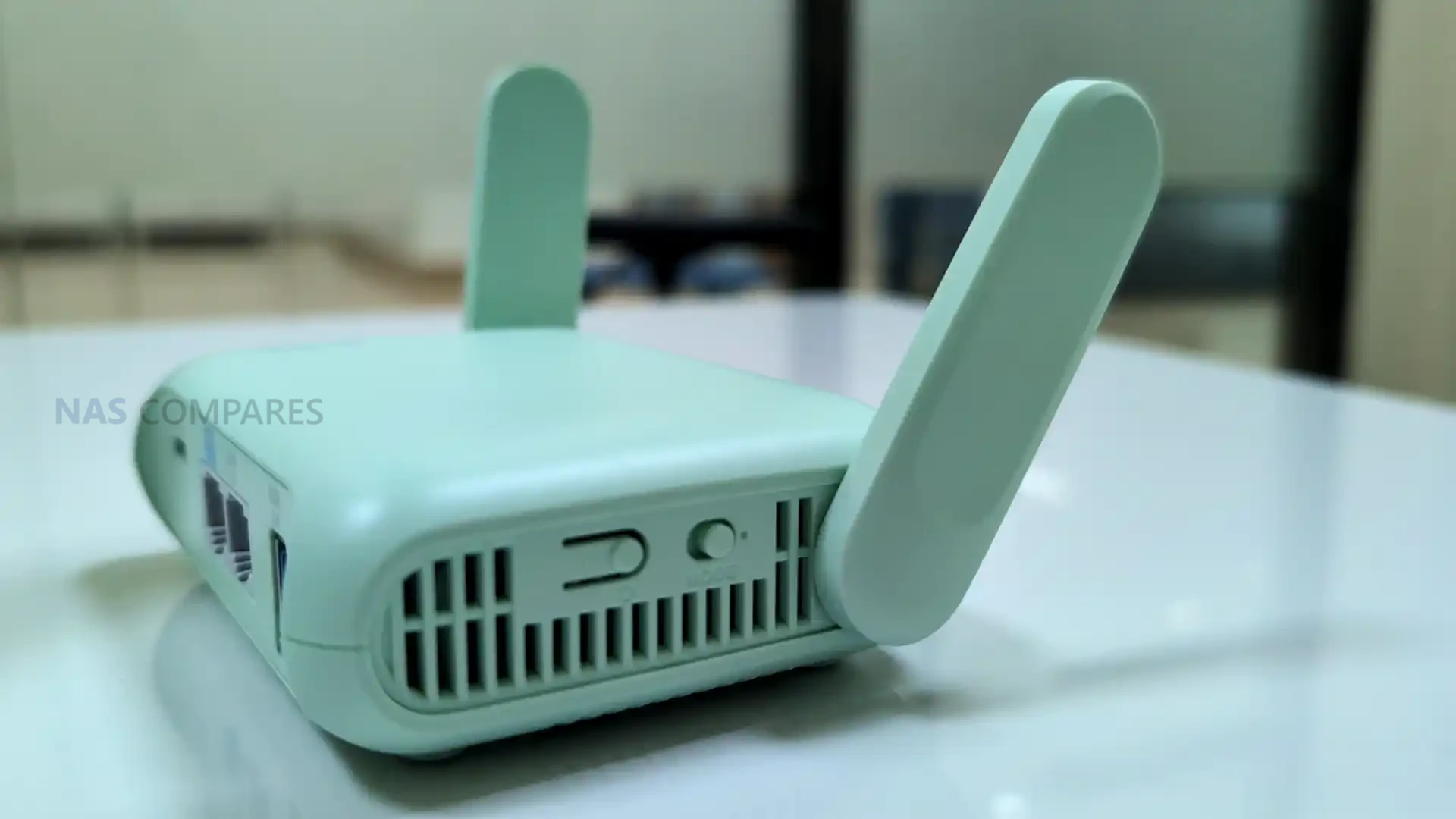
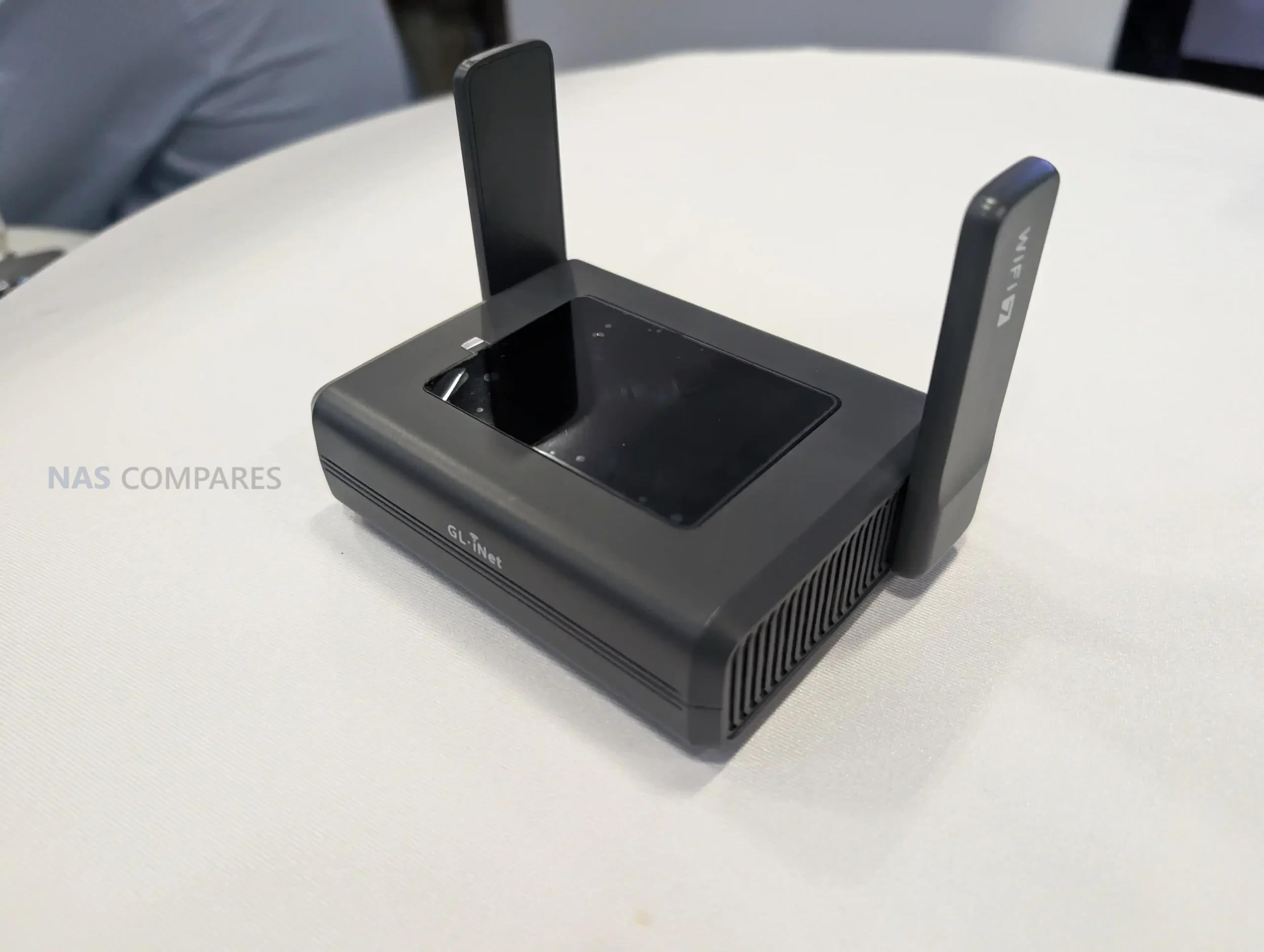
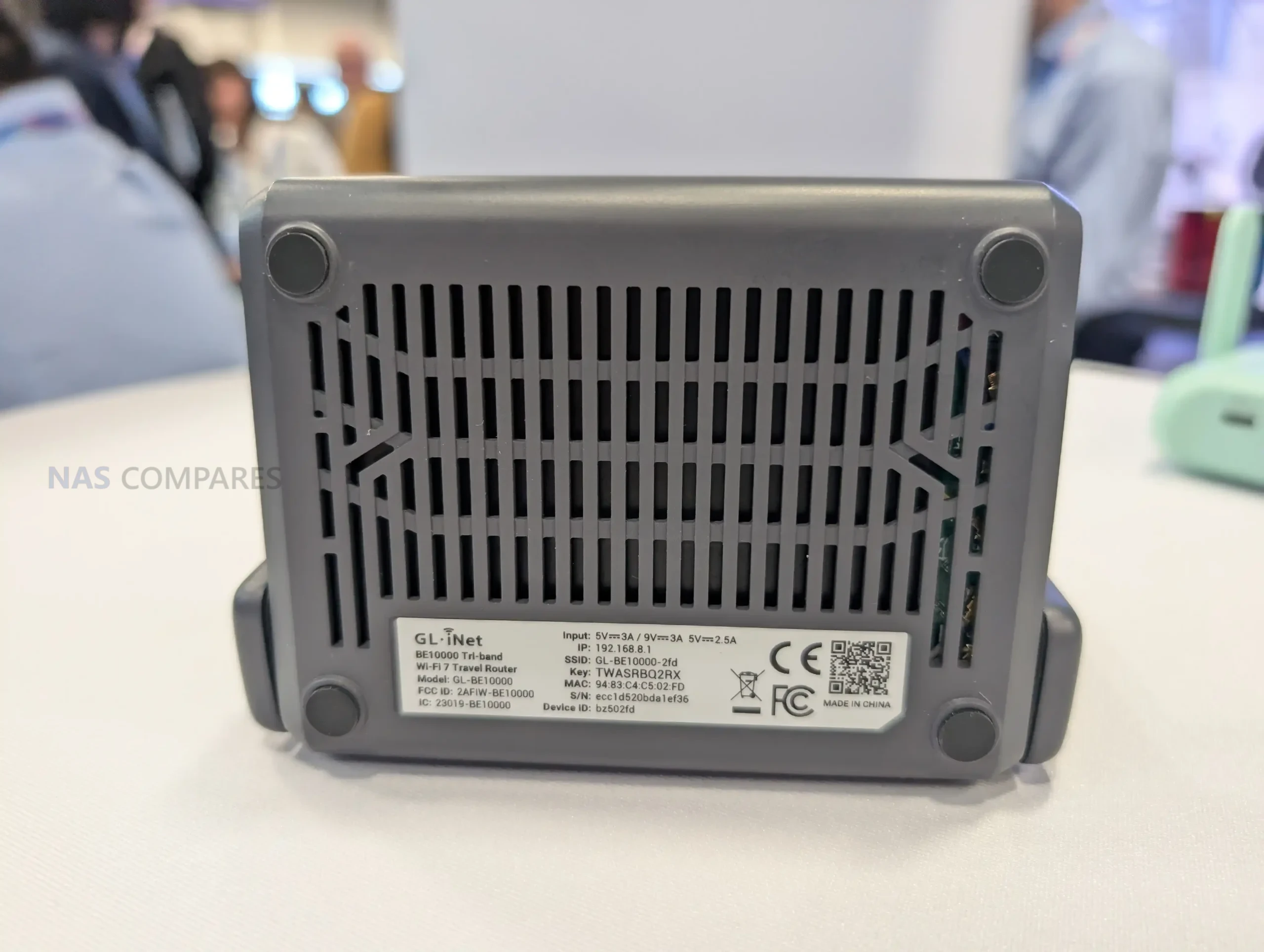
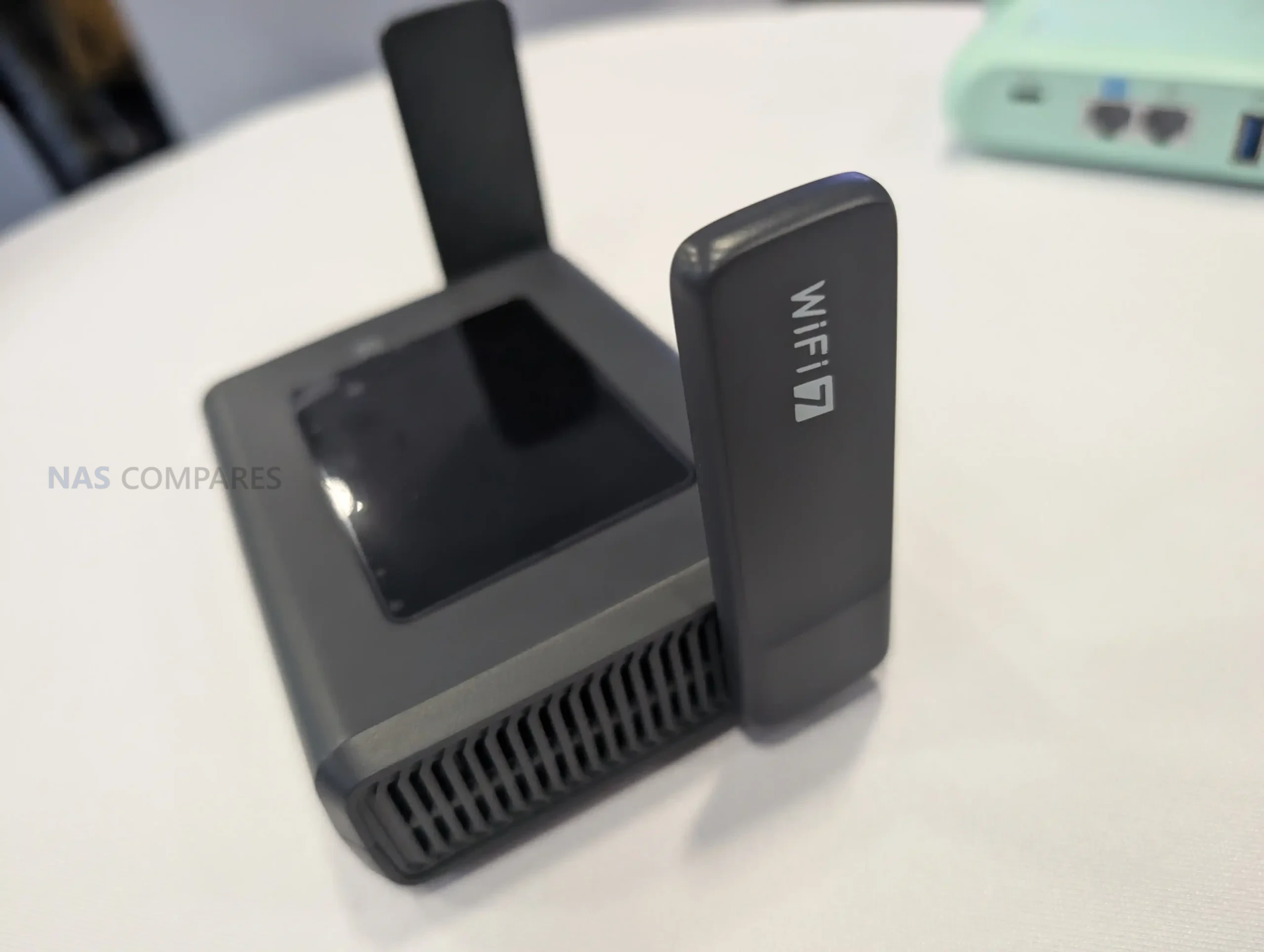
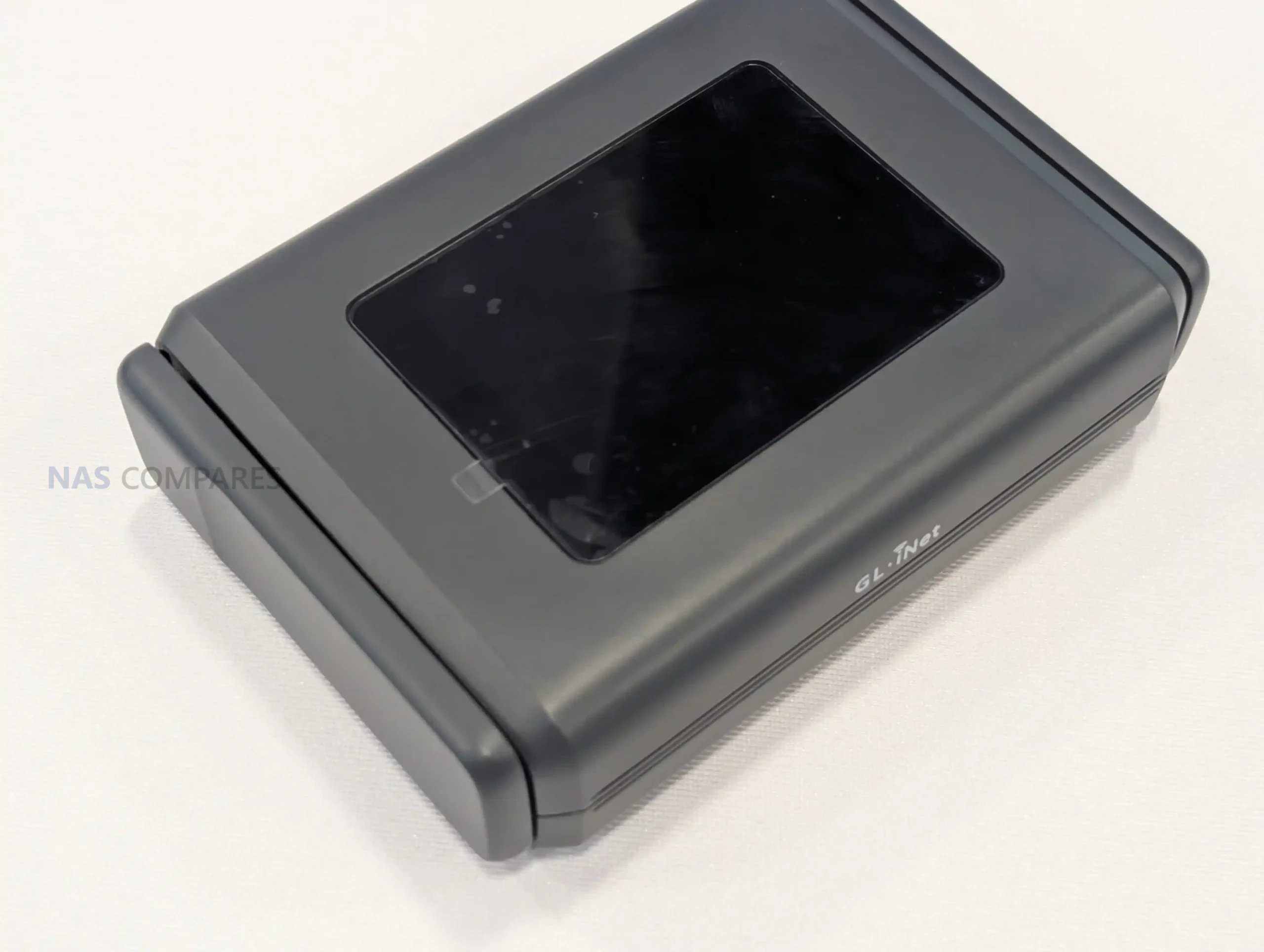
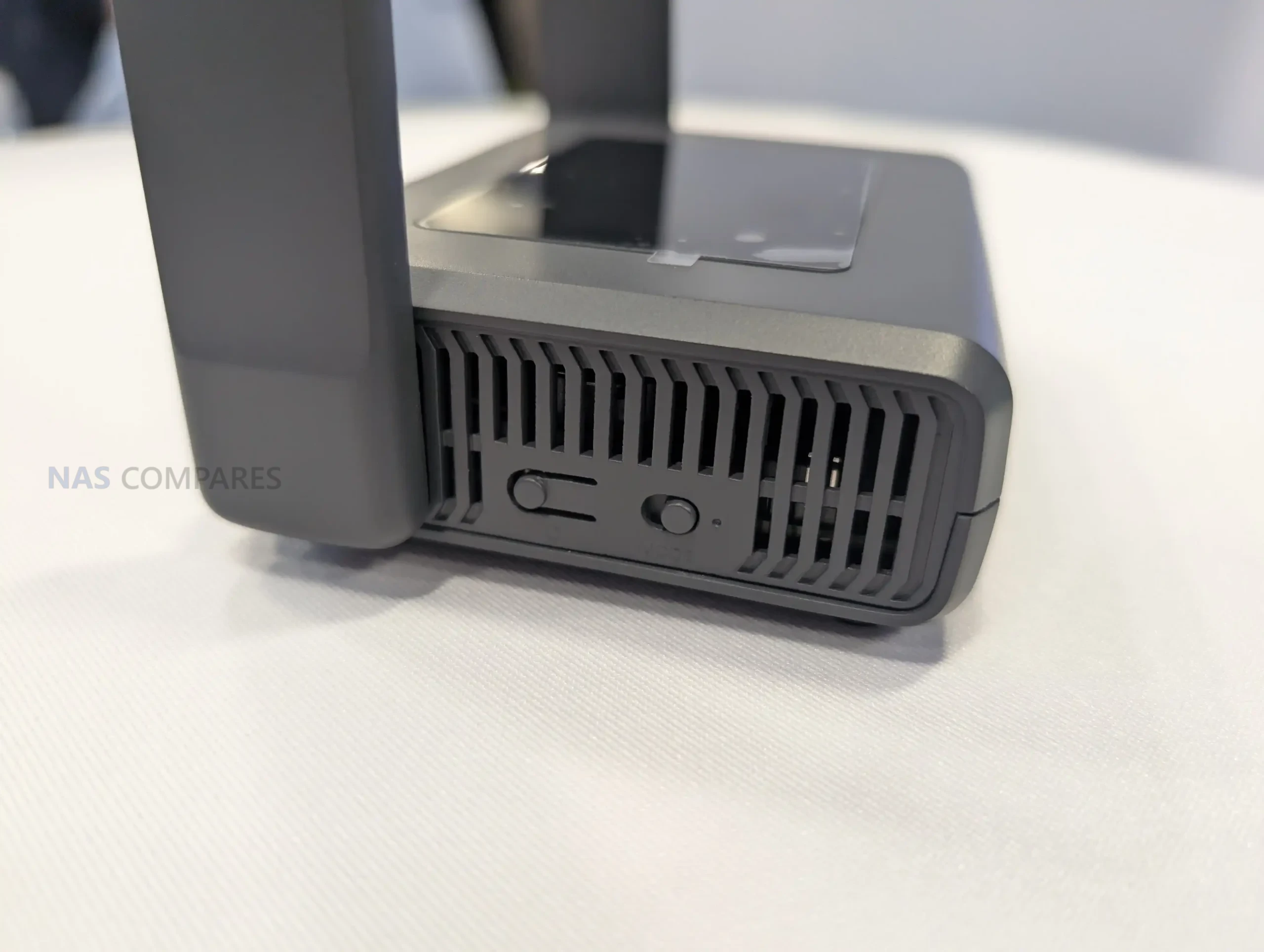
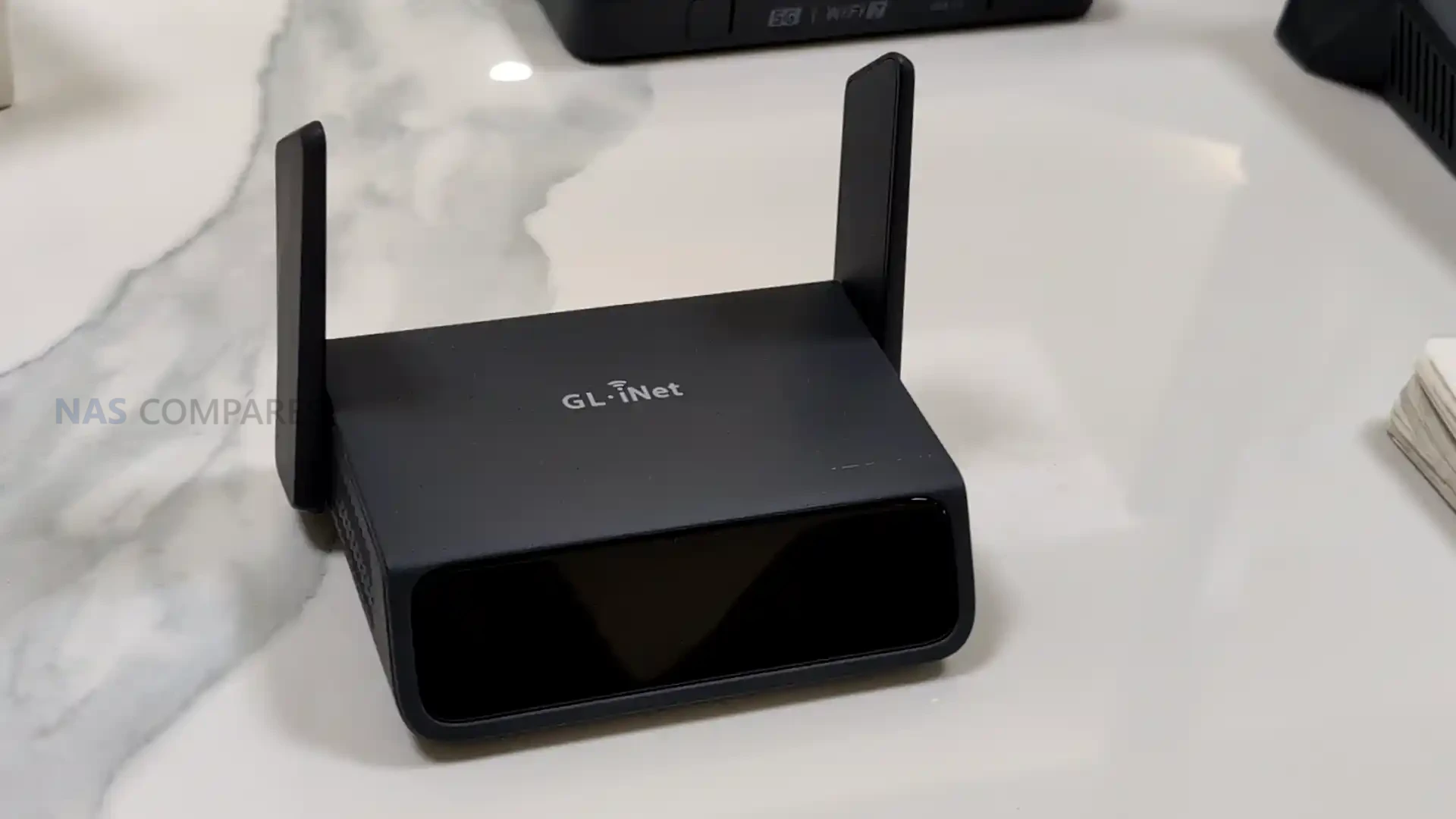
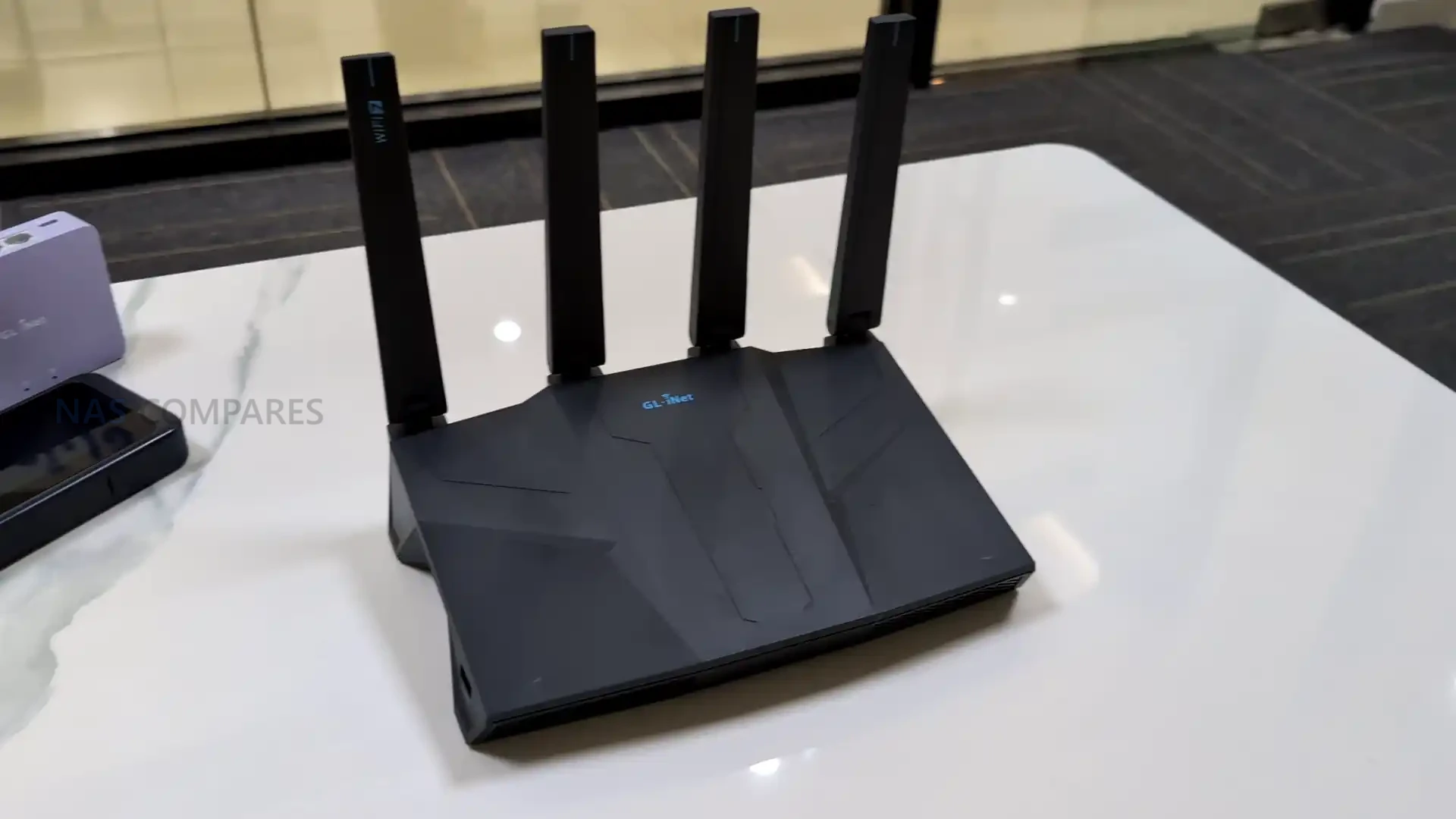
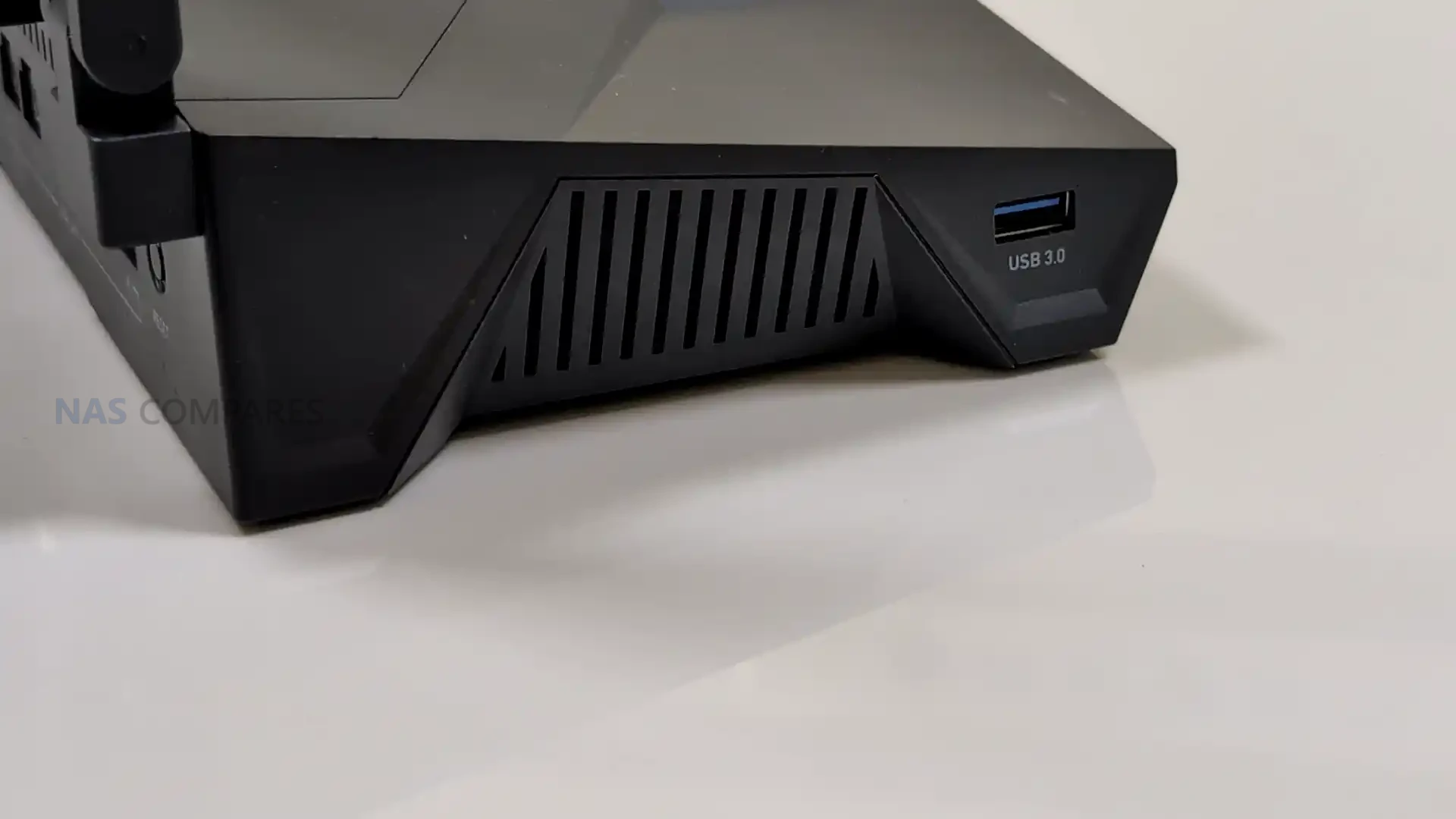
The Beryl 7 follows the compact design language established by earlier Beryl models, maintaining a footprint of 120 x 83 x 34mm and a weight of 205g. It is not pocket sized in the strictest sense, but it remains small enough to fit easily into hand luggage, a laptop bag, or a cable pouch. The chassis uses rounded edges rather than sharp corners, which makes it easier to handle and store alongside other equipment. Ventilation is distributed around the casing to support passive cooling, and there is no internal fan, meaning operation is silent under load.

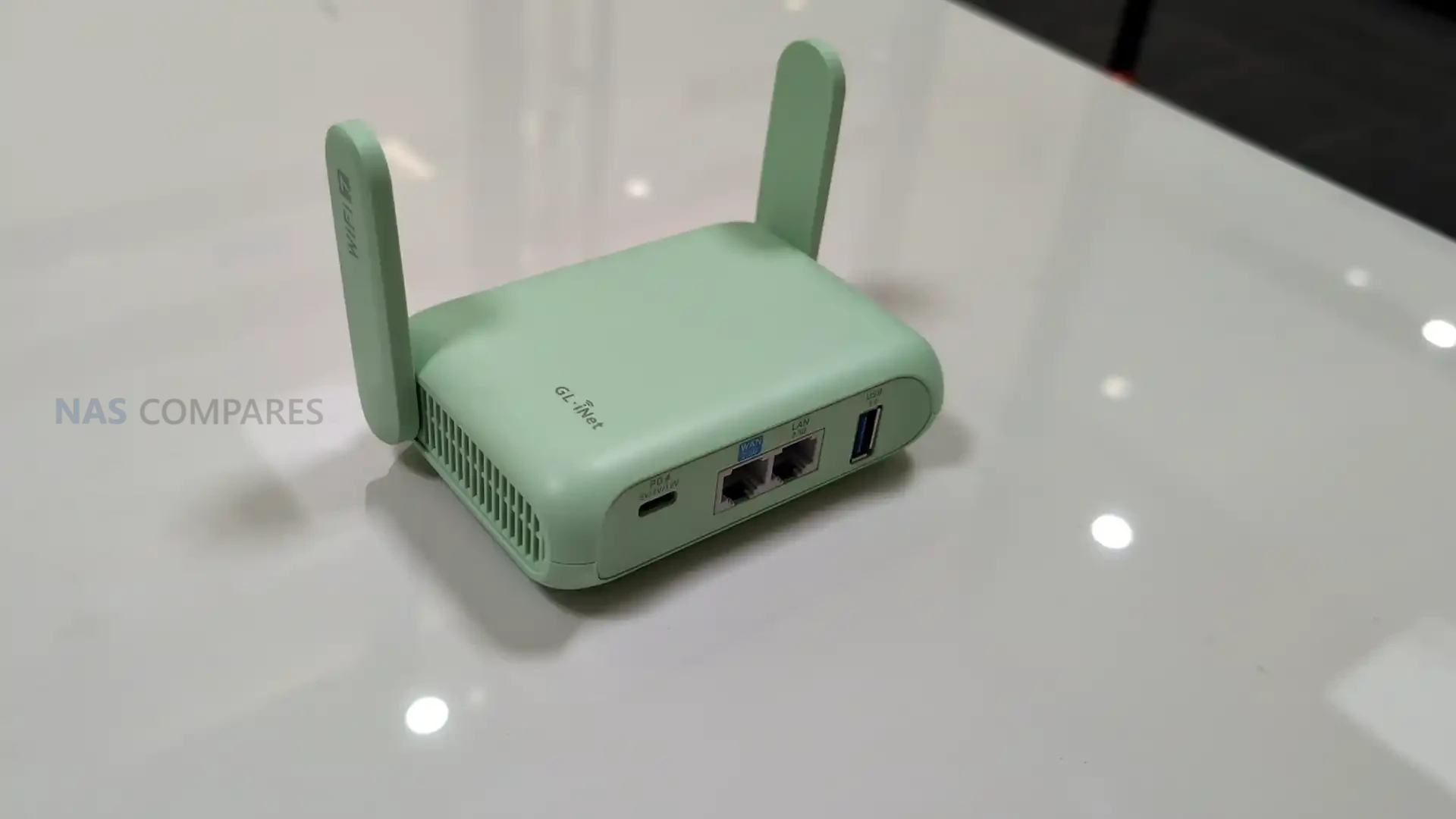
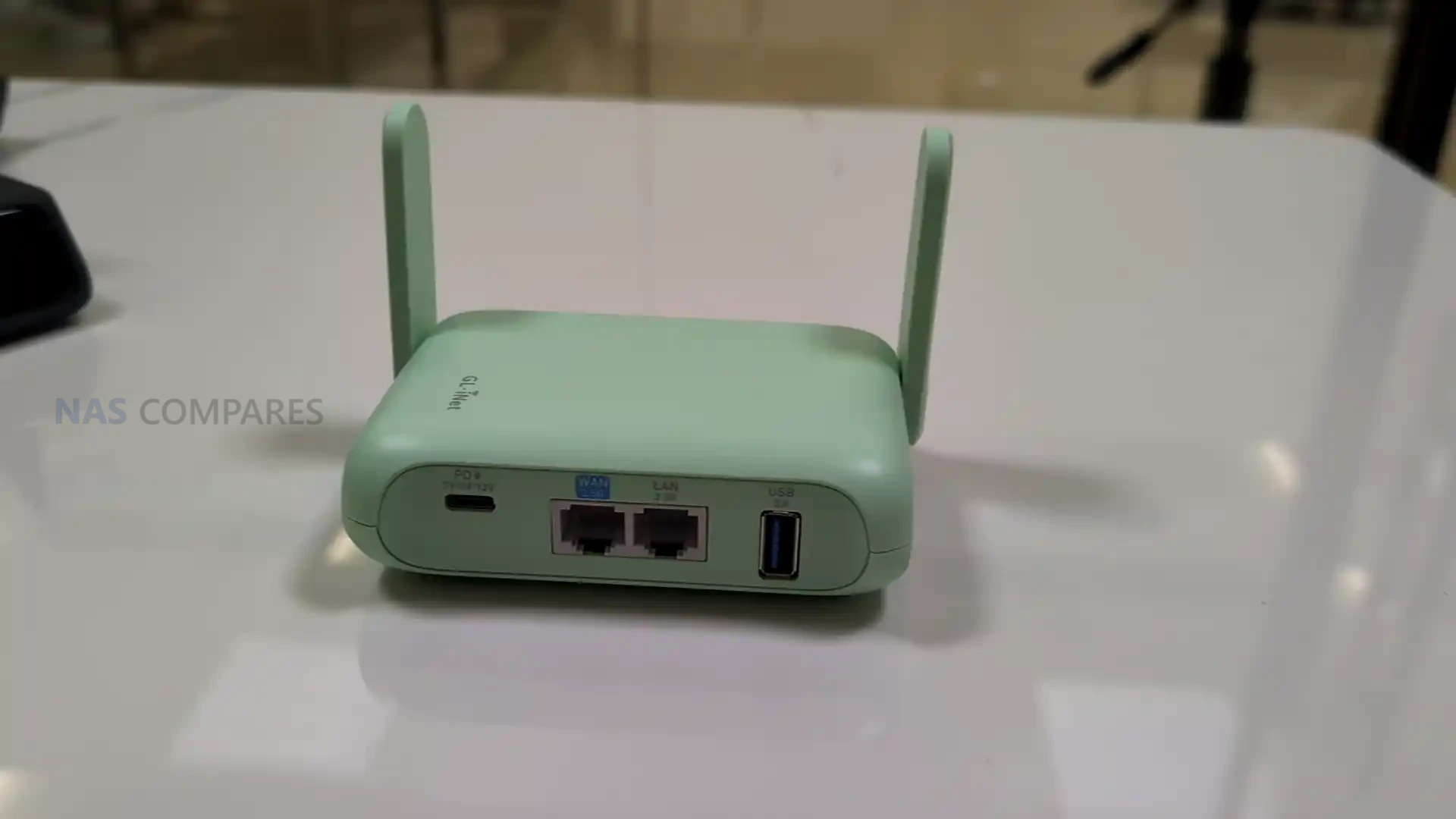
A distinguishing visual change compared to previous models is the mint green finish, which replaces the darker tones commonly associated with networking hardware. While aesthetic preference is subjective, the color makes the device visually distinct from most black or grey travel routers on the market. The overall construction feels rigid, and the dual external antennas are foldable and adjustable up to 180°, allowing users to reposition them depending on orientation and signal direction.

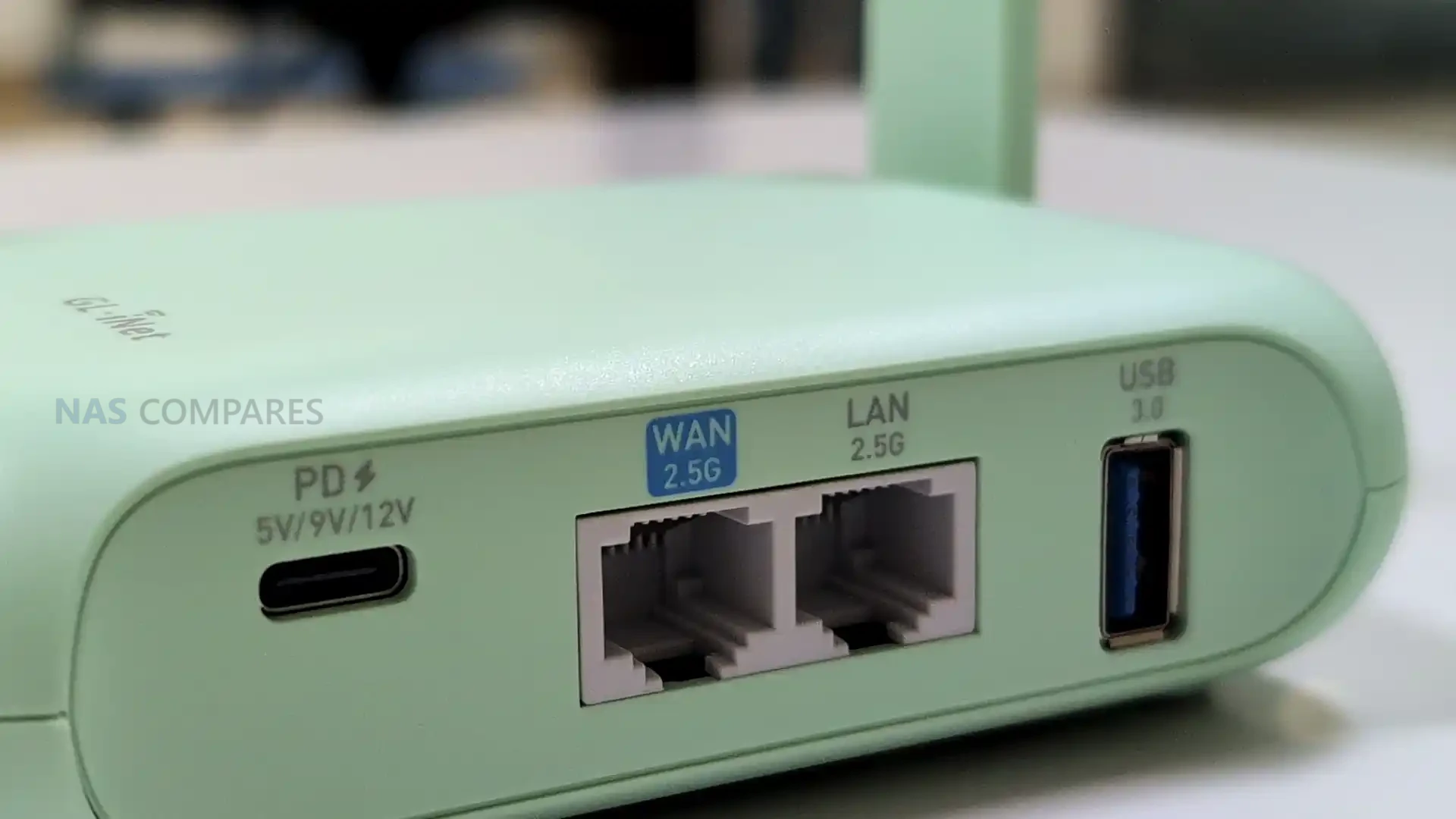
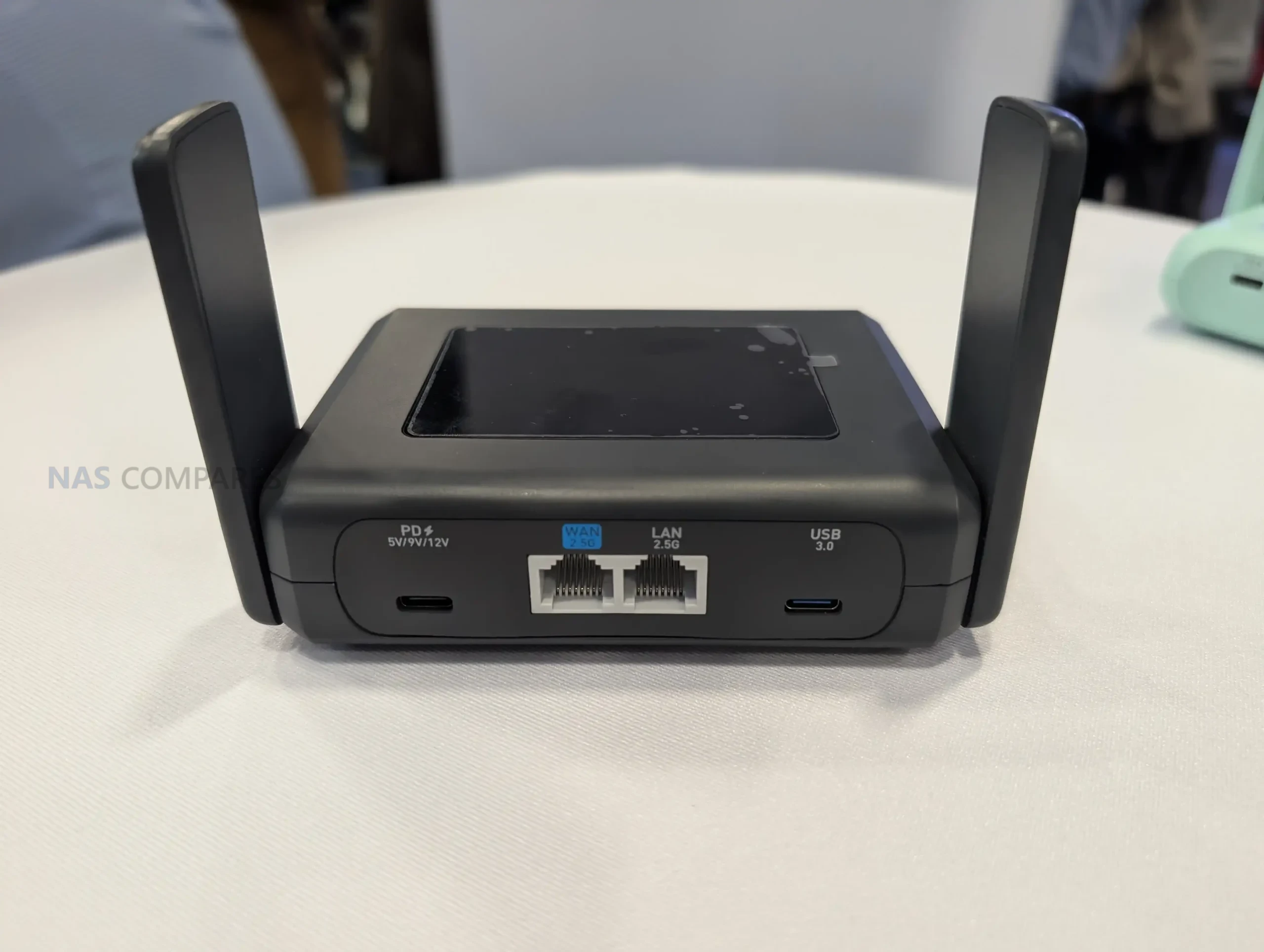
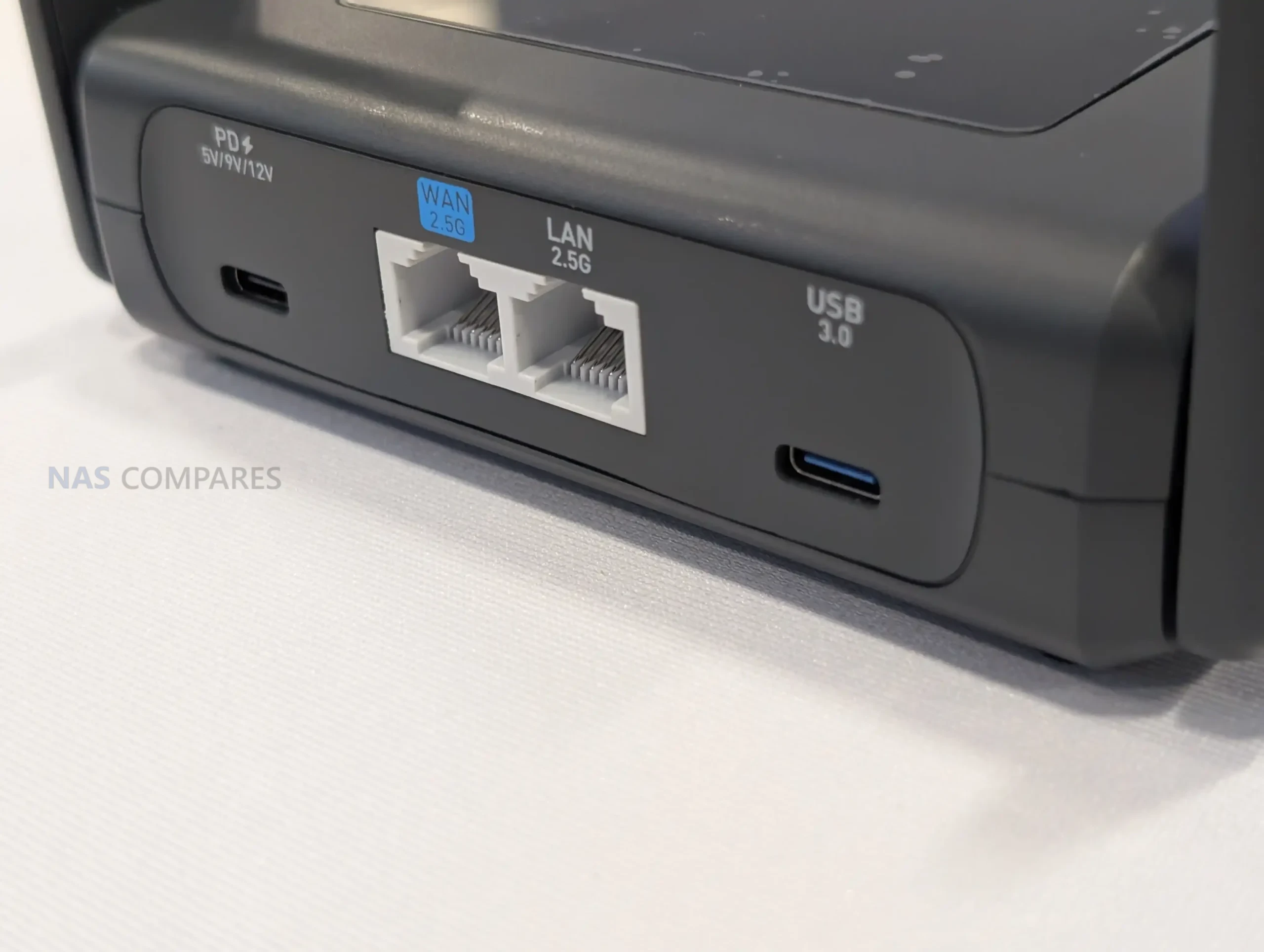
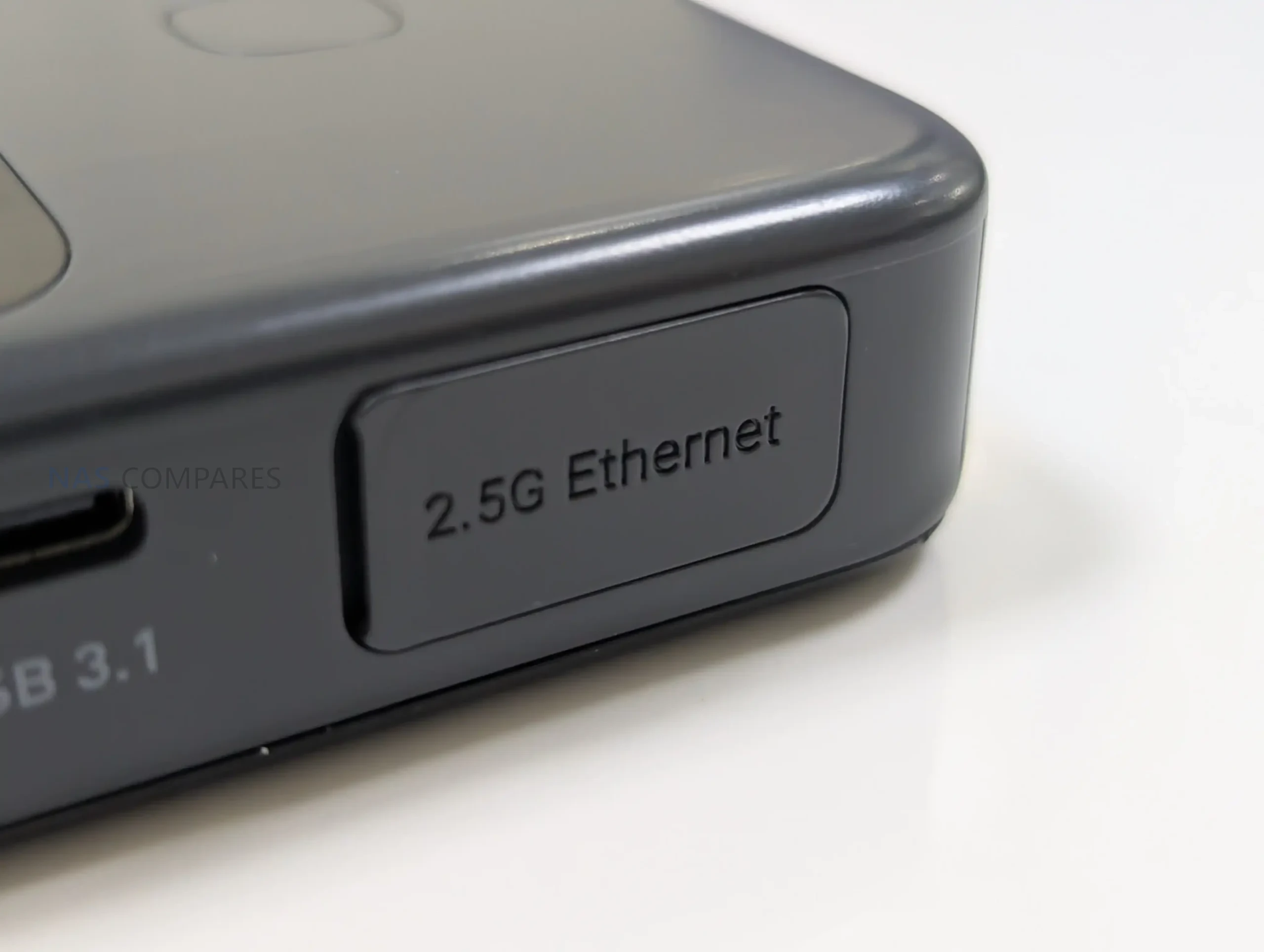
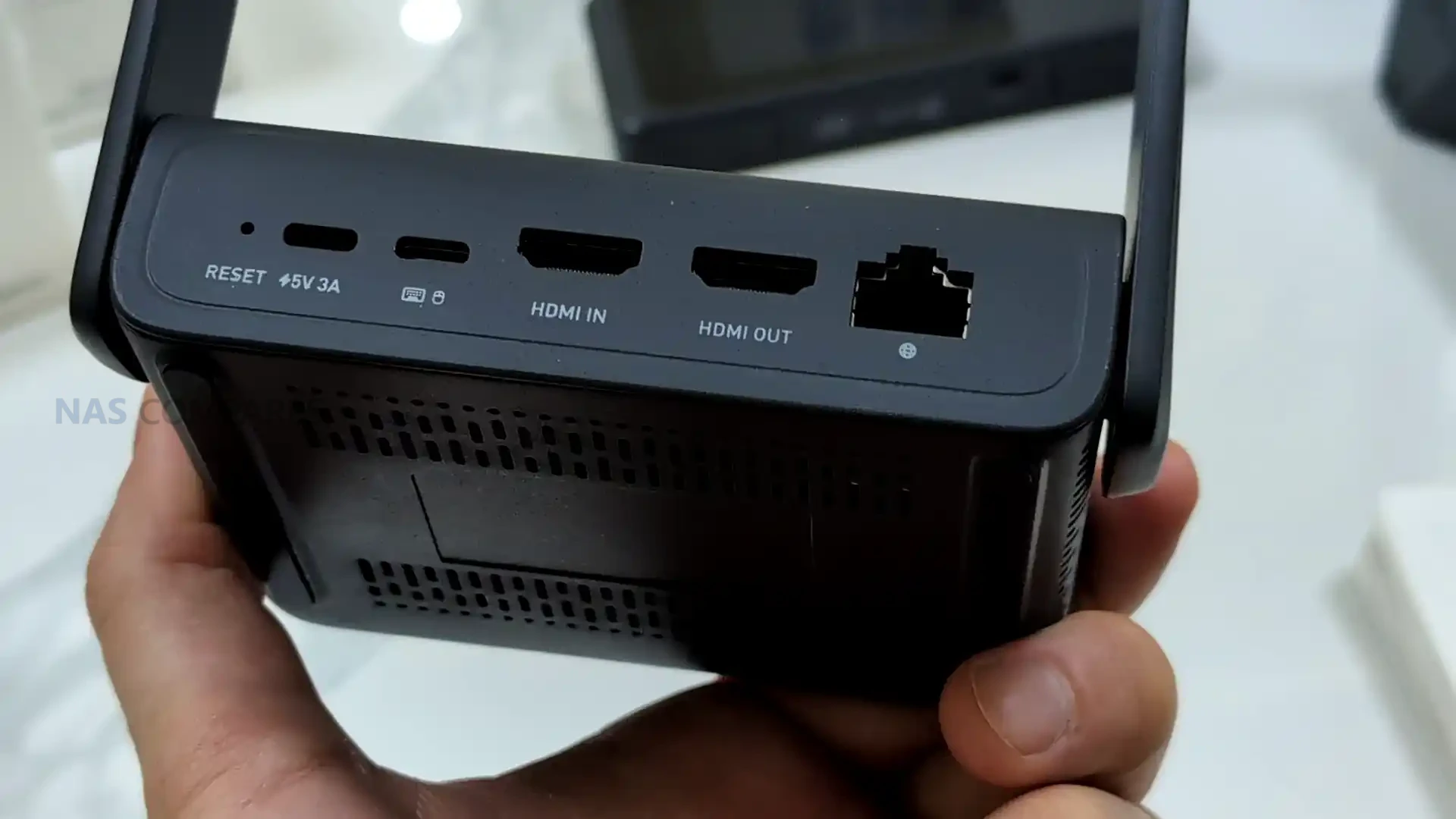
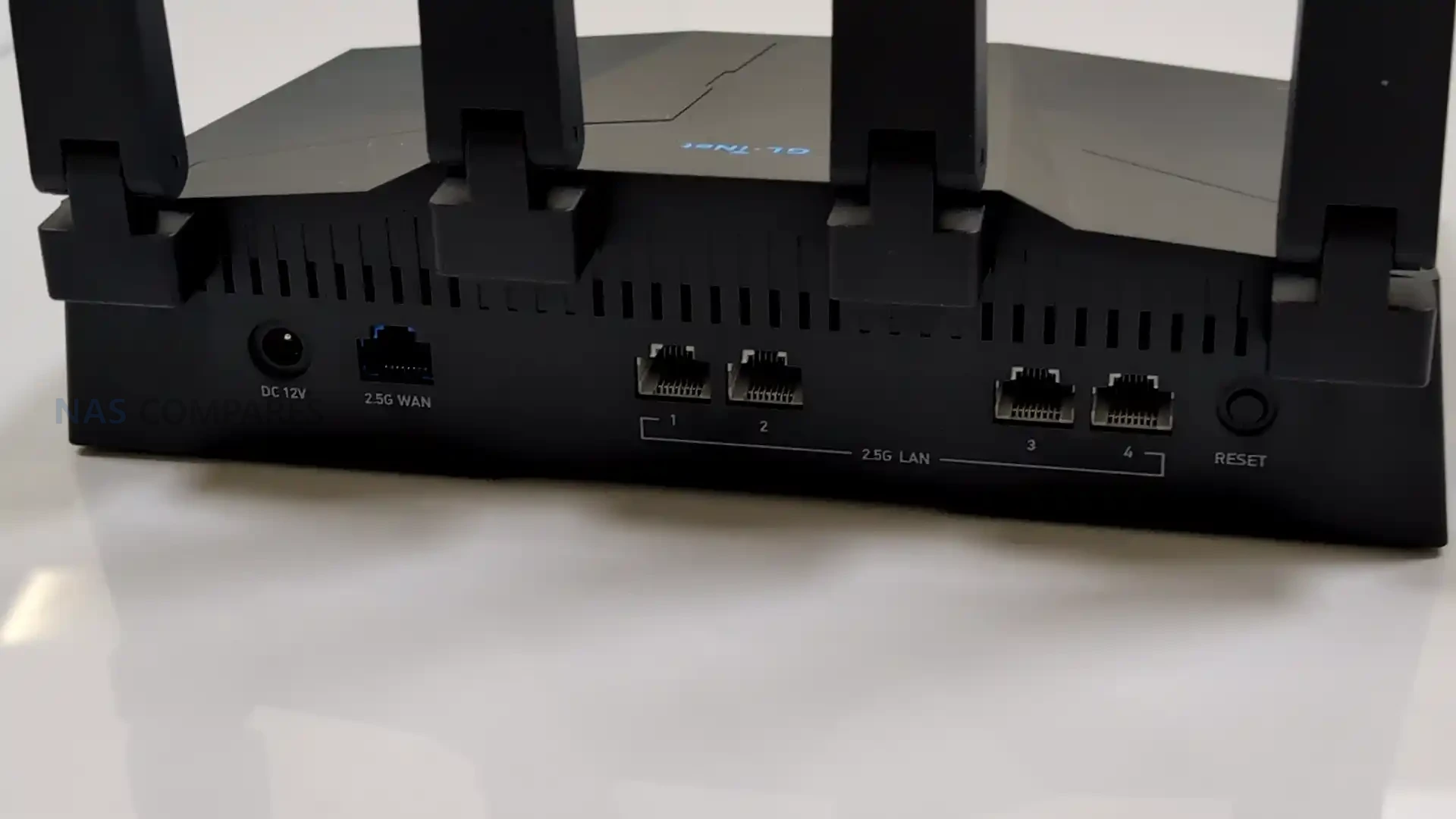
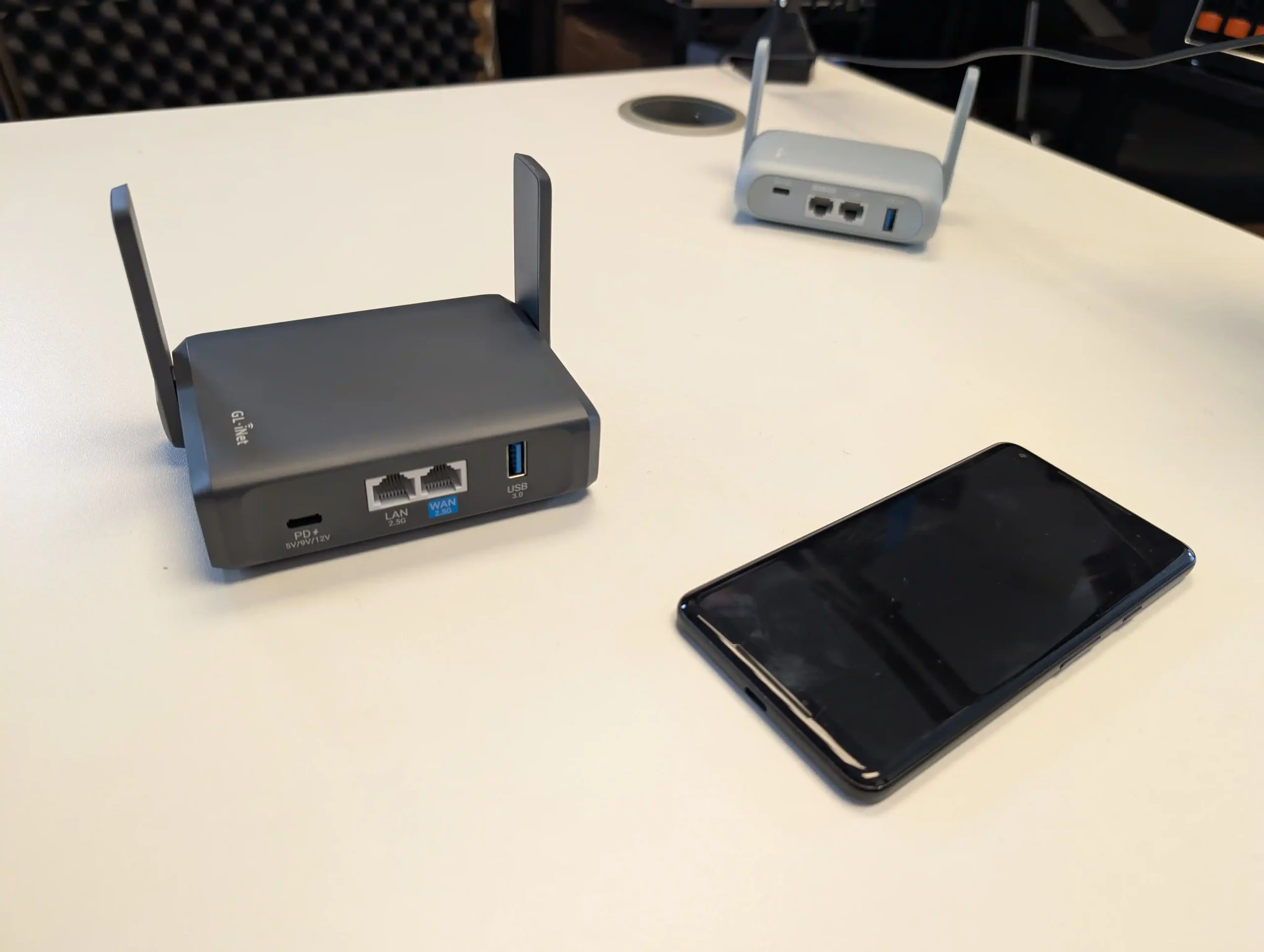
In terms of physical connectivity, the Beryl 7 includes 2 x 2.5GbE ports, configurable as 1 x WAN and 1 x LAN. This is a notable upgrade over older 1GbE limited travel routers and enables higher throughput when connected to multi gig internet services or high speed local networks. For portable scenarios, this can be relevant in environments such as serviced apartments or offices where faster wired backhaul is available. The inclusion of 2.5GbE on both ports provides flexibility, particularly when using the router in bridge, repeater, or failover configurations.

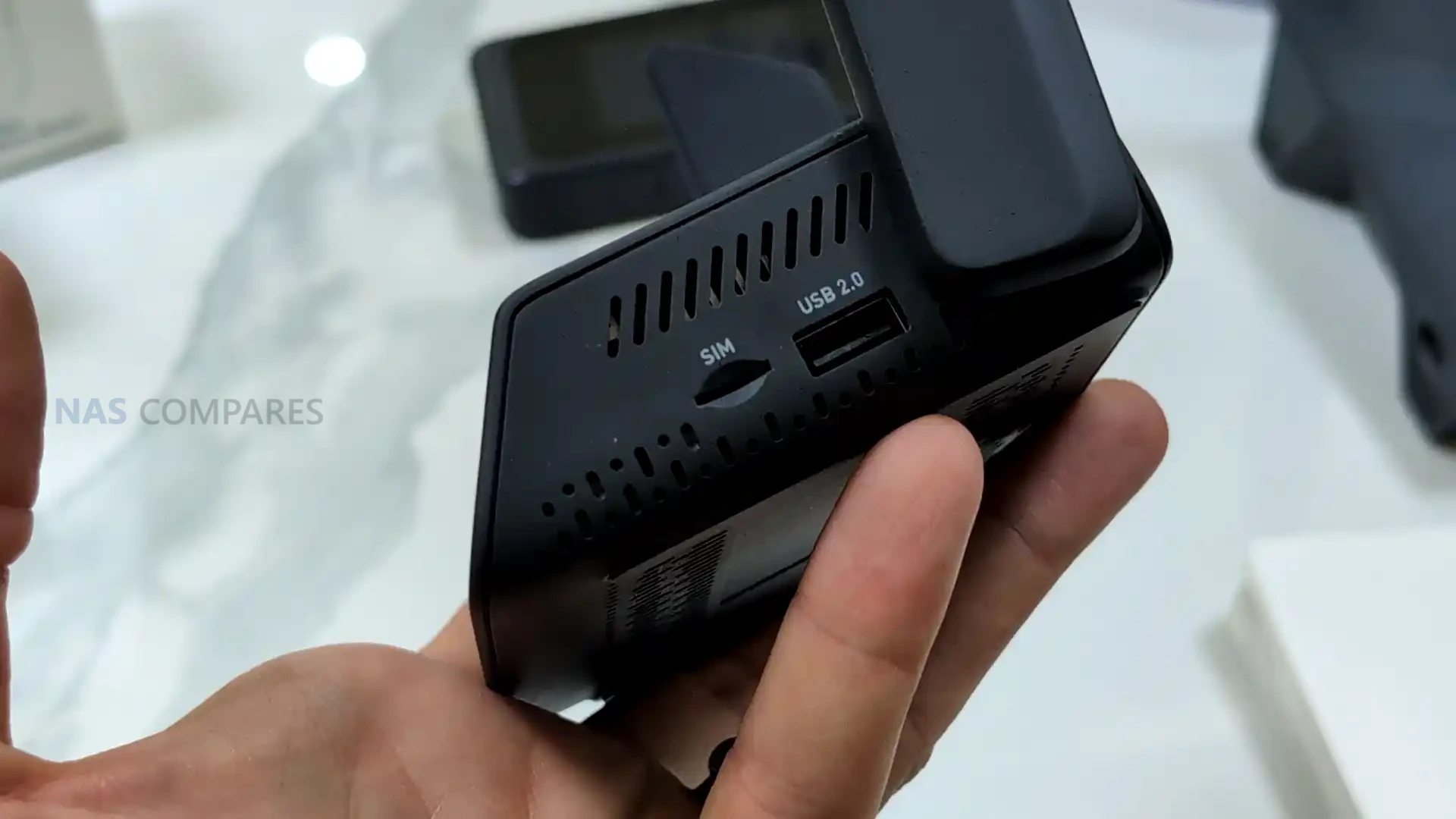
A single USB 3.0 Type A port is located on the side, supporting external storage devices or USB tethering from a smartphone. While it provides expansion capability, the presence of only one USB port means users must choose between storage and tethering unless they rely on a powered hub, which may introduce stability or power delivery considerations.

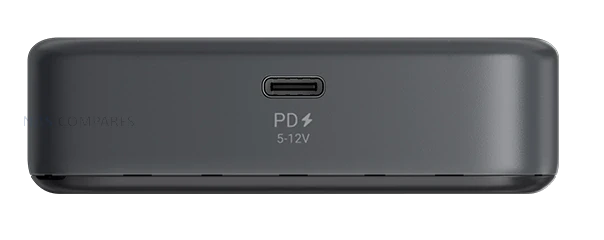
Power is delivered via a USB C input, supporting 5V/3A, 9V/3A, and 12V/2.5A. This allows the router to be powered by standard phone chargers, power banks, or USB outlets commonly found on transport systems.

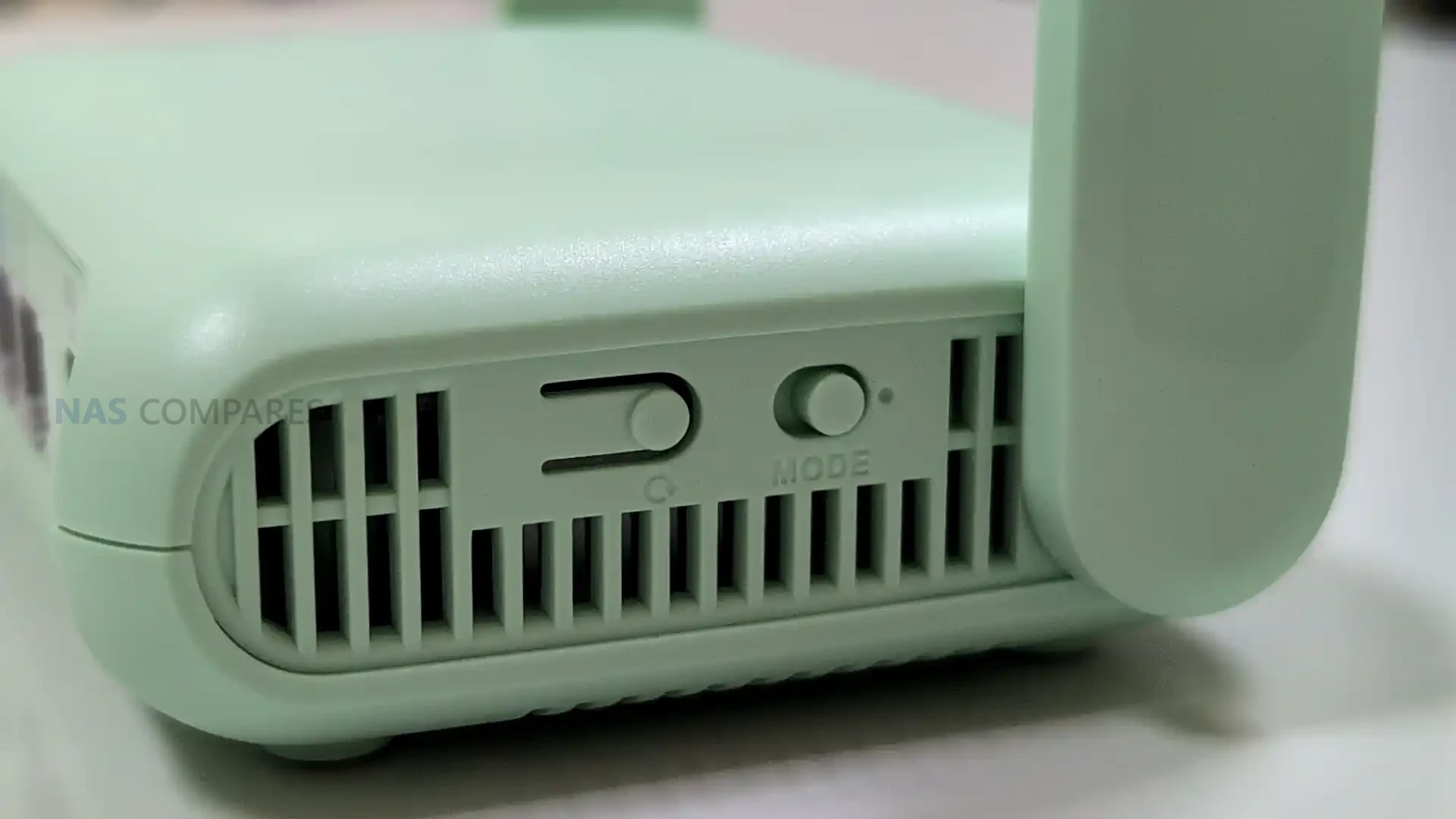
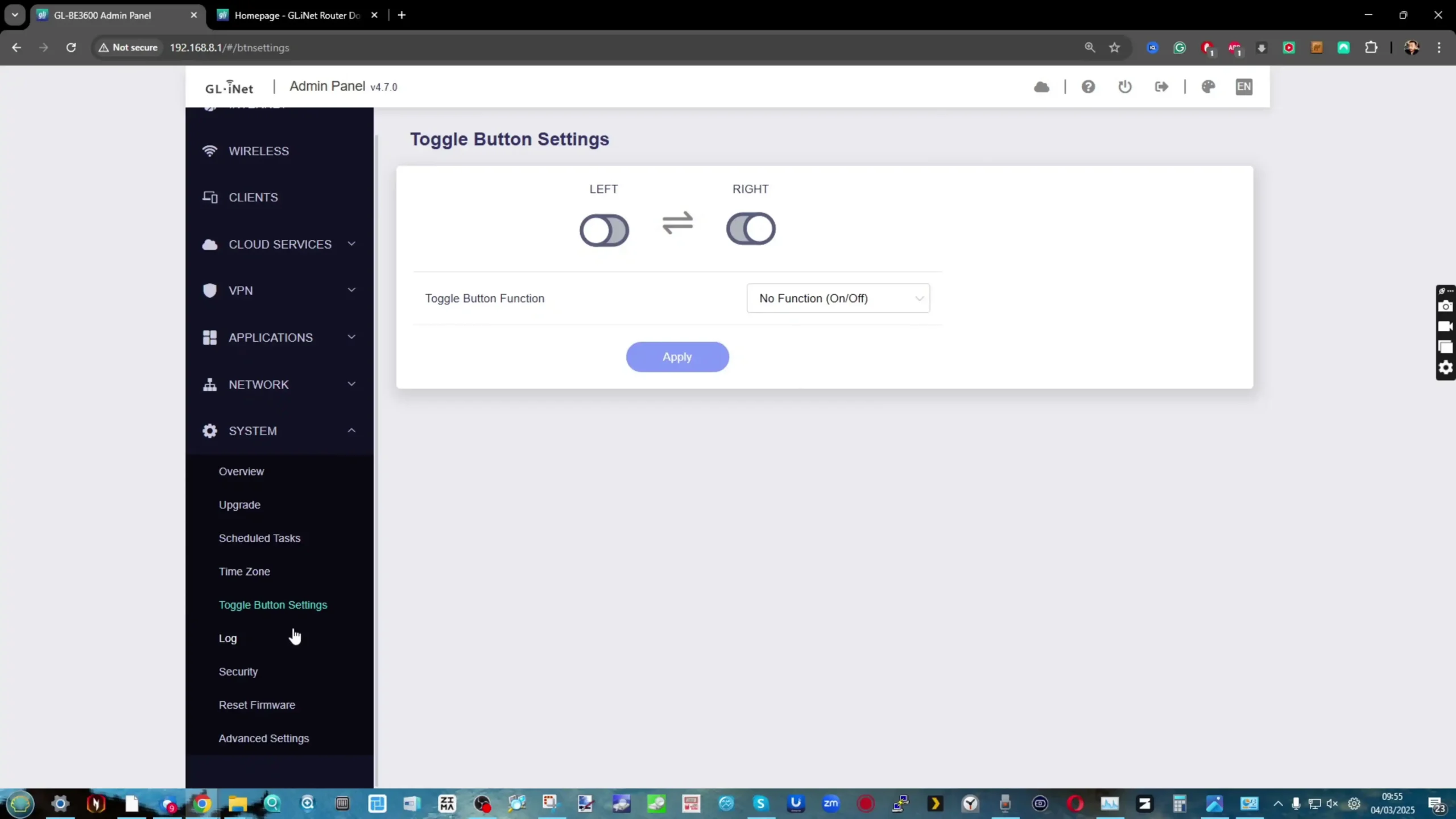
Additional physical controls include a reset button and a programmable toggle button. The toggle button can be configured for tasks such as enabling or disabling a VPN or switching network modes, providing quick hardware level control without accessing the web interface. LED indicators are minimal and can be adjusted or disabled via software, reducing visual distraction in low light environments. Overall, the design prioritizes portability, silent operation, and practical connectivity over integrated batteries or cellular modems, reflecting its focus on wired and Wi Fi based networking rather than standalone mobile broadband functionality.

Gl.iNet Beryl 7 Review – Internal Hardware

The Beryl 7 is built around a MediaTek quad core processor running at 2.0GHz, marking a clear step up from the dual core 1.3GHz platform used in the previous Beryl AX. This increase in core count and clock speed directly supports higher VPN throughput, improved multi WAN handling, and better performance under concurrent client load. In portable routing scenarios where encryption, traffic shaping, and failover may be active simultaneously, the additional processing headroom is relevant, particularly when compared to entry level travel routers that rely on lower power chipsets.

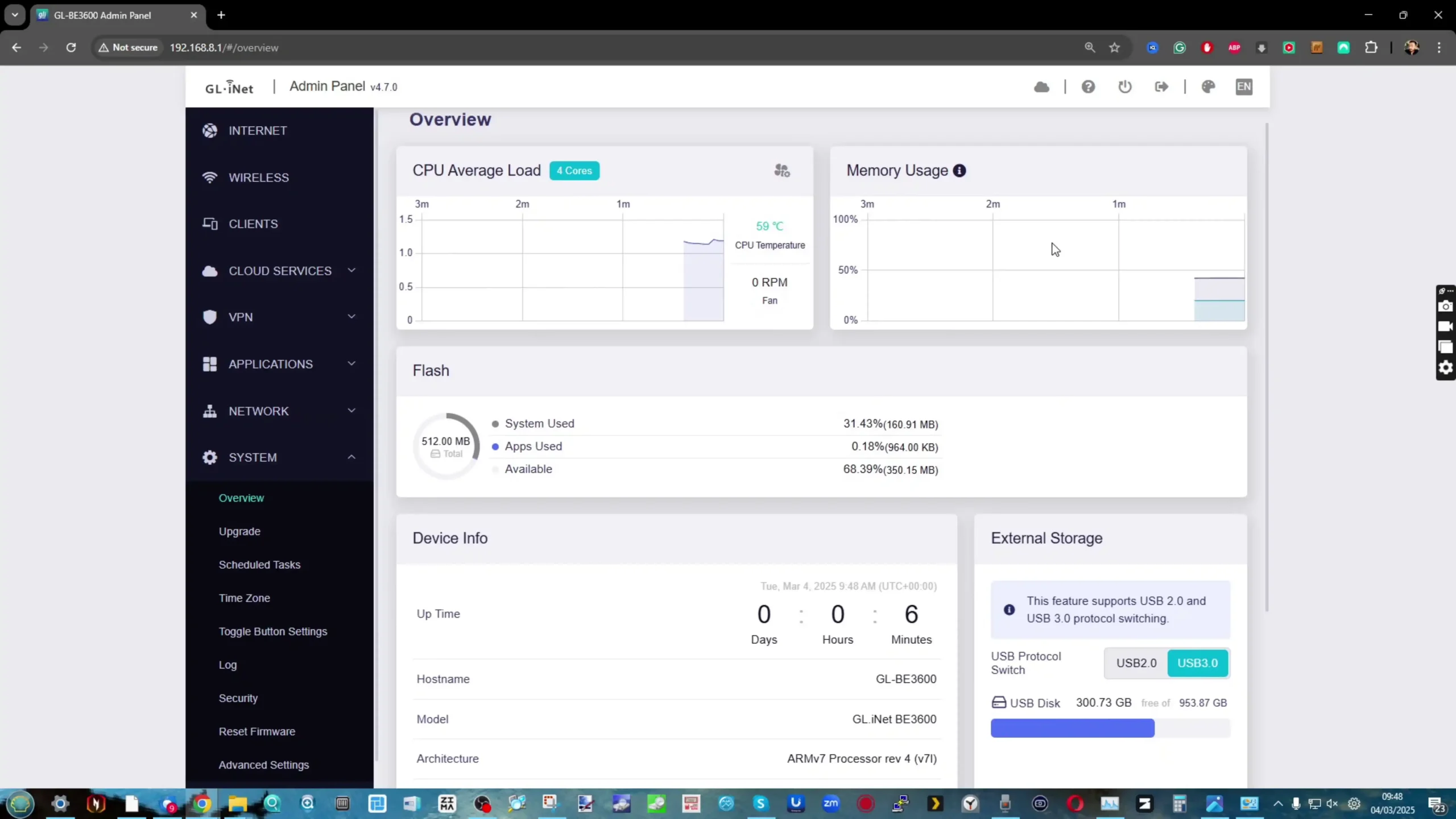
Memory and storage are provisioned at 512MB DDR4 RAM and 512MB NAND flash. The RAM capacity is sufficient for running multiple services concurrently, including VPN client or server roles, firewall rules, and installed plugins through the OpenWrt environment. The increased flash storage compared to the Beryl AX allows for a broader range of optional packages and services without immediately encountering storage constraints. For users intending to extend functionality beyond basic routing, this additional internal space provides practical flexibility.

On the wireless side, the router supports dual band Wi Fi 7 operation across 2.4GHz and 5GHz, with theoretical combined speeds of 3600Mbps. While it does not include 6GHz support, it does retain Multi Link Operation across the available bands, enabling simultaneous use of both radios for compatible clients. The internal architecture is therefore designed to balance power efficiency and thermal stability with next generation protocol support, rather than pursuing maximum theoretical bandwidth at the expense of heat output or energy draw.

Gl.iNet Beryl 7 Review – Software and Services

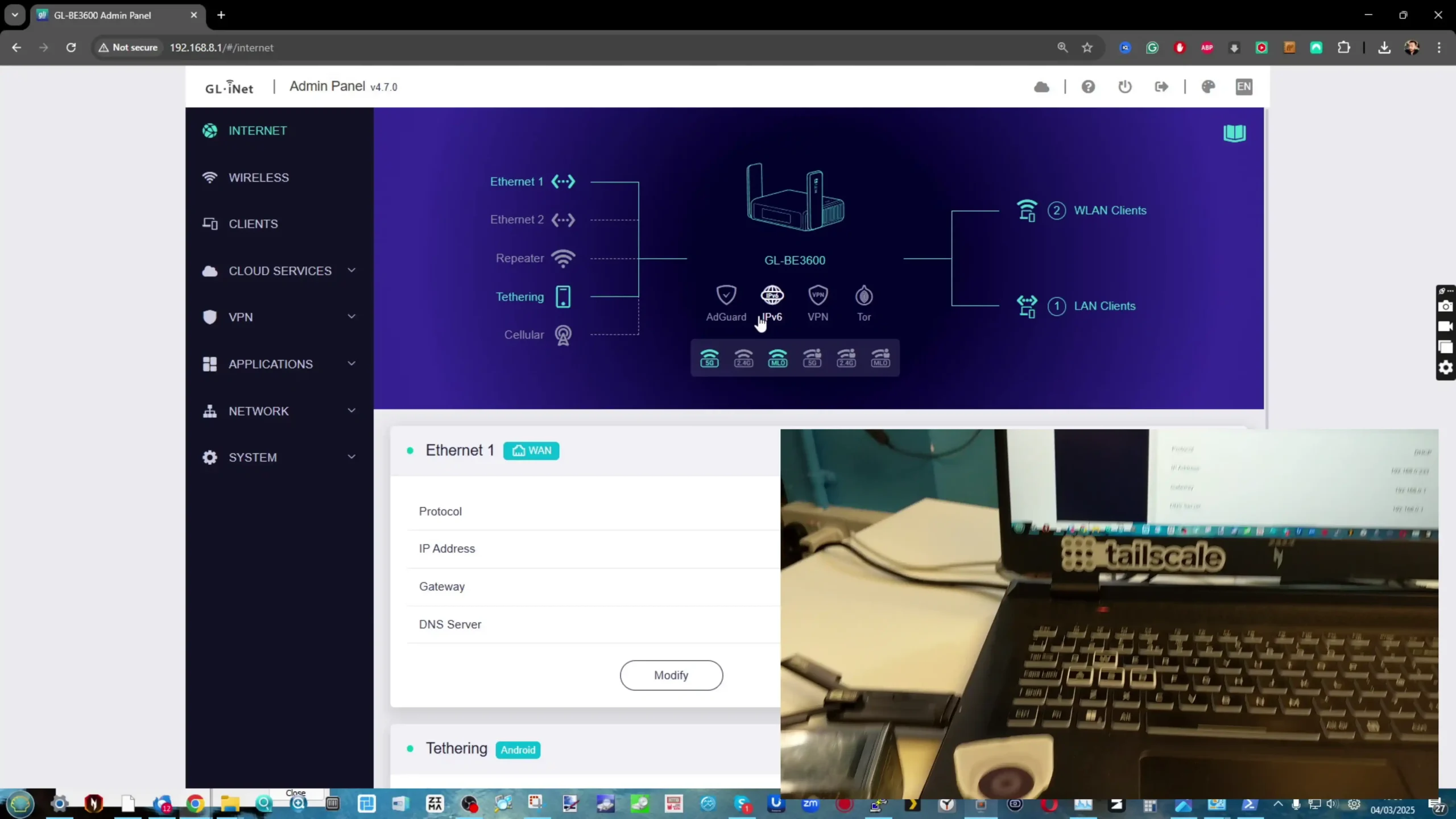
The Beryl 7 runs a customized OpenWrt based firmware developed by GL.iNet, providing a layered interface that caters to both general users and more technically experienced administrators. The primary web interface presents a structured dashboard for managing WAN connections, Wi Fi networks, VPN profiles, client devices, and failover rules without requiring direct interaction with raw OpenWrt configuration files. For users who prefer deeper customization, full access to the underlying OpenWrt LuCI environment is available, allowing granular control over firewall rules, routing tables, VLAN configuration, and advanced networking parameters.

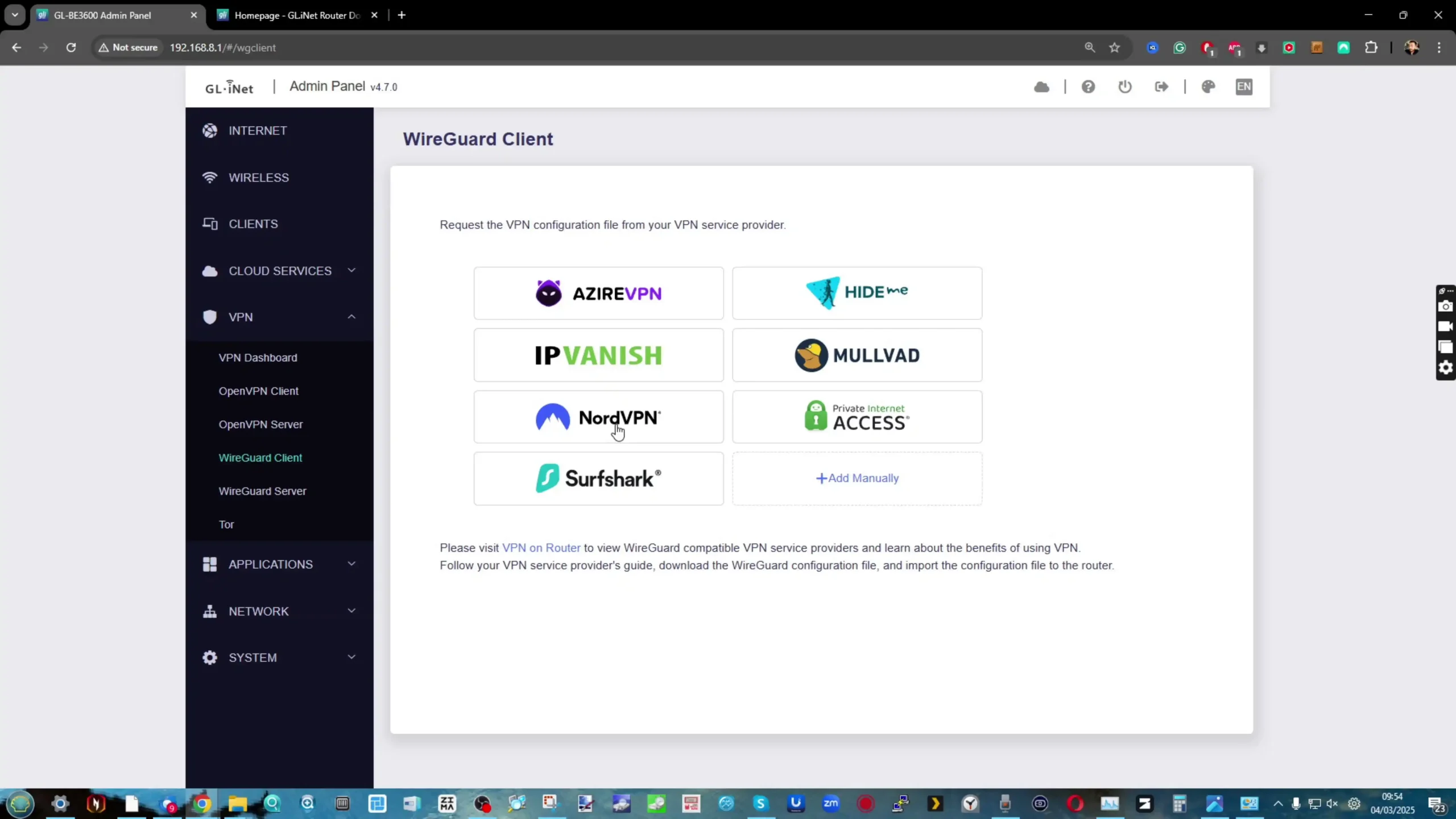
VPN functionality is a central component of the platform. The router supports both client and server modes, including WireGuard and OpenVPN with DCO acceleration. Configuration can be handled manually or through profile imports from commercial VPN providers. A physical toggle button on the device can be assigned to enable or disable VPN connections instantly, providing hardware level control without logging into the interface. This is particularly relevant in travel scenarios where switching between encrypted and non encrypted traffic may be necessary for compatibility with certain captive portals or services.

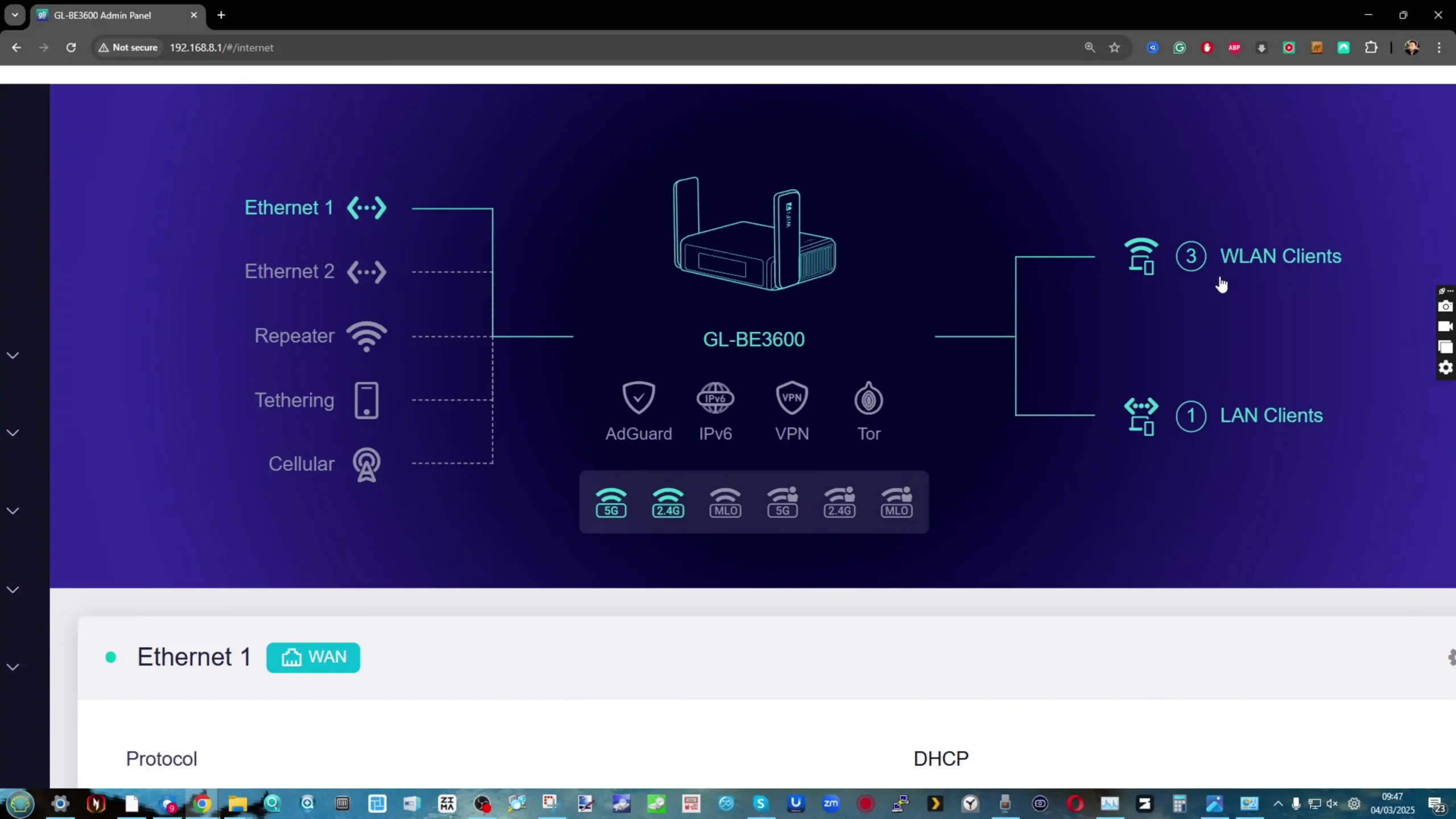
Multi WAN support is integrated into the firmware, enabling wired WAN, Wi Fi repeater mode, and USB tethering to operate in combination or as automatic failover paths. Users can define priority levels so that if one connection drops, the router transitions to another within seconds.

This feature is typically found in larger business oriented routers and is less common in compact travel models. The ability to combine wired and wireless sources adds resilience in temporary setups where network stability may vary.

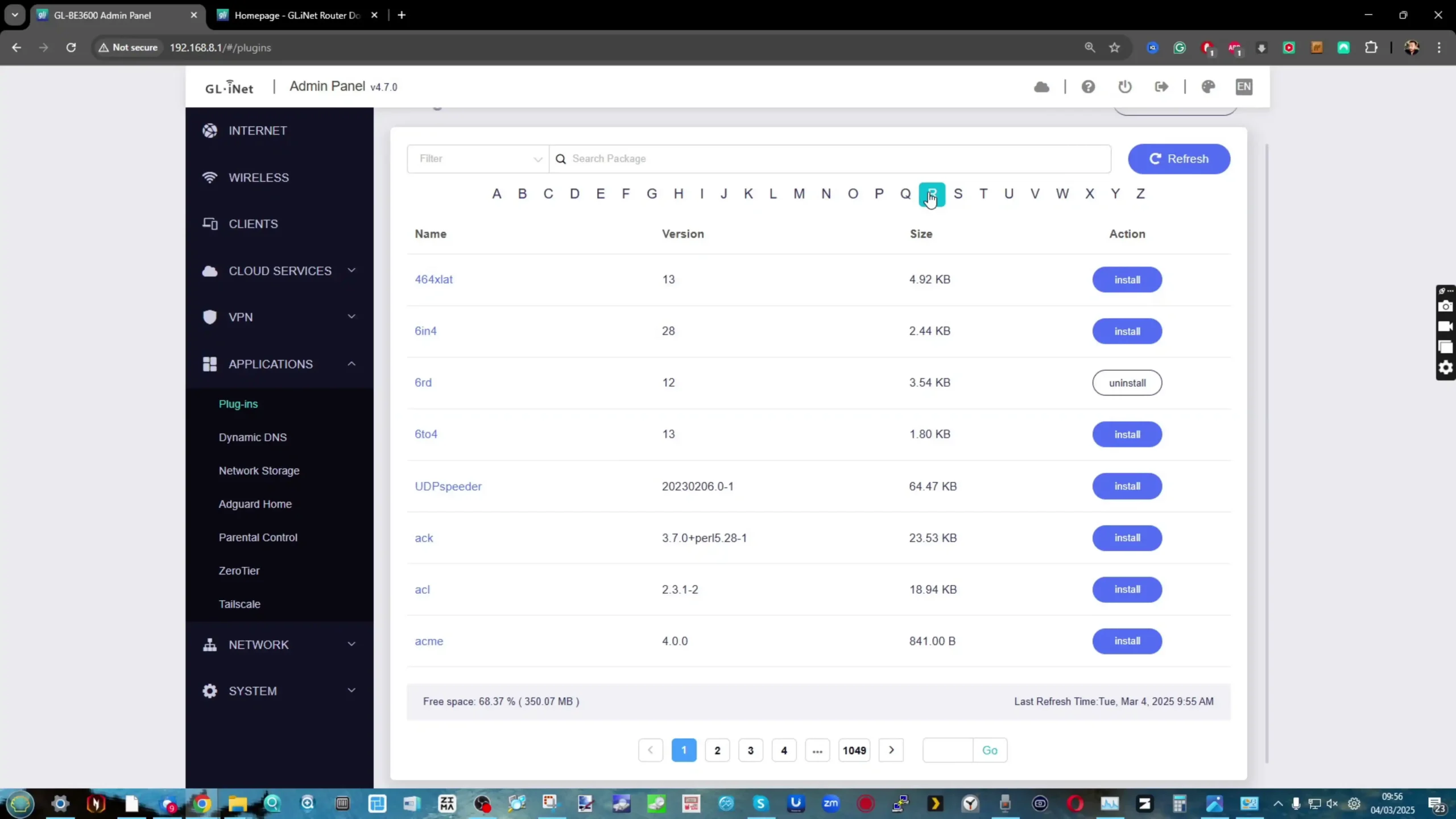
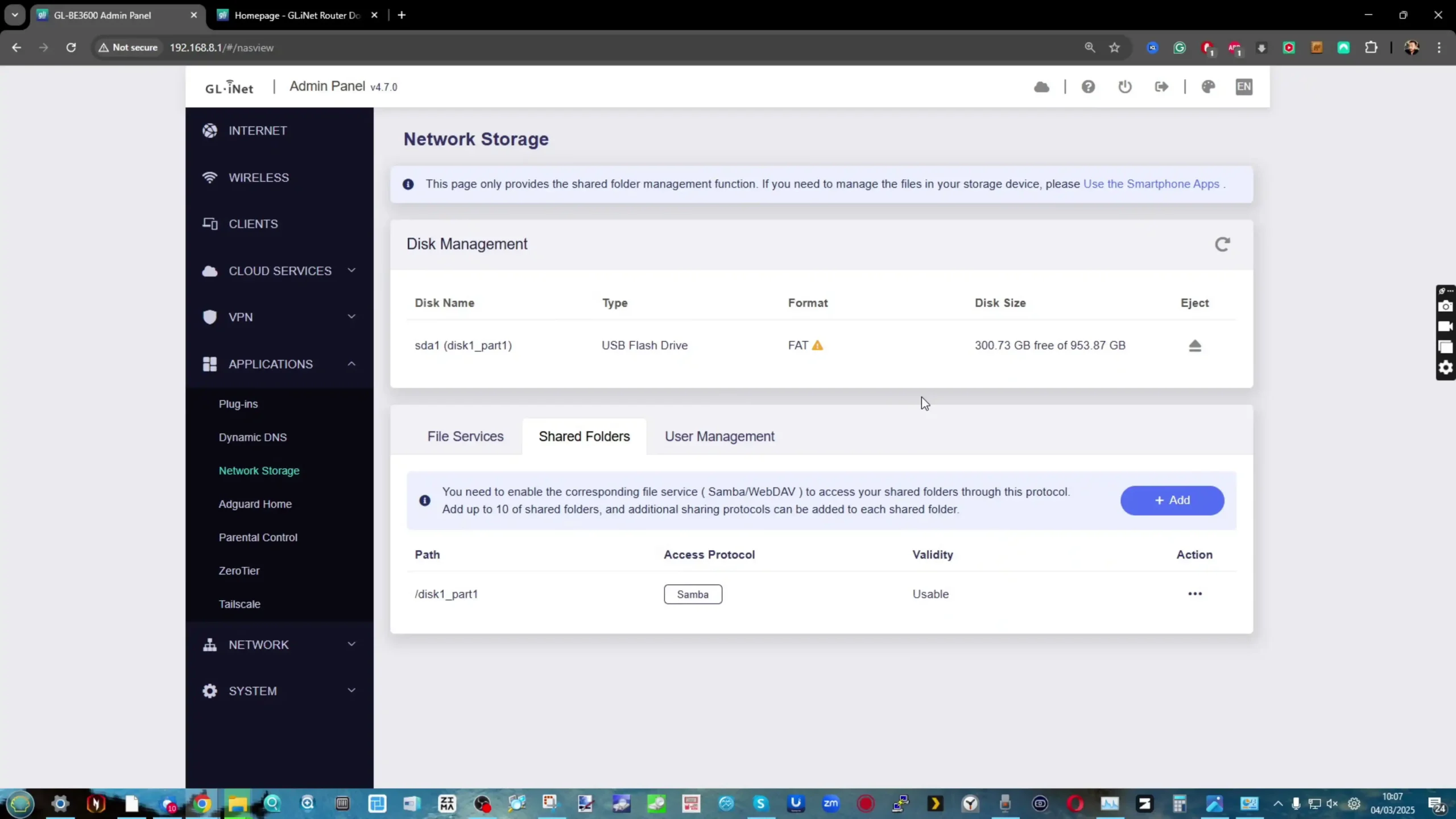
An integrated app center allows additional services to be installed directly onto the router’s internal storage or external USB storage if attached. These may include ad blocking tools, network monitoring utilities, file sharing services, and lightweight media server applications. While performance is limited by the ARM based hardware and USB throughput, the software ecosystem provides flexibility beyond standard routing tasks. Remote management is also supported through the GoodCloud platform, enabling off site monitoring and configuration if required.

Gl.iNet Beryl 7 Review – Tests and Performance

Boot time from a full power off state to complete interface availability measured approximately 51 seconds, which is relatively quick for a router running a full OpenWrt based stack. Accessing and connecting to a public Wi Fi network, including reaching a captive portal login page, typically took around 35 seconds from initial startup. In practical travel scenarios, this reduces setup friction when moving between networks in hotels, cafés, or shared office environments.

Power consumption remained low across multiple usage patterns. With 3 wireless client devices streaming 4K video simultaneously, draw averaged between 3.7W and 3.8W. Under heavier mixed load involving multiple wireless clients, an active wired WAN and LAN connection, and repeated speed testing, consumption increased to roughly 5W to 6W. When adding a USB connected SSD and sustained traffic, readings reached approximately 6.4W to 6.7W. These figures allow the device to be powered reliably by common USB C chargers and mid capacity power banks without stability issues.

Thermal behavior reflected the passive cooling design. After 1 hour of sustained wireless streaming load, external casing temperatures remained around 41°C to 42°C. Under heavier combined wired and wireless traffic for a similar duration, surface temperatures rose to approximately 51°C to 54°C, with localized vent readings reaching about 56°C. No thermal throttling was observed during testing, and the absence of an internal fan resulted in silent operation throughout.

VPN throughput and failover functionality were key performance areas. Using WireGuard, speeds approached the advertised 1100Mbps ceiling under favorable conditions, while OpenVPN DCO performance reached close to 1000Mbps over Ethernet. Compared to non VPN traffic, throughput reductions of roughly 20% to 25% were observed depending on server location and encryption overhead. Multi WAN failover switching between wired, repeater, and tethered connections typically completed within 4 to 5 seconds, maintaining active sessions in most cases. USB storage performance, however, was limited, with transfer rates generally between 50MB/s and 70MB/s, indicating that while file sharing is possible, it is not a replacement for a dedicated NAS.

Gl.iNet Beryl 7 Review – Verdict and Conclusion

The Beryl 7 (GL-MT3600BE) represents an incremental but meaningful update to the Beryl travel router line. It introduces dual 2.5GbE connectivity, significantly higher VPN throughput, and Wi Fi 7 protocol support within a compact and low power chassis. Its strengths lie in wired flexibility, strong encryption performance, multi WAN failover capability, and the depth of control provided by its OpenWrt based firmware. Boot times are short, public Wi Fi onboarding is quick, power consumption remains modest even under mixed wired and wireless load, and thermal behavior stays within reasonable limits despite the absence of active cooling. The programmable hardware toggle for VPN control adds practical usability in travel scenarios, and the ability to power the device from common USB C chargers or transport based USB outlets increases deployment flexibility. At the same time, it omits 6GHz support, limiting full spectrum Wi Fi 7 functionality and restricting channel width to 160MHz rather than 320MHz. USB storage performance remains modest compared to dedicated network storage devices, and the single USB port can constrain simultaneous tethering and storage use without additional powered accessories.

In market terms, the device sits between entry level Wi Fi 6 travel routers and higher priced Wi Fi 7 portable platforms such as the Slate 7. It does not attempt to compete with tri band hardware, integrated batteries, SIM or eSIM functionality, or touchscreen management panels. The release timing also places it within a crowded product window that includes closely related models from the same manufacturer, which may narrow differentiation for some buyers. However, at 139.99 dollars, it provides an accessible entry point into multi gig wired networking and high speed VPN acceleration in a travel focused form factor. It does not redefine the category or present itself as a flagship device, but for users who prioritize portability, advanced routing controls, reliable failover, and strong encrypted throughput over full band Wi Fi 7 or integrated mobile broadband features, the Beryl 7 remains a technically competent and competitively positioned option within its segment.

Buy the Gl.iNet Beryl 7 from Amazon Below: Buy the Gl.iNet Beryl 7 from the Official Store Below:


Gl.iNet Beryl 7 PROs Gl.iNet Beryl 7 PROs
  • Dual 2.5GbE WAN and LAN ports enable multi gig wired connectivity

  • WireGuard performance up to 1100Mbps with strong OpenVPN DCO throughput

  • Wi Fi 7 support with Multi Link Operation across 2.4GHz and 5GHz

  • Compact 120 x 83 x 34mm chassis with 205g weight for travel deployment

  • Low power consumption between ~3.7W and ~6.7W under typical loads

  • Fast boot time of approximately 51 seconds from cold start

  • Robust OpenWrt based firmware with full LuCI access and app ecosystem

  • Multi WAN failover across wired, repeater, and USB tethering sources

  • No 6GHz band support, limiting full Wi Fi 7 capability

  • USB storage performance limited to approximately 50MB/s to 70MB/s

  • Only 1 USB 3.0 port, restricting simultaneous tethering and storage use


📧 SUBSCRIBE TO OUR NEWSLETTER 🔔
[contact-form-7]
🔒 Join Inner Circle

Get an alert every time something gets added to this specific article!


Want to follow specific category? 📧 Subscribe

This description contains links to Amazon. These links will take you to some of the products mentioned in today's content. As an Amazon Associate, I earn from qualifying purchases. Visit the NASCompares Deal Finder to find the best place to buy this device in your region, based on Service, Support and Reputation - Just Search for your NAS Drive in the Box Below

Need Advice on Data Storage from an Expert?

Finally, for free advice about your setup, just leave a message in the comments below here at NASCompares.com and we will get back to you. Need Help? Where possible (and where appropriate) please provide as much information about your requirements, as then I can arrange the best answer and solution to your needs. Do not worry about your e-mail address being required, it will NOT be used in a mailing list and will NOT be used in any way other than to respond to your enquiry. [contact-form-7] TRY CHAT Terms and Conditions

If you like this service, please consider supporting us. We use affiliate links on the blog allowing NAScompares information and advice service to be free of charge to you.Anything you purchase on the day you click on our links will generate a small commission which isused to run the website. Here is a link for Amazon and B&H.You can also get me a ☕ Ko-fi or old school Paypal. Thanks!To find out more about how to support this advice service check HEREIf you need to fix or configure a NAS, check Fiver Have you thought about helping others with your knowledge? Find Instructions Here  

 
Or support us by using our affiliate links on Amazon UK and Amazon US
    
 
Alternatively, why not ask me on the ASK NASCompares forum, by clicking the button below. This is a community hub that serves as a place that I can answer your question, chew the fat, share new release information and even get corrections posted. I will always get around to answering ALL queries, but as a one-man operation, I cannot promise speed! So by sharing your query in the ASK NASCompares section below, you can get a better range of solutions and suggestions, alongside my own.

☕ WE LOVE COFFEE ☕


Gl.iNet Beryl 7 vs Beryl AX Travel Router Comparison

Gl.iNet Beryl 7 vs Beryl AX Travel Router – Which Should You Buy?

The GL.iNet Beryl AX (GL-MT3000) and the GL.iNet Beryl 7 (GL-MT3600BE) are two compact travel routers from the same product line, aimed at users who need portable, secure network access for travel, remote work, or temporary deployments. They share a similar physical footprint, OpenWrt based software environment, USB powered design, and the ability to convert a single wired or wireless uplink into a private network for multiple client devices. The comparison between them is relevant because the price difference is relatively modest, yet they are based on different wireless generations and hardware platforms. As a result, prospective buyers and existing Beryl AX users may reasonably question whether the newer Beryl 7 represents a meaningful upgrade, or whether the earlier model remains sufficient for most travel focused networking requirements.

Gl.iNet Beryl 7 Travel Router

Gl.iNet Beryl AX Travel Router

Buy From Gl.iNet

Buy From Amazon

Buy From Gl.iNet

Buy From Amazon

Gl.iNet Beryl 7 vs Beryl AX – WiFi 6 vs WiFi 7 (Do You Need It?)

The GL.iNet Beryl AX (GL-MT3000) is based on the WiFi 6 standard, supporting dual band operation across 2.4GHz and 5GHz with a combined theoretical maximum of 3000Mbps, rated at 574Mbps on 2.4GHz and 2402Mbps on 5GHz. The GL.iNet Beryl 7 (GL-MT3600BE) moves to WiFi 7 and increases the combined theoretical bandwidth to 3600Mbps, rated at 688Mbps on 2.4GHz and 2882Mbps on 5GHz. Both devices operate on 2 bands only, as the Beryl 7 does not include 6GHz support, meaning it does not use the additional spectrum sometimes associated with WiFi 7 implementations.

The practical distinction between WiFi 6 and WiFi 7 in this comparison lies less in raw peak numbers and more in protocol efficiency and connection handling. WiFi 7 introduces Multi Link Operation, allowing compatible client devices to connect across multiple bands simultaneously rather than selecting a single band. In supported environments, this can improve throughput consistency and reduce latency under load. However, the benefit depends on the presence of WiFi 7 capable client hardware. Devices limited to WiFi 6 or earlier will connect using backward compatible standards, reducing the generational advantage to incremental improvements in signal handling and overhead efficiency.

In real world travel scenarios such as hotel rooms, shared apartments, or temporary office spaces, both routers provide sufficient bandwidth for streaming, browsing, cloud access, and moderate file transfers across multiple devices.

The Beryl 7 offers higher theoretical wireless ceilings and additional aggregation capability for compatible hardware, while the Beryl AX provides established WiFi 6 performance that remains adequate for most sub 2.5Gb internet connections. The decision between them in wireless terms is therefore primarily influenced by client device compatibility and the value placed on higher theoretical throughput within a portable deployment context.

It is also worth noting that 6GHz WiFi support, while often associated with WiFi 7, currently has more limited regulatory and client adoption in parts of Europe compared to other regions. Even if a travel router in this class were to include 6GHz radios, many users in European markets would not consistently benefit from the wider 320MHz channels or expanded spectrum due to regional availability constraints and lower client device penetration. In practical terms, this reduces the immediate advantage of tri band WiFi 7 for a large portion of the target audience. Integrating 6GHz capability would also require more advanced RF design, revised antenna layout, higher power handling, and often a different class of processor platform, frequently moving toward higher tier Qualcomm solutions. That shift would increase component cost, thermal requirements, and overall retail pricing, placing the device in a materially different market segment than the current dual band Beryl models.

Gl.iNet Beryl 7 vs Beryl AX – Wired Connectivity for WAN and LAN?

Both the GL.iNet Beryl AX (GL-MT3000) and the GL.iNet Beryl 7 (GL-MT3600BE) include 2 Ethernet ports that can be configured as WAN or LAN depending on deployment needs. The structural difference lies in port speed allocation. The Beryl AX provides 1 x 2.5G port and 1 x 1G port, while the Beryl 7 provides 2 x 2.5G ports. This distinction directly affects how multi-gigabit internet connections and high speed wired clients can be distributed within the local network.

On the Beryl AX, users must decide whether the 2.5G interface will function as WAN or LAN if both upstream and downstream multi gigabit throughput is required. If the 2.5G port is assigned to WAN for an internet connection above 1G, the remaining LAN port is limited to 1G for wired clients such as a NAS or workstation. In contrast, the Beryl 7 allows a multi gigabit WAN input and a separate 2.5G LAN output simultaneously. This removes the need to prioritize one side of the connection when operating in environments with faster than gigabit internet access.

In lower bandwidth scenarios, such as hotel or public WiFi uplinks that rarely exceed 1G, the practical difference may be minimal. However, in deployments involving fiber connections above 1G, local high speed storage, or internal data transfers over wired connections, the dual 2.5G configuration of the Beryl 7 provides greater flexibility. The distinction is therefore less about port quantity and more about simultaneous throughput capability when handling multi gigabit traffic on both WAN and LAN interfaces.

Gl.iNet Beryl 7 vs Beryl AX – Internal Hardware (and what difference it makes?)

The GL.iNet Beryl AX (GL-MT3000) uses the MediaTek MT7981B dual core processor running at 1.3GHz per core, whereas the GL.iNet Beryl 7 (GL-MT3600BE) moves to a MediaTek quad core processor running at 2.0GHz per core. This is not simply an incremental clock speed increase, but a combination of higher per core frequency and a doubling of available cores. In practical routing workloads, additional cores allow parallel handling of encryption, NAT, firewall inspection, QoS rules, and multiple concurrent sessions. The higher clock speed per core also improves single threaded tasks such as certain VPN operations and packet inspection routines. As network traffic increases, particularly when VPN encryption is enabled, the scaling advantage of 4 cores at 2.0GHz becomes more relevant than raw wireless bandwidth alone.

Both devices include 512MB DDR4 memory, so runtime capacity for active services and simultaneous connections is comparable at a base level. The difference lies in onboard NAND flash storage. The Beryl AX provides 256MB of flash, while the Beryl 7 includes 512MB. For basic firmware and light package installation, 256MB is typically sufficient. However, users deploying additional OpenWrt packages, extended logging, container based services, or more complex VPN and DNS filtering configurations may benefit from the additional internal storage headroom on the Beryl 7. The larger flash capacity reduces the need to offload configuration or expand storage through external means.

Both routers feature a single USB 3.0 port for data connectivity, while the separate USB Type C port is dedicated to power input. This means there is only 1 usable USB interface for peripherals. External storage devices such as USB flash drives or portable SSDs can be connected for file sharing via Samba or WebDAV, effectively turning the router into a lightweight network storage node. However, using the USB port for storage prevents simultaneous use for USB tethering or a USB cellular dongle. In travel deployments where USB tethering to a smartphone or 4G or 5G modem is required, the port cannot be shared. As a result, internal flash capacity and USB role allocation may influence configuration decisions depending on whether the router is being used primarily for storage sharing, mobile broadband input, or wired WAN operation.

Gl.iNet Beryl 7 vs Beryl AX – Performance and Deployment Scale Long term

The hardware and wireless differences between the GL.iNet Beryl AX (GL-MT3000) and the GL.iNet Beryl 7 (GL-MT3600BE) translate into measurable differences in VPN throughput and concurrent device handling. The Beryl AX is rated for up to 300Mbps via WireGuard and up to 150Mbps via OpenVPN in client mode. The Beryl 7 increases those ceilings to 1100Mbps via WireGuard and 1000Mbps via OpenVPN DCO. These figures are dependent on network conditions and configuration, but the scaling difference reflects the impact of the stronger quad core 2.0GHz processor on encryption and packet processing workloads.

Client device capacity is also higher on the Beryl 7. The Beryl AX is positioned to support 70 plus connected devices, while the Beryl 7 is rated for 120 plus. In most travel scenarios, such as hotel rooms or short term rentals, both limits exceed realistic usage. However, in small office, lab, classroom, or event environments where a travel router may be used as a temporary gateway, the higher client handling ceiling provides additional headroom. The increase is less about encouraging high density deployments and more about ensuring stability when multiple devices are actively transferring data simultaneously.

Deployment flexibility also differs when combining wired, wireless, and VPN loads. On the Beryl AX, performance limitations are more likely to appear when multi gigabit WAN input, active VPN encryption, and numerous client sessions are all enabled concurrently. The Beryl 7, with dual 2.5G ports, higher wireless ceilings, and stronger CPU resources, is designed to sustain heavier mixed workloads before reaching saturation. In low bandwidth environments such as standard hotel WiFi, both units operate comfortably within their limits. The divergence becomes more apparent in high speed fiber connections, homelab testing, or sustained VPN dependent remote work scenarios.

Gl.iNet Beryl 7 vs Beryl AX – Which One Should You Buy?

The GL.iNet Beryl AX (GL-MT3000) and the GL.iNet Beryl 7 (GL-MT3600BE) occupy the same physical category and share a similar deployment philosophy, but they differ meaningfully in processing capability, wired configuration flexibility, wireless ceiling, and VPN throughput. The Beryl AX remains a WiFi 6 based travel router with 2.5G WAN support, stable OpenWrt integration, and sufficient CPU resources for encrypted traffic at moderate broadband speeds. For users operating within sub gigabit internet connections, running standard VPN client configurations, and connecting a typical number of personal devices, its limitations are unlikely to surface in normal travel use. It continues to provide a compact, USB powered solution for converting public or shared internet access into a private subnet.

The Beryl 7 expands on that foundation with WiFi 7 protocol support across 2.4GHz and 5GHz, Multi Link Operation, dual 2.5G Ethernet ports, higher VPN throughput ceilings, a stronger quad core 2.0GHz processor, and increased onboard flash storage. These upgrades primarily increase performance headroom rather than altering the use case itself. In environments involving faster than 1G internet connections, sustained encrypted traffic, heavier concurrent client activity, or mixed wired and wireless high throughput workloads, the Beryl 7 is less likely to encounter processing or port bottlenecks. The higher rated VPN performance, particularly with WireGuard and OpenVPN DCO, may also be relevant for remote workers whose encrypted tunnel speed is constrained by router hardware rather than the upstream connection.

It is also relevant that the Beryl 7 does not include 6GHz spectrum support, meaning it does not implement the full 3 band WiFi 7 feature set. Within the broader portfolio of GL.iNet, development is ongoing toward a 6GHz capable WiFi 7 travel platform, referenced as the Slate 7 Pro, which is expected no earlier than Q2 2026. As such, the Beryl 7 represents an incremental step forward within dual band travel routers rather than the final stage of WiFi 7 implementation in this segment. Buyers prioritizing immediate WiFi 7 support with stronger processing and dual 2.5G ports may find the Beryl 7 aligned with their requirements, while those satisfied with WiFi 6 performance and lower VPN ceilings may find the Beryl AX remains proportionate to its price and intended scope.

Gl.iNet Beryl 7 Travel Router

Gl.iNet Beryl AX Travel Router

Buy From Gl.iNet

Buy From Amazon

Buy From Gl.iNet

Buy From Amazon

PROs CONs PROs CONs
+ WiFi 7 and MLO

+ Dual 2.5G WAN/LAN

+ Better CPU

+ More Storage

– More Expensive

– Lack of 6Ghz

– Same RAM/Memory

+ Cheaper

+ Lower Power Use

+ Same RAM/Memory

+ Same Software & Features

– Lacks MLO

– Less Base Storage

– Lower USB PD Support


📧 SUBSCRIBE TO OUR NEWSLETTER 🔔
[contact-form-7]
🔒 Join Inner Circle

Get an alert every time something gets added to this specific article!


Want to follow specific category? 📧 Subscribe

This description contains links to Amazon. These links will take you to some of the products mentioned in today's content. As an Amazon Associate, I earn from qualifying purchases. Visit the NASCompares Deal Finder to find the best place to buy this device in your region, based on Service, Support and Reputation - Just Search for your NAS Drive in the Box Below

Need Advice on Data Storage from an Expert?

Finally, for free advice about your setup, just leave a message in the comments below here at NASCompares.com and we will get back to you. Need Help? Where possible (and where appropriate) please provide as much information about your requirements, as then I can arrange the best answer and solution to your needs. Do not worry about your e-mail address being required, it will NOT be used in a mailing list and will NOT be used in any way other than to respond to your enquiry. [contact-form-7] TRY CHAT Terms and Conditions
If you like this service, please consider supporting us. We use affiliate links on the blog allowing NAScompares information and advice service to be free of charge to you.Anything you purchase on the day you click on our links will generate a small commission which isused to run the website. Here is a link for Amazon and B&H.You can also get me a ☕ Ko-fi or old school Paypal. Thanks!To find out more about how to support this advice service check HEREIf you need to fix or configure a NAS, check Fiver Have you thought about helping others with your knowledge? Find Instructions Here  

 
Or support us by using our affiliate links on Amazon UK and Amazon US
    
 
Alternatively, why not ask me on the ASK NASCompares forum, by clicking the button below. This is a community hub that serves as a place that I can answer your question, chew the fat, share new release information and even get corrections posted. I will always get around to answering ALL queries, but as a one-man operation, I cannot promise speed! So by sharing your query in the ASK NASCompares section below, you can get a better range of solutions and suggestions, alongside my own.

☕ WE LOVE COFFEE ☕


Gl.iNet Beryl 7 WiFi 7 Travel Router Revealed

The Beryl 7 from Gl.iNet Finally Revealed

On January 6, 2026, day 1 of CES 2026, Gl.iNet is highlighting the Beryl 7 (GL-MT3600BE) as an upcoming travel router positioned below the company’s more premium Slate 7 in the same Wi-Fi 7 travel category. The device is being presented as a successor direction to the earlier Beryl AX generation, with Gl.iNet focusing its messaging on VPN throughput, portable use, and the practical ports and power features that matter when the router is used on the road. Pricing and a firm release date have not been included in the information shared so far.

In its CES materials, Gl.iNet describes Beryl 7 as a compact, dual-band Wi-Fi 7 model aimed at users who want higher encrypted throughput without stepping up to a larger, more feature-heavy travel router. Key claims include up to 1100Mbps on OpenVPN-DCO and WireGuard, dual 2.5G Ethernet capability, and support for 120+ connected devices, alongside USB Power Delivery compatibility and a 5V/2A power output intended to integrate cleanly with uFi and MiFi devices for primary or backup WAN use.

Item Detail
Product name Gl.iNet Beryl 7
Model GL-MT3600BE
Wi-Fi Dual-band Wi-Fi 7
Frequency 2.4GHz, 5GHz
Wi-Fi speeds 688Mbps (2.4GHz), 2882Mbps (5GHz)
Wireless protocols 802.11a/b/g/n/ac/ax/be
CPU MediaTek, quad-core @ 2.0GHz
Memory 512MB DDR4
Flash 512MB NAND
VPN performance claim Up to 1100Mbps on OpenVPN-DCO and WireGuard
Ethernet 1x WAN, 1x LAN
Ethernet speed 100/1000/2500Mbps
USB 1x USB 3.0
Power input USB PD 5V/3A, 9V/3A, 12V/2.5A
Power consumption <12W
Power output 5V/2A
Dimensions / weight 120 x 83 x 34mm / 205g
Operating temperature 0C to 40C
Built-in battery None (USB-C powered)
SIM / eSIM None (no SIM or eSIM Support)

Gl.iNet Beryl 7 Travel Router – Design & Portability

The Beryl 7 measures at 120 x 83 x 34mm and 205 grams, placing it in the small-router class rather than the pocket-hotspot style. Compared with battery-powered travel routers, the added thickness is consistent with a design that prioritizes full-size ports and airflow while still staying compact enough for a backpack or a small tech pouch. Gl.iNet also lists an operating temperature range of 0C to 40C, which sets basic expectations for typical indoor and travel use, even though performance under sustained load will still depend on ventilation and ambient conditions.

Unlike cellular travel routers, the Beryl 7 is designed to be powered externally rather than running from an internal battery, so it is closer in use to a small plug-in router than a self-contained hotspot. It takes USB-C power via USB Power Delivery and is specified for 5V/3A, 9V/3A, or 12V/2.5A input, which keeps powering simple with common phone and laptop adapters and most power banks that support PD. Gl.iNet also lists a 5V/2A power output, intended to pair with uFi and MiFi devices when you want the router to sit in front of a separate upstream connection and keep that upstream device powered from the same setup.

Gl.iNet Beryl 7 Travel Router – Connectivity

The Beryl 7 is a dual-band Wi-Fi travel router rather than a cellular router. It does not include a SIM slot or eSIM support, which means it is not designed to connect directly to a carrier network on its own. In practice, internet access is expected to come from an upstream source such as a wired connection, USB tethering, or an external hotspot or modem that provides the WAN link. This approach matches travel setups where the router’s job is to manage your local network and security policies, while a separate device handles mobile connectivity when needed.

On the wireless side, the Beryl 7 supports 802.11a/b/g/n/ac/ax/be and operates on 2.4GHz and 5GHz. The published maximum rates are 688Mbps on 2.4GHz and 2882Mbps on 5GHz, which sets its theoretical peak figures for those bands. Because there is no 6GHz band listed, it will not have access to the cleaner spectrum that some tri-band Wi-Fi 7 routers use to reduce congestion in dense environments. Real-world performance will still depend heavily on client device capability, channel conditions, and how crowded the local RF environment is, especially in hotels, apartments, or event venues.

For wired networking, the Beryl 7 includes 1x WAN and 1x LAN, with both ports rated at 100/1000/2500Mbps. Having 2.5Gbps capability on both sides can matter if you are connecting to faster-than-gigabit service, or if you want to avoid bottlenecking a wired client such as a laptop dock, mini PC, or NAS while the router is also handling wireless clients. The dedicated WAN and LAN labeling also suggests a straightforward topology for travel use, where the router can sit between a wired uplink and your personal devices without requiring additional switches. Specific options like port re-assignment or multi-WAN behavior are still dependent on the final firmware feature set.

For tethering and peripherals, the router includes 1 USB 3.0 port. Gl.iNet’s positioning also references pairing it with uFi and MiFi devices for primary or backup WAN use, which aligns with common travel workflows where a hotspot provides the upstream connection and the router distributes it to multiple devices. Depending on software support, USB can also be relevant for other functions such as attaching storage for basic file sharing, but those capabilities are not confirmed solely by the presence of the port. The practical takeaway is that the Beryl 7’s connectivity design focuses on managing and distributing an external internet source rather than replacing that source with built-in cellular hardware.

Gl.iNet Beryl 7 Travel Router – Internal Hardware

The Beryl 7 is specified with a MediaTek quad-core CPU clocked at 2.0GHz. Gl.iNet has not stated the exact chipset model in the material provided, so it is difficult to compare directly against specific MediaTek families used in other routers, but the listed clock speed and core count indicate it is intended to handle routing and VPN workloads beyond basic hotspot sharing. How that translates in practice will depend on the final firmware feature mix and how much processing overhead is added by enabled services. Memory is listed as 512MB of DDR4. That capacity is typically sufficient for a travel router doing standard routing, firewalling, and VPN duties, but it can become a limiting factor if heavy logging, multiple concurrent services, or more advanced packages are enabled. In practical use, headroom will depend on how Gl.iNet tunes the stock firmware and whether the router is expected to run additional features beyond its default configuration. Storage is specified as 512MB of NAND flash. This is a smaller onboard footprint than some higher-end travel routers that use multi-gigabyte eMMC, and it generally implies a tighter space budget for the base firmware image, installed packages, and retained logs. It also means features that rely on persistent local storage may be more constrained unless Gl.iNet provides options to offload data to external storage via USB.

Gl.iNet Beryl 7 Travel Router – Software & Services

Gl.iNet is presenting the Beryl 7 as part of its travel router lineup, which typically uses the company’s GL.iNet firmware with a web-based management interface. That software approach tends to balance simplified setup for common tasks with access to more detailed configuration when needed, which is relevant for travel scenarios where you may want quick changes without digging through advanced menus.

For this model in particular, VPN is the main emphasis in Gl.iNet’s CES messaging. The company is making a specific performance claim of up to 1100Mbps on OpenVPN-DCO and WireGuard, positioning encrypted throughput as a headline reason to choose the Beryl 7 over older Beryl models or lower-end travel routers. Actual results will still depend on factors such as upstream bandwidth, server performance, encryption settings, and network conditions.

Gl.iNet also highlights Amnezia VPN support as part of the Beryl 7’s privacy and censorship-bypass positioning. That places the router within the company’s broader direction of expanding VPN tooling and privacy-related options across its travel lineup, though the exact implementation details for the Beryl 7 will come down to the shipping firmware and how features are exposed in the final interface.

Beyond VPN-related claims, Gl.iNet has not published a complete, model-specific list of software functions for the Beryl 7. Features that appear across other Gl.iNet travel routers, such as traffic controls, DNS and filtering options, remote access services, and package-style add-ons, may be present, but they are not confirmed by the hardware spec sheet alone. For ownership considerations, the missing pieces remain the update cadence, support window, and any limitations imposed by the device’s relatively small flash storage.

Gl.iNet Beryl 7 Travel Router – Conclusion

As presented on day 1 of CES 2026, the Beryl 7 (GL-MT3600BE) is positioned as a more affordable Wi-Fi 7 travel router option that sits below the Slate 7 in capability and likely in price, while serving as the next step after the Beryl AX generation. Its core proposition is a compact, USB-C powered router that focuses on high VPN throughput, dual-band Wi-Fi, and practical wired networking for travel setups. The specification sheet outlines a MediaTek quad-core 2.0GHz platform with 512MB DDR4 and 512MB NAND, paired with 2.5Gbps-capable WAN and LAN ports, plus a USB 3.0 port. It does not include an internal battery and it has no SIM or eSIM support, which means it is designed to sit behind an external internet source such as hotel Ethernet, phone tethering, or a dedicated hotspot. Power is handled through USB Power Delivery, and Gl.iNet also lists a 5V/2A output intended to keep an upstream mobile device powered in a single-cable travel arrangement.

The remaining unknowns are mostly around launch details and how the final firmware is packaged for a device with limited flash storage. Gl.iNet has not published pricing or a release date, and it has not provided a full, model-specific breakdown of software features beyond its VPN and privacy positioning. Those details will likely matter most to buyers deciding between the Beryl 7 and higher-end travel routers, especially if they plan to rely on add-on services, extensive logging, or other features that place more demand on storage and memory.


📧 SUBSCRIBE TO OUR NEWSLETTER 🔔
[contact-form-7]
🔒 Join Inner Circle


Get an alert every time something gets added to this specific article!


Want to follow specific category? 📧 Subscribe

This description contains links to Amazon. These links will take you to some of the products mentioned in today's content. As an Amazon Associate, I earn from qualifying purchases. Visit the NASCompares Deal Finder to find the best place to buy this device in your region, based on Service, Support and Reputation - Just Search for your NAS Drive in the Box Below

Need Advice on Data Storage from an Expert?

Finally, for free advice about your setup, just leave a message in the comments below here at NASCompares.com and we will get back to you. Need Help? Where possible (and where appropriate) please provide as much information about your requirements, as then I can arrange the best answer and solution to your needs. Do not worry about your e-mail address being required, it will NOT be used in a mailing list and will NOT be used in any way other than to respond to your enquiry. [contact-form-7] TRY CHAT Terms and Conditions
If you like this service, please consider supporting us. We use affiliate links on the blog allowing NAScompares information and advice service to be free of charge to you.Anything you purchase on the day you click on our links will generate a small commission which isused to run the website. Here is a link for Amazon and B&H.You can also get me a ☕ Ko-fi or old school Paypal. Thanks!To find out more about how to support this advice service check HEREIf you need to fix or configure a NAS, check Fiver Have you thought about helping others with your knowledge? Find Instructions Here  
 
Or support us by using our affiliate links on Amazon UK and Amazon US
    
 
Alternatively, why not ask me on the ASK NASCompares forum, by clicking the button below. This is a community hub that serves as a place that I can answer your question, chew the fat, share new release information and even get corrections posted. I will always get around to answering ALL queries, but as a one-man operation, I cannot promise speed! So by sharing your query in the ASK NASCompares section below, you can get a better range of solutions and suggestions, alongside my own.

☕ WE LOVE COFFEE ☕


Where to Buy a Product
amzamexmaestrovisamaster 24Hfree delreturn VISIT RETAILER ➤ 
amzamexmaestrovisamaster 24Hfree delreturn VISIT RETAILER ➤

If you like this service, please consider supporting us.
We use affiliate links on the blog allowing NAScompares information and advice service to be free of charge to you. Anything you purchase on the day you click on our links will generate a small commission which is used to run the website. Here is a link for Amazon and B&H. You can also get me a ☕ Ko-fi or old school Paypal. Thanks! To find out more about how to support this advice service check HERE    

☕ WE LOVE COFFEE ☕

Or support us by using our affiliate links on Amazon UK and Amazon US
     

Gl.iNet Slate 7 Pro Revealed at CES 2026

Gl.iNet Slate 7 Pro (GL-BE10000) Travel Router Revealed

GL.iNet used CES 2026 to show an early prototype of the Slate 7 Pro, described as a larger, more capable follow-up to the Slate 7 travel router released in 2025. The prototype presentation suggests the company is keeping the core Slate concept intact, meaning a compact router designed for use on the move with an emphasis on quick status checks and practical networking features, while addressing some of the limitations that shaped opinions on the original model. At this stage, the Slate 7 Pro should be treated as a work-in-progress product rather than a finalized retail device, so details like wireless band support, storage capacity, and final performance targets may still change before launch.

Gl.iNet Slate 7 Pro –  Internal Hardware

The Slate 7 Pro prototype is described as staying on a Qualcomm-based platform, retaining the general performance profile expected from GL.iNet’s higher-end travel routers. In the prototype coverage, this is framed as a continuation rather than a redesign, with the expectation that routing, firewall rules, and typical travel use cases such as hotel network sharing remain the primary focus. If the platform remains closely related to the Slate 7, performance should be oriented around consistent throughput and stability rather than pushing peak numbers that are difficult to realize in real-world travel environments.

Memory is described as 1 GB of DDR4, matching the Slate 7’s baseline configuration. That amount is generally sufficient for common workloads like basic routing, ad blocking, and running a VPN client, but it can become a limiting factor in more complex setups, such as heavier logging, multiple concurrent tunnels, or add-on packages. Because the Slate 7 Pro was shown in prototype form, the practical expectation is that CPU, RAM, and firmware feature support will be confirmed closer to release, including whether GL.iNet adjusts hardware targets based on final thermal, power, or cost constraints.

Gl.iNet Slate 7 Pro – Design

The Slate 7 Pro prototype shown at CES 2026 appears to follow the same general design language as the Slate 7, but in a larger chassis intended to support more functionality. The most visible change is the display, described in the prototype coverage as bigger and brighter for at-a-glance monitoring while traveling. Physical controls also remain part of the concept, including a side-mounted VPN button and a separate toggle switch, aligning with GL.iNet’s usual approach of making common actions accessible without opening the web interface.

Storage is one of the areas where the prototype is discussed as an upgrade rather than a confirmed specification. The Slate 7 uses 512 MB of NAND flash for the operating system, which has been viewed as limited for users who install additional packages or run heavier VPN configurations. In the CES prototype discussion, the Slate 7 Pro is suggested to increase internal OS storage substantially, with an estimate around 8 GB, but this has not been formally finalized in the available prototype details. Until GL.iNet publishes a full spec sheet, the most accurate framing is that expanded storage is expected, but the exact capacity and implementation remain subject to change.

Gl.iNet Slate 7 Pro – Ports and Wireless Connectivity

On the wired side, the Slate 7 Pro is presented as a step up from the Slate 7’s 2-port layout. The CES-facing information points to 2 x 2.5 GbE Ethernet ports, which would allow more flexibility for setups that need a dedicated WAN feed plus multiple wired clients, or for separating devices by role when traveling. If that port count is retained for retail, it would be one of the more practical upgrades for users who rely on wired backhaul to a laptop, streaming box, or a small switch.

USB and power are also positioned as part of the scaled-up design. The prototype discussion references USB Power Delivery input over USB-C, consistent with the travel-router approach of using common chargers and power banks. There is also mention of USB support alongside the Ethernet upgrades, which matters for users who tether storage, phone-based WAN, or other peripherals, but the prototype details do not yet fully lock down the final USB data specification and how GL.iNet intends users to prioritize power vs peripheral use in real deployments.

Wireless capability is the area with the most uncertainty based on currently available information. The prototype is described as adding 6 GHz to become tri-band Wi-Fi 7, with headline class figures referenced as 688 Mbps (2.4 GHz) + 2882 Mbps (5 GHz) + 5764 Mbps (6 GHz), plus MLO support to combine links where supported. At the same time, public CES material has described the Slate 7 Pro as dual-band in a few locations, so the safest conclusion is that band support and final Wi-Fi configuration were still in flux at the time upto the point the unit was shown. Until GL.iNet publishes the full retail spec sheet, it is best to treat tri-band and 6 GHz support as prototype-indicated rather than fully confirmed. However, REALISTICALLY it would be rather underwhelming to label this system as a ‘PRO’ model to the existing non-6Ghz Slate 7, especially when the recently revealed MUDI 7 mobile Router supports the 6Ghz band. Nevertheless, I would treat this as 90% confirmed for now.

Gl.iNet Slate 7 Pro Travel Router – Conclusion

Based on what has been shown so far, the Slate 7 Pro looks like an attempt to push the Slate 7 concept further rather than replace it with a different class of device. The prototype focus is on practical upgrades: more visible real-time status via a larger screen, more flexible wired networking through 2.5 GbE ports alongside the increased band coverage, and a likely increase in internal storage intended to better accommodate modern firmware features and optional add-ons. These changes align with the needs of users who treat a travel router as a primary networking tool rather than an occasional accessory. The main limitation in evaluating the Slate 7 Pro at this stage is that it is still a prototype, and key details remain inconsistent between early reporting and CES-facing descriptions, particularly around dual-band versus tri-band operation and 6 GHz support. Until GL.iNet publishes a finalized specification sheet, the Slate 7 Pro is best viewed as an indicator of direction: a larger, more capable travel router with a higher likely price point, but with enough unresolved details that purchase decisions are better based on the confirmed Slate 7 specification rather than assumptions about the Pro model’s final feature set.

📧 SUBSCRIBE TO OUR NEWSLETTER 🔔
[contact-form-7]
🔒 Join Inner Circle

Get an alert every time something gets added to this specific article!


Want to follow specific category? 📧 Subscribe

This description contains links to Amazon. These links will take you to some of the products mentioned in today's content. As an Amazon Associate, I earn from qualifying purchases. Visit the NASCompares Deal Finder to find the best place to buy this device in your region, based on Service, Support and Reputation - Just Search for your NAS Drive in the Box Below

Need Advice on Data Storage from an Expert?

Finally, for free advice about your setup, just leave a message in the comments below here at NASCompares.com and we will get back to you. Need Help? Where possible (and where appropriate) please provide as much information about your requirements, as then I can arrange the best answer and solution to your needs. Do not worry about your e-mail address being required, it will NOT be used in a mailing list and will NOT be used in any way other than to respond to your enquiry. [contact-form-7] TRY CHAT Terms and Conditions
If you like this service, please consider supporting us. We use affiliate links on the blog allowing NAScompares information and advice service to be free of charge to you.Anything you purchase on the day you click on our links will generate a small commission which isused to run the website. Here is a link for Amazon and B&H.You can also get me a ☕ Ko-fi or old school Paypal. Thanks!To find out more about how to support this advice service check HEREIf you need to fix or configure a NAS, check Fiver Have you thought about helping others with your knowledge? Find Instructions Here  
 
Or support us by using our affiliate links on Amazon UK and Amazon US
    
 
Alternatively, why not ask me on the ASK NASCompares forum, by clicking the button below. This is a community hub that serves as a place that I can answer your question, chew the fat, share new release information and even get corrections posted. I will always get around to answering ALL queries, but as a one-man operation, I cannot promise speed! So by sharing your query in the ASK NASCompares section below, you can get a better range of solutions and suggestions, alongside my own.

☕ WE LOVE COFFEE ☕


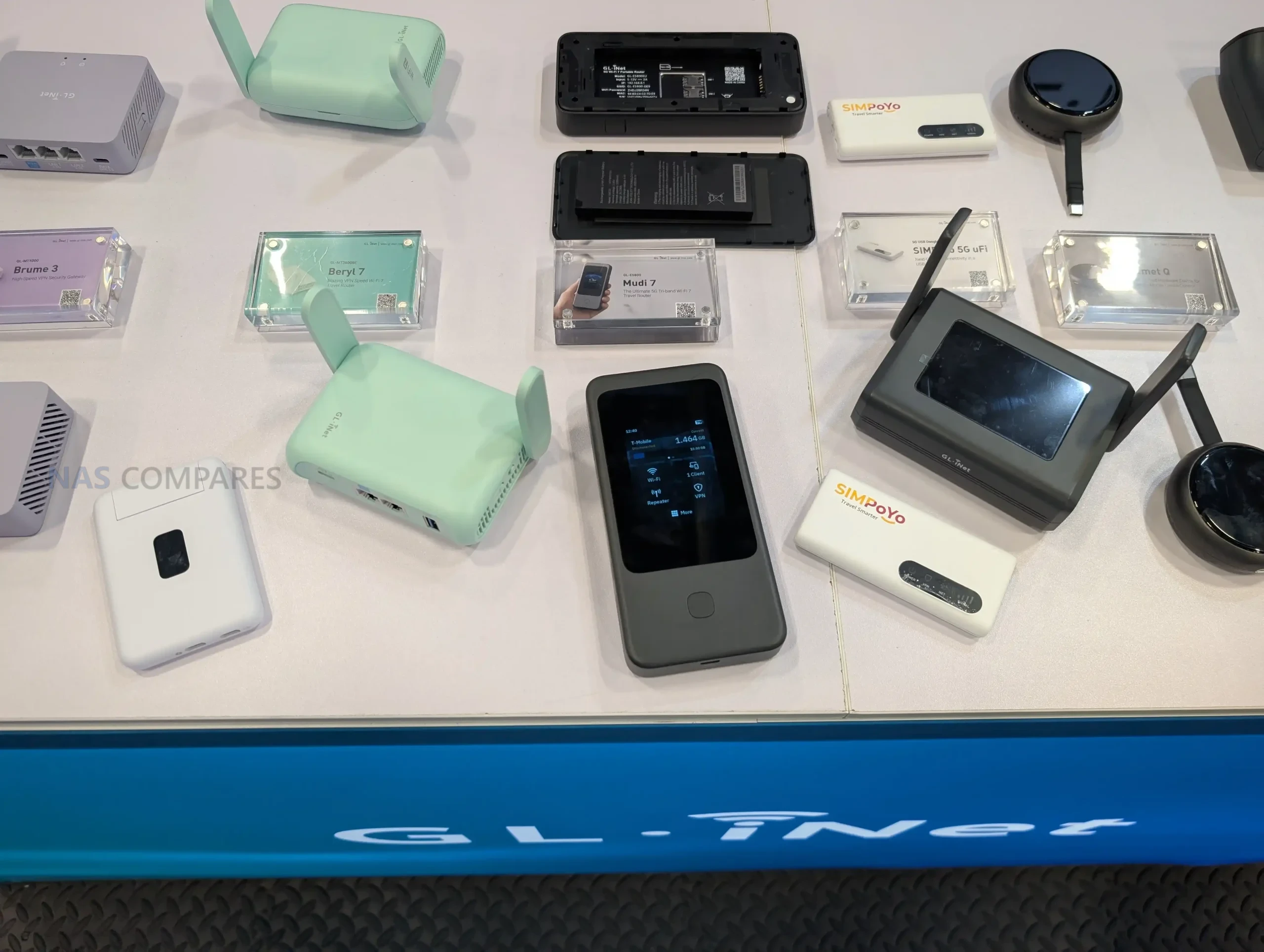
Gl.iNet Mudi 7 Revealed – Dual 5G SIM, eSIM, WiFi 7, 2.5GbE – YES, YES, YES!

New Gl.iNet Mudi 7 INSANE Travel Router Revealed

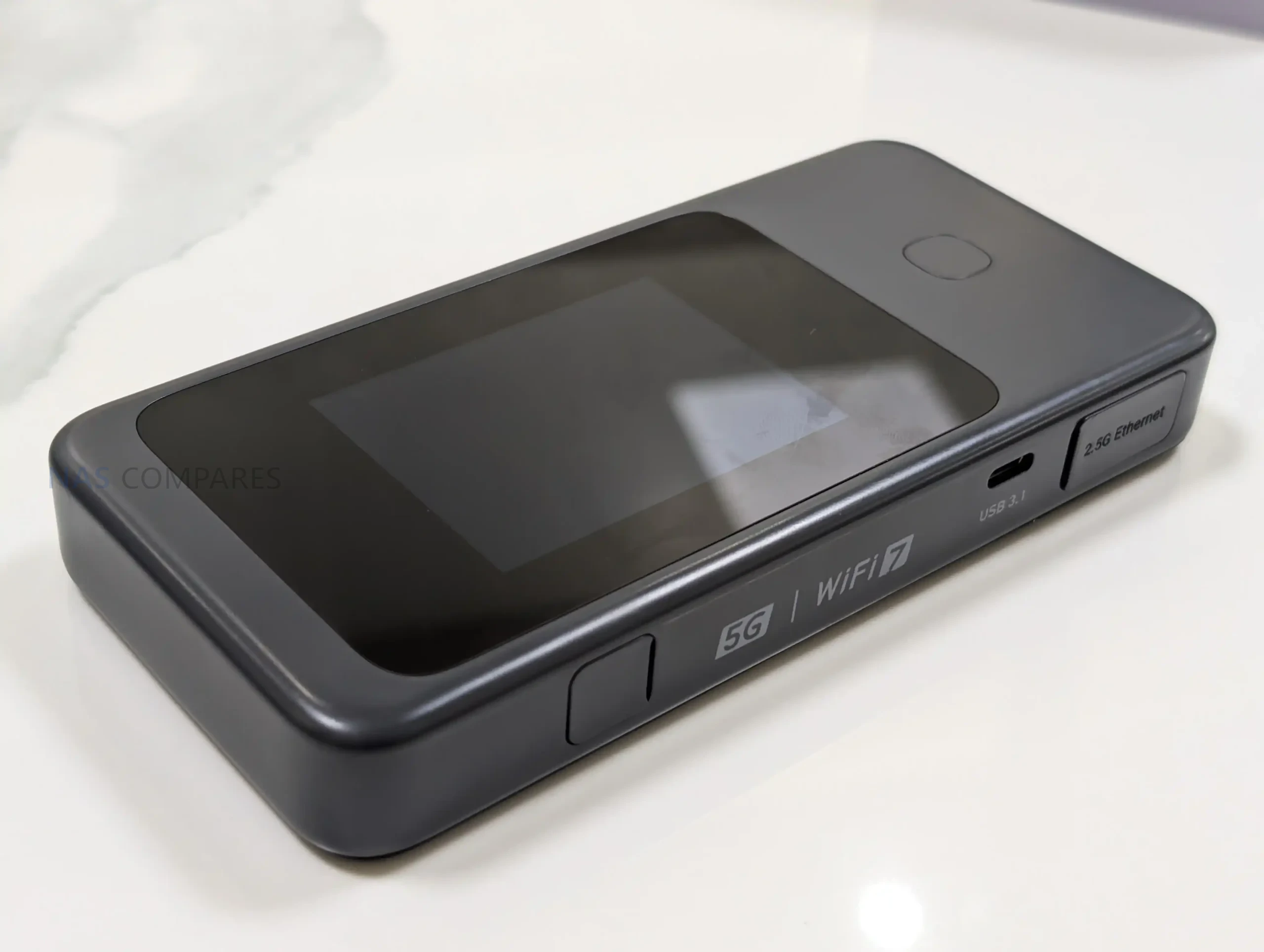
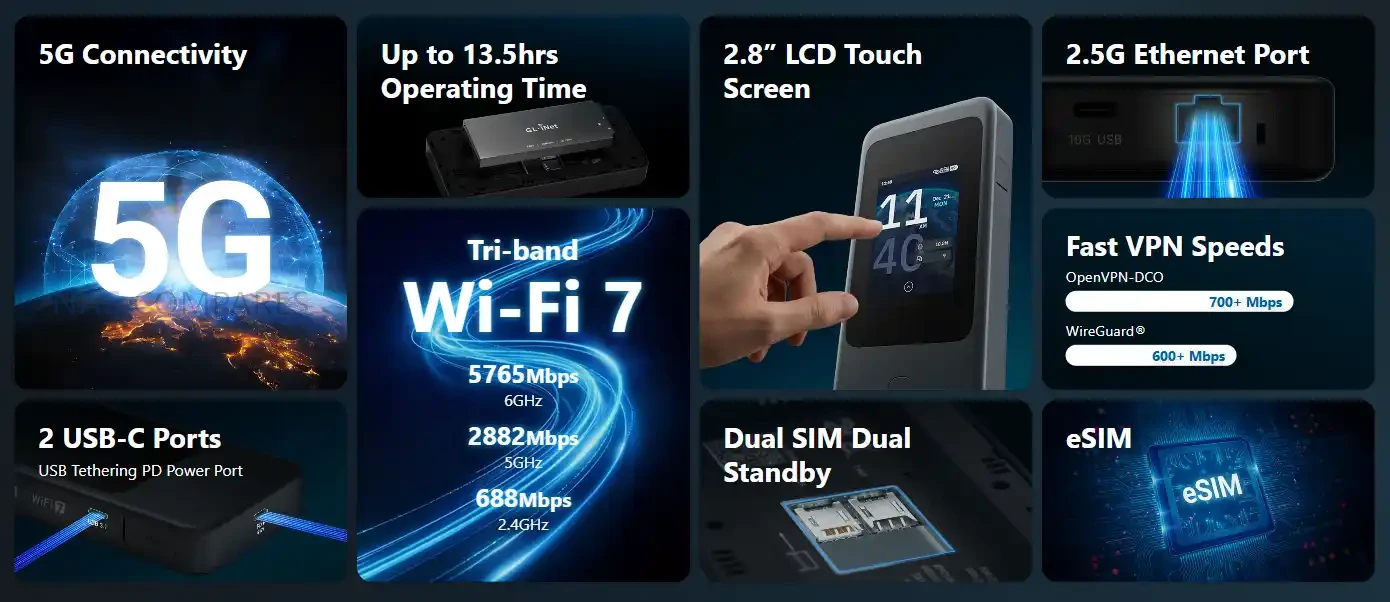
Gl.iNet is using day 1 of CES 2026 to spotlight the Mudi 7 travel router, with 2 listed variants: GL-E5800NA and GL-E5800EU. While the company is now formally presenting the device at the show and directing attention to its travel-focused positioning, it still has not published pricing or a confirmed retail release date in the materials available today. That leaves the Mudi 7’s market placement and availability timeline unresolved, even as the hardware is being discussed publicly at CES. Alongside the CES reveal, Gl.iNet has shared a full specification sheet that clarifies the Mudi 7’s core platform and feature set. It is based on a Qualcomm quad-core 2.2GHz design with 2GB LPDDR4X and 8GB eMMC, and it combines 5G NR with tri-band Wi-Fi 7-class networking, dual SIM dual standby plus eSIM, and a built-in touchscreen for on-device management. I previously saw an early prototype during a visit to Gl.iNet’s Shenzhen offices in October 2025, and the CES-era specification release fills in the internal details that were not available at the time, making it easier to assess what Gl.iNet intends to ship in the NA and EU variants.


Item Detail
Product name Gl.iNet Mudi 7 (Link to Official Page)
Models GL-E5800NA, GL-E5800EU
CPU Qualcomm, quad-core @ 2.2GHz
Memory 2GB LPDDR4X
Flash 8GB eMMC
Wireless protocol 802.11a/b/g/n/ac/ax/be
Bands 2.4GHz, 5GHz, 6GHz
Wi-Fi speeds 688Mbps (2.4GHz), 2882Mbps (5GHz), 5764Mbps (6GHz)
Cellular 5G NR NSA/SA; 4G LTE Cat 20 (DL)
SIM Dual SIM dual standby + eSIM
Ethernet 1x WAN/LAN, 100/1000/2500Mbps
USB 1x USB 3.1
External antenna Supported; 2x TS-9 (cellular)
Screen 2.8-inch touchscreen
Power input USB PD/PPS 5-12V, 30W max
Power consumption <30W
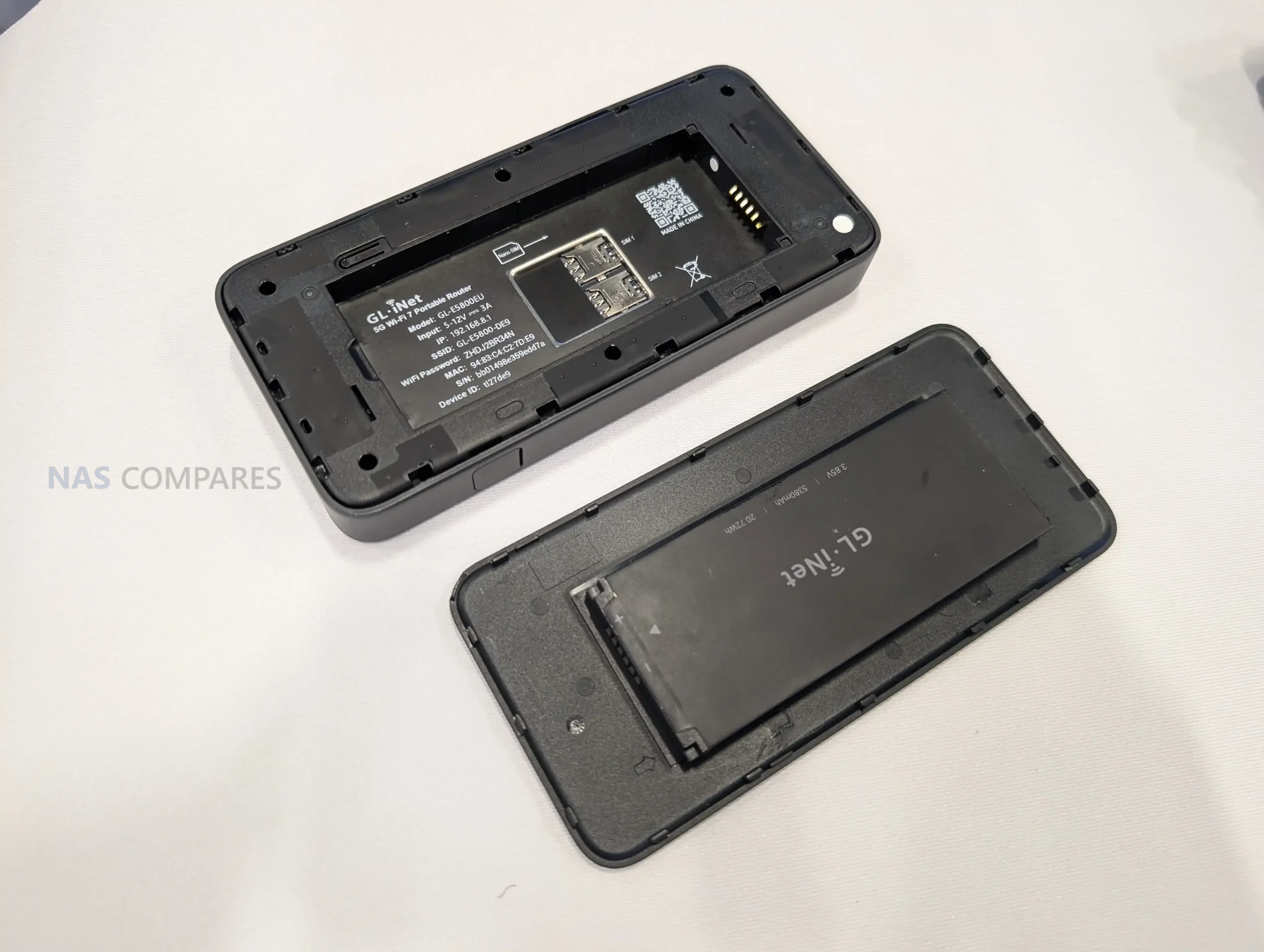
Battery 3.85V, 5380mAh, 20.72Wh
Dimensions / weight 157 x 75 x 22.8mm / 300g
Operating temperature 0C to 40C

Gl.iNet Mudi 7 Router – Design and Portability

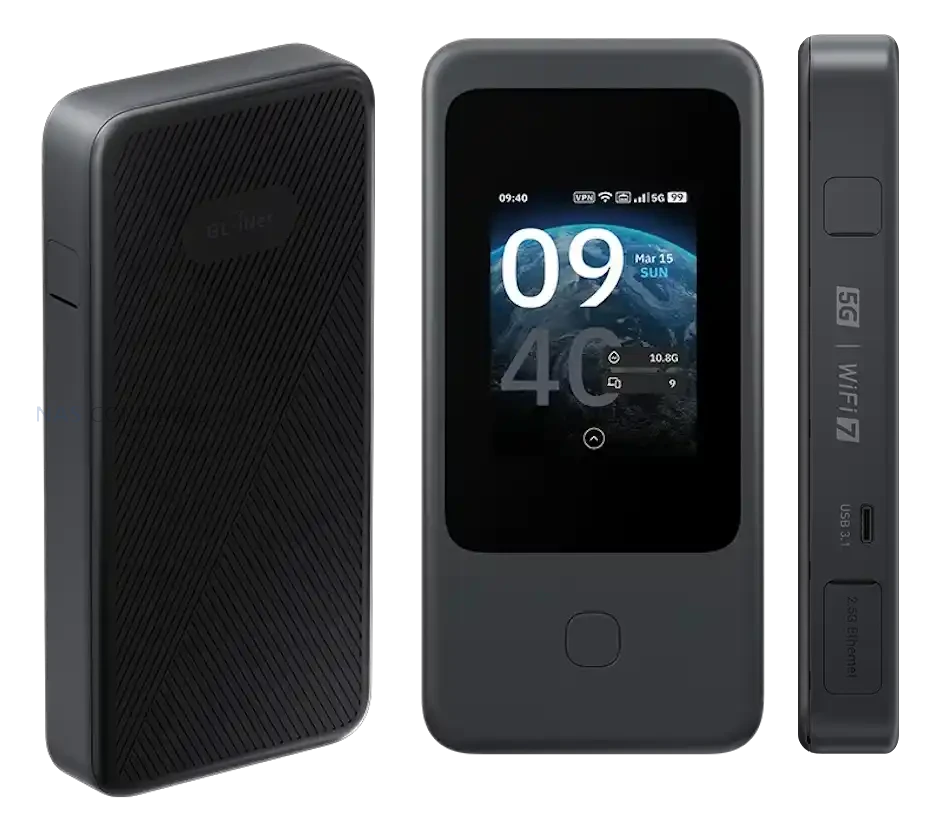
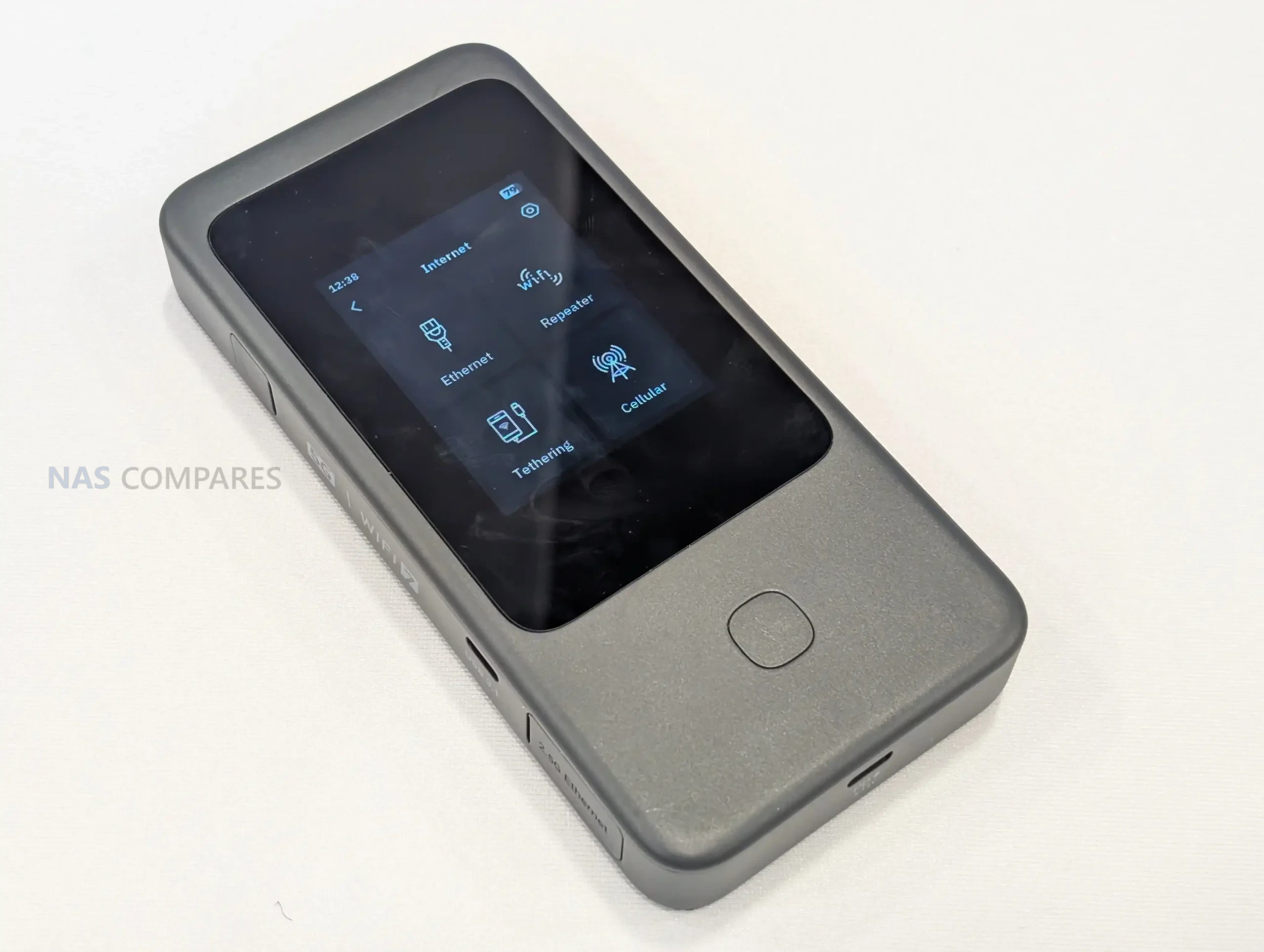
With the full specifications now available, the Mudi 7 is confirmed as a compact, battery-powered travel router measuring 157 x 75 x 22.8mm and weighing 300g. That footprint places it closer to a portable hotspot than a small desktop router, with enough thickness to accommodate a touchscreen, battery, and internal antennas.

Gl.iNet lists a 2.8-inch touchscreen as the primary on-device interface. In practical terms, this design choice supports situations where you need to check status or adjust basic settings without relying on a separate phone or laptop, which can be useful when moving between locations or sharing access with other devices.

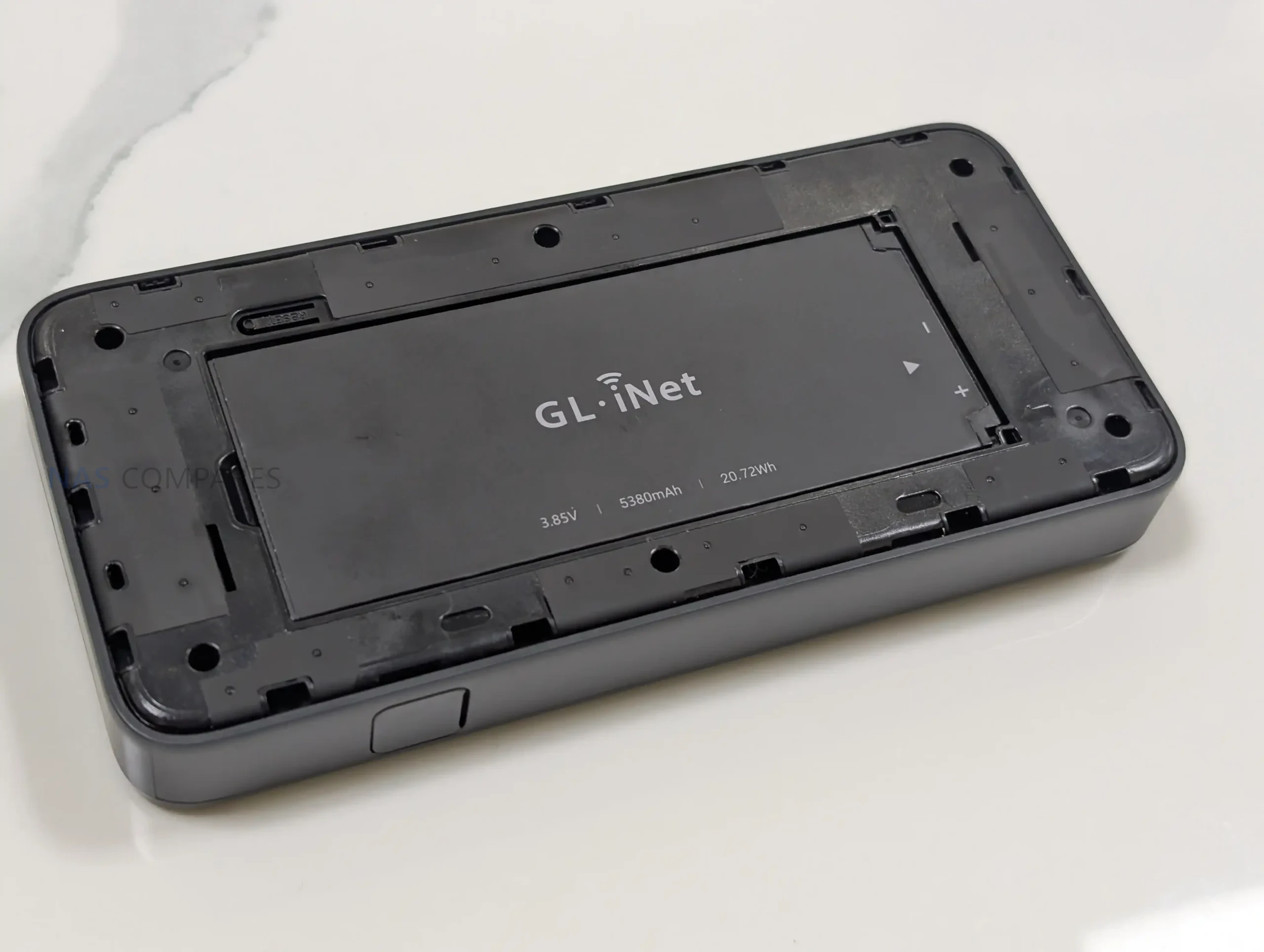
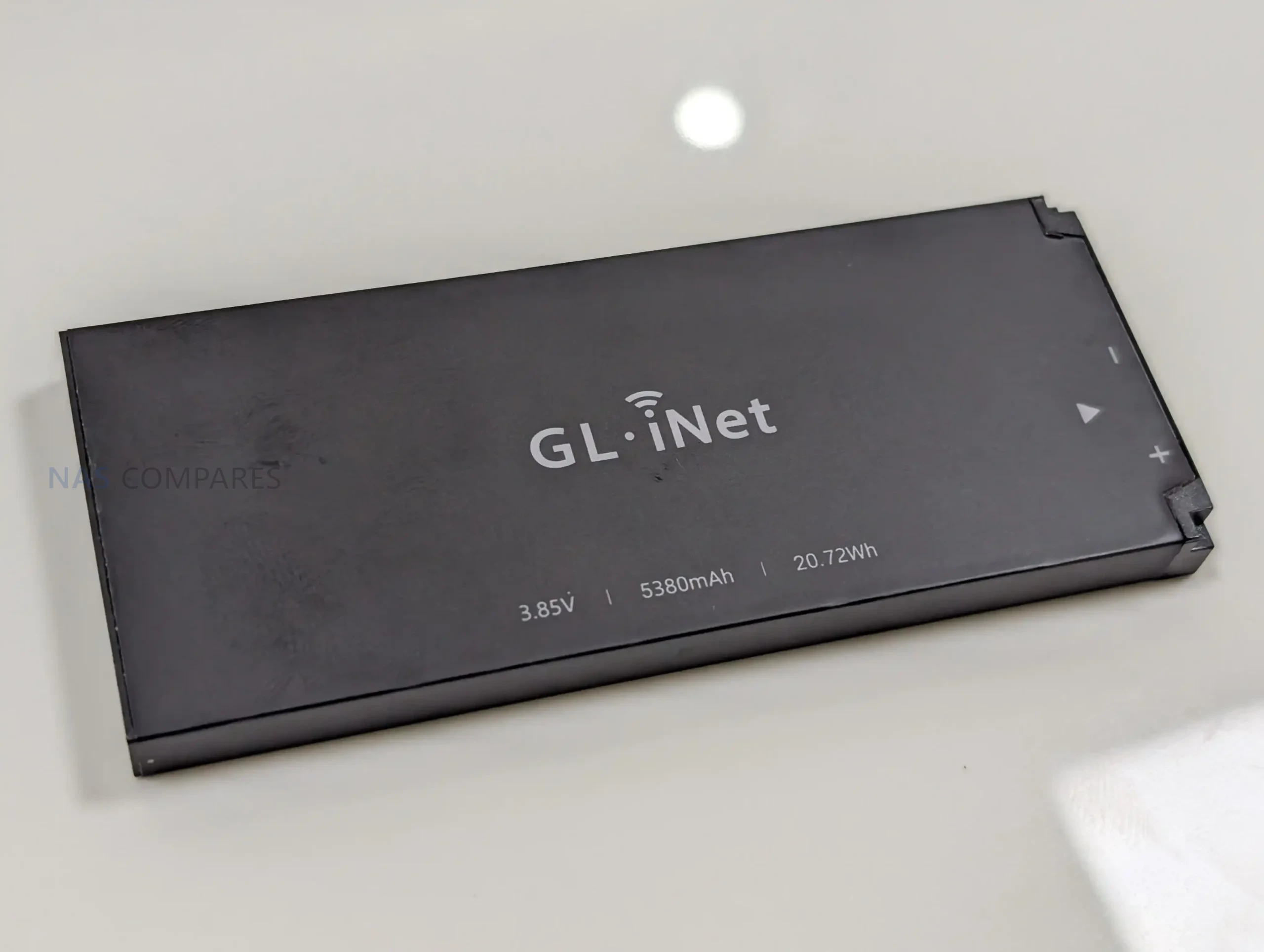
Power is handled through a built-in 3.85V, 5380mAh battery rated at 20.72Wh, and charging is specified as USB PD/PPS from 5V to 12V with up to 30W input. Gl.iNet also lists power consumption below 30W, which provides a ceiling for expected draw under load, though real battery life will still depend on cellular conditions, connected devices, and the mix of Wi-Fi and wired usage.

Gl.iNet Mudi 7 Router – Connectivity

Cellular is the main uplink option on the Mudi 7, with support listed for 5G NR in both NSA and SA modes. For fallback coverage, it also supports 4G LTE with Cat 20 download capability, which becomes relevant when 5G coverage is weak, when indoor signal conditions push the modem back to LTE, or when a roaming profile limits access to certain 5G services. Gl.iNet still has not published a band list in the specifications you shared, so region-by-region compatibility will depend on the exact supported bands of the NA and EU variants.

For SIM management, the router is specified with dual SIM dual standby and built-in eSIM support. In day-to-day use, that combination is intended to simplify switching between carriers, maintaining a backup line, or separating plans for different regions without having to physically swap cards as often. What remains unclear is how Gl.iNet handles priority rules, failover behavior, and eSIM provisioning in its interface, including whether switching can be automated based on signal or data limits.

On the local network side, the Mudi 7 supports 802.11a/b/g/n/ac/ax/be across 2.4GHz, 5GHz, and 6GHz. The published maximum Wi-Fi rates are 688Mbps on 2.4GHz, 2882Mbps on 5GHz, and 5764Mbps on 6GHz, which sets expectations for its theoretical peak throughput rather than typical sustained performance. Antenna information is also listed, including 2 internal Wi-Fi antennas covering 2.4GHz, 5GHz, and 6GHz, plus 6 internal cellular antennas for LTE and 5G NR, indicating an emphasis on maintaining link quality in variable travel environments.

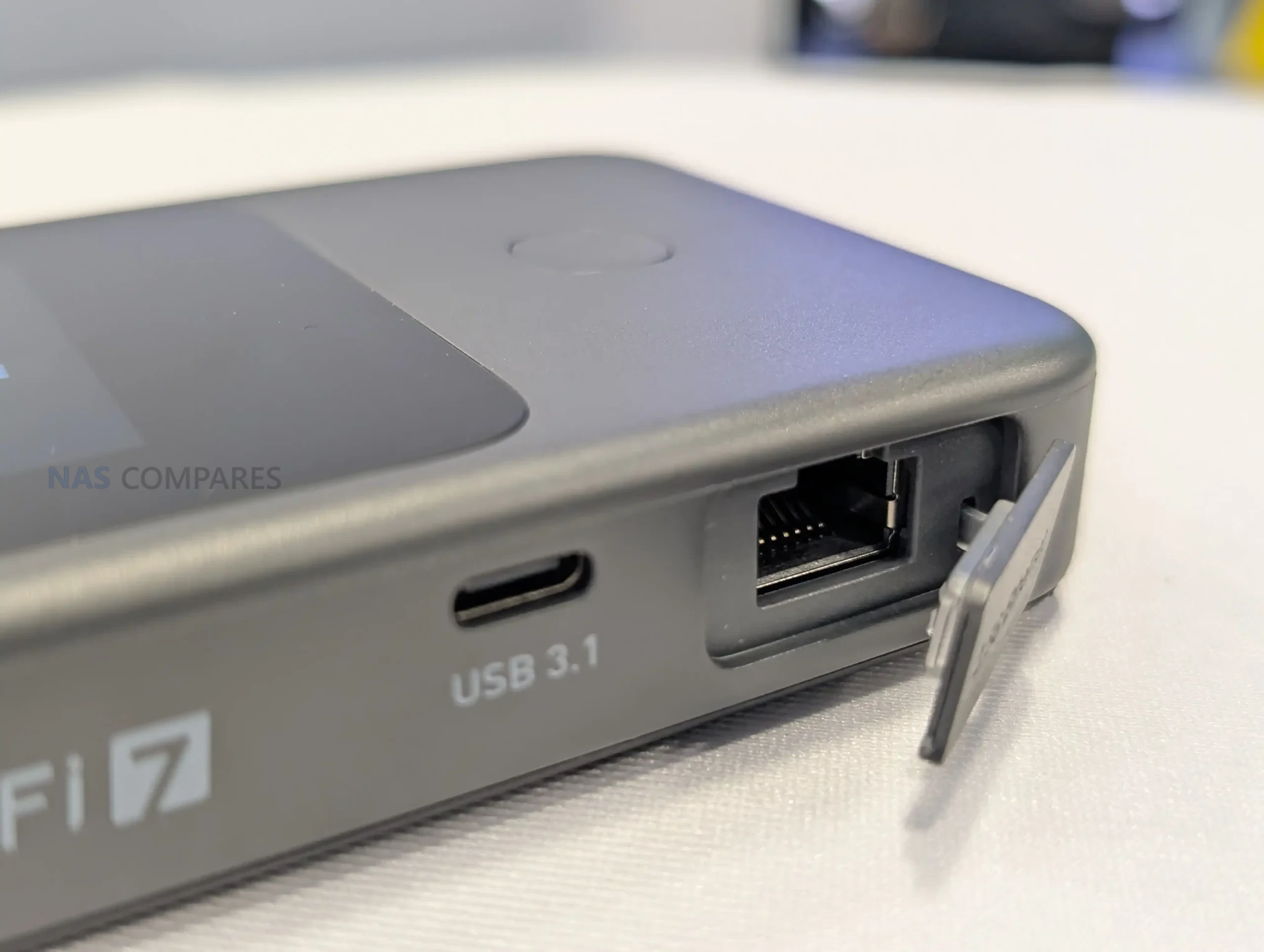
For wired and tethered connectivity, the router includes a single WAN/LAN Ethernet port rated at 100/1000/2500Mbps, allowing it to slot into networks that offer faster-than-gigabit service while keeping the option for a basic wired LAN connection. It also lists 1 USB 3.1 port, which can be relevant for tethering or attaching compatible peripherals depending on firmware support, but Gl.iNet has not detailed the exact supported use cases yet. External antennas are supported for cellular via 2 TS-9 ports, while external Wi-Fi antenna support is not specified in the sheet, suggesting any range extension is primarily aimed at improving cellular reception.

Gl.iNet Mudi 7 Router – Internal Hardware

The Mudi 7 is based on a Qualcomm platform, listed with a quad-core CPU clocked at 2.2GHz. Gl.iNet does not specify the exact chipset model in the specification sheet, so it is not yet possible to compare its CPU class directly against other travel routers using named Snapdragon or IPQ-series parts. Even so, the stated clock speed and multi-core layout indicate it is designed to handle routing, Wi-Fi management, and cellular tasks concurrently rather than relying on a lower-power single-core design.

Memory is specified as 2GB of LPDDR4X. That capacity is typically relevant for sustaining multiple client connections, running VPN tunnels, and keeping the management interface responsive while traffic is flowing. In practice, how far 2GB goes will depend on the software stack, the number of enabled services, and whether features like traffic monitoring or advanced firewall rules are running continuously.

For onboard storage, the Mudi 7 includes 8GB of eMMC flash. This is generally used for the operating system image, configuration data, and any built-in packages or logs, though Gl.iNet has not detailed how much of that space is reserved versus user-accessible. The specification also does not clarify whether there is any storage expansion path, or how storage is managed over time for items like VPN profiles, connection history, and accumulated logs.

Gl.iNet Mudi 7 Router – Conclusion

On January 6, 2026, the opening day of CES 2026, Gl.iNet is drawing attention to the Mudi 7 as its next travel router, listed in 2 variants: GL-E5800NA and GL-E5800EU. The published specification sheet outlines a Qualcomm quad-core 2.2GHz platform with 2GB LPDDR4X and 8GB eMMC, paired with 5G NR (NSA and SA) and tri-band Wi-Fi across 2.4GHz, 5GHz, and 6GHz. The physical and power details are also clear at this stage. Gl.iNet lists the Mudi 7 at 157 x 75 x 22.8mm and 300g, with a 3.85V 5380mAh battery rated at 20.72Wh and USB PD/PPS input up to 30W. Interfaces include a single WAN/LAN Ethernet port rated up to 2500Mbps, 1 USB 3.1 port, and 2 TS-9 ports for external cellular antennas, while a 2.8-inch touchscreen is positioned as a central part of on-device control.

Even with those specifications confirmed, several practical release details remain open on day 1. Gl.iNet has not published pricing, a retail availability date, or a cellular band list for each regional variant, which will determine how well the NA and EU models align with specific carriers and travel use cases. The company has also not provided a complete, Mudi 7-specific breakdown of firmware features and long-term software support, leaving the final day-to-day picture dependent on what is shown during CES and what ships in the retail firmware.


📧 SUBSCRIBE TO OUR NEWSLETTER 🔔
[contact-form-7]
🔒 Join Inner Circle

Get an alert every time something gets added to this specific article!


Want to follow specific category? 📧 Subscribe

This description contains links to Amazon. These links will take you to some of the products mentioned in today's content. As an Amazon Associate, I earn from qualifying purchases. Visit the NASCompares Deal Finder to find the best place to buy this device in your region, based on Service, Support and Reputation - Just Search for your NAS Drive in the Box Below

Need Advice on Data Storage from an Expert?

Finally, for free advice about your setup, just leave a message in the comments below here at NASCompares.com and we will get back to you. Need Help? Where possible (and where appropriate) please provide as much information about your requirements, as then I can arrange the best answer and solution to your needs. Do not worry about your e-mail address being required, it will NOT be used in a mailing list and will NOT be used in any way other than to respond to your enquiry. [contact-form-7] TRY CHAT Terms and Conditions
If you like this service, please consider supporting us. We use affiliate links on the blog allowing NAScompares information and advice service to be free of charge to you.Anything you purchase on the day you click on our links will generate a small commission which isused to run the website. Here is a link for Amazon and B&H.You can also get me a ☕ Ko-fi or old school Paypal. Thanks!To find out more about how to support this advice service check HEREIf you need to fix or configure a NAS, check Fiver Have you thought about helping others with your knowledge? Find Instructions Here  
 
Or support us by using our affiliate links on Amazon UK and Amazon US
    
 
Alternatively, why not ask me on the ASK NASCompares forum, by clicking the button below. This is a community hub that serves as a place that I can answer your question, chew the fat, share new release information and even get corrections posted. I will always get around to answering ALL queries, but as a one-man operation, I cannot promise speed! So by sharing your query in the ASK NASCompares section below, you can get a better range of solutions and suggestions, alongside my own.

☕ WE LOVE COFFEE ☕

 
Where to Buy a Product
amzamexmaestrovisamaster 24Hfree delreturn VISIT RETAILER ➤ 
amzamexmaestrovisamaster 24Hfree delreturn VISIT RETAILER ➤

If you like this service, please consider supporting us.
We use affiliate links on the blog allowing NAScompares information and advice service to be free of charge to you. Anything you purchase on the day you click on our links will generate a small commission which is used to run the website. Here is a link for Amazon and B&H. You can also get me a ☕ Ko-fi or old school Paypal. Thanks! To find out more about how to support this advice service check HERE    

☕ WE LOVE COFFEE ☕

Or support us by using our affiliate links on Amazon UK and Amazon US
     

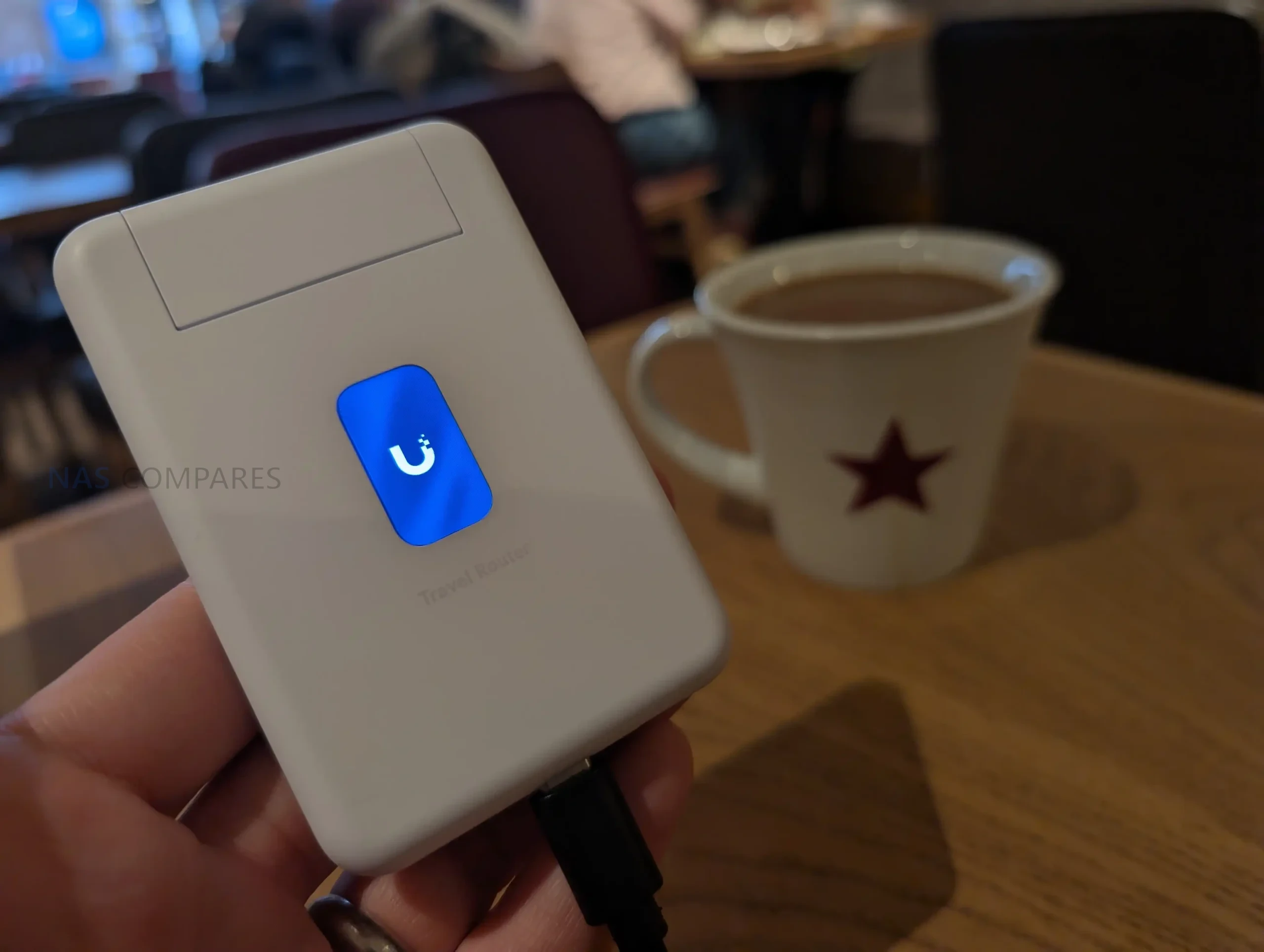
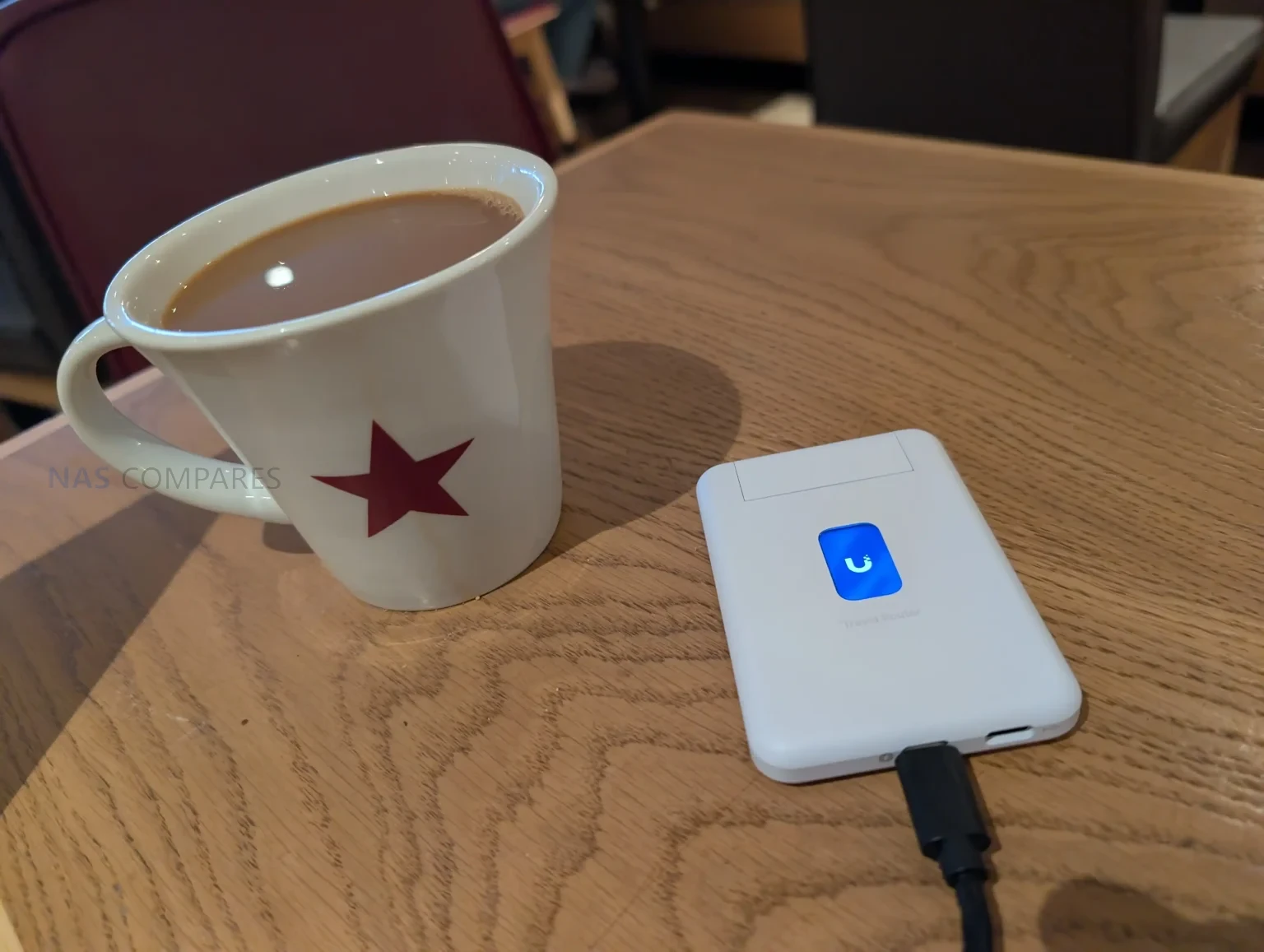
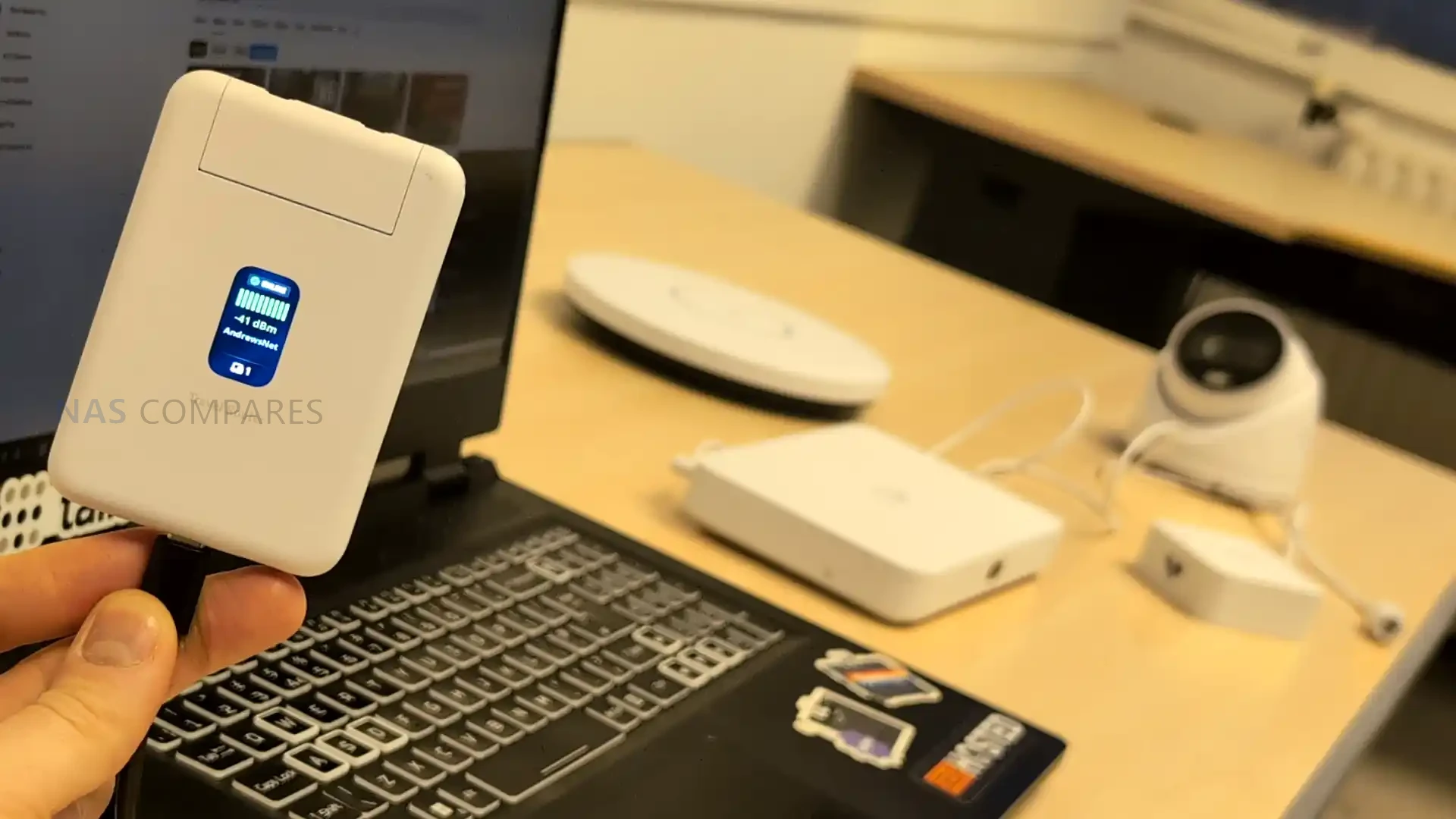
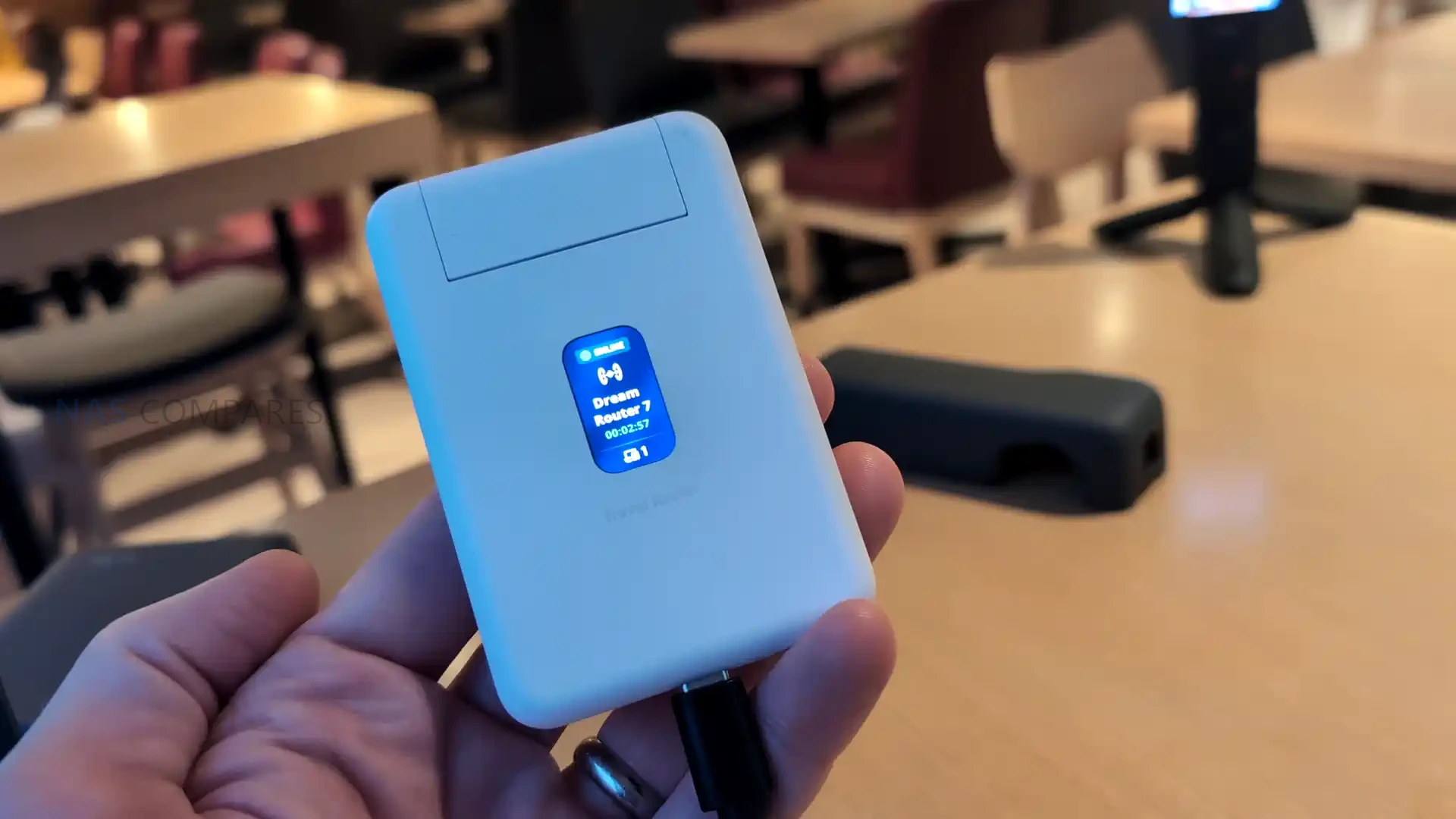
UniFi Travel Router Early Review

UniFi’s New Travel Router – Pocket-Sized Perfection?

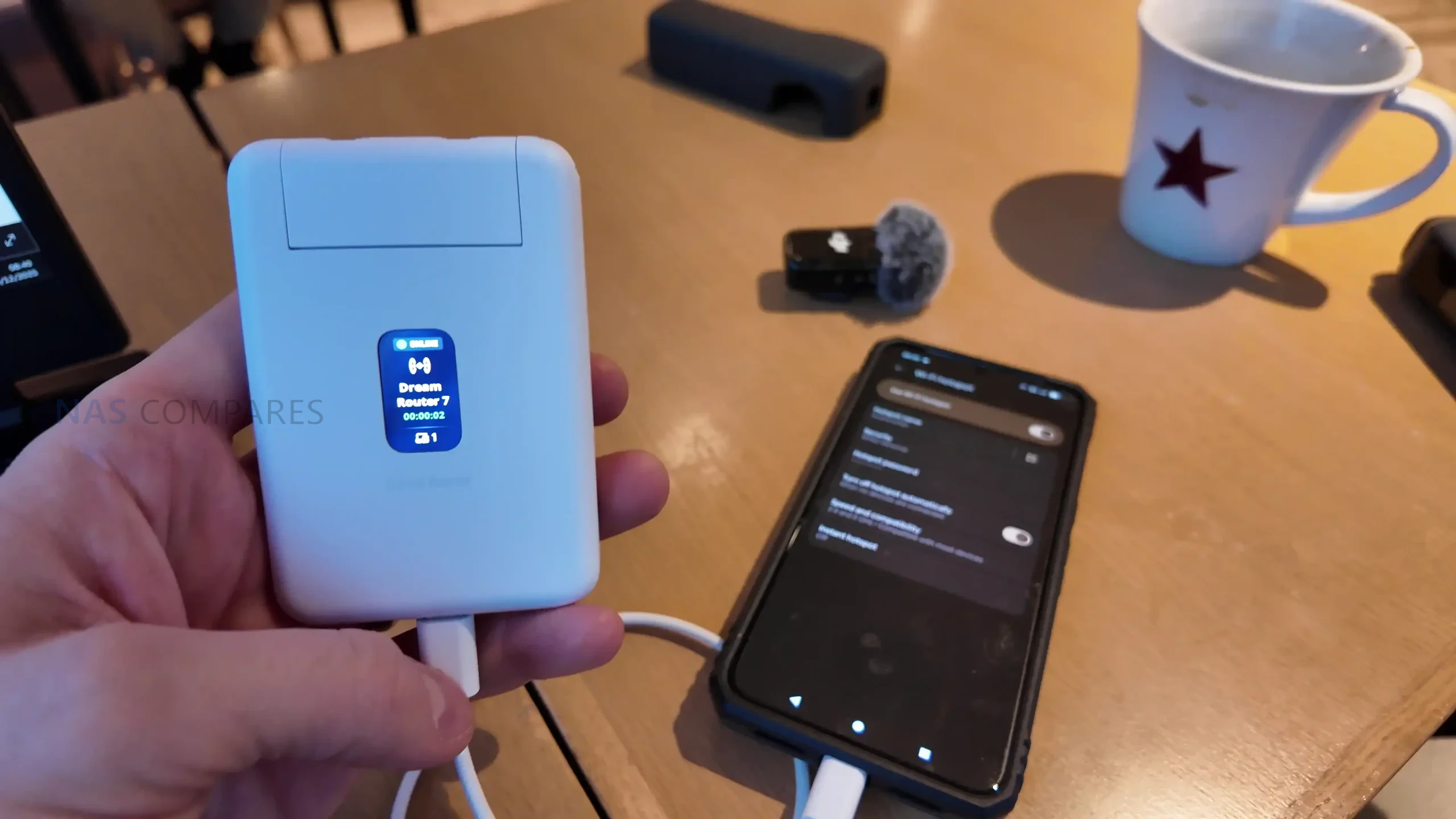
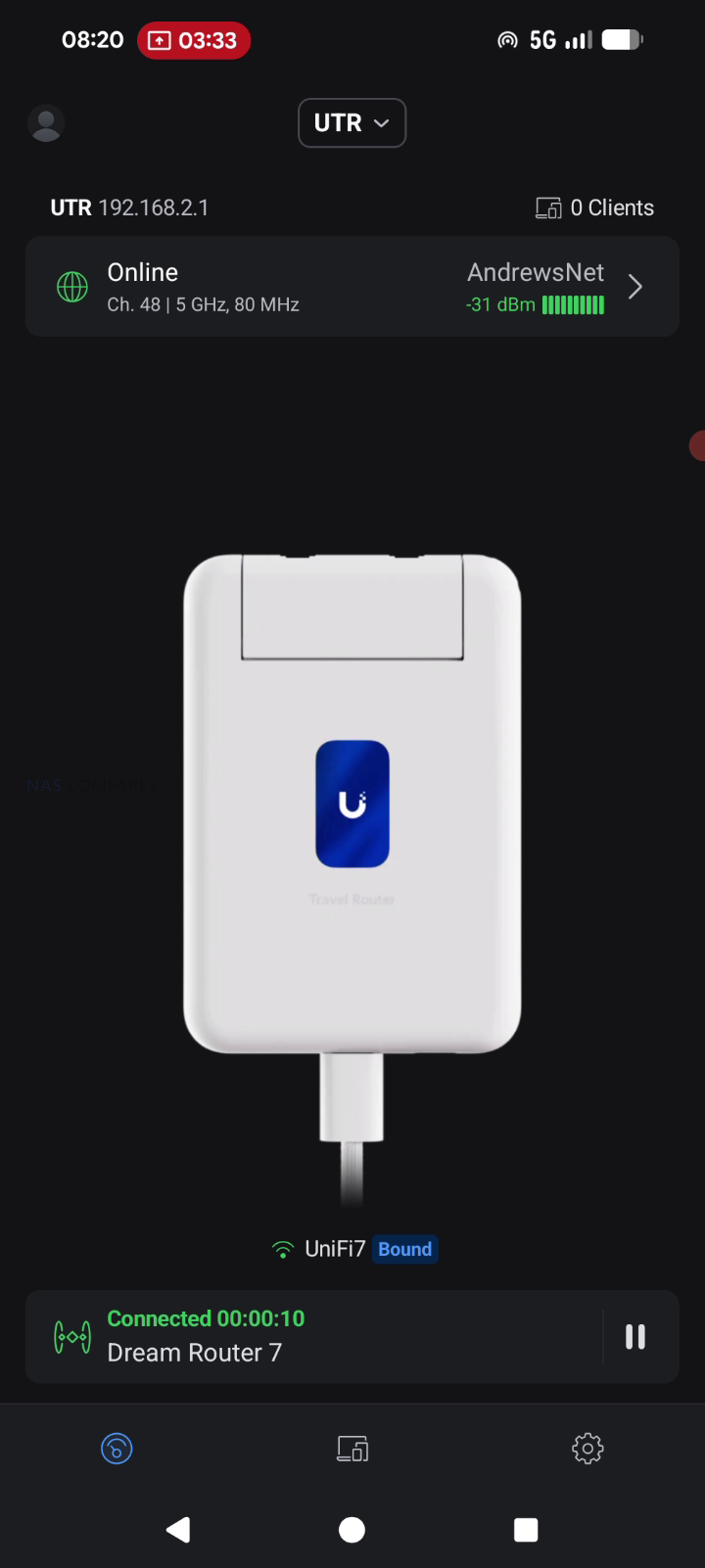
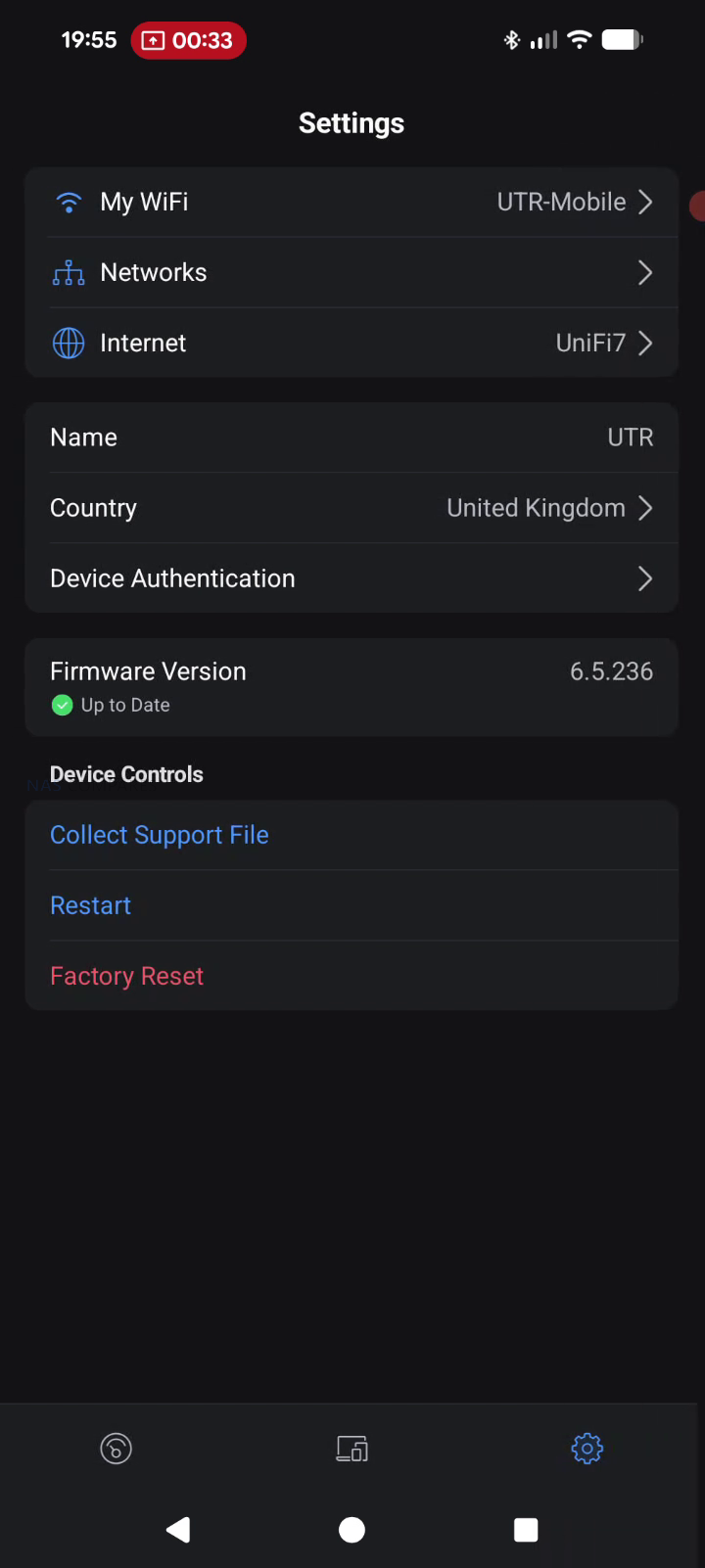
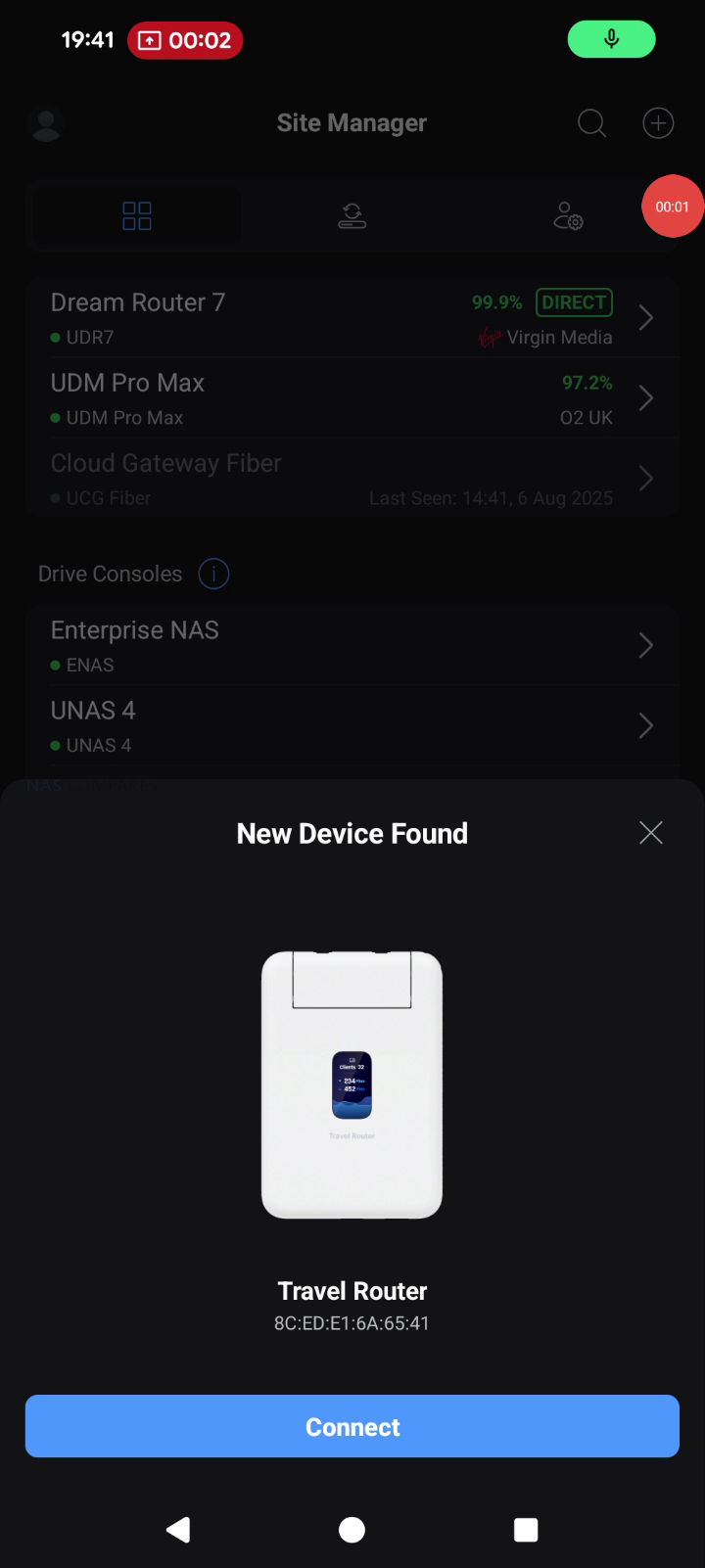
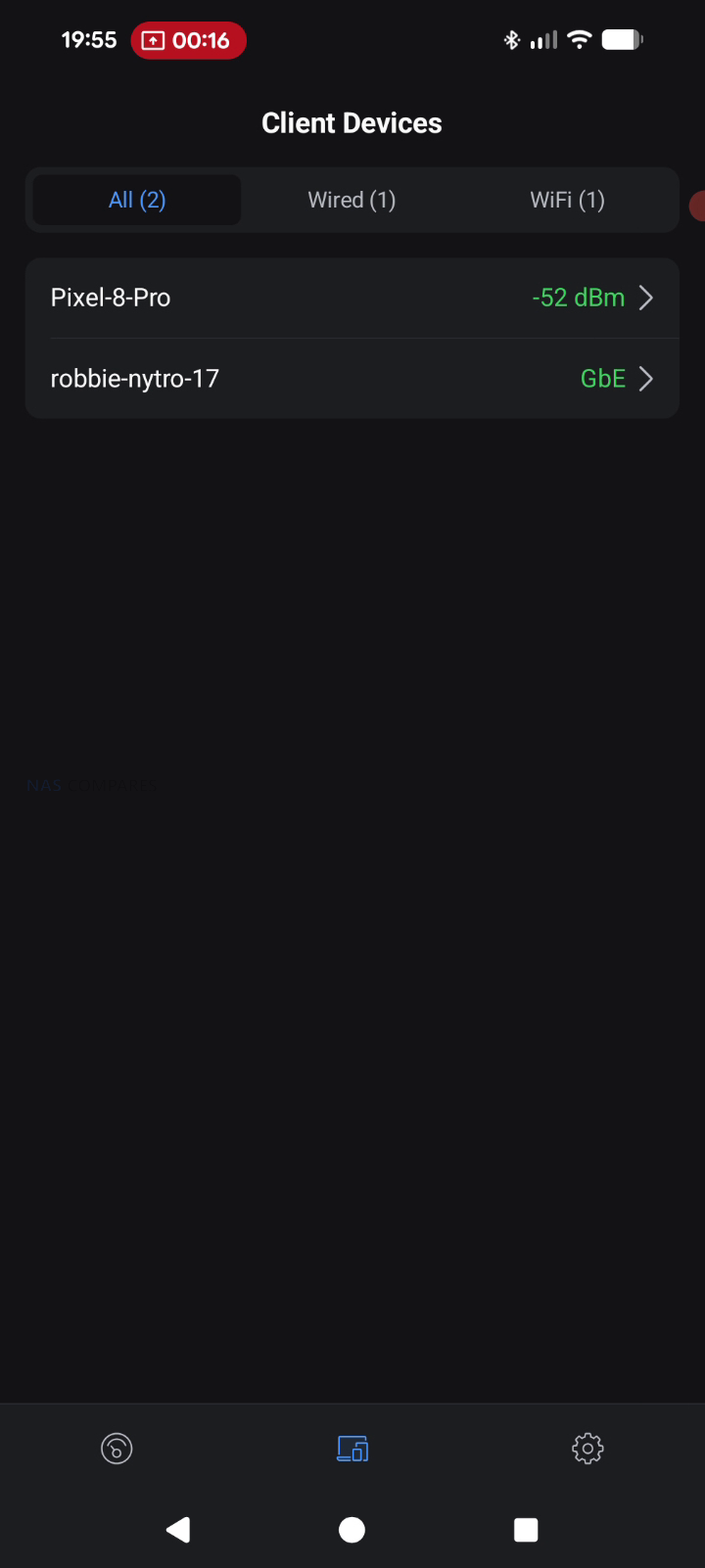
The UniFi Travel Router (UTR) is a compact router intended to extend an existing UniFi network to temporary locations such as hotels, offices, or public WiFi environments, with setup and changes handled through the UniFi Mobile App rather than on device controls. It is designed to bind to a UniFi site so that WiFi settings and Teleport can be applied automatically, allowing a familiar SSID and consistent LAN behavior to follow the user between locations without re adopting devices each time. In practical use, this positions it as a way to place multiple client devices behind a single controlled access point when working from shared networks, while still routing traffic through a VPN path back to a UniFi gateway if desired. The UTR also supports multiple uplink types, including Ethernet, WiFi, and USB tethering through a smartphone, with the ability to set uplink priority once an upstream connection has been established and any captive portal login has been completed via the phone.

Item Detail
Product UniFi Travel Router (UTR)
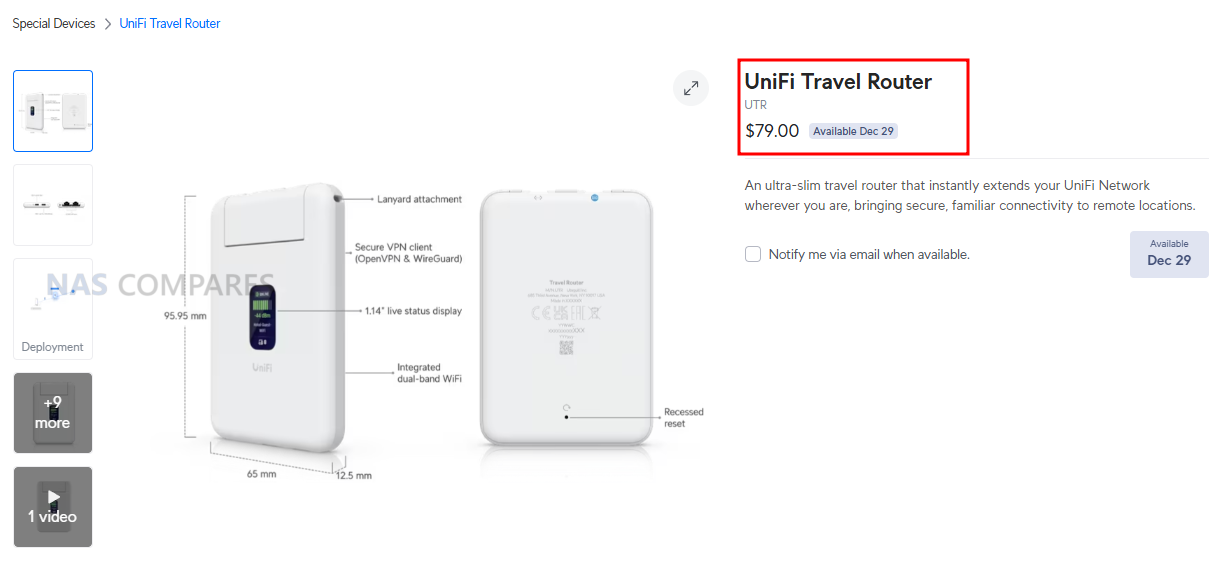
Price $79.00
Dimensions 95.95 x 65 x 12.5 mm
Weight 89 g
WiFi standard WiFi 5 (802.11ac)
Bands 2.4 GHz, 5 GHz
WiFi MIMO 2 x 2
Antennas 2 embedded WiFi antennas
Max TX power 2.4G: 13 dBm, 5G: 13 dBm
Ethernet ports 2 x GbE RJ45
VPN client support OpenVPN, WireGuard
Power method USB-C
Power input 5V / 2A (adapter not included)
Max power consumption 5W
Display 1.14″ status display
Button Factory reset
Certifications CE, FCC, IC
Compliance NDAA compliant
Not supported (per docs) WPA Enterprise, Passpoint

UniFi Travel Router Review – Quick Conclusion

The UniFi Travel Router looks like a genuinely handy tool for people already invested in UniFi: it gives you a small, light travel router with two gigabit ports (WAN and LAN), USB C power, separate USB tethering for using a phone as a 5G uplink, and a status screen that makes it easy to confirm what uplink you are using and whether Teleport is active, plus the big headline benefit that you can bind it to an existing UniFi setup and effectively carry your familiar SSID and behavior with you so your devices and even colleagues can connect without reconfiguring anything, while tunneling sensitive traffic back home through Teleport for safer use on hotel, office, or coffee shop networks and simplifying captive portal logins through the app. The tradeoffs are mostly about performance and features compared with newer rivals: it is WiFi 5 only with modest real world throughput expectations, the Ethernet ports are 1 GbE rather than 2.5 GbE, the screen is not touch so you still rely on the mobile app for changes, and there is no internal battery plus no built in SIM or eSIM option, which will disappoint anyone wanting an all in one, fully cellular travel router rather than a UniFi focused extender that leans on WiFi uplinks, wired WAN, or phone tethering.

BUILD QUALITY - 9/10
HARDWARE - 8/10
PERFORMANCE - 7/10
PRICE - 8/10
VALUE - 8/10


8.0
PROS
👍🏻Deep UniFi ecosystem fit, can bind to an existing UniFi site for a familiar setup on the go
👍🏻Teleport support enables secure remote access back to your UniFi network on public WiFi
👍🏻Can clone an existing SSID so your devices connect without reconfiguring
👍🏻Multi uplink flexibility: WiFi uplink, wired WAN via Ethernet, and USB tethering via smartphone
👍🏻Captive portal logins are handled through the mobile app, simplifying hotel and guest WiFi access
👍🏻Two gigabit ports (WAN and LAN) allow simple wired integration when available
👍🏻Separate USB C power and separate USB tethering is practical for travel scenarios
👍🏻Pocket sized, lightweight design with a helpful status display for quick connection checks
CONS
👎🏻WiFi 5 only, so performance and feature set trail newer WiFi 6 or WiFi 7 travel routers
👎🏻Ethernet is 1 GbE, not 2.5 GbE
👎🏻No internal battery and no built in SIM or eSIM option for standalone cellular use


UniFi Travel Router – Design

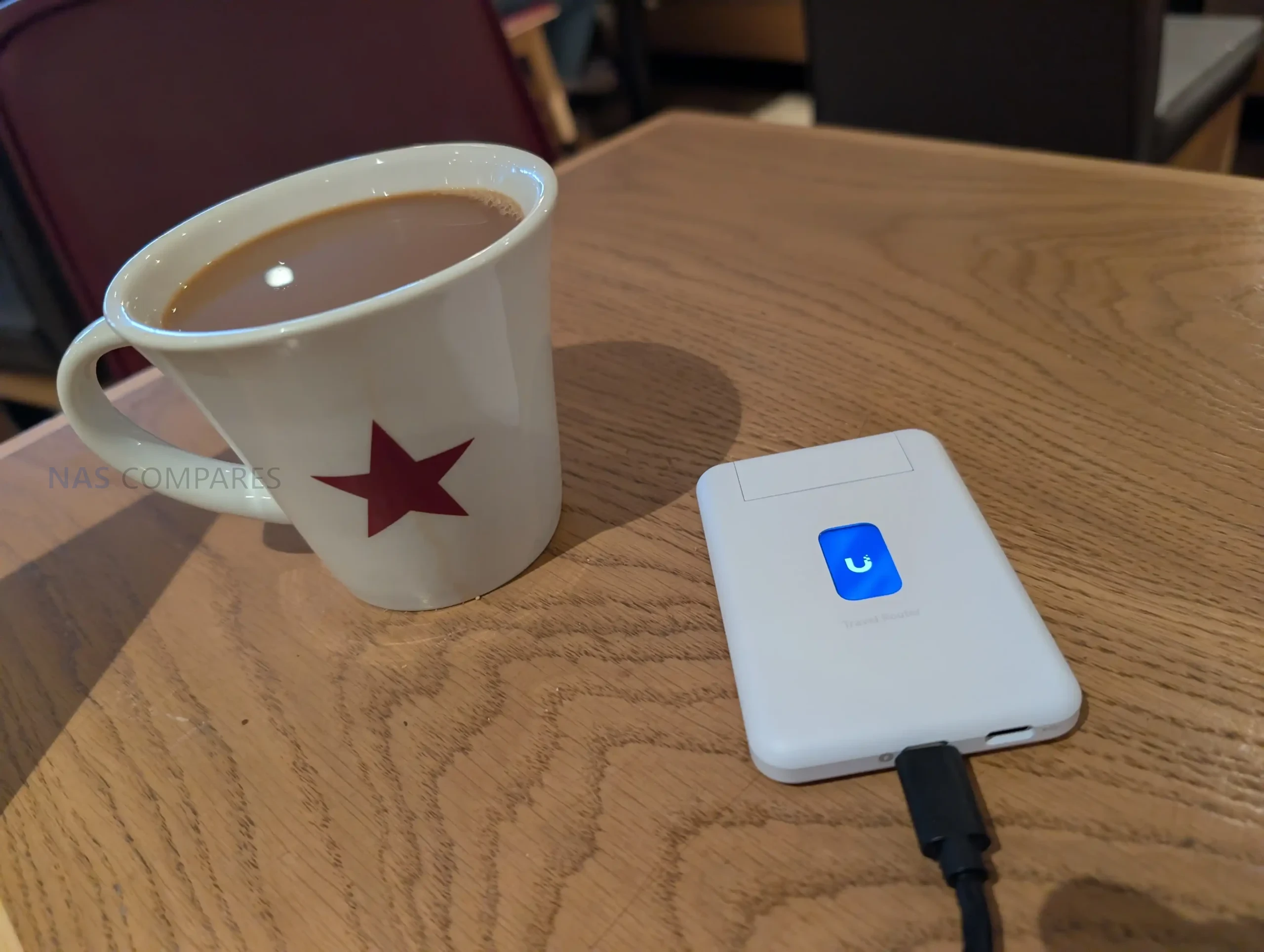
The UTR uses a slim, pocket oriented chassis that matches its intended role as a portable router rather than a fixed installation device. At 95.95 x 65 x 12.5 mm and 89 g, it is sized to carry alongside a phone, power bank, or small toolkit, and the enclosure is polycarbonate rather than metal. The design is built around external power, with no internal battery listed, so it is meant to be powered from common USB sources such as a charger, a power bank, or an available USB port in transit environments. UniFi specifies a USB-C 5V 2A input and up to 5W consumption, which places it within the output range of typical phone chargers and many shared USB outlets, but also means functionality depends on having a reliable external power source.

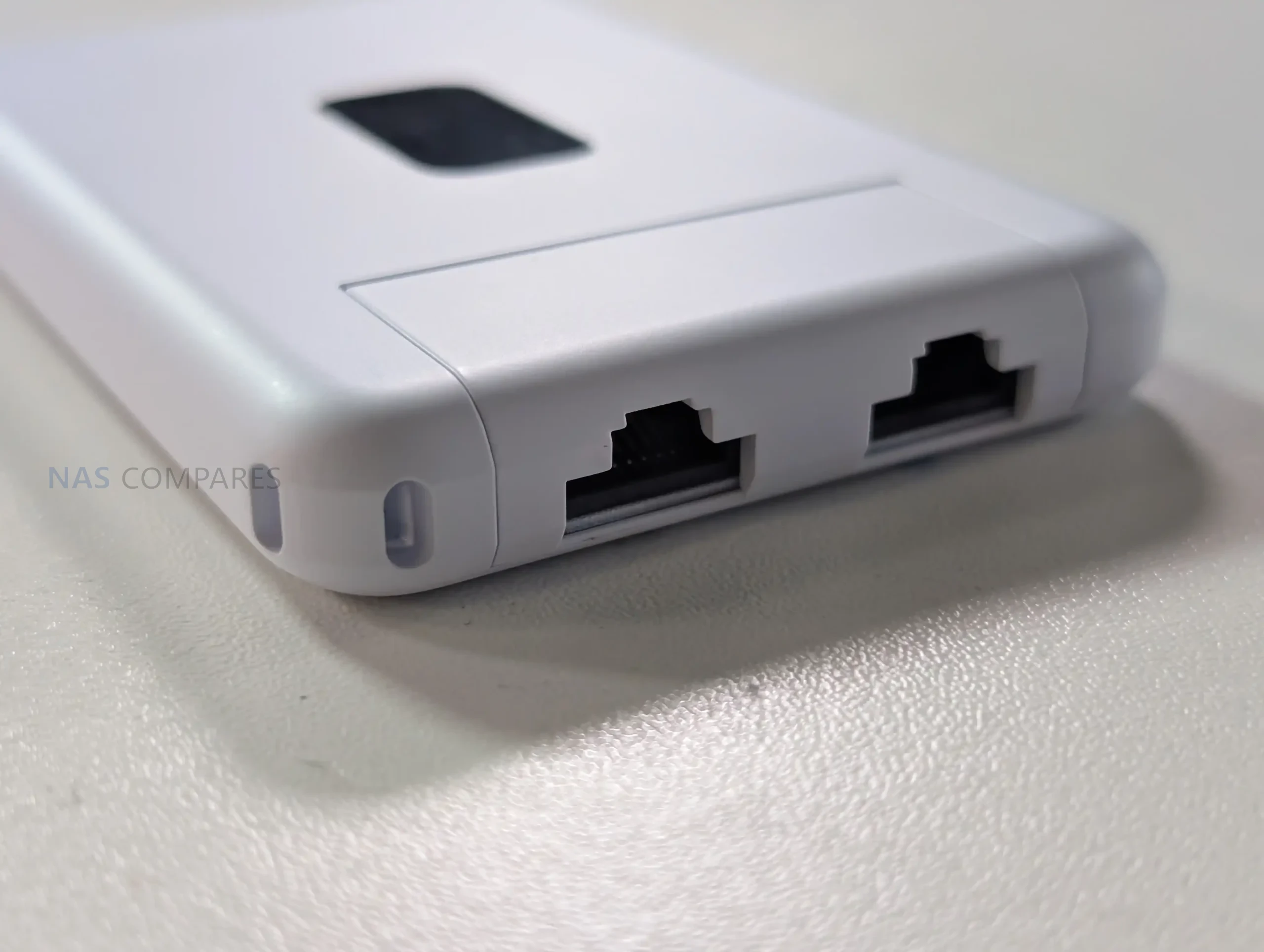
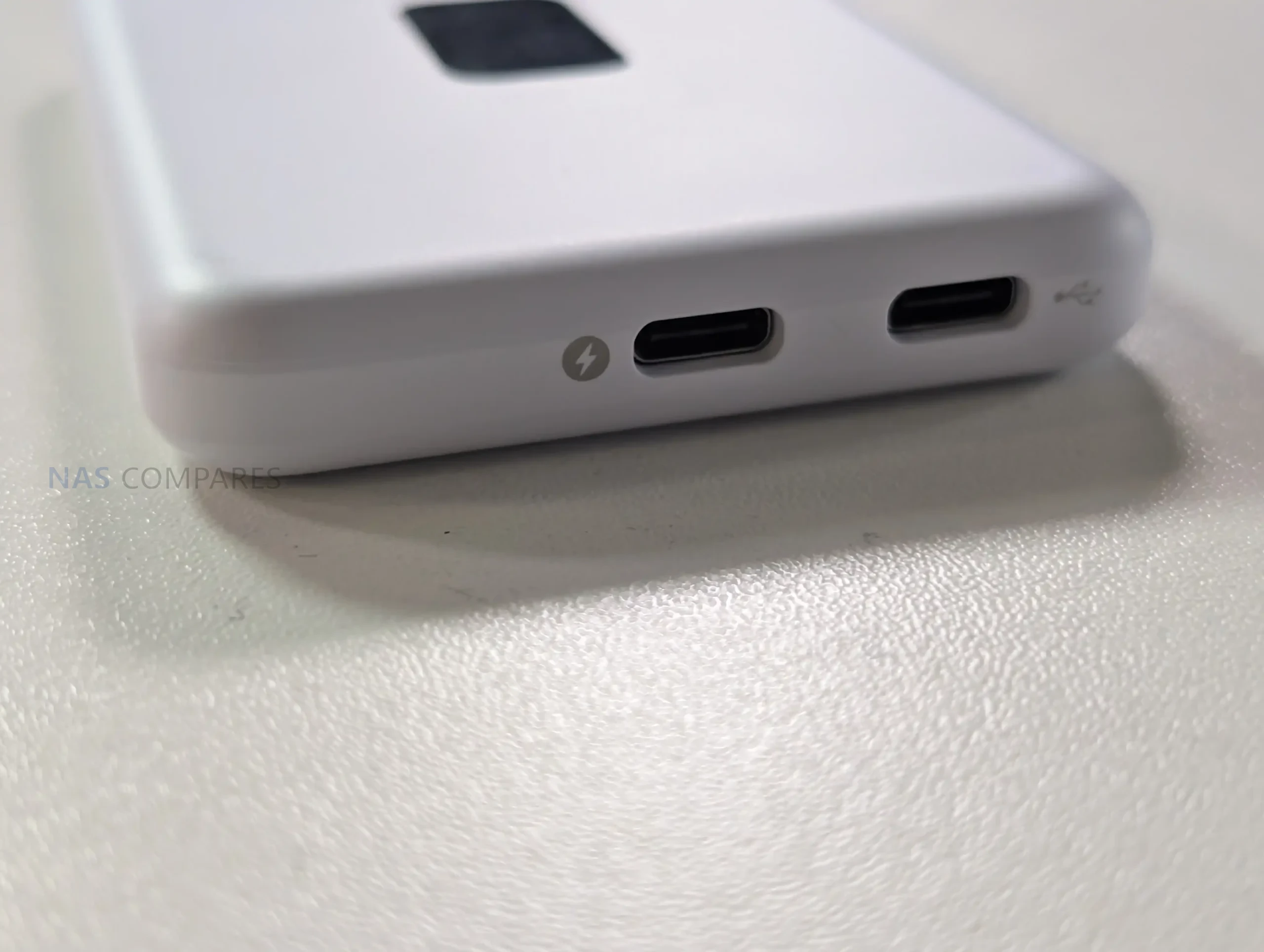
Physical I O is minimal and focused on travel use, with emphasis on flexibility rather than high port count. The unit provides 2 x GbE RJ45 ports for wired connectivity, typically used as WAN and LAN in practice, enabling either a wired upstream connection or a direct wired link to a local device when needed. It also includes a factory reset button but no other on device controls for configuration changes. In your usage notes, you highlighted that power and USB tethering are separated, allowing the device to stay powered from one source while using a different connection for phone tethering, which avoids the single port limitation found on some compact travel routers. You also noted that this layout suits scenarios where the most convenient power source might be a multi port power bank or a vehicle and public USB outlet, while the tether source remains the phone.

Status feedback is provided through a 1.14 inch display, but it is not a touchscreen, and configuration changes are handled in the UniFi Mobile App. This means the display functions as a quick reference for connection state and operational mode, such as whether it is using a particular uplink or whether Teleport is active, rather than a control surface for changing settings. Internally, WiFi is delivered via 2 embedded antennas with 2 x 2 MIMO and listed maximum transmit power of 13 dBm on both 2.4G and 5G, reflecting a design focused on compactness rather than external antenna placement. Operating limits are specified at -10 to 40 C and 5 to 95% noncondensing humidity, and the unit is listed as NDAA compliant with CE, FCC, and IC certifications, which may matter for users deploying it in regulated or corporate environments.

UniFi Travel Router – Connectivity

The UTR is built around 3 uplink paths: wired Ethernet, wireless WAN, and USB tethering through a smartphone, with the router acting as the single aggregation point for connected client devices. On the wired side, it provides 2 x GbE RJ45 ports, typically used as 1 WAN and 1 LAN, which allows a direct connection to an upstream network where a desk port or wall jack is available, while still offering a wired LAN handoff to a laptop, switch, or other local device. In your review, you also noted the practical advantage of using a wired uplink in temporary deployments, since it avoids relying entirely on building WiFi when you are on site for multiple days and want more predictable upstream stability.

For wireless connectivity, the UTR uses WiFi 5 (802.11ac) across 2.4 GHz and 5 GHz, with 2 x 2 MIMO and support for typical channel widths of 20, 40, and 80 MHz. UniFi lists a maximum 802.11ac data rate of up to 866.7 Mbps at VHT 80 and corresponding 802.11n rates up to 300 Mbps, with legacy 802.11a b g rates also supported for compatibility. In your video, you set expectations around real world throughput, noting that this class of WiFi 5 travel router can feel limited compared with newer WiFi 6 and WiFi 7 options, and you referenced typical observed uplink figures around 150 Mbps in the context of public WiFi and travel scenarios rather than sustained near gigabit speeds.

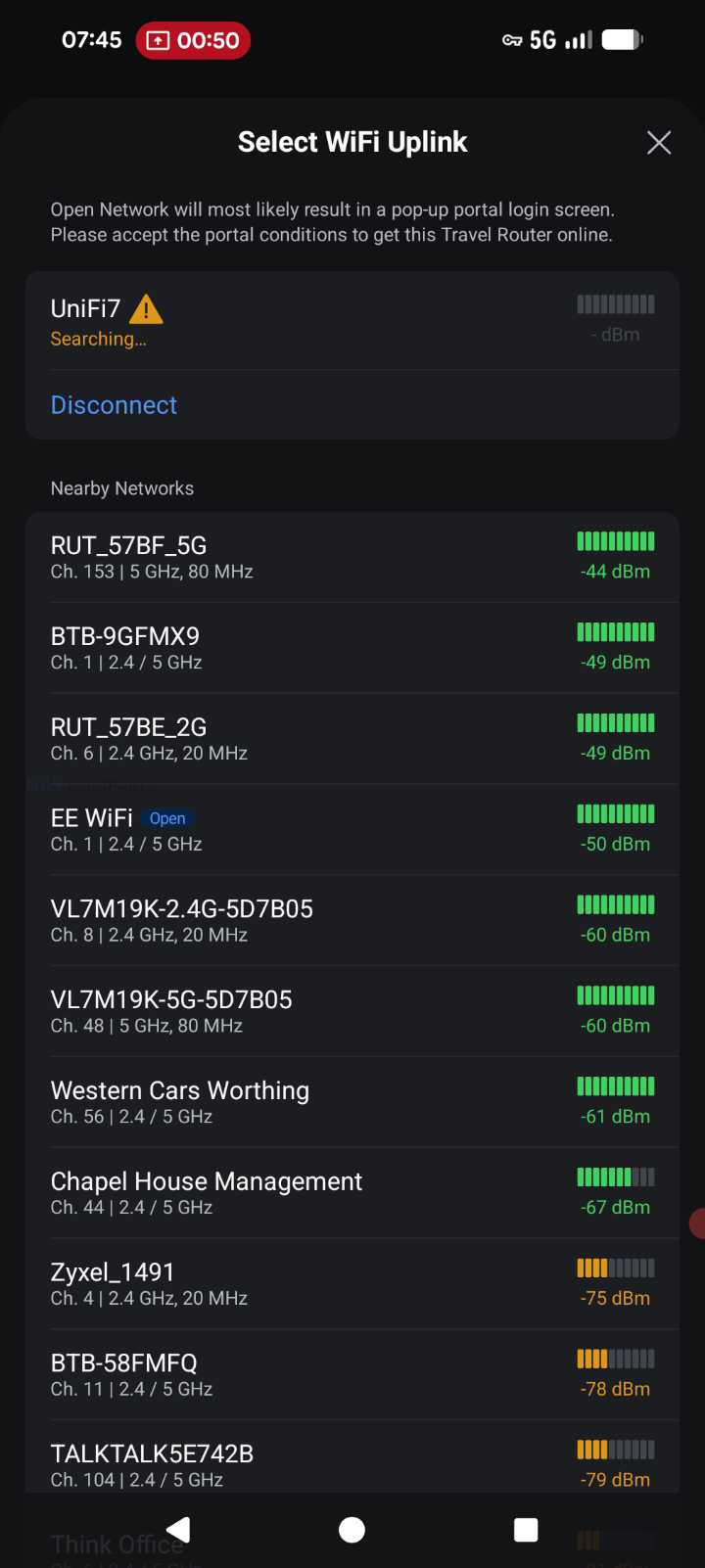
When connecting through hotel or venue WiFi, captive portal handling is part of the connectivity workflow rather than a separate feature layer. The documented process is to select the upstream network in the UniFi Mobile App, then complete any captive portal login on the phone when prompted, after which the router maintains that authenticated upstream session for the devices behind it. This approach can simplify group use, since multiple devices can share the same authenticated uplink without each device individually interacting with the portal. Connectivity limitations are also defined in the documentation, including lack of support for WPA Enterprise and Passpoint networks, which can affect compatibility in some corporate or managed public environments where those authentication methods are enforced.

UniFi Travel Router – Software & Services

The UTR is designed to integrate into an existing UniFi deployment rather than operate as a standalone router with its own separate management model. Once it is bound to a UniFi site, it can automatically apply WiFi configuration and bring up the same network identity used elsewhere, including expected SSIDs and routing behavior. UniFi positions this as a continuity feature, where location aware policies and routing rules can activate when the router connects at a new site, reducing the amount of manual setup typically needed when moving between venues.

Teleport is the primary UniFi service feature tied to remote access on the UTR. The documented workflow is to complete initial setup, open the UniFi Mobile App, select an available UniFi gateway or console, and then connect using Teleport, creating a private path back to the user’s UniFi network. Alongside Teleport, the UTR lists VPN client support for OpenVPN and WireGuard, allowing VPN enforcement at the router level so connected devices use the same tunnel without requiring separate VPN configuration per device. In your review use case, this was framed around keeping work traffic routed through a known UniFi environment while operating on public or untrusted networks during multi day on site work.

Beyond remote access, the feature set includes core router functions such as firewall and port forwarding, with UniFi management intended to keep LAN behavior consistent across locations. UniFi also describes plug and play pairing with existing UniFi devices, aiming to reduce friction when traveling with preconfigured hardware that is expected to reappear on a familiar network. The documentation also references Auto Link in the context of keeping wireless cameras and devices online automatically, positioning it as a continuity mechanism rather than a separate setup workflow. Operationally, configuration and connection selection are handled through the UniFi Mobile App, including joining upstream WiFi and completing captive portal authentication when present, while enterprise style WiFi authentication methods like WPA Enterprise and Passpoint are listed as unsupported.

UniFi Travel Router – Conclusion

The UniFi Travel Router makes the most sense as a “UniFi extender you can pocket” rather than a generic travel router trying to win on raw specs. The real value is how quickly it drops you back into a familiar environment: bind it to your UniFi setup, carry over the SSID you already use, and your devices can reconnect without you rebuilding a network from scratch each time you land somewhere new. For people who work on site, bounce between coffee shops, or travel with a small team, that convenience adds up fast: one upstream connection, one captive portal login handled through the app, and everything behind the UTR can ride through a secure Teleport tunnel back to your home or office UniFi gateway. Add the practical hardware touches, like two gigabit ports for wired WAN or LAN use, separate USB C power and USB tethering for pulling in a phone connection, and a status display that helps you confirm what is actually happening at a glance, and it is easy to see why this little box is appealing if you already live in the UniFi ecosystem.

The drawbacks are largely about what it is not trying to be. If you want a bleeding edge travel router, the UTR’s WiFi 5 radio and 1 GbE ports will feel conservative next to WiFi 6E or WiFi 7 options, and your top end wireless throughput is simply going to be capped by the platform. The screen is useful, but it is not touch, so you are still leaning on the mobile app for most changes, and there is no internal battery to make it a truly self contained travel companion. Just as importantly, there is no integrated SIM or eSIM, so anyone hoping for an all in one cellular travel router will be looking elsewhere or relying on phone tethering. Taken together, the UniFi Travel Router is a strong niche product: it is not the fastest, but for existing UniFi users who care most about consistency, security, and getting online quickly in messy real world networks, it is a smart and affordable addition to the kit bag.

PROS of the UniFI Travel Router CONS of the UniFI Travel Router
  • Deep UniFi ecosystem fit, can bind to an existing UniFi site for a familiar setup on the go

  • Teleport support enables secure remote access back to your UniFi network on public WiFi

  • Can clone an existing SSID so your devices connect without reconfiguring

  • Multi uplink flexibility: WiFi uplink, wired WAN via Ethernet, and USB tethering via smartphone

  • Captive portal logins are handled through the mobile app, simplifying hotel and guest WiFi access

  • Two gigabit ports (WAN and LAN) allow simple wired integration when available

  • Separate USB C power and separate USB tethering is practical for travel scenarios

  • Pocket sized, lightweight design with a helpful status display for quick connection checks

  • WiFi 5 only, so performance and feature set trail newer WiFi 6 or WiFi 7 travel routers

  • Ethernet is 1 GbE, not 2.5 GbE

  • No internal battery and no built in SIM or eSIM option for standalone cellular use

📧 SUBSCRIBE TO OUR NEWSLETTER 🔔
[contact-form-7]
🔒 Join Inner Circle

Get an alert every time something gets added to this specific article!


Want to follow specific category? 📧 Subscribe

This description contains links to Amazon. These links will take you to some of the products mentioned in today's content. As an Amazon Associate, I earn from qualifying purchases. Visit the NASCompares Deal Finder to find the best place to buy this device in your region, based on Service, Support and Reputation - Just Search for your NAS Drive in the Box Below

Need Advice on Data Storage from an Expert?

Finally, for free advice about your setup, just leave a message in the comments below here at NASCompares.com and we will get back to you. Need Help? Where possible (and where appropriate) please provide as much information about your requirements, as then I can arrange the best answer and solution to your needs. Do not worry about your e-mail address being required, it will NOT be used in a mailing list and will NOT be used in any way other than to respond to your enquiry. [contact-form-7] TRY CHAT Terms and Conditions
If you like this service, please consider supporting us. We use affiliate links on the blog allowing NAScompares information and advice service to be free of charge to you.Anything you purchase on the day you click on our links will generate a small commission which isused to run the website. Here is a link for Amazon and B&H.You can also get me a ☕ Ko-fi or old school Paypal. Thanks!To find out more about how to support this advice service check HEREIf you need to fix or configure a NAS, check Fiver Have you thought about helping others with your knowledge? Find Instructions Here  
 
Or support us by using our affiliate links on Amazon UK and Amazon US
    
 
Alternatively, why not ask me on the ASK NASCompares forum, by clicking the button below. This is a community hub that serves as a place that I can answer your question, chew the fat, share new release information and even get corrections posted. I will always get around to answering ALL queries, but as a one-man operation, I cannot promise speed! So by sharing your query in the ASK NASCompares section below, you can get a better range of solutions and suggestions, alongside my own.

☕ WE LOVE COFFEE ☕


New Gl.iNet Beryl 7, Comet 5G and Flint 3e Revealed

New KVMs, Travel Routers and WiFi 7 Tech on the way from Gl.iNet Soon

Gl.iNet is preparing several new devices for late 2025 and early 2026 that expand its presence in mobile networking, remote access management, and high speed home routing. These include the Beryl 7 travel router, the Comet 5G RedCap KVM with an integrated WiFi access point, and the Flint 3e dual band WiFi 7 desktop router. Each system is positioned to address a specific operational requirement, ranging from portable VPN-enabled wireless access to remotely deployable KVM control and multi gigabit home connectivity. The updated lineup also includes the Brume 3 high speed VPN security gateway, which builds on the Brume 2 by adding faster encrypted throughput and broader support for open VPN standards such as AmneziaVPN. Collectively, these releases indicate that Gl.iNet is prioritising more capable processors, improved wireless performance, and tighter integration between VPN features and local network tools.

Beryl 7 Travel Router (GL-MT3600BE)

The Beryl 7 is positioned as an updated travel router that builds on the feature set of the original Beryl while shifting to a more capable Qualcomm quad core processor running at 1.1GHz and 256MB of DDR4 memory. It uses IEEE 802.11a, b, g, n, ac, ax and be wireless standards and supports dual band WiFi 7 operation on the 2.4GHz and 5GHz bands. Although it does not include 6GHz support, it delivers higher throughput than its predecessor, reaching 688Mbps on 2.4GHz and 2882Mbps on 5GHz. The unit also integrates two foldable external antennas and two 2.5GbE ports that can be configured as WAN plus LAN or as dual LAN for specific on-the-go deployment requirements.

The system maintains the travel-focused design of the original model by keeping compact dimensions, low power requirements and USB-C power delivery suitable for laptops, power banks and small chargers. The physical toggle switch remains, allowing quick selection between standard routing and VPN operation without navigating menus. VPN capability is supported by OpenVPN DCO, WireGuard and AmneziaVPN, enabling users to run a VPN server at home and connect to it through the Beryl 7 when travelling. As noted during the demonstration, the WiFi 7 implementation prioritises improved packet handling and multi-link operation rather than wide-band 6GHz performance, which keeps the device compatible in regions where 6GHz availability is limited or restricted.

The Beryl 7 aims to retain pricing similar to the original Beryl while scaling both its internal hardware and wireless capabilities. It uses a gigabit-class Ethernet configuration, supports sub-18W peak power draw and retains a form factor suited for hotel WiFi, temporary offices and public hotspot environments. The inclusion of 2.5GbE, higher throughput on both bands and broader VPN support allows it to operate as a compact edge router for users needing reliable encrypted access across multiple devices. Despite carrying a WiFi 7 label, it does not support the 6GHz band, mirroring the Slate 7, and instead focuses on maximising performance within the 2.4GHz and 5GHz ranges. Nevertheless, this is going to be a disappointment to users who were hoping to see ‘full fat’ WiFi 7 with that 3rd frequency in play, and really maximize MLO use.

Comet 5G KVM with Redcap 5G SIM/LTE Support (GL-RM10RC)

The Comet 5G is a RedCap-based KVM device that integrates remote management, HDMI capture and mobile connectivity into a single compact unit. It uses a quad core ARM Cortex-A53 processor, 1GB of DDR3 memory and 64GB of eMMC storage, matching the hardware profile of the existing Comet Pro. The device includes both HDMI in and HDMI out, allowing it to be used for remote console access, system monitoring and basic pass-through scenarios. A 2.22-inch touchscreen provides local visual feedback including IP address, active WiFi status and connection indicators. Wireless capability is delivered through 802.11a/n/ac/ax at 150Mbps on 2.4GHz and 286Mbps on 5GHz, supported by an external dual band WiFi 6 antenna rather than a WiFi 7 module.

A key addition to this model is the integrated 5G RedCap SIM slot. This allows the device to operate independently of the local network when deployed on-site, which is relevant for administrators or engineers who need to access remote systems without relying on customer-provided WiFi or Ethernet. The mobile connection also supports failover for situations where the primary network becomes unavailable, ensuring that remote KVM access remains possible. During the demonstration, it was highlighted that this improves usability for workloads such as multi-day monitoring or configuration tasks performed in locations where network restrictions or firewall rules prevent direct access.

The Comet 5G retains a familiar selection of ports including USB-C for power, USB-A for peripherals, a gigabit Ethernet port for direct LAN connection and a SIM slot for mobile data. The device is not PoE-powered, although an injector or adapter is expected to be offered as an accessory. This approach keeps the unit closer in design to a travel-friendly tool rather than a fixed enterprise appliance. It remains suited to users who already deploy compact KVM units as part of their field equipment and who require a method of accessing remote devices through either wired, wireless or cellular links.

The combination of 5G failover and HDMI-based remote access positions it as a small-scale management device for distributed environments, temporary field sites or systems that require out-of-band connectivity. Many users will make comparisons between this and the recently crowdfunded ‘Comet Pro’ device (very similar, but alongside a few small changes internally and adjustable antennae, also does not support a 5G SIM CARD/LTE), as well as the Comet PoE device recently released. This is largely the same, but tailored towards a different, decidedly more mobile deployment.

Flint 3e Dual Band WiFi 7 Router (GL-BE5600)

The Flint 3e is a dual band WiFi 7 router aimed at users who want higher wireless throughput and multi gigabit Ethernet connectivity without moving to a full tri band system. It is built around a Qualcomm quad core processor running at 1.5GHz with 1GB of DDR4 memory and 512MB of NAND storage. Wireless support covers IEEE 802.11a, b, g, n, ac, ax and be, delivering 688Mbps on 2.4GHz and 5764Mbps on 5GHz. The unit includes four external foldable antennas, a dual colour LED indicator and a housing designed for stable operation in home or small office environments. Connectivity is centred around five 2.5GbE ports, with one operating as a dedicated WAN input and the remainder configurable as LAN. This gives the router a faster wired backbone than earlier consumer models from the brand.

The router maintains a focus on local performance and low latency operation rather than offering the widest possible spectrum support. It does not include 6GHz capability, placing it closer to the Beryl 7 and Slate 7 in terms of band allocation. However, the higher 5GHz ceiling and improved channel management provide an upgrade path for users moving from WiFi 6 or earlier models who still want to take advantage of WiFi 7 features such as improved modulation and multi link operation. USB 3.0 support is included for storage or tethering tasks, and the system integrates the company’s familiar software stack with options for AdGuard Home, parental controls and fast VPN throughput, including WireGuard and OpenVPN DCO at speeds up to 680Mbps.

The Flint 3e is presented as a more accessible alternative to the full tri band Flint 3, offering similar processing power and Ethernet flexibility while reducing overall wireless complexity. Its design suits users who require multi gigabit wired networking for NAS systems, workstations or mesh uplinks, while maintaining predictable WiFi coverage within standard two band environments. Power consumption remains below 25W without USB load and below 37.2W with active USB devices. This allows the router to operate efficiently in homes with multiple connected devices, including smart home hubs, streaming systems and personal storage servers.

When comparing the Flint 3e with the currently available Flint 3, the key distinction lies in wireless scope and deployment scale. The Flint 3 includes an additional 6GHz band with a 5765Mbps ceiling, a larger 8GB eMMC module and the same five port 2.5GbE layout. This gives the Flint 3 wider spectrum availability, higher aggregate throughput and more headroom for larger properties or higher density environments. The Flint 3e, by contrast, focuses on delivering similar processor performance and identical wired networking while intentionally omitting the 6GHz band to reduce cost and complexity. The result is a model suited for medium sized homes or users who rely primarily on 5GHz and wired backhaul, while the Flint 3 is positioned for broader coverage, multi floor layouts and deployments with more simultaneous wireless clients.


When will the Comet 5G, Beryl 7 and Flint 3e Be Released and What Price?

Gl.iNet’s forthcoming device trio is designed to cover distinct deployment needs across travel, remote management and wired-performance routing. The Beryl 7 travel router brings dual-band WiFi 7, USB-C power, 2.5GbE wired ports and VPN switch functionality; it is estimated to launch at a price similar to the original Beryl AX model. The Comet 5G KVM device increases flexibility by adding 5G RedCap connectivity, HDMI I/O, gigabit Ethernet and WiFi 6, positioning it in terms of design and feature set somewhere between the Comet Pro and the Slate 7; pricing is yet to be confirmed. The Flint 3e desktop router offers dual-band WiFi 7 and five 2.5GbE ports while foregoing the 6GHz band, making it more affordable than the tri-band Flint 3; this pricing strategy targets users seeking strong wired and wireless performance without full spectrum coverage. All models are expected to be formally announced at CES 2026 and become available in Q1 2026.

Gl.iNet Comet KVM Series on Amazon HERE

Gl.iNet Slate 7 Mobile Router on Amazon HERE


📧 SUBSCRIBE TO OUR NEWSLETTER 🔔
[contact-form-7]
🔒 Join Inner Circle

Get an alert every time something gets added to this specific article!


Want to follow specific category? 📧 Subscribe

This description contains links to Amazon. These links will take you to some of the products mentioned in today's content. As an Amazon Associate, I earn from qualifying purchases. Visit the NASCompares Deal Finder to find the best place to buy this device in your region, based on Service, Support and Reputation - Just Search for your NAS Drive in the Box Below

Need Advice on Data Storage from an Expert?

Finally, for free advice about your setup, just leave a message in the comments below here at NASCompares.com and we will get back to you. Need Help? Where possible (and where appropriate) please provide as much information about your requirements, as then I can arrange the best answer and solution to your needs. Do not worry about your e-mail address being required, it will NOT be used in a mailing list and will NOT be used in any way other than to respond to your enquiry. [contact-form-7] TRY CHAT Terms and Conditions
If you like this service, please consider supporting us. We use affiliate links on the blog allowing NAScompares information and advice service to be free of charge to you.Anything you purchase on the day you click on our links will generate a small commission which isused to run the website. Here is a link for Amazon and B&H.You can also get me a ☕ Ko-fi or old school Paypal. Thanks!To find out more about how to support this advice service check HEREIf you need to fix or configure a NAS, check Fiver Have you thought about helping others with your knowledge? Find Instructions Here  
 
Or support us by using our affiliate links on Amazon UK and Amazon US
    
 
Alternatively, why not ask me on the ASK NASCompares forum, by clicking the button below. This is a community hub that serves as a place that I can answer your question, chew the fat, share new release information and even get corrections posted. I will always get around to answering ALL queries, but as a one-man operation, I cannot promise speed! So by sharing your query in the ASK NASCompares section below, you can get a better range of solutions and suggestions, alongside my own.

☕ WE LOVE COFFEE ☕

 
Where to Buy a Product
amzamexmaestrovisamaster 24Hfree delreturn VISIT RETAILER ➤ 
amzamexmaestrovisamaster 24Hfree delreturn VISIT RETAILER ➤

If you like this service, please consider supporting us.
We use affiliate links on the blog allowing NAScompares information and advice service to be free of charge to you. Anything you purchase on the day you click on our links will generate a small commission which is used to run the website. Here is a link for Amazon and B&H. You can also get me a ☕ Ko-fi or old school Paypal. Thanks! To find out more about how to support this advice service check HERE    

☕ WE LOVE COFFEE ☕

Or support us by using our affiliate links on Amazon UK and Amazon US
     

❌