Vue lecture

Il y a de nouveaux articles disponibles, cliquez pour rafraîchir la page.

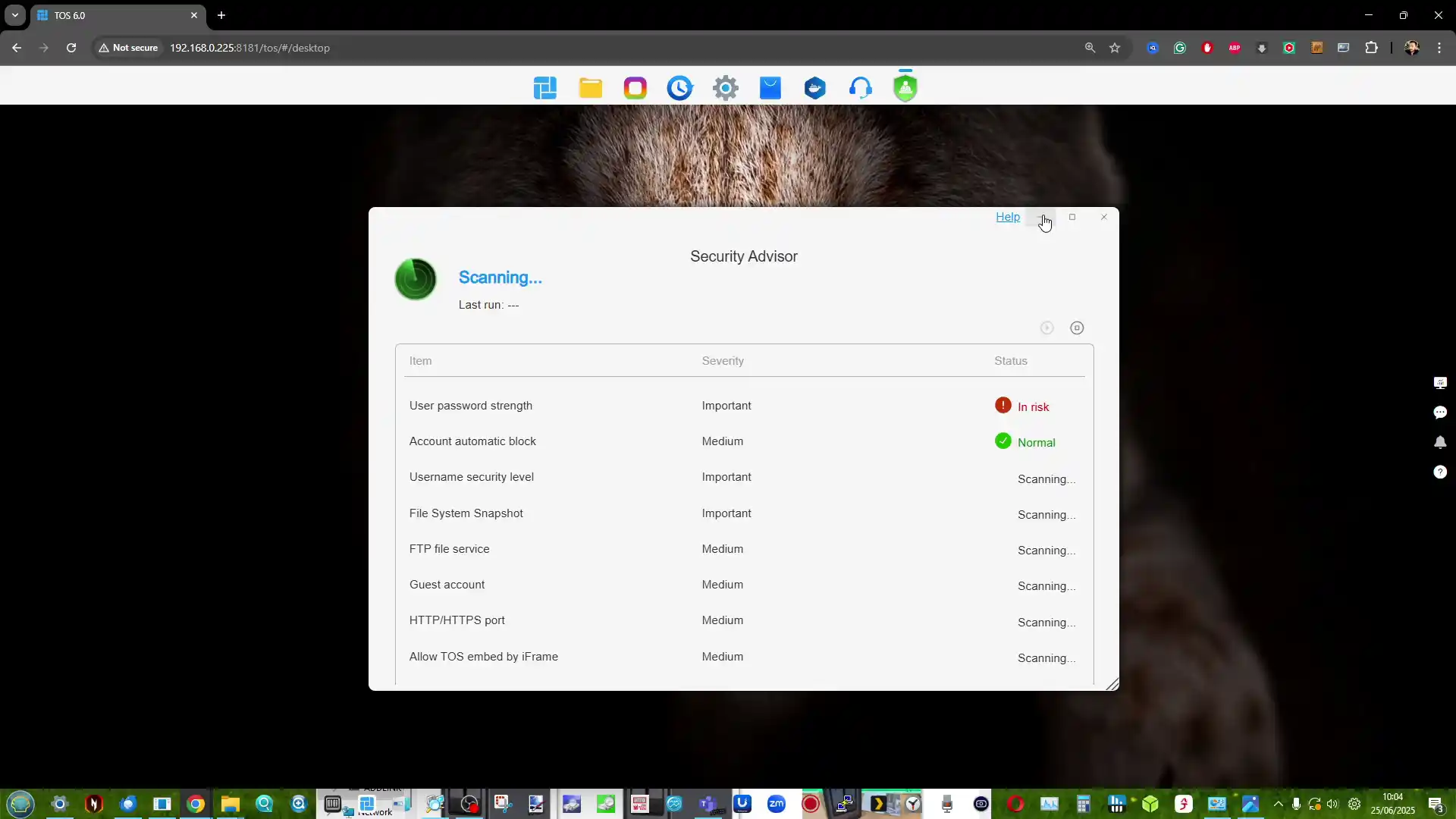
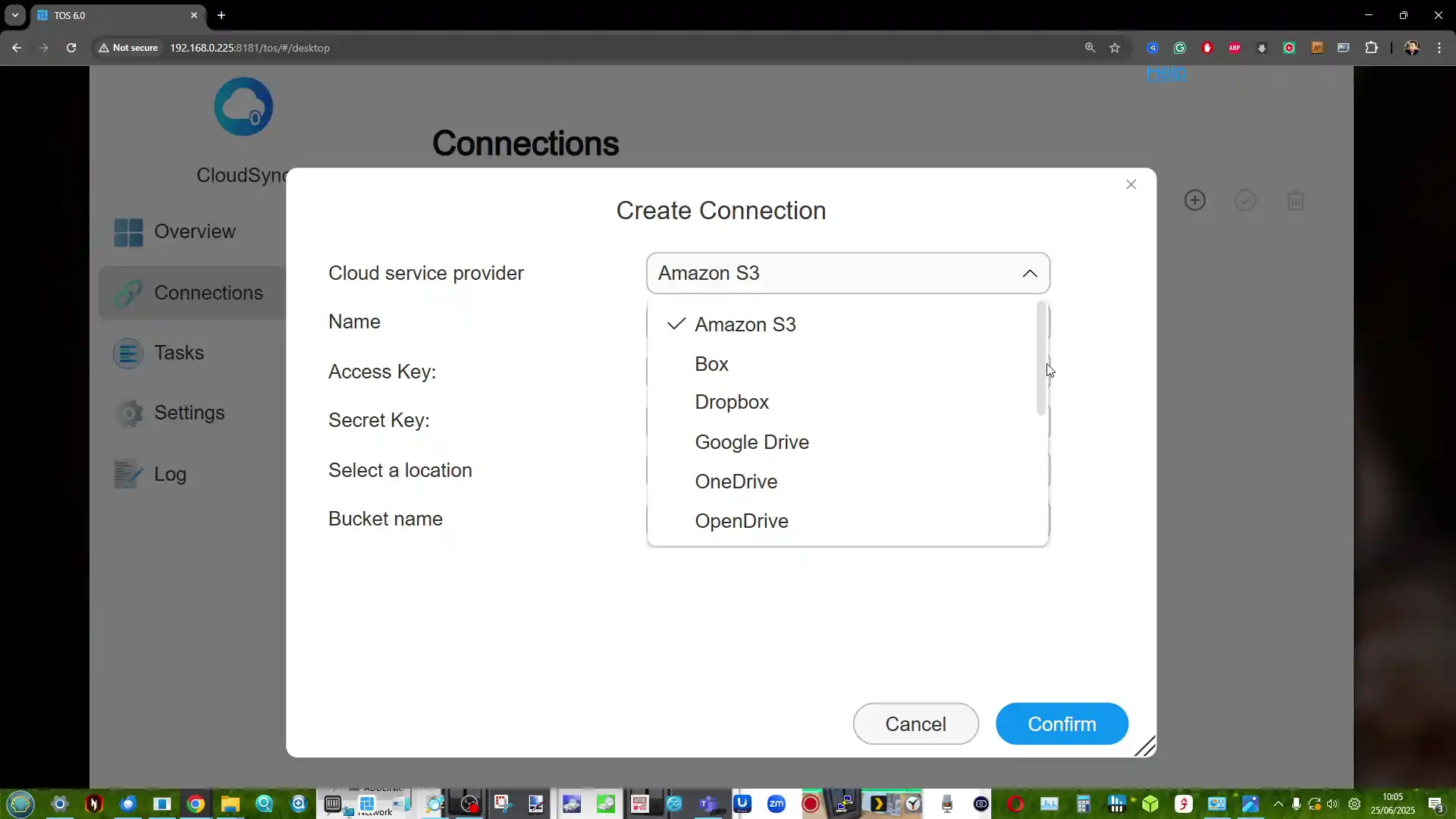
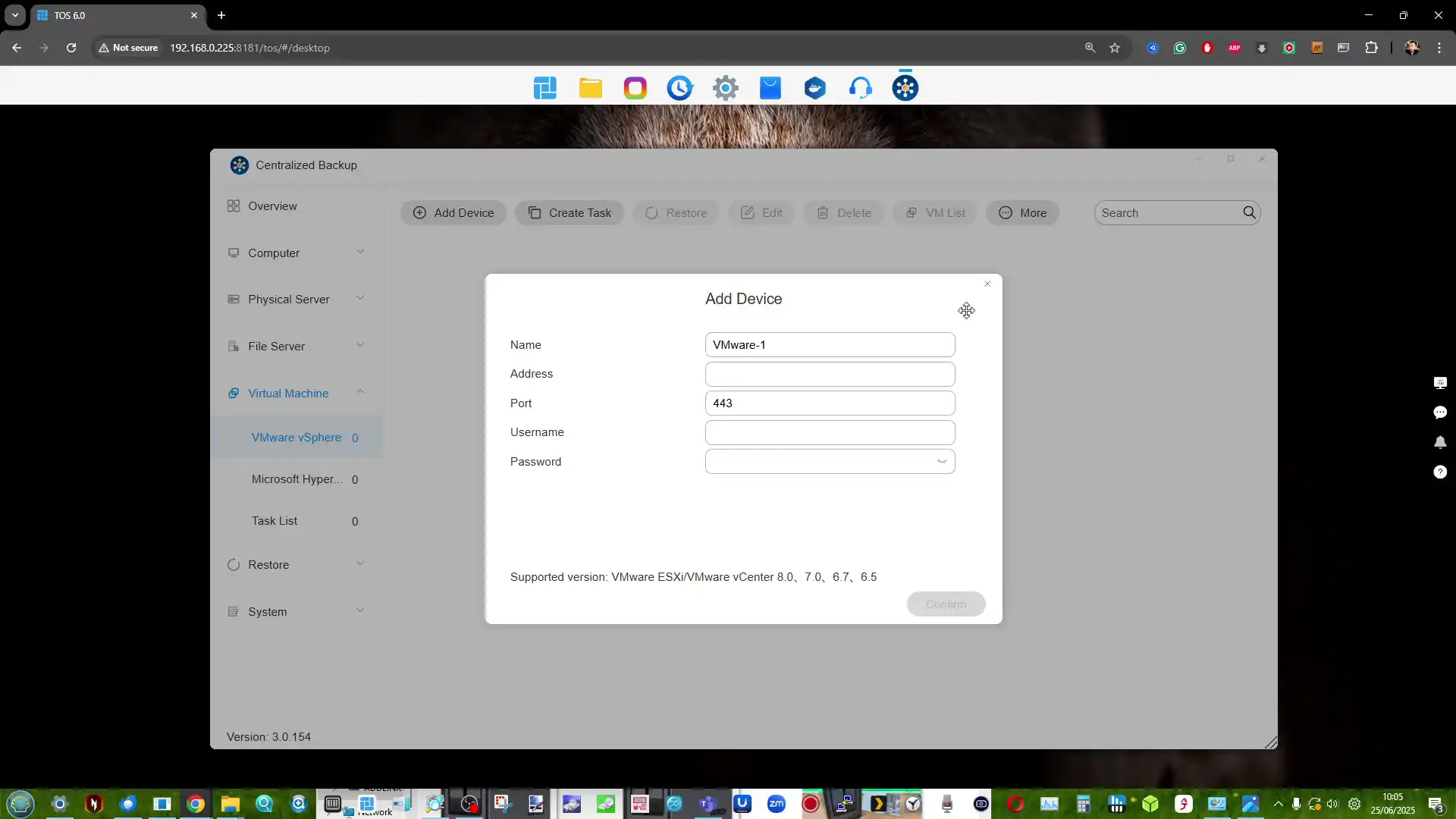
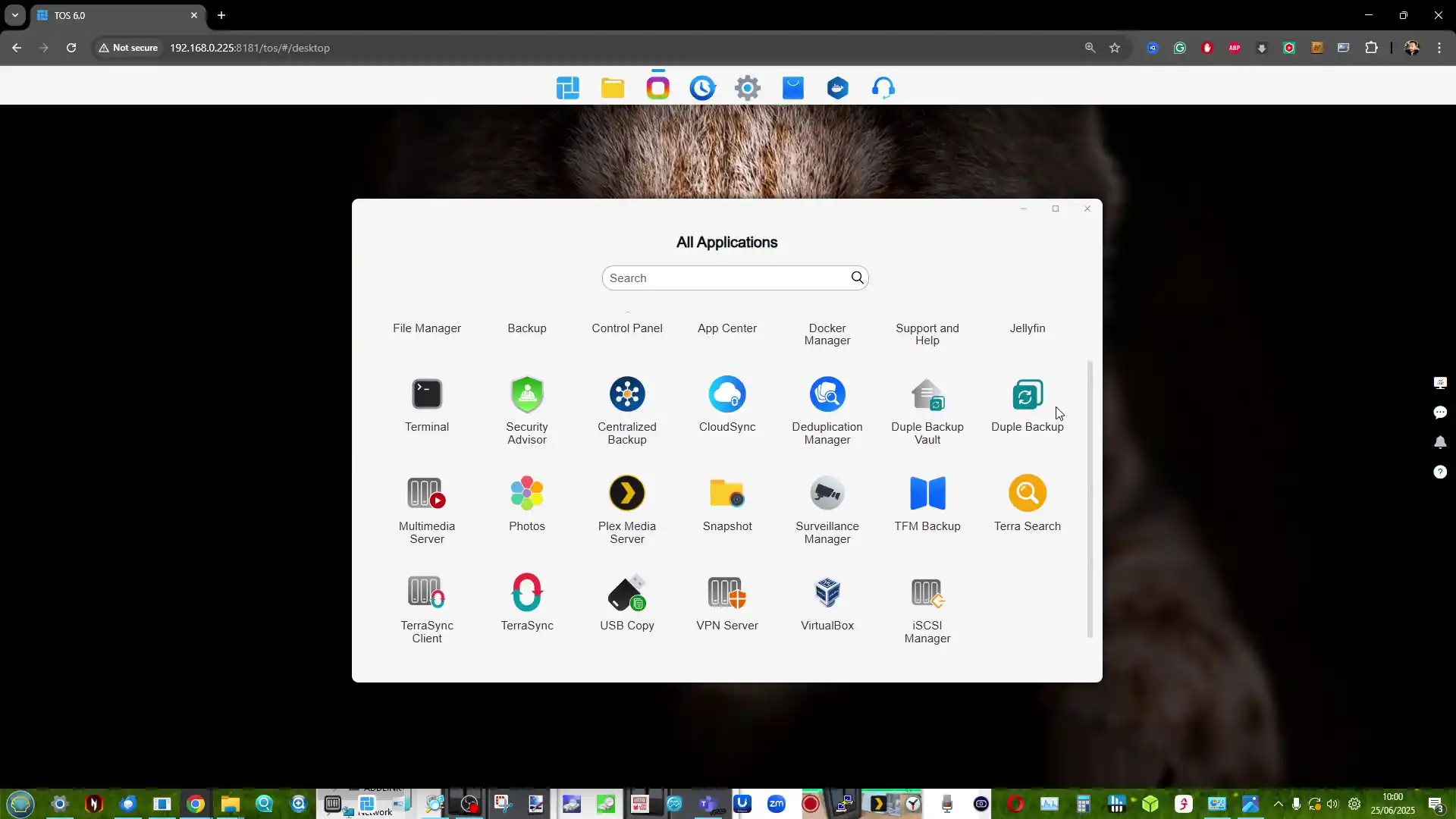
Terramaster TOS 7 Public Beta – Now LIVE

Terramaster new TOS 7 NAS Software Beta Ready to Test

December 15, 2025 | TerraMaster, a professional storage brand dedicated to delivering innovative solutions for home users, businesses, and developers, today officially launches the public beta of TOS 7. This highly anticipated release, developed over nearly two years by a team of more than 100 engineers, not only celebrates the 15th anniversary of the TOS operating system but also marks its stunning transformation from a simple storage tool into a full-featured private cloud platform. Looking back to 2011, TOS 1.0 debuted alongside TerraMaster’s very first NAS product. Back then, the interface was bare-bones—you could create shared folders, enable SMB, and add a handful of user accounts. It was simple, almost primitive, but it laid a rock-solid foundation.

Fifteen years later, TOS has evolved into its 7th generation. A single TerraMaster NAS can now effortlessly serve as a file server, virtual machine host, developer workstation, online collaboration platform, or even an enterprise-grade permissions fortress. Throughout this journey, we’ve kept asking ourselves one core question: How should a device that people interact with dozens of times a day actually be designed to truly fit the way you work?

With TOS 7, the answer is finally here—and it’s within reach. Built on a brand-new kernel (upgraded to Linux 6.12) and a completely refreshed design language, TOS 7 features 90% newly drawn icons and over 1,000 refined interaction details, making every operation more intuitive, smoother, and faster than ever before.
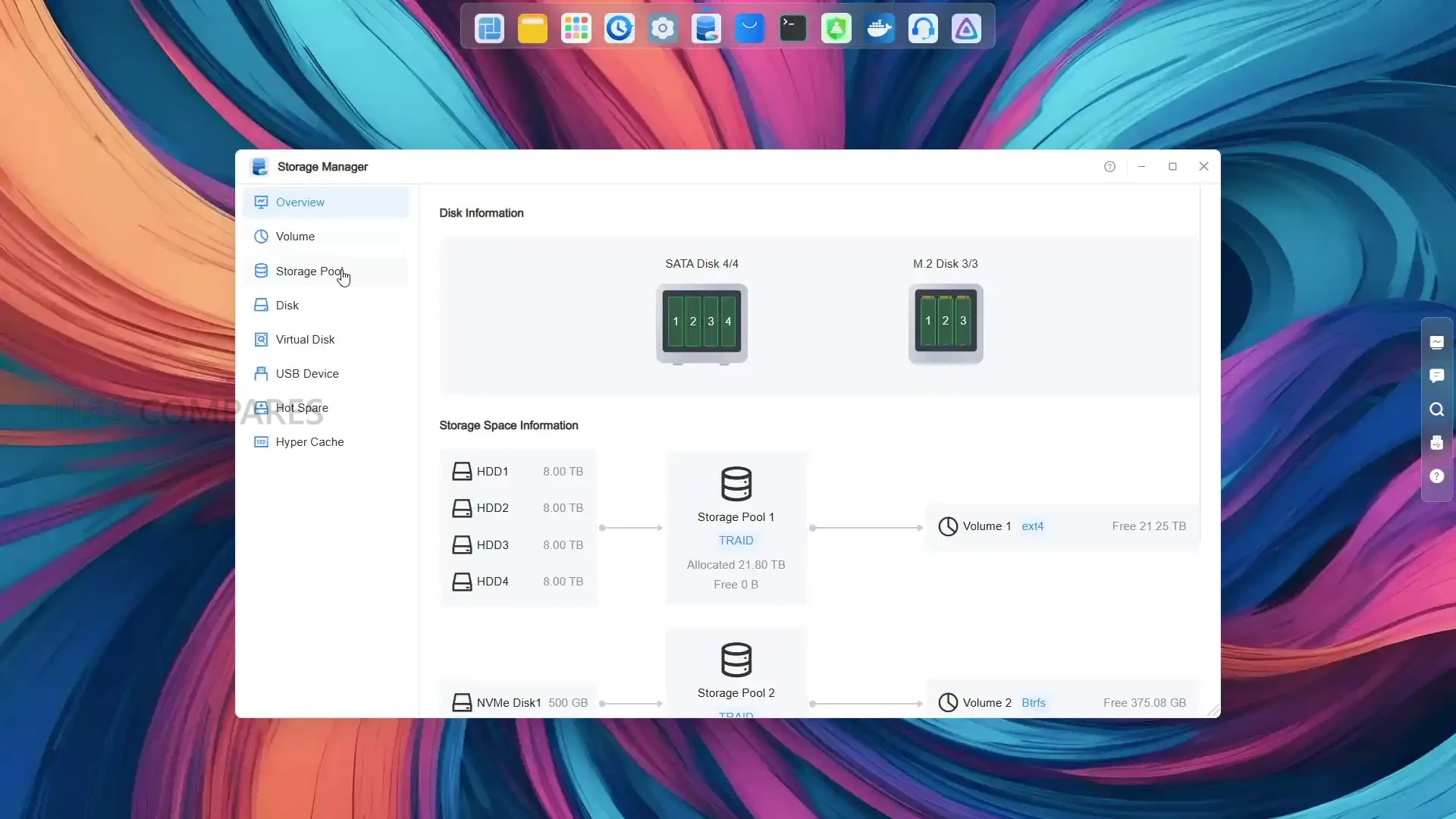
Transform into an All-Powerful Host and Unleash Unlimited Possibilities

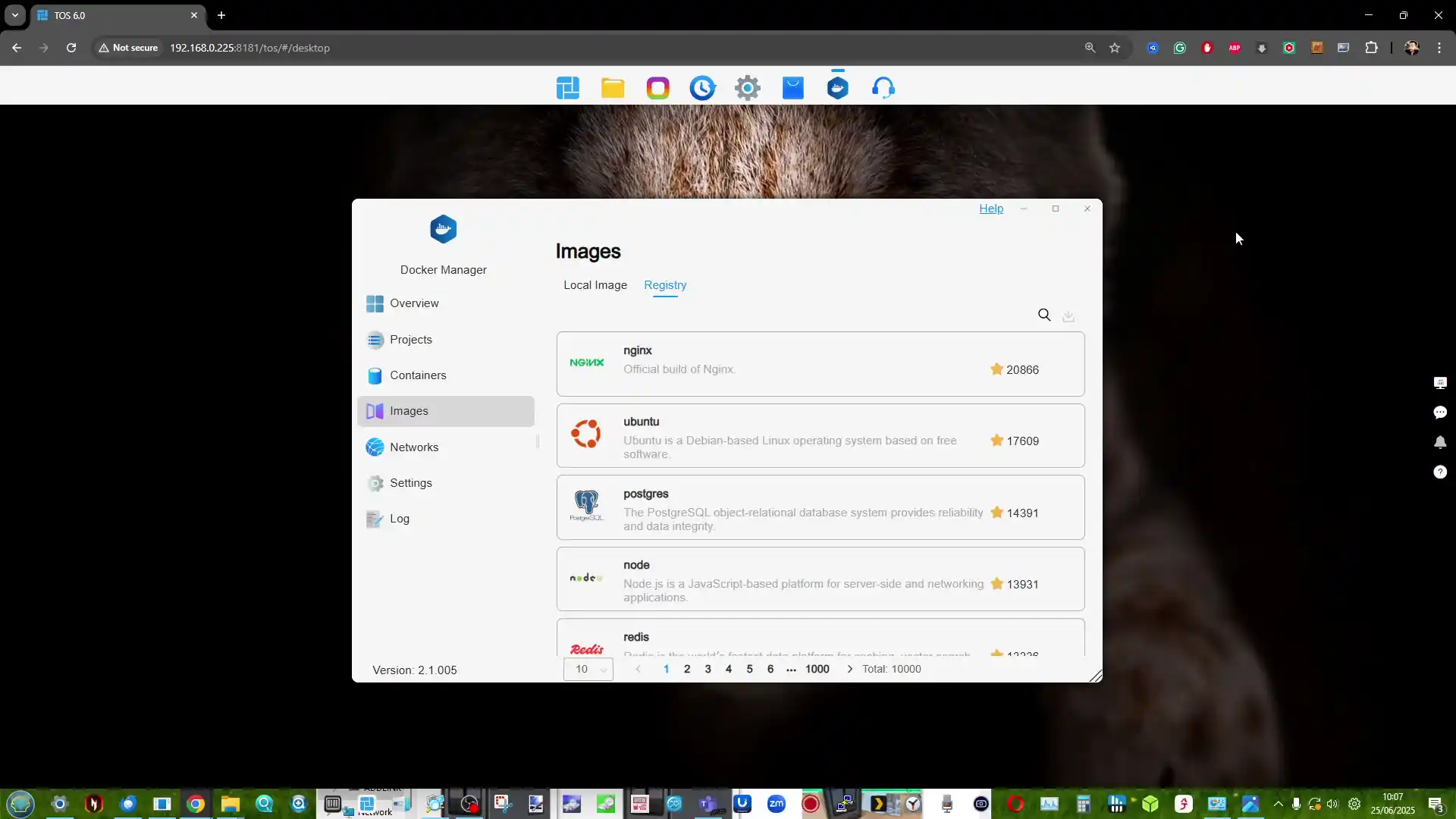
TOS 7 marks the first time we’ve opened full root access while seamlessly integrating official Ubuntu repositories. Developers can now instantly install Nginx, Node.js, Python environments, databases, or compilers using apt—turning your NAS into a fully SSH-accessible Linux server with zero jailbreaking and zero third-party plugins. It’s all native.

The built-in Virtual Machines (VMs) module lets you deploy Windows, Linux, macOS (on supported hardware), or any distro with a single click. Whether you’re building test environments, migrating legacy systems, isolating applications, or creating a compact private cloud, TOS 7 squeezes every last drop of performance from your hardware and turns your NAS into a true flexible computing hub.

Collaboration with Zero Barriers – Your Data Stays Local Forever

Say goodbye to the old “download-edit-upload” hassle. TOS 7 natively integrates online Office tools that support real-time viewing and multi-user collaborative editing of Word, Excel, and PowerPoint files. Documents are saved directly on your NAS—no third-party cloud, no extra subscription fees. Changes sync in seconds, boosting team productivity by 100%. Your data, always under your control.

Search as Smooth as Thought – Instant Response for Millions of Files

Our in-house global search engine combines inverted indexing, kernel-level real-time file monitoring, and asynchronous I/O caching to deliver second-level full-disk scans for millions of files — 10× faster than TOS 6, with 120% higher search accuracy. No need for exact filenames; just type a keyword and get precise hits instantly. File management efficiency jumps by 60%.
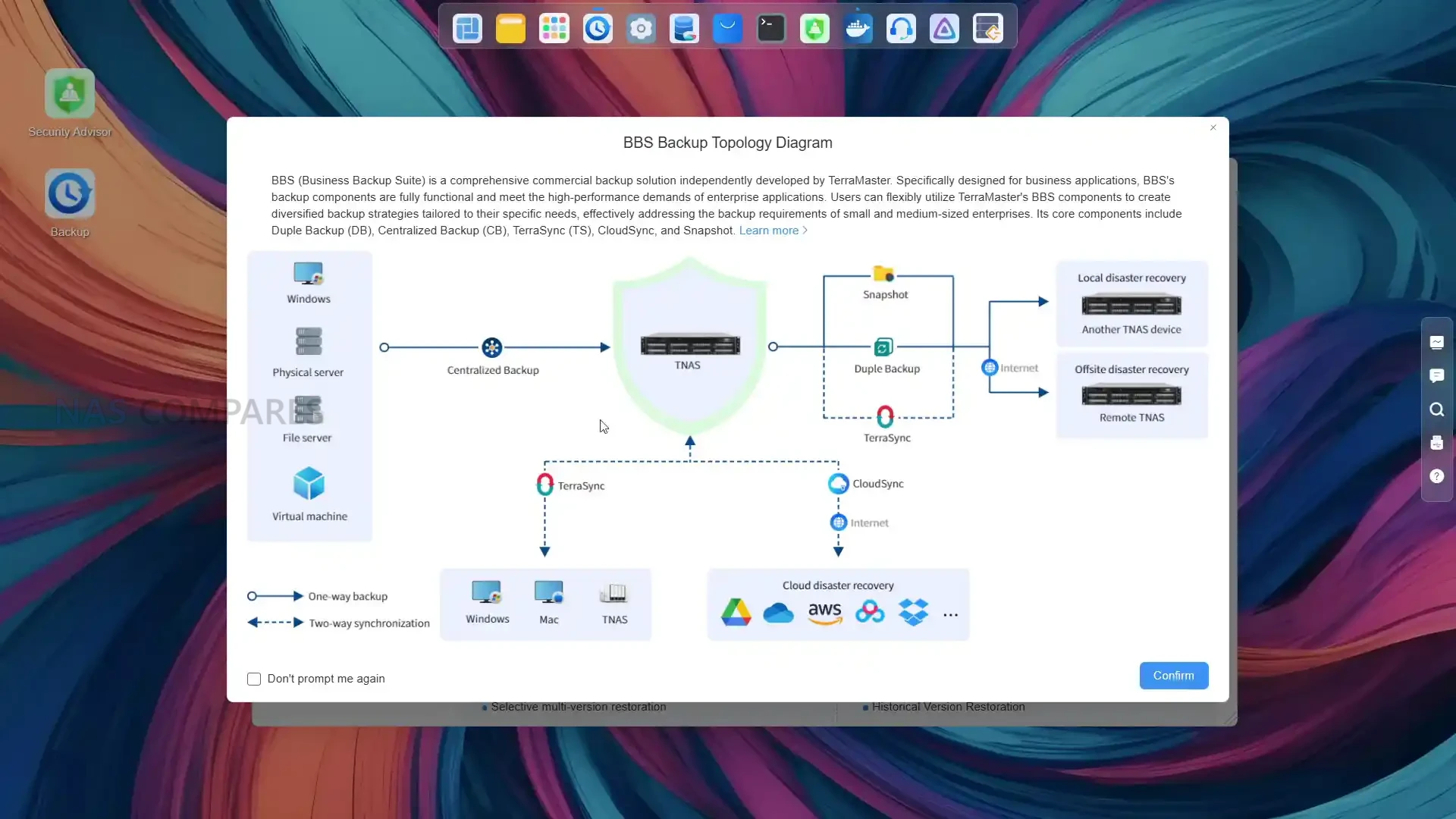
Granular Permissions Down to the Thread – Rock-Solid Security

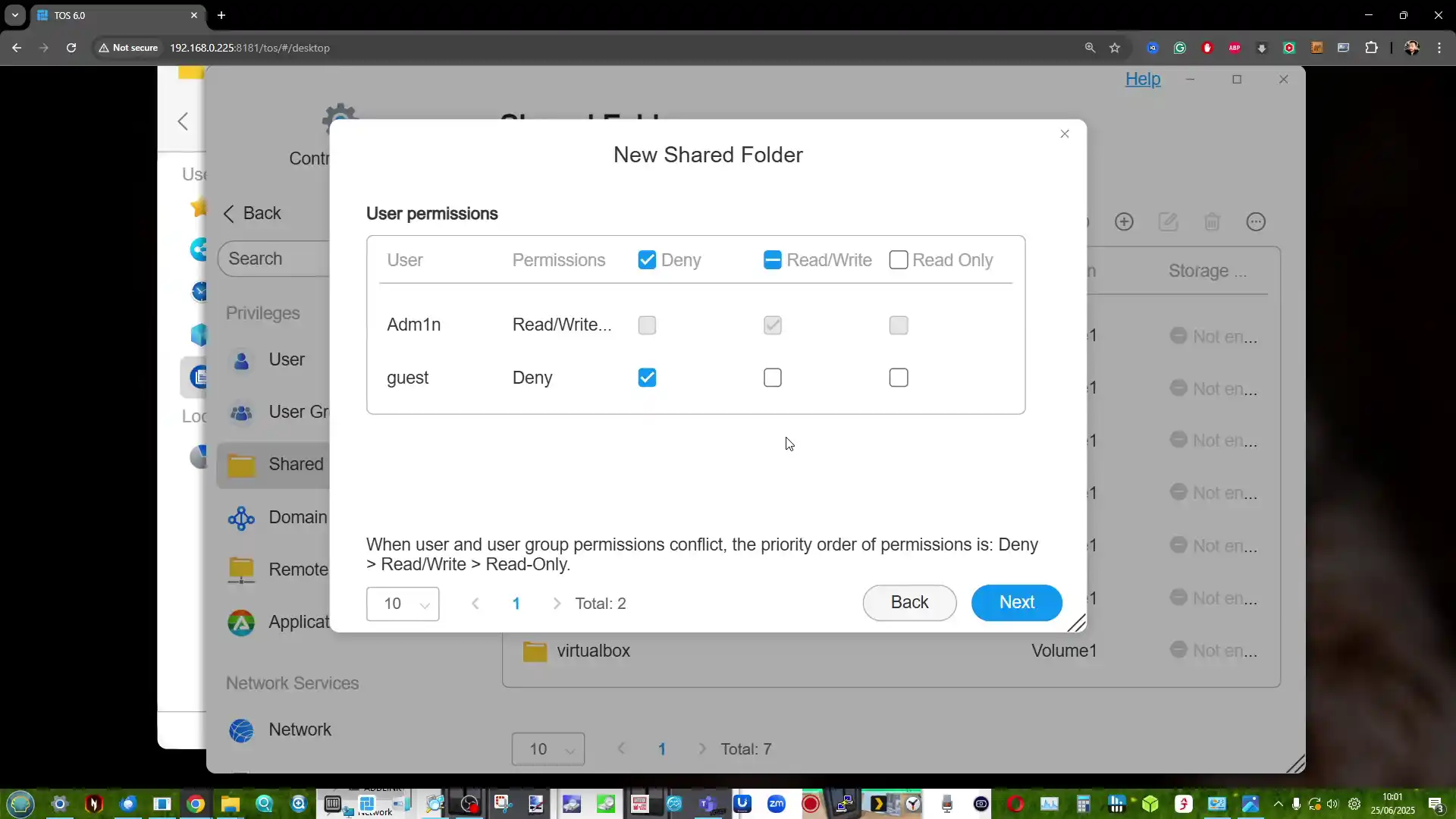
The permission system has been expanded from 3 basic types to 13 combinable domain-based ACL policies, with fully customizable rules (e.g., “department can only read/write specific folders and is prohibited from deleting”). Setup time is 99.6% shorter than TOS 6 — complex authorizations are done in seconds — striking the perfect balance between ironclad data security and flexible access control.
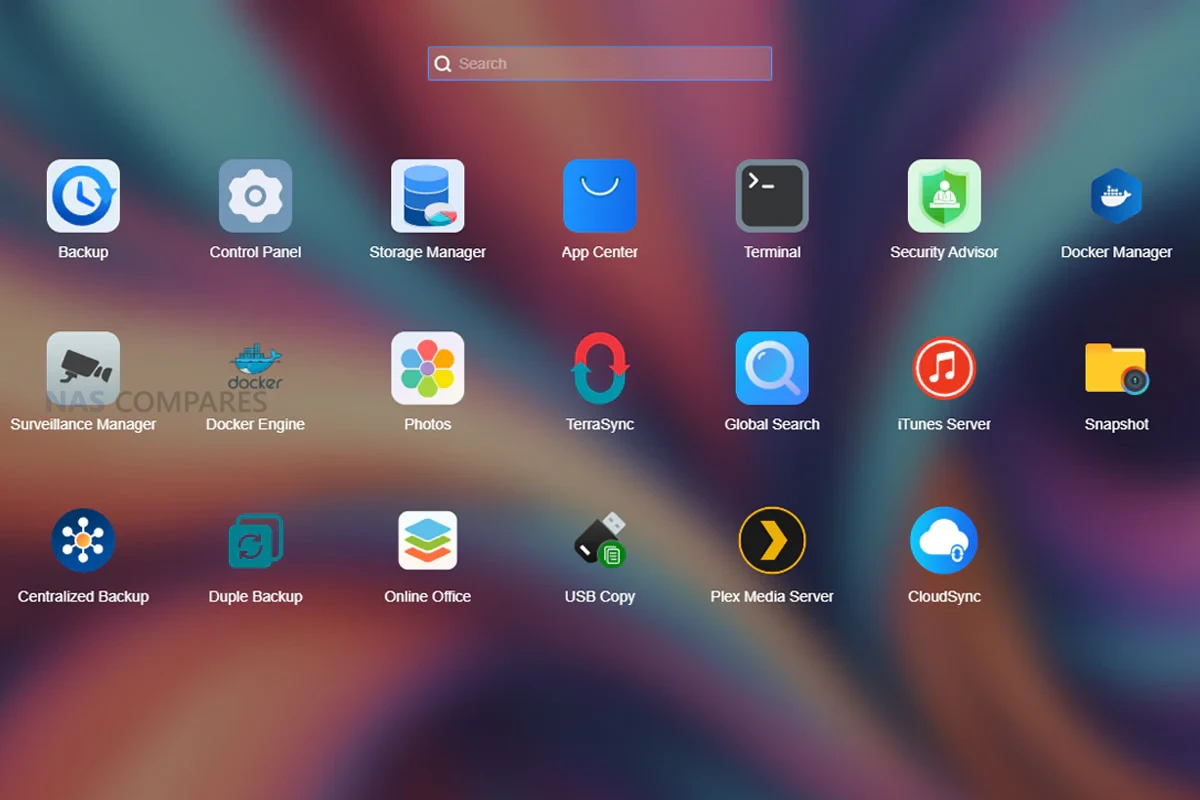
How to Access the Terramaster TOS 7 Beta?

After over 300 days of meticulous development and the collaborative efforts of hundreds of engineers, we have developed the all-new TOS 7 for you—more user-friendly and visually refined. With over 50 new features and more than 1,000 detailed optimizations, TOS 7 delivers a faster response, smoother interactions, and a more elegant interface. Designed with forward-looking interaction concepts, it achieves a comprehensive transformation from the inside out, ushering you into a refreshing new era of operation.

Download the TOS 7 Software Here (Read the notesr below first)

Compatible Models:
• F2-424, F4-424, F6-424, F4-424 Pro, F4-424 Max, F6-424 Max
• T9-450, T12-450, U8-450
• T9-500 Pro, T12-500 Pro, U8-500 Plus, U12-500 Plus
• F2-425, F4-425, F2-425 Plus, F4-425 Plus
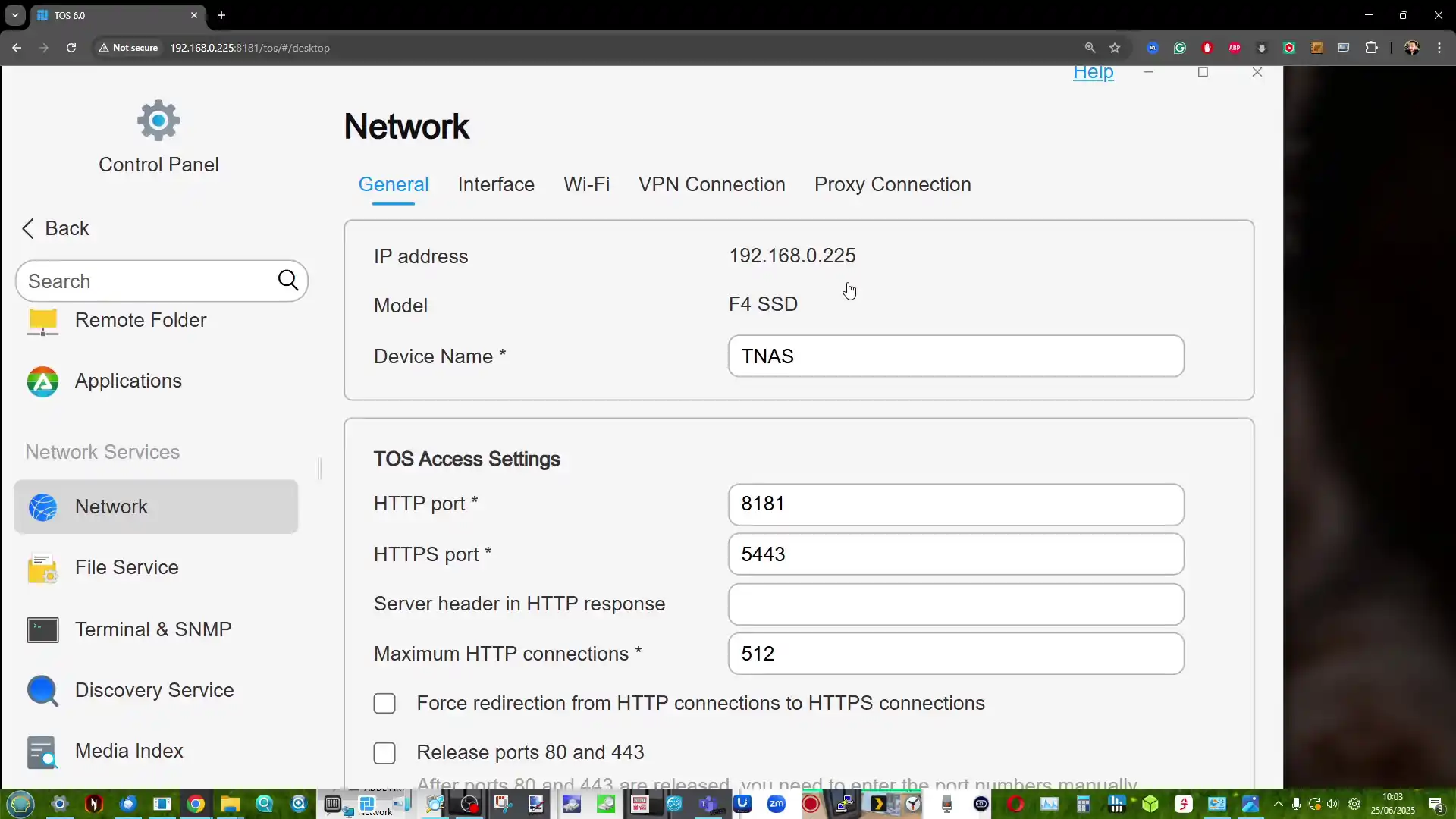
• F4 SSD

Conditional Compatible Models(Read the following Special Notes):
• F2-221,F2-422, F4-221, F4-421, F4-422, F5-221, F5-421, and F5-422
• F8 SSD and F8 SSD Plus
• F2-223, F2-423, F4-223, F4-423, T6-423, T9-423, T12-423, U4-423, U8-423, and U12-423

Special Notes:
• For users of F2-221,F2-422, F4-221, F4-421, F4-422, F5-221, F5-421, and F5-422: Please first verify that your BIOS version falls within the range of MAPL0304V16 to V22 or MAPL0303V16 to V22. Otherwise, you will not be able to update to TOS 7.
How to check: Go to TOS Control Panel > System > Update to view your BIOS version.
• For F8 SSD and F8 SSD Plus users: Before updating, you must first update the system to version 6.0.794 (the firmware will be updated during the system update). If you directly installed TOS 6.0.794 via an installation package, please manually update TOS 6.0.794 once again, and then update to TOS 7.
• For users of F2-223, F2-423, F4-223, F4-423, T6-423, T9-423, T12-423, U4-423, U8-423, and U12-423: If your TOS system is currently installed or planned to be installed on an M.2 NVMe SSD, please adjust the BIOS boot order according to the guide before proceeding with the update.

Warning:
1. This update is only applicable to version 6.0.794 or higher.
2. TOS 7 adopts a completely new permission management method. After the update, permission conversion is required. It is recommended to choose automatic conversion. This process is time-consuming, please wait patiently (for example, approximately 400,000 folders may take about 3 hours).
3. After the update, besides the storage pools and volumes in normal use, the Storage Manager interface may display several corrupted storage pools and volumes caused by abnormal operations (such as directly pulling out disks) in TOS 6. If you confirm they are no longer in use, you can delete them directly.
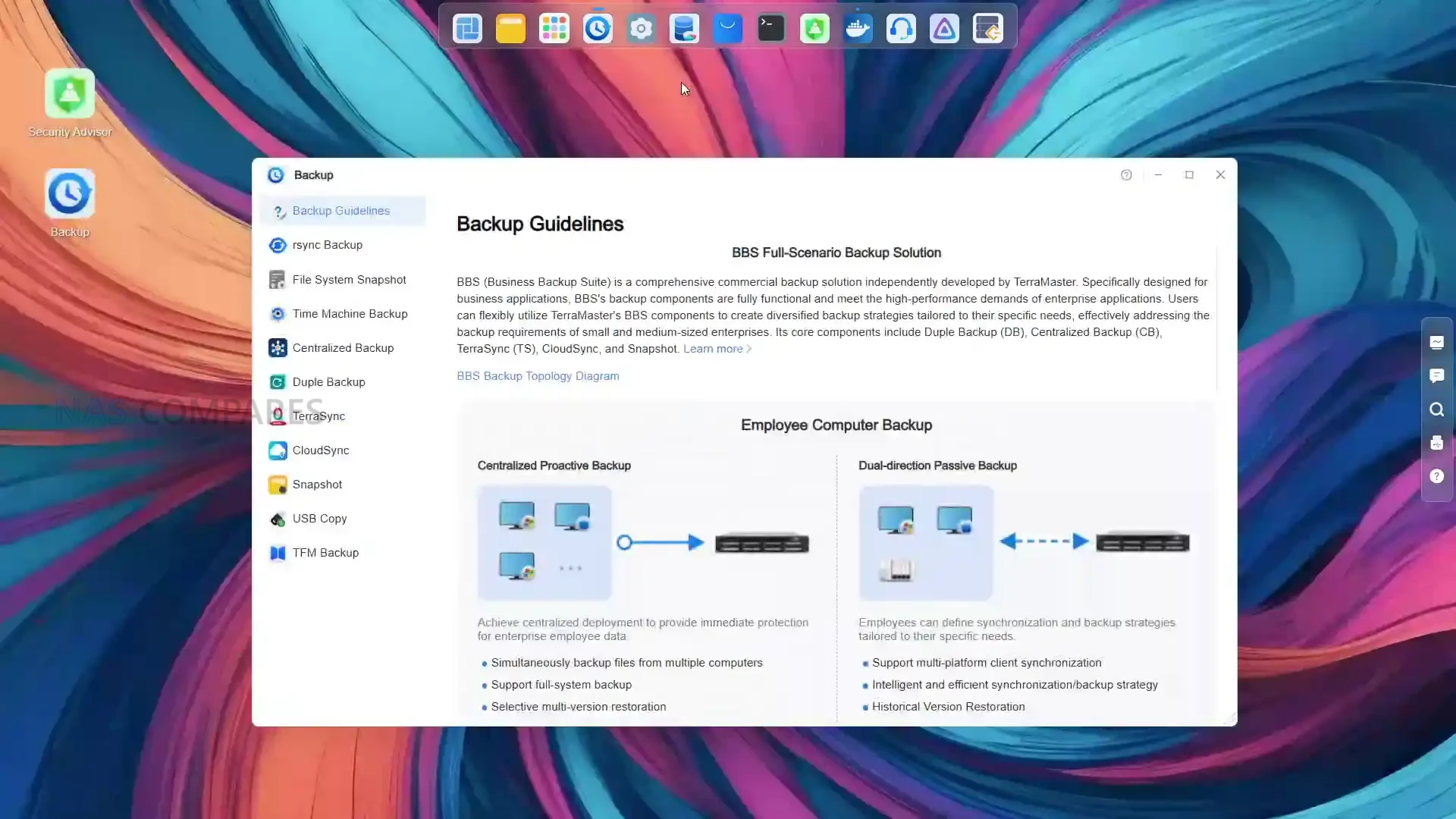


Important Notes:
1. The Beta version is an early testing release and may contain defects. It is not suitable for production environments or storing critical data. Do not use it for official business operations.
2. The update is designed to preserve data on hard drives. However, as a precaution, it is essential to back up all important data before proceeding.
3. If your shared folders were generated by Snapshot, their permissions will need to be reconfigured after the update.
4. After updating, all existing share links, desktop notifications, recent access history, application logs, system logs, and scheduled SMART test plans will be cleared.
5. Following the update, the Resource Dashboard, navigation bar icons, and Debug mode will revert to their default states.
6. The newly added cloud drive mounting features for Alibaba Cloud Drive and S3 protocol in File Manage are not yet complete and are temporarily unavailable.
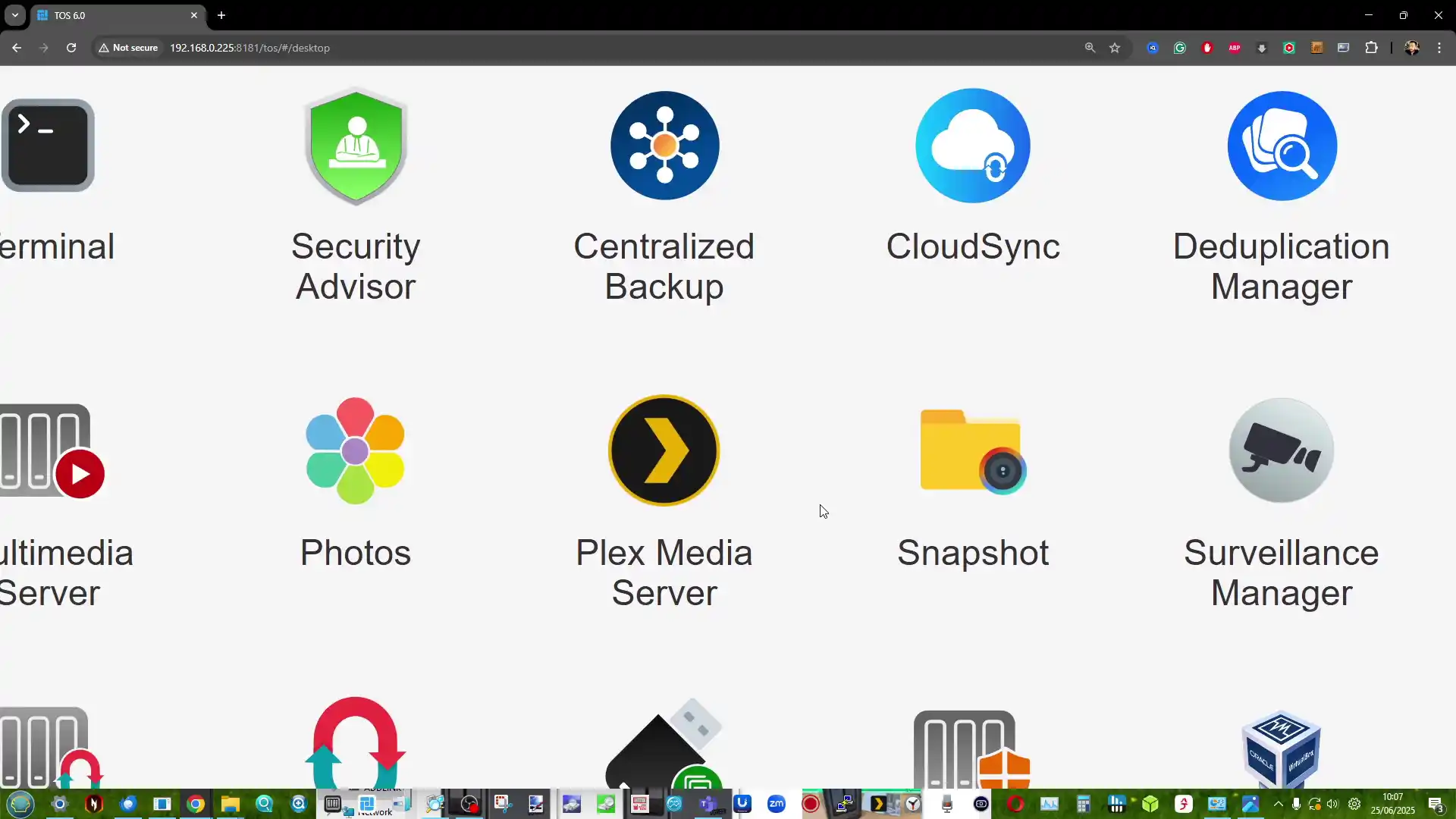
7. Due to security protocol changes, some applications will require updates or reconfiguration after the update. Community applications may need to be re-downloaded and reinstalled.
8. If you have previously modified the BIOS boot order, please adjust it before updating to ensure the TOS system drive has priority over other boot devices (such as USB drives). Failure to do so may cause the system to boot into the installation interface after the update.
9. System configurations from TOS 6 cannot be directly restored to TOS 7. A new configuration backup will need to be created after the update.
10. Before updating, please ensure your main volume (typically volume1) has at least 3 GB of free space. Insufficient space may cause the update to fail.
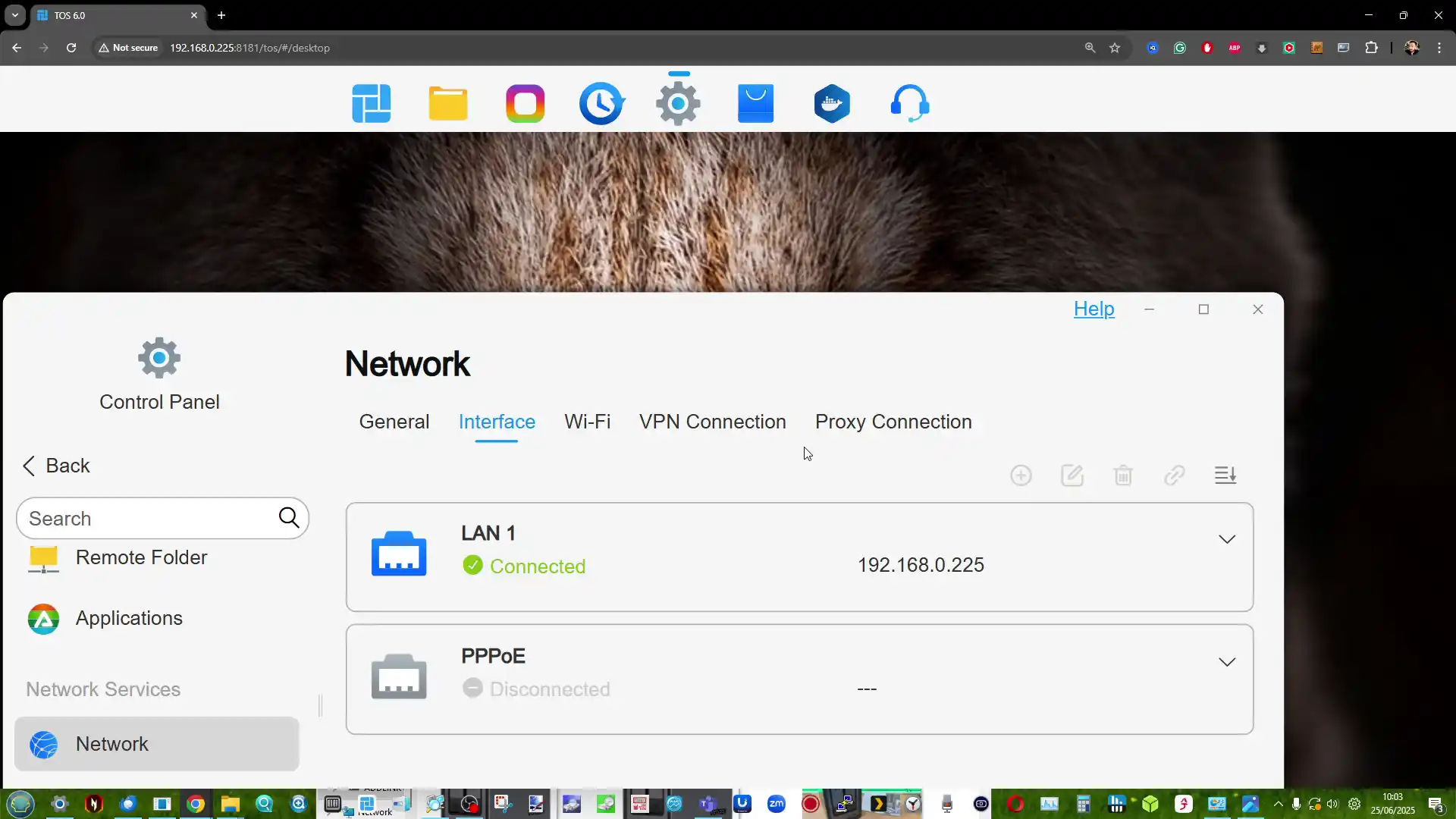
11. After updating, the device’s IP address may change. Please use the TNAS PC client to search for and reconnect to your device.
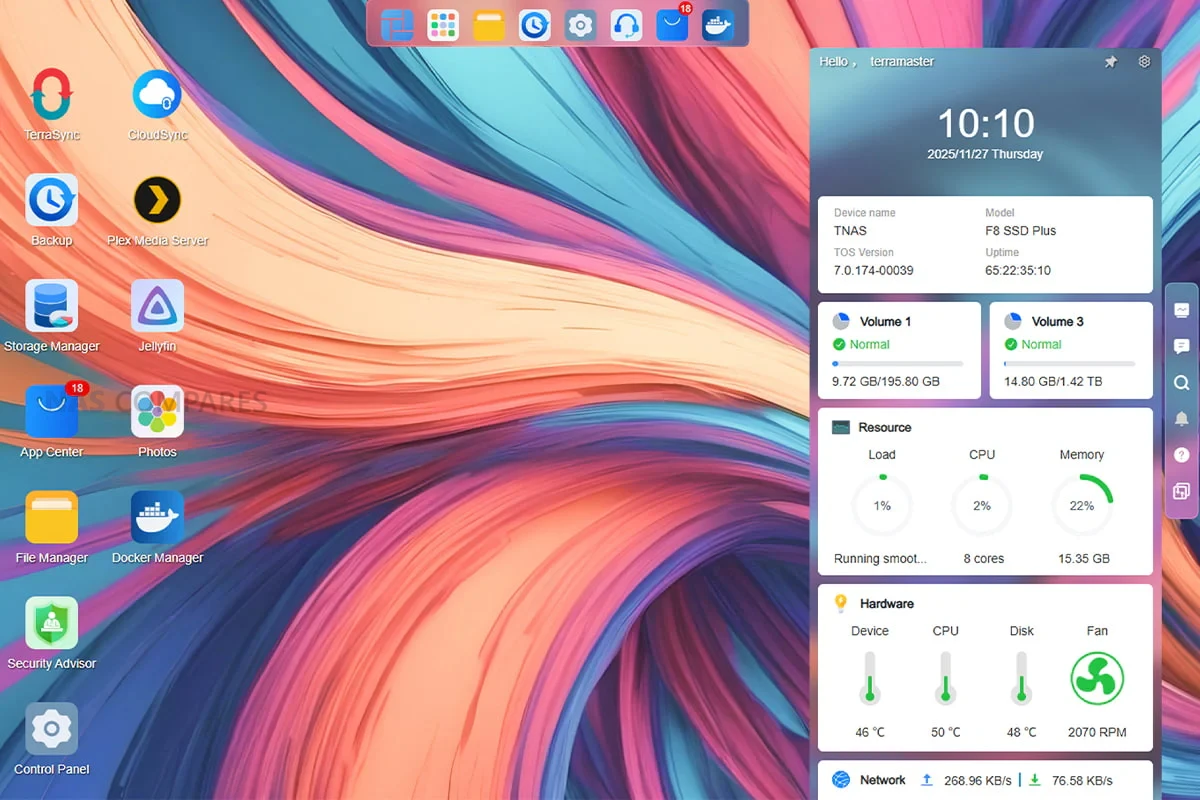


How to Update to TOS 7?
Manual Update:
1. Download the update package: TOS 7 (md5: 3287e60464d2e1dd0fceb04b570fe1cf)
2. Go to TOS > Control Panel > General Settings > System.
3. Under “Manual Update”, upload the update package.
4. Click “Apply”.
5. Once the system update is complete, you will need to refresh your browser.
6. After the update, your TNAS IP address may change. If you cannot connect to your TNAS using the previous IP address, please use the TNAS PC client to search for the new IP address.

Client Downloads:
1. Download TNAS PC 5.2.506 for Windows OS.
2. Download TNAS PC 5.2.506 for macOS (x86 and ARM architectures).
3. Download TNAS PC 5.2.506 for macOS (ARM architecture).
4. Download TNAS PC for Linux.
5. Download TNAS Mobile 3.X for Android.
6. For iOS, experience TNAS Mobile 3.X via: https://testflight.apple.com/join/wFWYABJS.

Bug Report
We sincerely thank you for taking the time to help us with testing! Every bug discovered is an important step toward the official release.
As the Beta version is an early-stage build of the program and may contain defects, please refrain from sharing Beta-related bugs publicly to avoid unnecessary confusion for others.
If you need to report a bug, please send a description of the issue, steps to reproduce it, and screenshots to the designated email address: [email protected].

https://www.youtube.com/watch?v=n0aabftiG7Q

📧 SUBSCRIBE TO OUR NEWSLETTER 🔔
[contact-form-7]
🔒 Join Inner Circle


Get an alert every time something gets added to this specific article!


Want to follow specific category? 📧 Subscribe

This description contains links to Amazon. These links will take you to some of the products mentioned in today's content. As an Amazon Associate, I earn from qualifying purchases. Visit the NASCompares Deal Finder to find the best place to buy this device in your region, based on Service, Support and Reputation - Just Search for your NAS Drive in the Box Below

Need Advice on Data Storage from an Expert?

Finally, for free advice about your setup, just leave a message in the comments below here at NASCompares.com and we will get back to you. Need Help? Where possible (and where appropriate) please provide as much information about your requirements, as then I can arrange the best answer and solution to your needs. Do not worry about your e-mail address being required, it will NOT be used in a mailing list and will NOT be used in any way other than to respond to your enquiry. [contact-form-7] TRY CHAT Terms and Conditions

If you like this service, please consider supporting us. We use affiliate links on the blog allowing NAScompares information and advice service to be free of charge to you.Anything you purchase on the day you click on our links will generate a small commission which isused to run the website. Here is a link for Amazon and B&H.You can also get me a ☕ Ko-fi or old school Paypal. Thanks!To find out more about how to support this advice service check HEREIf you need to fix or configure a NAS, check Fiver Have you thought about helping others with your knowledge? Find Instructions Here  

 
Or support us by using our affiliate links on Amazon UK and Amazon US
    
 
Alternatively, why not ask me on the ASK NASCompares forum, by clicking the button below. This is a community hub that serves as a place that I can answer your question, chew the fat, share new release information and even get corrections posted. I will always get around to answering ALL queries, but as a one-man operation, I cannot promise speed! So by sharing your query in the ASK NASCompares section below, you can get a better range of solutions and suggestions, alongside my own.

☕ WE LOVE COFFEE ☕


Terramaster Black Friday 2025 Deals

Black Friday Terramaster NAS Deals Now Live

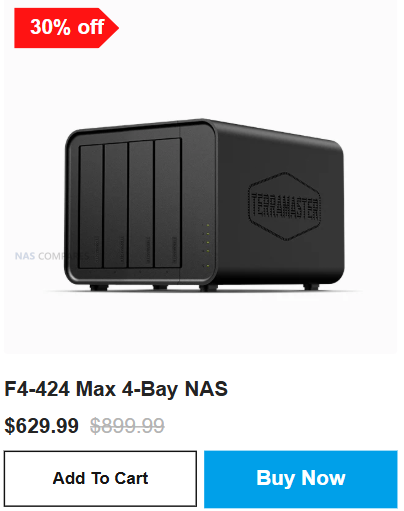
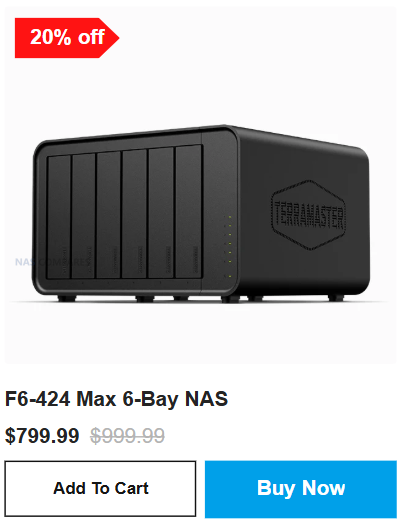
Black Friday 2025 brings some of the strongest price cuts Terramaster has offered to date, with major reductions across the entire lineup of NAS and DAS systems. Flagship units like the F4-424 Max drop from $899.99 to $629.99, the F6-424 Max sees deep reductions on high-capacity six-bay storage, and the all-flash F4 SSD now sits at $319.99 instead of $399.99. Even the entry models receive meaningful cuts, such as the F2-425 Plus falling to $319.99 and the D1 SSD Plus dropping to $76.99. This mix of discounts spans home users, creative workflows, SMB deployment, and high-speed all-flash storage, setting the stage for one of the most competitive Terramaster Black Friday lineups yet.

Terramaster 2025 Generation NAS Black Friday Deals

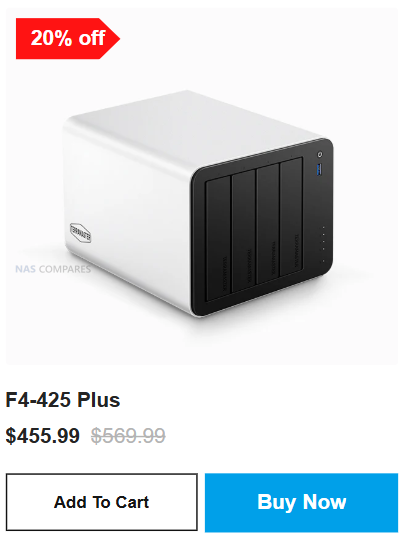
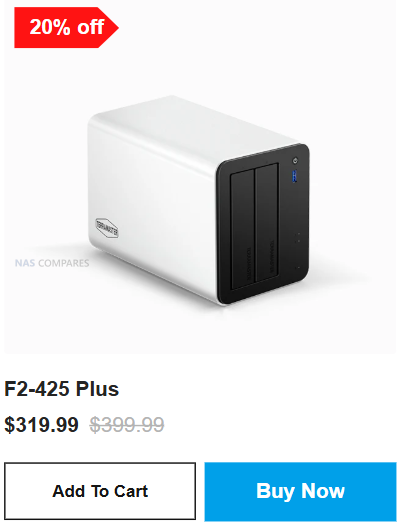
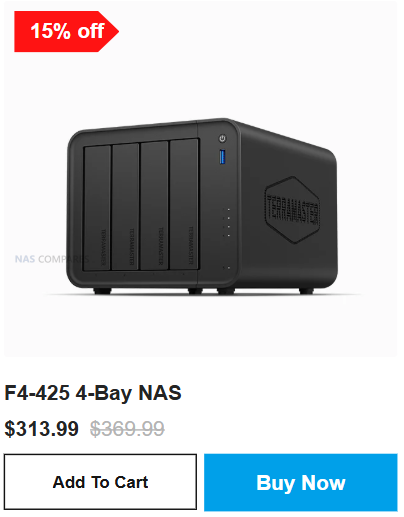
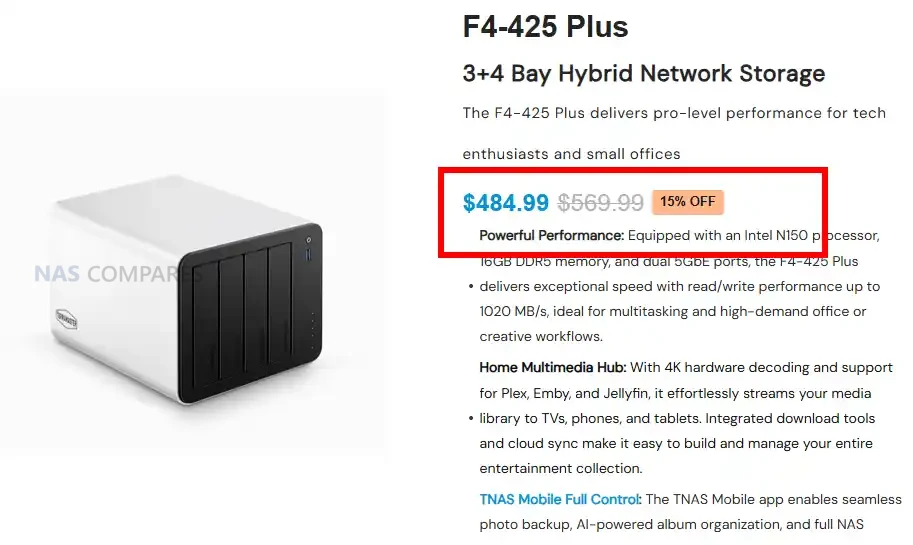
The Terramaster F4-425 Plus, F2-425 Plus, and F4-425 form the core of the brand’s 2025 generation Black Friday lineup, each delivering a significant jump in performance over older Terramaster models while receiving sizeable price cuts for the sale period. The F4-425 Plus is reduced to $455.99 from $569.99 and features an Intel N150 processor, 16GB DDR5 memory, dual 5GbE ports, and three M.2 NVMe slots, making it suitable for large Plex libraries, virtual machines, 8K transcoding, and high speed RAID arrays using TRAID or RAID 5 or RAID 6. The smaller F2-425 Plus drops to $319.99 from $399.99 and keeps the same N150 CPU and dual 5GbE networking but in a two bay format with 8GB DDR5 memory and three M.2 slots for SSD caching or high speed all flash pools, which suits creators or compact home labs. The F4-425 sits at a lower price of $313.99 from $369.99 and uses the Intel N5095 processor with 4GB DDR4 memory and a single 2.5GbE port, making it a more affordable entry point for home backups, light Plex streaming, and RAID 5 or TRAID setups while retaining the same push lock drive bays and aluminum chassis design found across the range.


Terramaster Best SSD System Black Friday Deals

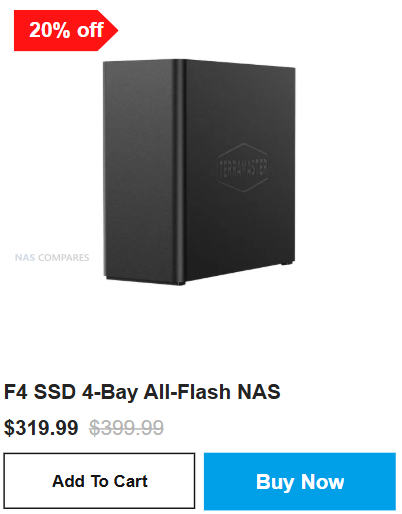
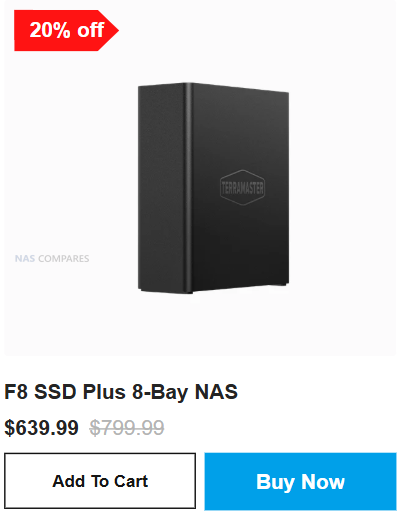
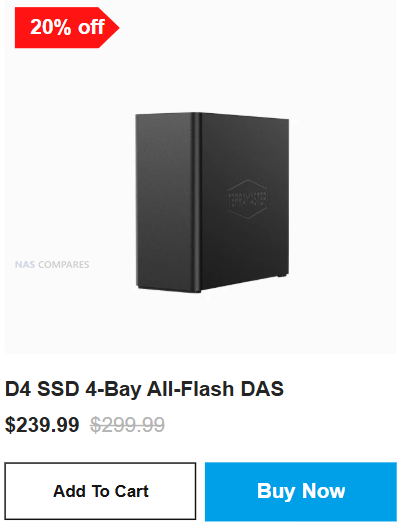
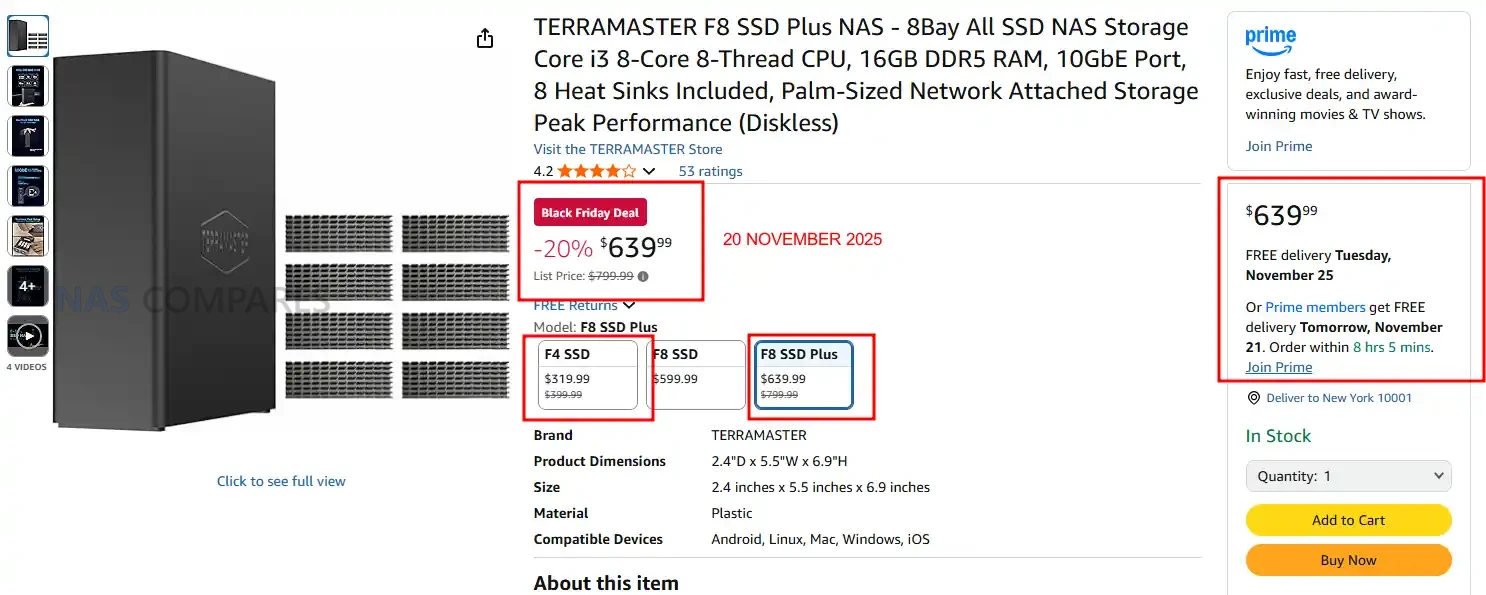
The spotlight turns to high‐performance SSD-based storage in Terramaster’s Black Friday 2025 lineup with the F4 SSD, the F8 SSD Plus NAS, and the D4 SSD 4-Bay USB DAS—all receiving deep discounts. The F4 SSD 4-Bay All-Flash NAS is offered for $319.99 (down from $399.99) and gives creators and small workgroups fast NVMe caching support, all-flash RAID (0/1/5/6/10) readiness and a desktop form factor suited to demanding media workflows. The F8 SSD Plus 8-Bay NAS, now $639.99 instead of $799.99, scales up that performance into a larger chassis: excellent for high throughput workloads, database hosting, content creation pipelines or consolidation of multiple flash volumes with plenty of headroom and robust NAS services. Rounding out the trio, the D4 SSD 4-Bay All-Flash DAS is discounted to $239.99 (from $299.99) and provides USB-C or Thunderbolt 3/4 (depending on region) direct access to four SSDs, making it a great companion for video editors, mobile creators or anyone who needs ultra-low latency local storage with the ability to archive later to a full NAS. Together, these three systems cover fast all-flash storage needs—from editing bays to fast-access workstations to high-capacity large NAS units—at some of Terramaster’s most aggressive Black Friday pricing.


Terramaster Power Desktop NAS Black Friday Deals

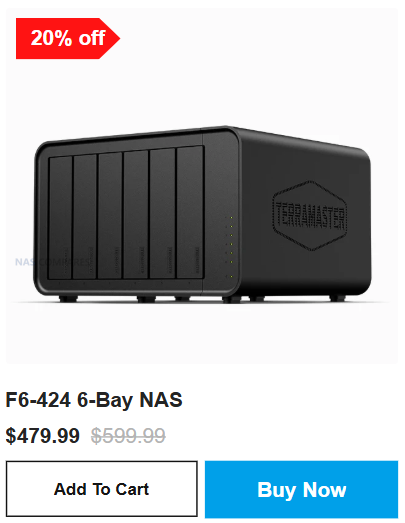
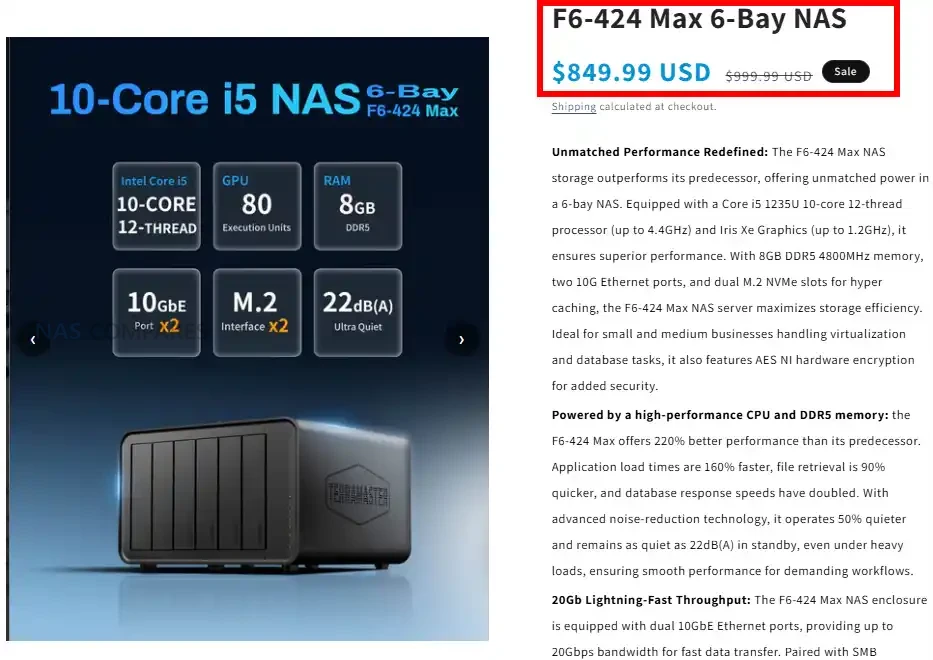
Terramaster’s Power Desktop NAS lineup sees serious Black Friday cuts in 2025 for users who need multi-bay capacity and high performance in a compact desktop form factor. The F4-424 Max 4-Bay NAS is offered at $629.99 (down from $899.99) and delivers a strong balance of features: Intel N5095 or equivalent quad-core processor, multiple high speed LAN options, M.2 SSD caching or expansion, and support for large 30 TB+ drives in RAID 5 or TRAID+. The F6-424 (non-Max) drops to $479.99 (from $599.99) and bumps capacity up to six bays while maintaining the compact footprint, offering creators and small offices a six-drive pool with ample headroom for large media libraries or datasets. The F6-424 Max takes it further, combining six-bay mechanics with the “Max” class enhancements—higher memory, faster networking, and premium chassis build—making it a powerhouse for homelab users or prosumers at the reduced Black Friday price (specific price not listed, but expect similar ~20% discount). Together, these three units represent Terramaster’s desktop NAS workhorses—ideal for high capacity, multi-drive setups during Black Friday 2025.


Other Terramaster NAS Deals to check out:

Here are a few of the other Amazon Black Friday Deals available during this Black Friday event:

Terramaster F8 SSD PLUS Flash NAS – 20% OFF, NOW $639.99


Terramaster F4-425 PLUS (New 2025 Series Release) NAS – $484.99


Terramaster F6-424 Max – Powerhouse 6-Bay NAS – $150 OFF, Now $849.99


📧 SUBSCRIBE TO OUR NEWSLETTER 🔔
[contact-form-7]
🔒 Join Inner Circle

Get an alert every time something gets added to this specific article!


Want to follow specific category? 📧 Subscribe

This description contains links to Amazon. These links will take you to some of the products mentioned in today's content. As an Amazon Associate, I earn from qualifying purchases. Visit the NASCompares Deal Finder to find the best place to buy this device in your region, based on Service, Support and Reputation - Just Search for your NAS Drive in the Box Below

Need Advice on Data Storage from an Expert?

Finally, for free advice about your setup, just leave a message in the comments below here at NASCompares.com and we will get back to you. Need Help? Where possible (and where appropriate) please provide as much information about your requirements, as then I can arrange the best answer and solution to your needs. Do not worry about your e-mail address being required, it will NOT be used in a mailing list and will NOT be used in any way other than to respond to your enquiry. [contact-form-7] TRY CHAT Terms and Conditions
If you like this service, please consider supporting us. We use affiliate links on the blog allowing NAScompares information and advice service to be free of charge to you.Anything you purchase on the day you click on our links will generate a small commission which isused to run the website. Here is a link for Amazon and B&H.You can also get me a ☕ Ko-fi or old school Paypal. Thanks!To find out more about how to support this advice service check HEREIf you need to fix or configure a NAS, check Fiver Have you thought about helping others with your knowledge? Find Instructions Here  

 
Or support us by using our affiliate links on Amazon UK and Amazon US
    
 
Alternatively, why not ask me on the ASK NASCompares forum, by clicking the button below. This is a community hub that serves as a place that I can answer your question, chew the fat, share new release information and even get corrections posted. I will always get around to answering ALL queries, but as a one-man operation, I cannot promise speed! So by sharing your query in the ASK NASCompares section below, you can get a better range of solutions and suggestions, alongside my own.

☕ WE LOVE COFFEE ☕


Why is 10GbE STILL NOT Everywhere (especially on NAS)?

Why are NAS Systems not 10GbE as Standard Right Now?

It is 2025, yet the majority of NAS systems on the market continue to ship with 1GbE or, at best, 2.5GbE networking, leaving many users questioning why 10GbE has not become a standard feature. Over the past decade, the cost of 10GbE networking equipment, including switches, NICs, and adapters, has steadily declined, and the technology has long since moved from being an enterprise-only option into mainstream availability. Home labs, creative professionals, and small businesses are increasingly working with 4K and 8K media, large VM environments, and multi-terabyte datasets, all of which can easily saturate a 1GbE or even 2.5GbE connection. Despite this shift, when browsing the portfolios of Synology, QNAP, Asustor, TerraMaster, or even newer DIY-friendly NAS brands, the entry-level and mid-tier systems remain locked at bandwidth speeds that are already dwarfed by modern SSD arrays and multi-bay RAID configurations.

asdasd

This gap between user expectations and manufacturer offerings has become more striking as affordable consumer motherboards and even some mini-PCs now integrate 5GbE or 10GbE as standard. By contrast, NAS vendors still tend to position 10GbE as a high-end add-on or restrict it to flagship models, often requiring costly proprietary NIC upgrades. For the average buyer, this creates the perception that NAS devices are lagging behind broader networking trends and are artificially constrained to maintain price tiers. The reality is more complex. The question of why 10GbE has not become universal in NAS hardware cannot be answered solely by pointing to falling market prices of controllers and switches. Instead, the explanation lies in a mix of economics, hardware design limitations, CPU lane allocations, and the fact that networking itself is evolving beyond 10GbE into alternatives like 25GbE and USB4. All of these factors together show why the integration of 10GbE into NAS devices remains more complicated than it may first appear.

Discussing the Issue / Barriers to Manufacturers

One of the most persistent barriers to universal 10GbE adoption in NAS systems is the economic reality of how these devices are positioned. Vendors like Synology, QNAP, and Asustor operate in a layered product ecosystem, where each tier is designed to push customers toward more expensive models. Entry-level devices often compete on affordability rather than raw performance, meaning that features like 10GbE are deliberately held back to differentiate mid-range and enterprise systems. The actual bill of materials (BOM) cost for including 10GbE hardware is lower than it was five years ago, but manufacturers still view it as a premium feature that justifies higher price points. By holding 10GbE in reserve for upper tiers, vendors protect their margins, avoid cannibalising sales of more profitable models, and keep upgrade paths clear for customers as their needs grow. This is not simply technical gatekeeping but a conscious market segmentation strategy.

A second, more technical challenge comes from CPU and chipset design. The processors used in affordable NAS devices are almost always low-power embedded models—Intel Celeron, Atom, or entry-level AMD Ryzen Embedded chips—which provide only a limited number of PCIe lanes. These lanes must be distributed across storage controllers, NVMe slots, expansion slots, and network interfaces. Introducing 10GbE requires not only dedicating at least two, and often four, PCIe lanes, but also ensuring that the CPU can handle the higher throughput without becoming the bottleneck. If a vendor reallocates lanes to add 10GbE, they may have to reduce the number of NVMe slots, cut down on SATA ports, or compromise expansion card bandwidth. For many manufacturers, it is simpler to leave 10GbE out of the base design than to risk producing a system that looks good on paper but struggles to deliver in practice.

Beyond lane allocation, there is also the issue of power, thermals, and board layout. 10GbE controllers typically draw more power and generate more heat than 1GbE or 2.5GbE chips. In compact NAS enclosures designed for low-noise operation, this can force more aggressive cooling solutions or tighter thermal management. For brands already working within strict acoustic and energy efficiency limits, especially in home or small office NAS devices, the integration of 10GbE becomes a balancing act between speed and stability. Higher thermal load can also reduce the overall lifespan of components or require larger enclosures, both of which erode the appeal of entry-level systems where buyers expect compact and efficient designs.

Another factor that discourages widespread 10GbE adoption is ecosystem alignment. NAS vendors are keenly aware that a large percentage of their target audience does not yet operate in 10GbE-ready environments. Even though 10GbE switches and NICs are more affordable in 2025, many households and small offices still rely on routers and switches with 1GbE or 2.5GbE uplinks. For these users, the inclusion of 10GbE would have little practical benefit, since the rest of the network infrastructure cannot support it. From the manufacturer’s perspective, bundling 10GbE into a device that will simply be throttled by the customer’s network backbone risks making the feature look pointless, or worse, “non-functional.” As such, 10GbE tends to be reserved for prosumer and enterprise segments, where it is more likely that users already have or are willing to invest in compatible infrastructure.

Finally, there is a subtle but important business factor at play: vendor ecosystems and upsell opportunities. Many NAS brands sell proprietary 10GbE upgrade cards or branded NICs, which can only be used with their systems. By omitting onboard 10GbE but providing expansion slots, vendors create an additional revenue stream while giving customers flexibility to upgrade later. This model also ensures that users who truly require 10GbE end up spending more within the brand’s ecosystem, while casual buyers stick to lower-cost systems that do not overdeliver. In this sense, the absence of 10GbE on affordable NAS units is not only about technical limitations, but also about preserving a staged upgrade model that aligns with each brand’s long-term revenue strategy.

The Solution – How Can 10GbE Be More Accessible?

The landscape for 10GbE networking hardware has improved significantly in the last few years, with controllers becoming cheaper, more efficient, and easier to integrate into consumer systems. Early 10GbE relied heavily on costly Intel or Mellanox chipsets designed primarily for enterprise servers, often priced in the hundreds of dollars per card. Today, vendors such as Realtek, Aquantia (now under Marvell), and Broadcom produce consumer-focused 10GbE controllers that are smaller, run cooler, and consume less power. These newer chipsets are also designed to integrate more smoothly with mainstream CPUs and motherboards, reducing the need for complex PCB layouts. The result has been a marked reduction in the cost of standalone NICs and USB-to-10GbE adapters, which now frequently sell for under $100, making them accessible even for home users experimenting with faster networking.

Even with this progress, manufacturers remain hesitant to make 10GbE a baseline feature across all NAS devices. Part of the reason lies in how modern NAS systems must juggle limited resources. As CPUs have shifted to PCIe Gen 4 and Gen 5, the available bandwidth has increased, but vendors are also using these lanes to expand NVMe storage pools, enable GPU acceleration, or add AI-focused co-processors for surveillance, indexing, or media analysis. In many cases, vendors see greater value in offering more M.2 slots, dual PCIe expansion options, or flexible NIC bays than in permanently dedicating space to 10GbE. This explains why hybrid designs are now common: devices shipping with 2.5GbE or 5GbE onboard, with a dedicated slot for an optional 10GbE card. Such configurations give users a faster-than-gigabit baseline, but also keep upgrade paths open for power users who truly need multi-gigabit networking.

The state of 10GbE is also being influenced by the rapid adoption of adjacent technologies. 2.5GbE has become the de facto standard in new consumer motherboards and mid-tier switches, offering a cheap and widely compatible upgrade path for everyday users who want more than 1GbE without changing their cabling. At the other end of the spectrum, higher-speed networking such as 25GbE or 40GbE is filtering down from data centres to advanced prosumer setups, while direct-connect solutions like Thunderbolt 4 and USB4 offer bandwidth well beyond 10GbE with less CPU overhead and simpler plug-and-play deployment. Software optimisation is also playing a role: modern NAS operating systems increasingly support IP over Thunderbolt or USB4, which provides a parallel path to multi-gigabit performance without the traditional reliance on Ethernet standards. As a result, 10GbE finds itself squeezed in the middle—too expensive to be a no-brainer at the entry level, but increasingly overshadowed by faster alternatives at the top end. It remains a critical sweet spot for small businesses and creative professionals, but its window of dominance is being challenged by the pace of networking innovation.

Verdict and Conclusion – Buy a 10GbE NAS Now or Wait?

The question of why 10GbE has not become a standard feature across NAS devices in 2025 does not have a single answer, but rather a convergence of factors. Manufacturers face technical challenges in CPU lane allocation, thermal management, and system design, while also making deliberate market choices to protect product segmentation and encourage upsell opportunities. At the same time, 10GbE sits in an awkward position within the networking landscape: cheaper and more efficient than ever, yet increasingly bypassed by the widespread adoption of 2.5GbE on the low end and the emergence of 25GbE, Thunderbolt, and USB4 on the high end. For now, this means that 10GbE remains reserved for higher-tier NAS systems where the hardware can genuinely sustain its throughput and where the user base is prepared to invest in compatible infrastructure. While prices will continue to fall and adoption will grow, it is unlikely that every NAS will adopt 10GbE as standard before other technologies begin to replace it as the next performance baseline.

5 affordable Turnkey 10GbE NAS Solutions (Between $499 and $699)

For years, 10GbE networking has been seen as a premium feature reserved for high-end or enterprise-grade NAS devices, often pushing total system costs well beyond the reach of home users and small businesses. However, as controller prices have dropped and demand for faster data transfers has grown, a new wave of affordable NAS solutions has started to appear with built-in 10GbE. These systems no longer require expensive proprietary upgrade cards or third-party NICs, and many sit comfortably below the $699 / £599 price point. They cover a range of use cases, from compact SSD-based NAS devices to rackmount storage appliances and versatile desktop units. Below is a selection of some of the most notable options currently available, each offering a balance of performance, connectivity, and affordability for users who want to move beyond 1GbE or 2.5GbE without breaking the bank.

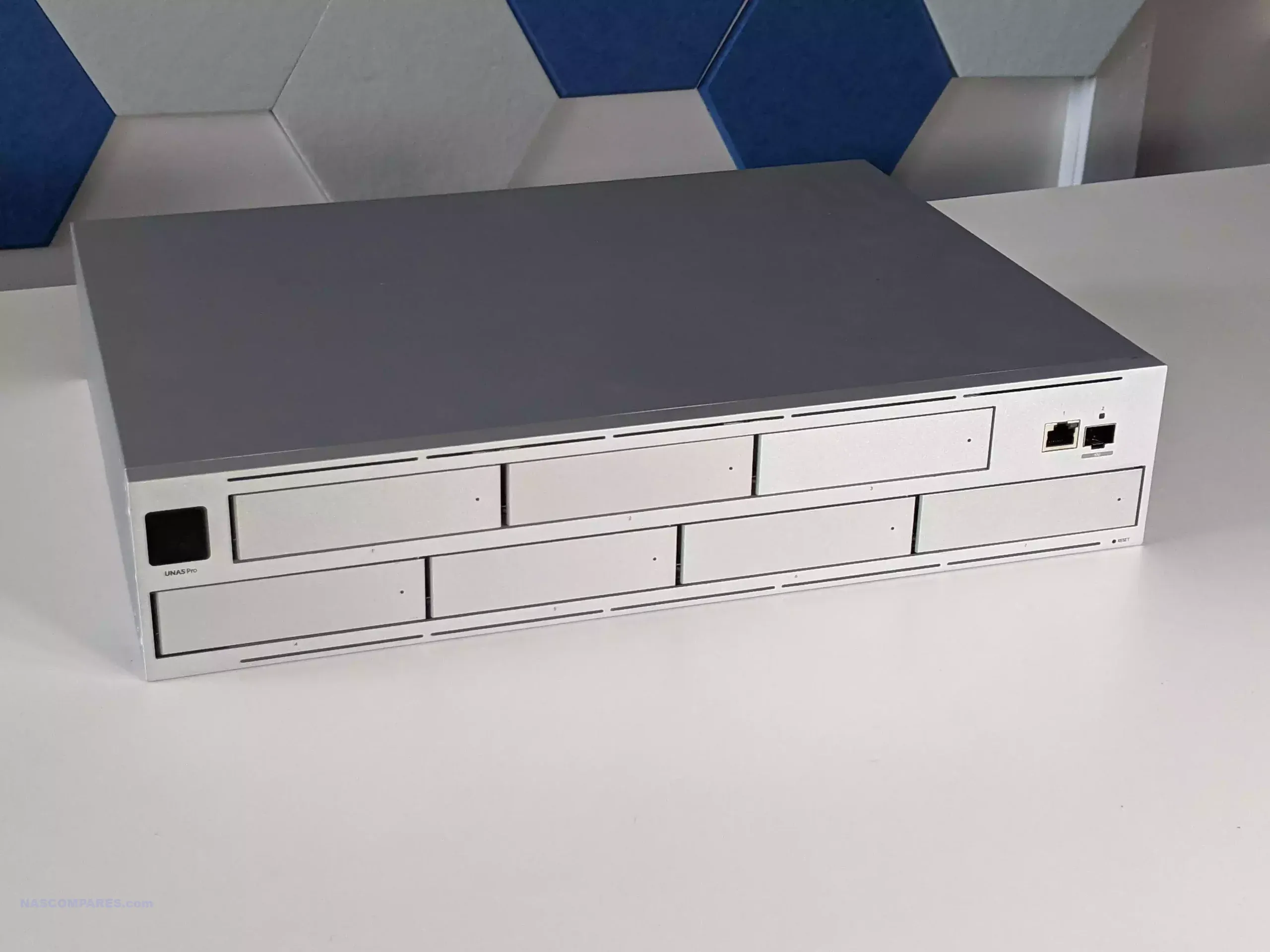
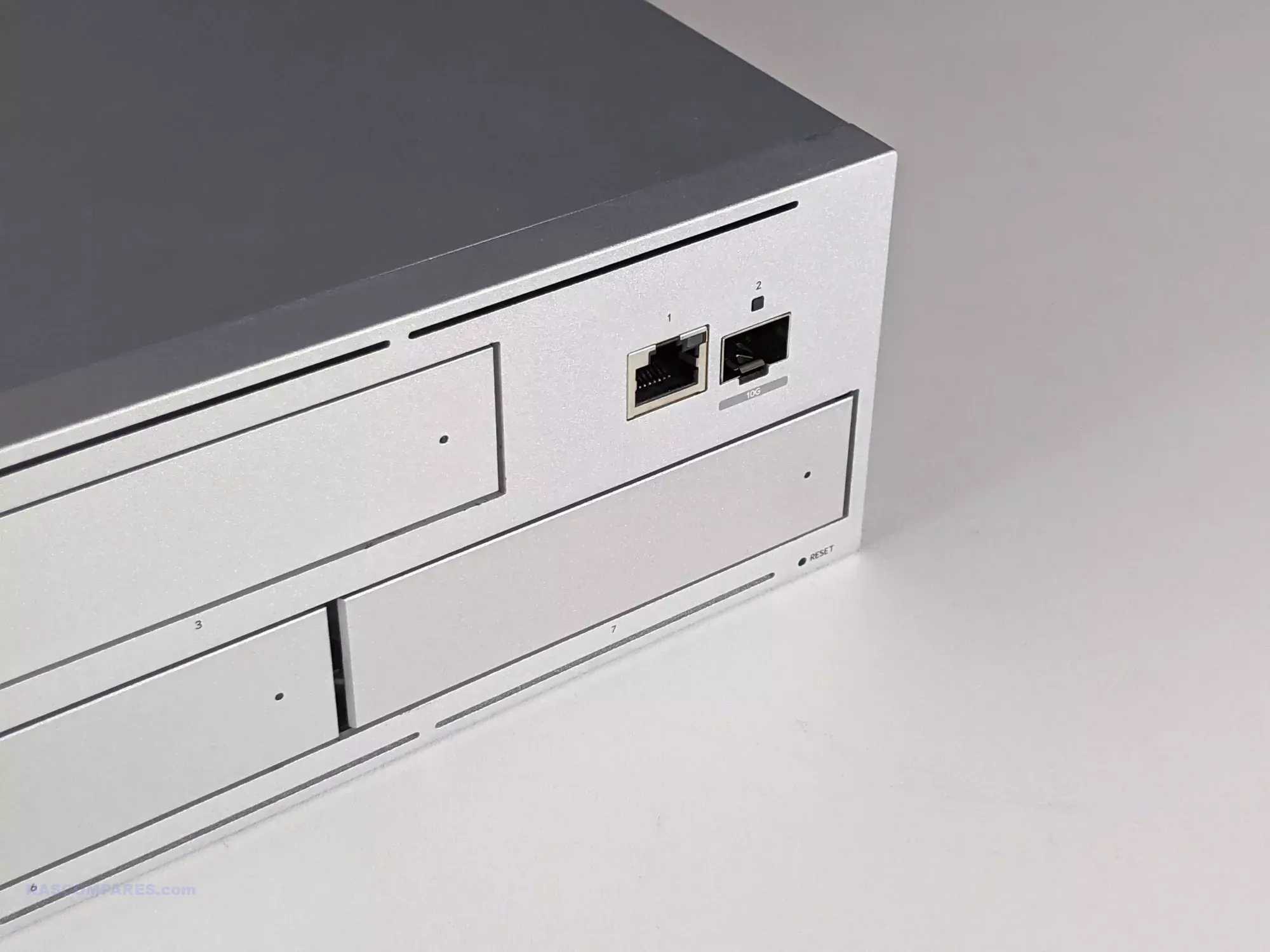
UniFi UNAS Pro (7-Bay, Rackmount)

I keep coming back to two words for the UniFi UNAS Pro—fundamentals and consistency. UniFi has clearly focused on making this system a strong addition to their ecosystem, prioritizing the essential storage needs of a NAS. They’ve succeeded in this, but comparisons with long-established competitors are inevitable. While solid, reliable, and stable, the UniFi UNAS Pro will take time to be competitive on the software front. If you’re deeply invested in the UniFi ecosystem, you’ll appreciate its ease of use and integration. However, outside of a UniFi network, it may feel feature-light compared to alternatives. The pricing is competitive for a launch product at $499, and while it’s not the best NAS on the market, it’s the most user-friendly and UniFi-ready. It will likely satisfy many users’ needs. I can certainly see this being integrated into existing UniFi networks as a 2nd stage backup alongside their already existing 3rd party NAS solution, with the potential to graduating to their primary storage as Ubiquiti continue to evolve this platform above and beyond the fundamentals their have nailed down in the UNAS Pro system.

  • Approx. Price: $499 / £400

  • Specs: ARM Cortex-A57 quad-core CPU, 8 GB RAM, seven 2.5″/3.5″ SATA bays, 1×10GbE SFP+ and 1×1GbE.

  • Why It Stands Out: Exceptional price-to-performance for pure storage needs. Lacks advanced multimedia or container apps but ideal for high-speed backups in a rackmount setup.

BUILD QUALITY - 10/10
HARDWARE - 7/10
PERFORMANCE - 7/10
PRICE - 9/10
VALUE - 8/10


8.2
PROS
👍🏻Nails down the fundamentals of NAS Storage very well
👍🏻Easy to use GUI and well suited in the UniFi Ecosystem/UX
👍🏻Complete Offline Use is supported
👍🏻Use of a UI account is NOT compulsory
👍🏻Excellently deployed Snapshot Features
👍🏻10GbE out-the-box
👍🏻Open HDD Compatibility, but also 1st party options too
👍🏻Backup and Restoration Options Nailed down perfectly
👍🏻Very power efficient and CPU/, Memory utilization rarely high
👍🏻Compact, Quite and well designed chassis
👍🏻The LCD controls are completely \'different level\' compared to other brands in the market
👍🏻Promised competitive pricing
👍🏻FAST deployment (3-5mins tops)
👍🏻Reactive Storage expandability and easy-to-understand storage failover options
👍🏻Mobile app deployment is intuitive/fast
👍🏻Feels stable, secure and reliable at all times
👍🏻Performance is respectable (considering SATA Bay count and CPU) but also sustained performance is very good
👍🏻Single screen dashboard is clear and intuitive
👍🏻Ditto for the native file explorer
CONS
👎🏻7 Bays is a bit unusual, plus feels like the existing UNVR with different firmware
👎🏻Additional App installation (eg. \'Protect\') not currently supported. So no container support for 3rd party apps
👎🏻Network Controls are limited
👎🏻Works at it\'s best in an existing UniFi managed network, feels a little limited in \'standalone\'
👎🏻Multiple storage pools not supported (nor is RAID 0)
👎🏻Lack of Scheduled On/Off
👎🏻Lack of redundant PSU
👎🏻Only 1 10Gb port and 1x 1GbE, no USBs for expanded storage or an expansion


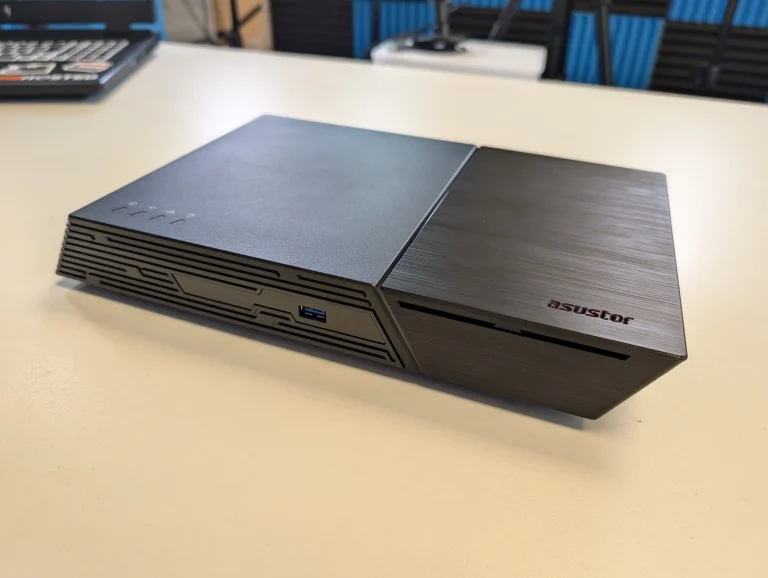
Asustor Flashstor 12 Gen 1 (Compact NVMe NAS)

The Asustor Flashstor Gen 2 12-Bay NAS is a robust and versatile solution for users with demanding storage needs. Its combination of high-performance hardware, extensive connectivity options, and compact design makes it a standout choice for content creators, small businesses, and enthusiasts. With dual 10GbE ports, USB 4.0 connectivity, and support for up to 12 M.2 NVMe drives, it offers exceptional speed and scalability. While the device has a few quirks, such as its mixed PCIe slot speeds and lack of M.2 heat sinks, these are manageable with proper planning and aftermarket solutions. The Flashstor Gen 2 excels in raw performance, handling intensive workflows with ease and maintaining low noise levels even under load. Its power efficiency and robust thermal management further enhance its appeal for 24/7 operation. For users prioritizing hardware capabilities and performance, the Flashstor Gen 2 delivers on its promises. While its complexity may deter less experienced users, those with the technical expertise to configure and optimize the system will find it a valuable addition to their workflow.

  • Approx. Price: $750 / £600

  • Specs: Intel Celeron N5105, 12×M.2 NVMe slots, single 10GbE port, compact form factor.

  • Notable Traits: High-density SSD storage in a small desktop chassis. Excellent value for SSD-heavy builds.

SOFTWARE - 6/10
HARDWARE - 9/10
PERFORMANCE - 10/10
PRICE - 7/10
VALUE - 8/10


8.0
PROS
👍🏻Exceptional Performance: Dual 10-Gigabit Ethernet ports and USB 4.0 connectivity deliver fast and reliable data transfer speeds, ideal for 4K editing and collaborative environments.
👍🏻Extensive Storage Options: Supports up to 12 M.2 NVMe SSDs, allowing for large-scale, high-speed storage arrays.
👍🏻ECC Memory Support: Includes 16GB of DDR5-4800 ECC memory (expandable to 64GB), ensuring data integrity for critical applications.
👍🏻Compact Design: Small footprint makes it perfect for workspaces with limited room.
👍🏻Quiet Operation: Dual-fan system keeps noise levels low, even under heavy loads.
👍🏻Flexible Connectivity: Features two USB 4.0 Type-C ports and three USB 3.2 Gen 2 Type-A ports for direct storage access and peripheral integration.
👍🏻Power Efficiency: Low power consumption (32.2W idle, 56W under load) makes it economical to run, even for 24/7 operation.
👍🏻Thermal Management Enhancements: Dual fans and copper heat pipes efficiently dissipate heat, ensuring stable performance.
👍🏻Support for Third-Party Operating Systems: Compatible with platforms like TrueNAS and Unraid for advanced customization.
CONS
👎🏻Mixed PCIe Slot Speeds: Inconsistent PCIe bandwidth across M.2 slots complicates unified RAID configurations.
👎🏻Lack of M.2 Heat Sinks: NVMe slots do not include heat sinks, requiring aftermarket cooling solutions for intensive workloads.
👎🏻No Integrated Graphics: The AMD Ryzen V3C14 processor lacks integrated graphics, limiting hardware transcoding and multimedia capabilities.
👎🏻Steep Price: The 12-bay model’s cost ($1,300–$1,400) and the six-bay version’s lack of ECC memory make them expensive compared to alternatives.


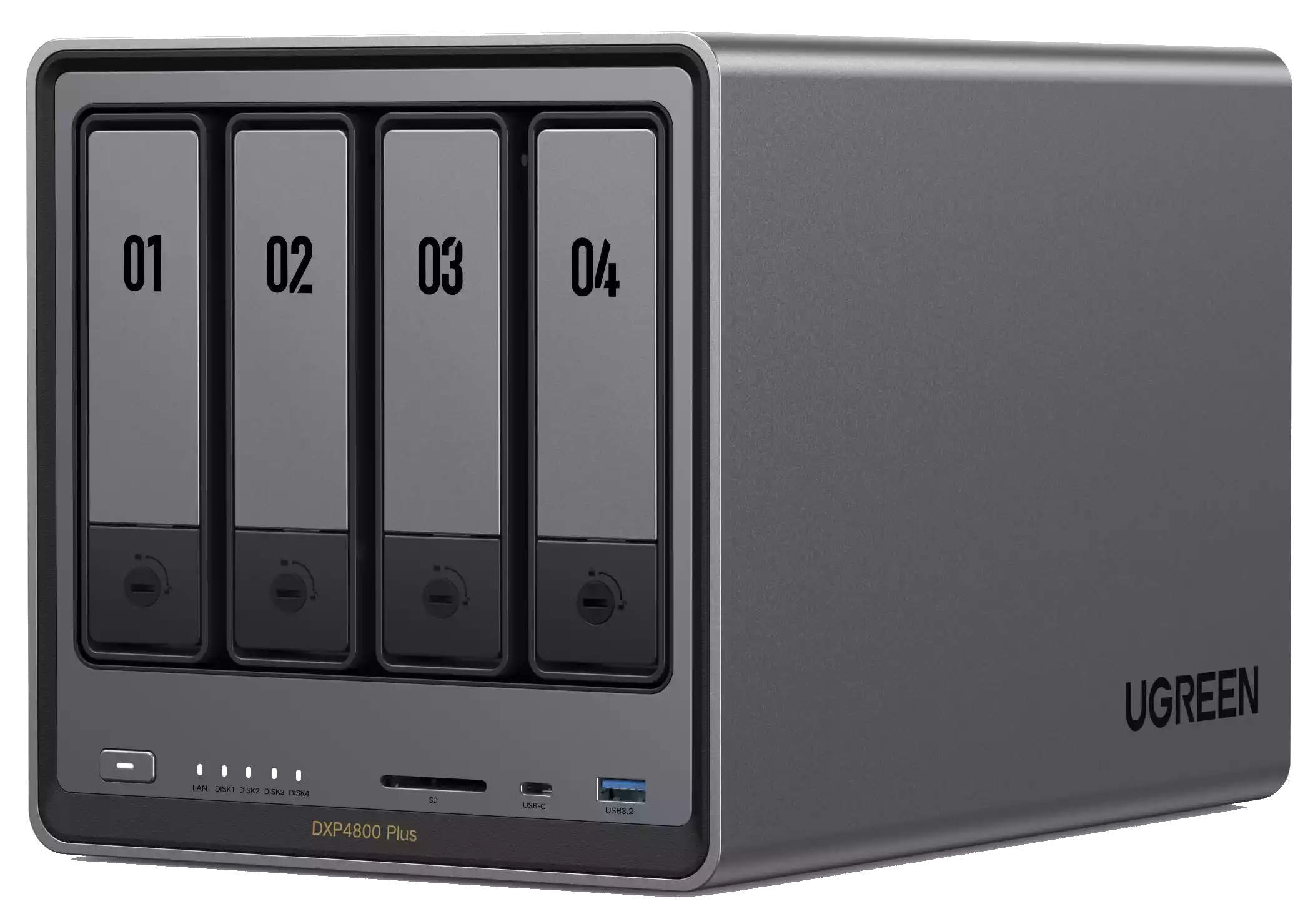
UGREEN NASync DXP4800 Plus

BOTTOM LINE – The UGREEN NASYnc DXP4800 Plus does not feel ‘finished’ yet and still needs more time in the over, but UGREEN have been very clear with me that this product is not intended for release and fulfilment till summer 2024 and improvements, optimization and product completion is still in progress. Judging the UGREEN NAS systems, when what we have is a pre-release and pre-crowdfunding sample, was always going to be tough. The DXP4800 PLUS is a very well put-together NAS solution, arriving with a fantastic launching price point (arguably even at its RRP for the hardware on offer). UGREEN has clearly made efforts here to carve out their own style, adding their own aesthetic to the traditional 4-bay server box design that plagues NAS boxes at this scale. Equally, although they are not the first brand to consider Kickstarter/Crowdfunding for launching a new product in the NAS/personal-cloud sector, this is easily one of the most confident entries I have seen yet. The fact that this system arrives on the market primarily as a crowdfunded solution (though almost certainly, if successful, will roll out at traditional retail) is definitely going to give users some pause for thought. Equally, the UGREEN NAS software, still in beta at the time of writing, although very responsive and nailing down the basics, still feels like it needs more work to compete with the bigger boys at Synology and QNAP. Hardware architecture, scalability, and performance are all pretty impressive, though the performance of the Gen 4×4 M.2 NVMe slots didn’t seem to hit the numbers I was expecting. Perhaps a question of PCIe bottlenecking internally, or a need for further tweaking and optimization as the system continues development. Bottom line, with expected software updates to roll out closer to launch and fulfillment, such as an expanded App center and mobile client, the UGREEN DXP4800 Plus is definitely a device worth keeping an eye on in the growing Turnkey and semi-DIY NAS market. As an alternative to public cloud services, this is a no-brainer and worth the entry price point. As an alternative to established Turnkey NAS Solutions, we will hold off judgment till it is publicly released.

  • Approx. Price: $595 / £475

  • Specs: Intel Pentium Gold 8505 (6-thread), 8 GB DDR5, 4×SATA + 2×M.2 slots, 1×10GbE and 1×2.5GbE, plus HDMI, USB-C, USB-A, and SD reader.

  • Why It’s Attractive: Well-rounded design with rich connectivity and media support, undercuts most rivals on price and features.

SOFTWARE - 6/10
HARDWARE - 9/10
PERFORMANCE - 6/10
PRICE - 9/10
VALUE - 8/10


7.6
PROS
👍🏻Exceptional Hardware for the Price
👍🏻4 HDDs + 2x Gen 4x4 M.2 in 1 box under $400
👍🏻Good Balanced CPU choice in the Pentium Gold 8505
👍🏻10GbE and 2.5GbE as standard
👍🏻An SD Card Slot (wielrd rare!)
👍🏻10/10 Build Quality
👍🏻Great Scalability
👍🏻Fantastic Mobile Application (even vs Synology and QNAP etc)
👍🏻Desktop/Browser GUI shows promise
👍🏻Established Brand entering the NAS Market
👍🏻Not too noisy (comparatively)
👍🏻Very Appealing retail package+accessories
CONS
👎🏻10GbE Performance was underwhelming
👎🏻Crowdfunding choice is confusing
👎🏻Software (still in Beta) is still far from ready 22/3/24
👎🏻non-UGREEN PSU is unexpected
👎🏻


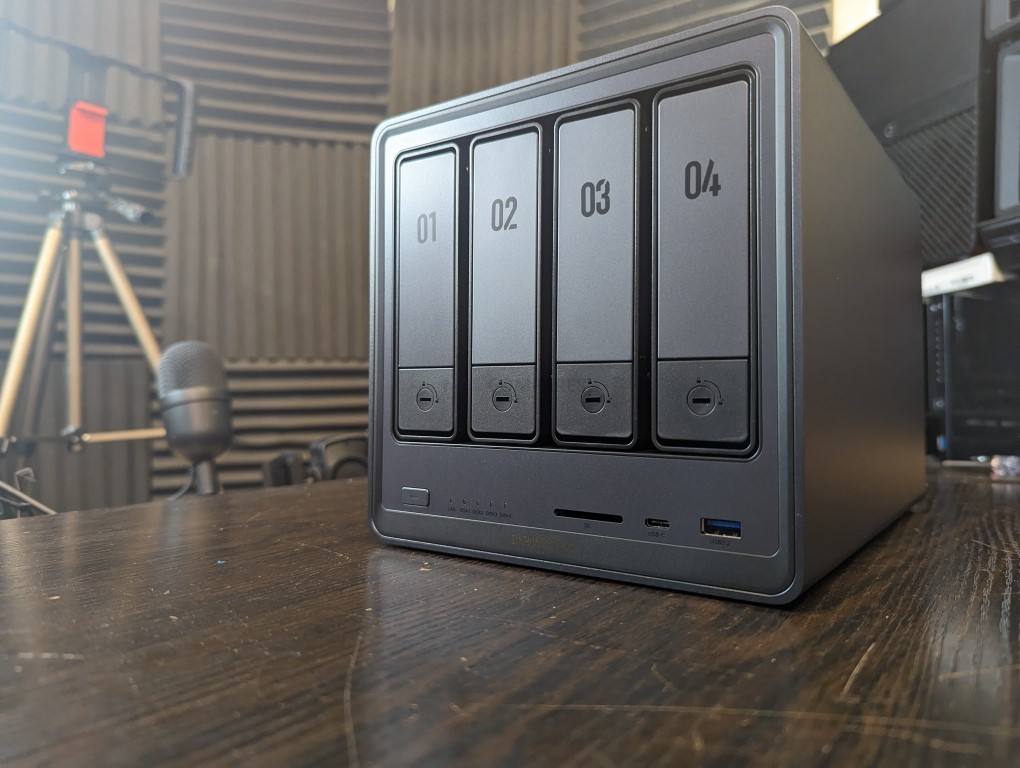
TerraMaster F4-424 Max / F6-424 Max

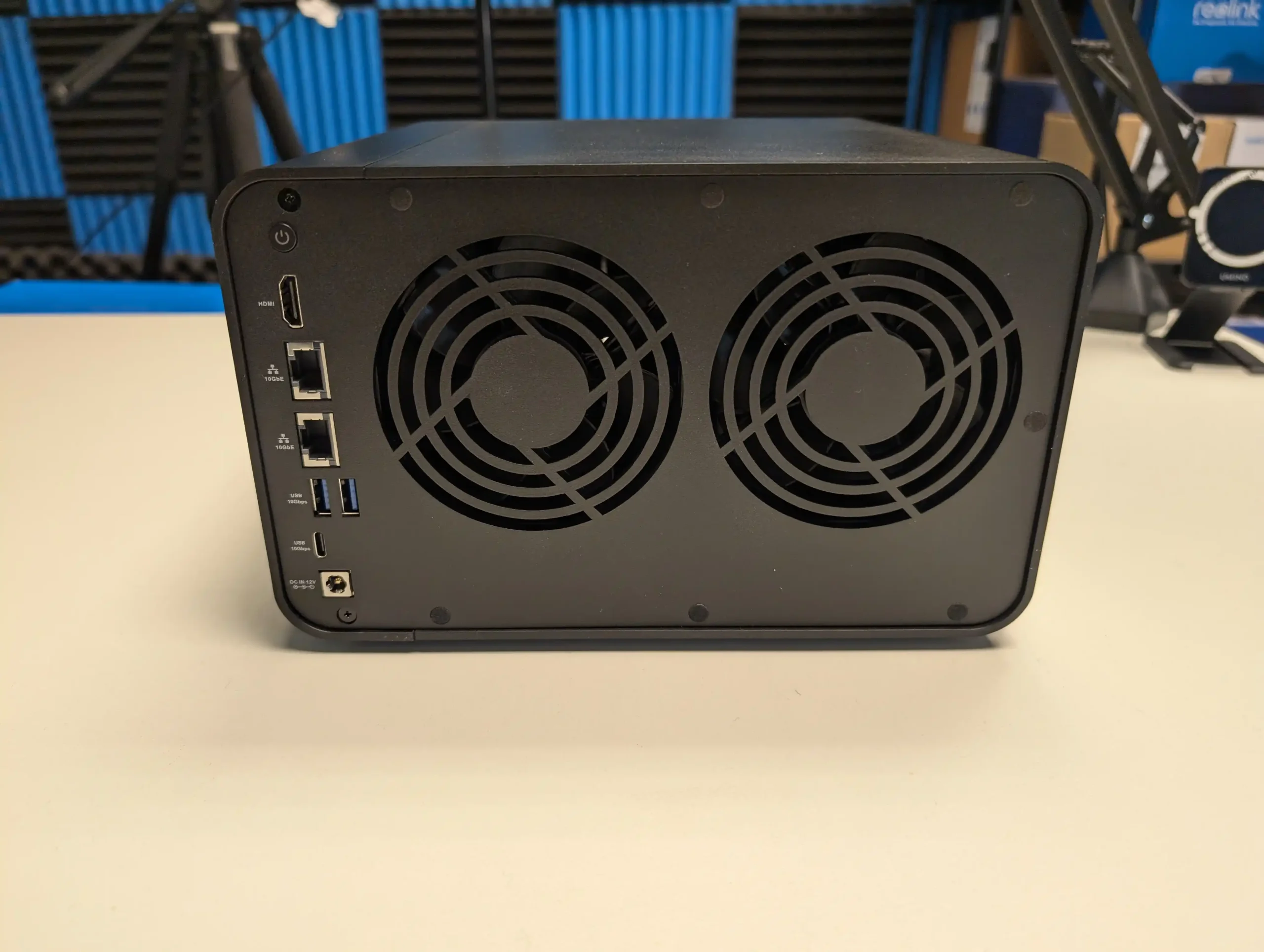
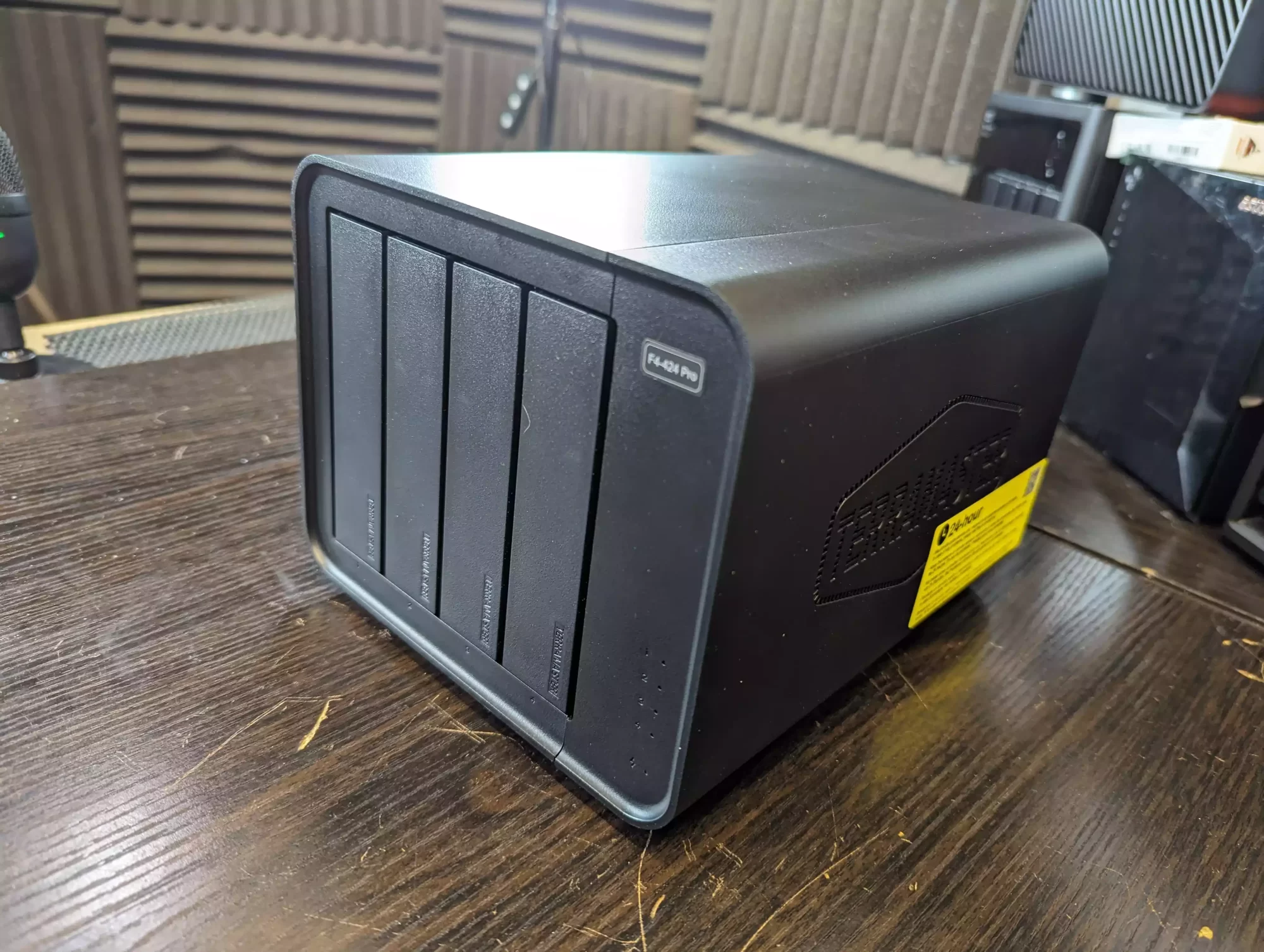
The TerraMaster F4-424 Max is a robust 4-bay NAS system that offers a powerful mix of features and flexibility for a wide range of tasks. Powered by the Intel i5-1235U CPU with 10 cores and 12 threads, the F4-424 Max excels at resource-intensive applications such as Plex media streaming, 4K hardware transcoding, and virtual machine hosting. Its dual M.2 NVMe slots running at PCIe Gen 4 speeds significantly improve storage performance, especially when used for caching, while the two 10GbE ports offer high-speed networking environments, allowing for 20Gbps throughput via link aggregation.

In terms of software, TOS 6 brings notable improvements, although it still lags behind the more polished ecosystems of Synology DSM and QNAP QTS. That said, TerraMaster’s continuous software evolution with each new version of TOS ensures that users have access to more robust tools and security features. For its price point of $899.99, the F4-424 Max is a compelling option for those seeking high-performance NAS solutions with scalability in mind. While the Pro model offers competitive performance, the Max takes it a step further with advanced networking, making it ideal for environments where speed is a priority.

  • Approx. Price: $675 / £550 (F4-424 Max, during sale) – $899 / £700 (F6-424 Max, regular)

  • Specs: Intel Core i5-1235U (10-core), 8 GB RAM, dual 10GbE ports, dual M.2, with 4 or 6 SATA bays depending on model.

  • Why It Helps: The F4-424 Max frequently drops below the $800 mark in promotions, offering unusually strong CPU performance and dual 10GbE at a mid-range price point.

Where to Buy?

Terramaster F4-424 Max ($899 Amazon)HERETerramaster F4-424 Max ($799 Aliexpress) – HERE

SOFTWARE - 6/10
HARDWARE - 9/10
PERFORMANCE - 9/10
PRICE - 9/10
VALUE - 8/10


8.2
PROS
👍🏻Powerful Hardware: Intel i5-1235U with 10 cores and 12 threads for resource-heavy tasks.
👍🏻Dual 10GbE Ports: High-speed networking capabilities with link aggregation for up to 20Gbps, ideal for large file transfers.
👍🏻PCIe Gen 4 NVMe Support: Two M.2 NVMe slots offering exceptional performance for caching or additional high-speed storage.
👍🏻Efficient Cooling: The large 120mm fan ensures quiet and effective cooling, making it suitable for home and office environments.
👍🏻Improved TOS 6 Software: Enhancements in GUI, backup tools, and overall security bring TOS closer to its competitors.
CONS
👎🏻Higher Price Tag: At $899.99, it’s more expensive than TerraMaster’s other models, which may deter budget-conscious buyers.
👎🏻No PCIe Expansion: Lack of a PCIe slot limits potential for future upgrades, such as adding 10GbE cards or more M.2 drives.
👎🏻Presentation: The software has improved a lot, but still feels inconsistent in places compared with alternatives from brands such as Synology and QNAP.


Summary Table


Model 10GbE Ports Price (USD) Under $800? Highlights
UniFi UNAS Pro 1×10GbE SFP+ ~$499 Yes Rackmount, high bay count, pure storage
Asustor Flashstor 12 Gen 1 1×10GbE ~$750 Yes 12×M.2 NVMe, SSD-focused design
UGREEN DXP4800 Plus 1×10GbE + 1×2.5GbE ~$595 Yes Versatile ports, compact and affordable
QNAP TS-332X 1×10GbE SFP+ ~$600–700 Yes Entry-level 10GbE desktop NAS
TerraMaster F4-424 Max 2×10GbE ~$675 (sale) Yes Strong CPU, 4-bay, Plex-friendly
TerraMaster F6-424 Max 2×10GbE ~$899 No 6-bay version, exceeds budget


📧 SUBSCRIBE TO OUR NEWSLETTER 🔔
[contact-form-7]
🔒 Join Inner Circle

Get an alert every time something gets added to this specific article!


Want to follow specific category? 📧 Subscribe

This description contains links to Amazon. These links will take you to some of the products mentioned in today's content. As an Amazon Associate, I earn from qualifying purchases. Visit the NASCompares Deal Finder to find the best place to buy this device in your region, based on Service, Support and Reputation - Just Search for your NAS Drive in the Box Below

Need Advice on Data Storage from an Expert?

Finally, for free advice about your setup, just leave a message in the comments below here at NASCompares.com and we will get back to you. Need Help? Where possible (and where appropriate) please provide as much information about your requirements, as then I can arrange the best answer and solution to your needs. Do not worry about your e-mail address being required, it will NOT be used in a mailing list and will NOT be used in any way other than to respond to your enquiry. [contact-form-7] TRY CHAT Terms and Conditions
If you like this service, please consider supporting us. We use affiliate links on the blog allowing NAScompares information and advice service to be free of charge to you.Anything you purchase on the day you click on our links will generate a small commission which isused to run the website. Here is a link for Amazon and B&H.You can also get me a ☕ Ko-fi or old school Paypal. Thanks!To find out more about how to support this advice service check HEREIf you need to fix or configure a NAS, check Fiver Have you thought about helping others with your knowledge? Find Instructions Here  
 
Or support us by using our affiliate links on Amazon UK and Amazon US
    
 
Alternatively, why not ask me on the ASK NASCompares forum, by clicking the button below. This is a community hub that serves as a place that I can answer your question, chew the fat, share new release information and even get corrections posted. I will always get around to answering ALL queries, but as a one-man operation, I cannot promise speed! So by sharing your query in the ASK NASCompares section below, you can get a better range of solutions and suggestions, alongside my own.

☕ WE LOVE COFFEE ☕


Super Budget 6 Port 10GbE Managed Switch Review (Is AliExpress Worth it?)

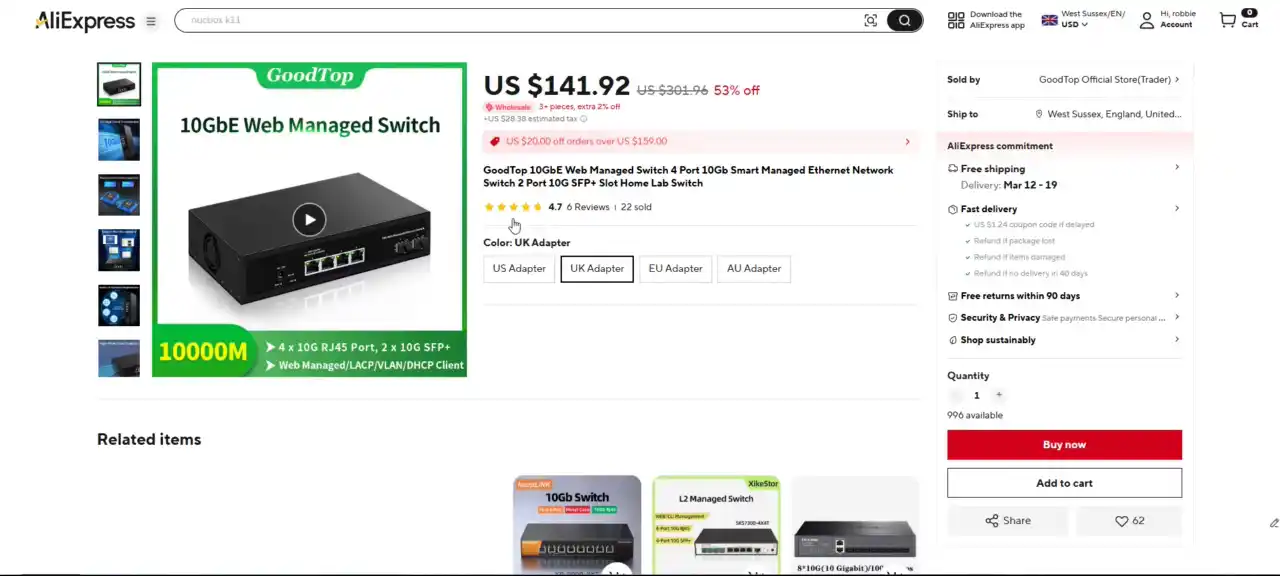
Does this Budget $140 AliExpress 10GbE Switch Deserve Your Data?

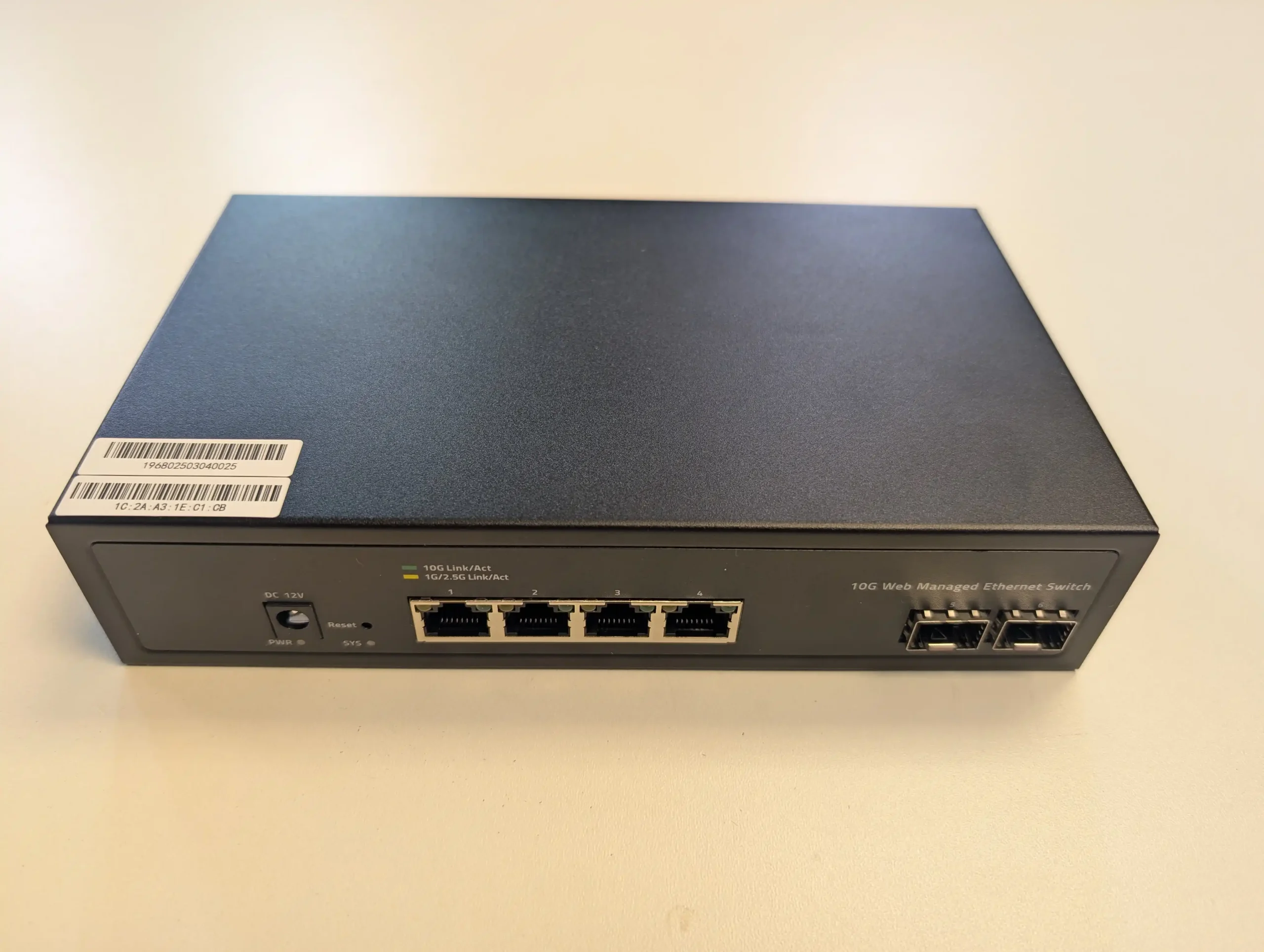
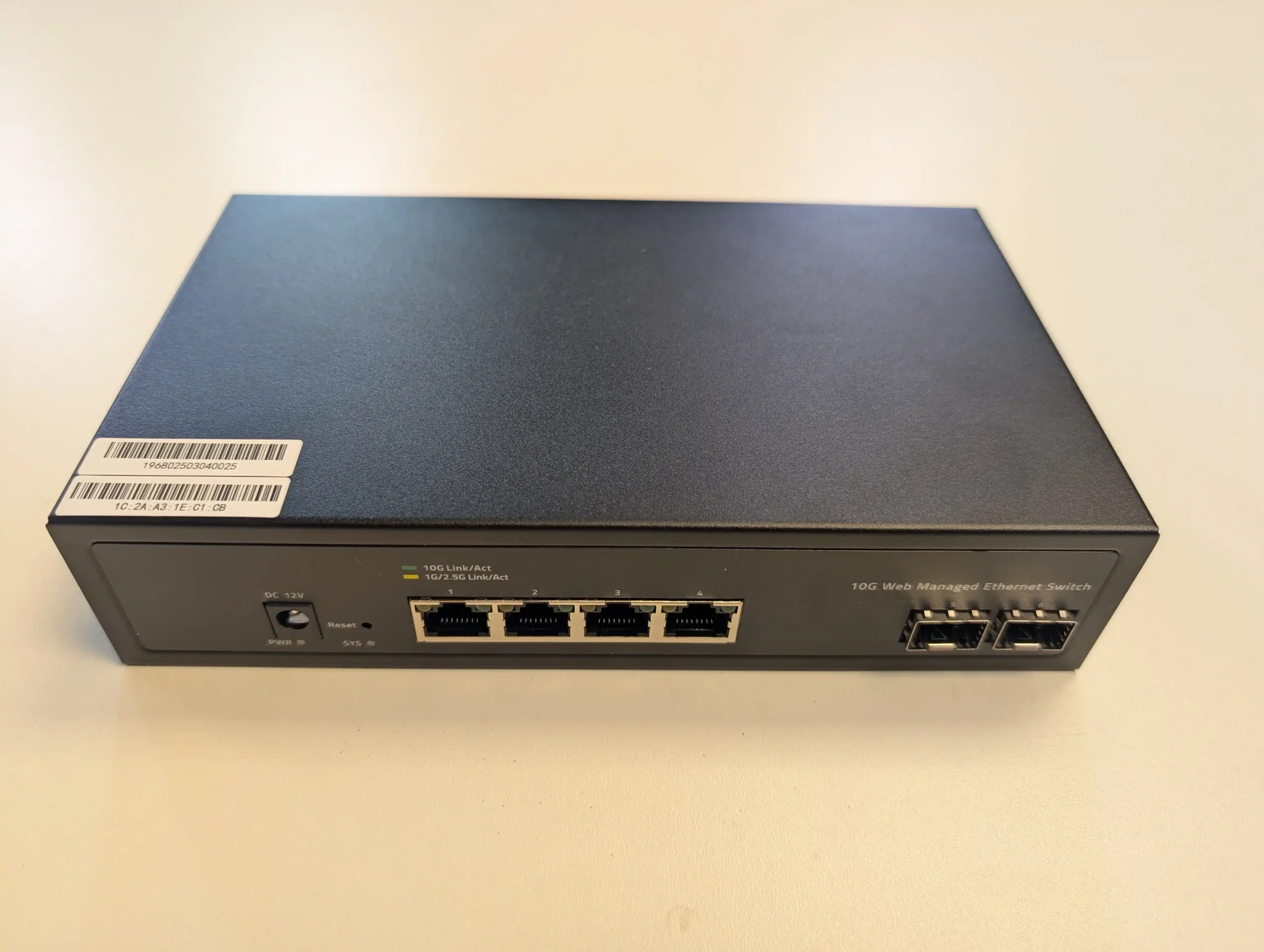
The landscape of 10 Gigabit Ethernet networking has a significant shift over the past few years, with hardware that was once considered enterprise-only gradually trickling down to the consumer and prosumer market. Affordable multi-gig switches, particularly those with 2.5G or SFP-only configurations, are now commonplace. However, the search becomes much more complicated when you’re looking for a compact, budget-friendly 10GbE switch that combines both RJ45 copper and SFP+ fiber ports — and adds basic managed features to the mix. This is precisely where the Goodtop 6-Port 10GbE Managed Switch positions itself, offering four 10GBase-T ports, two SFP+ ports, and a claimed 120Gbps backplane bandwidth, all for around $140 on AliExpress.

At this price point, it’s important to approach products like this with realistic expectations. The Goodtop switch is not aiming to compete with the likes of Cisco, Aruba, or even MikroTik in terms of long-term support or security posture. Like many white-label or lesser-known brands shipping out of China, concerns around firmware transparency, update frequency, and potential vulnerabilities are valid. This is particularly relevant for users planning to expose management interfaces to external networks or integrate these switches into larger, more sensitive environments. Still, for isolated use in lab setups, home networks, or behind firewall-protected infrastructure, devices like this can offer compelling value — if they deliver on core functionality. This review takes a closer look at the Goodtop switch’s physical design, port configuration, internal hardware, software interface, and performance characteristics. Rather than focusing on theoretical specs alone, this analysis is based on hands-on testing to determine where the unit succeeds, where it cuts corners, and what kind of buyer it’s realistically suited for.

Goodtop Budget 6 Port 10GbE Switch Review – Quick Conclusion

The Goodtop 6-Port 10GbE Managed Switch delivers impressive value by combining four 10GBase-T and two 10G SFP+ ports in a compact, low-cost form factor, making it one of the most affordable mixed-media 10GbE switches on the market. It performs reliably under load, supports a full set of essential Layer 2 features like VLANs, link aggregation, and QoS, and provides a practical way for home lab users or small setups to adopt 10G networking without overspending. However, the switch’s low price is reflected in its build quality, fixed-speed noisy fan, and a barebones, unintuitive web interface that may challenge less experienced users. Security features are minimal, with no HTTPS, 2FA, or multi-user support, making it best suited for isolated, firewall-protected environments rather than critical infrastructure. For technically confident users seeking affordable, high-speed connectivity in a controlled setting, the Goodtop switch is a capable and cost-effective option—as long as its limitations are clearly understood.

Need a Budget 10GbE Switch? RECOMMENDED TO BUY:

Goodtop Budget 6 Port 10GbE Switch Review – Design

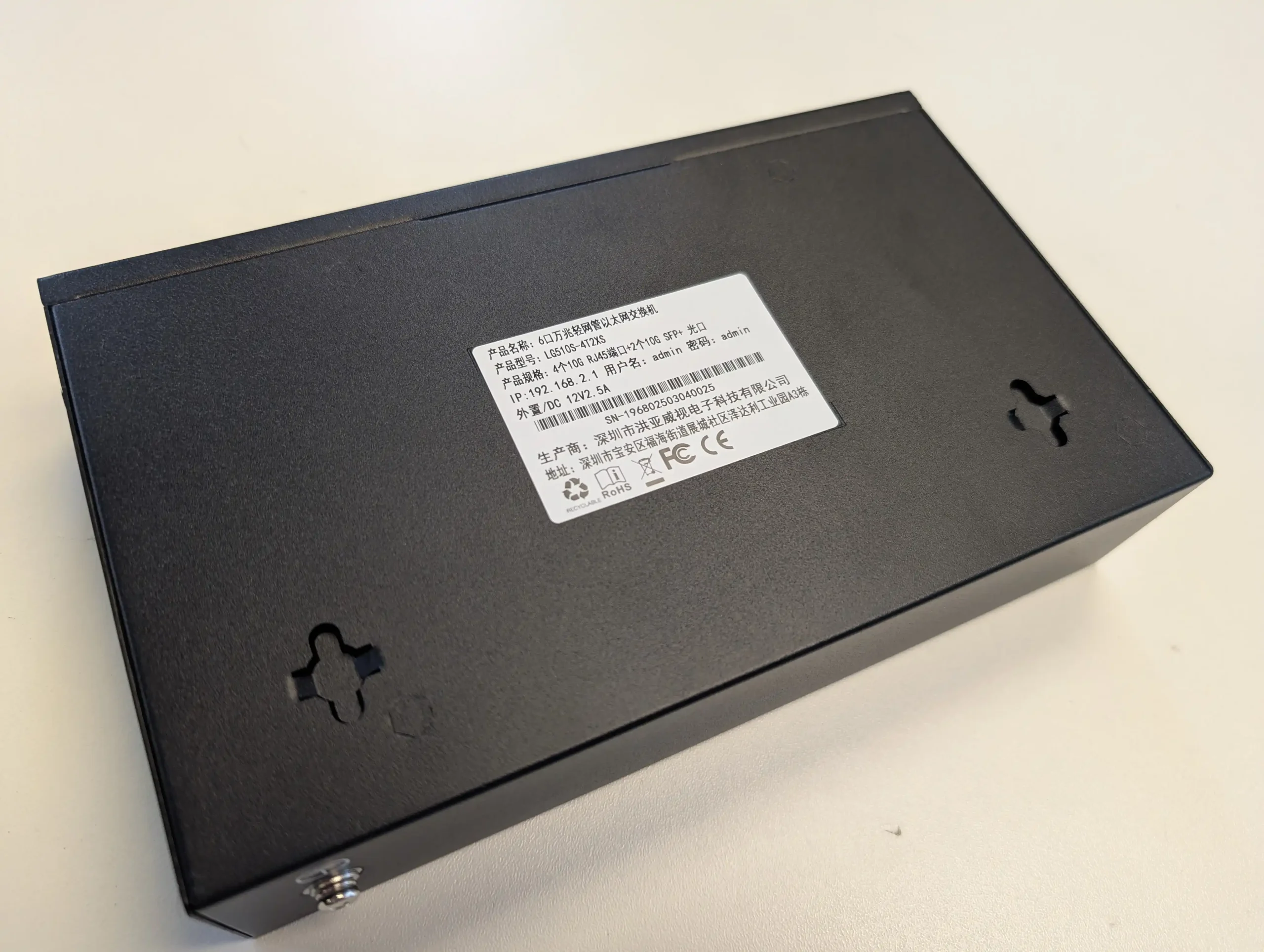
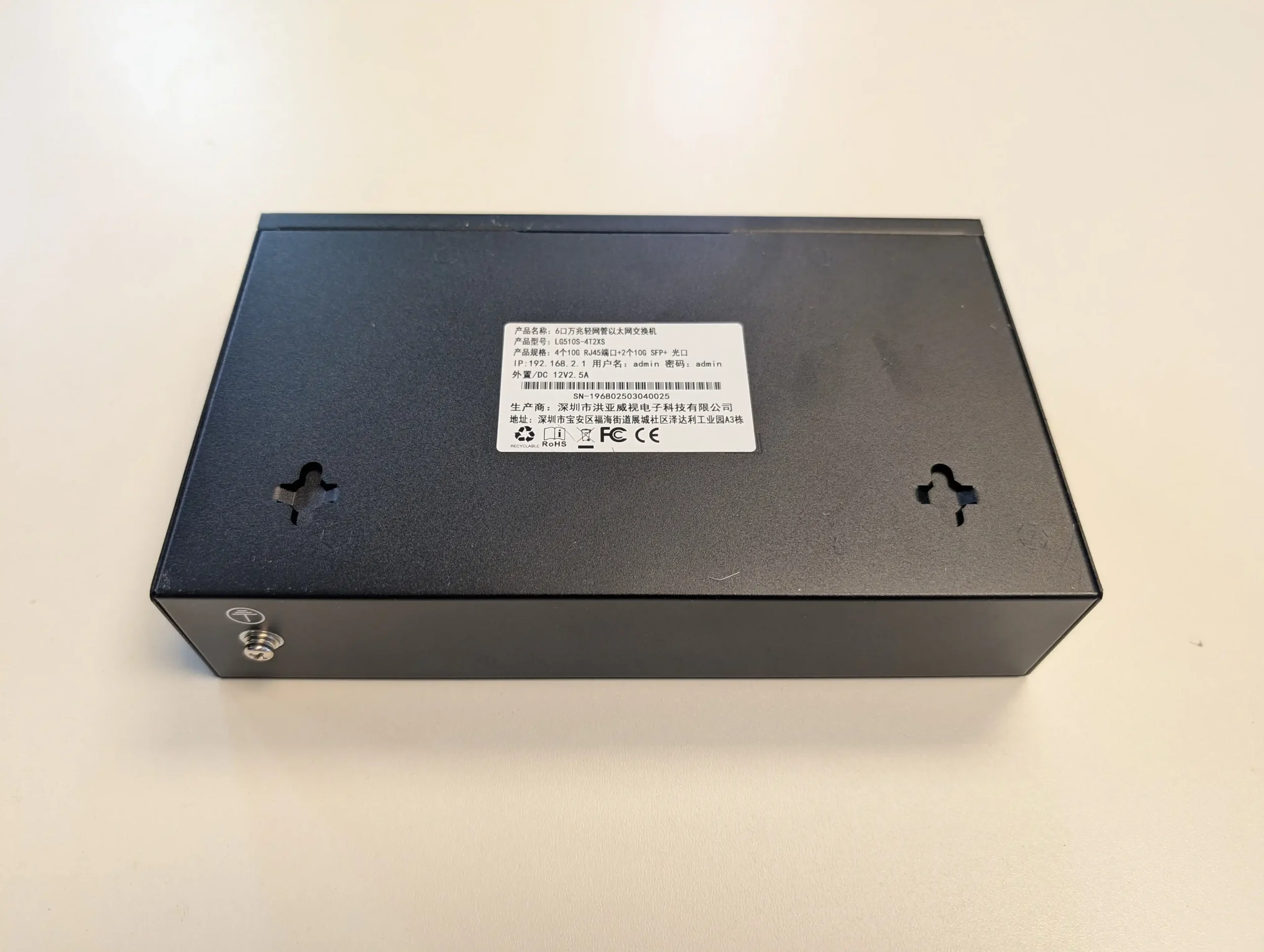
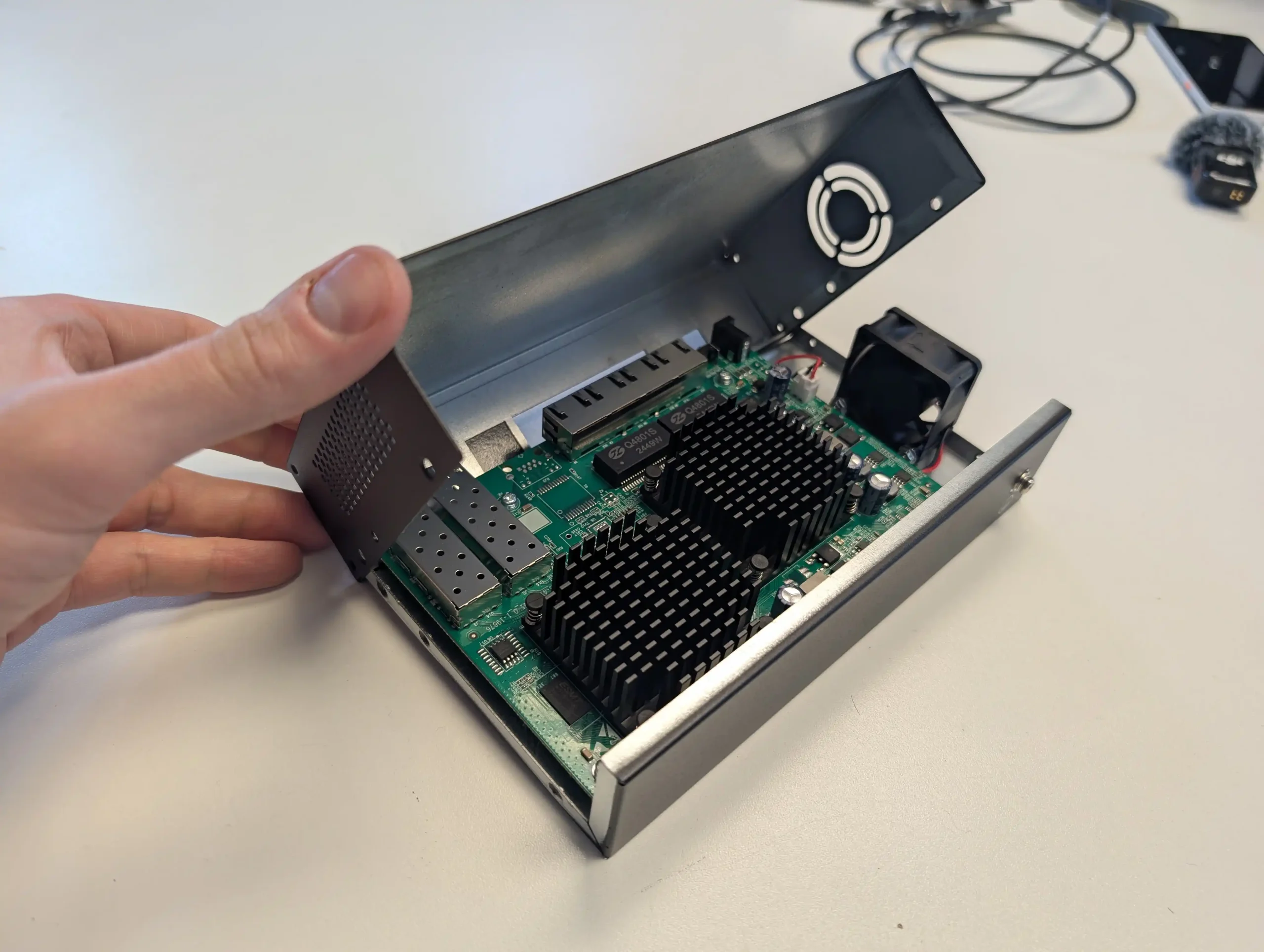
The Goodtop 6-Port 10GbE switch adopts a compact footprint and minimalist industrial design that aligns with many of the budget-friendly networking products emerging from OEMs in the Chinese market. Its chassis measures 200mm x 118mm x 44mm and is constructed from a thin, painted sheet metal. At just under 700 grams, the device is easy to handle and unobtrusive on a desk or shelf. It supports both desktop placement and wall mounting, the latter made possible by a pair of hook points integrated into the casing. While the construction is adequate for light to moderate use, it doesn’t offer the heft or rigidity seen in more enterprise-leaning gear.

There are no rubber feet to reduce surface vibration, nor any rack-mounting ears included by default. The paint finish is clean but basic, and minor flexing of the panels is possible under moderate pressure. These design choices reflect an emphasis on affordability rather than robustness, and users intending to deploy this switch in harsher physical environments may want to consider added enclosure or structural reinforcement. Still, for indoor use where vibration and temperature control are consistent, the physical form is entirely serviceable.

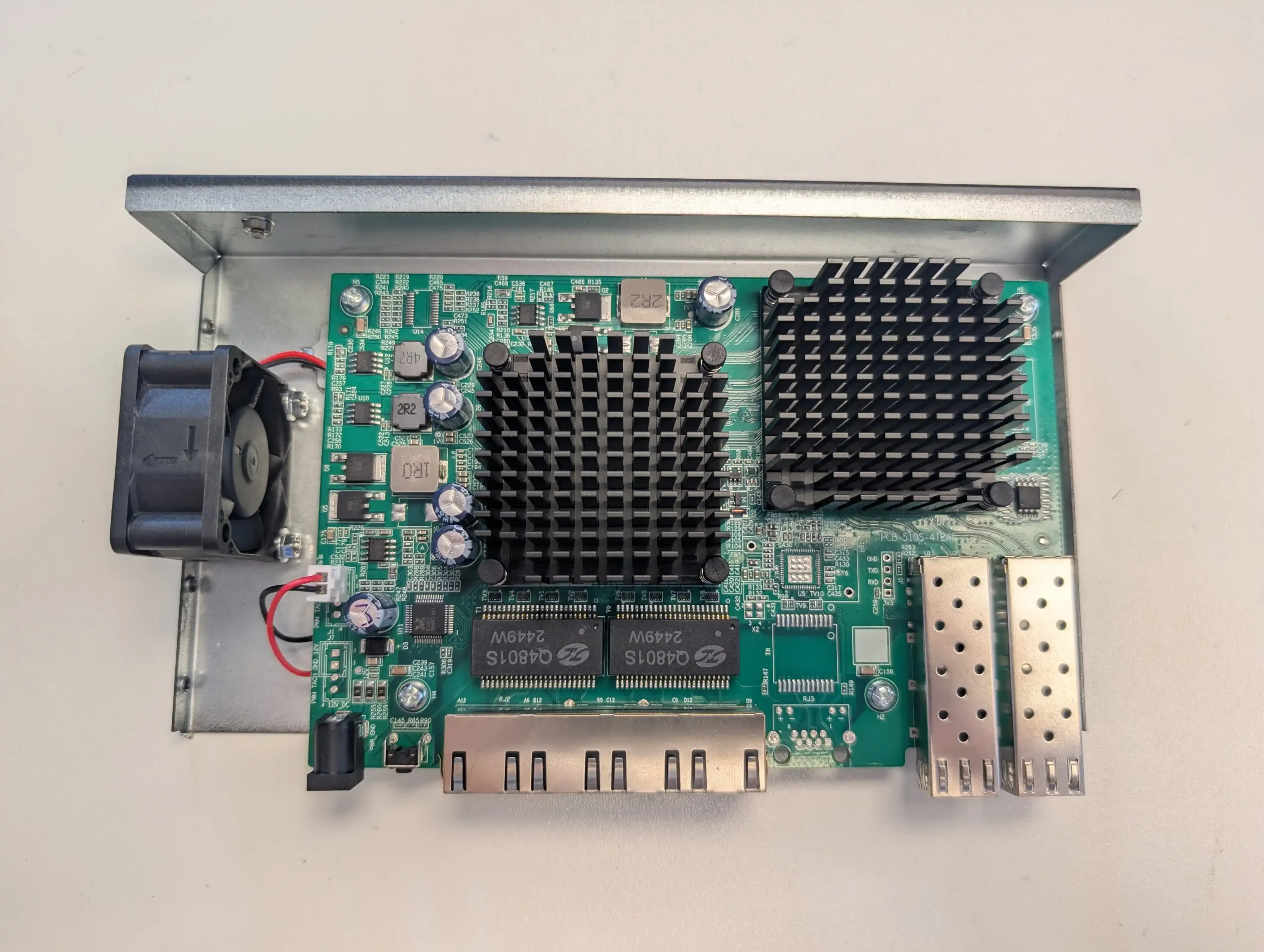
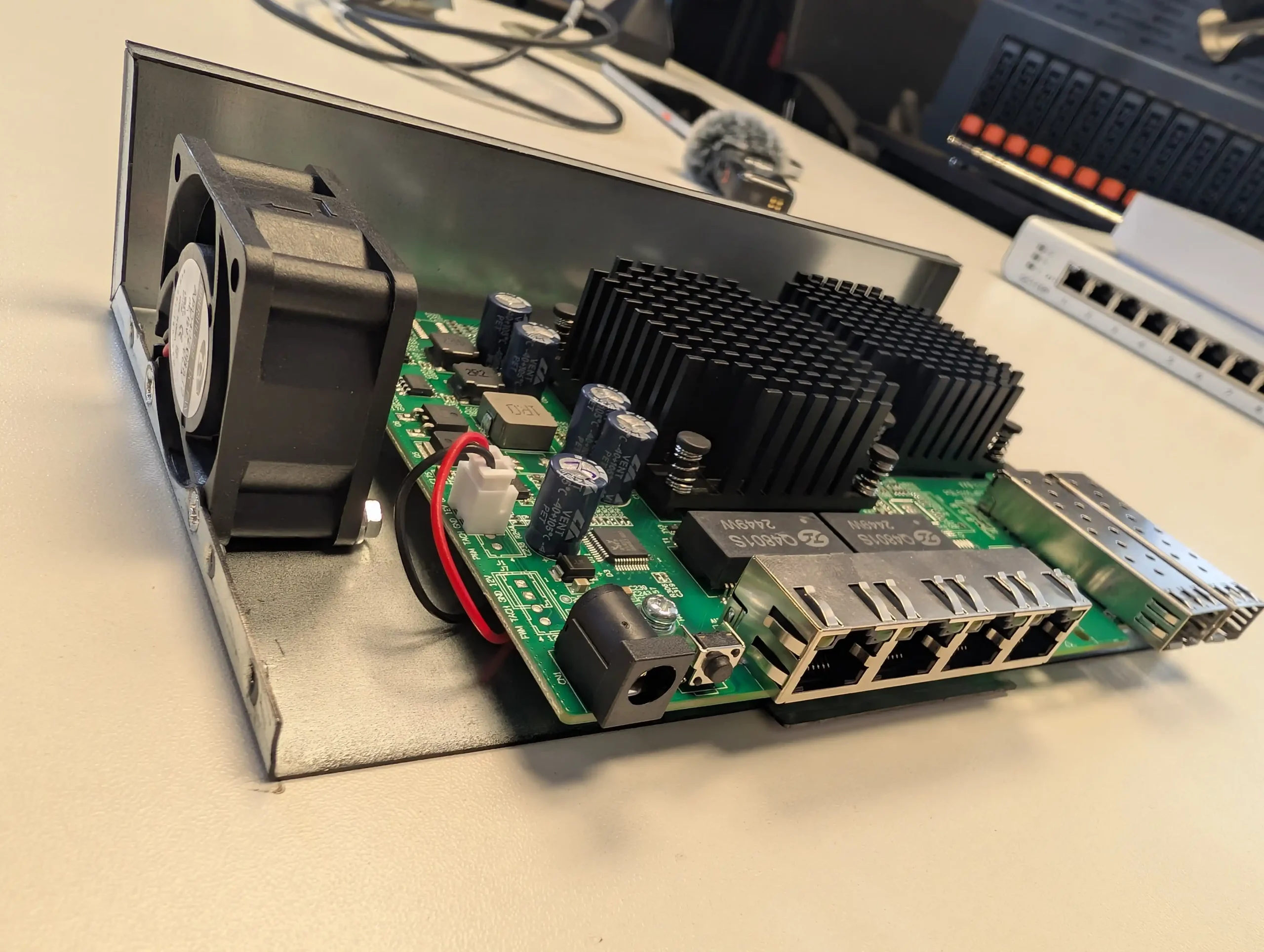
Thermal management is handled by a single small-diameter fan mounted laterally inside the chassis, supported by perforated ventilation cutouts on the opposing side. This active cooling setup is necessary given the heat output of the internal 10GbE components, particularly when all ports are under load.

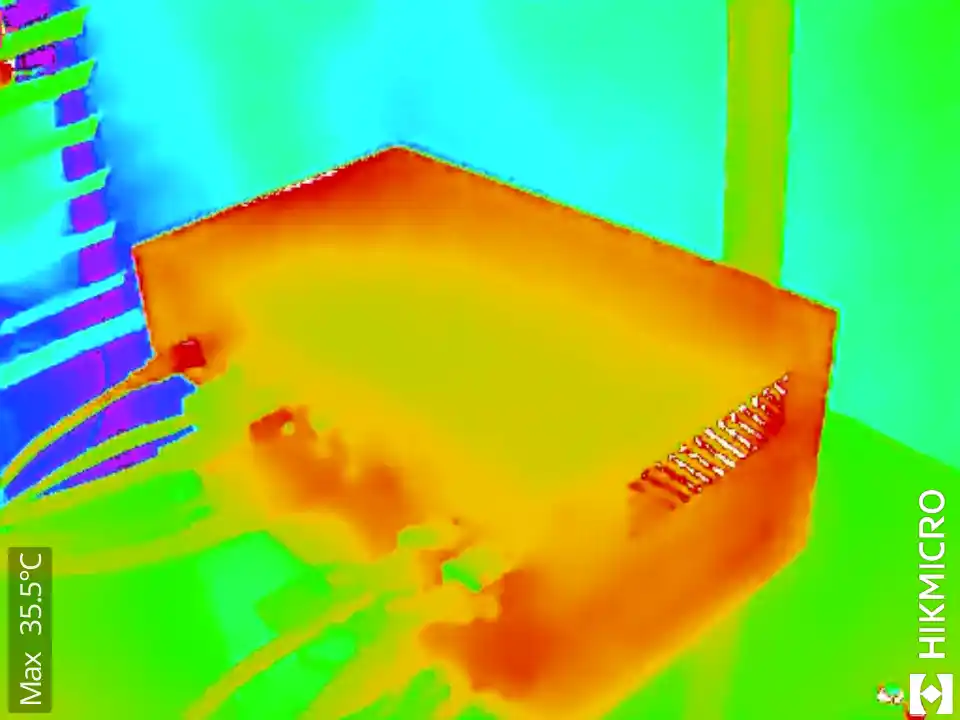
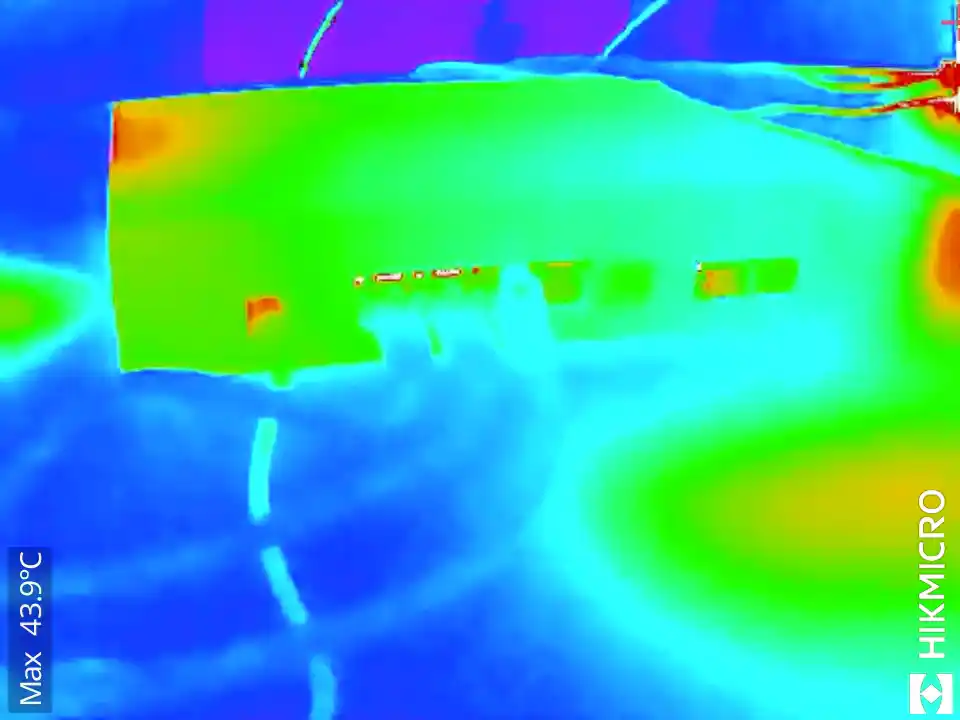
During testing, the fan proved effective in maintaining safe thermal levels across typical workloads, with internal temperature readings ranging between 31°C and 36°C depending on ambient conditions and port usage. However, the fan’s acoustic characteristics are worth noting: it operates at a fixed RPM, regardless of system temperature or network activity.

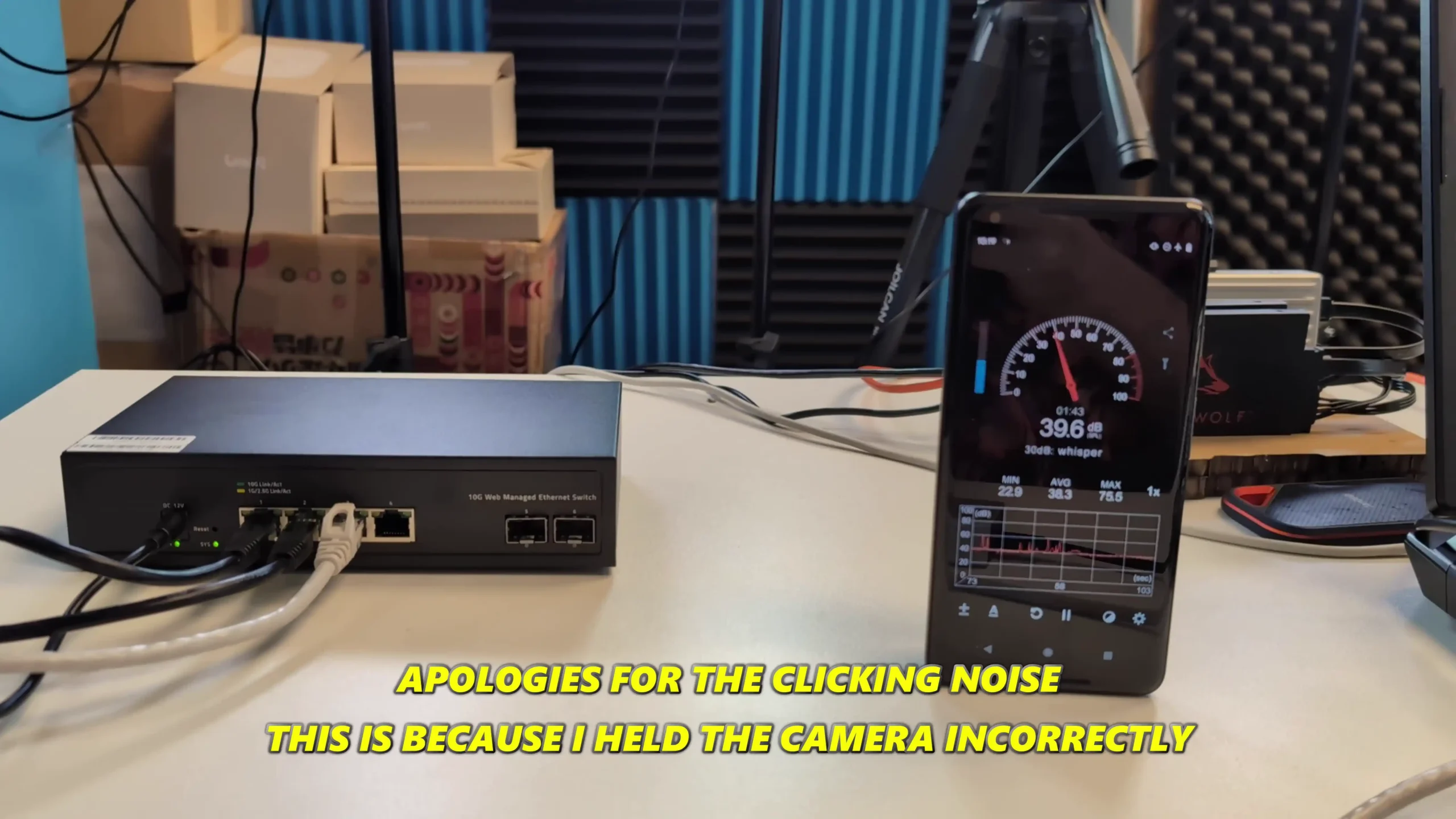
This results in a constant hum that registers between 38 and 41 dBA — not excessive, but certainly noticeable in quiet environments. There are no accessible fan speed controls in the management interface, and the unit lacks thermal sensors or thresholds that would allow for adaptive fan curves.

For users operating this switch in a studio, home office, or any acoustically sensitive environment, the persistent fan noise could be a drawback. Modifications, such as third-party silent fan replacements, may be feasible but would require disassembly and some DIY effort. Overall, the cooling solution works, but its implementation is clearly a compromise between function and cost.

Goodtop Budget 6 Port 10GbE Switch Review – Hardware & Connections

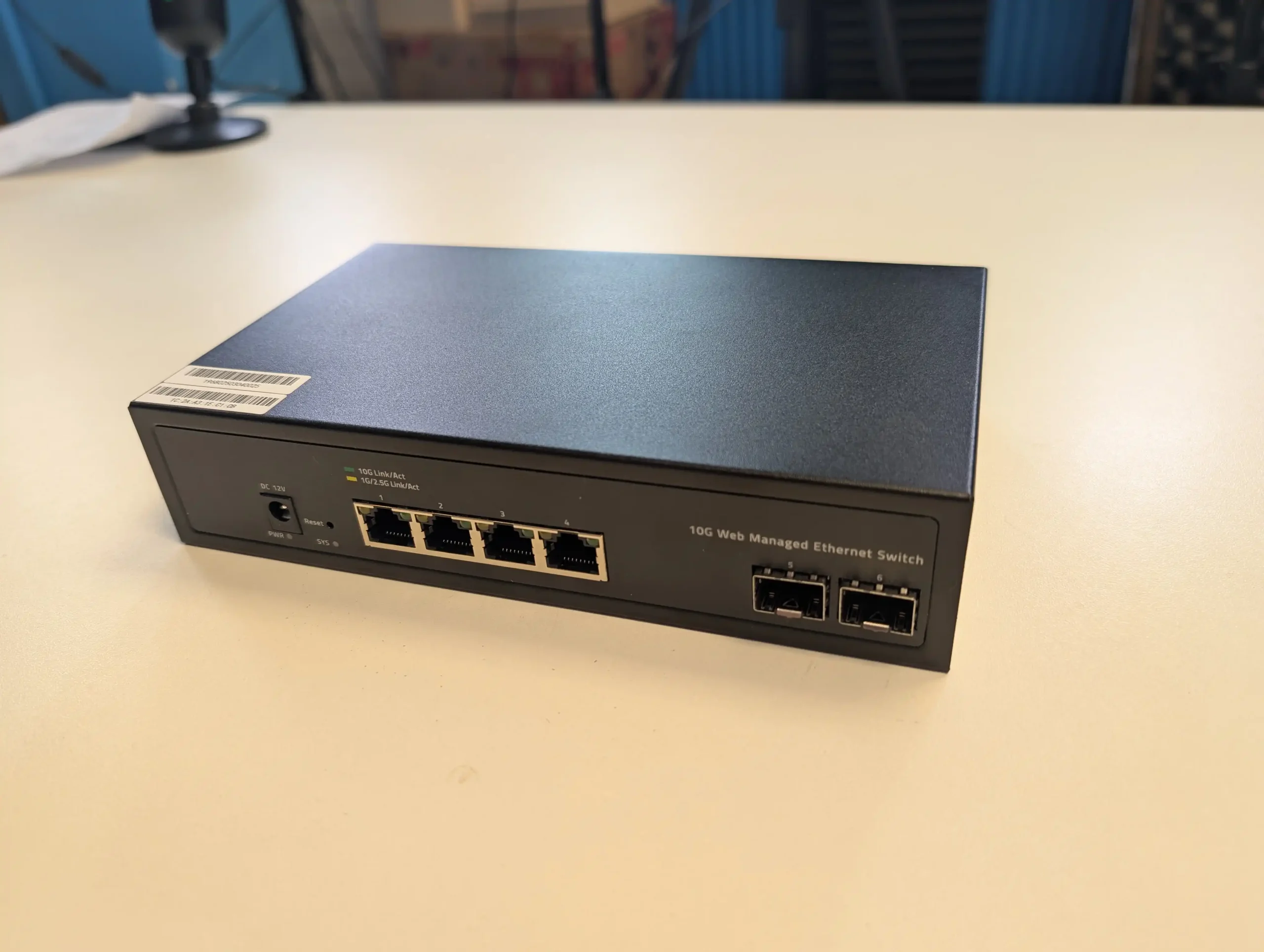
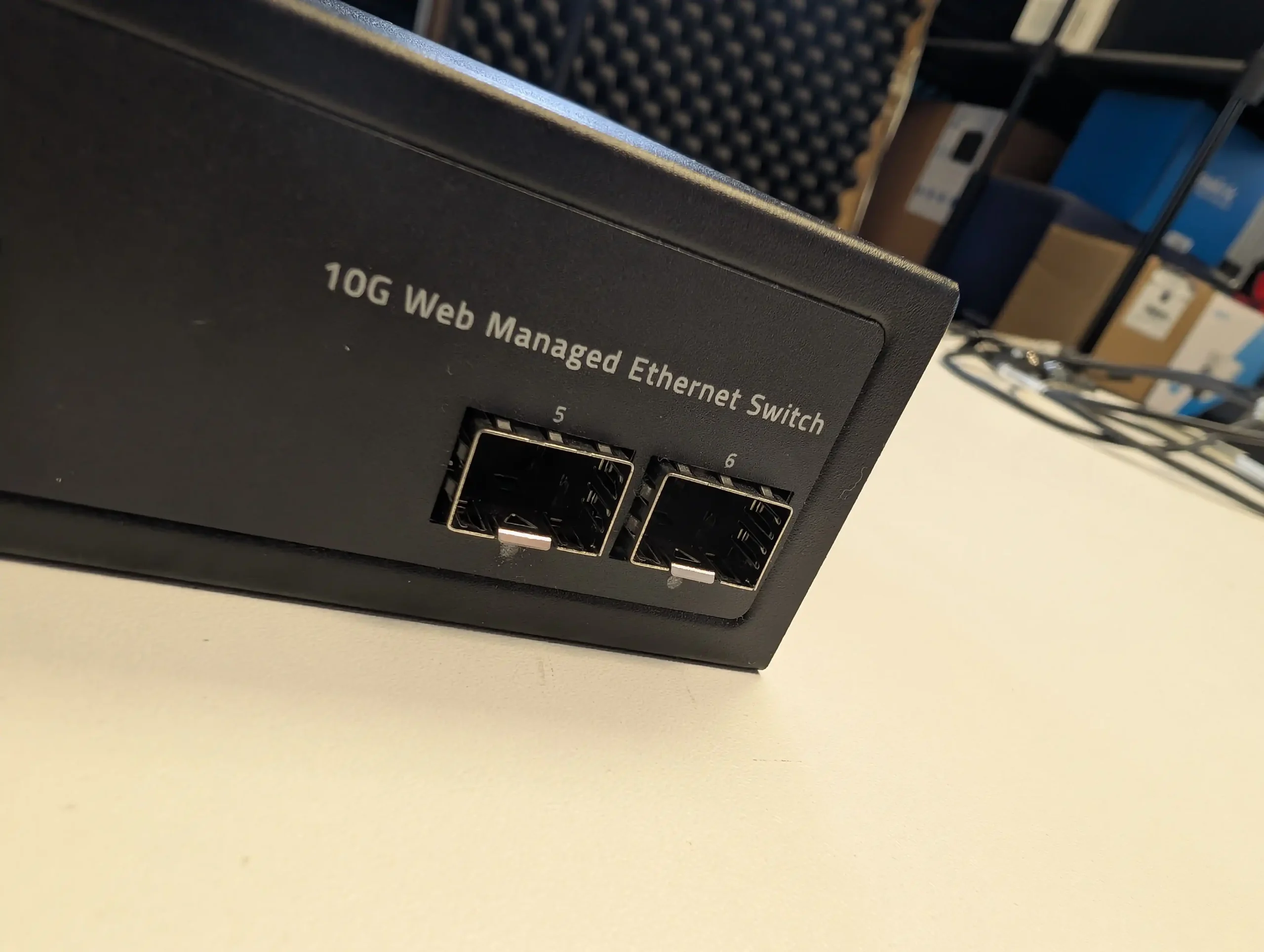
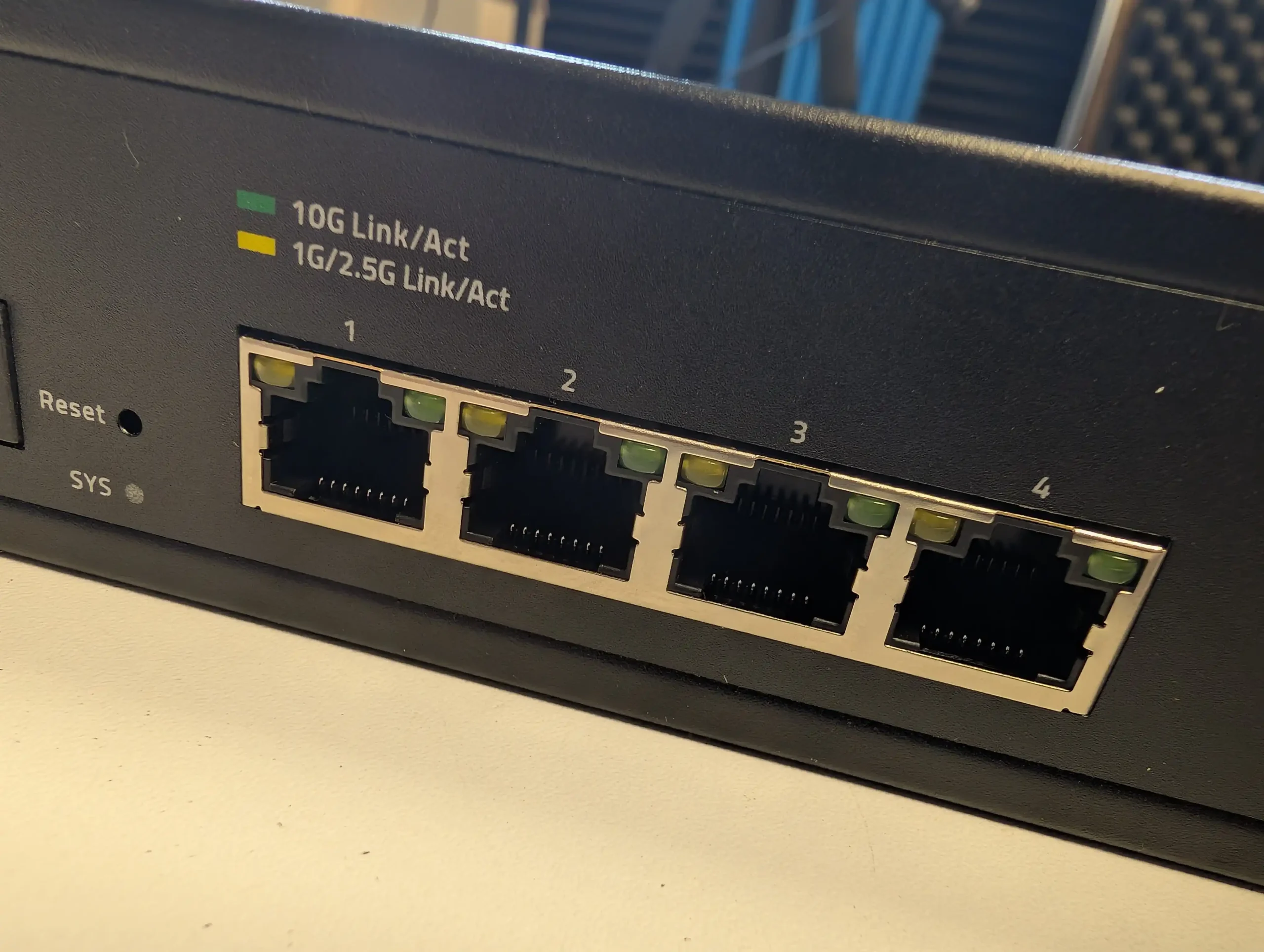
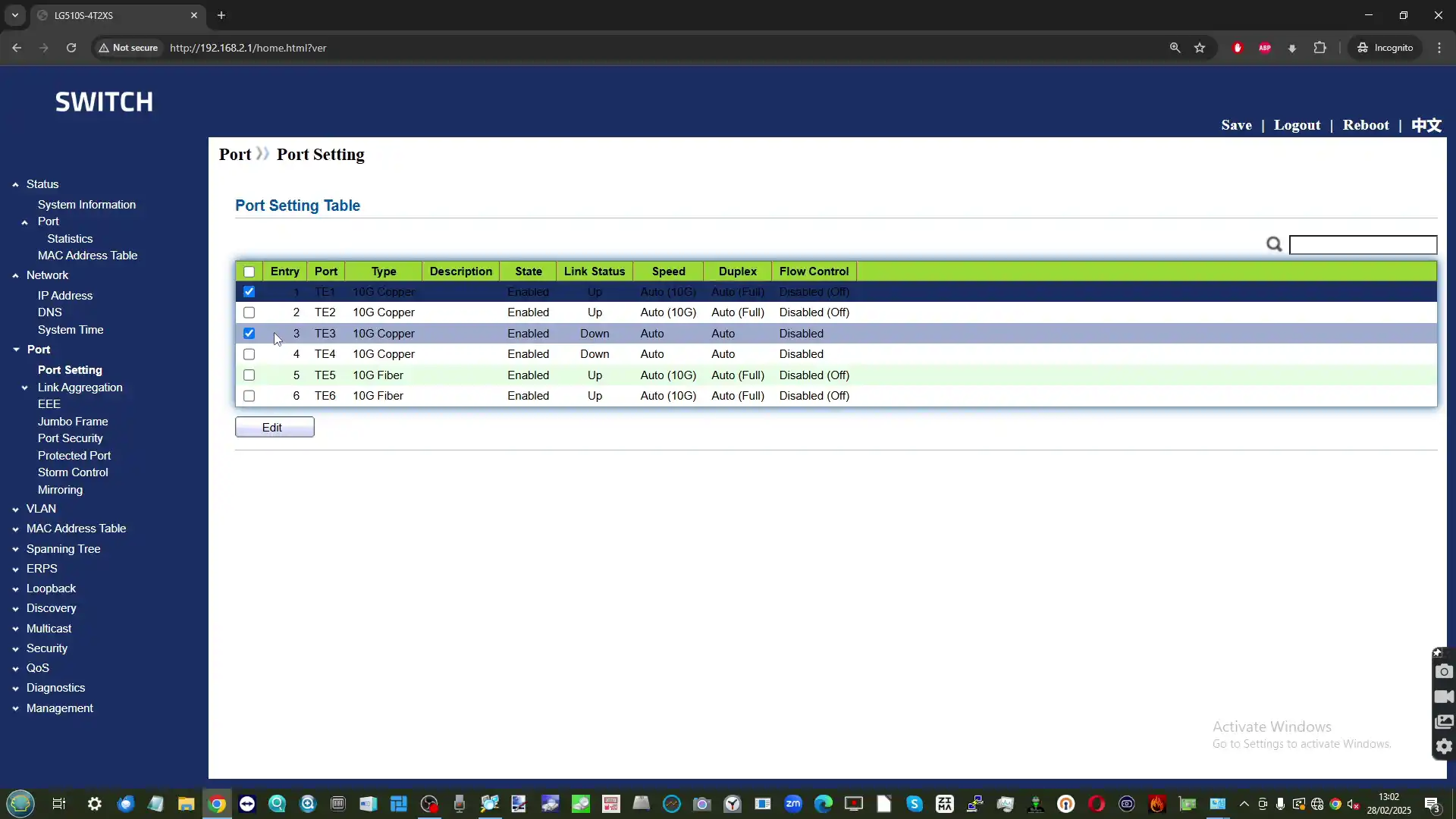
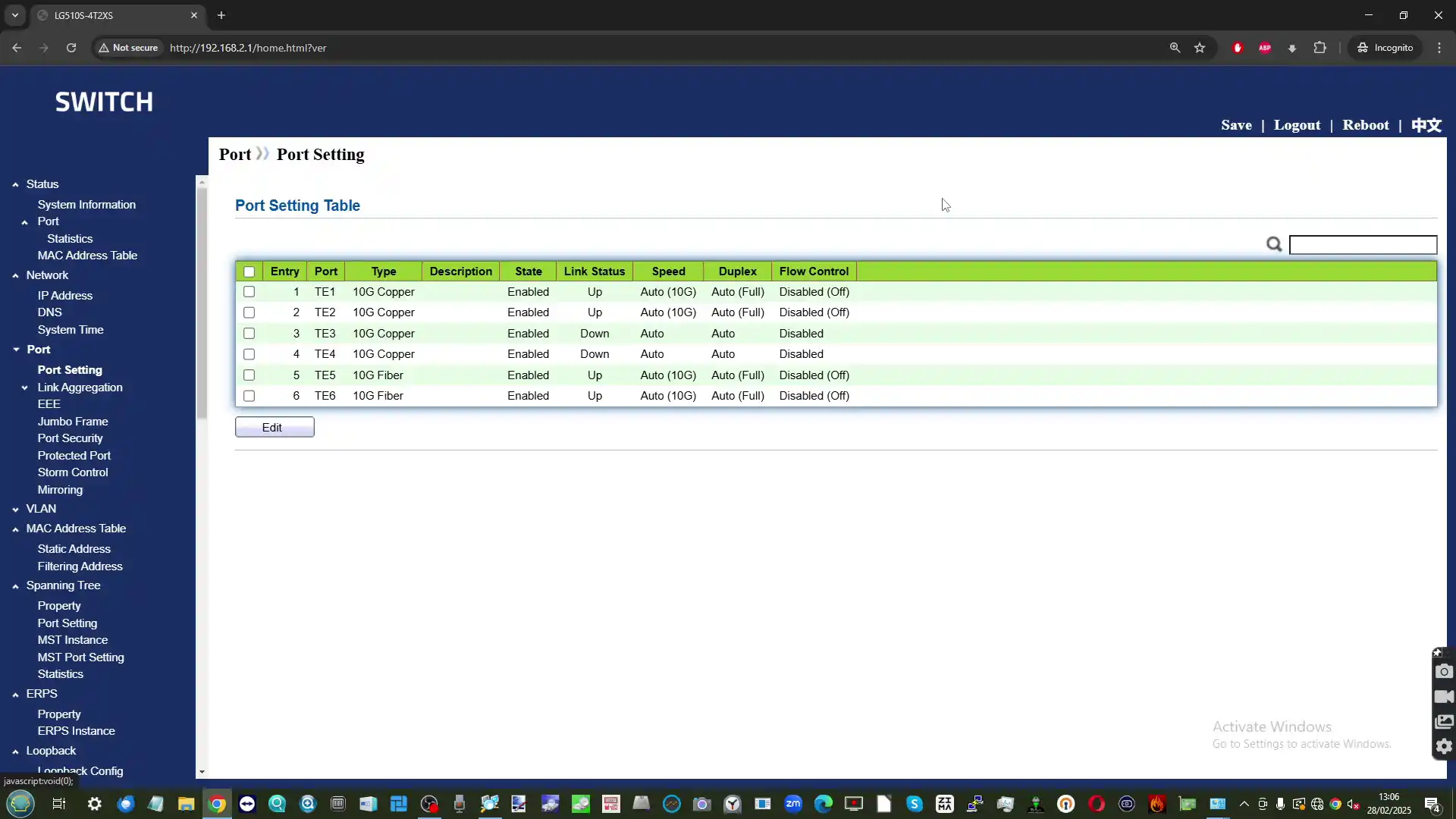
The Goodtop switch is equipped with a total of six 10-Gigabit-capable ports, split between four RJ45 (10GBase-T) and two SFP+ slots. This particular configuration is uncommon at this price tier, especially among switches that offer web-based management. The inclusion of both copper and fiber interfaces in one device provides flexibility for mixed network environments — ideal for users bridging legacy copper infrastructure with newer fiber deployments or integrating NAS devices and uplinks with varying interface standards. All six ports are located on the front panel, clearly labeled and spaced far enough apart to accommodate bulkier cables and transceivers without interference.

The RJ45 ports support standard multi-gig Ethernet protocols, with backward compatibility for 100Mb, 1G, 2.5G, and 5GBase-T connections, depending on cabling. According to the manufacturer’s specs, Cat6 or better is recommended for full 10GBase-T performance up to 100 meters.

The SFP+ ports accept a wide range of 10G transceivers, including DACs (Direct Attach Copper), SR/LR fiber modules, and media converters, offering strong compatibility with third-party optics and hardware.

Despite its low cost, the switch claims a 120Gbps backplane switching capacity and a non-blocking architecture capable of 89.28 million packets per second. While exact benchmarking under full simultaneous port saturation wasn’t possible due to hardware limitations during testing, four concurrent 10GBase-T connections were tested successfully with sustained bidirectional transfers.

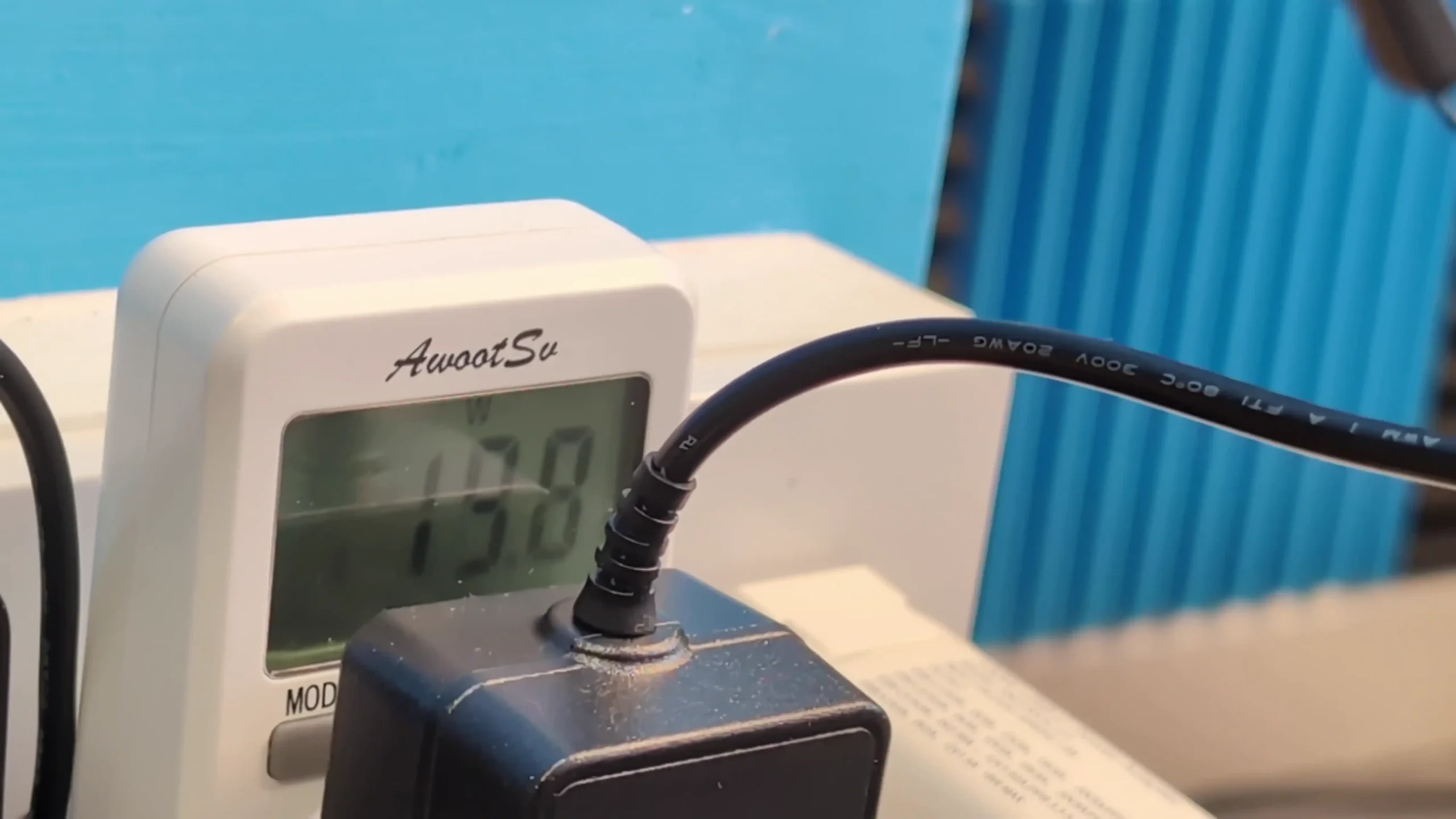
Under load, the unit handled transmission reliably without packet loss or obvious performance degradation. Power consumption scales with usage: idle draw sits at approximately 7.5 watts with no connected clients, while active use with four 10G copper links under sustained read/write activity peaked around 19.8 watts.

These values are in line with expectations for a full-10G switch operating with active cooling, and while not low, they are acceptable for most desktop or lab environments. It’s worth noting that due to heat generation and airflow limitations, users may experience rising internal temperatures if all six ports are driven continuously, especially in poorly ventilated setups. However, the flexibility to use either media type and the stable throughput on tested ports suggest that the internal switching logic and port handling are effectively implemented, given the device’s pricing and market position.

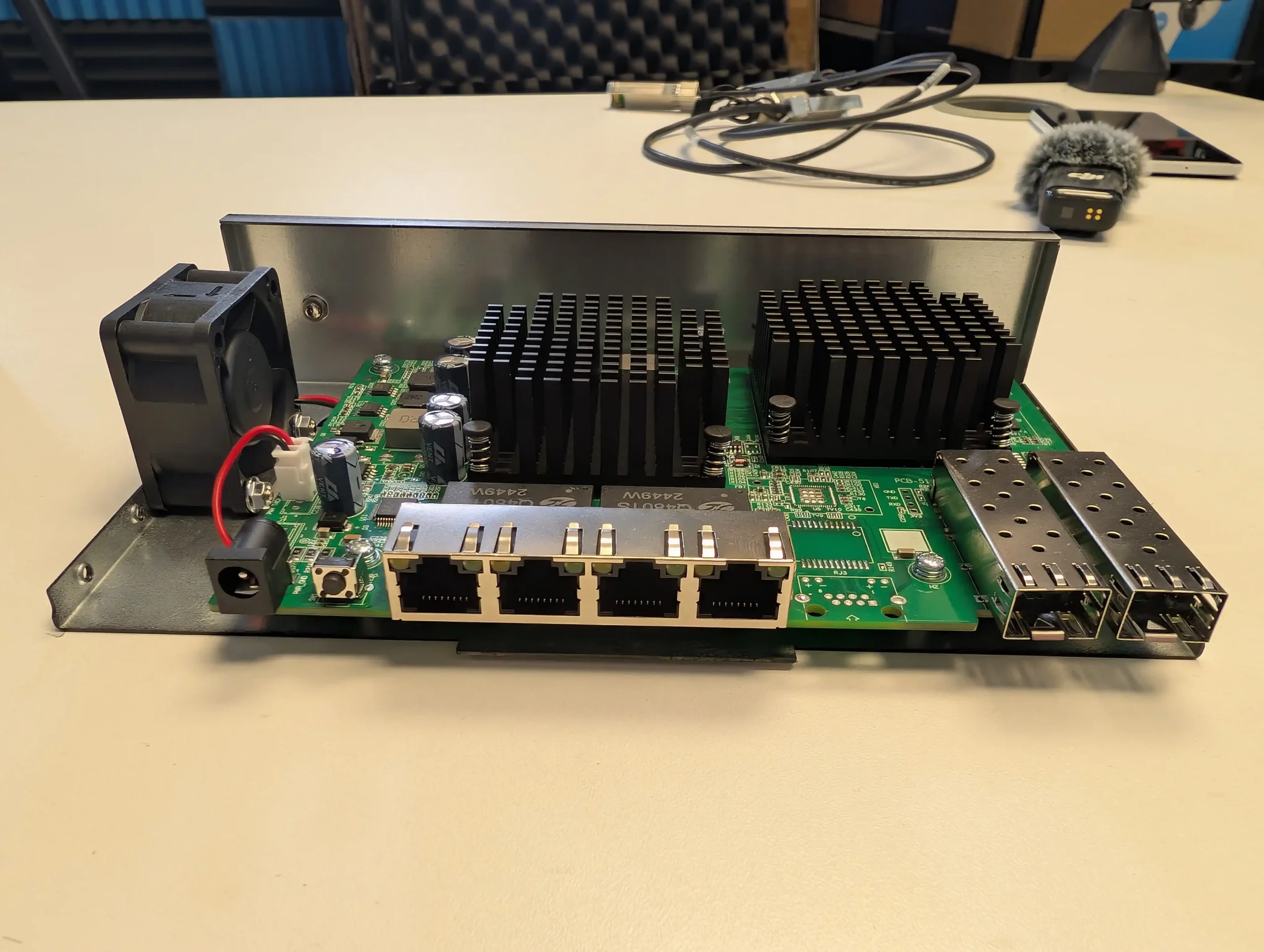
Internally, the Goodtop 6-Port 10GbE switch is built around a Realtek chipset configuration comprising the RTL9303 switch controller and RTL8264B PHYs, a pairing commonly found in recent budget and white-label 10G networking products. These components are designed to deliver basic Layer 2 managed functionality with support for VLAN tagging, link aggregation, and other expected switching features. Two medium-sized aluminum heatsinks cover the main chips, with thermal paste applied to ensure contact and heat dissipation, albeit passively reliant on the unit’s single fan for airflow. There is no internal battery backup, surge suppression beyond nominal protection, or modular power regulation — design choices consistent with its low cost.

The unit includes a modest 12Mbit of packet buffer memory and supports a MAC address table size of up to 16K entries, which should be sufficient for most small-to-medium environments. There are no removable components or visible debugging headers, and the board layout is straightforward with no major thermal bottlenecks observed during operation. Overall, the hardware design is minimal but appropriate for the target use case: non-critical environments requiring inexpensive multi-gig connectivity without expectations of advanced redundancy or hardware resilience. While it doesn’t compete with enterprise-class internals in terms of engineering quality or extensibility, it does reflect a competent implementation of entry-level switching silicon with functional thermal management.

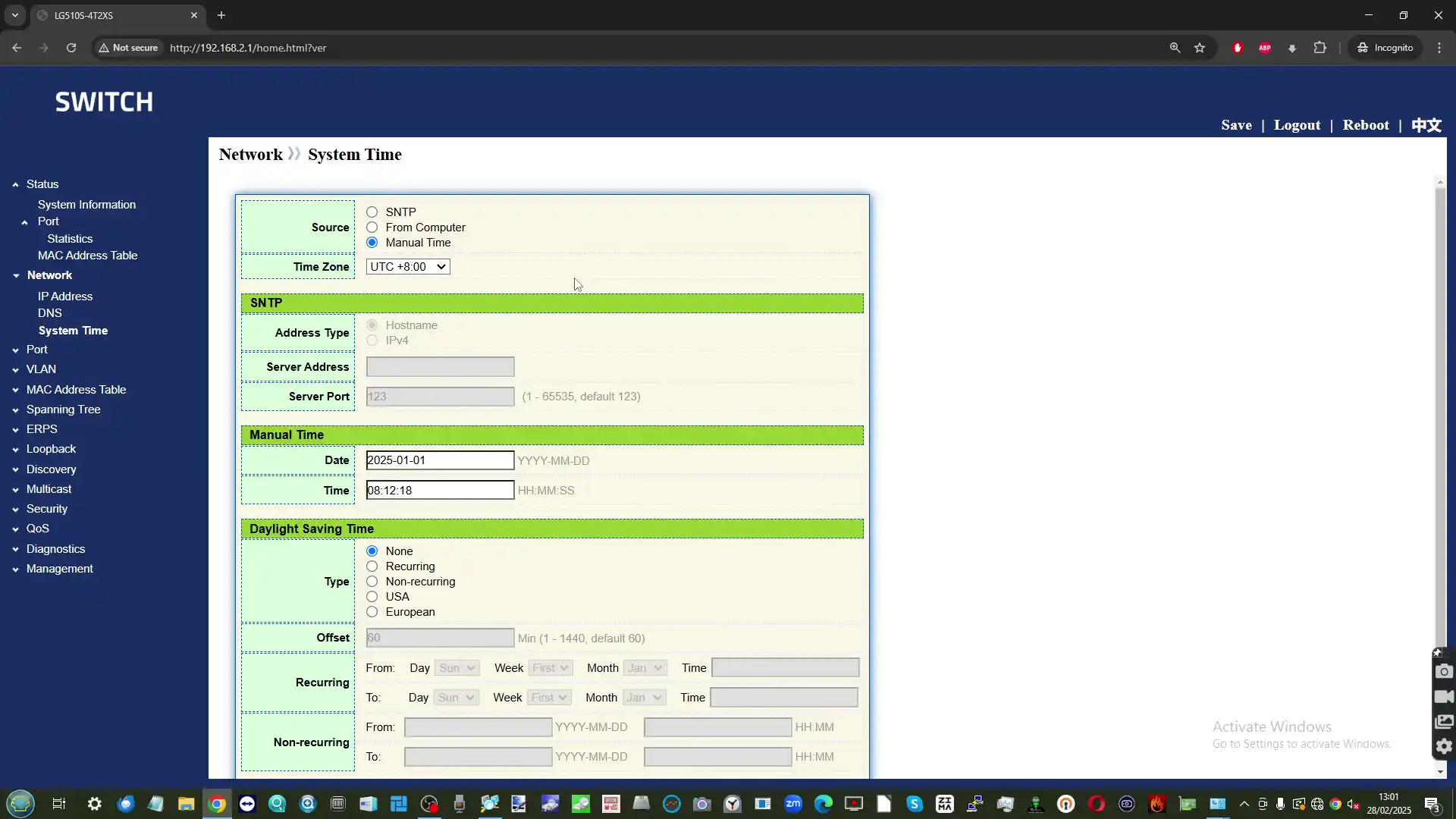
Goodtop Budget 6 Port 10GbE Switch Review – Software

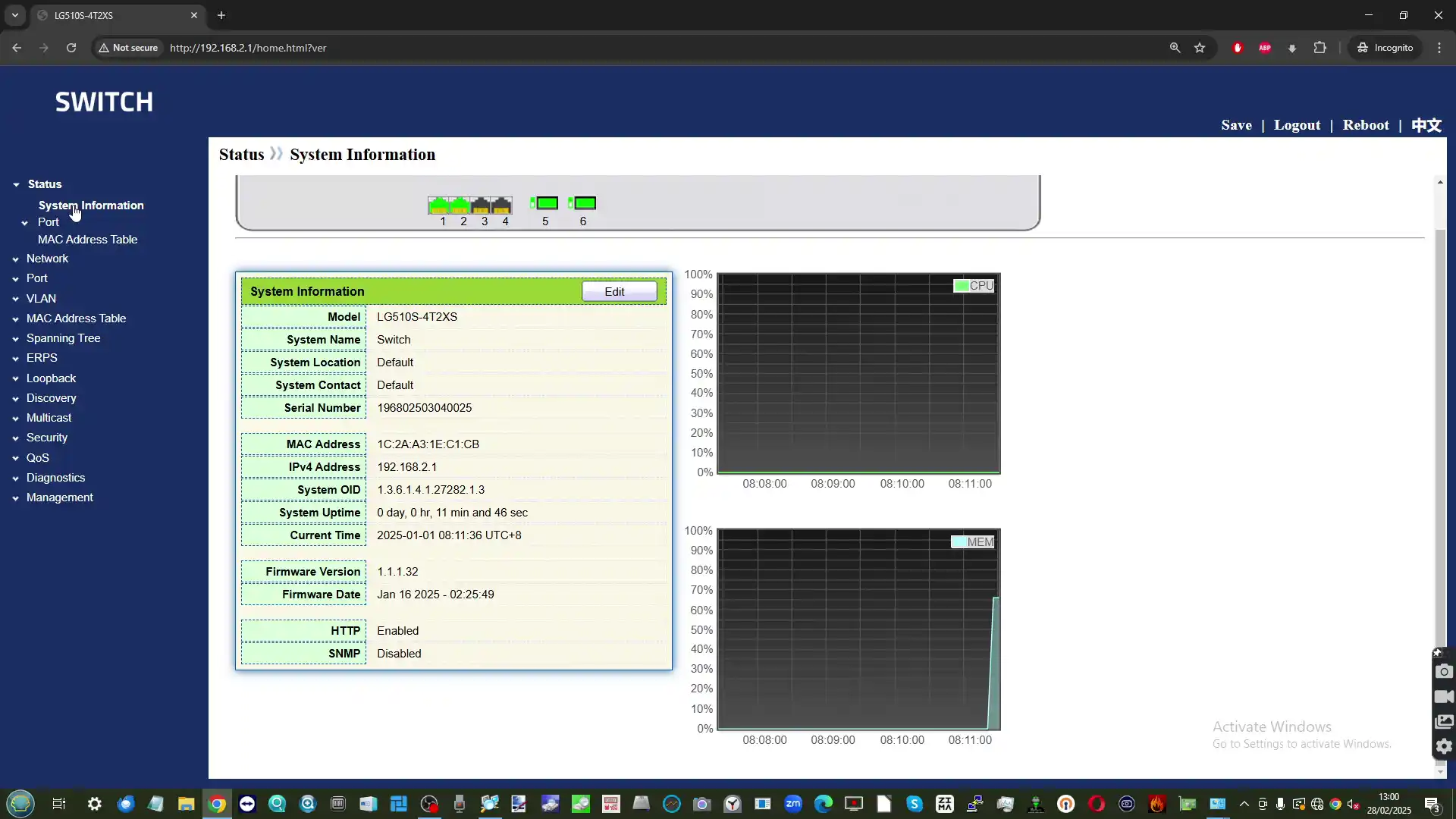
The Goodtop switch ships with a built-in web-based management interface that allows users to configure a range of Layer 2 features typical of entry-level managed switches. The interface is accessible via a browser once an IP address is assigned, and no additional software is required. However, the overall presentation and usability of the software are quite basic. The UI lacks visual polish, contextual help, or guided configuration tools. Navigation is functional but unintuitive, with much of the terminology and layout appearing generic and unbranded — a likely result of the firmware being repurposed from a reference design or OEM platform.

There are no wizards or safety prompts to prevent misconfiguration, which could make the switch challenging for less experienced users to manage safely. Additionally, there is no mobile optimization or official companion app, and the interface does not support HTTPS out of the box. Firmware updates are possible via the web console, though update channels or changelogs are not provided, and documentation is sparse.

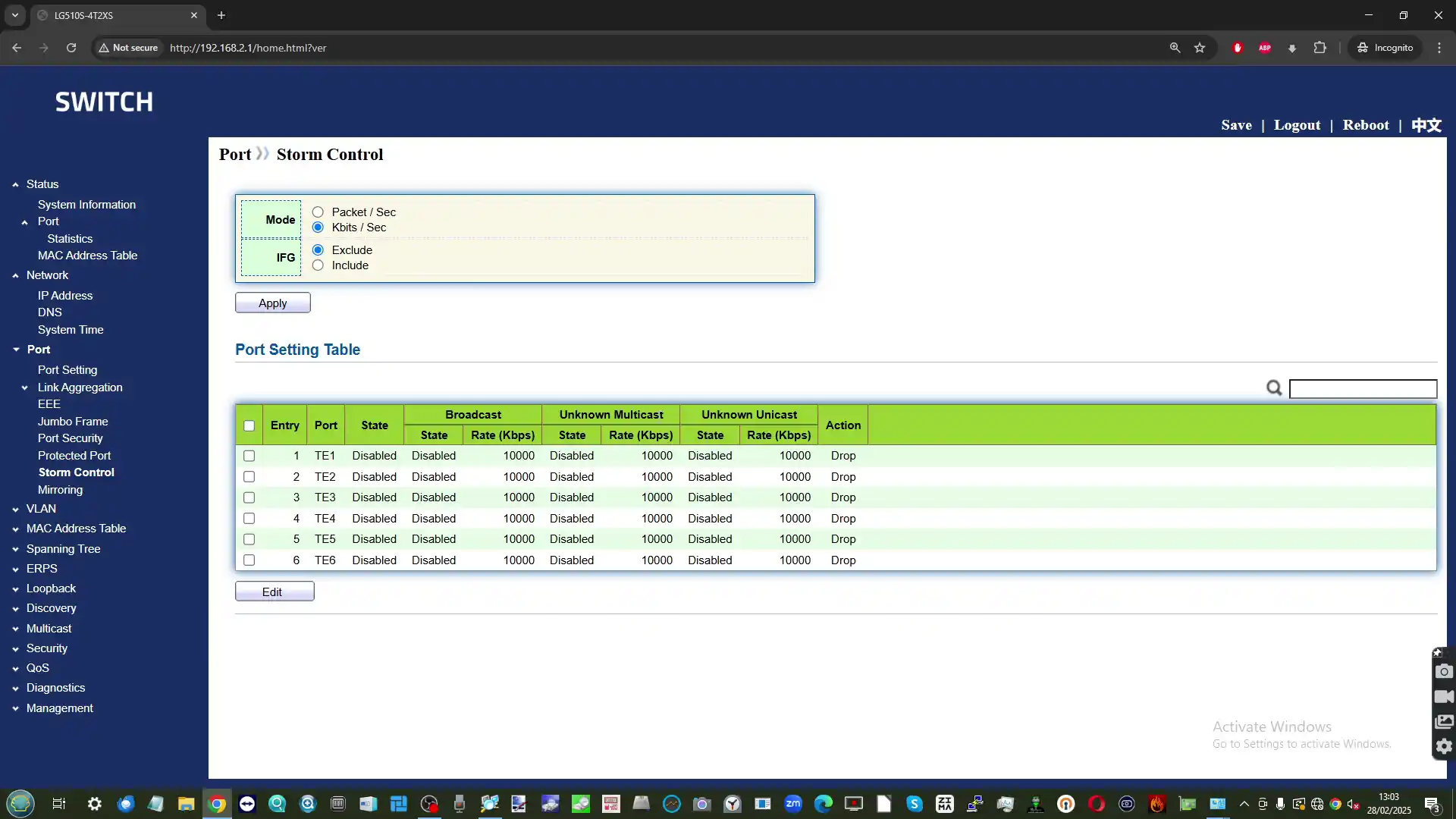
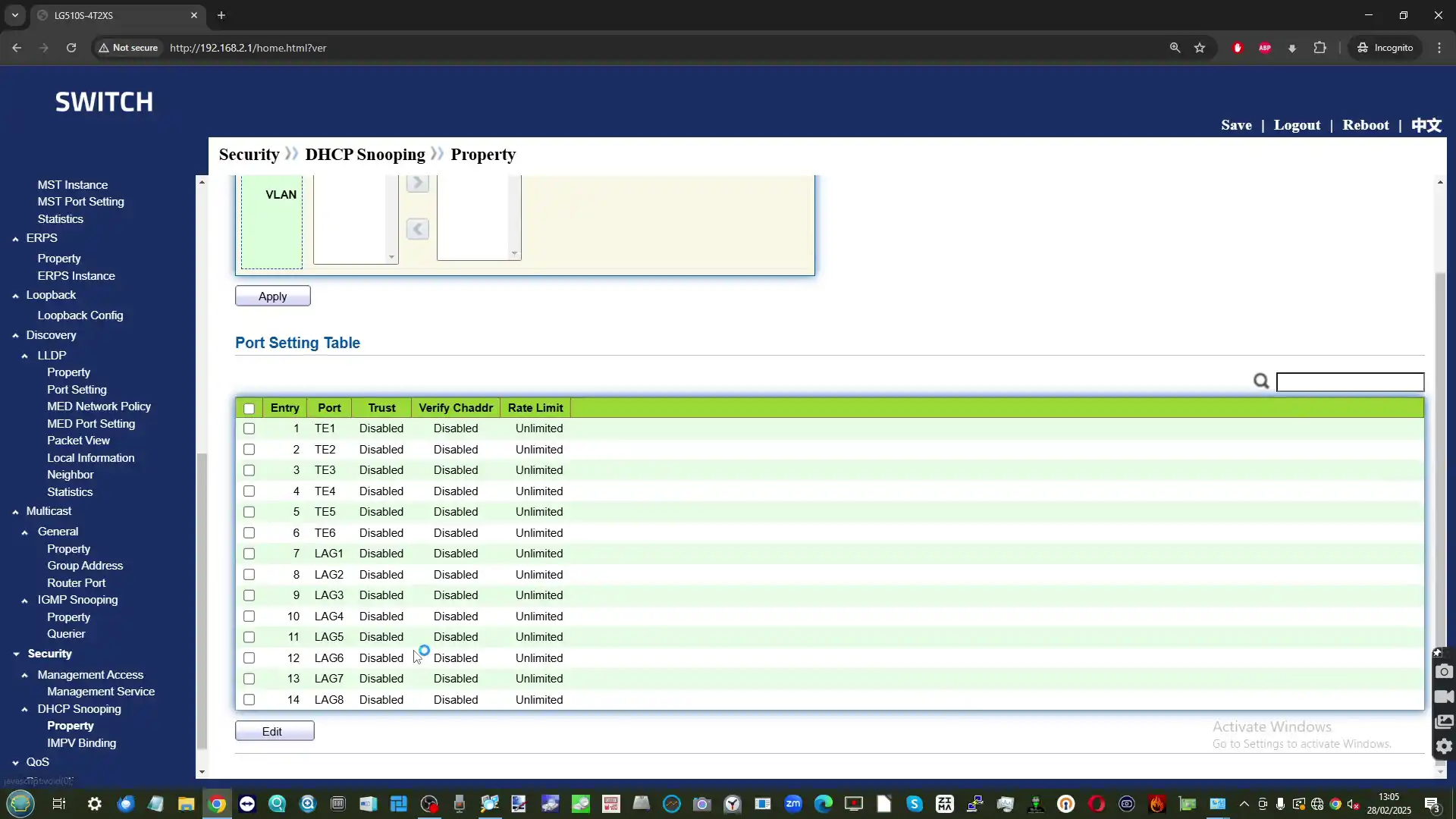
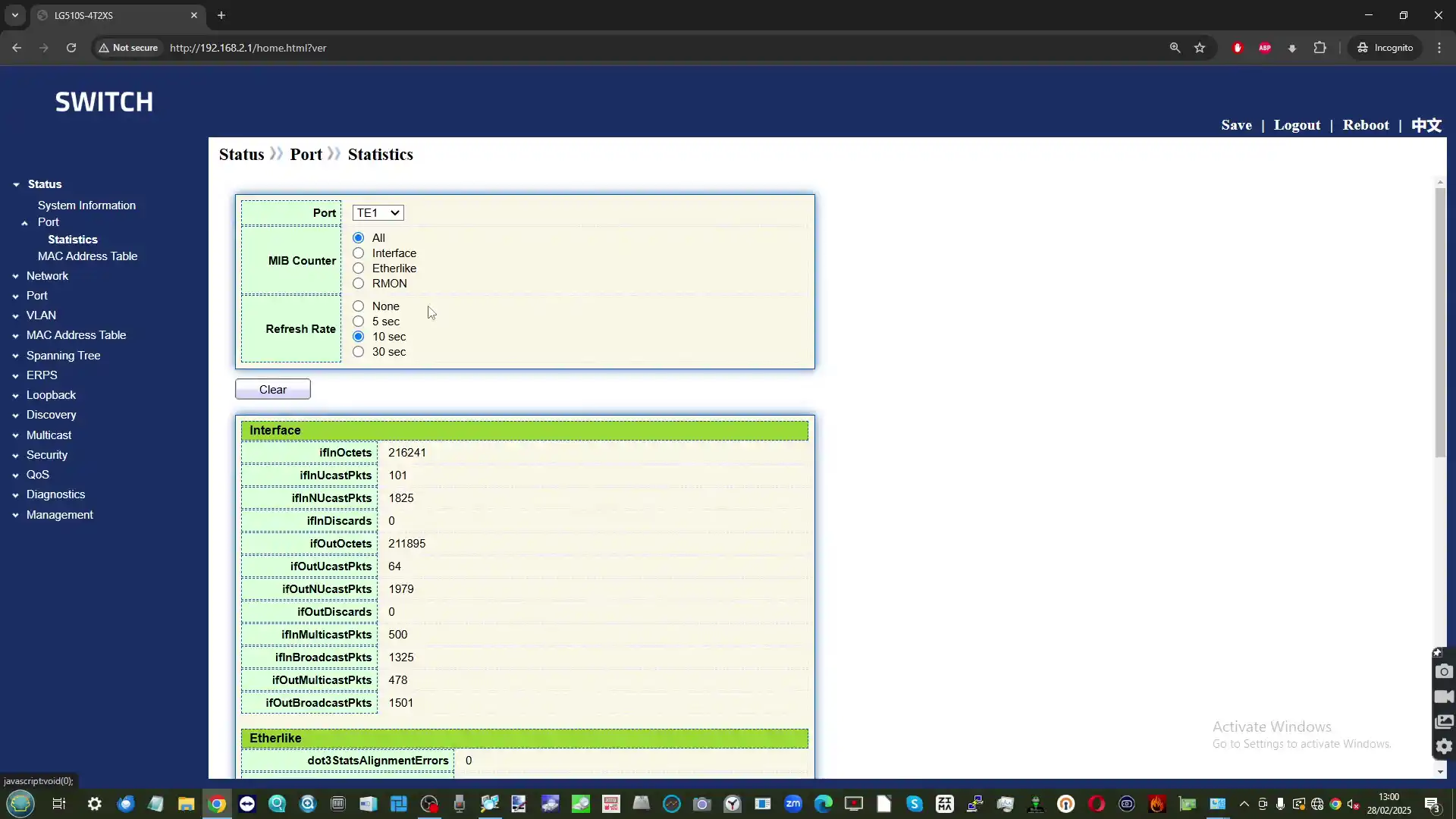
Despite its limited interface design, the switch includes a solid range of features that are normally found in more expensive units. These include core Layer 2 controls and essential traffic management capabilities, offering flexibility for VLAN segmentation, link aggregation, and network troubleshooting. While these features are mostly geared toward technical users, they cover a surprisingly broad spectrum of functionality for a switch in this price bracket. However, it’s worth noting that the interface offers no access controls beyond a single user account, no two-factor authentication, and no role-based access — all of which may concern users deploying this switch in sensitive or multi-user environments. Fan speed control, system logs, or SNMP monitoring are also absent, limiting the unit’s viability for more advanced administrative needs. Key supported features include:

  • VLAN support (802.1Q, VLAN IDs 1–4094)

  • Port-based VLAN assignment

  • Link Aggregation (LACP)

  • Loop detection

  • Jumbo frame support (up to 9K bytes)

  • MAC address filtering

  • Port mirroring

  • Broadcast storm control

  • QoS / Port-based priority settings

  • Traffic statistics monitoring

  • Basic firmware upgrade support

These tools are adequate for static network environments or those with fixed segmentation needs, but administrators seeking dynamic configuration, remote logging, or integration with monitoring platforms will find the software lacking in depth.

Goodtop Budget 6 Port 10GbE Switch Review – Verdict and Conclusion

The Goodtop 6-Port 10GbE Managed Switch offers an appealing combination of features that are rarely found together in a product at this price point. With four 10GBase-T copper ports and two 10G SFP+ fiber slots, it caters to users who need to bridge different media types without investing in multiple specialized devices. The unit delivers consistent throughput, a practical management interface, and baseline Layer 2 capabilities suitable for most small-scale, static deployments. For those building or expanding home labs, adding high-speed links between servers and NAS devices, or testing 10GbE equipment without committing to enterprise-level budgets, this switch is a very practical and accessible option. The price tag — typically hovering between $130 and $140 — is particularly compelling when compared with similar switches from established brands, which often cost two to three times as much while offering fewer ports or omitting management functionality.

However, it’s important to understand what trade-offs make that low cost possible. Physically, the unit is built with budget-grade materials, and although the compact design is functional, the thin metal chassis lacks the rigidity and passive cooling features seen in more expensive models. The inclusion of active cooling is necessary given the switch’s full 10GbE capability, but the fixed-speed fan results in a persistent acoustic presence that may not be acceptable in quiet workspaces. In terms of power usage and thermal output, the switch performs within expectations, though it naturally draws more power than multi-gig or 1G devices — something to consider if operating in environments sensitive to power efficiency or heat buildup.

On the software side, the web-based management interface includes a reasonably full feature set for configuring VLANs, link aggregation, QoS, and port monitoring, but the UI is visually dated, lacking intuitive navigation, helpful prompts, or contextual explanations. For seasoned users comfortable with networking terminology and manual configuration, this isn’t a major obstacle. However, newcomers may find the software overwhelming or difficult to use without external guidance. Security is another area where the switch shows its limitations. The absence of HTTPS access, multi-user management, or basic features like two-factor authentication limits its suitability for exposed or multi-tenant environments. Firmware updates are possible, but no public update path or official support channels are offered, making long-term update viability uncertain.

Ultimately, this is a product built around value — and that value is real, as long as buyers know what they’re getting into. The Goodtop switch does not pretend to be a polished enterprise-grade solution, nor does it offer the ecosystem integration or long-term support found in more expensive alternatives. Instead, it provides raw functionality: six full-speed 10GbE ports, a working management layer, and compatibility with a wide range of copper and optical transceivers. For environments that are self-contained, technically managed, and not security-critical, this device offers performance that aligns well with its low cost. For those willing to make small compromises on build quality and user experience, it’s an excellent option for extending 10G connectivity without overspending.


Need a Budget 10GbE Switch? RECOMMENDED TO BUY:
PROS CONS
  • Affordable price point (~$140) for a full 10GbE managed switch

  • Mixed media support with 4 x 10GBase-T and 2 x 10G SFP+ ports

  • Compact, wall-mountable design suitable for home labs or tight setups

  • Functional web-based management with core Layer 2 features

  • Reliable throughput under multi-port 10G load without packet loss

  • Active cooling maintains safe temperatures during sustained use

  • Broad compatibility with copper and fiber transceivers and cables

  • Constant 38–41 dBA fan noise; no fan speed control

  • Basic, unrefined software UI with a steep learning curve

  • No HTTPS, user roles, or 2FA; lacks advanced security controls. Overall security concerns.

  • Thin metal casing and lightweight construction feel budget-grade


📧 SUBSCRIBE TO OUR NEWSLETTER 🔔
[contact-form-7]
🔒 Join Inner Circle

Get an alert every time something gets added to this specific article!


Want to follow specific category? 📧 Subscribe

This description contains links to Amazon. These links will take you to some of the products mentioned in today's content. As an Amazon Associate, I earn from qualifying purchases. Visit the NASCompares Deal Finder to find the best place to buy this device in your region, based on Service, Support and Reputation - Just Search for your NAS Drive in the Box Below

Need Advice on Data Storage from an Expert?

Finally, for free advice about your setup, just leave a message in the comments below here at NASCompares.com and we will get back to you. Need Help? Where possible (and where appropriate) please provide as much information about your requirements, as then I can arrange the best answer and solution to your needs. Do not worry about your e-mail address being required, it will NOT be used in a mailing list and will NOT be used in any way other than to respond to your enquiry. [contact-form-7] TRY CHAT Terms and Conditions
If you like this service, please consider supporting us. We use affiliate links on the blog allowing NAScompares information and advice service to be free of charge to you.Anything you purchase on the day you click on our links will generate a small commission which isused to run the website. Here is a link for Amazon and B&H.You can also get me a ☕ Ko-fi or old school Paypal. Thanks!To find out more about how to support this advice service check HEREIf you need to fix or configure a NAS, check Fiver Have you thought about helping others with your knowledge? Find Instructions Here  
 
Or support us by using our affiliate links on Amazon UK and Amazon US
    
 
Alternatively, why not ask me on the ASK NASCompares forum, by clicking the button below. This is a community hub that serves as a place that I can answer your question, chew the fat, share new release information and even get corrections posted. I will always get around to answering ALL queries, but as a one-man operation, I cannot promise speed! So by sharing your query in the ASK NASCompares section below, you can get a better range of solutions and suggestions, alongside my own.

☕ WE LOVE COFFEE ☕


Terramaster F4 SSD NAS Review

Should You Buy the Terramaster F4 SSD NAS?

The TerraMaster F4 SSD is a 4-bay all-flash NAS aimed at home and prosumer users who want compact, quiet, and high-speed network storage based on SSD technology. Priced at $399, it represents the third entry in TerraMaster’s SSD-focused lineup, positioned below the larger 8-bay F8 SSD and the i5-powered F8 SSD Plus. This model is designed to deliver a balance between affordability and performance, featuring the Intel N95 quad-core processor, 8GB of DDR5 memory (upgradeable to 32GB), and four M.2 NVMe SSD slots across mixed-speed PCIe lanes. While its architecture targets lower power consumption and silent operation (rated at 19 dB in standby), it also integrates a 5GbE network port, USB 3.2 connectivity, and a toolless design to ease deployment. Designed for both turnkey usage with TerraMaster’s TOS 6 OS or as a flexible bare-metal option for TrueNAS or UnRAID, the F4 SSD sits at a crossroads between convenience and configurability—providing users with both preconfigured software and open-ended potential for third-party operating systems.

Terramaster F4 SSD NAS Review – Quick Conclusion

The TerraMaster F4 SSD delivers a compelling package for users seeking an affordable, compact, and all-flash NAS solution with a strong blend of performance and usability. Its toolless, space-saving design makes installation easy, while the inclusion of four M.2 NVMe slots—two at PCIe 3.0 x2 and two at x1—offers fast storage potential, albeit with some asymmetry that could affect RAID performance in certain configurations. Powered by the efficient Intel N95 CPU and 8GB of DDR5 memory, the system supports multimedia streaming, Docker containers, virtual machines, and AI-powered photo indexing, all handled by the continually improving TOS 6 operating system. Key strengths include the 5GbE networking for faster data access, support for mixed-capacity SSDs via TRAID, and very low noise and power consumption, making it ideal for home environments. However, limitations such as the single network port with no redundancy, lack of ECC memory support, and the presence of mixed-speed NVMe slots may be off-putting to power users or small businesses seeking higher resilience and uniform throughput. Still, at $399, the F4 SSD offers a well-rounded balance of speed, features, and ease of use for home users, prosumers, and content creators who want SSD-level performance without the complexity or cost of higher-end systems.

SOFTWARE - 7/10
HARDWARE - 8/10
PERFORMANCE - 7/10
PRICE - 9/10
VALUE - 9/10


8.0
PROS
👍🏻Compact, toolless chassis with easy-access thumb screw and SSD installation
👍🏻All-flash NVMe architecture with support for four M.2 2280 SSDs
👍🏻5GbE network port enables high-speed local and remote transfers
👍🏻TRAID and TRAID+ allow mixed-capacity SSDs and seamless storage expansion
👍🏻TOS 6 OS includes Plex, Jellyfin, Docker, VM support, and AI photo indexing
👍🏻Quiet operation (19 dB) and low power usage (32W under load)
👍🏻Priced competitively at $399 for a turnkey SSD NAS
CONS
👎🏻Single 5GbE port with no failover or link aggregation
👎🏻Two of the four SSD slots are limited to PCIe Gen3 x1, creating potential RAID bottlenecks
👎🏻Non-ECC DDR5 memory may not meet strict data integrity requirements


Where to Buy a Product
amzamexmaestrovisamaster 24Hfree delreturn VISIT RETAILER ➤ 
amzamexmaestrovisamaster 24Hfree delreturn VISIT RETAILER ➤

Terramaster F4 SSD NAS

Amazon in Your Region for the Terramaster F4 SSD NAS @ $399

B&H for the Terramaster F4 SSD NAS @ $399.99


Terramaster F4 SSD NAS Review – Design and Storage

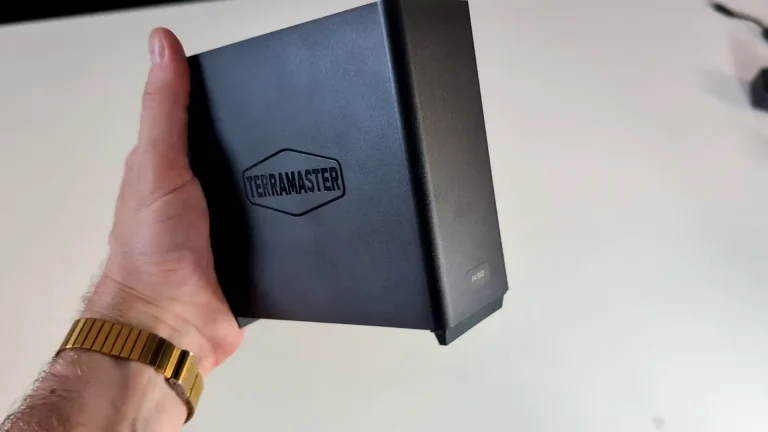
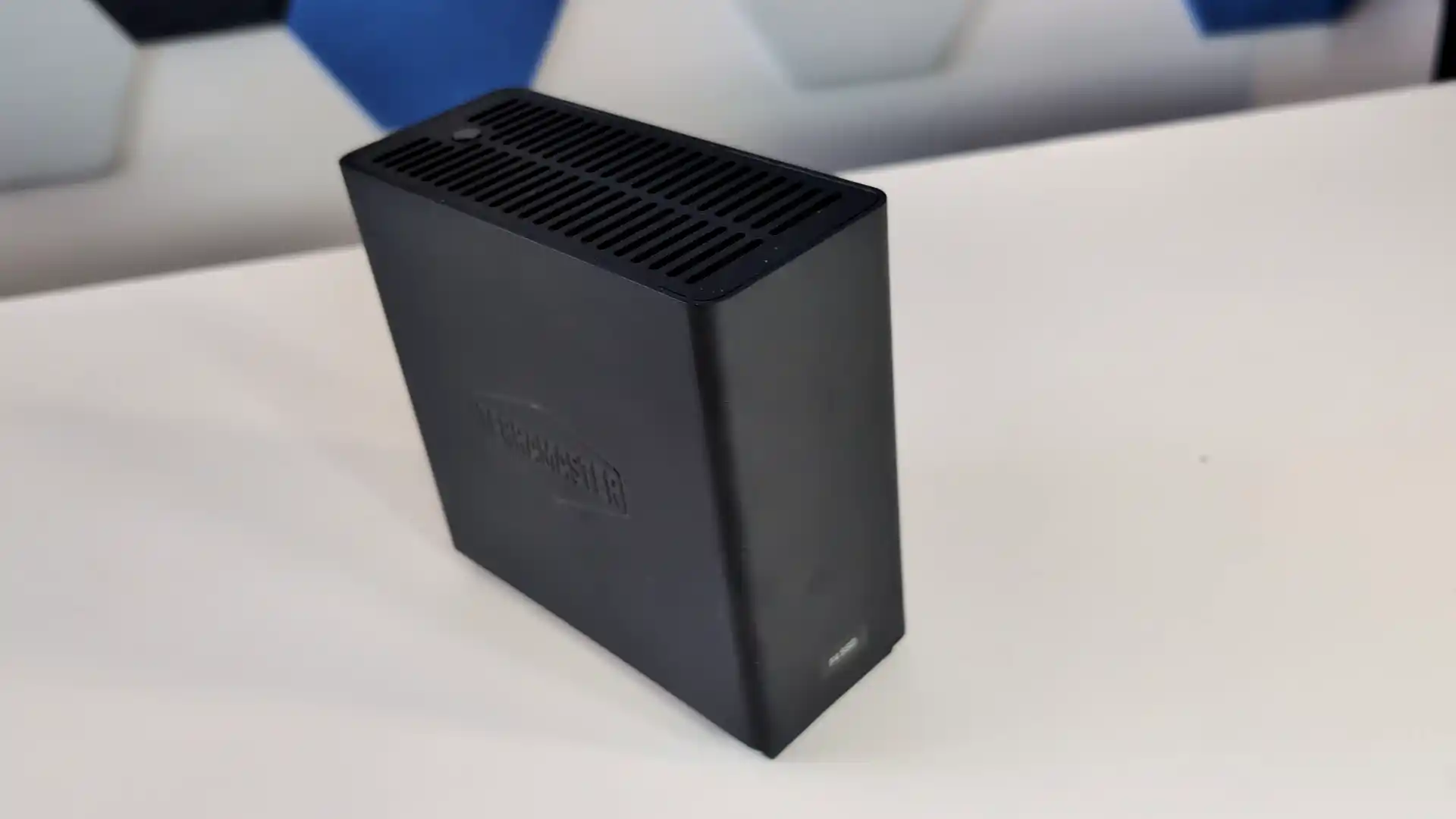
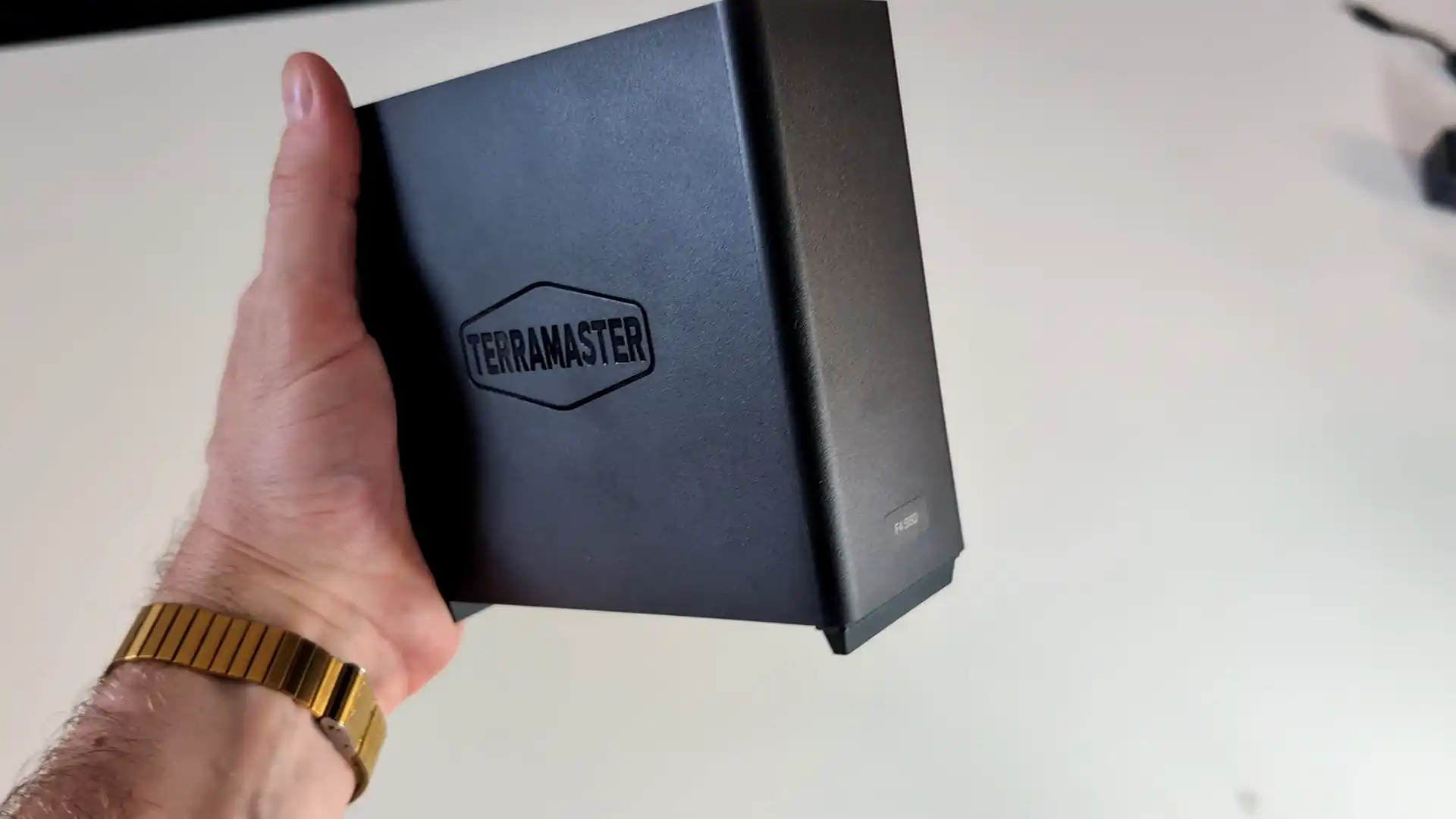
The TerraMaster F4 SSD adopts a compact, minimalist design that is clearly optimized for silent, flash-only operation. Measuring just 138mm x 60mm x 140mm and weighing 0.6 kg, it is one of the smallest 4-bay NAS chassis on the market, aided by its exclusive use of M.2 NVMe SSDs instead of traditional 3.5-inch hard drives. This all-flash design allows the chassis to maintain a reduced footprint while still offering significant internal capacity—up to 32TB using four 8TB drives. The unit features a clean, industrial aesthetic with smooth surfaces and subtle branding, aligning with TerraMaster’s recent design choices in their SSD NAS series. Importantly, the internal layout supports top-to-bottom convection airflow, with side ventilation and smart fan controls designed to balance cooling and acoustics.

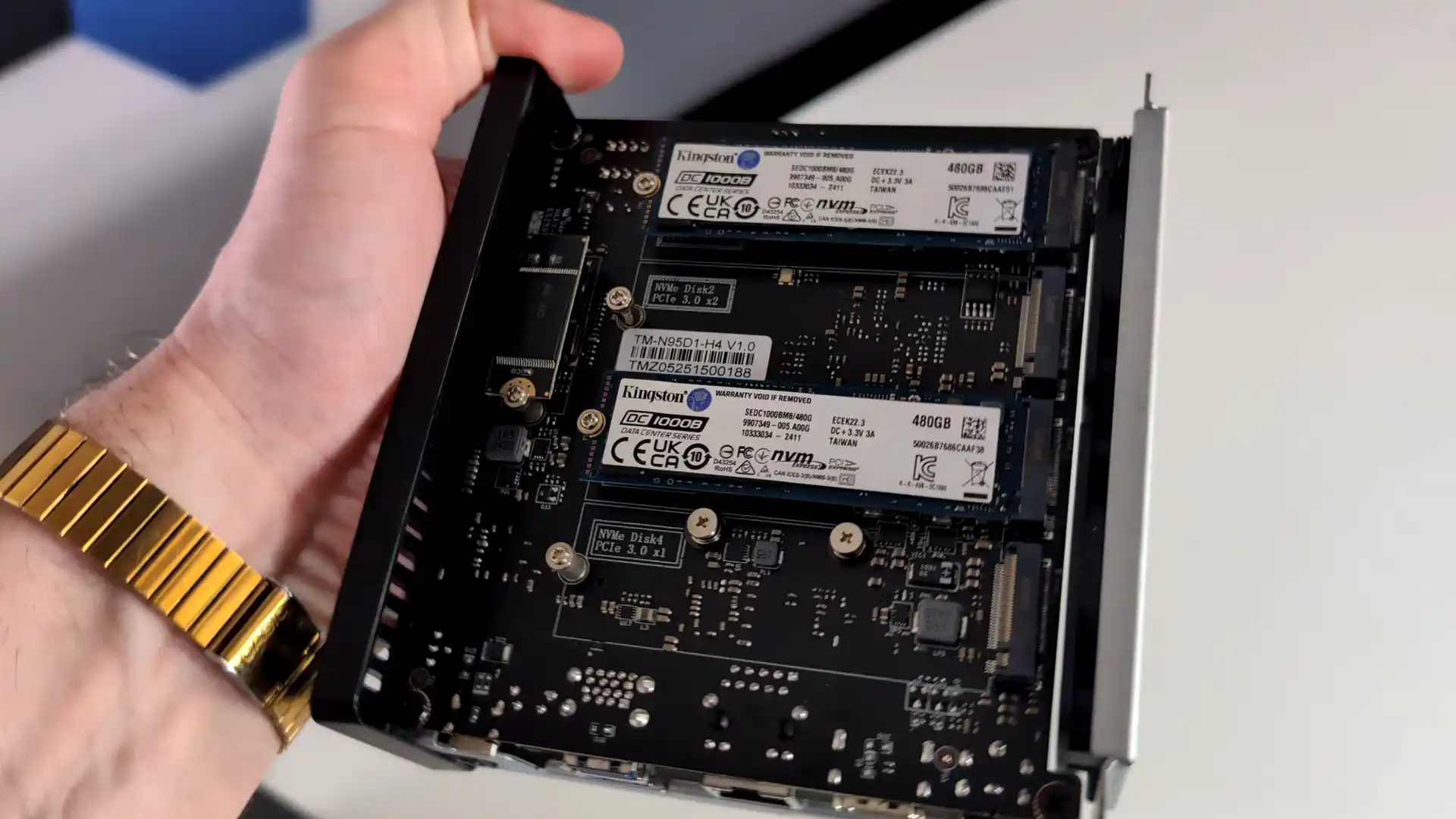
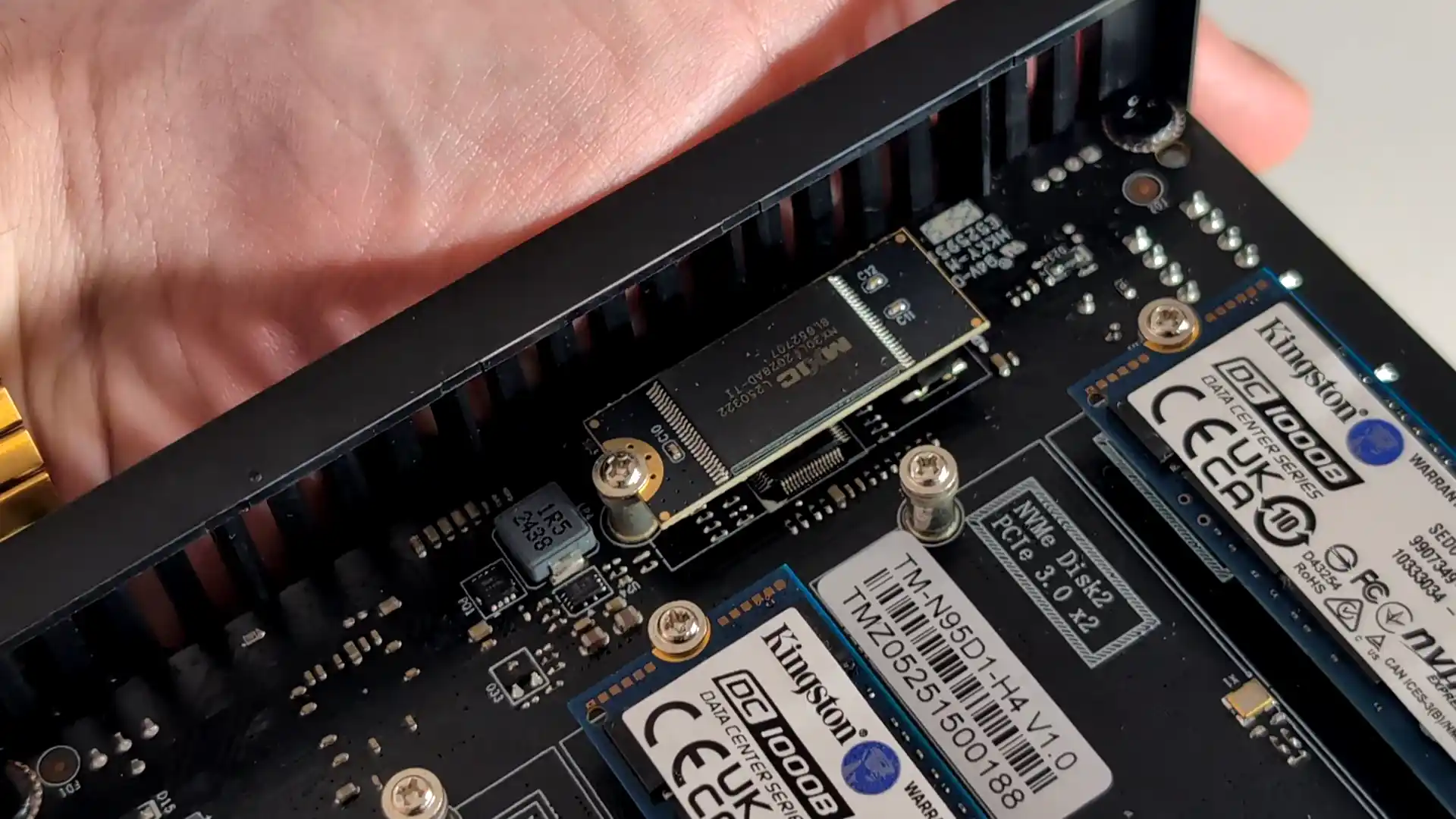
Installation is clearly a design priority here. The F4 SSD uses a toolless construction held together by a single thumbscrew, allowing the user to remove the outer casing in seconds. Internally, SSDs are inserted via a pull-out drawer mechanism with dedicated mounting trays, and there’s ample clearance around each M.2 slot for installing large passive heatsinks.

Notably, the SSD slots are laid out in such a way that their orientation lines up directly with the two 50mm rear fans. These fans are positioned to channel airflow across both the SSDs and the large passive heatsink mounted over the Intel N95 CPU, ensuring that even under sustained workloads the thermals remain controlled without relying on noisy active cooling systems.

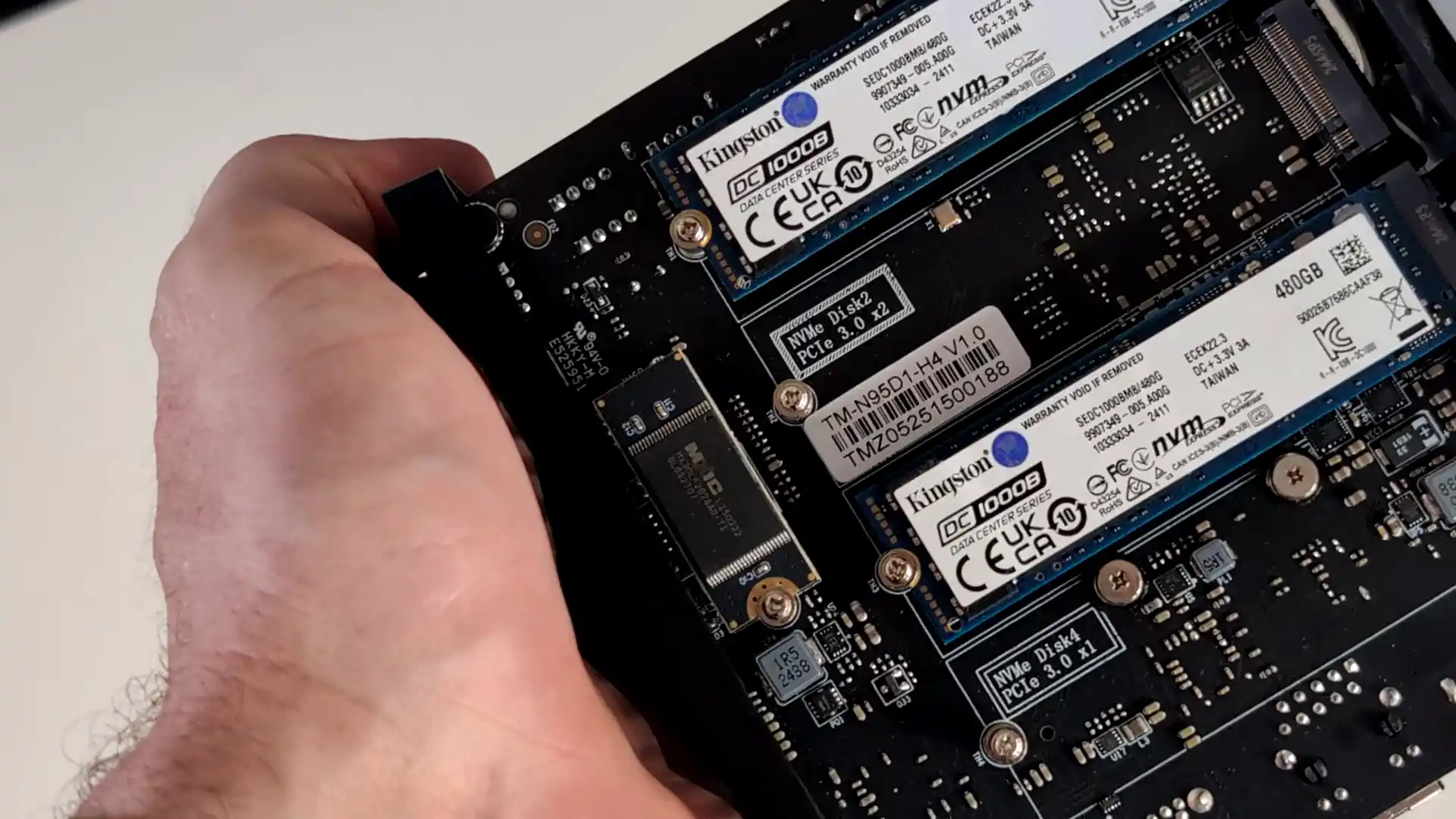
The internal storage configuration is somewhat mixed in terms of interface speed. Of the four M.2 slots, two operate over PCIe 3.0 x2 lanes, and two are limited to PCIe 3.0 x1. This introduces a disparity in potential transfer speeds—approximately 1.6GB/s per drive for the faster pair, and around 700-900MB/s for the slower ones.

While this approach is a practical trade-off due to CPU lane limitations, it may pose bottlenecks in RAID scenarios where all four drives are used in a single pool. However, for users willing to configure their SSDs into two independent volumes, or who rely on TerraMaster’s TRAID system with mixed-capacity drives, the system can still make efficient use of available bandwidth.

The F4 SSD supports a range of RAID configurations including TRAID, TRAID+, RAID 0, 1, 5, 6, and 10, as well as JBOD and single-drive modes. TRAID, TerraMaster’s hybrid RAID system, is especially notable here as it supports storage expansion using drives of different sizes—an advantage for users who plan to incrementally upgrade their SSDs over time. This flexibility is rare in entry-level NAS units, and helps avoid the traditional pitfalls of having to replace all drives at once in standard RAID arrays. The software layer automatically calculates parity and adjusts volume size without requiring complete data migration or reconfiguration.

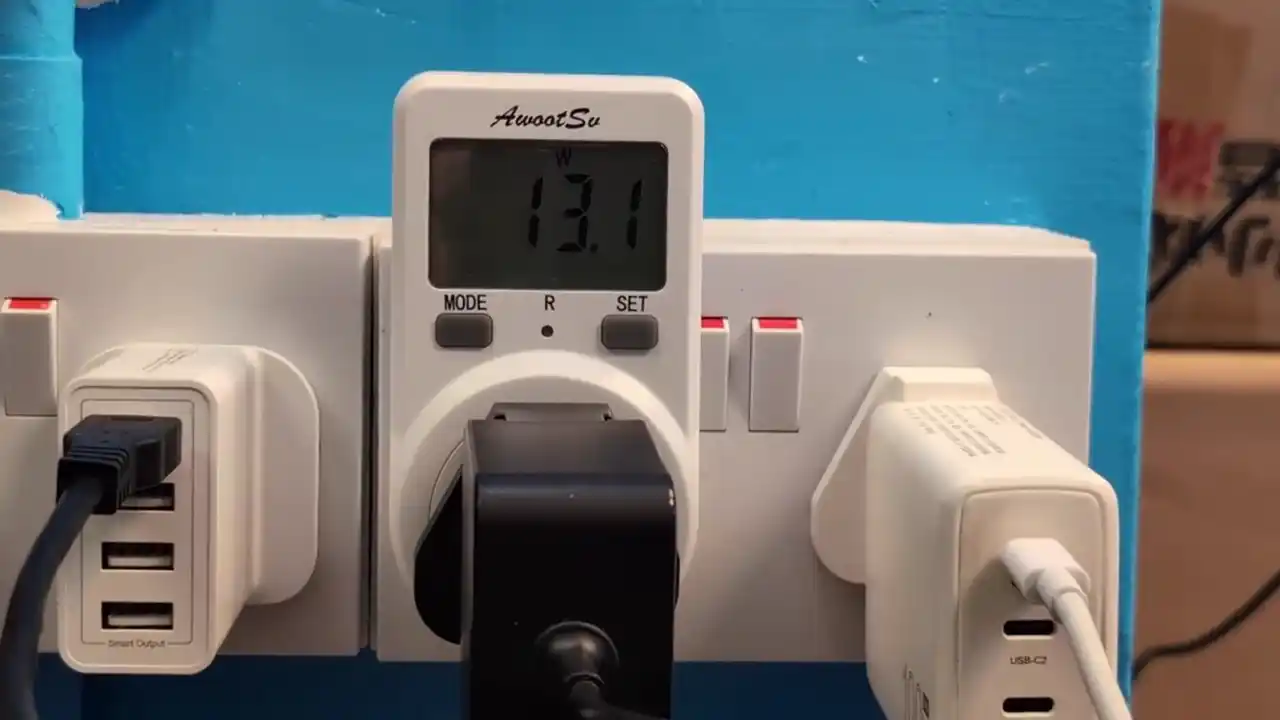
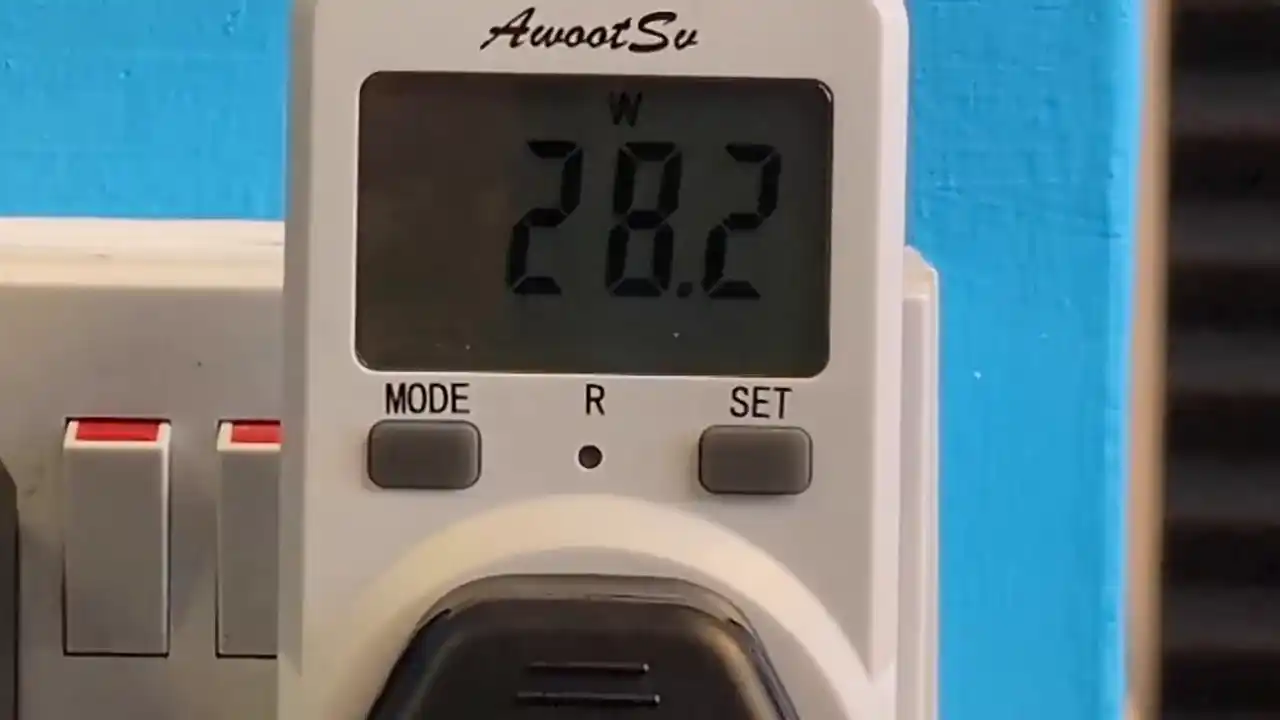
From a practical perspective, the move to SSD-only architecture enables faster access times, reduced power usage, and significantly lower noise. TerraMaster reports a typical power draw of just 32W under full load with four SSDs, around 11-13W with all 4 SSD in a ‘read state’ with the CPU at sub 5%, and only 8W in complete hibernation. The fan noise sits below 19dB during idle operation, placing it among the quietest NAS units available. For environments such as living rooms or bedrooms where noise sensitivity is key, this silent thermal design makes the F4 SSD particularly well-suited for home multimedia centers and always-on photo backup servers.

Terramaster F4 SSD NAS Review – Internal Hardware

At the heart of the TerraMaster F4 SSD is the Intel N95 processor, a quad-core, four-thread CPU based on the Alder Lake-N architecture. Clocked at a base frequency of 1.7GHz with a boost up to 3.4GHz, it offers efficient processing power with a low 15W TDP, which contributes to the unit’s low thermal output and power consumption. While not designed for heavy computational workloads, the N95 supports Intel Quick Sync for hardware-accelerated video transcoding and includes integrated UHD graphics capable of handling 4K@60Hz decoding.

This makes the F4 SSD suitable for multimedia servers like Plex or Jellyfin, which are supported out of the box by TerraMaster’s TOS operating system. The CPU also provides nine PCIe Gen3 lanes for connecting NVMe drives, network interfaces, and USB ports—something that TerraMaster appears to have carefully balanced across components.

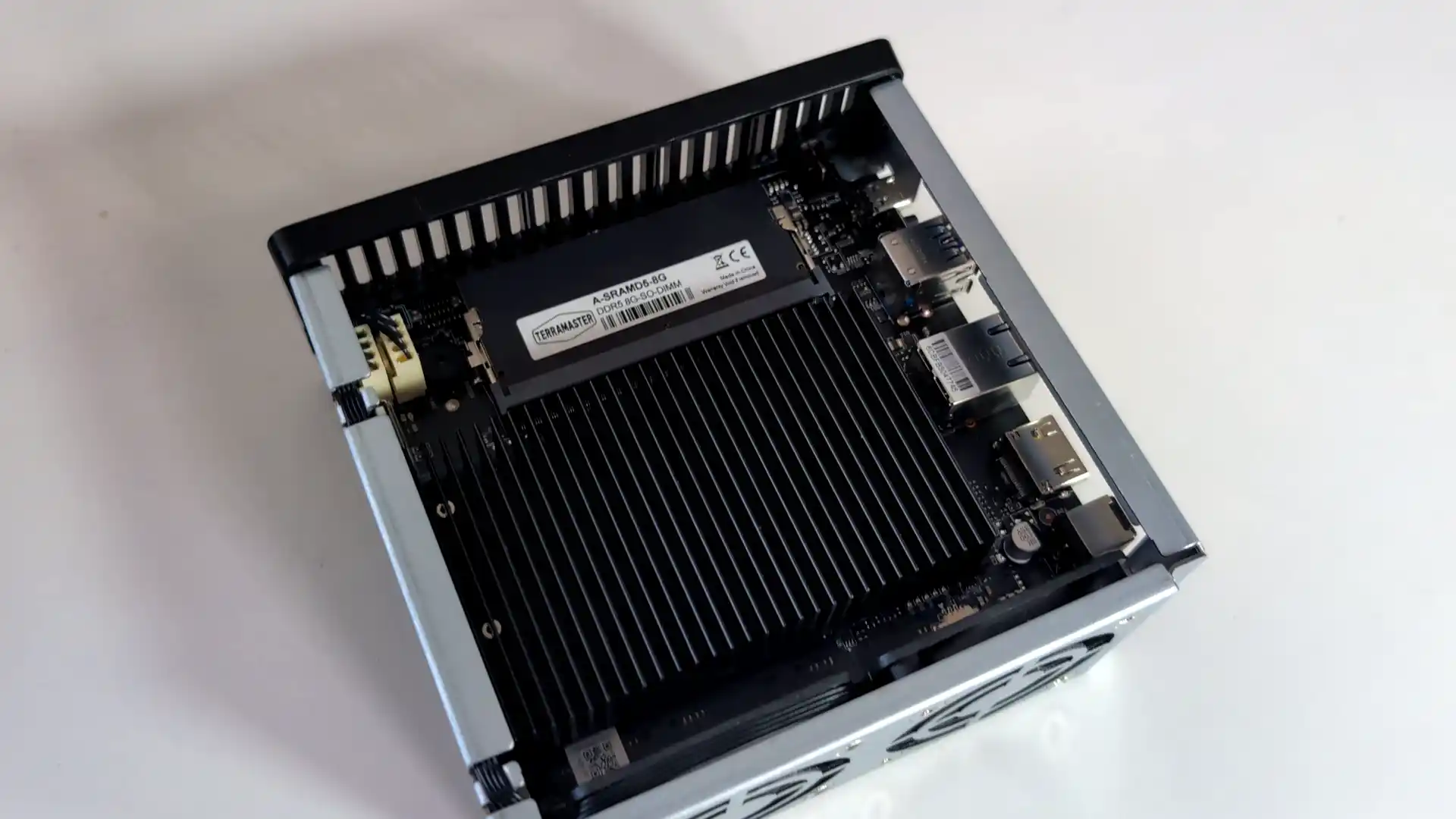
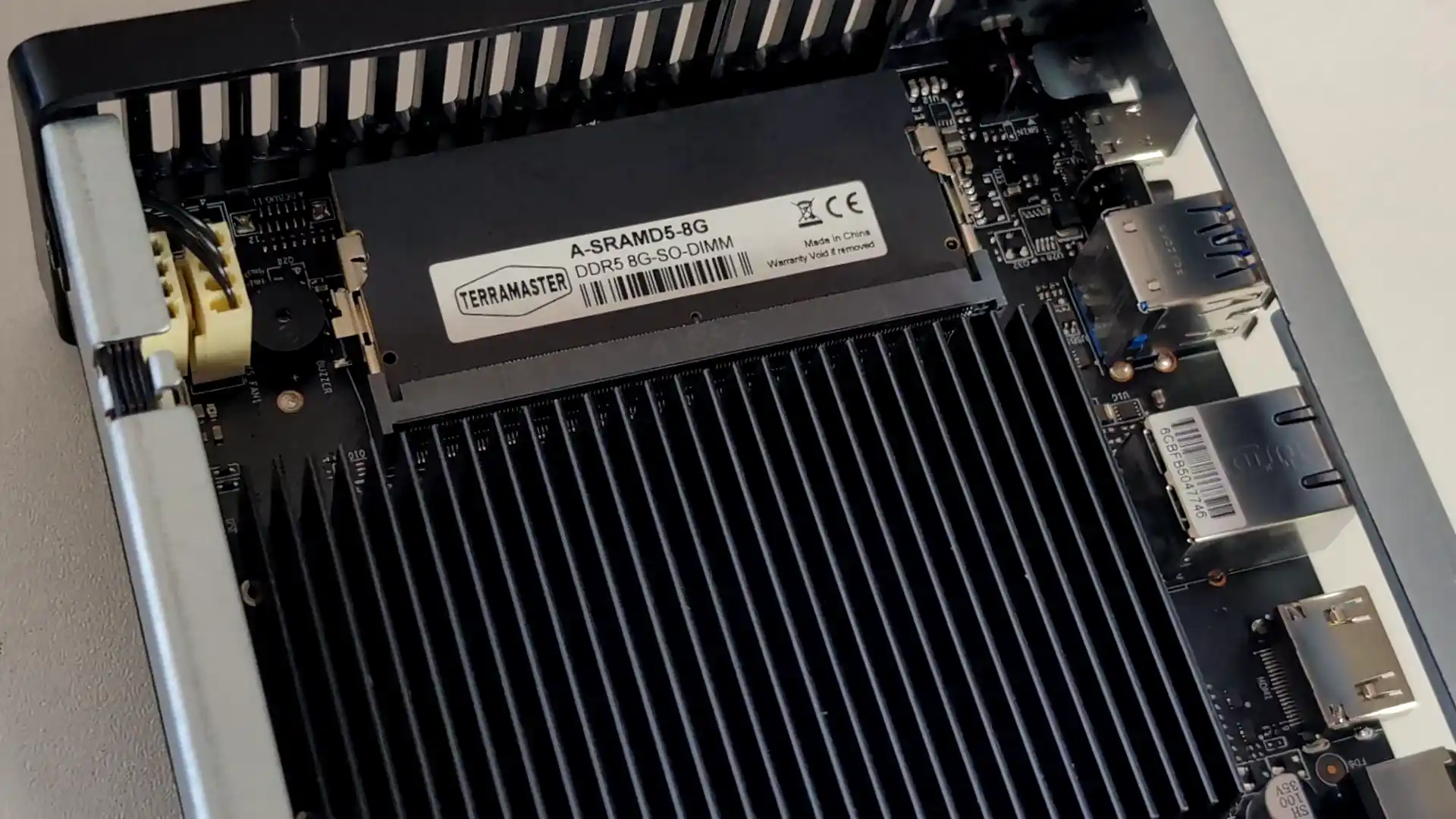
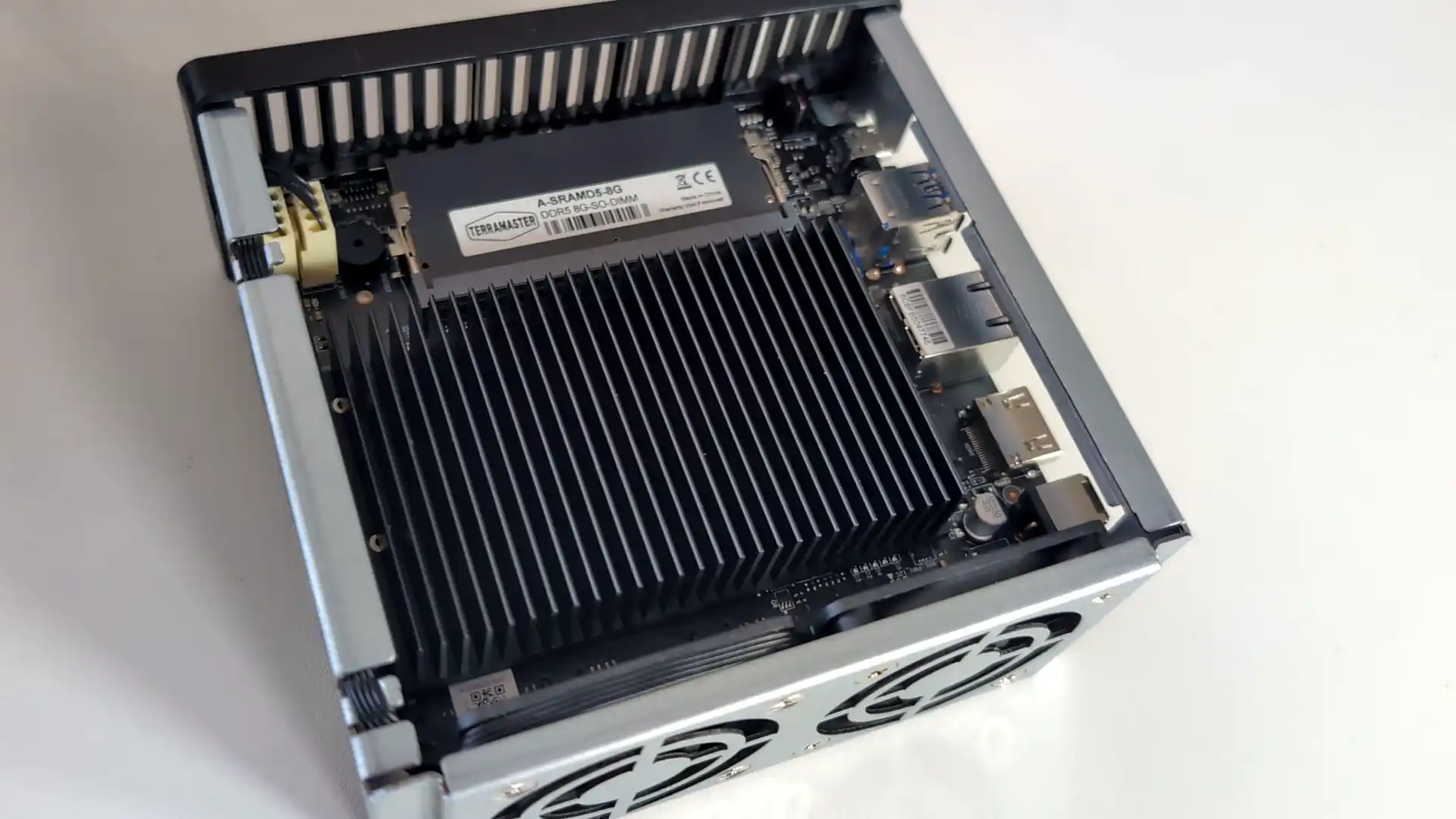
The system is equipped with 8GB of DDR5 memory pre-installed in a single SODIMM slot, with support for up to 32GB. The memory is non-ECC, which is expected for this price bracket and CPU class, though some users may view this as a drawback in data-critical environments. DDR5 support is a notable inclusion, offering higher bandwidth and lower power consumption than DDR4.

Because there is only a single memory slot, upgrades require replacing the pre-installed module entirely, but access is straightforward thanks to the removable chassis design. Combined with the N95 CPU and SSD storage, the memory allows for lightweight virtualization, Docker container deployment, and simultaneous access by multiple users—within the limitations of the CPU’s architecture.

Internally, the F4 SSD supports four M.2 2280 NVMe drives: two connected via PCIe 3.0 x2, and two via PCIe 3.0 x1. This setup is a direct consequence of the limited PCIe lane count on the N95 CPU, and reflects a compromise between cost and performance. While this layout means that users may encounter performance bottlenecks if building a single RAID array across all four slots, TerraMaster’s OS allows for flexible configuration, including the creation of separate volumes. The system also includes a substantial heatsink on the CPU and aligns airflow directly over both the CPU and storage bays. Together, these components form a power-efficient, quiet, and competent NAS platform optimized for SSD workloads.

Component Specification
CPU Model Intel N95 (4C/4T, up to 3.4 GHz, 15W TDP)
CPU Architecture Intel Alder Lake-N, x86 64-bit
Integrated Graphics Intel UHD, 1.2 GHz, 4K@60Hz support
Memory Type DDR5 SODIMM (Non-ECC)
Pre-installed Memory 8GB DDR5 (1x8GB)
Maximum Memory Supported 32GB DDR5
Memory Slots 1 x DDR5 SODIMM
Internal Storage Slots 4 x M.2 2280 NVMe SSD (2 x PCIe 3.0 x2, 2 x x1)
RAID Support TRAID, TRAID+, RAID 0/1/5/6/10, JBOD, Single
Cooling 2 x 50mm fans + large passive CPU heatsink
Power Consumption 32W (read/write), 8W (hibernation with SSDs)
Noise Level 19 dB(A) in standby

Terramaster F4 SSD NAS Review – Ports and Connections

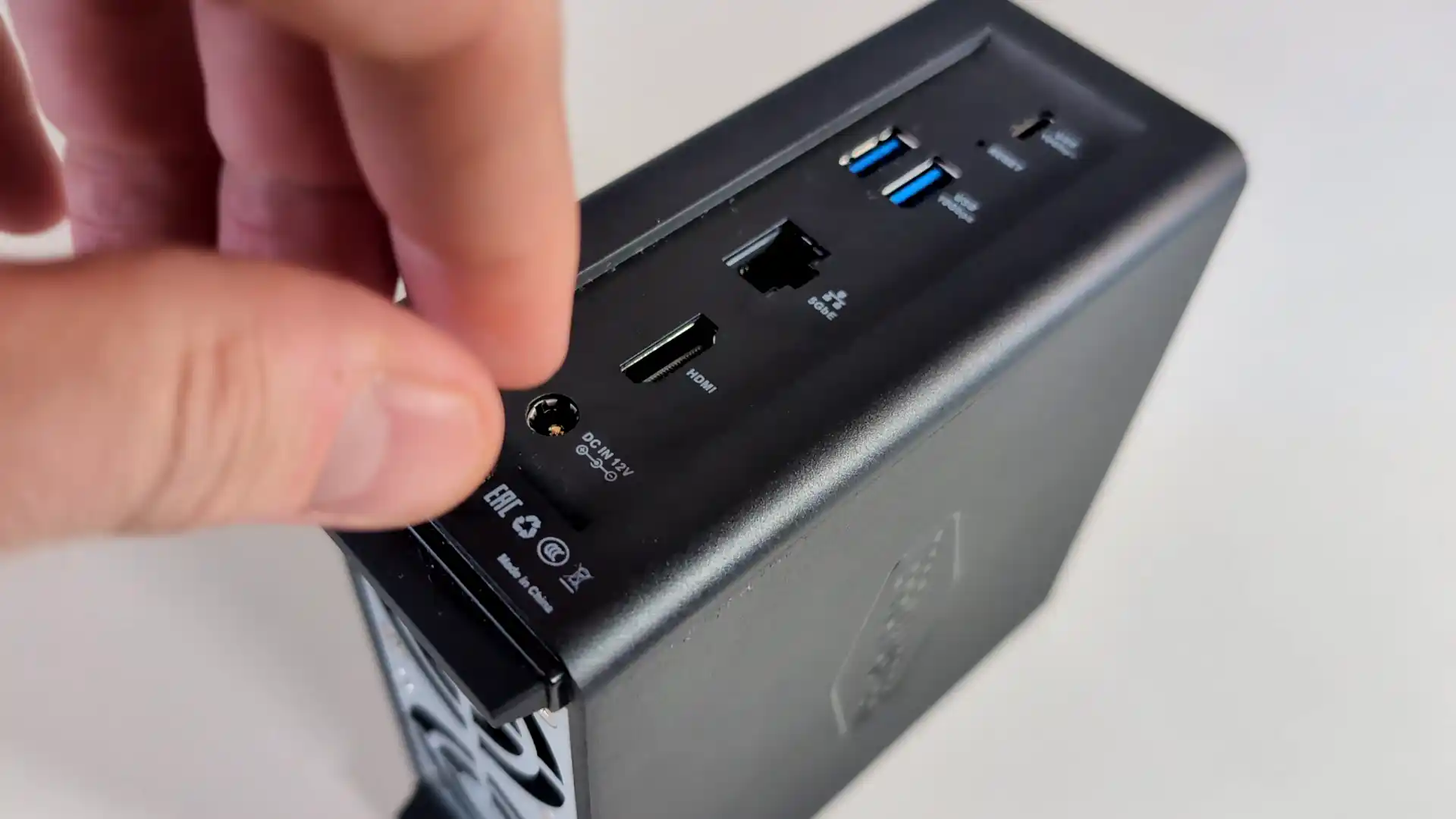
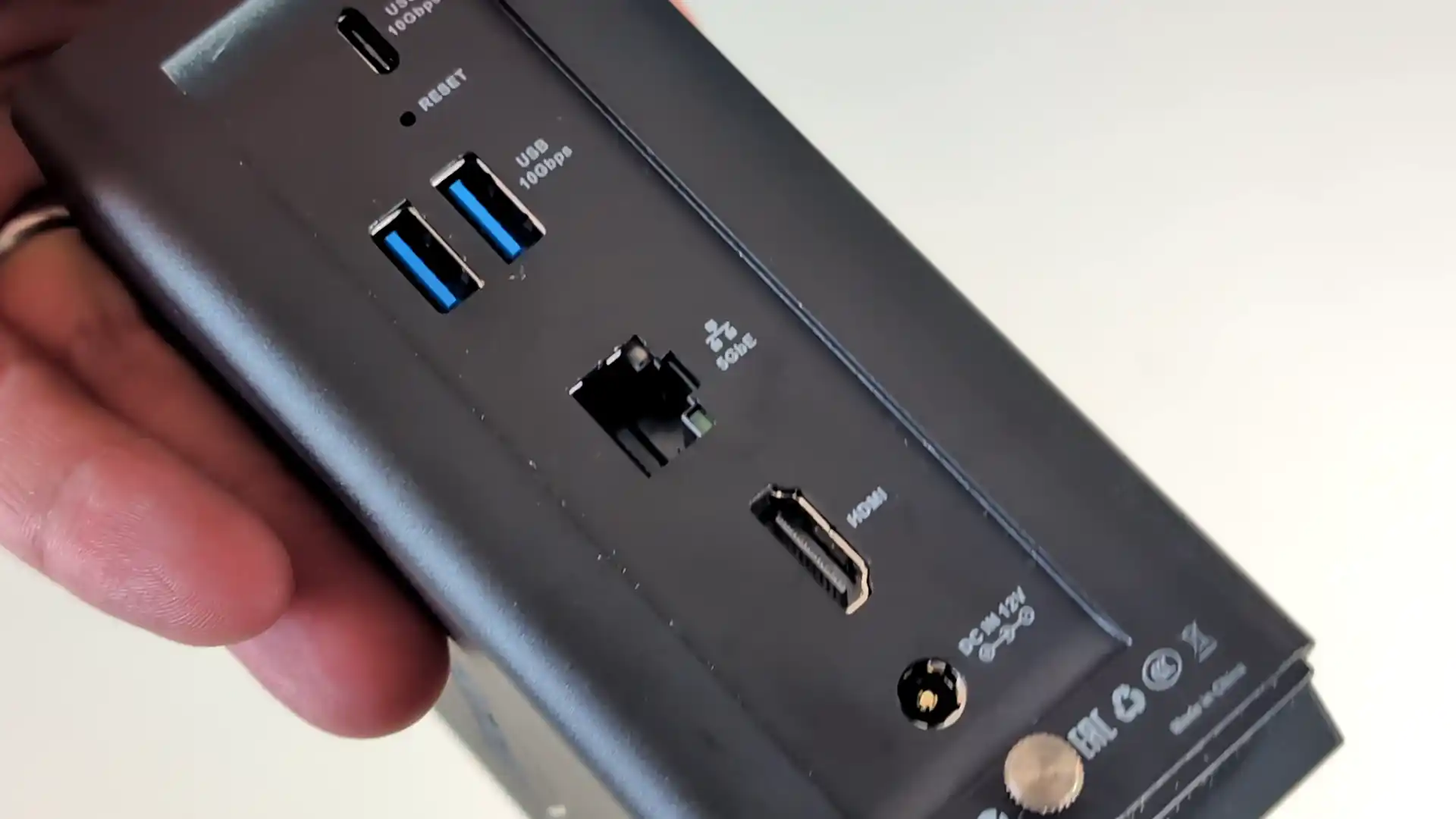
The TerraMaster F4 SSD is equipped with a practical selection of ports that reflect its mid-tier positioning. The standout feature is a single RJ-45 5GbE Ethernet port, offering five times the bandwidth of standard Gigabit connections and double that of 2.5GbE. This enables significantly faster file transfers when paired with compatible switches or direct-to-PC connections, making it a viable solution for photo and video editing over the network. However, the inclusion of only one network port—without redundancy or support for link aggregation—limits failover options and prevents more advanced networking setups, a drawback that may be felt in business or multi-user deployments. Users seeking dual LAN ports for redundancy or trunking will need to resort to USB-to-Ethernet adapters, which are supported via the system’s high-speed USB 3.2 ports.

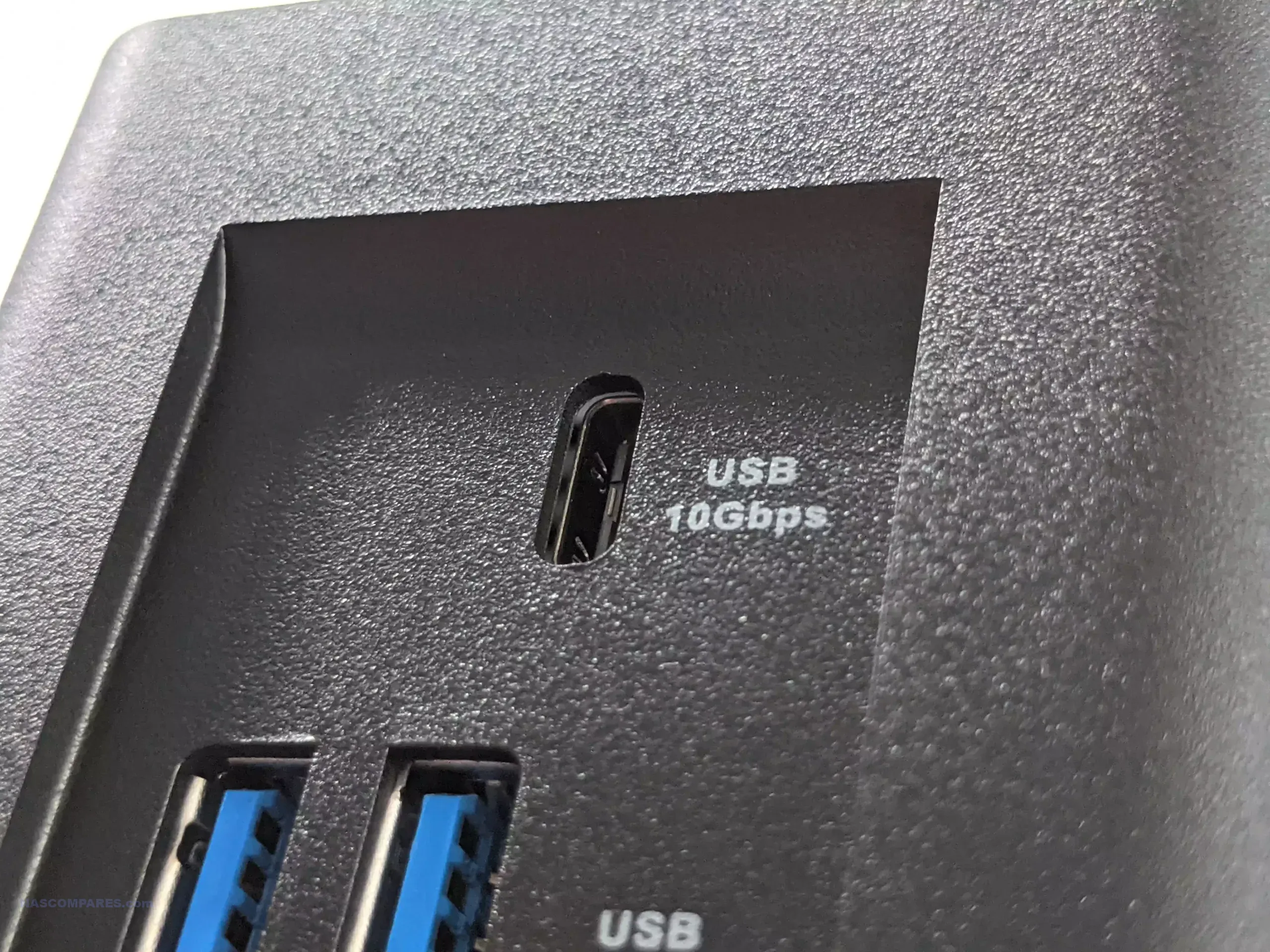
In addition to its network interface, the F4 SSD features three USB 3.2 Gen 2 ports rated at 10Gbps each—two Type-A and one Type-C. These ports support a variety of functions, including attaching external storage for backups, connecting USB-based 2.5GbE/5GbE adapters, or even interfacing with uninterruptible power supplies (UPS). This level of connectivity is somewhat uncommon in compact SSD NAS systems and adds useful flexibility, particularly for users operating the unit as a personal cloud or remote access point. Notably absent, however, are legacy USB 2.0 ports or additional network expansion slots (such as PCIe or SFP+), which would have extended the F4 SSD’s upgradeability for more advanced users.

On the display side, the NAS includes a single HDMI 2.0b port, allowing for direct output of its graphical interface or multimedia playback, though this feature is seldom used in headless NAS operation. Still, its presence supports limited desktop use cases or direct-attached displays for VM consoles and Docker GUIs. Internally, the Intel N95 CPU provides up to three display outputs, but only one is exposed in this system. The absence of a VGA port, PCIe expansion slots, or front-facing ports keeps the design clean but does reduce options for advanced customization. Ultimately, the F4 SSD provides just enough I/O for mainstream home or small office use, while intentionally leaving out more enterprise-grade connectivity.

Port Type Quantity / Specification
RJ-45 Network Port 1 x 5GbE (5 Gigabit Ethernet)
USB 3.2 Gen 2 (10Gbps) 3 total: 2 x Type-A, 1 x Type-C
HDMI Output 1 x HDMI 2.0b
PCIe Slots None
SFP+ 10GbE Port None
VGA Port None
Audio Jack / COM Ports None
USB 2.0 Ports None
Networking Features TNAS.online, DDNS, VPN Server/Client, Link Aggregation (limited)

Terramaster F4 SSD NAS Review – TOS Software and Services

The TerraMaster F4 SSD ships with TOS 6, the company’s latest revision of its NAS operating system. TOS 6 has matured significantly compared to earlier versions, now offering a more stable and responsive interface with support for modern NAS functionality. The OS features a multi-window desktop-like environment accessible via browser, along with mobile and desktop clients for streamlined access.

The interface, though less polished than Synology’s DSM, has seen improvements in usability, with clearer organization of applications, settings, and user tools. Key system features include centralized backup, file indexing, user/group controls, and integrated snapshot functionality for shared folders and iSCSI volumes. For home users and prosumers, these updates represent a notable step forward, especially when paired with the low latency benefits of SSD storage.

Among TOS 6’s more prominent features is TRAID (TerraMaster RAID), a hybrid RAID system designed to offer flexible storage expansion and mixed-capacity drive support. Similar in principle to Synology’s SHR, TRAID allows users to start with a small number of SSDs and expand later with larger ones without reconfiguring the entire array.

This flexibility is especially useful in all-flash systems where high-capacity SSDs can be cost-prohibitive to install all at once. In addition to TRAID and TRAID+, the system also supports traditional RAID levels (0, 1, 5, 6, 10), JBOD, and single-drive configurations. Volume expansion, RAID migration, SSD TRIM, and S.M.A.R.T. monitoring are supported natively, along with scheduled snapshots and USB-based backups.

TOS 6 includes a growing suite of first- and third-party applications that address multimedia, surveillance, and cloud connectivity. The F4 SSD supports Plex Media Server, Jellyfin, Emby, and TerraMaster’s own Multimedia Server for DLNA/UPnP streaming. Users can also deploy Docker containers, virtual machines, and network services such as iSCSI, FTP, WebDAV, and VPN servers.

Multimedia support is further bolstered by hardware-accelerated 4K video decoding via the Intel UHD iGPU, making the NAS suitable as a home media hub. AI photo indexing is also integrated into Terra Photos, allowing automated categorization of people, pets, and scenes. For mobile users, the TNAS app offers automatic photo/video uploads and remote file access, enhancing backup automation and content management.

Enterprise and security features are present but modest. TOS 6 includes AES-encrypted folders, SSL certificate import, two-factor authentication, and alerting via email or desktop notifications. Integration with AD domains and LDAP clients is supported, but ECC memory is not, reflecting the system’s home and small-office focus. Additional cloud integration is provided via CloudSync, which supports Google Drive, OneDrive, Amazon S3, Dropbox, Baidu, and Alibaba Cloud.

For users requiring simple hybrid-cloud backups or syncing across multiple platforms, this unified interface is functional and sufficient. While TOS lacks the enterprise depth of some competing NAS platforms, its overall range of applications and services is now competitive for most home or light professional needs.

Category Feature Support
Operating System TOS 6 (Web-based + Mobile + PC Clients)
RAID Support TRAID, TRAID+, RAID 0/1/5/6/10, JBOD, Single
Snapshots Shared folder and iSCSI LUN snapshots
Multimedia Support Plex, Jellyfin, Emby, DLNA, Terra Multimedia Server
AI Features AI Photo Indexing, Face/Object Recognition
Backup Tools Duple Backup, Centralized Backup, USB Backup
Virtualization Docker, Virtual Machine Manager
Security AES folder encryption, SSL, 2FA, firewall, alerts
User Management 128 users, ACL, quotas, domain & LDAP integration
Cloud Integration Google Drive, OneDrive, Dropbox, Amazon S3, etc.
Networking Services VPN, DDNS, TNAS.online, NFS, SMB, FTP, WebDAV
Access Tools TNAS Mobile, TNAS PC, Remote Browser Access

Terramaster F4 SSD NAS Review – Verdict and Conclusion

The TerraMaster F4 SSD presents itself as a well-considered entry into the compact, all-flash NAS segment, balancing low noise, energy efficiency, and competitive performance at a sub-$400 price point. With its fanless NVMe-based design, Intel N95 quad-core processor, and DDR5 memory, it meets the essential needs of home and small office users looking for a reliable and responsive storage solution. The inclusion of TerraMaster’s increasingly capable TOS 6 operating system, featuring AI-driven photo management, centralized backup, and Docker/VM support, makes it more than just a network storage device—it becomes a lightweight but versatile data center for the home. Its TRAID support allows for mixed SSD deployments with easy expansion, which is particularly attractive to users upgrading gradually or working within budget constraints. The thoughtful internal layout and cooling also ensure performance remains consistent even under sustained load, without sacrificing the near-silent operation.

However, the F4 SSD is not without caveats. The use of a single 5GbE port, without redundancy or aggregation, may deter users requiring network failover or higher throughput for simultaneous operations. Additionally, although the PCIe lane allocation strategy maximizes the N95’s limited bandwidth, the asymmetry between Gen3 x2 and x1 slots could bottleneck RAID performance depending on how volumes are configured. When compared to the larger F8 SSD or DIY options with dual 10GbE or ECC support, the F4 SSD may feel limiting to power users or business environments with stricter reliability requirements. That said, for the vast majority of home users, content creators, and prosumers looking for an all-in-one, high-speed NAS that blends well into living spaces, the F4 SSD delivers a solid and accessible solution. Its price-to-performance ratio, combined with the simplicity of deployment and maturing software ecosystem, makes it a compelling option in the growing market of SSD NAS devices.

Terramaster F4 SSD NAS

Amazon in Your Region for the Terramaster F4 SSD NAS @ $399

B&H for the Terramaster F4 SSD NAS @ $399.99


PROs of the Terramaster F4 SSD CONs of the Terramaster F4 SSD
  • Compact, toolless chassis with easy-access thumb screw and SSD installation

  • All-flash NVMe architecture with support for four M.2 2280 SSDs

  • 5GbE network port enables high-speed local and remote transfers

  • TRAID and TRAID+ allow mixed-capacity SSDs and seamless storage expansion

  • TOS 6 OS includes Plex, Jellyfin, Docker, VM support, and AI photo indexing

  • Quiet operation (19 dB) and low power usage (32W under load)

  • Priced competitively at $399 for a turnkey SSD NAS

  • Single 5GbE port with no failover or link aggregation

  • Two of the four SSD slots are limited to PCIe Gen3 x1, creating potential RAID bottlenecks

  • Non-ECC DDR5 memory may not meet strict data integrity requirements


📧 SUBSCRIBE TO OUR NEWSLETTER 🔔
[contact-form-7]
🔒 Join Inner Circle

Get an alert every time something gets added to this specific article!


Want to follow specific category? 📧 Subscribe

This description contains links to Amazon. These links will take you to some of the products mentioned in today's content. As an Amazon Associate, I earn from qualifying purchases. Visit the NASCompares Deal Finder to find the best place to buy this device in your region, based on Service, Support and Reputation - Just Search for your NAS Drive in the Box Below

Need Advice on Data Storage from an Expert?

Finally, for free advice about your setup, just leave a message in the comments below here at NASCompares.com and we will get back to you. Need Help? Where possible (and where appropriate) please provide as much information about your requirements, as then I can arrange the best answer and solution to your needs. Do not worry about your e-mail address being required, it will NOT be used in a mailing list and will NOT be used in any way other than to respond to your enquiry. [contact-form-7] TRY CHAT Terms and Conditions
If you like this service, please consider supporting us. We use affiliate links on the blog allowing NAScompares information and advice service to be free of charge to you.Anything you purchase on the day you click on our links will generate a small commission which isused to run the website. Here is a link for Amazon and B&H.You can also get me a ☕ Ko-fi or old school Paypal. Thanks!To find out more about how to support this advice service check HEREIf you need to fix or configure a NAS, check Fiver Have you thought about helping others with your knowledge? Find Instructions Here  
 
Or support us by using our affiliate links on Amazon UK and Amazon US
    
 
Alternatively, why not ask me on the ASK NASCompares forum, by clicking the button below. This is a community hub that serves as a place that I can answer your question, chew the fat, share new release information and even get corrections posted. I will always get around to answering ALL queries, but as a one-man operation, I cannot promise speed! So by sharing your query in the ASK NASCompares section below, you can get a better range of solutions and suggestions, alongside my own.

☕ WE LOVE COFFEE ☕

 
❌