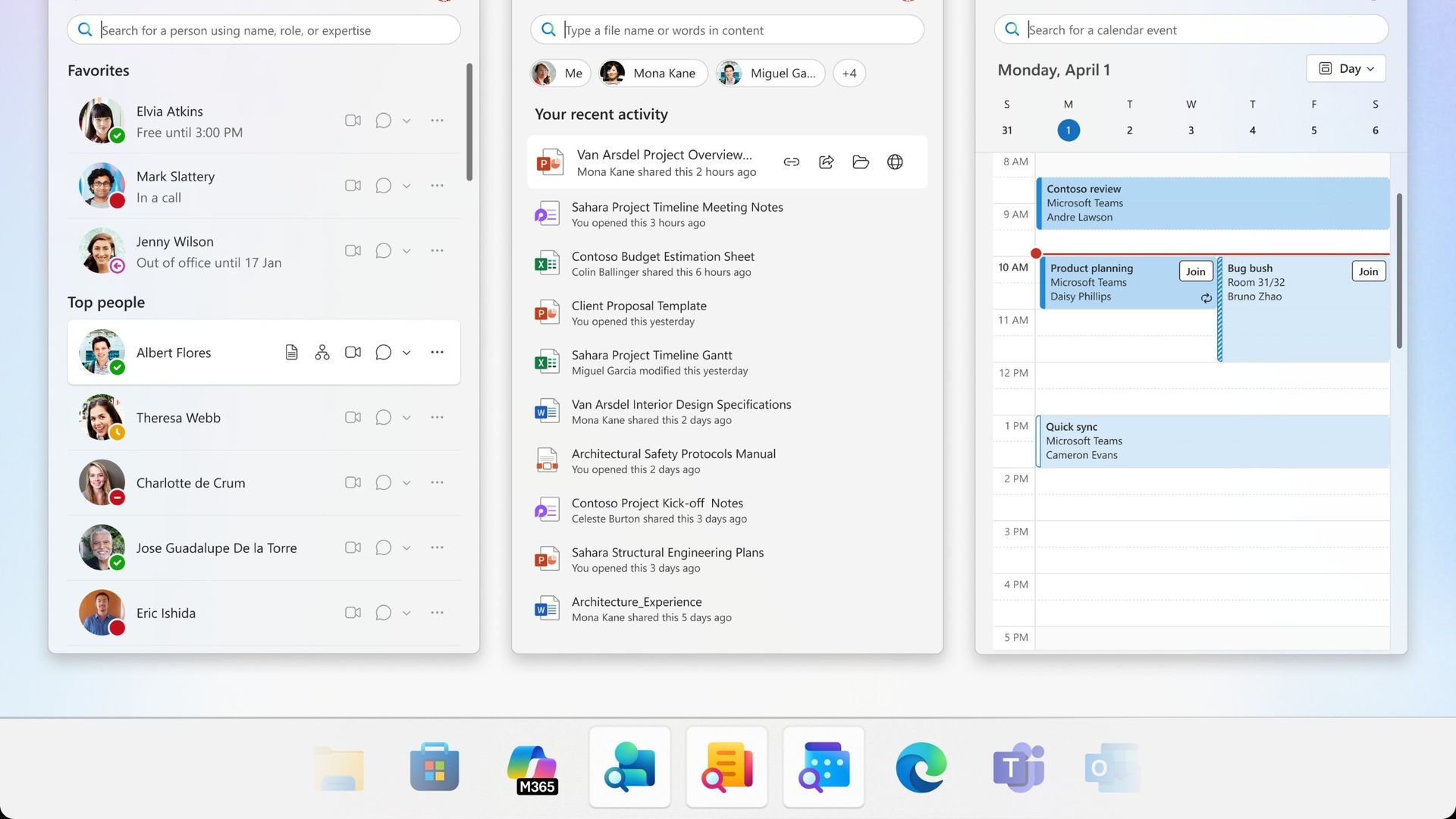
Microsoft plans to get rid of three Microsoft 365 companion apps before the end of the year. Calendar, People, and Files are all on the chopping block and set to be retired on December 16, 2026.
Calendar, People, and Files are apps that integrate with the taskbar on Windows 11 to allow quick access to certain tasks and pieces of information.
I'd forgive you for not knowing about the companion apps since they only shipped last year.
Microsoft outlined the three companion apps at the time and highlighted how the apps "enhance productivity" by providing quick access to information. Now, one year later, that productivity boost is going away.
It's interesting to compare the language Microsoft used to describe the apps when they were new and now as the apps approach retirement.
"Microsoft 365 companions are a suite of apps designed to enhance productivity by providing quick access to people, files, and calendar- powered by the Microsoft Graph, directly from the Windows 11 taskbar."
"The companion apps were an additional way to find calendar information, people, and files. Removing them doesn't delete or affect any existing capabilities or Microsoft 365 data. You can continue finding the same information by using existing Microsoft 365 and Windows experiences."
It appears sometime over the last year the apps devolved from being ways to enhance productivity to additional ways to find information you can get elsewhere.
Microsoft recommends a mix of Outlook, Teams, Windows Search, File Explorer, SharePoint, OneDrive, Word, Excel, PowerPoint, and other Microsoft tools to replace the three companion apps.
The three companion apps will stop working on or before December 16, 2026, so even if you have them installed on your PC, they will not work after the cutoff.
Join us on Reddit at r/WindowsCentral to share your insights and discuss our latest news, reviews, and more.
Switzerland's federal government wants to move away from any reliance on Microsoft 365, as it begins testing alternatives to replace the American-made software suite. It's a recurring theme of European countries pursuing digital sovereignty, as we saw earlier this year when the French government began dropping Windows 10/11 in favor of Linux-based operating system 'distros'.
Rising license costs are also attributed to the Swiss switch, but that isn't much of a new trend. (Image credit: Getty Images | Sunphol Sorakul)
For my money, the most interesting part is the data protection reasoning, as Professor Matthias Stürmer at Bern University of Applied Sciences described his concerns about the implied risk of leaks from a system controlled by foreign governments. Stürmer predictably lists rising license costs as a secondary problem, but it's frontloaded by the move away from America's Microsoft.
We know that foreign governments can access this data — this is available at any time.
Professor Matthias Stürmer, BFH (via RTS)
For now, it's just a trial that could yield unsatisfactory results, ultimately leading the Swiss government to stick with Microsoft 365. Either way, the pilot is apparently expected to move 7% of federal admin staff and their 3,000 workstations to whichever alternative suites are selected, taking private government data with them.
On the other hand, Microsoft's own Sovereign Cloud already focuses on data sovereignty, so it's not as if the company isn't aware of these kinds of concerns. The platform "ensures customer data stays in Europe, under European Law — and encryption is under full control of customers," but that hasn't been enough to convince the governments of Germany, France, and now Switzerland.
Join us on Reddit at r/WindowsCentral to share your insights and discuss our latest news, reviews, and more.
The Microsoft 365 Roadmap is gone. This week, the site was rebranded as the "AI at Work Roadmap." The baffling change raises questions about what's going on at Microsoft and why its leaders think they can label anything as AI.
The roadmap lets you track features and updates to a variety of apps and services from Microsoft. Microsoft justifies the name change by highlighting that the roadmap now includes features from Dynamics 365, Power Platform, and Dataverse as well.
But the AI at Work Roadmap still details plans for thousands of features that have nothing to do with AI.
Neowin's Usama Jawad shared an editorial on Microsoft's latest rebrand already, and I'll echo some of the same thoughts. But some decisions are so astonishingly stupid that they require editorials from multiple outlets.
The name isn't even accurate
The "AI at Work Roadmap" lists hundreds of features that have nothing to do with AI. (Image credit: Getty Images | SOPA Images)
Microsoft is so eager to push AI that its decision makers have not even considered if the new name of the Microsoft 365 Roadmap is accurate. Yes, the roadmap includes AI features across the Microsoft 365 suite. It also now outlines changes to Dynamics 365, Power Platform, and Dataverse.
Microsoft Teams: Coordinated meetings support on Teams Rooms on Android
Outlook: Manage multiple inbox rules at once.
Microsoft Teams: Hide organizer name in the calendar view on Teams Panels and MTR-A
Microsoft Teams: Breakout room support on Teams Rooms on Android
Microsoft Teams: Report a message or an external user for security concerns in Gov clouds.
As far as I can tell, none of those are AI features. Perhaps there's some AI-written code in there or AI working in the background, but I doubt anyone would refer to breakout rooms support as an AI feature.
Microsoft, what are we doing here? Have we reached a point of desperation so extreme that the option to hide an organizer name needs to fall under the AI umbrella? I suppose if every single feature to ever ship to Microsoft 365 is considered AI, that metrics measuring AI use will trend upward.
A history of bad branding
Microsoft rebranded its Office subscription to "Microsoft 365" several years ago. (Image credit: Jennifer Young - Windows Central)
Microsoft already had an established brand name recognized around the world in "Office." But the tech giant decided to rebrand its productivity suite as Microsoft 365. While that decision drew criticism, it at least made sense because Microsoft 365 includes several pieces of software that are not Office apps.
In 2025, Microsoft announced the baffling decision to rebrand Microsoft 365 as "Microsoft 365 Copilot." Our Executive Editor Jez Corden took Microsoft to task for that, and rightly so:
"The rebrand of Microsoft Office was dumb to start with, trampling on a legacy spanning decades. The second rebrand attaching Copilot is even more dumb, and follows the Copilot+ PC thought process of firmly putting the cart several miles before the horse. Copilot hasn't earned the right to be showcased alongside [technological] cultural milestones like Microsoft Excel or Microsoft Word."
Microsoft went on a spree in which it renamed a bunch of services to include some form of Copilot. The company had so many types of Copilots that it had to merge Copilot and Microsoft 365 Copilot.
Microsoft's dumbest rebrand in history just got EVEN dumber. https://t.co/qtzIvgLyfjJanuary 16, 2025
That obsession with Copilot begs another question: If Microsoft needs to rename the Microsoft 365 Roadmap to mention AI, why not call it the Microsoft 365 Copilot Roadmap? I'd still hate the change but at least it would be somewhat consistent.
The idea of slapping "AI" onto anything is still silly, but at least Microsoft would be reusing a name that appears elsewhere.
Join us on Reddit at r/WindowsCentral to share your insights and discuss our latest news, reviews, and more.

 Connexion