Vue lecture

Il y a de nouveaux articles disponibles, cliquez pour rafraîchir la page.

UniFi Dream Machine BEAST – Should You Buy?

Should You Upgrade to the UniFi Dream Machine Beast?

The UniFi Dream Machine Beast arrives as a more serious entry in the Dream Machine range, and that immediately raises the main question: who is it actually for? Existing UniFi users may look at it as a possible upgrade from a UDM Pro, UDM SE, or UDM Pro Max, while new buyers may see it as a way to start with a more capable console from day 1. On paper, it is clearly built for larger and busier networks, but that does not automatically make it the right choice for every UniFi setup. Whether the Dream Machine Beast makes sense depends less on the headline specification and more on the network around it. For some users, it may offer useful headroom for faster internet, heavier security processing, larger Protect installations, or wider UniFi management. For others, it may be more hardware than the deployment can realistically use, especially once the cost of switches, cabling, cameras, access points, and redundancy are taken into account. This article looks at where the Beast is a practical upgrade, where it may be excessive, and what trade-offs should be considered before buying.

UniFi Dream Machine Beast – Should You Buy? (The tl;dr)

The UniFi Dream Machine Beast is best viewed as a higher-capacity UniFi OS console for larger UniFi networks, rather than a default upgrade for every Dream Machine user. Its main advantages are the 8-core Arm v9 processor, 16GB of memory, 10GbE RJ45 ports, 10G SFP+ connectivity, 25G SFP28 support, 25Gbps-class IDS/IPS throughput, support for 750+ managed UniFi devices, 7,500+ concurrent clients, and 2 3.5-inch NVR bays for larger UniFi Protect deployments. These upgrades make it a more suitable option for businesses, multi-site networks, heavier camera installations, faster WAN environments, and users who are starting to outgrow the UDM Pro, UDM SE, or UDM Pro Max. It also makes sense where security inspection, VPN use, traffic analysis, and UniFi application hosting are all expected to run at a larger scale on the same appliance. However, the Beast is not a simple plug-in upgrade for every setup. The $1,499 price, lack of PoE, internal non-removable PSU, and dependency on wider 25GbE infrastructure all make the total cost higher than the unit alone suggests. Users with mostly 1GbE, 2.5GbE, or 10GbE networks may not see enough practical benefit to justify the move, especially if their existing Dream Machine is not close to its limits. In many smaller UniFi deployments, the better use of budget may be a UDM Pro, UDM SE, or UDM Pro Max combined with stronger switches, more access points, improved camera coverage, larger storage, or backup power. The Dream Machine Beast is therefore a strong option for larger and more demanding UniFi environments, but it should be bought with a clear network plan rather than as an automatic upgrade.


BUILD QUALITY - 10/10
HARDWARE - 9/10
PERFORMANCE - 9/10
PRICE - 7/10
VALUE - 8/10


8.6
PROS
👍🏻8-core Arm v9 processor: Gives the Beast more headroom for routing, firewall rules, VPNs, IDS/IPS, DPI, SD-WAN, and UniFi application hosting.
👍🏻25Gbps-class IDS/IPS throughput: A major step up from earlier Dream Machine models, making it better suited to high-speed networks with security inspection enabled.
👍🏻25G SFP28 connectivity: Provides a faster uplink path for aggregation switches, high-speed WAN, NAS systems, and larger network cores.
👍🏻10GbE RJ45 ports as standard: Makes the device more practical for users with existing 10GBASE-T equipment, without relying entirely on SFP modules or adapters.
👍🏻16GB of system memory: Helps the appliance manage heavier UniFi workloads when Network, Protect, VPNs, traffic analysis, and security services are active at the same time.
👍🏻Higher UniFi device and client capacity: Supports 750+ managed UniFi devices and 7,500+ concurrent clients, making it more suitable for larger sites and busy business networks.
👍🏻Larger UniFi Protect capability: Supports up to 100 HD cameras, 60 2K cameras, or 40 4K cameras.
👍🏻Dual 3.5-inch NVR drive bays: Gives Protect users more flexibility for recording capacity or redundancy than a single-drive Dream Machine.
CONS
👎🏻High price compared with other Dream Machines: At $1,499, it costs far more than the UDM Pro, UDM SE, and UDM Pro Max.
👎🏻No built-in PoE: Cameras, access points, phones, and other powered UniFi devices require separate PoE switches or injectors.
👎🏻25GbE can make the wider upgrade expensive: To properly benefit from the Beast’s 25GbE capability, users may also need 25GbE switches, SFP28 modules, DACs, faster servers, or upgraded aggregation links.

Where to Buy

UniFi Dream Machine BEAST (UDM-Beast) –  $1499 HERE 

UniFi Dream Machine Pro Max –$599 HERE 

UniFi Pro XG 24 25Gb & 10Gb L3 Switch- $1099 HERE

Infrastructure-Class CPU for Heavier Routing and Security Workloads

A key hardware change in the UniFi Dream Machine Beast is its move to an 8-core Arm v9 processor running at 2.1GHz. This is a notable step up from the older Dream Machine models, such as the UDM SE, which uses a quad-core Arm Cortex-A57 at 1.7GHz with 4GB of memory. The Beast is built around Arm Neoverse N2 architecture, which Arm describes as its 1st Arm v9 infrastructure CPU, designed for cloud-to-edge workloads with improved performance per watt and a claimed 40% scalar performance uplift over Neoverse N1.

In practical terms, the CPU matters because the gateway is not just passing traffic from 1 port to another. It may also be handling firewall rules, IDS/IPS inspection, VPN traffic, DPI, policy routing, SD-WAN, VLANs, and UniFi application management at the same time. The supplied specification lists IDS/IPS throughput at 24.9Gbps, which is far beyond the 3.5Gbps figure associated with the UDM Pro class. That does not mean every user will need this level of processing headroom, but for larger networks it reduces the chance that security features or encrypted traffic become the main limit before the ports themselves do.

25GbE Uplinks and 10GbE Copper as Standard

The Dream Machine Beast makes a clear jump in physical connectivity compared with the smaller Dream Machine models. Instead of treating 10GbE as the higher-end connection, it uses 10GbE RJ45 as the baseline for its main LAN ports, alongside 10G SFP+ and 25G SFP28 connectivity. This matters because it gives the unit enough port flexibility to sit between faster WAN services, high-speed switches, NAS systems, and larger UniFi deployments without immediately forcing everything through a single 10GbE bottleneck.

The 25G SFP28 port is the more significant part of the design, as it gives the Beast room to aggregate traffic from larger networks rather than simply serve a handful of local devices. For users with multi-gig internet, large camera deployments, heavy internal routing, or multiple downstream switches, this creates a more capable central gateway than the UDM Pro Max. However, the benefit depends heavily on the rest of the network. A 25GbE port only becomes useful when switches, cabling, transceivers, and connected systems can also take advantage of it.

16GB of Memory for Larger UniFi Workloads

The Dream Machine Beast also increases system memory to 16GB, which is a practical upgrade when compared with smaller Dream Machine models. RAM is not as visible as the ports on the front of the unit, but it matters when the console is managing routing, firewall rules, VPNs, IDS/IPS, traffic identification, UniFi Network, UniFi Protect, and other UniFi applications at the same time. More memory gives the system more room to handle these services without the same pressure on resources as deployments grow.

In real terms, this is reflected in the stated management limits. The Beast is rated for 750+ managed UniFi devices and 7,500+ simultaneous connected users, while also supporting larger Protect deployments of up to 100 HD cameras, 60 2K cameras, or 40 4K cameras. Those figures put it in a different class from a typical small office or prosumer Dream Machine setup. The benefit is not just that the Beast can run faster, but that it is better equipped to keep multiple UniFi workloads active at once without becoming constrained as quickly.

Dual Drive Bays Give Protect More Room to Scale

The Dream Machine Beast includes 2 3.5-inch NVR HDD bays, which makes storage a more serious part of the appliance rather than a minor add-on. This is most relevant for UniFi Protect users, because camera recording is where local storage capacity has the biggest day-to-day impact. With support for up to 100 HD cameras, 60 2K cameras, or 40 4K cameras, the Beast is clearly intended to handle larger surveillance deployments than a basic Dream Machine setup.

The 2-bay design also gives users more flexibility than a single-drive console. It allows for higher total recording capacity or a redundant storage configuration, depending on how the system is deployed. The built-in 128GB SSD is separate from this and is used to keep the UniFi OS experience responsive rather than acting as the main video archive. This does not turn the Beast into a dedicated high-bay NVR, but it does make it more practical for sites that want gateway, management, and Protect recording in 1 rackmount device.

The Price Gap Against Other Dream Machines

The main drawback with the Dream Machine Beast is the price. At the quoted $1,499 figure from the launch material, it sits well above the rest of the Dream Machine range. For comparison, the UDM Pro is listed by Ubiquiti’s UK store at £300 before VAT, while the UDM SE is listed at £395 before VAT and the UDM Pro Max at £475 before VAT. Those models are clearly lower in throughput and capacity, but the difference still matters because the Beast is not a small step up in cost.

That makes the buying decision less about whether the Beast is technically better, and more about whether the network will actually use what it offers. A UDM Pro Max already provides 5Gbps IPS routing, 2,000+ client support, 200+ UniFi device support, and 2 NVR drive bays, which is still enough for many UniFi deployments. The Beast makes more sense when the extra routing capacity, larger client count, 25GbE connectivity, and higher Protect ceiling are genuinely required. For smaller sites, the money saved by choosing a lower Dream Machine could be more useful if spent on switches, access points, cameras, or backup power instead.

No PoE Limits Its Use as a Self-Contained Console

The Dream Machine Beast does not include PoE ports, which is a noticeable omission for a device at this price and scale. This does not affect its role as a gateway, firewall, UniFi OS console, or NVR, but it does mean that access points, cameras, door access hardware, phones, and smaller UniFi devices will need power from a separate PoE switch, injector, or other power source. For larger deployments this may not be a major issue, because a dedicated PoE switch would usually be part of the design anyway.

The drawback is more obvious for users upgrading from a Dream Machine model that already includes PoE, such as the UDM SE. Even a small number of PoE ports can be useful for directly powering a nearby access point, test device, camera, or compact downstream switch. On the Beast, the lack of PoE reinforces the idea that it is not intended to be a self-contained all-in-one network box. It is better understood as the central gateway and controller for a wider UniFi installation, rather than a device that can power much of that installation on its own.

Internal Power Supply Makes Hardware Servicing Less Convenient

The Dream Machine Beast uses an internal AC/DC power supply rather than a removable PSU module. It does support DC power backup through UniFi’s RPS system, which gives it a path for power failover when used with the required external hardware. However, this is not the same as having a hot-swappable or easily replaceable PSU built into the unit itself. If the internal supply fails, servicing is likely to be less convenient than it would be on a rackmount device with a standard removable power module.

This matters more because the Beast is aimed at larger and more business-critical UniFi environments. At this level, some buyers may expect either dual onboard PSUs or at least a removable single PSU design for easier replacement and reduced maintenance time. The RPS option helps with continuity, but it also adds another device to the rack and another cost to the overall setup. For users planning around uptime, this is an area where the Beast is functional, but not as service-friendly as some enterprise-style rack hardware.

Be Aware – 25GbE Can Push the Rest of the Network Into a Costly Upgrade Path

The Dream Machine Beast’s 25GbE capability is useful, but it can also change the scale of the upgrade. To take proper advantage of a 25GbE gateway, the rest of the network needs to be able to feed it and receive traffic from it at similar speeds. That usually means 25GbE-capable switches, suitable SFP28 modules or DAC cables, and potentially faster links to servers, NAS systems, or aggregation switches. Without that supporting hardware, the 25GbE port may end up being useful mainly as future headroom rather than something the network benefits from immediately.

This is where the Beast can become more expensive than it first appears. A network built around 2.5GbE or 10GbE copper may not need to move to 25GbE yet, especially if most endpoints are access points, cameras, desktops, or smaller servers. In those cases, a lower-cost Dream Machine paired with better 2.5GbE or 10GbE switching may be the more balanced upgrade. The Beast makes more sense when the wider network is already moving toward 25GbE, or when there is a clear plan to scale into it, rather than when the 25GbE port is the only part of the setup ready for that speed.

Verdict: Highly Capable Hardware, High Scalability, But Not a Universal Upgrade for All

The UniFi Dream Machine Beast is a stronger fit for users who have already reached the limits of the existing Dream Machine models, or who can clearly see those limits approaching. Its faster processor, 16GB of memory, 25GbE connectivity, high IDS/IPS throughput, larger UniFi management capacity, and 2 NVR drive bays all point toward larger networks with heavier traffic, more cameras, more clients, or more demanding security features. In that context, it is not simply a faster UDM Pro Max. It is a more substantial gateway and UniFi OS console for deployments that need more headroom.

For everyone else, the value is less clear. The higher price, lack of PoE, internal non-removable PSU, and likely need for wider 25GbE infrastructure all make it a device that should be bought with a specific network plan in mind. Users running smaller UniFi systems, mostly 1GbE to 10GbE networks, or modest Protect installations may get better value from a UDM Pro, UDM SE, or UDM Pro Max with money left for switches, access points, storage, or backup power. The Beast is best judged as a targeted upgrade for larger UniFi environments, not as the default Dream Machine for every buyer.

Where to Buy

UniFi Dream Machine BEAST (UDM-Beast) –  $1499 HERE 

UniFi Dream Machine Pro Max –$599 HERE 

UniFi Pro XG 24 25Gb & 10Gb L3 Switch- $1099 HERE


📧 SUBSCRIBE TO OUR NEWSLETTER 🔔
[contact-form-7]
🔒 Join Inner Circle


Get an alert every time something gets added to this specific article!


Want to follow specific category? 📧 Subscribe

This description contains links to Amazon. These links will take you to some of the products mentioned in today's content. As an Amazon Associate, I earn from qualifying purchases. Visit the NASCompares Deal Finder to find the best place to buy this device in your region, based on Service, Support and Reputation - Just Search for your NAS Drive in the Box Below

Need Advice on Data Storage from an Expert?

Finally, for free advice about your setup, just leave a message in the comments below here at NASCompares.com and we will get back to you. Need Help? Where possible (and where appropriate) please provide as much information about your requirements, as then I can arrange the best answer and solution to your needs. Do not worry about your e-mail address being required, it will NOT be used in a mailing list and will NOT be used in any way other than to respond to your enquiry. [contact-form-7] TRY CHAT Terms and Conditions

If you like this service, please consider supporting us. We use affiliate links on the blog allowing NAScompares information and advice service to be free of charge to you.Anything you purchase on the day you click on our links will generate a small commission which isused to run the website. Here is a link for Amazon and B&H.You can also get me a ☕ Ko-fi or old school Paypal. Thanks!To find out more about how to support this advice service check HEREIf you need to fix or configure a NAS, check Fiver Have you thought about helping others with your knowledge? Find Instructions Here  

 
Or support us by using our affiliate links on Amazon UK and Amazon US
    
 
Alternatively, why not ask me on the ASK NASCompares forum, by clicking the button below. This is a community hub that serves as a place that I can answer your question, chew the fat, share new release information and even get corrections posted. I will always get around to answering ALL queries, but as a one-man operation, I cannot promise speed! So by sharing your query in the ASK NASCompares section below, you can get a better range of solutions and suggestions, alongside my own.

☕ WE LOVE COFFEE ☕


QNAP QSW-L2110 : une montée en gamme plus qu’appéciable

QNAP QSW L2110 - QNAP QSW-L2110 : une montée en gamme plus qu'appéciable

QNAP annonce le lancement d’une nouvelle gamme de switches : QSW-L2110. Derrière ce nom se cachent des produits destinés aussi bien aux professionnels qu’aux particuliers exigeants. Les modèles QSW-L2110-2S8T et QSW-L2110-10T sont administrables et s’inscrivent dans une tendance de fond : démocratiser le Multi-Gig sans se ruiner. Les prix démarrent à partir de 139 €.

QNAP QSW L2110 - QNAP QSW-L2110 : une montée en gamme plus qu'appéciable

QSW-L2110-2S8T et QSW-L2110-10T : le Multi-Gig accessible

QSW L2110 2S8T 2026 - QNAP QSW-L2110 : une montée en gamme plus qu'appéciable
QSW-L2110-2S8T

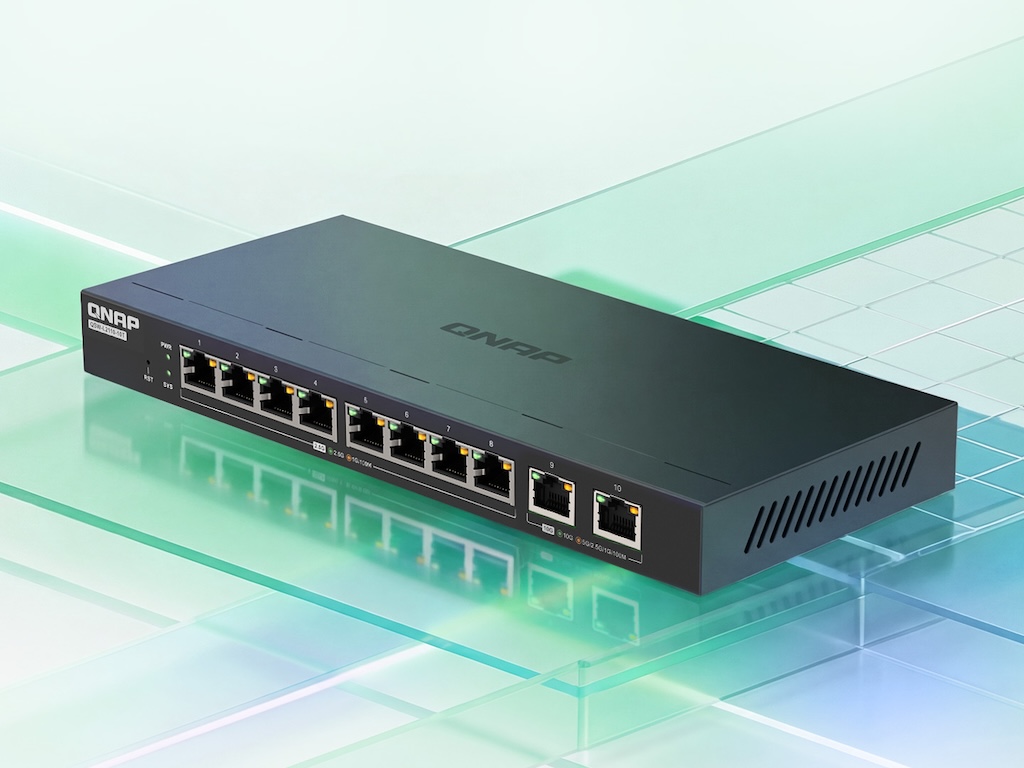
Le QSW-L2110-2S8T dispose 8 ports 2,5 Gb/s RJ45 et 2 ports 10 Gb/s SFP+, ce qui permet de structurer un réseau hybride performant. Cette configuration est plutôt pertinente pour raccorder des NAS, des switches cœur de réseau ou encore un routeur compatible.

QSW L2110 10T 2026 - QNAP QSW-L2110 : une montée en gamme plus qu'appéciable
QSW-L2110-10T

De son côté, le QSW-L2110-10T mise sur une approche full RJ45 avec 8 ports 2,5 Gb/s et 2 ports 10 Gb/s. Une solution adaptée aux infrastructures existantes câblées en RJ45, qui simplifie les déploiements et limite les coûts d’installation.

Dans les 2 cas, le gain de performance par rapport au gigabit traditionnel est réel et immédiatement : transferts de fichiers volumineux, virtualisation, production vidéo, etc. Il est important de noter que ces nouveaux produits sont sans ventilateur. Ils pourront donc être installés facilement, y compris sur un bureau.

Gestion simplifiée, mais suffisante

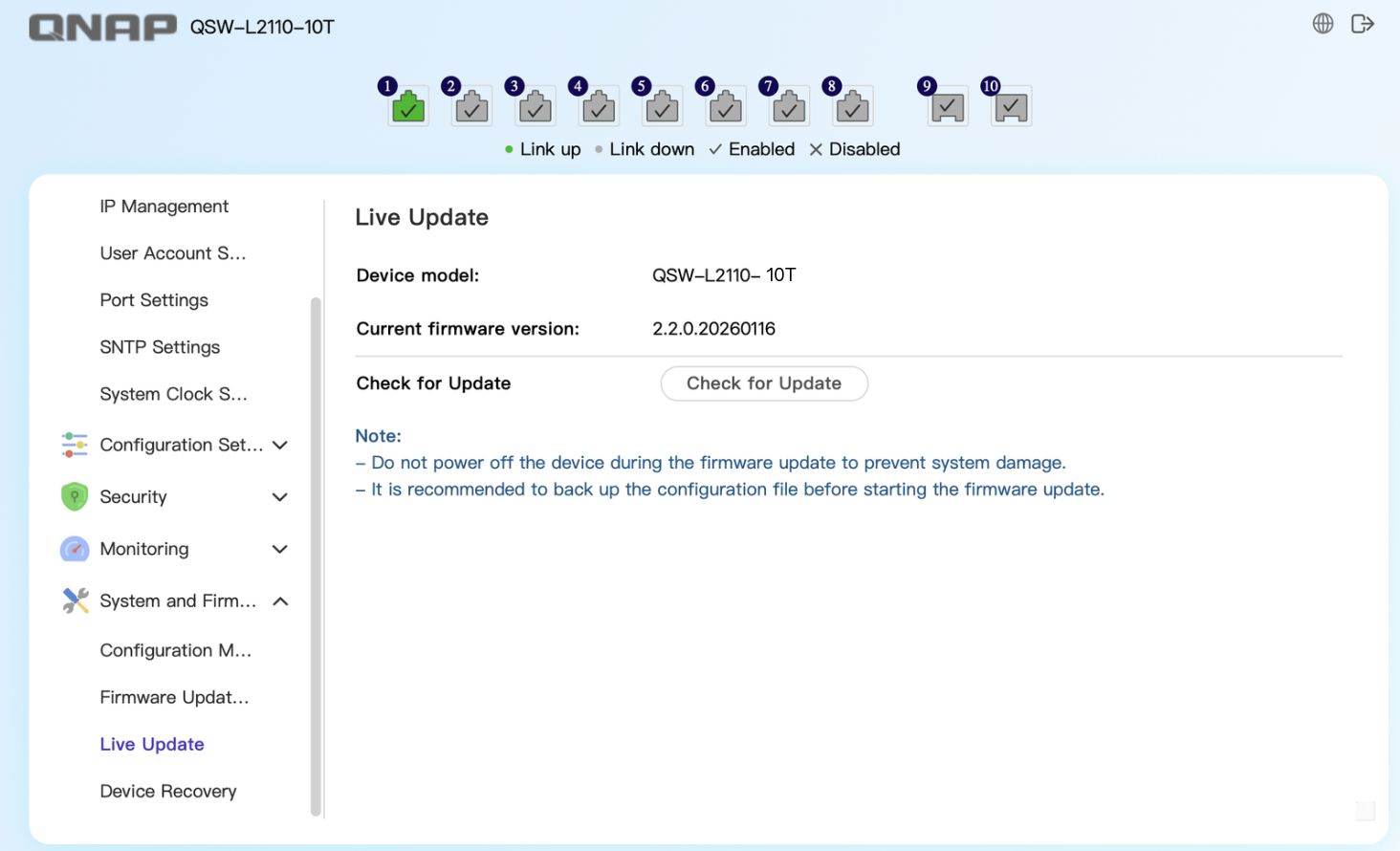
Les 2 switches s’appuient sur le système QSS (QNAP Switch System), déjà bien connu sur d’autres équipements de la marque. Depuis l’interface Web, on retrouve les fonctions essentielles de niveau 2 : VLAN, QoS, agrégation de liens (LACP), etc.

QSS lite - QNAP QSW-L2110 : une montée en gamme plus qu'appéciable

On reste sur une gestion allégée par rapport aux modèles plus haut de gamme… mais cela reste largement suffisant pour la majorité des usages. C’est totalement assumé et cohérent au regard du positionnement tarifaire.

Monter en débit sans tout reconstruire

L’atout majeur de la gamme QSW-L2110, c’est sa capacité à moderniser son infrastructure existante sans repartir de zéro. Le support du 2,5 Gb/s est compatible avec du câblage Cat 5e, ce qui évite de refaire son installation… Les ports 10 Gb/s du modèle apportent une couche de scalabilité supplémentaire, idéale pour connecter un NAS performant, consolider un réseau…

En synthèse

QNAP propose une solution cohérente pour les petites structures et les particuliers exigeants. Ces nouveaux produits permettent de passer au Multi-Gig sans se heurter à une complexité inutile… et cerise sur le gâteau, ils sont administrable via QSS. C’est plutôt rare pour ce type de produits.

Ces nouveaux modèles devraient arriver d’ici quelques jours. Côté tarif, le fabricant annonce :

  • QSW-L2110-2S8T : 139€ HT
  • QSW-L2110-10T : 189€ HT

L’équilibre entre performances, simplicité de gestion et rapport qualité/prix est bien maîtrisé. Difficile de trouver à redire sur le positionnement.

TerraMaster D1 SSD Rugged Enclosure Launched

Terramaster D1 SSD (IP67 Waterproof & 1.2-Ton Crush Resistance and Silent)

April 28, 2026 | The Professional storage brand TerraMaster today officially introduces the all-new rugged portable SSD enclosure — D1 SSD. Designed for users who demand both data security and high-speed performance, the D1 SSD features an aircraft-grade all-metal chassis, IP67 water and dust resistance, and 1.2-ton crush resistance. Combined with high-speed data transfer, silent cooling, and broad platform compatibility, it becomes an ideal storage companion for photographers, outdoor professionals, and mobile workers.

Buy from Terramaster Official Site:

Buy from Your Local Amazon:

Specification TerraMaster D1 SSD
Drive Bays 1
Supported SSD Type PCIe 3.0/4.0/5.0 M.2 2280 NVMe SSD
Maximum Capacity 8TB
Interface USB 10Gbps
Max Read Speed 1020MB/s
Max Write Speed 1010MB/s
File Systems NTFS, APFS, Mac OS, FAT32, EXT4, exFAT
Supported OS Windows, macOS, Linux
Ingress Protection IP67
Cooling Fanless passive cooling
Noise Level Noiseless
Power Consumption 3.2W read/write, 0.2W hibernation
Dimensions 113.6 x 45.0 x 21.0mm
Net Weight 146g
Warranty 2 years

Three Layers of Protection Build an Unbreakable Data Shield

  1. Solid All-Metal Chassis for High-Intensity Work Environments

 The D1 SSD adopts a unibody aircraft-grade aluminum alloy construction. The full-metal enclosure offers excellent scratch resistance and corrosion protection, making it well-suited for long-term, heavy-duty usage. Whether facing extreme temperature differences outdoors or constant wear from mobile work, the enclosure ensures stable operation, extended lifespan, and reliable storage performance for professional users.

  1. IP67 Water & Dust Resistance for Harsh Conditions

 Equipped with precision silicone sealing rings, the D1 SSD meets IP67 certification standards. It can withstand submersion in up to 1 meter of water for 30 minutes and is fully protected against dust and splashes. From rainy outdoor shoots and desert environments to construction sites, the enclosure safeguards both the SSD and your data. Protection performance is verified by internationally recognized testing organizations such as SGS.

  1. 1.2-Ton Crush Resistance with Shock & Drop Protection

 The aircraft-grade aluminum unibody structure enables the enclosure to withstand up to 1.2 tons of vehicle-level pressure. Its dedicated shock-resistant internal design absorbs impacts from drops and collisions during daily use. Even under extreme external force, internal drives and data remain fully protected—eliminating the fragility issues of ordinary enclosures.

High-Speed Performance with Silent Operation and Broad Compatibility

 The D1 SSD features a USB 3.2 Gen2 interface, supports UASP protocol and TRIM optimization, and delivers real-world sequential read/write speeds of up to 1020 MB/s. Transferring a 1GB file takes just seconds, making it ideal for 4K video editing and large photo backups. The all-metal housing provides 2.5× larger heat dissipation area, while the fanless passive cooling design ensures completely silent operation.

 The enclosure supports up to 8TB single-drive capacity and is compatible with M.2 2280 NVMe SSDs based on PCIe 3.0 / 4.0 / 5.0 standards. It can store up to 2.79 million high-resolution photos or 5,400 HD movies. Compatible with Windows, macOS, and Linux, it also connects to computers, TVs, and OTG-enabled smartphones for true plug-and-play use.

Additionally, the D1 SSD supports one-touch photo backup via the TerraMaster TDAS mobile app. Once connected, photos are automatically synchronized from your smartphone, with data stored locally to prevent privacy leakage and enable efficient cross-device file management.

 Designed for Multiple Usage Scenarios:

  • Photographers & Outdoor Professionals

Rugged protection handles complex environments, enabling fast backups and eliminating data loss risks. Ideal for field exploration, construction sites, and harsh outdoor conditions.

  • Mobile Professionals & Students

Ultra-lightweight at only 146g, pocket-sized design, and instant file transfer create a portable “light office” anywhere.

  • General Users & Mac Professionals

Perfect as an external expansion drive or boot drive—quiet, stable, and plug-and-play.

Availability & Service

The TerraMaster D1 SSD is now officially available through the TerraMaster website (https://www.terra-master.com/) and authorized global channels. Customers who purchase within the first two weeks of launch can enjoy a 15% discount. The product is backed by a two-year global warranty and lifetime technical support for a worry-free user experience.

Interested in the D1 SSD, or want to know more about the rest of the D1 SSD Range, below are the specs and prices for the D1 SSD (10Gb/s), D1 SSD PLUS (40Gb/s) and D1 SSD Pro (80Gb/s):

Specification TerraMaster D1 SSD TerraMaster D1 SSD Plus TerraMaster D1 SSD Pro
Interface USB 10Gbps USB4 40Gbps USB 80Gbps / Thunderbolt 5 class
Claimed Max Read 1020MB/s 3641MB/s specification, 3853MB/s listed in testing 7061MB/s
Claimed Max Write 1010MB/s 3498MB/s specification, 3707MB/s listed in testing 6816MB/s
SSD Support PCIe 3.0/4.0/5.0 M.2 2280 NVMe PCIe 3.0/4.0/5.0 M.2 2280 NVMe PCIe 3.0/4.0/5.0 M.2 2280 NVMe
Max Capacity 8TB 8TB 8TB
Cooling Fanless aluminum passive cooling Fanless aluminum passive cooling Fanless aluminum body with finned passive cooling
Protection / Build IP67, dustproof, waterproof, crush-resistant up to 1.2 tons All-metal unibody chassis, short circuit, surge, and ESD protection All-aluminum dual-fin design, smart status indicator, short circuit, surge, and ESD protection
Price Listed $33.99 (15% OFF $39.99) $76.99 (30% OFF $109.99) $199.99 (20% OFF $199.99)

📧 SUBSCRIBE TO OUR NEWSLETTER 🔔
[contact-form-7]
🔒 Join Inner Circle

Get an alert every time something gets added to this specific article!


Want to follow specific category? 📧 Subscribe

This description contains links to Amazon. These links will take you to some of the products mentioned in today's content. As an Amazon Associate, I earn from qualifying purchases. Visit the NASCompares Deal Finder to find the best place to buy this device in your region, based on Service, Support and Reputation - Just Search for your NAS Drive in the Box Below

Need Advice on Data Storage from an Expert?

Finally, for free advice about your setup, just leave a message in the comments below here at NASCompares.com and we will get back to you. Need Help? Where possible (and where appropriate) please provide as much information about your requirements, as then I can arrange the best answer and solution to your needs. Do not worry about your e-mail address being required, it will NOT be used in a mailing list and will NOT be used in any way other than to respond to your enquiry. [contact-form-7] TRY CHAT Terms and Conditions
If you like this service, please consider supporting us. We use affiliate links on the blog allowing NAScompares information and advice service to be free of charge to you.Anything you purchase on the day you click on our links will generate a small commission which isused to run the website. Here is a link for Amazon and B&H.You can also get me a ☕ Ko-fi or old school Paypal. Thanks!To find out more about how to support this advice service check HEREIf you need to fix or configure a NAS, check Fiver Have you thought about helping others with your knowledge? Find Instructions Here  

 
Or support us by using our affiliate links on Amazon UK and Amazon US
    
 
Alternatively, why not ask me on the ASK NASCompares forum, by clicking the button below. This is a community hub that serves as a place that I can answer your question, chew the fat, share new release information and even get corrections posted. I will always get around to answering ALL queries, but as a one-man operation, I cannot promise speed! So by sharing your query in the ASK NASCompares section below, you can get a better range of solutions and suggestions, alongside my own.

☕ WE LOVE COFFEE ☕


Interview Chad CHIANG, directeur général de Synology France…

Chad Chiang Synology France - Interview Chad CHIANG, directeur général de Synology France...

Aujourd’hui nous recevons sur Cachem, Chad CHIANG, Directeur Général de Synology France. Il a pris ses fonctions en janvier de cette année au siège de Paris La Défense et supervise la France, le Benelux, l’Europe du Sud et l’Afrique.

Chad Chiang Synology France - Interview Chad CHIANG, directeur général de Synology France...

Cachem : Bonjour Chad, merci de prendre quelques minutes pour répondre à nos questions. Vous arrivez dans un contexte un peu particulier pour Synology. Comment abordez-vous cette prise de fonction ?

Chad : J’aborde cette mission avec la volonté de donner la priorité à l’écoute. Prendre mes fonctions de directeur général pour l’Europe implique de trouver un équilibre entre les attentes élevées d’une base d’utilisateurs très avertis en matière de technologie et notre expansion rapide dans le secteur B2B. Mon objectif est de veiller à ce que, malgré notre croissance, nous ne perdions pas « l’ADN de Synology », cette alliance parfaite entre un matériel abordable et des logiciels intuitifs.

Cachem : Les équipes en France continuent de grandir. Pouvez-vous nous en dire plus ?

Chad : La France est l’un de nos marchés les plus dynamiques. Nous renforçons significativement notre présence locale à Paris afin d’offrir un meilleur support technique et un accompagnement dédié à nos partenaires entreprises. La croissance ne se limite pas aux ventes : il s’agit aussi d’avoir des experts sur le terrain capables d’accompagner une PME française comme une grande institution dans la définition de leur stratégie de résilience des données.

Cachem : Synology reste un acteur majeur du NAS, mais certains utilisateurs évoquent une forme de stagnation ces dernières années, tant sur le matériel que sur DSM. Partagez-vous ce constat ?

Chad : Je comprends cette perception, mais je ne pense pas que nous soyons à l’arrêt. Notre priorité a évolué : nous sommes passés d’une logique de “spécifications pour le simple plaisir de spécifications” à un focus sur la stabilité et la fiabilité des systèmes. Dans l’univers des NAS, être “ennuyeux” est souvent une qualité : cela signifie que vos données sont en sécurité. Cela dit, nous continuons d’innover, notamment sur les volumes NVMe et les réseaux à haut débit sur une plus large gamme de produits.

Cachem : Justement, parlons d’un sujet qui a fait beaucoup réagir en 2025 : la politique autour des disques durs et SSD. Synology a d’abord imposé ses propres disques sur les modèles Plus, avant de faire partiellement machine arrière avec DSM 7.3. Beaucoup d’utilisateurs ont parlé d’un écosystème fermé, voire d’un “DRM matériel”. Que s’est-il passé ?

Chad : L’objectif était, et reste, de garantir un niveau maximal de disponibilité et de fiabilité en utilisant des disques dont le firmware est validé par nos équipes. Cela dit, nous avons bien entendu les retours de la communauté. Avec DSM 7.3 sorti en octobre dernier, nous avons réintroduit plus de flexibilité. Notre intention n’est pas d’enfermer les utilisateurs, mais de proposer une offre “sans compromis” pour ceux qui ont besoin d’une fiabilité 24/7. Pour les autres, l’écosystème reste ouvert. Nous apprécions les retours de la communauté, et c’est une bonne leçon pour nous.

Cachem : Plus globalement, ce changement de cap a pu fragiliser la confiance des utilisateurs historiques, qui appréciaient justement la flexibilité de Synology. Comment comptez-vous la regagner ?

Chad : La confiance se regagne par la transparence et la performance. Nous réaffirmons notre engagement envers le segment “prosumer”. Cela se traduira dans nos prochaines évolutions matérielles et logicielles, en prenant en compte les retours sur des éléments comme les ports 2.5GbE ou la mémoire extensible. Nous voulons démontrer qu’il n’est pas nécessaire de choisir entre un outil professionnel et un système flexible.

Cachem : Autre sujet : les routeurs. Synology avait suscité beaucoup d’intérêt avec sa gamme RT, mais depuis plusieurs années, les évolutions sont quasi inexistantes. Le segment est-il toujours stratégique ? Certains utilisateurs ont le sentiment d’un abandon progressif face à une concurrence très dynamique… Peut-on attendre du nouveau à court terme ?

Chad : La plateforme SRM (Synology Router Manager) n’est pas abandonnée. La concurrence est forte, mais notre force réside dans la sécurité et la gestion des VPN. Nous ne sortons pas cinq routeurs par an, car nous voulons que ceux que nous lançons restent pertinents pendant plusieurs années. Nous continuons également à publier des mises à jour régulières et la dernière date de février 2026. https://www.synology.com/fr-fr/releaseNote/SRM

Cachem : Parlons maintenant de DSM. La version 7.3 a apporté des ajustements, mais reste relativement modeste en termes de nouveautés. Où en est DSM 8 ? Peut-on s’attendre à une vraie rupture ou simplement à une continuité de DSM 7 ?

Chad : Si DSM 7.x était axé sur le perfectionnement et l’hybridation avec le cloud (C2), la prochaine version marquera une avancée majeure avec l’intégration de l’IA dans la gestion. Nous travaillons sur des systèmes capables de s’auto-optimiser et sur une déduplication des données plus intelligente. L’objectif est clair : rendre le NAS plus autonome et réduire les interventions manuelles.

Cachem : Synology s’est fortement orienté vers les entreprises. Quels sont vos avantages face à des acteurs comme Dell EMC ou NetApp ?

Chad : Notre principal avantage réside dans le coût total de possession (TCO) et la simplicité d’utilisation. Il n’est pas nécessaire de suivre une formation spécialisée pendant une semaine pour gérer un cluster Synology. Nous proposons des fonctionnalités de niveau entreprise (snapshots, réplication, sauvegarde, etc) sans les coûts de licences élevés souvent pratiqués par nos concurrents.

Cachem : Synology développe également ses activités dans la vidéosurveillance. Où en êtes-vous aujourd’hui ?

Chad : La vidéosurveillance est l’un de nos piliers de croissance les plus rapides. En intégrant nos propres caméras Synology à Surveillance Station, nous avons mis au point une solution d’analyse avec IA prête à l’emploi. Nous ne sommes plus seulement un espace de stockage de vidéos ; nous sommes désormais une plateforme qui les analyse en temps réel pour fournir des informations concrètes en matière de sécurité.

Cachem : Le BeeDrive avait surpris lors de son lancement. La frontière entre le BeeDrive (version Plus) et un NAS est assez étroite. Quelle est sa place aujourd’hui ?

Chad : BeeDrive est une porte d’entrée vers l’écosystème Synology. Il s’adresse aux particuliers ou aux créatifs sans expertise IT, qui trouvent le NAS encore trop complexe mais qui ont dépassé les limites du stockage cloud classique. Il ne remplace pas le cloud, il le complète en apportant un stockage local, intelligent et rapide.

Exemple ici : https://www.youtube.com/watch?v=cSRtD0KQWmE

Cachem : Cet interview touche à sa fin, souhaitez-vous adresser un dernier mot à nos lecteurs ?

Chad : Aux lecteurs de Cachem et à la communauté tech française : merci d’être nos critiques les plus exigeants. Vos retours nous empêchent de devenir un acteur figé. Nous entrons dans une ère où la souveraineté des données est plus importante que jamais, et Synology s’engage à vous redonner le contrôle, que vous soyez freelance ou une grande entreprise du CAC 40. Synology ne propose pas seulement des produits, mais une véritable alternative de confiance sur le marché.

New Thunderbolt 5 NVMe Storage Solution Revealed – The OWC 4M2 Ultra

New Thunderbolt 5 NVMe Storage Solution Revealed – The OWC 4M2 Ultra

OWC has introduced the Express 4M2 Ultra at NAB 2026 as a compact 4 bay NVMe enclosure built around Thunderbolt 5. It is designed as a DIY storage solution for users who want to install their own M.2 SSDs and configure the enclosure for different RAID modes, including RAID 0, 1, 4, 5, 10, and JBOD. OWC positions it as a high performance option for media production, post production, and other bandwidth intensive workloads that benefit from fast external solid state storage.

The enclosure supports up to 4 NVMe M.2 drives in 2280 or 2242 formats and is rated for up to 6622MB/s in RAID 0 when paired with PCIe 4.0 or newer SSDs on Thunderbolt 5 systems. It also retains backward compatibility with Thunderbolt 4, Thunderbolt 3 on Mac, and USB4 hosts, though throughput is lower on 40Gb/s connections. Capacity starts with whatever drives the user installs, with support for up to 32TB in a single unit based on current 8TB SSD support, while additional units can be daisy chained for larger storage pools.

Specification OWC Express 4M2 Ultra
Product type External DIY NVMe RAID enclosure
Drive bays 4 x M.2 SSD
Supported drive sizes M.2 2280, M.2 2242
Drive type NVMe SSD, PCIe Gen 3 and later
Max stated speed Up to 6622MB/s
Host interface Thunderbolt 5
Secondary compatibility Thunderbolt 4, Thunderbolt 3 on Mac, USB4
RAID modes RAID 0, 1, 4, 5, 10, JBOD
Max stated capacity per unit 32TB
Daisy chain expansion Up to 128TB as stated with multiple units
Cooling 40mm adaptive fan
Material Aluminum
Price Starts at $399.99
Availability Pre-order now, ships Q3 2026

OWC Express 4M2 Ultra – Design & Storage

The Express 4M2 Ultra uses a compact aluminum enclosure with a vertical desktop form factor intended to keep its footprint relatively small. OWC states that the chassis is built from aircraft grade aluminum, which serves both as the structural housing and as part of the thermal design. The unit measures 12.3 cm tall, 11.7 cm long, and 6.0 cm wide, with a listed weight of 900 g.

Internally, the enclosure provides 4 drive bays for NVMe M.2 SSDs and supports both 2280 and 2242 form factors. It accepts single sided and double sided drives, though SSDs with integrated heatsinks are not supported. OWC specifies support for PCIe Gen 3 and later SSDs, with Gen 4 and newer drives recommended for higher performance. Each bay operates at PCIe 4.0 x1, and single drive performance is rated at up to 1600MB/s.

From a storage flexibility standpoint, the enclosure is aimed at users who prefer to source and install their own drives rather than buy a preconfigured array. That allows the capacity and performance profile to vary depending on the SSDs installed. With current 8TB drives, the maximum listed capacity is 32TB in a single enclosure, while future higher capacity drives could increase that figure without requiring a new chassis.

RAID support is handled in software rather than through a dedicated hardware RAID controller. The Express 4M2 Ultra supports RAID 0, 1, 4, 5, 10, and JBOD, with OWC highlighting SoftRAID as its main management option. This gives users a wider range of configuration choices depending on whether they prioritize throughput, redundancy, usable capacity, or a balance between those factors.

Thermal management is handled by a 40mm cooling fan with multiple speed thresholds tied to internal temperature. According to OWC’s listed profile, the fan remains off below 35°C, then ramps progressively from 40% to 100% as temperatures rise from 35°C to 55°C and above. The stated approach is to reduce unnecessary noise under lighter workloads while maintaining SSD performance during sustained transfers.

OWC Express 4M2 Ultra – Ports and Connections

The Express 4M2 Ultra uses Thunderbolt 5 as its primary host interface, with 1 USB C host port rated for up to 80Gb/s. OWC also lists support for USB Attached SCSI Protocol, and the enclosure is designed to work across Thunderbolt 5, Thunderbolt 4, USB4, and Thunderbolt 3 on supported Mac systems. In practice, that gives it a broader compatibility range than a Thunderbolt 5 only accessory, though maximum throughput depends on the bandwidth available from the connected system.

A second Thunderbolt 5 port is included for downstream connectivity. OWC states that this allows users to daisy chain up to 5 additional Thunderbolt devices, along with 1 USB peripheral, from the same connection path. The same port can also be used to connect additional Express 4M2 Ultra units, with OWC positioning that as a way to build larger storage volumes without treating each enclosure as an entirely separate destination.

Compatibility varies by platform and interface generation. On newer Thunderbolt 5 Macs and PCs, OWC rates the enclosure at up to 6622MB/s, while Thunderbolt 4 and USB4 systems are listed at up to 3200MB/s. Intel Macs with Thunderbolt 3 are rated up to 2800MB/s, and OWC notes that Thunderbolt 3 support is Mac only. No driver is required, and the enclosure is listed as compatible with macOS 14.x Sonoma, macOS 15.x Sequoia, macOS 26.x Tahoe, Windows 11, and Linux, with some features depending on OS version and connection type.

OWC Express 4M2 Ultra – Price and Release date

OWC has set the starting price of the Express 4M2 Ultra at $399.99 for the standard non SoftRAID version. A version bundled with SoftRAID is priced at $549.99. As a result, the enclosure enters the market as a premium DIY storage option rather than a low cost external SSD enclosure, with the final overall build cost depending heavily on the NVMe drives a buyer installs.

The company says the Express 4M2 Ultra is available for pre order now following its reveal at NAB 2026 in Las Vegas. OWC lists shipping for Q3 2026, so early buyers will still be waiting several months for general availability. That places the launch window firmly in the second half of the year, even though orders have already opened.

📧 SUBSCRIBE TO OUR NEWSLETTER 🔔
[contact-form-7]
🔒 Join Inner Circle

Get an alert every time something gets added to this specific article!


Want to follow specific category? 📧 Subscribe

This description contains links to Amazon. These links will take you to some of the products mentioned in today's content. As an Amazon Associate, I earn from qualifying purchases. Visit the NASCompares Deal Finder to find the best place to buy this device in your region, based on Service, Support and Reputation - Just Search for your NAS Drive in the Box Below

Need Advice on Data Storage from an Expert?

Finally, for free advice about your setup, just leave a message in the comments below here at NASCompares.com and we will get back to you. Need Help? Where possible (and where appropriate) please provide as much information about your requirements, as then I can arrange the best answer and solution to your needs. Do not worry about your e-mail address being required, it will NOT be used in a mailing list and will NOT be used in any way other than to respond to your enquiry. [contact-form-7] TRY CHAT Terms and Conditions
If you like this service, please consider supporting us. We use affiliate links on the blog allowing NAScompares information and advice service to be free of charge to you.Anything you purchase on the day you click on our links will generate a small commission which isused to run the website. Here is a link for Amazon and B&H.You can also get me a ☕ Ko-fi or old school Paypal. Thanks!To find out more about how to support this advice service check HEREIf you need to fix or configure a NAS, check Fiver Have you thought about helping others with your knowledge? Find Instructions Here  
 
Or support us by using our affiliate links on Amazon UK and Amazon US
    
 
Alternatively, why not ask me on the ASK NASCompares forum, by clicking the button below. This is a community hub that serves as a place that I can answer your question, chew the fat, share new release information and even get corrections posted. I will always get around to answering ALL queries, but as a one-man operation, I cannot promise speed! So by sharing your query in the ASK NASCompares section below, you can get a better range of solutions and suggestions, alongside my own.

☕ WE LOVE COFFEE ☕


Accès NAS à distance : comparatif des 5 meilleures solutions (VPN, DDNS, Cloudflare…)

acces nas distant - Accès NAS à distance : comparatif des 5 meilleures solutions (VPN, DDNS, Cloudflare…)

Accéder à son NAS depuis l’extérieur n’a rien de compliqué… mais toutes les méthodes ne se valent pas. Certaines privilégient la simplicité, d’autres la sécurité ou les performances. Si vous possédez un NAS, vous vous êtes probablement déjà demandé quelles solutions existent et quelles sont leurs différences. Voici un rapide tour d’horizon, avec les bonnes pratiques à connaître 😉

acces nas distant - Accès NAS à distance : comparatif des 5 meilleures solutions (VPN, DDNS, Cloudflare…)

Accès à distance

Quand on possède un NAS, on devient vite exigeant en matière de sécurité. Pendant longtemps, il était strictement impossible d’accéder à mon NAS depuis l’extérieur. Et puis, les usages ont changé, les enfants ont grandi… nos besoins ne sont plus les mêmes.

La question n’est donc plus “faut-il y accéder ?” mais plutôt “comment le faire correctement ?”

Accès facile des constructeurs

Les fabricants de NAS proposent des solutions clés en main, très simples à configurer. Chacun propose son propre service de type Cloud Relay.

Service Accès
Synology QuickConnect quickconnect.to/mon-id
QNAP myQNAPcloud Link qlink.to/mon-id
ASUSTOR EZ-Connect mon-id.ezconnect.to
UGREEN UGREENlink ug.link/mon-id
TerraMaster TNAS.online tnas.online/mon-id

L’activation se fait généralement en un clic, sans configuration réseau ni redirection de port. Ces services fonctionnent via un serveur relais hébergé par le fabricant. Cela signifie que vos données transitent par une infrastructure tierce. Même si elles sont chiffrées, cela implique une dépendance à l’écosystème du fabricant… et des performances souvent en retrait.

Sa simplicité extrême pousse de nombreux utilisateurs à l’activer sans en mesurer les implications, d’autant que certains fabricants la proposent dès le premier démarrage. C’est tellement simple que personnellement, je trouve cela dangereux.

DDNS

Le DDNS (Dynamic DNS) permet d’associer une adresse IP publique (celle de votre Box qui change régulièrement) à un nom de domaine fixe.  Vous pouvez acheter un domaine (.fr, .com, .eu…) pour quelques euros par an chez un registrar comme OVH ou Cloudflare, ou opter pour un sous-domaine gratuit via des services tiers tels que ChangeIP, FreeDNS, ou ceux proposés directement par les fabricants de NAS. Dans ce dernier cas, vous n’aurez pas la maîtrise totale du nom de domaine.

Cette méthode nécessite une redirection de port sur votre routeur. Il est également possible d’intégrer un reverse proxy (directement sur le NAS ou sur un autre équipement) pour gérer proprement un domaine et ses sous-domaines avec HTTPS.

VPN auto-hébergé

Héberger son propre serveur VPN est la solution offrant le meilleur rapport sécurité/contrôle. Le VPN constitue une porte d’entrée chiffrée vers votre réseau domestique. Pour accéder au NAS, vous devez d’abord vous authentifier via ce tunnel sécurisé… vous êtes connectés ensuite comme si vous étiez en local.

Le serveur VPN peut être installé sur :

  • Votre Box ou routeur ;
  • Un appareil dédié comme un Raspberry Pi ;
  • Le NAS lui-même.

Je recommande WireGuard, qui combine une sécurité élevée avec d’excellentes performances, notamment en mobilité. C’est la solution que je privilégie personnellement. La contrepartie, c’est que sa configuration est plus technique que les autres méthodes. Elle nécessite également une redirection d’un port sur votre Box.

VPN hybride (mesh VPN)

Des solutions comme Tailscale proposent une approche simplifiée du VPN. Il suffit d’installer l’application sur le NAS et sur vos appareils, puis de se connecter avec un compte. La mise en relation entre les appareils est gérée automatiquement, sans configuration réseau.

Ces outils sont bien sécurisés (chiffrement de bout en bout), mais les données transitent via les serveurs de l’éditeur pour l’établissement de la connexion. Les performances sont souvent inférieures à un VPN auto-hébergé. L’offre gratuite est souvent suffisante pour un usage personnel…

Cloudflare Tunnel

Cloudflare Tunnel permet d’exposer son NAS via un nom de domaine, sans ouvrir le moindre port sur votre box… et en bénéficiant de la protection applicative de Cloudflare (WAF, gestion des accès, authentification à deux facteurs…).

Le fonctionnement repose sur un agent installé sur le NAS (généralement via Docker), qui établit une connexion sortante vers les serveurs Cloudflare. C’est ce tunnel qui permet l’accès depuis l’extérieur, sans exposition directe de votre réseau. La limite principale reste la même que pour toute solution cloud : vous faites confiance à un tiers pour le transit de vos données.

Rappel de sécurité

Dès qu’un NAS est accessible depuis Internet, il devient une cible potentielle. Des robots scannent en permanence le Web à la recherche de services exposés et des failles exploitables.

Je vous recommande d’appliquer un minimum de règles de sécurité :

  • Activez le blocage automatique après plusieurs tentatives de connexion infructueuses ;
  • Désactivez les comptes par défaut (admin, guest) ;
  • Activez le pare-feu du NAS ;
  • Utilisez un mot de passe robuste (majuscules, minuscules, chiffres et caractères spéciaux) ;
  • Changez les ports par défaut ;
  • Forcez l’utilisation du HTTPS (redirection HTTP vers HTTPS) ;
  • Maintenez votre NAS à jour (système et applications) ;
  • Mettez en place des sauvegardes régulières…

Il faut respecter toutes ces règles, voire plus…

En synthèse

Accéder à son NAS à distance est aujourd’hui indispensable, mais cela ne doit pas se faire au détriment de la sécurité. Plus une solution est simple à activer, plus elle mérite d’être questionnée. Prenez le temps de comprendre vos besoins et privilégiez toujours une approche sécurisée, même si elle demande un peu plus d’effort à la mise en place.

Facilité Sécurité Contrôle Ouverture de port
Solution constructeur ⭐⭐⭐⭐⭐ ⭐⭐ ⭐ Non
DDNS ⭐⭐⭐ ⭐⭐ ⭐⭐⭐⭐ Oui
VPN auto-hébergé ⭐⭐ ⭐⭐⭐⭐⭐ ⭐⭐⭐⭐⭐ Oui
VPN hybride ⭐⭐⭐⭐ ⭐⭐⭐⭐ ⭐⭐ Non
Cloudflare Tunnel ⭐⭐⭐ ⭐⭐⭐⭐ ⭐⭐⭐⭐⭐ Non

Seagate 44TB Hard Drives Revealed (ST4400NM002M)

Seagate Shows Off It’s 44TB Hard Drive at NAB 2026

At the 2026 NAB Show 2026, Seagate Technology formally introduced its latest generation of high-capacity enterprise hard drives built on the Mozaic 4+ platform. These drives, (model ID ST4400NM002M)  reaching up to 44TB, represent the current peak of commercially deployed hard disk capacity and are already being shipped to select hyperscale cloud providers. The announcement reflects ongoing demand for higher-density storage as data generation continues to accelerate, particularly in artificial intelligence and large-scale cloud environments.

Rather than targeting general consumers, these drives are designed specifically for hyperscale data centres where efficiency, density, and cost per terabyte are critical considerations. The Mozaic 4+ platform is also notable for its reliance on heat-assisted magnetic recording (HAMR), a technology that has moved from experimental development into production-scale deployment. With broader qualification underway, the 44TB model serves as both a milestone in current storage capabilities and a step toward projected capacities approaching 100TB in future generations.

Everything we know about the Seagate 44TB Hard Drives

The 44TB drives are built on Seagate’s Mozaic 4+ platform, which represents the company’s production-ready implementation of heat-assisted magnetic recording (HAMR). Unlike earlier perpendicular magnetic recording approaches, HAMR uses localized heating via a nanophotonic laser to temporarily reduce the coercivity of the disk surface, allowing data to be written at much higher densities. This enables significantly greater areal density without requiring a complete redesign of the underlying hard drive architecture, allowing Seagate to scale capacity incrementally across generations.

At a physical level, the drives use a multi-platter design, widely understood to consist of 10 platters, each delivering over 4TB of capacity. This results in the total 44TB figure within a standard 3.5-inch enterprise form factor. The spindle speed is expected to remain at 7200 RPM, consistent with other enterprise-capacity drives, balancing throughput, reliability, and power consumption. Early estimates suggest sustained transfer rates in the region of 300 MB/s, though final performance characteristics depend on deployment conditions and firmware tuning. I think we are likely much more liekly to hit 280MB/s or so, such as you find in the 30TBs.

A key aspect of the Mozaic 4+ design is its vertically integrated photonics system. Seagate has developed its own laser components in-house, embedding them directly into the recording head. This allows precise, nanosecond-scale heating during write operations, which is critical for maintaining data integrity at such high densities. Vertical integration also gives Seagate tighter control over manufacturing consistency, yield, and long-term reliability, all of which are essential when deploying drives at hyperscale volumes.

The recording stack itself incorporates several advanced components. These include a Gen 2 superlattice platinum-alloy media designed for improved magnetic stability, a Gen 2 plasmonic writer responsible for delivering the heat-assisted write process, and a Gen 8 spintronic reader that improves read accuracy from increasingly smaller data bits. Together, these components enable higher density while maintaining error rates and durability within enterprise requirements.

Supporting these physical advancements is a 7nm integrated controller, which manages drive operations with improved precision. This controller enhances servo control, allowing the read/write heads to maintain accurate positioning over narrower tracks. It also contributes to improved power efficiency, reducing watts per terabyte and helping data centres optimize energy usage at scale. These gains are particularly relevant in large deployments where power and cooling costs scale with capacity.

From a manufacturing perspective, the Mozaic platform is designed to scale without requiring disruptive architectural changes between generations. Each iteration builds on existing processes, allowing Seagate to increase per-platter capacity over time. The company has indicated a roadmap toward 10TB per platter, which would enable drives approaching 100TB within a similar physical footprint. This approach prioritizes continuity in deployment while steadily increasing storage density.

Specification Details
Platform Mozaic 4+
Recording Technology HAMR (Heat-Assisted Magnetic Recording)
Maximum Capacity 44TB
Form Factor 3.5-inch
Number of Platters 10
Capacity per Platter 4TB+
Spindle Speed 7200 RPM (expected)
Recording Method CMR
Estimated Throughput ~300 MB/s (speculative)
Target Market Hyperscale data centres
Controller 7nm integrated SoC

Seagate 44TB HDDs – SMR or CMR?

Despite the push toward higher capacities, the 44TB drives based on the Mozaic 4+ platform use conventional magnetic recording (CMR) rather than shingled magnetic recording (SMR). This distinction is relevant because SMR typically achieves higher capacities by overlapping data tracks, which can negatively impact rewrite performance and latency in certain workloads. By retaining CMR, Seagate is prioritising predictable performance characteristics, particularly for enterprise environments where consistent throughput and low latency are required.

This approach also differentiates Seagate’s offering from competing high-capacity drives, such as those being developed by Western Digital, which have explored SMR and related technologies like UltraSMR to reach similar capacity points. While SMR can be effective for archival or sequential workloads, CMR remains better suited to mixed or write-intensive applications commonly found in hyperscale deployments. In this context, the use of HAMR allows Seagate to increase density without relying on SMR trade-offs, maintaining compatibility with existing data centre workloads and software stacks.

The introduction of 44TB hard drives based on the Mozaic 4+ platform reflects a continued focus on increasing storage density within the constraints of existing data centre infrastructure. By combining HAMR with incremental architectural improvements, Seagate Technology has demonstrated that higher capacities can be achieved without fundamental changes to form factor or deployment models. The emphasis remains on scaling capacity per rack and per watt, which aligns with the operational priorities of hyperscale environments.

At the same time, these drives remain firmly positioned within enterprise and cloud use cases, with limited relevance to consumer or small-scale storage in the near term. Factors such as cost, workload requirements, and integration complexity restrict their adoption outside large data centres. However, as with previous generations, advancements at this level are likely to influence broader storage markets over time, particularly as manufacturing scales and newer technologies mature.

📧 SUBSCRIBE TO OUR NEWSLETTER 🔔
[contact-form-7]
🔒 Join Inner Circle

Get an alert every time something gets added to this specific article!


Want to follow specific category? 📧 Subscribe

This description contains links to Amazon. These links will take you to some of the products mentioned in today's content. As an Amazon Associate, I earn from qualifying purchases. Visit the NASCompares Deal Finder to find the best place to buy this device in your region, based on Service, Support and Reputation - Just Search for your NAS Drive in the Box Below

Need Advice on Data Storage from an Expert?

Finally, for free advice about your setup, just leave a message in the comments below here at NASCompares.com and we will get back to you. Need Help? Where possible (and where appropriate) please provide as much information about your requirements, as then I can arrange the best answer and solution to your needs. Do not worry about your e-mail address being required, it will NOT be used in a mailing list and will NOT be used in any way other than to respond to your enquiry. [contact-form-7] TRY CHAT Terms and Conditions
If you like this service, please consider supporting us. We use affiliate links on the blog allowing NAScompares information and advice service to be free of charge to you.Anything you purchase on the day you click on our links will generate a small commission which isused to run the website. Here is a link for Amazon and B&H.You can also get me a ☕ Ko-fi or old school Paypal. Thanks!To find out more about how to support this advice service check HEREIf you need to fix or configure a NAS, check Fiver Have you thought about helping others with your knowledge? Find Instructions Here  
 
Or support us by using our affiliate links on Amazon UK and Amazon US
    
 
Alternatively, why not ask me on the ASK NASCompares forum, by clicking the button below. This is a community hub that serves as a place that I can answer your question, chew the fat, share new release information and even get corrections posted. I will always get around to answering ALL queries, but as a one-man operation, I cannot promise speed! So by sharing your query in the ASK NASCompares section below, you can get a better range of solutions and suggestions, alongside my own.

☕ WE LOVE COFFEE ☕


Edito du 22 avril

edito - Edito du 22 avril

Bonjour à tous,

J’espère que vous allez bien. Les beaux jours sont enfin de retour et certains d’entre vous sont peut-être déjà en vacances… je dois avouer que je vous envie un peu 😄 Mais pas d’inquiétude, mon tour arrive bientôt… J’ai aussi prévu de lever le pied quelques jours.

Du côté de Cachem, j’ai fait quelques petits ajustements récemment. Rien de révolutionnaire, mais des petites optimisations pour garder un site toujours aussi rapide et agréable à parcourir. Le thème que j’utilise continue d’évoluer régulièrement depuis 2019.

Suite à mon article sur mes doutes, plusieurs idées intéressantes ont émergé. Parmi elles : une newsletter. Je vous le dis franchement, je n’ai jamais été un grand adepte… même si j’en lis quelques-unes. Tout le monde ne passe pas sur Cachem tous les jours (ni même toutes les semaines). Cette newsletter mensuelle sera donc là comme un rappel simple et pratique : l’essentiel à ne pas manquer, sans spam ni blabla inutile. L’objectif ? Vous partager les nouveautés, quelques trouvailles, et remettre en avant certains contenus passés entre les mailles du filet ou plus ancien mais toujours d’actualité comme ce guide pour nettoyer votre NAS. En résumé : un concentré de Cachem (mais pas seulement), avec une petite touche de fun en plus.

Abonnez-vous à la newsletter

Vérifiez votre boite de réception ou votre dossier d’indésirables pour confirmer votre abonnement. Après confirmation, vous recevrez le guide sous 10 minutes...

Côté séries TV, j’ai enchaîné ces derniers temps : la dernière saison de Bad Sisters, toujours aussi réussie ; The Rookie, qui se laisse regarder tranquillement ; Shrinking, qui reste clairement l’une de mes favorites (bonne nouvelle : une saison 4 a déjà été commandée par Apple).

Je vous laisse en vous souhaitant une bonne semaine,
FX

New UniFi Dream Machine BEAST, FG Core, 100GbE Tech and MASSIVE PoE+++ Switches

New UniFi UDM Beast, Enterprise FG Core, Enterprise 100G and Enterprise S Revealed

At NAB 2026 in Las Vegas, Ubiquiti Inc. showcased a number of rackmount UniFi devices that have not yet been formally announced or released. These systems were presented alongside existing products, making it necessary to distinguish between current hardware and what appears to be forthcoming or experimental equipment. The devices observed represent a noticeable increase in port density, throughput capability, and overall positioning compared to the current UniFi lineup.

Four specific devices stand out from this showcase: the UniFi Dream Machine Beast, the Enterprise Fortress Gateway Core, the Enterprise 100G switch, and the Enterprise S PoE switch. Based on available observations and supporting information, these products appear to form a cohesive expansion of the UniFi ecosystem into higher-performance enterprise and datacenter environments. However, specifications remain unconfirmed and should be considered provisional until officially published.

UniFi Dream Machine BEAST – A 25GbE UDM!

The UniFi Dream Machine BEAST appears to be a significant evolution of the existing Dream Machine platform, extending beyond the capabilities of current models such as the UniFi Dream Machine Pro Max. Based on observed hardware, this device integrates substantially higher port density, particularly in 10G and 25G connectivity, while also introducing onboard storage via dual SATA bays. This suggests a continued emphasis on combining routing, switching, and application hosting within a single appliance, including UniFi OS services such as Protect and other controller-based functions.

Compared to previous Dream Machine models, the BEAST shifts closer toward an enterprise-focused deployment, particularly in environments requiring direct multi-gigabit connectivity without reliance on additional aggregation switches. However, key system details such as CPU architecture, memory capacity, and throughput performance remain unconfirmed. The absence of official documentation indicates that this device is still in a pre-release or prototype stage, and its final positioning within the UniFi portfolio is not yet defined.

Feature Specification
2.5G RJ45 Ports 2
10G RJ45 Ports 8
10G SFP+ Ports 2
25G SFP28 Ports 2
Storage 2 × SATA drive bays
Form Factor Rackmount
Software UniFi OS (expected)
CPU / RAM Not confirmed
Release Status Unreleased

UniFi Enterprise Fortress Gateway Core – Truly Enterprise

The UniFi Enterprise Fortress Gateway Core appears to extend the capabilities of the existing UniFi Enterprise Fortress Gateway into a significantly higher performance tier. While the current Enterprise Fortress Gateway is already positioned as a high-end UniFi routing platform, the Core variant introduces substantially greater port density and bandwidth, including support for 100G connectivity. This suggests a shift from traditional edge gateway roles toward deployment in core or aggregation layers within larger enterprise or datacenter environments.

The observed hardware indicates a design focused on high-throughput routing and multi-layer network integration, with a combination of 10G copper, 25G SFP28, and 100G QSFP28 interfaces. This represents a notable departure from existing UniFi gateway designs, which typically rely on lower port counts and external switching for aggregation. As with the Dream Machine BEAST, critical specifications such as processing architecture, memory configuration, and pricing remain undisclosed, reinforcing the likelihood that this device is still in a pre-release stage.

Feature Specification
2.5G RJ45 Ports 2
10G RJ45 Ports 8
25G SFP28 Ports 4
100G QSFP28 Ports 4
Power Supply Dual redundant
Form Factor Rackmount
CPU / RAM Not confirmed
Release Status Unreleased

UniFi Enterprise 100G – Next-Level Connections

The UniFi Enterprise 100G appears to be a high-density aggregation or spine switch designed for environments requiring large-scale bandwidth distribution. Its configuration, centered around 25G access ports and 100G uplinks, aligns with common leaf-spine architectures used in enterprise and datacenter networks. Within the current UniFi portfolio, the closest comparison would be aggregation-focused switches such as the UniFi Switch Enterprise Aggregation, although the observed specifications of this device significantly exceed existing models in both port count and total throughput capacity.

This device is likely intended for deployment deeper within network infrastructure rather than at the edge, acting as a central switching layer connecting multiple high-speed access or distribution switches. The combination of 48 × 25G and 6 × 100G ports suggests a focus on scalability and backbone connectivity rather than end-device access. As with the other devices observed, no official documentation, pricing, or detailed hardware specifications have been released, and its final role within the UniFi ecosystem remains unconfirmed.

Feature Specification
25G SFP28 Ports 48
100G QSFP28 Ports 6
Form Factor Rackmount
Switching Role Aggregation / Spine
Cooling Not confirmed
Power Not confirmed
Release Status Unreleased / Prototype

UniFi Enterprise S – PoE Powerhouse

The UniFi Enterprise S appears to be a high-density access switch focused on multi-gigabit connectivity and high-power PoE delivery. Its configuration combines a large number of 2.5G and 10G copper ports, all supporting PoE+++, alongside 25G uplinks for upstream connectivity. Within the current UniFi lineup, there is no direct equivalent, although products such as the UniFi Switch Pro XG 48 PoE operate in a similar space with lower overall port density and more limited PoE capability. The Enterprise S extends this concept by standardising high-power PoE across all access ports.

This design suggests deployment in environments with dense endpoint requirements, including wireless access points, cameras, and AV equipment, where both bandwidth and power delivery are critical. The combination of 2.5G and 10G ports allows for flexibility across different device classes, while the inclusion of 25G uplinks supports integration into higher-speed aggregation layers. As with the other devices observed, there is no confirmed information regarding total power budget, internal hardware, or release timeline, and the device should be considered pre-release.

Feature Specification
2.5G RJ45 PoE+++ Ports 32
10G RJ45 PoE+++ Ports 16
25G SFP28 Ports 4
PoE Standard PoE+++ (802.3bt)
Power Budget Not confirmed
Form Factor Rackmount
Cooling Not confirmed
Release Status Unreleased / Prototype


The four devices observed at NAB 2026 indicate a broader shift in the UniFi portfolio toward higher-performance networking tiers. Collectively, they introduce increased port density, support for 25G and 100G connectivity, and in some cases, significantly expanded power delivery capabilities. Compared to currently available products such as the UniFi Enterprise Fortress Gateway and UniFi Dream Machine Pro Max, these systems represent a move beyond traditional edge and SMB-focused deployments into roles typically associated with enterprise core, aggregation, and high-density access layers.

However, all four devices remain unannounced and lack confirmed specifications, pricing, and release timelines. As a result, their final positioning and availability cannot be determined with certainty. While the observed hardware suggests a structured expansion into a more complete end-to-end networking stack, any conclusions remain provisional until formal details are released by Ubiquiti Inc..


📧 SUBSCRIBE TO OUR NEWSLETTER 🔔
[contact-form-7]
🔒 Join Inner Circle

Get an alert every time something gets added to this specific article!


Want to follow specific category? 📧 Subscribe

This description contains links to Amazon. These links will take you to some of the products mentioned in today's content. As an Amazon Associate, I earn from qualifying purchases. Visit the NASCompares Deal Finder to find the best place to buy this device in your region, based on Service, Support and Reputation - Just Search for your NAS Drive in the Box Below

Need Advice on Data Storage from an Expert?

Finally, for free advice about your setup, just leave a message in the comments below here at NASCompares.com and we will get back to you. Need Help? Where possible (and where appropriate) please provide as much information about your requirements, as then I can arrange the best answer and solution to your needs. Do not worry about your e-mail address being required, it will NOT be used in a mailing list and will NOT be used in any way other than to respond to your enquiry. [contact-form-7] TRY CHAT Terms and Conditions
If you like this service, please consider supporting us. We use affiliate links on the blog allowing NAScompares information and advice service to be free of charge to you.Anything you purchase on the day you click on our links will generate a small commission which isused to run the website. Here is a link for Amazon and B&H.You can also get me a ☕ Ko-fi or old school Paypal. Thanks!To find out more about how to support this advice service check HEREIf you need to fix or configure a NAS, check Fiver Have you thought about helping others with your knowledge? Find Instructions Here  
 
Or support us by using our affiliate links on Amazon UK and Amazon US
    
 
Alternatively, why not ask me on the ASK NASCompares forum, by clicking the button below. This is a community hub that serves as a place that I can answer your question, chew the fat, share new release information and even get corrections posted. I will always get around to answering ALL queries, but as a one-man operation, I cannot promise speed! So by sharing your query in the ASK NASCompares section below, you can get a better range of solutions and suggestions, alongside my own.

☕ WE LOVE COFFEE ☕


New QNAP TS-h666TX, TS-h866TX and TS-h966TX NAS Revealed

New QNAP TS-xh66TX SERIES – Intel i3, USB4, 2x 10GbE, M.2/E1.S, SATA, U.2, PCIe and MORE

QNAP’s TS h666TX, TS h866TX and TS h966TX arrive at a point where the company’s tower portfolio has had a fairly visible split between mainstream QTS systems such as the TS 464 and TS 664, and higher tier QuTS hero models such as the TVS h674. The older TS x64 family remains relevant, but those systems are built around the Intel Celeron N5095 with DDR4 memory and a lower ceiling for memory expansion, while the TVS h674 moves into a more performance led and more expensive part of the range with desktop class Intel Core processors and QuTS hero support. Against that backdrop, a new ZFS focused series with Intel Core i3 1215U, DDR5 memory, integrated 10GbE and USB4 has a clear role in the lineup, at least on paper.

That is also why these systems are likely to attract attention from buyers who want more than the current TS 464 or TS 664 can offer, but who may not need, or want to pay for, a TVS h674 class solution. The i3 1215U itself is a 6 core, 8 thread mobile processor with 2 Performance cores, 4 Efficient cores and boost speeds up to 4.40 GHz, which places it well above the older Celeron class hardware used in the TS x64 generation. Combined with QuTS hero’s ZFS platform and the broader move toward hybrid HDD and SSD storage layouts, these new TS h66xTX models appear designed to address demand for a more modern mid range NAS that balances file services, high speed networking and SSD aware storage without immediately stepping into QNAP’s more workstation style hero systems.

Specification TS-h666TX TS-h866TX TS-h966TX
CPU Intel Core i3-1215U Intel Core i3-1215U Intel Core i3-1215U
Memory 8GB DDR5, up to 64GB 8GB DDR5, up to 64GB 8GB DDR5, up to 64GB
SATA Bays 4 x 3.5-inch 6 x 3.5-inch 5 x 3.5-inch
SSD Bays 2 x E1.S / M.2 NVMe 2280 2 x E1.S / M.2 NVMe 2280 4 x U.2 / SATA 2.5-inch
Network 2 x 10GbE 2 x 10GbE 1 x 10GbE, 1 x 2.5GbE
USB 2 x USB 10Gb/s, 2 x USB4 2 x USB 10Gb/s, 2 x USB4 2 x USB 10Gb/s, 2 x USB4
PCIe Expansion 1 x PCIe Gen 3 x4 1 x PCIe Gen 3 x4 None listed

QNAP TS-h666TX, TS-h866TX and TS-h966TX – Design & Storage

The clearest design distinction in this series is that QNAP is not treating all 3 models as simple capacity variants of the same enclosure. The TS h666TX and TS h866TX appear to share the same newer tower styling, with the standard 3.5 inch bays on the front and a separate area for the solid state media, while the TS h966TX moves into the denser mixed media format that QNAP has used before on some of its hybrid hero systems. That already places the range closer to a purpose built QuTS hero family than a straightforward update of the older TS 464 and TS 664, which used a more conventional compact tower layout with 4 or 6 HDD bays and 2 internal M.2 slots rather than externally accessible SSD facing bays.

From a storage layout perspective, the TS h666TX and TS h866TX are the more direct and easier models to position. They combine either 4 or 6 SATA HDD bays with 2 additional E1.S or M.2 NVMe capable bays, effectively giving each system a built in hybrid structure for HDD capacity and SSD tiering or fast pool allocation. That is a notable step away from the TS 464 and TS 664 approach, where the SSD element is present but still secondary, with 2 x M.2 2280 PCIe Gen 3 x1 slots intended mainly for caching or separate SSD storage rather than being presented as a more central part of the overall bay count.

The TS h966TX is the more unusual model in the group because it uses a 5 plus 4 arrangement, with 5 SATA HDD bays and 4 U.2 or SATA 2.5 inch bays. In practical terms, that design is less about scaling raw HDD capacity and more about offering a denser mixed media platform for users who want heavier SSD integration without moving into a full flash chassis. That layout is more in line with some of QNAP’s existing hybrid hero systems, where ZFS storage is paired with a more deliberate split between bulk HDD storage and higher speed SSD media, rather than the simpler HDD plus cache model seen in entry and lower mid range systems.

This is also where the new series starts to sit in a more defined position between the TS x64 range and the TVS h674 class. The TS 464 and TS 664 are still marketed as compact and affordable towers with M.2 support, but their storage design remains closer to mainstream SMB and prosumer use. The TVS h674, by comparison, is a 6 bay QuTS hero platform with 2 x M.2 NVMe slots and a much more traditional premium desktop NAS structure, focused on higher end ZFS deployment and PCIe expansion. The TS h666TX and TS h866TX seem to introduce a middle route, where the chassis and bay layout are more SSD aware and more explicitly hybrid than the TS x64 generation, but without fully mirroring the larger TVS hero desktop approach.

Overall, the design language here suggests that QNAP is targeting users who want direct access to both hard drive and flash storage in a tower form factor without relying entirely on internal motherboard mounted SSD slots. For QuTS hero in particular, that matters because ZFS benefits from clearer separation of storage roles, whether for high speed pools, application storage, read intensive workloads or automated tiering as QNAP continues to develop Qtier support in its ZFS platform. As a result, the storage design of the TS h666TX, TS h866TX and TS h966TX is not just a matter of adding more bays, but of shifting the product family toward more structured hybrid storage deployment than the older TS 464 and TS 664 offered.

QNAP TS-h666TX, TS-h866TX and TS-h966TX – Internal Hardware

Internally, the most important shift in this series is the move to Intel Core i3 1215U. This is a 6 core, 8 thread processor with a hybrid layout of 2 Performance cores and 4 Efficient cores, up to 4.40 GHz boost, and a 15 W base power profile. In broad terms, that puts it above the Intel Celeron N5095 used in the TS 464 and TS 664 generation, which is a 4 core, 4 thread chip with a lower performance ceiling and no hybrid core structure. For a QuTS hero platform, that matters because ZFS services, snapshots, background data operations, deduplication related overhead where applicable, and multi user file handling all benefit from having more CPU headroom than the older Celeron class systems can typically provide.

Memory is the other clear upgrade point. According to the revealed specification, all 3 systems arrive with 8GB DDR5 and support expansion up to 64GB. That is a substantial change in class compared with the TS 464, which uses DDR4 and officially tops out at 16GB, and it aligns more closely with the expectations of a ZFS based system where memory capacity can have a direct effect on caching behaviour, data services and overall responsiveness under heavier workloads. It does not place these models at the same level as QNAP’s higher end QuTS hero hardware with larger default memory pools or ECC focused enterprise positioning, but it does move them noticeably beyond the entry and lower mid range segment.

That leaves these systems in an interesting middle position when compared with the TVS h674. The TVS h674 is still the more powerful desktop hero system overall, with Intel Core desktop CPUs such as the Core i5 12400 or Core i3 12100 depending on configuration, higher default memory allocations, and a more overtly performance focused design. At the same time, the new TS h666TX, TS h866TX and TS h966TX seem to be aiming for a more efficient balance of modern CPU architecture, ZFS support and hybrid storage flexibility without moving fully into that higher cost workstation style category. In other words, the internal hardware does not suggest a direct replacement for the TVS h674, but it does suggest a clear move away from the older TS x64 class and toward a more serious mid tier hero platform.

QNAP TS-h666TX, TS-h866TX and TS-h966TX – Ports and Connectivity

Connectivity is one of the areas where this series separates itself most clearly from the older TS x64 generation. The TS h666TX and TS h866TX both combine 2 x 10GbE with 2 x USB 10Gb/s and 2 x USB4, alongside a PCIe Gen 3 x4 expansion slot. That is a substantial step forward from systems such as the TS 464, which provides 2 x 2.5GbE as standard and relies on PCIe expansion if higher bandwidth networking is needed. In practical terms, that means the new h66xTX models are being positioned for multi user editing, faster backup windows and direct attached workflows in a way that the mainstream TS line was not originally built around.

The inclusion of USB4 is particularly relevant here because QNAP has already used this kind of connectivity in creator focused products such as the TVS h674T, where Thunderbolt 4 is presented as a direct host connection option for Mac and Windows systems. While QNAP will still need to confirm the exact implementation and host workflow support on these new NAB 2026 systems, the presence of 2 x USB4 on all 3 models suggests that direct high bandwidth connection is a deliberate part of their design, rather than a secondary feature. That places these units closer to QNAP’s media and production focused hardware than to the more general office and home NAS segment.

The TS h966TX is slightly different, and arguably less aggressive, in its network configuration. Instead of the dual 10GbE arrangement of the h666TX and h866TX, the h966TX is listed with 1 x 10GbE and 1 x 2.5GbE, while still retaining 2 x USB 10Gb/s and 2 x USB4. That means the 9 bay model has the most storage flexibility in the family, but not the strongest network specification on paper. If that specification is accurate at launch, it makes the h966TX a more storage led hybrid platform rather than the highest bandwidth model in the group, which is not the usual assumption buyers would make when looking at the largest chassis first.

Specification:
TS h666TX: 2 x 10GbE, 2 x USB 10Gb/s, 2 x USB4, 1 x PCIe Gen 3 x4
TS h866TX: 2 x 10GbE, 2 x USB 10Gb/s, 2 x USB4, 1 x PCIe Gen 3 x4
TS h966TX: 1 x 10GbE, 1 x 2.5GbE, 2 x USB 10Gb/s, 2 x USB4

QNAP TS-h666TX, TS-h866TX and TS-h966TX – Price and Release Date

At the time of writing, QNAP does not appear to have published final retail pricing or a formal product page for the TS h666TX, TS h866TX or TS h966TX on its main product catalogue or 2026 newsroom pages, so both availability and price should still be treated as unconfirmed. Based on the information shared at NAB 2026, the current indication is a target launch window around Q2 to Q3 2026, but that remains provisional until QNAP publishes official listings, regional store pages or a formal press release. QNAP’s own 2026 newsroom and product comparison pages currently show no live retail entry for these 3 systems, which supports the view that the series is still in the pre release stage rather than being commercially available now. In pricing terms, the most reasonable expectation is that this range will sit above the TS x64 family and below the TVS h74 class, assuming QNAP keeps the rest of its tower lineup structured in the same way. The TS 464 is still positioned by QNAP as a mainstream high performance tower option in its 2026 buying guide, while the current TVS h674 remains a more premium QuTS hero desktop platform with stronger CPU options and a generally higher specification tier. Given that the new TS h666TX and TS h866TX introduce QuTS hero, DDR5, Intel Core i3 1215U, integrated 10GbE and USB4, they would logically land between those 2 product families rather than alongside either one directly.

That said, the TS h966TX may prove harder to price neatly because its storage configuration is more specialised than the other 2 models. Its 5 plus 4 hybrid layout, mixed 10GbE and 2.5GbE networking, and heavier SSD oriented design could place it closer to existing hybrid hero systems in value, even if its processor remains the same. Until QNAP confirms MSRPs, any exact figure would be speculative, but the broader market position appears to be that these are intended as a mid tier QuTS hero tower family, not a direct budget replacement for the TS 464 and TS 664, and not a full substitute for the TVS h674 or TVS h674T either.


📧 SUBSCRIBE TO OUR NEWSLETTER 🔔
[contact-form-7]
🔒 Join Inner Circle

Get an alert every time something gets added to this specific article!


Want to follow specific category? 📧 Subscribe

This description contains links to Amazon. These links will take you to some of the products mentioned in today's content. As an Amazon Associate, I earn from qualifying purchases. Visit the NASCompares Deal Finder to find the best place to buy this device in your region, based on Service, Support and Reputation - Just Search for your NAS Drive in the Box Below

Need Advice on Data Storage from an Expert?

Finally, for free advice about your setup, just leave a message in the comments below here at NASCompares.com and we will get back to you. Need Help? Where possible (and where appropriate) please provide as much information about your requirements, as then I can arrange the best answer and solution to your needs. Do not worry about your e-mail address being required, it will NOT be used in a mailing list and will NOT be used in any way other than to respond to your enquiry. [contact-form-7] TRY CHAT Terms and Conditions
If you like this service, please consider supporting us. We use affiliate links on the blog allowing NAScompares information and advice service to be free of charge to you.Anything you purchase on the day you click on our links will generate a small commission which isused to run the website. Here is a link for Amazon and B&H.You can also get me a ☕ Ko-fi or old school Paypal. Thanks!To find out more about how to support this advice service check HEREIf you need to fix or configure a NAS, check Fiver Have you thought about helping others with your knowledge? Find Instructions Here  
 
Or support us by using our affiliate links on Amazon UK and Amazon US
    
 
Alternatively, why not ask me on the ASK NASCompares forum, by clicking the button below. This is a community hub that serves as a place that I can answer your question, chew the fat, share new release information and even get corrections posted. I will always get around to answering ALL queries, but as a one-man operation, I cannot promise speed! So by sharing your query in the ASK NASCompares section below, you can get a better range of solutions and suggestions, alongside my own.

☕ WE LOVE COFFEE ☕


OVHcloud suspend les nouveaux enregistrements en .ovh

domaine ovh 2026 - OVHcloud suspend les nouveaux enregistrements en .ovh

Discrètement, OVHcloud a modifié les règles autour de son extension maison. Lors de la recherche d’un nom de domaine en .ovh, un message apparaît désormais : « L’extension .ovh n’est temporairement plus disponible à l’enregistrement, mais le renouvellement reste possible. En attendant, nous vous invitons à essayer une autre extension (.com, .fr, .net…) ». Cela soulève plusieurs questions…

domaine ovh 2026 - OVHcloud suspend les nouveaux enregistrements en .ovh

Extension .ovh, une option populaire

Lancée comme une alternative économique, l’extension .ovh s’était rapidement imposée : auto-hébergement, développeurs, possesseur de NAS… Son principal argument, un tarif ultra-agressif : 1,99 € HT par an. Dans un contexte où les extensions classiques voient leurs prix augmenter, le .ovh représentait une solution idéale pour multiplier les projets sans exploser son budget. Beaucoup d’entre vous l’utilisaient…

Pourquoi cette suspension ?

OVHcloud n’a pas communiqué officiellement sur les raisons. Plusieurs hypothèses circulent :

  • Rentabilité insuffisante : à ce tarif, la marge est inexistante ;
  • Abus et spam : les extensions peu chères attirent souvent des usages malveillants (phishing, détournement de domaine) ;
  • Repositionnement stratégique : rationaliser l’offre et recentrer les activités.

Quelle que soit la raison, le caractère “temporaire” reste flou. Rien n’indique à ce jour un retour à court terme…

Quel impact pour les utilisateurs ?

Pour les détenteurs existants (ceux qui ont déjà un domaine .ovh), pas de panique : les domaines restent actifs et renouvelables. En revanche, il est désormais impossible d’enregistrer de nouveaux noms en .ovh. Pour tout nouveau projet, il faudra se tourner vers d’autres extensions.

Quelles alternatives ?

Les utilisateurs orientés homelab et auto-hébergement peuvent prendre :

  • .fr / .be / .eu : fiable, avec un référencement local ;
  • .com : universel mais plus onéreux…

Attention au prix d’appel : certaines extensions affichent des tarifs très attractifs la première année, mais le renouvellement peut réserver de mauvaises surprises. L’extension .site par exemple est proposée à 0,99€ la première année, puis passe à 32,99 € les années suivantes.

Un signal pour le marché

Malheureusement, cette décision met en lumière une tendance de fond : le modèle des domaines low-cost atteint ses limites. Entre hausse des coûts opérationnels, lutte contre les abus et exigences de qualité… les registrars ajustent leur stratégie.

Pour les utilisateurs, le message est clair : mieux vaut privilégier la stabilité et la pérennité d’une extension plutôt que de se fier au seul critère du prix.

UGREEN DH4300 PLUS vs UniFi UNAS 4 – Which Should You Buy?

UGREEN DH4300 PLUS vs UniFi UNAS 4 – Which Should You Buy?

The UniFi UNAS 4 and the UGREEN DH4300 Plus are being compared because they currently occupy a very similar part of the 4-bay NAS market, with both systems targeting buyers who want a relatively affordable turnkey storage solution with 2.5GbE connectivity, modern desktop design, and a lower entry price than many traditional NAS brands. On paper, they are close enough in price to be direct alternatives, but in practice they approach NAS deployment very differently. The UniFi UNAS 4 is built around tight integration with the wider UniFi ecosystem and focuses primarily on straightforward storage, backup, and remote file access, whereas the UGREEN DH4300 Plus is designed as a broader standalone NAS platform with more memory, a more powerful ARM processor, HDMI output, and a wider range of applications and services. That makes this comparison relevant not just because of the hardware and price overlap, but because each system reflects a different idea of what an entry to mid-range 4-bay NAS should be in 2026.

UniFi vs UGREEN NAS – Brand vs Brand

Before I dig into which of the DH4300 or UNAS 4 is best for you, it is worth highlighting again that these are two comparatively new players in the NAS scene (compared with long time multi-decade vetrans such as Synology, QNAP, Asustor and Terramaster), so let’s talk about their priorities and focus at a brand level. Both UGREEN and UniFi have entered the NAS sector from distinct starting points and continue to move in different directions, each targeting a particular type of user. UniFi’s UNAS series delivers consistency, predictable performance, and dependable integration with the broader UniFi ecosystem. Its software is stable, lightweight, and well-suited to users who prioritize straightforward storage management, reliable data handling, and unified control across routers, switches, and surveillance systems. While the hardware is limited to fixed ARM configurations and non-expandable memory, it is efficient, quiet, and designed for continuous operation with minimal maintenance. For organizations already invested in UniFi infrastructure, the UNAS systems provide a logical expansion that keeps management centralized and operational risk low. However, their value depends heavily on ecosystem synergy; outside of that environment, the systems remain competent but relatively inflexible standalone NAS options.

UGREEN’s NASync platform, on the other hand, appeals to users seeking broader performance capability and independence. Its x86-based models, upgradable memory, and open software environment allow it to serve as a hybrid between NAS and compact server, capable of running applications, containers, and virtual machines alongside storage tasks. The design language is more suited to individual or small business use than datacenter deployment, but the hardware range—from ARM to Core i5—covers a far wider performance spectrum than UniFi’s. Software maturity continues to evolve quickly, with new features added frequently, and the systems provide extensive compatibility with third-party clients and backup services. The trade-off is that long-term reliability and enterprise-level security validation are still developing.

Ultimately, UniFi NAS suits users who already rely on UniFi’s networking ecosystem and value simplicity, predictability, and centralized management, while UGREEN NAS caters to those prioritizing flexibility, compute power, and open software capability. Both brands have lowered the entry barrier into reliable NAS ownership, but they embody opposing philosophies: UniFi focuses on integration and control, whereas UGREEN emphasizes capability and independence.

Why Buy UniFi NAS?

Why Buy UGREEN NAS?

  • Ecosystem Integration: Seamlessly integrates with UniFi Network, Protect, and Access systems, allowing unified management through a single controller interface.

  • Centralized Management: Designed for administrators managing multiple UniFi sites or devices, providing consistent firmware, remote access, and monitoring from one dashboard.

  • Reliable, Efficient Design: ARM-based architecture ensures low power draw, cool operation, and stable long-term performance with minimal maintenance.

  • Enterprise-Grade Networking: Equipped with up to dual 10G SFP+ and 10GBase-T ports, plus USP-RPS redundancy for professional deployments.

  • Proven Security Framework: Benefits from Ubiquiti’s mature network security infrastructure, signed firmware updates, and NDAA-compliant hardware.

  • Superior Hardware Performance: Offers a full range from ARM to Intel Core i5 CPUs, with upgradable RAM, NVMe storage pools, and optional PCIe expansion.

  • Versatile Software (UGOS Pro): Supports Docker, virtual machines, AI photo indexing, and multi-platform backups out of the box.

  • All-in-One Standalone System: Functions independently without relying on an external ecosystem, ideal for users wanting a complete server in one unit.

  • Advanced Connectivity: Includes 2.5 GbE and 10 GbE networking, USB 4/Thunderbolt 4, and support for direct-attached workflows like video editing or large-file transfer.

  • Rapid Development and Updates: Frequent firmware releases continually add new features, broader hardware support, and improved backup and security options.

Want to support us NASCompares? Use the links/buttons below, and anything you purchase results in a small commission coming to me and Eddie @NASCompares. It really is just the two of us doing everything, and purchasing things via these links will allow you to passively support creators like us (as well as allow us to keep making videos, providing support, running the forum, making tutorials and more) at no extra cost to yourself!


UGREEN DH4300 vs UniFi UNAS 4 – Design and Storage

From a physical design perspective, these 2 NAS systems take very different approaches. The UniFi UNAS 4 has a taller, narrower chassis with a more vertical layout, while the UGREEN DH4300 Plus uses a more cubic desktop design that will look more familiar to buyers coming from Synology, QNAP, or Asustor hardware. The UniFi system is also available in black or white, which gives it a more deliberate visual identity within the wider UniFi product range, whereas the UGREEN keeps to a more conventional single-finish enclosure. In both cases, the chassis material is primarily plastic, so neither is especially premium in material terms, but each is clearly trying to prioritize compactness and low manufacturing cost rather than metal construction.

The drive arrangement is also notably different. The UniFi UNAS 4 places its 4 SATA bays in the base of the chassis, with the drives inserted from underneath, while the UGREEN DH4300 Plus uses a top-loaded vertical bay arrangement hidden under a removable outer shell. Neither system uses a particularly enterprise-focused tray design, and neither is really built around frequent hot-swap use in the same way as more expensive rackmount or prosumer NAS systems. That said, the UniFi trays are easier to describe as straightforward click-in drive carriers, while the UGREEN trays feel more budget-oriented in construction and do not leave the same impression of robustness as more established NAS brands.

In storage flexibility, the UniFi has the more ambitious configuration. Alongside its 4 SATA bays, it also includes 2 dedicated M.2 NVMe slots for SSD cache. That gives it an advantage in hybrid storage architecture, since the hard drives can be used for capacity while the NVMe media handles read and write cache duties. The UGREEN DH4300 Plus does not include M.2 storage slots, so any SSD deployment has to consume one or more of the main SATA bays, which reduces total storage capacity. At the same time, UniFi currently limits those NVMe bays to cache use rather than general storage pools, so the practical advantage is still narrower than the raw hardware layout suggests.

The 2 brands also differ in RAID and storage management philosophy. The UGREEN supports a broader list of RAID modes, including JBOD, Basic, RAID 0, RAID 1, RAID 5, RAID 6, and RAID 10, which gives it more deployment flexibility for different user priorities around performance, redundancy, or simple linear storage. The UniFi platform supports RAID 5, RAID 6, and RAID 10, but its overall storage structure is more controlled and less flexible, with a stronger focus on a simplified single storage pool approach. For buyers who want fewer decisions and a cleaner setup process, that may be acceptable, but for users who want more granular control over how storage is arranged, the UGREEN is less restrictive.

In pure storage potential, the UGREEN is also easier to quantify because it officially supports up to 128TB across 4 bays using 32TB drives, whereas UniFi focuses more on supported drive compatibility and cache pairing than on headline raw capacity figures. The UniFi does have the practical advantage of SSD caching built in, which can improve responsiveness in repeated access and write-heavy workloads, but the UGREEN has the simpler storage proposition overall and does not tie part of its internal design to optional accessories such as UniFi’s separate M.2 tray approach. As a result, the UniFi has the more distinctive and technically layered storage design, while the UGREEN has the more conventional and broadly flexible one.

UniFi UNAS4 vs UGREEN DH 4300 – Internal Hardware & Connections

Internally, the UGREEN DH4300 Plus has the stronger hardware specification. It uses an 8-core Rockchip ARM processor based on Cortex-A76 and Cortex-A55 cores running at up to 2.0GHz, alongside 8GB of LPDDR4X memory and 32GB of eMMC for the system. By comparison, the UniFi UNAS 4 uses a quad-core ARM Cortex-A55 processor at 1.7GHz with 4GB of memory. Both systems are clearly built around low-power ARM architecture rather than x86 processing, but the UGREEN has the more capable platform on paper and offers more headroom for multitasking, background services, and broader software functionality.

The UniFi system does, however, counter with a more unusual internal layout. In addition to its 4 SATA bays, it includes 2 M.2 NVMe slots dedicated to SSD cache, which gives it a storage acceleration feature that the UGREEN does not match natively. For users dealing with repeated file access, background synchronization, or burst-heavy write activity, that cache support has practical value. The UGREEN relies entirely on its 4 SATA bays for storage media, so although its CPU and memory are stronger, its internal storage architecture is less advanced in terms of tiered storage.

External connectivity is broader on the UGREEN. It includes 1x 2.5GbE LAN port, HDMI output at up to 4K 60Hz, 1x front USB 3.2 Gen 1 port at 5Gb/s, and 2 additional USB-A 5Gb/s ports. The UniFi UNAS 4 is much more limited, offering 1x 2.5GbE RJ45 port and 1x 5Gb/s USB-C port. This narrower I/O profile reflects the fact that UniFi has positioned the UNAS 4 as a focused network storage appliance rather than a multi-role NAS for media output, peripheral attachment, or application expansion. In direct hardware terms, the UGREEN is better equipped for users who expect more than basic file serving.

Power and deployment also separate these 2 systems. The UniFi UNAS 4 supports PoE+++ and includes a 90W PoE adapter, which allows both power and network connectivity over a single cable in supported environments. That is unusual in this part of the NAS market and makes it particularly relevant for users already invested in UniFi switching infrastructure or those deploying hardware in locations where simplified cabling matters. The UGREEN uses a more conventional external power arrangement, which is less distinctive but also less dependent on network infrastructure choices. Therefore, the UGREEN has the stronger internal compute hardware and broader physical connectivity, while the UniFi has the more specialized deployment advantage.

UGREEN DH4300 vs UniFi UNAS 4 – Software & Services

The biggest difference between these 2 NAS systems is not the chassis or the processor, but the software scope. The UniFi UNAS 4 runs UniFi Drive and is clearly built around a narrower storage-first brief, with support for SMB, NFS, snapshots, file encryption, Time Machine, share links, user groups, remote backup, cloud backup targets, and client apps. It covers the main NAS fundamentals expected by home users and small offices, but it does so within a more controlled environment that places simplicity and consistency ahead of feature breadth. The UGREEN DH4300 Plus, running UGOS Pro, aims much wider and includes not only file serving and backup tools, but also multimedia applications, container support, HDMI-based media playback, AI-assisted photo features, and broader service depth overall.

For pure storage management, UniFi Drive is cleaner and more focused, particularly for users who want the NAS to act primarily as private cloud storage, backup target, and centralized file repository. Its interface is built to align with the broader UniFi platform, and that gives it an advantage for users already running UniFi networking equipment and remote management tools. However, that same focus also means the UNAS 4 is less flexible as a general-purpose NAS. The UGREEN platform does not have the same ecosystem tie-in, but it operates more independently and gives the user more scope to use the system for different workloads beyond file storage.

Application support is where the gap becomes more obvious. The UGREEN DH4300 Plus supports Docker and has a noticeably broader service layer for media, backup, and user applications. That creates options for running third-party software, home media tools, and more customized services that simply are not part of the UniFi approach. The UniFi UNAS 4 does not currently try to compete in that area and instead presents itself as a dedicated NAS platform rather than an application host. For some users that will be a limitation, while for others it will be a benefit, because it reduces complexity and keeps the system centered on storage tasks rather than mixed workload experimentation.

In practical terms, the software decision comes down to whether the buyer values depth or focus. The UGREEN DH4300 Plus offers the broader NAS software experience and is better suited to users who want more features, more applications, and more ways to extend the system over time. The UniFi UNAS 4 offers the more controlled and storage-specific platform, with the clearest advantage appearing when it is deployed inside an existing UniFi environment. As a result, the UGREEN software stack is more versatile, while the UniFi software stack is more specialized.

UniFi UNAS 4 vs UGREEN DH4300 NAS – Conclusion & Verdict

Taken as a whole, these 2 systems are aimed at a similar buyer in price terms, but they are not trying to solve the same problem in the same way. The UniFi UNAS 4 is a more specialized NAS that focuses on storage, backup, remote access, and integration within the UniFi ecosystem. The UGREEN DH4300 Plus is a broader standalone NAS that gives the user more hardware resources, more software flexibility, and a wider overall role in the network. That difference matters more than the relatively small gap in price, because in day to day use they will appeal to different priorities. The UniFi UNAS 4 makes more sense for buyers who already use UniFi switches, gateways, and management tools, or for those who specifically want a NAS that stays focused on file storage instead of trying to become a media server or container host. Its built in NVMe cache support and PoE+++ deployment give it some useful differentiators, and its simpler software scope will suit users who want a more controlled experience. However, outside of the UniFi ecosystem, some of its strengths become less important, while its limitations in application support, connectivity, and hardware power become harder to ignore.

The UGREEN DH4300 Plus is the better fit for users who want a more traditional all-round NAS. It has the stronger CPU, more memory, broader external connectivity, more RAID options, HDMI output, Docker support, and a software platform with more room to scale into multimedia, backup variety, and third party services. It is the more capable choice for mixed home and small business use, particularly for buyers who are not tied to any specific network brand and want their NAS to handle more than just centralized storage. It is also the easier system to recommend to users comparing it against other established 4-bay NAS platforms in the same price bracket. So, in direct usage terms, the UniFi UNAS 4 is better for UniFi-centric deployments, cleaner storage-first use, and buyers who value NVMe caching and PoE-based installation. The UGREEN DH4300 Plus is better for users who want stronger hardware, more software features, better connectivity, and a wider long term usage profile. If the question is which is the better pure value NAS for the largest number of users, the UGREEN DH4300 Plus is the stronger overall option. If the question is which fits better into a UniFi-led network and a simpler storage-focused role, the UniFi UNAS 4 is the more appropriate choice.

Buy the UGREEN DH4300 on Amazon @399 Buy the UniFi UNAS 4 on The UniFi Store for $379


📧 SUBSCRIBE TO OUR NEWSLETTER 🔔
[contact-form-7]
🔒 Join Inner Circle

Get an alert every time something gets added to this specific article!


Want to follow specific category? 📧 Subscribe

This description contains links to Amazon. These links will take you to some of the products mentioned in today's content. As an Amazon Associate, I earn from qualifying purchases. Visit the NASCompares Deal Finder to find the best place to buy this device in your region, based on Service, Support and Reputation - Just Search for your NAS Drive in the Box Below

Need Advice on Data Storage from an Expert?

Finally, for free advice about your setup, just leave a message in the comments below here at NASCompares.com and we will get back to you. Need Help? Where possible (and where appropriate) please provide as much information about your requirements, as then I can arrange the best answer and solution to your needs. Do not worry about your e-mail address being required, it will NOT be used in a mailing list and will NOT be used in any way other than to respond to your enquiry. [contact-form-7] TRY CHAT Terms and Conditions
If you like this service, please consider supporting us. We use affiliate links on the blog allowing NAScompares information and advice service to be free of charge to you.Anything you purchase on the day you click on our links will generate a small commission which isused to run the website. Here is a link for Amazon and B&H.You can also get me a ☕ Ko-fi or old school Paypal. Thanks!To find out more about how to support this advice service check HEREIf you need to fix or configure a NAS, check Fiver Have you thought about helping others with your knowledge? Find Instructions Here  
 
Or support us by using our affiliate links on Amazon UK and Amazon US
    
 
Alternatively, why not ask me on the ASK NASCompares forum, by clicking the button below. This is a community hub that serves as a place that I can answer your question, chew the fat, share new release information and even get corrections posted. I will always get around to answering ALL queries, but as a one-man operation, I cannot promise speed! So by sharing your query in the ASK NASCompares section below, you can get a better range of solutions and suggestions, alongside my own.

☕ WE LOVE COFFEE ☕


Choisir un NAS : le guide simple pour éviter les erreurs (gratuit)

annonce guide PDF - Choisir un NAS : le guide simple pour éviter les erreurs (gratuit)

Choisir un NAS peut vite devenir un casse-tête. Entre les marques, les modèles, le nombre de baies, les performances, le RAID ou encore les usages possibles, il est facile de s’y perdre… et de faire un mauvais choix. Et pourtant, dans de nombreux cas, quelques critères suffisent pour trouver le modèle adapté à ses besoins.

annonce guide PDF - Choisir un NAS : le guide simple pour éviter les erreurs (gratuit)

Les erreurs les plus fréquentes

Avec le recul, on observe souvent les mêmes erreurs :

  • Choisir un NAS trop puissant (et donc trop cher) par rapport à son usage ;
  • Sous-estimer ses besoins en stockage ;
  • Ne pas vérifier les fonctionnalités disponibles ;
  • Négliger la sécurité ou la sauvegarde.

Résultat : un équipement mal exploité… ou qu’il faut remplacer plus tôt que prévu.

Les critères essentiels pour choisir un NAS

Plutôt que de se focaliser sur les fiches techniques, mieux vaut commencer par l’essentiel.

L’usage principal :

  • Sauvegarde de fichiers
  • Stockage de photos et vidéos
  • Serveur multimédia (Plex, streaming)
  • Usage avancé (Docker, virtualisation)

Pour moi, c’est LE critère le plus important.

Le nombre d’utilisateurs :

  • 1 à 2 utilisateurs → NAS 2 baies
  • Famille ou équipe → NAS 4 baies recommandé

Plus il y a d’utilisateurs, plus les besoins en performances et en stockage augmentent. Cela peut sembler évident, mais c’est souvent sous-estimé…

L’évolutivité

Un NAS est un investissement sur plusieurs années. Il est donc préférable de prévoir :

  • un peu plus de capacité que nécessaire ;
  • une solution évolutive (RAM, disques, extensions).

Anticiper permet d’éviter un remplacement prématuré !

En pratique

Dans la majorité des cas :

  • Un NAS 2 baies suffit pour débuter ;
  • Un NAS 4 baies apporte plus de confort et de sécurité ;
  • Les fabricant comme Synology, QNAP, Asustor ou TerraMaster couvrent la plupart des besoins…

Il est inutile de viser trop haut dès le départ, mais de nombreux utilisateurs commencent avec un NAS 2 baies et un an après… passent sur le modèle 4 baies.

📥 Vous cherchez un NAS ? Téléchargez le guide gratuit pour faire le bon choix en quelques minutes

Vérifiez votre boite de réception ou votre dossier d’indésirables pour confirmer votre abonnement. Après confirmation, vous recevrez le guide sous 10 minutes...

Comment fonctionne NAS - Choisir un NAS : le guide simple pour éviter les erreurs (gratuit)

Un guide pour aller plus loin

Pour vous aider à faire le bon choix rapidement, j’ai créé un guide complet complet : Choisir son NAS en 10 minutes. Ce guide reprend les bases, explique simplement les notions importantes et propose des recommandations concrètes selon votre profil.

Vous y trouverez notamment :

  • Les points essentiels à vérifier ;
  • Les erreurs à éviter ;
  • Un tableau pour choisir rapidement ;
  • Une checklist avant achat.

👉 TÉLÉCHARGER LE GUIDE

Une newsletter (1 fois par mois)

J’en profite également pour lancer une newsletter Cachem. Une fois par mois, vous recevrez :

  • Les actualités importantes autour des NAS ;
  • Des conseils pratiques ;
  • Du contenu exclusif réservé aux abonnés ;
  • Une sélection de ressources utiles.

L’objectif reste le même : vous faire gagner du temps et éviter les erreurs.

Recevoir le guide gratuitement

Le guide est accessible gratuitement en vous inscrivant à la newsletter

Vérifiez votre boite de réception ou votre dossier d’indésirables pour confirmer votre abonnement. Après confirmation, vous recevrez le guide sous 10 minutes...

Pour aller plus loin

Vous pouvez également consulter les guides déjà disponibles sur le site :

  • Guide d’achat NAS
  • Conseils pour bien choisir son NAS
  • Comment choisir un NAS
  • Meilleurs NAS : le comparatif complet

Comme toujours sur Cachem, l’objectif est de proposer des contenus simples, utiles et directement exploitables. Si ce guide peut vous éviter une erreur ou vous faire gagner du temps, alors il aura rempli son rôle.

Synology Beestation BST151-4T – A 2026 Refresh?

What is the Synology BeeStation BST151-4T NAS?

The Synology BeeStation BST151-4T is a 4 TB single drive personal cloud device that sits somewhere between an external hard drive and a traditional NAS, targeting users who want centralized storage, photo backup, file syncing, and remote access without dealing with a conventional multi bay server setup. It follows the original BST150-4T BeeStation, first released in February 2024, and appears to be a light refresh of that earlier model rather than a full redesign. As with the first version, the focus is on quick deployment, simple management, and a more consumer friendly software experience, using Synology’s BeeStation platform instead of the broader and more configurable DSM system found on the company’s standard NAS lineup.

Synology BeeStation BST151-4T Hardware Specifications

At a hardware level, the BST151-4T remains a very compact single bay network storage appliance with a fixed 4 TB hard drive, built around the Realtek RTD1619B platform and a 1GbE network connection. Physical connectivity is unchanged from the earlier BeeStation, with 1 x USB-A 3.2 Gen 1 port, 1 x USB-C 3.2 Gen 1 port, and 1 x RJ-45 LAN port, all housed in the same 148.0 x 62.6 x 196.3 mm enclosure weighing 820 g.

That hardware profile makes clear where the BeeStation sits in Synology’s lineup. This is not a flexible NAS chassis with room for drive upgrades, SSD cache, multi bay expansion, or faster networking. The internal disk is part of the appliance design, so there is no meaningful path to RAID redundancy, easier drive level recovery, or long term capacity scaling in the way there is on a conventional 2 bay or 4 bay NAS.

Power and thermals are also modest, which is consistent with a low power, always on personal cloud device. Synology lists power consumption at about 7.85 W during access and 1.65 W in HDD hibernation, with a 36 W external power adapter. The system continues to use a single HAT3300-4T drive, and Synology’s current 4 TB HAT3300 model is a 5400 RPM class disk rather than a faster 7200 RPM unit.

The one specification that requires care is memory. Synology’s March 30, 2026 product specification PDF and the current BeeStation comparison page both list the BST151-4T with 1 GB DDR4, but Synology’s newer BST151-4T datasheet, published later in March 2026 and mirrored across multiple regional versions, lists 2 GB DDR4 instead. On balance, the later datasheet appears to reflect the intended refresh specification, but Synology’s own published material is not yet fully consistent. (UPDATE – RAM on the BST151-4T is CONFIRMED as 2GB)

Assuming the 2 GB figure in the later datasheet is the correct final spec, the BST151-4T is best understood as a minimal revision of the BST150-4T rather than a new hardware generation. The enclosure, CPU, ports, networking, and drive class are effectively the same, while the main change is the move from the predecessor’s 1 GB memory configuration to 2 GB. That could simply reflect practical component economics as much as performance tuning, since lower density memory packages can become less cost effective over time as supply shifts. In either case, this still appears to be fixed onboard memory, not a user upgradeable SO-DIMM arrangement, so the platform remains closed in the same way as the original model.

Specification Synology BeeStation BST151-4T
Capacity 4 TB
Drive type Synology HAT3300-4T
Processor Realtek RTD1619B
Memory 2 GB DDR4 listed in the newer datasheet; 1 GB DDR4 still appears on some Synology product spec pages
LAN 1 x 1GbE RJ-45
USB 1 x USB-A 3.2 Gen 1, 1 x USB-C 3.2 Gen 1
Dimensions 148.0 x 62.6 x 196.3 mm
Weight 820 g
Power adapter 36 W
Power consumption 7.85 W access, 1.65 W HDD hibernation
Operating temperature 0°C to 35°C
Warranty 3 years

Synology BeeStation in 2026 – What can it do?

In 2026, the BeeStation platform is no longer limited to basic remote file access. Synology positions it as a consumer focused private cloud for storing, syncing, and sharing files and photos, with web, desktop, and mobile access, support for sign in via Google Account, Apple ID, or Synology Account, and shared access for up to 8 users on a single device. It is designed to pull together data from phones, computers, external drives, and selected cloud services into one managed location rather than acting only as a simple networked hard drive.

Photo handling is one of the more developed parts of the platform. Synology states that BeeStation can back up mobile photos, import content from sources such as Google Photos and iCloud Photos, and organize images with local AI based recognition for people, subjects, and places. The software also supports timeline and map based browsing, album creation, and controlled photo sharing, which places the BST151-4T closer to a private cloud photo hub than to a basic USB backup box.

Its data protection features have also expanded since launch. BeeStation now supports internal restore points based on snapshots, backups to BeeProtect, Synology NAS, and external drives, plus a 3 year Acronis True Image Essentials license for 1 computer. BeeStation OS 1.5 also added BeeCamera support, but Synology limits that feature to BeeStation Plus models rather than the standard 4 TB unit, so the BST151-4T does not currently gain the surveillance role that the higher tier model has started to take on.

Where the BeeStation still differs from a DSM based NAS such as the DS124 or DS223 is in breadth and flexibility. Synology’s DS124 and DS223 product pages explicitly advertise broader DSM functions including Synology Drive based private cloud workflows, Btrfs snapshot features, ShareSync between Synology systems, full Surveillance Station support, and the wider DSM application platform. By contrast, BeeStation remains a curated appliance with a narrower software stack, no general DSM Package Center environment, no broad package driven expansion path, and on the standard 4 TB model no BeeCamera surveillance support either. In other words, it can cover the main personal cloud tasks, but it still does not replace the wider role of even Synology’s entry level DSM NAS systems.

The BST151-4T looks like a modest revision of the original BeeStation rather than a substantially new product. Its appeal remains the same: a preconfigured, low friction private cloud for users who want basic file storage, photo backup, syncing, sharing, and remote access without moving into a full DSM based NAS environment. The hardware envelope is still narrow, with a fixed internal 4 TB drive, 1GbE networking, and no real upgrade path for storage expansion or RAID style redundancy, but that is consistent with its role as an entry level turnkey appliance rather than a general purpose NAS. Synology’s own later datasheet points to 2 GB of RAM on the new model, which would make the BST151-4T a small but practical refresh of the BST150-4T rather than a platform shift. Pricing is the main unknown at the time of writing. Synology’s support status page already lists the BST151-4T as generally available, but public retail pricing is still not clearly established. On that basis, the safest expectation is that it will land close to the earlier 4 TB BeeStation, which launched around $199 in the US and about £209 in the UK, while more recent BST150-4T retail listings have also appeared higher depending on seller and region, sat around $309 without TAX. That likely places the BST151-4T will land in excess of $300 and maybe closer to $350 when factoring the RAM increase.

Check Amazon in Your Region for the Synology Beestation BST151-4T

Check B&H for the Synology 4TB BST151-4T

📧 SUBSCRIBE TO OUR NEWSLETTER 🔔
[contact-form-7]
🔒 Join Inner Circle


Get an alert every time something gets added to this specific article!


Want to follow specific category? 📧 Subscribe

This description contains links to Amazon. These links will take you to some of the products mentioned in today's content. As an Amazon Associate, I earn from qualifying purchases. Visit the NASCompares Deal Finder to find the best place to buy this device in your region, based on Service, Support and Reputation - Just Search for your NAS Drive in the Box Below

Need Advice on Data Storage from an Expert?

Finally, for free advice about your setup, just leave a message in the comments below here at NASCompares.com and we will get back to you. Need Help? Where possible (and where appropriate) please provide as much information about your requirements, as then I can arrange the best answer and solution to your needs. Do not worry about your e-mail address being required, it will NOT be used in a mailing list and will NOT be used in any way other than to respond to your enquiry. [contact-form-7] TRY CHAT Terms and Conditions
If you like this service, please consider supporting us. We use affiliate links on the blog allowing NAScompares information and advice service to be free of charge to you.Anything you purchase on the day you click on our links will generate a small commission which isused to run the website. Here is a link for Amazon and B&H.You can also get me a ☕ Ko-fi or old school Paypal. Thanks!To find out more about how to support this advice service check HEREIf you need to fix or configure a NAS, check Fiver Have you thought about helping others with your knowledge? Find Instructions Here  
 
Or support us by using our affiliate links on Amazon UK and Amazon US
    
 
Alternatively, why not ask me on the ASK NASCompares forum, by clicking the button below. This is a community hub that serves as a place that I can answer your question, chew the fat, share new release information and even get corrections posted. I will always get around to answering ALL queries, but as a one-man operation, I cannot promise speed! So by sharing your query in the ASK NASCompares section below, you can get a better range of solutions and suggestions, alongside my own.

☕ WE LOVE COFFEE ☕


Wi-Fi 7 : faut-il vraiment passer à la nouvelle norme ?

WiFi 7 - Wi-Fi 7 : faut-il vraiment passer à la nouvelle norme ?

En 2026, le Wi-Fi 7 n’est plus une promesse marketing ni une technologie en cours de développement. La norme IEEE 802.11be existe depuis 2024, certifiée et progressivement déployée sur les équipements grand public comme professionnels. Mais au-delà des effets d’annonce, que vaut vraiment le Wi-Fi 7 aujourd’hui ? Est-il pertinent de s’équiper ? Et surtout, quels bénéfices concrets peut-on en attendre ?

WiFi 7 - Wi-Fi 7 : faut-il vraiment passer à la nouvelle norme ?

Wi-Fi 7 en 2026

Le Wi-Fi 7 repose sur la norme IEEE 802.11be. De nombreux appareils affichent leur compatible avec le Wi-Fi 7 :  routeurs, téléphones, ordinateurs, cartes réseau… facilitant l’adoption progressive.

Contrairement aux générations précédentes, le Wi-Fi 7 ne se limite pas à une augmentation brute des débits. Il introduit des optimisations profondes au niveau de la couche physique et de la gestion du spectre… afin d’améliorer les performances, la latence et la fiabilité.

Des performances largement supérieures

Sur le papier, le Wi-Fi 7 affiche des débits théoriques jusqu’à 46 Gb/s, contre 9,6 Gb/s pour le Wi-Fi 6. Cette hausse repose sur plusieurs innovations clés :

  • Utilisation des bandes 2,4 GHz, 5 GHz et 6 GHz ;
  • Canal 320 MHz (bande 6 GHz, sur un 1 canal en Europe) ;
  • Modulation avancée 4096-QAM (4K-QAM) ;
  • Amélioration du MIMO (Multiple Input Multiple Output).

À noter : les canaux 320 MHz et la modulation 4096-QAM nécessitent des conditions idéales (signal fort, faible distance) et ne sont pas supportés par tous les téléphones du marché. Certains restent limités à 160 MHz et un MIMO 2×2 pour des contraintes physiques d’antenne.

Résultat :

  • Débits plus élevés ;
  • Meilleure stabilité ;
  • Réduction de la congestion réseau ;
  • Meilleure gestion des interférences.

Ces améliorations sont visibles dans les environnements avec de nombreux appareils connectés, les zones d’habitations denses… ou encore les environnements professionnels.

MLO : la fonctionnalité clé du Wi-Fi 7

La principale innovation du Wi-Fi 7 est le Multi-Link Operation (MLO). Cette technologie permet à un appareil d’utiliser simultanément plusieurs bandes de fréquence et canaux. En pratique, cela signifie :

  • Une agrégation de liens pour augmenter les débits ;
  • Une réduction significative de la latence ;
  • Une meilleure résilience face aux perturbations.
WiFi 7 MLO - Wi-Fi 7 : faut-il vraiment passer à la nouvelle norme ?
source : tp-link.com

Contrairement aux générations précédentes, où les appareils basculaient d’une bande à l’autre, le MLO permet une utilisation parallèle. La promesse est belle… mais en pratique, le support du MLO reste encore inégal sur les routeurs grand public. Pour le moment, la plupart des appareils mobiles ne l’activent pas pour préserver leur autonomie.

Tableau comparatif Wi-Fi 7 vs Wi-Fi 6E vs Wi-Fi 6

Voici un rapide tableau pour comprendre les différences :

Caractéristiques Wi-Fi 6
(802.11ax)
Wi-Fi 6E
(802.11ax étendu)
Wi-Fi 7
(802.11be)
Année de la norme 2019 2020 2024
Bandes de fréquences 2,4 / 5 GHz 2,4 / 5 / 6 GHz 2,4 / 5 / 6 GHz
Largeur de canal max 160 MHz 160 MHz 320 MHz
(6 GHz)
Modulation 1024-QAM 1024-QAM 4096-QAM
(4K-QAM)
MIMO (Entrées-Sorties Multiples) MU-MIMO MU-MIMO MU-MIMO + améliorations
OFDMA Oui Oui Oui (plus efficace)
Multi-Link Operation (MLO) ❌ ❌ ✅ Oui
Latence Réduite Réduite Faible
(MLO, suivant l’équipement)
Débit théorique max 9,6 Gb/s 9,6 Gb/s 46 Gb/s
Débit réel attendu 1 Gb/s 1,5 à 2 Gb/s 2 à 5 Gb/s
Gestion des interférences Bonne Très bonne
(6 GHz)
Excellente
Usage cible Grand public Environnements denses Usages intensifs / temps réel

Quels usages concret

Le Wi-Fi 7 prend tout son sens avec l’évolution des usages, de plus en plus exigeants :

  • Streaming vidéo en 4K et 8K (avec ou sans compression) ;
  • Cloud gaming avec latence ultra-faible ;
  • Réalité virtuelle (VR) et augmentée (AR) ;
  • Environnements multi-appareils (smart home, IoT) ;
  • Applications professionnelles temps réel (visioconférence, outils collaboratifs)

Des entreprises comme Microsoft ou NVIDIA développent déjà des services qui tirent parti de ces nouvelles capacités réseau.

Compatibilité et équipement en 2026

Les routeurs Wi-Fi 7 sont désormais disponibles chez la plupart des fabricants. Les Box opérateurs (FAI) compatibles sont déjà en cours de déploiement. Comme indiqué précédemment, de plus en plus de téléphones haut de gamme sont déjà compatibles, comme les PC récents.

Faut-il passer au Wi-Fi 7 ?

Le passage au Wi-Fi 7 dépend de votre usage. Si vous disposez d’une connexion fibre (rapide) à la maison et que vous avez des appareils compatibles, vous êtes clairement dans la cible. Si en plus vous utilisez des services exigeants, vous devez sérieusement y penser.

Par contre, si votre usage est limité et que vous êtes déjà en Wi-Fi 6 (voire Wi-Fi 6e), la question peut se poser… mais sincèrement, vous avez encore le temps. Il y aura un gain, mais pas forcément perceptible au quotidien.

Il faut également garder en tête que si votre besoin est la bande 6 GHz et ses avantages en termes de congestion, le Wi-Fi 6E y répond déjà très bien pour un coût souvent inférieur.

En synthèse

Le Wi-Fi 7 représente une belle avancée dans l’évolution des réseaux sans fil. Grâce à plusieurs innovations comme le MLO, la modulation 4K-QAM ou le 320 MHz, il ne se contente pas d’accélérer les débits… il améliore profondément l’expérience réseau.

En 2026, il devient un choix pertinent pour les utilisateurs exigeants et les environnements connectés. Pour les autres, le Wi-Fi 6 reste une solution largement suffisante.

Et vous, avez-vous sauté le pas ? N’hésitez pas à laisser un commentaire…

Gl.iNet Slate 7 Pro Travel Router – Should You Buy? (5 PROs and 5 CONs)

FINALLY, A REAL WiFI 7 Travel Router? Is the Gl.iNet Slate 7 Pro for you?

The Slate 7 Pro (GL-BE10000) is the latest travel router from GL.iNet, and it exists largely because the original Slate 7 (GL-BE3600) did not go quite far enough. The earlier model carried Wi Fi 7 branding but lacked 6GHz support, which for many users felt like a limitation rather than a stepping stone. The Slate 7 Pro corrects that by moving to full tri band Wi Fi 7, adding a dedicated 6GHz radio, expanding wireless bandwidth, and upgrading the touchscreen. It keeps the dual 2.5GbE ports and USB C powered design, but pushes the hardware and feature set further into premium territory.

I have reviewed and evaluated ALOT of travel routers over the years, and today I want to focus specifically on the pros and cons of the Slate 7 Pro (full detailed review still in progress, but this article will serve as the main focus good and bad bits). Rather than listing specifications alone, it looks at what those changes actually mean day to day, especially for travelers, remote workers, and users who rely heavily on VPN, captive portal access, and flexible networking. Some areas are clear improvements over the previous model, while others remain imperfect or introduce new trade offs. The goal here is to outline both sides clearly, without overselling what the device does well or ignoring where it still falls short.

Buy the Gl.iNet Slate 7 Pro Here for 169 (Early Bird Price) – HERE

Amazon HERE for the Gli.Net Slate 7 Pro – HERE

Gl.iNet Beryl 7 Review – Quick Conclusion

The Slate 7 Pro (GL-BE10000) is a full tri band Wi Fi 7 travel router from GL.iNet that corrects the biggest limitation of the earlier Slate 7 by adding dedicated 6GHz support and 320MHz channel capability, delivering combined theoretical wireless bandwidth of 688Mbps on 2.4GHz, 2882Mbps on 5GHz, and 5764Mbps on 6GHz. It pairs this with dual 2.5GbE ports, high speed VPN performance up to 1100Mbps via WireGuard, integrated Deep Packet Inspection, a larger 2.8 inch touchscreen for on device management, and an optional active cooling system that engages only when thermals demand it. The OpenWrt based firmware remains one of the most flexible in the travel router space, supporting multi WAN failover, advanced traffic rules, plugin expansion, and remote management. However, it draws more power than the previous model, retains only 1 USB C data port with unreliable hub expansion, cannot handle captive portal login pages directly on the touchscreen, and implements single radio MLO rather than full multi radio aggregation. For users who want full spectrum Wi Fi 7 in a portable form, stronger VPN throughput, and granular network control while traveling or working remotely, it is a technically stronger and more complete option than the non 6GHz Slate 7, but it comes with higher power demands and a price premium that may not suit those who only need basic travel connectivity.

SOFTWARE - 10/10
HARDWARE - 9/10
PERFORMANCE - 9/10
PRICE - 7/10
VALUE - 8/10


8.6
PROS
👍🏻Full tri band Wi Fi 7 with dedicated 6GHz support and 320MHz channel capability
👍🏻Combined theoretical wireless bandwidth of 688Mbps (2.4GHz), 2882Mbps (5GHz), and 5764Mbps (6GHz)
👍🏻Dual 2.5GbE ports with configurable WAN/LAN and multi WAN failover support
👍🏻High speed VPN performance up to 1100Mbps via WireGuard and 1000Mbps via OpenVPN DCO
👍🏻2.8 inch color touchscreen for direct device level control and monitoring
👍🏻Integrated Deep Packet Inspection for advanced traffic visibility and filtering
👍🏻Active cooling system that engages only when required
👍🏻OpenWrt based firmware with full customization, plugin support, and remote management
CONS
👎🏻Touchscreen cannot handle captive portal login pages directly
👎🏻Higher baseline power consumption compared to the earlier Slate 7
👎🏻Only 1 USB C data port for storage or tethering
👎🏻USB hub expansion remains unreliable for multi device use
👎🏻MLO implementation is single radio coordination rather than full multi radio aggregation

Buy the Gl.iNet Slate 7 Pro Here for 169 (Early Bird Price) – HERE

Amazon HERE for the Gli.Net Slate 7 Pro – HERE

Buy the Gl.iNet Slate 7 Pro from Amazon Below: Buy the Gl.iNet Slate 7 Pro from the Official Store Below:

6GHz Support Finally Brings Full Tri Band Wi Fi 7 to the Slate 7 Pro

One of the most significant changes in the Slate 7 Pro compared with the earlier Slate 7 is the addition of a dedicated 6GHz band. The previous model operated only on 2.4GHz and 5GHz, which meant it technically supported Wi Fi 7 features but did not deliver the full tri band experience many users associate with the standard. By adding 6GHz, the Slate 7 Pro increases total theoretical wireless throughput to 688Mbps on 2.4GHz, 2882Mbps on 5GHz, and 5764Mbps on 6GHz. More importantly, it allows access to wider 320MHz channels, which are not available on 5GHz in most regulatory regions.

In practical terms, 6GHz provides a cleaner spectrum with less congestion, particularly in dense environments such as hotels, conferences, or apartment buildings. When combined with Multi Link Operation, the router can distribute traffic more effectively across three bands rather than two. This does not automatically guarantee higher real world speeds for every client, but it does increase headroom and flexibility for multiple active devices. For users who dismissed the original Slate 7 due to its lack of 6GHz, this update addresses that limitation directly and aligns the Pro model more closely with what most would consider a complete Wi Fi 7 implementation.

Active Cooling in a Travel Router, but Only When It Is Needed

One of the more unusual additions in the Slate 7 Pro is the inclusion of an internal cooling fan. Most travel routers rely entirely on passive cooling due to their compact size and relatively low power processors. Under moderate use this is usually sufficient, but in warmer climates or during sustained high load activity such as heavy VPN use, multi device streaming, or extended 6GHz operation, temperatures can rise enough to cause throttling or instability. The Slate 7 Pro addresses this by integrating active cooling, which is not common in this category.

Importantly, the fan does not run continuously. It can be configured to activate only once the CPU reaches a defined temperature threshold. In standard operation, the device remains silent. The fan engages only when sustained workload or environmental conditions demand additional cooling. This approach attempts to balance reliability and acoustics, reducing the risk of heat related slowdowns without introducing constant background noise. For users who travel to high humidity or high temperature regions, this is a practical addition, though it also reflects the higher performance hardware and increased power demands of the Pro model.

Strong Wired and Physical Connectivity Without Additional Accessories

The Slate 7 Pro continues to offer dual 2.5GbE ports, with 1 configurable WAN and 1 LAN port, providing multi gig wired connectivity in a compact travel router form factor. This allows users to connect to high speed wired internet sources where available, while also supporting local high bandwidth transfers across a wired network. The ports can be reassigned depending on deployment needs, and multi WAN failover remains supported through combinations of wired, wireless repeater, and tethered connections. For users who frequently move between hotel networks, offices, or temporary workspaces, this flexibility remains one of the defining strengths of the device.

In addition to Ethernet, the Slate 7 Pro replaces the previous USB Type A data port with a USB C 3.0 data port, aligning it more closely with modern devices and accessories. This port supports storage devices and USB tethering, while power is delivered through a separate USB C PD input. The programmable hardware toggle button is retained for quick VPN or feature switching, and the reset button remains accessible. Overall, the physical connectivity is broad for a travel router, and the Pro model maintains compatibility with high speed wired networks while modernizing the data interface.

The Larger 2.8 Inch Touchscreen Adds Real Practical Control

The Slate 7 Pro includes a 2.8 inch color touchscreen on the front panel, replacing the smaller and more limited display found on the earlier Slate 7. While the previous model did introduce touchscreen control to the travel router category, the Pro version expands both the size and usability of the interface.

From the screen, users can view network status, generate QR codes for Wi Fi sharing, toggle VPN connections, monitor connection modes, and manage basic wireless settings without needing to open a browser or mobile app.

For short term or ad hoc setups, this makes a noticeable difference. When arriving at a new location, it is possible to power on the router, assign a Wi Fi password, enable or disable a VPN, and confirm connectivity directly from the device itself. It also provides real time visibility of WAN, repeater, tethering, and LAN states through clear indicators. The screen does not replace the full web interface for advanced configuration, but for quick adjustments and monitoring, it reduces reliance on a secondary device and simplifies routine tasks.

The OpenWrt Based Software Platform Remains One of the Strongest in This Category

The Slate 7 Pro continues to run the customized OpenWrt based firmware developed by GL.iNet, and this remains one of the defining advantages of the platform. The interface provides a structured and accessible front end for everyday tasks such as WAN configuration, repeater mode, VPN management, and client monitoring, while still allowing full access to the underlying OpenWrt environment for advanced users. This dual layer approach means the device can operate as a simple travel router for casual users, or as a highly configurable networking tool for those comfortable with deeper control.

Beyond standard routing functions, the firmware includes integrated VPN client and server options, multi WAN failover, traffic rules per SSID, and application support through an app center. The Pro model also introduces built in Deep Packet Inspection, adding another layer of visibility and filtering capability.

Users can assign the physical toggle button to trigger specific actions, switch to raw OpenWrt if desired, and manage the device remotely through GoodCloud. In terms of flexibility and feature depth within a travel form factor, the software stack remains one of the most complete available.

The Touchscreen Still Cannot Handle Captive Portal Logins

While the 2.8 inch touchscreen adds useful control and monitoring features, it does not eliminate the need for a secondary device when dealing with captive portals. In environments such as hotels, cafés, airports, or in flight Wi Fi systems, users often encounter web based login pages that must be completed before internet access is granted. The Slate 7 Pro cannot display or interact with these login portals directly on its screen. As a result, a phone, tablet, or laptop is still required to complete the authentication process.

This limitation reduces some of the independence that the touchscreen otherwise provides. In scenarios where the goal is to connect once and share access with multiple devices through the router, the expectation might be that everything could be handled directly on the unit itself. Instead, the workflow still requires connecting a client device to trigger and complete the portal login. Given that the hardware includes a capable display and processing power, the absence of even a basic embedded browser feels like a missed opportunity rather than a technical constraint.

Increased Power Consumption Compared to the Previous Model

The Slate 7 Pro draws more power than the earlier Slate 7, which is not unexpected given the addition of 6GHz, a larger LCD, integrated DPI processing, and an active cooling system. Even under light usage with a single wireless client connected and no wired WAN active, the Pro model typically operates above 5W. By comparison, the earlier Slate 7 generally sat between 3W and 4W under similar conditions. While these figures are not high in absolute terms, they are noticeably different when measured side by side.

For most users powering the router from a standard USB C PD adapter, this increase will not present an issue. However, in travel scenarios where power is sourced from lower output USB ports on buses, trains, aircraft seats, or compact power banks, the higher baseline draw could matter.

It also reflects the broader shift in the Pro model toward higher performance hardware. The device remains portable and reasonably efficient, but it is less power conservative than its predecessor.

Single USB Port Continues to Limit Expansion and Hub Compatibility

Despite moving to a USB C 3.0 data port, the Slate 7 Pro still provides only 1 USB data interface for peripherals. This means users must choose between connecting external storage, tethering a smartphone, or attaching another USB based device. In practical travel use, it is common to want both tethering and storage active at the same time, particularly when using the router as a small file sharing hub or media server. With only a single port, that flexibility remains constrained.

Attempts to expand the port using USB hubs continue to produce inconsistent results. While some powered hubs may partially function, stable multi device operation is not guaranteed. This mirrors behavior seen in earlier models and suggests that the limitation is architectural rather than cosmetic. For users who rely heavily on USB expansion, especially for simultaneous tethering and storage, this remains a practical restriction rather than a minor inconvenience.

MediaTek Platform Instead of Qualcomm Hardware

The Slate 7 Pro is powered by a MediaTek quad core processor running at 2.0GHz, rather than a Qualcomm chipset. In previous generations, Qualcomm based platforms were often associated with stronger power efficiency and broader upstream driver maturity within certain networking ecosystems. The move to MediaTek is not uncommon in this segment, but it does represent a shift in hardware positioning compared with devices that have relied on Qualcomm silicon.

From a performance perspective, the 2.0GHz MediaTek CPU provides the necessary headroom for tri band Wi Fi 7, high throughput VPN, and DPI processing. However, MediaTek platforms are generally viewed as slightly less power efficient than comparable Qualcomm solutions, which ties back to the higher baseline power draw observed in the Pro model. For most users, the practical difference will center on efficiency rather than raw capability, but it remains a consideration for those who closely follow chipset selection in networking hardware.

Multi Link Operation Is Present, but Not Full Multi Radio Aggregation

The Slate 7 Pro supports Wi Fi 7 Multi Link Operation across its 2.4GHz, 5GHz, and 6GHz bands, allowing compatible clients to establish links over multiple frequencies. In practice, this improves connection stability and can help balance traffic dynamically between bands. However, it is important to clarify that this implementation follows the more common single radio MLO model, where traffic is coordinated across bands rather than fully aggregated simultaneously through independent radio chains.

This means the router does not deliver true parallel multi radio throughput in the way some marketing descriptions of Wi Fi 7 may imply. Instead, it prioritizes stability, latency reduction, and intelligent band switching. At present, very few consumer or travel routers implement full multi radio MLO aggregation, and the Slate 7 Pro is not an exception to that wider market reality. For most users, the benefit will be smoother performance under load rather than a simple multiplication of peak speeds.


Should You Buy the Gl.iNet Slate 7 Pro Travel Router? Conclusion and Verdict

The Slate 7 Pro builds directly on the foundation of the earlier Slate 7 by addressing its most discussed limitation, namely the absence of 6GHz. With full tri band Wi Fi 7 support, dual 2.5GbE ports, a larger 2.8 inch touchscreen, integrated DPI, high throughput VPN capabilities up to 1100Mbps via WireGuard, and optional active cooling, it positions itself as a more complete and performance oriented travel router. For users who were hesitant about the original model due to clipped wireless capability, the Pro version resolves that concern and expands overall functionality in a meaningful way.

That said, it is not without compromises. Power draw is higher than before, USB expansion remains limited to a single port with inconsistent hub support, the touchscreen cannot handle captive portal logins directly, and its MLO implementation reflects the broader limitations of current consumer Wi Fi 7 hardware rather than a fully parallel multi radio design. The MediaTek platform delivers the required performance, but it does not prioritize efficiency to the same degree as some Qualcomm based alternatives. For buyers deciding between the Slate 7 and the Slate 7 Pro, the Pro model is the technically stronger device, provided the increased price and power requirements align with their intended use case.

Buy the Gl.iNet Slate 7 Pro Here for 169 (Early Bird Price) – HERE

Amazon HERE for the Gli.Net Slate 7 Pro – HERE

Buy the Gl.iNet Slate 7 Pro from Amazon Below: Buy the Gl.iNet Slate 7 Pro from the Official Store Below:
PROs of the Gl.iNet Slate 7 Pro  CONs of the Gl.iNet Slate 7 Pro 
  • Full tri band Wi Fi 7 with dedicated 6GHz support and 320MHz channel capability
  • Combined theoretical wireless bandwidth of 688Mbps (2.4GHz), 2882Mbps (5GHz), and 5764Mbps (6GHz)
  • Dual 2.5GbE ports with configurable WAN/LAN and multi WAN failover support
  • High speed VPN performance up to 1100Mbps via WireGuard and 1000Mbps via OpenVPN DCO
  • 2.8 inch color touchscreen for direct device level control and monitoring
  • Integrated Deep Packet Inspection for advanced traffic visibility and filtering
  • Active cooling system that engages only when required
  • OpenWrt based firmware with full customization, plugin support, and remote management
  • Touchscreen cannot handle captive portal login pages directly
  • Higher baseline power consumption compared to the earlier Slate 7
  • Only 1 USB C data port for storage or tethering
  • USB hub expansion remains unreliable for multi device use
  • MLO implementation is single radio coordination rather than full multi radio aggregation


📧 SUBSCRIBE TO OUR NEWSLETTER 🔔
[contact-form-7]
🔒 Join Inner Circle

Get an alert every time something gets added to this specific article!


Want to follow specific category? 📧 Subscribe

This description contains links to Amazon. These links will take you to some of the products mentioned in today's content. As an Amazon Associate, I earn from qualifying purchases. Visit the NASCompares Deal Finder to find the best place to buy this device in your region, based on Service, Support and Reputation - Just Search for your NAS Drive in the Box Below

Need Advice on Data Storage from an Expert?

Finally, for free advice about your setup, just leave a message in the comments below here at NASCompares.com and we will get back to you. Need Help? Where possible (and where appropriate) please provide as much information about your requirements, as then I can arrange the best answer and solution to your needs. Do not worry about your e-mail address being required, it will NOT be used in a mailing list and will NOT be used in any way other than to respond to your enquiry. [contact-form-7] TRY CHAT Terms and Conditions
If you like this service, please consider supporting us. We use affiliate links on the blog allowing NAScompares information and advice service to be free of charge to you.Anything you purchase on the day you click on our links will generate a small commission which isused to run the website. Here is a link for Amazon and B&H.You can also get me a ☕ Ko-fi or old school Paypal. Thanks!To find out more about how to support this advice service check HEREIf you need to fix or configure a NAS, check Fiver Have you thought about helping others with your knowledge? Find Instructions Here  
 
Or support us by using our affiliate links on Amazon UK and Amazon US
    
 
Alternatively, why not ask me on the ASK NASCompares forum, by clicking the button below. This is a community hub that serves as a place that I can answer your question, chew the fat, share new release information and even get corrections posted. I will always get around to answering ALL queries, but as a one-man operation, I cannot promise speed! So by sharing your query in the ASK NASCompares section below, you can get a better range of solutions and suggestions, alongside my own.

☕ WE LOVE COFFEE ☕


ASUSTOR AS7224RDX : NAS rackable 24 baies ultra performant

ASUSTOR

Le marché du stockage professionnel continue de monter en puissance. ASUSTOR annonce un nouveau NAS rackable : Lockerstor 24R Pro Gen2. Ce modèle vise les entreprises exigeantes, avec une capacité de stockage importante, des performances élevées et une sécurité avancée… regardons de plus près ce nouveau boitier.

ASUSTOR AS7224RDX

Lockerstor 24R Pro Gen2 (AS7224RDX)

Le Lockerstor 24R Pro Gen2 est un NAS rackable équipé de 24 baies pouvant acceuillir des disques durs ou SSD. Il dispose également de 4 emplacements pour des SSD NVMe (PCIe Gen 5) pour accélérer les performances via du cache ou pour du stockage rapide. Dans sa configuration maximale, il peut atteindre 768 To et même dépasser le pétaoctet avec une extension Xpanstor

Sous le capot, ce NAS embarque un processeur octo-core AMD Ryzen 7 Pro 7745, capable d’atteindre 5,3 GHz. Il est accompagné de 16 Go de RAM DDR5 ECC, extensible jusqu’à 192 Go. Cette configuration assure à la fois puissance de calcul, stabilité et évolutivité pour les charges de travail intensives.

Connectique et performance

Côté connectique, le Lockerstor 24R Pro Gen2 est orienté performance réseau. Il embarque 2 ports 10 Gb/s et 2 ports 1 Gb/s pour de la redondance par exemple. Selon le fabricant, les débits pourrait atteindre 2300 Mo/s en lecture et 1900 Mo/s en écriture séquentielles.

AS7224RDX arriere - ASUSTOR AS7224RDX : NAS rackable 24 baies ultra performant

Le NAS propose également 4 ports USB 3.0, 1 sortie HDMI (service uniqueemnt). À cela s’ajoutent 2 emplacements PCIe (Gen5 x8 et Gen5 x4), offrant des possibilités d’extension supplémentaires selon les besoins.

Il est important de noter que ce boitier dispose de 2 alimentations certifiées 80 PLUS Platinum pour la redondance.

En synthèse

Avec ce modèle 24 baies, ASUSTOR complète sa gamme Lockerstor Pro Gen2… Le positionnement est clair : répondre aux besoins des entreprises manipulant des volumes de données importants. La capacité d’évolution, notamment au-delà du pétaoctet, en fait une solution pérenne.

Les performances réseau annoncées et l’intégration d’un processeur Ryzen renforcent sa légitimité sur les charges intensives. L’évolutivité matérielle via PCIe est également un point intéressant pour les infrastructures spécifiques. Enfin, l’ensemble des caractéristiques en fait un NAS rackable solide et adapté aux environnements modernes.

COOL M.2 & USB4 ADAPTERS IN 2026 (Who Are IOCREST and LEKUO?)

New Cost-Effective USB4, M.2 and PCIe Adapters from IOCREST/Lekuo for 2026 Revealed

IOCREST, also marketed under the Lekuo name for consumer channels, is preparing a broader range of USB4, M.2, and PCIe expansion products aimed at users who need higher speed networking, storage expansion, or more flexible external PCIe connectivity. Based on the product information provided and the accompanying interview material, the current lineup combines shipping devices with several products still in development or not yet formally listed on the company’s official product pages, reflecting a portfolio that spans compact 10GbE adapters, SFP+ connectivity, multi-drive enclosures, and USB4 based PCIe breakout designs.

Lekuo USB4 to 10GbE Hub

Buy HERE on AmazonBuy HERE on AliExpress

The Lekuo DTB3R61 is a compact USB4 hub that combines 10GbE networking with basic peripheral and removable media expansion in a single enclosure. It is built around a USB4 upstream connection and is intended for hosts that support USB4 or Thunderbolt 3/4/5, rather than older USB 3.x only systems. In practical terms, this positions it as a multi function dock for users who need wired 10GbE, a small number of USB ports, and SD or TF card access without moving to a larger desktop class dock.

The port layout is relatively simple, consisting of 1x 10GbE RJ45 port, 3x 5Gbps USB Type A ports, and a TF/SD 3.0 card reader. The supplied specifications list a 40Gbps host link, support for Windows, macOS, and Linux, and a compact metal chassis. Although your transcript refers to a fanless design, the specification sheet provided here states an aluminum alloy casing with fan assisted cooling, so that distinction should be treated carefully in the article unless you want to frame it as pre release versus final spec variation.

Specification Details
Product Name Lekuo 6 in 1 USB4 Hub
Model DTB3R61
Host Interface USB4
Host Compatibility USB4 / Thunderbolt 5 / Thunderbolt 4 / Thunderbolt 3
Legacy USB Support Does not support USB 3.2 / 3.1 / 3.0 / 2.0 hosts
Network Port 1x RJ45 10GbE
Network Speeds 10 / 100 / 1000 / 2500 / 5000 / 10000Mbps
USB Ports 3x USB A
USB Data Rate 5Gbps
Card Reader 1x TF/SD 3.0
Card Reader Speed Up to 104MB/s
Upstream Bandwidth 40Gbps
Cooling Aluminum alloy casing + fan
OS Support Windows / Mac OS / Linux
Included Accessories 40Gbps cable, user manual
Product Size 90.2 × 92.2 × 28.4mm

Lekuo USB4 to 2x25GbE Adapter

Buy HERE on AmazonBuy HERE on AliExpress

This unreleased Lekuo adapter is one of the more bandwidth focused products discussed in the interview material, built around a USB4 host connection and 2x 25GbE network ports. Based on the information provided, the design uses an SFP based approach rather than RJ45, which is consistent with the higher thermal and signal demands of 25GbE. It is positioned as a compact external network adapter for systems that need significantly more throughput than 10GbE, while still relying on USB4 as the host side connection.

The transcript also indicates several design details that help distinguish this unit from more common USB or Thunderbolt network adapters. It is described as a silent design with no active fan, includes an external barrel power input, and features a physical power button on the enclosure. The company indicated that the product was expected around Q2 and priced below $200 at the time of filming, but as it is not yet listed on the official product page, those details should be treated as pre release guidance rather than final retail specification.

Specification Details
Product Name Lekuo USB4 to 2x25GbE Adapter
Model Not provided in supplied materials
Host Interface USB4
Host Compatibility USB4 / Thunderbolt host systems
Network Interface 2x 25GbE
Port Type SFP based 25GbE connectivity
Cooling Passive / no fan, based on interview statements
Power Input Barrel power input present
Power Control Physical on/off button present
Availability Status Not yet listed on official product page
Reported Launch Window Q2, as stated in interview
Reported Price Guidance Below $200, as stated in interview

Lekuo DTB3F21 USB4 to 2x10GbE Adapter

Buy HERE on AmazonBuy HERE on AliExpress

The Lekuo DTB3F21 is a dual port USB4 network adapter designed around 2x 10GbE SFP+ connections. Unlike simpler USB to Ethernet devices that target single port RJ45 connectivity, this model is positioned for users who need higher density fibre or DAC based networking from a single external enclosure. The supplied specifications identify the Intel 82599 controller, placing it closer to a traditional server class 10GbE design than a lower cost USB NIC.

From the product information and transcript, this adapter is part of Lekuo’s broader push into USB4 based external networking, especially for systems that lack internal expansion but still need multi port high speed network access. The enclosure is described as compact and externally connected over USB Type C, with support across Windows, Windows Server, Linux distributions, and several enterprise networking features such as VLAN support, jumbo frames, interrupt moderation, and virtual machine queue support. In the transcript, a dual 10GbE version is also discussed alongside the dual 25GbE model as part of the same general product family.

Specification Details
Product Name Lekuo USB4 to Dual 10Gb Fiber SFP+ Ports Network Adapter
Model DTB3F21
Host Interface USB
Output Interface 2x SFP+
Motherboard Slot USB
Network Speed 10Gbps per port
Controller Intel 82599
Host Cable Type C to Type C
Product Size 142.5 x 69.5 x 25.6mm
USB Standard Universal Serial Bus 3.2 Revision 1.0 compliant
Ethernet Standards 10Gb/s and 1Gb/s Ethernet / 802.3ap, 10Gb/s Ethernet / 802.3ae, 1000BASE-BX
Jumbo Frames Up to 15.5KB
VLAN Support 802.1q
Offload Features TCP segmentation offload up to 256KB, IPv6 checksum offload, fragmented UDP checksum offload
Interrupt Support MSI, MSI-X, interrupt throttling
Virtualization Support Up to 64 virtual machines per port
Additional Features Flow control, multiple receive queues, dynamic interrupt moderation, DCB support
Operating Temperature 0°C to +55°C
Storage Temperature -40°C to +70°C
OS Support Windows 10/11, Server 2022, RHEL/CentOS 7.3/7.6/7.9/8.2/8.3, Deepin 15.11/20/20.6, Ubuntu 16.04.3/18.04.5 and later
Package Contents Adapter, user manual, Type C to Type C cable

Lekuo M.2 to 10G SFP+ Adapter

Buy HERE on AmazonBuy HERE on AliExpress

Lekuo is also developing an M.2 to 10G SFP+ adapter, extending the same general idea seen in its M.2 to 10GbE RJ45 products toward fibre based networking. In the transcript, this product is described as a refined version of an existing concept rather than a completely new direction, aimed at compact systems that only have an M.2 slot available for expansion. That makes it relevant for small servers, mini PCs, and embedded platforms where a full PCIe slot is not available but higher speed network connectivity is still required.

The main distinction here is the move from copper 10GbE to SFP+, which allows use of fibre modules or DAC cabling depending on deployment requirements. That gives the adapter a different role from the RJ45 version, particularly in longer distance links or environments already using SFP+ switching infrastructure. Based on your notes, this product is not yet available on the official product page, so the current information is limited to what was shown and discussed during the visit rather than a finalized retail specification sheet.

Specification Details
Product Name Lekuo M.2 to 10G SFP+ Adapter
Model Not provided in supplied materials
Host Interface M.2
Network Interface 1x 10G SFP+
Port Type SFP+
Intended Use Adds 10GbE fibre connectivity to systems with available M.2 slot
Deployment Focus Compact systems, mini PCs, small servers
Design Status Shown during visit / discussed in transcript
Official Product Page Status Not yet listed
Cooling Not specified in supplied materials
Controller Not specified in supplied materials
OS Support Not specified in supplied materials
Included Accessories Not specified in supplied materials

Lekuo USB4 to 2x PCIe Gen4 x1 Slots Box

Buy HERE on AmazonBuy HERE on AliExpress

This unreleased Lekuo USB4 expansion box is designed to expose 2x PCIe slots from a single external USB4 connection, using the same basic enclosure approach shown on the company’s 8x 1GbE adapter. In the transcript, the unit is described as a small PCIe dock originally used internally for testing, with the USB4 connection bridging to 2 separate PCIe paths inside the enclosure. The concept is straightforward: rather than delivering fixed networking or storage, it provides a more flexible external PCIe breakout for users who want to install their own cards.

That flexibility is the main point of interest here. The transcript suggests use cases such as network cards, SATA cards, and other compact PCIe devices, with bus power available over USB4 and a barrel power input included for cards that need more power than the host connection can provide on its own. Since this product is not yet listed on the official product page, the available information is still limited and some details remain unconfirmed. The requested naming of this section as a PCIe Gen4 x1 slot box reflects the intended lane configuration you provided, but that specific wording was not fully documented in the supplied official specification text, so it should be treated as based on your product notes.

Specification Details
Product Name Lekuo USB4 to 2x PCIe Gen4 x1 Slots Box
Model Not provided in supplied materials
Host Interface USB4
Host Compatibility USB4 / Thunderbolt host systems
PCIe Expansion 2x PCIe slots
PCIe Lane Configuration 2x PCIe Gen4 x1 slots
Enclosure Basis Uses casing shown on Lekuo 8x 1GbE adapter
Power Source USB bus power supported
Supplemental Power Barrel power input present
Intended Use External PCIe expansion for add in cards
Example Use Cases NICs, SATA cards, other low power PCIe devices
Cooling Not specified in supplied materials
Official Product Page Status Not yet listed
Retail Status Development / internal test derived design

Lekuo USB4 to 4 HDD and 1x Gen4 M.2 Box

Buy HERE on AmazonBuy HERE on AliExpress

Lekuo is also preparing a multi drive USB4 enclosure that combines 4 HDD bays with a single PCIe Gen4 M.2 NVMe slot in the same chassis. Based on the transcript, this is a DAS rather than a NAS, so it is intended to provide direct attached storage expansion over USB4 instead of functioning as a self contained network appliance. The inclusion of the M.2 slot adds a layer of flexibility beyond a standard 4 bay enclosure, allowing for SSD caching, a dedicated fast volume, or a separate high speed workspace alongside the hard drive array.

The product is described as relying on software RAID rather than including a hardware RAID controller, and the transcript also notes a dual port TB4 style design for daisy chaining. At the same time, the core concept is clear: this is an external storage enclosure aimed at users who want a mix of larger capacity HDD storage and faster NVMe storage within a single USB4 connected device. As with several of the other products shown during the visit, this unit does not yet appear on the official product page, so the available details should be treated as pre release rather than final retail specifications.

Specification Details
Product Name Lekuo USB4 to 4 HDD and 1x Gen4 M.2 Box
Model Not provided in supplied materials
Host Interface USB4
Drive Bays 4x HDD bays
SSD Slot 1x PCIe Gen4 M.2 NVMe slot
Product Type DAS
RAID Software RAID
Hardware RAID Controller No
Daisy Chain Support Dual port TB4 style connectivity mentioned in transcript
Intended Use Direct attached storage expansion with mixed HDD and NVMe storage
Official Product Page Status Not yet listed
Retail Status In development / shown during visit
Cooling Not specified in supplied materials
OS Support Not specified in supplied materials
Included Accessories Not specified in supplied materials

Lekuo USB Expansion PCIe Card

Buy HERE on AmazonBuy HERE on AliExpress

Lekuo is also developing a PCIe expansion card that combines USB and storage connectivity on a single board, aimed at systems where slot space is limited and adding multiple separate controller cards is not practical. In the transcript, the card is shown with 2x USB Type C ports, 1x USB Type A port, 4x SATA ports, and an integrated 2.5GbE network connection. Rather than focusing on a single function, it is intended as a compact multi purpose expansion card for small form factor systems, embedded builds, or storage focused PCs that still need additional external connectivity.

The card is described as operating over a PCIe Gen4 x1 connection, giving it a total host side bandwidth of 20Gbps to allocate across its various controllers. That does not mean every port can run at maximum speed simultaneously, but it does make the board suitable for mixed duty use where SATA connectivity, modest USB expansion, and basic 2.5GbE networking need to be consolidated into one slot. Based on the material you provided, this product was shown during the visit rather than backed by a full standalone specification sheet, so some lower level details remain unspecified.

Specification Details
Product Name Lekuo USB Expansion PCIe Card
Model Not provided in supplied materials
Host Interface PCIe
PCIe Link PCIe Gen4 x1
Total Host Bandwidth 20Gbps
USB Ports 2x USB Type C, 1x USB Type A
Storage Ports 4x SATA
Network Port 1x 2.5GbE
Intended Use Multi function expansion for compact systems
Example Deployments Small servers, small form factor PCs, embedded systems
Additional Connectivity Extra output cable mentioned for further USB expansion depending on case layout
Official Product Page Status Not specified in supplied materials
Retail Status Shown in transcript / development status not fully confirmed
Cooling Not specified in supplied materials
OS Support Not specified in supplied materials
Included Accessories Additional output cable referenced in transcript

Lekuo USB4 to 10G SFP+ Adapter

Buy HERE on AmazonBuy HERE on AliExpress

Lekuo is also expanding its external 10GbE range with a USB4 to 10G SFP+ adapter, offering an alternative to the more common RJ45 based 10GbE designs already associated with the brand. In the transcript, this model is presented as a silent SFP based version of the company’s existing copper 10GbE adapter, intended for users who want fibre or DAC connectivity instead of 10GBASE T. That makes it more relevant for rackmount environments, structured fibre deployments, and users already working with SFP+ switching infrastructure.

The product appears to share the same broader design language as the other newer USB4 network adapters shown during the visit, including a compact metal enclosure, ventilation at each end, and an external power option. The transcript also notes a physical power button on this family of devices, which is relatively uncommon on compact external network adapters. As this specific single port USB4 to 10G SFP+ model is not included in the supplied formal product specification sheets, the current information is based on what was shown and described in the video rather than a final retail listing.

Specification Details
Product Name Lekuo USB4 to 10G SFP+ Adapter
Model Not provided in supplied materials
Host Interface USB4
Host Compatibility USB4 / Thunderbolt host systems
Network Interface 1x 10G SFP+
Port Type SFP+
Cooling Passive / silent design, based on transcript
Chassis Metal enclosure with ventilation at each end
Power Input Barrel power input mentioned in transcript
Power Control Physical on/off button mentioned in transcript
Intended Use External 10GbE fibre or DAC connectivity over USB4
Official Product Page Status Not yet listed in supplied materials
Retail Status Shown during visit / pre release context

Who Are IOCREST/Lekuo?

IOCREST and Lekuo are effectively 2 market facing identities used by the same company. Based on the interview material, the business was founded in 2000 and has operated for more than 20 years in adapter, connectivity, and expansion hardware design. IOCREST appears more closely associated with the company’s long standing OEM and B2B activity, while Lekuo is the branding now being pushed more directly toward end users and consumer retail channels.

A key point from the interview is that the company states that most of its products are designed in house, including the internal engineering and development work behind its USB, USB4, M.2, and PCIe based solutions. It also describes its product planning as being driven by practical gaps in the market, particularly in compact systems where users need to add networking, storage, or expansion features that are not available on the base hardware. That helps explain why many of its products focus on niche but increasingly relevant use cases such as M.2 to 10GbE, USB4 to multi port networking, and external PCIe breakout designs.

The other defining part of the company’s position is that much of its historical business has been behind the scenes. In the interview, Lekuo states that before its more recent consumer push, most of its sales were B2B, with products often sold through partners, distributors, or other companies without prominent IOCREST or Lekuo branding on the product listing itself. The current shift appears to be less about changing what it makes and more about putting its own name in front of products that were previously sold in a more anonymous OEM style model.

📧 SUBSCRIBE TO OUR NEWSLETTER 🔔
[contact-form-7]
🔒 Join Inner Circle

Get an alert every time something gets added to this specific article!


Want to follow specific category? 📧 Subscribe

This description contains links to Amazon. These links will take you to some of the products mentioned in today's content. As an Amazon Associate, I earn from qualifying purchases. Visit the NASCompares Deal Finder to find the best place to buy this device in your region, based on Service, Support and Reputation - Just Search for your NAS Drive in the Box Below

Need Advice on Data Storage from an Expert?

Finally, for free advice about your setup, just leave a message in the comments below here at NASCompares.com and we will get back to you. Need Help? Where possible (and where appropriate) please provide as much information about your requirements, as then I can arrange the best answer and solution to your needs. Do not worry about your e-mail address being required, it will NOT be used in a mailing list and will NOT be used in any way other than to respond to your enquiry. [contact-form-7] TRY CHAT Terms and Conditions
If you like this service, please consider supporting us. We use affiliate links on the blog allowing NAScompares information and advice service to be free of charge to you.Anything you purchase on the day you click on our links will generate a small commission which isused to run the website. Here is a link for Amazon and B&H.You can also get me a ☕ Ko-fi or old school Paypal. Thanks!To find out more about how to support this advice service check HEREIf you need to fix or configure a NAS, check Fiver Have you thought about helping others with your knowledge? Find Instructions Here  
 
Or support us by using our affiliate links on Amazon UK and Amazon US
    
 
Alternatively, why not ask me on the ASK NASCompares forum, by clicking the button below. This is a community hub that serves as a place that I can answer your question, chew the fat, share new release information and even get corrections posted. I will always get around to answering ALL queries, but as a one-man operation, I cannot promise speed! So by sharing your query in the ASK NASCompares section below, you can get a better range of solutions and suggestions, alongside my own.

☕ WE LOVE COFFEE ☕


Tesla FSD en France : Homologation européenne et date de sortie (2026)

tesla fsd france - Tesla FSD en France : Homologation européenne et date de sortie (2026)

Le système de conduite assistée avancée Full Self-Driving (FSD) supervisé de Tesla vient de franchir une étape importante sur le Vieux Continent. Le 10 avril 2026, le constructeur a obtenu une première homologation officielle aux Pays-Bas… qui lui ouvre la voie à un déploiement massif dans plusieurs pays européen, dont la France !

tesla fsd france - Tesla FSD en France : Homologation européenne et date de sortie (2026)

Une validation historique aux Pays-Bas

L’autorité néerlandaise de sécurité routière (RDW) a officiellement validé le système FSD supervisé, après un programme de tests rigoureux adaptés aux spécificités de nos infrastructures :

  • 1,6 million de kilomètres parcourus sur le réseau routier européen
  • 13 000 trajets réalisés en conditions réelles avec des clients

Une conformité stricte aux standards de sécurité de l’UE, réputés plus exigeants que les normes américaines. Le système est conçu pour accroître la sécurité routière, à la condition sine qua non que le conducteur demeure attentif et juridiquement responsable de son véhicule.
Si Mercedes et BMW proposent déjà des systèmes de niveau 3, l’approche de Tesla est différente avec sa volonté de généraliser cette technologie au-delà des segments de luxe. En Europe, 3 millions de Tesla en circulation seraient éligibles dès cette année.

Fonctionnement et supervision humaine

Le FSD supervisé repose sur l’architecture Tesla Vision (caméras haute définition et intelligence artificielle capable d’analyser l’environnement en temps réel). En pratique, le système est capable de :

  • Naviguer en milieu urbain complexe ;
  • Interpréter la signalisation et les feux de circulation ;
  • Gérer les changements de voie et les dépassements ;
  • Négocier les intersections et les ronds-points.

La sécurité est garantie par un dispositif de surveillance active. Une caméra intérieure analyse la direction du regard et la posture du conducteur. En cas de distraction, le système déclenche des alertes pouvant aller jusqu’à la désactivation forcée de l’assistance.

Calendrier de déploiement en Europe

Suite à cette homologation néerlandaise, 2 réglementations vont accélérer la généralisation :

  • La reconnaissance mutuelle entre les États membres de l’UE
  • La validation via le comité technique européen (TCMV)

Tesla prévoit un déploiement progressif en Allemagne et en Belgique dès cet été 2026, avant une extension globale à l’ensemble de l’Union européenne prévue pour l’automne.

Focus sur la France

En France, l’activation du FSD supervisé dépendra de la validation de l’exemption néerlandaise par l’UTAC. Une fois le feu vert obtenu, la mise à jour sera déployée à distance (OTA). La priorité matérielle est claire :

  • Hardware 4 (HW4) : Le déploiement débutera par ces véhicules (environ 125 000 voitures en France)
  • Hardware 3 (HW3) : Une version optimisée arrivera dans un second temps pour couvrir le reste du parc (environ 135 000 véhicules supplémentaires)

Nouveau modèle économique

Si l’option reste encore disponible à l’achat (7 500€), Tesla devrait introduire rapidement un forfait mensuel à 99€. Cette stratégie vise à démocratiser l’usage du système et offre plus flexibilité.

En synthèse

L’homologation néerlandaise est une étape importante pour Tesla, qui confirme l’accélération technologique en Europe. Si l’ambition est là, l’adoption finale restera tributaire des validations nationales et de l’harmonisation réglementaire entre les états membres.

source

❌