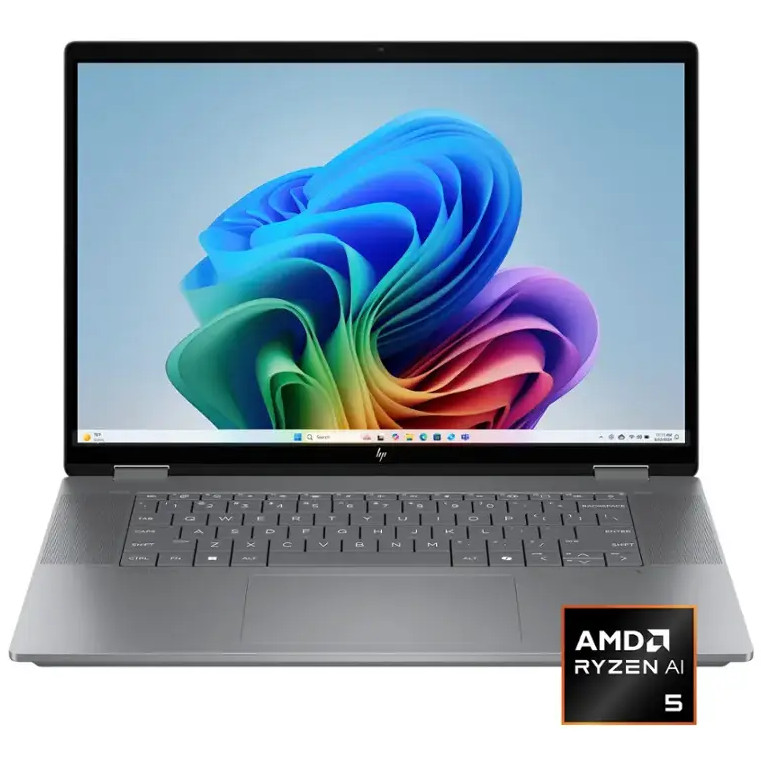
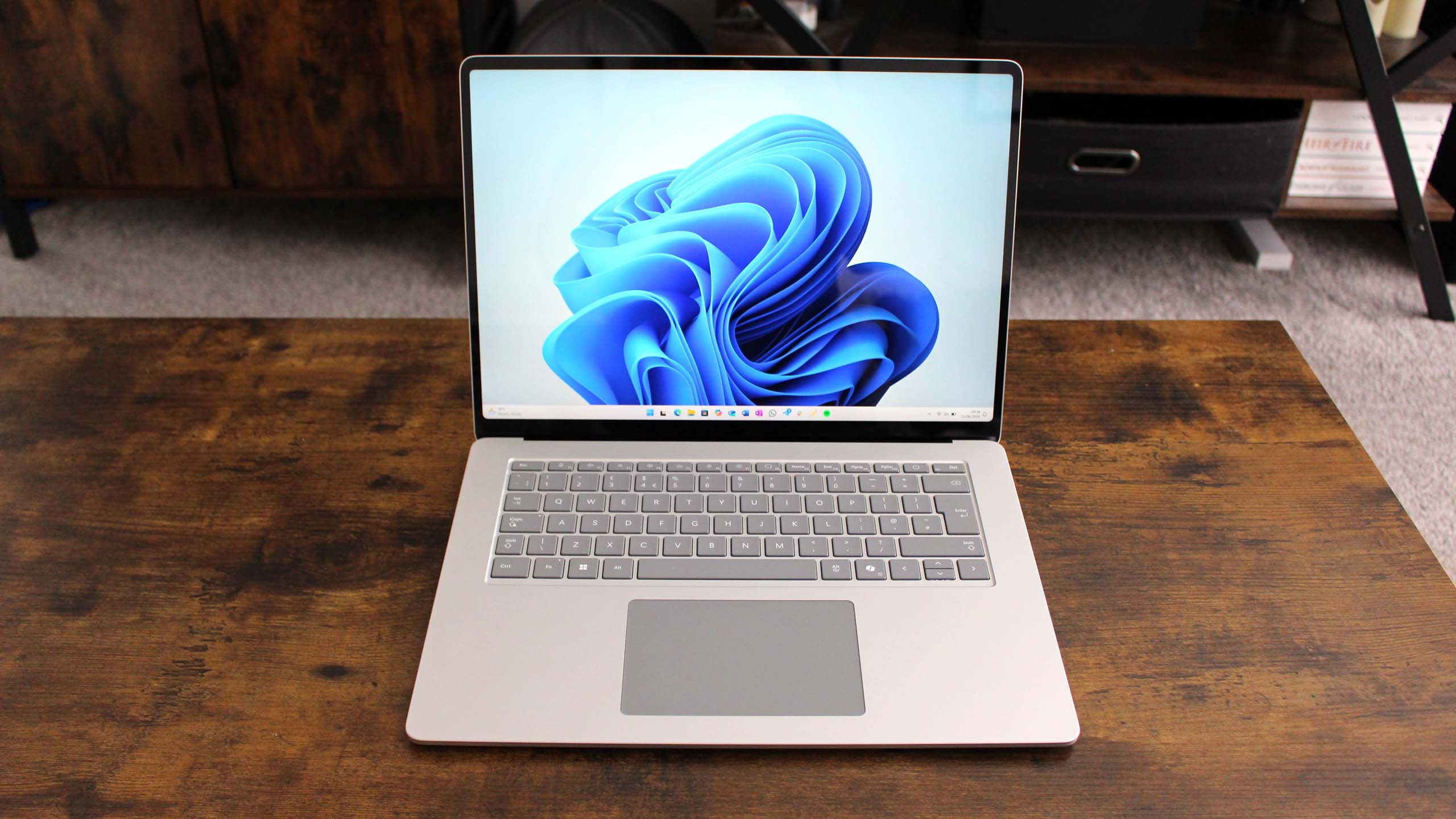
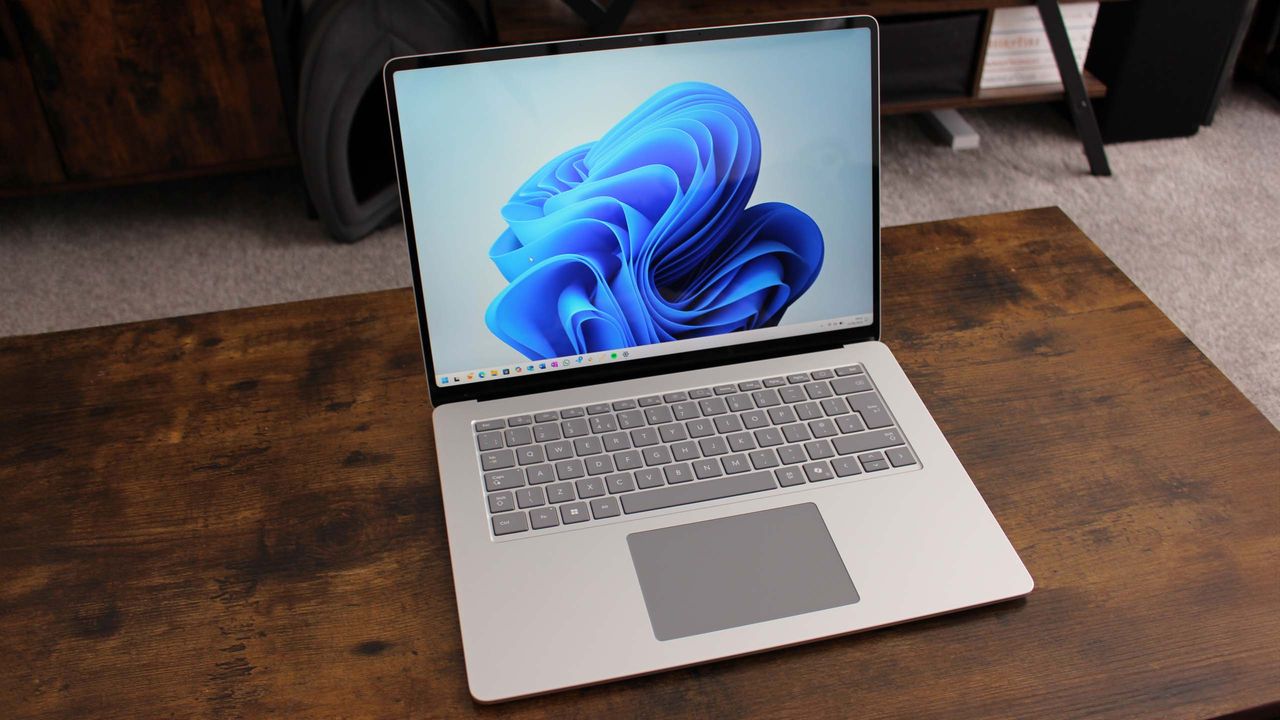
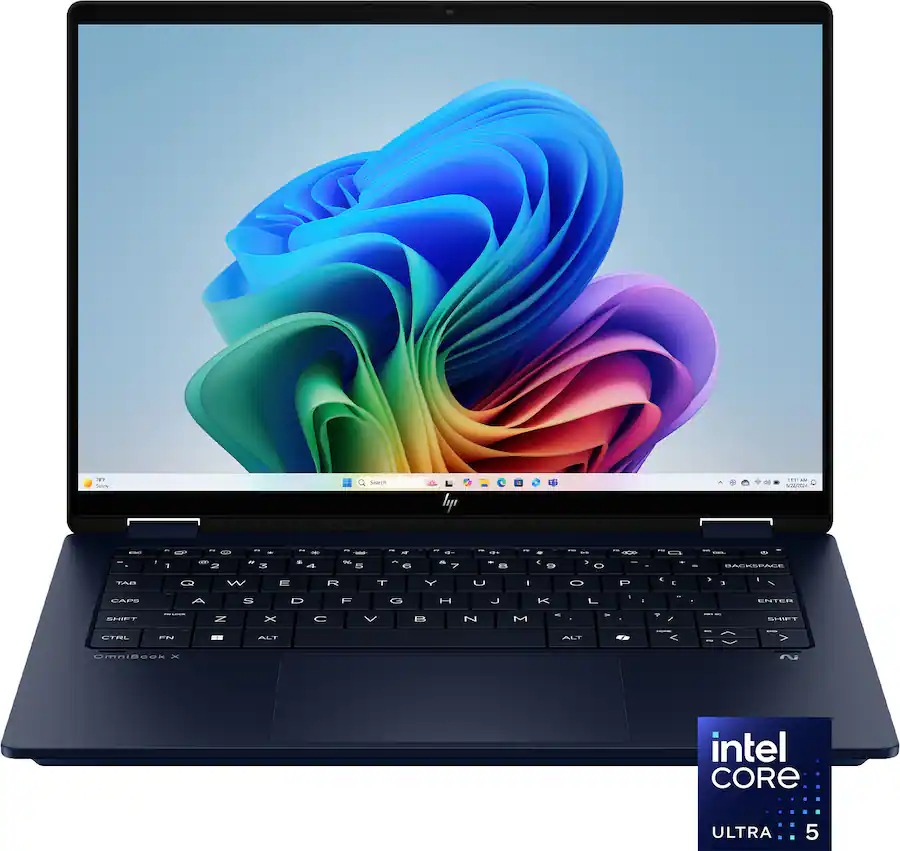
If you're looking for a laptop that's purely for crushing work without frivolous features eating its precious processing power, few are as simple yet effective as the HP OmniBook X Flip 2-in-1 laptop.
It's not going to win any design contests, but it will help you conquer your daily tasks with superb performance, detailed resolutions, and handy AI features, all of which are now 50% off for $699.99 at Best Buy for a limited time before it returns to its steep $1349.99 listing price on September 7, 2026.
The HP OmniBook X Flip 16-inch laptop will bulldoze any lightweight workflow tasks you throw at it thanks to its AMD Ryzen AI 5 430 (2026), 16GB RAM, and 512GB SSD, while being much cheaper than the competition.View Deal
Why buy the HP Omnibook X Flip 14"?
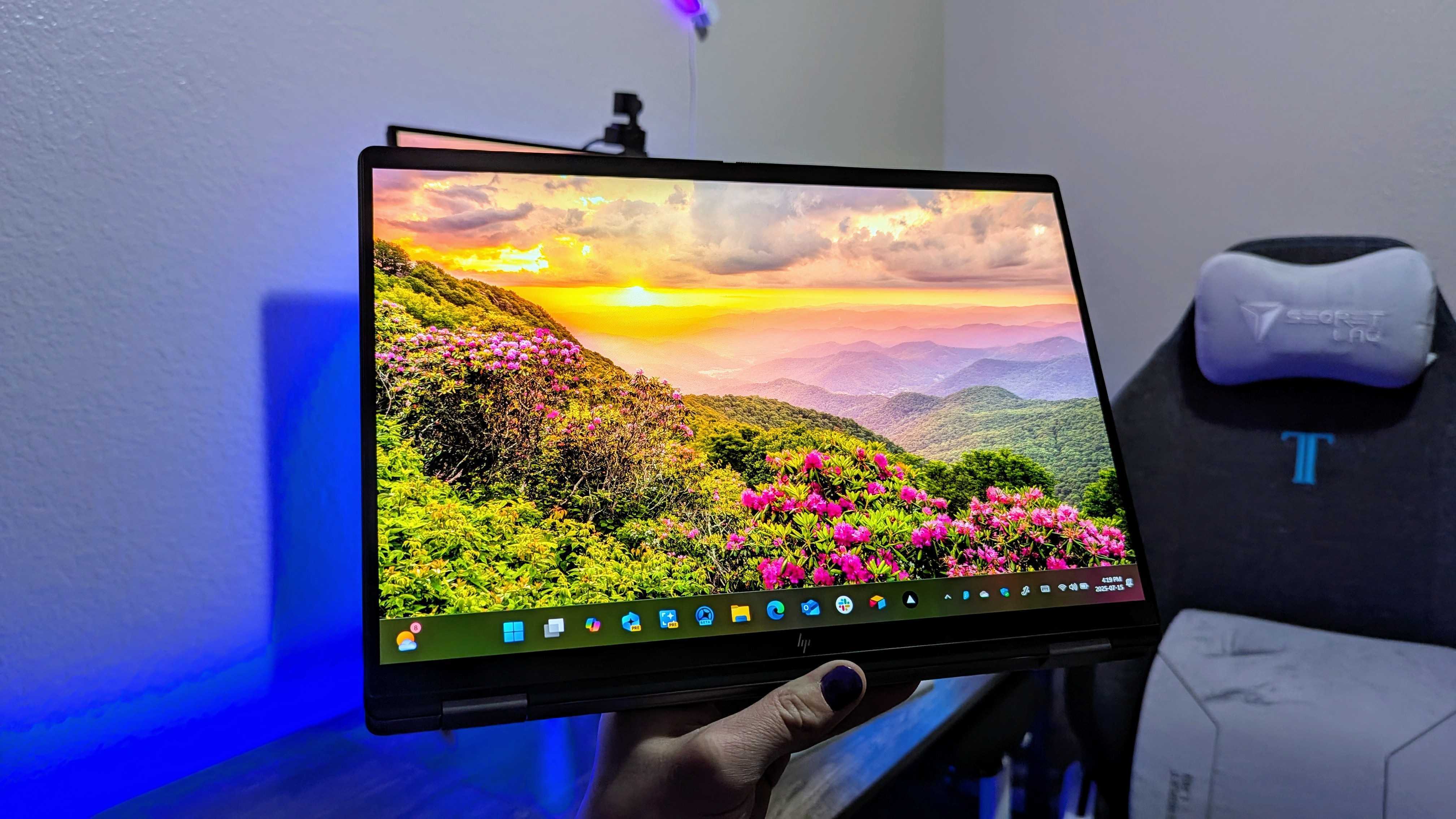
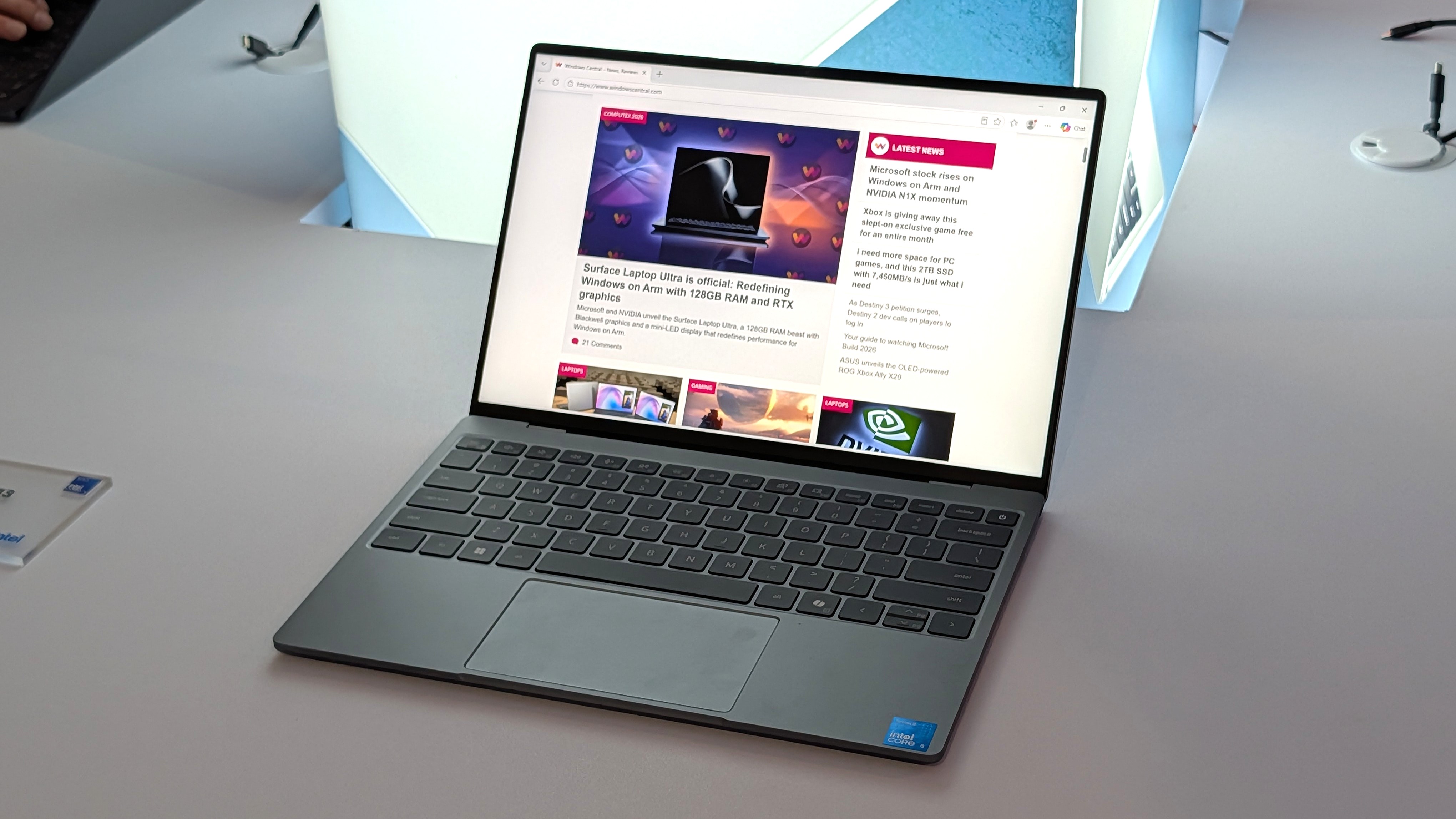
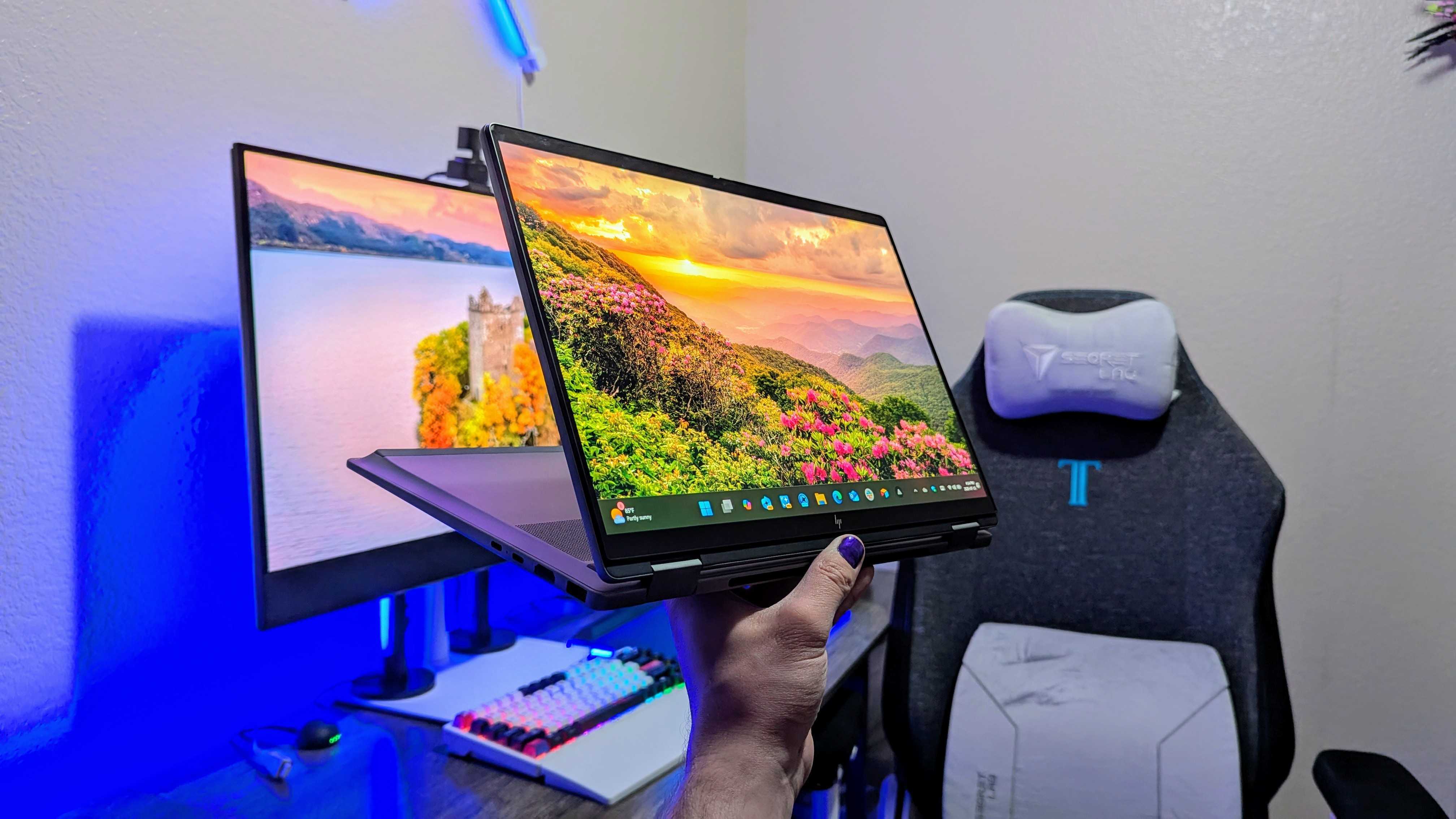
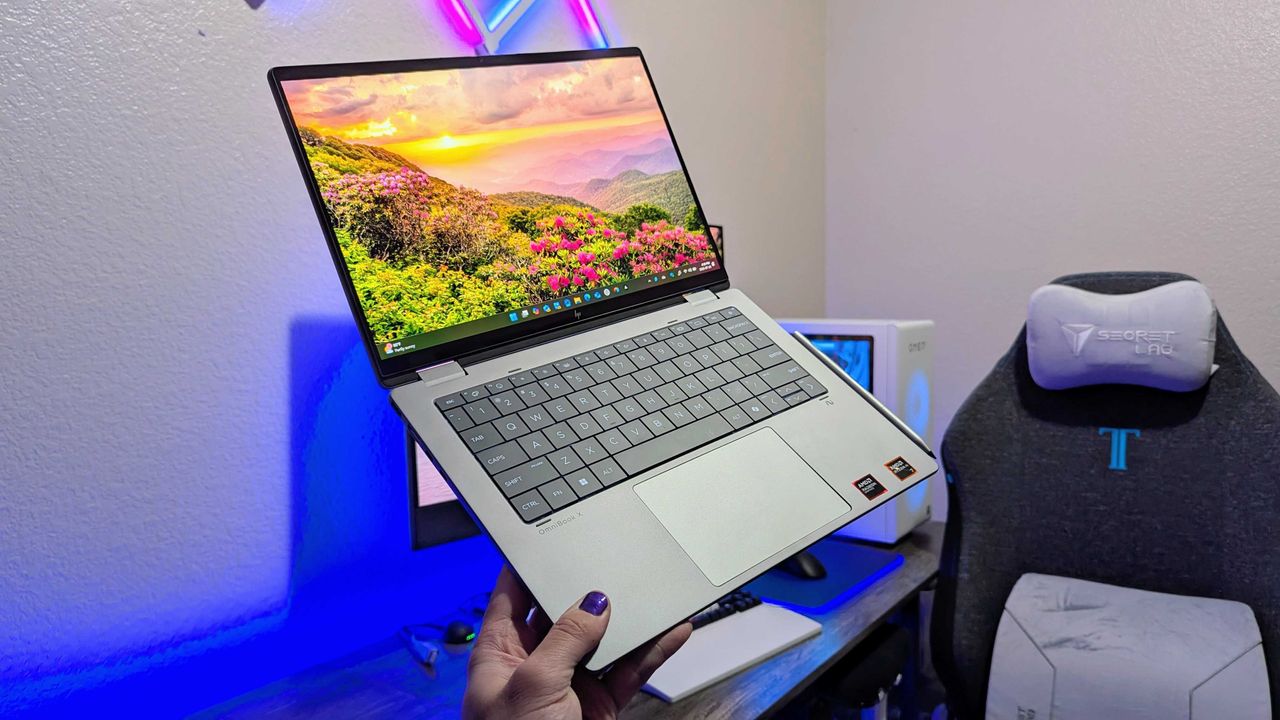
The HP OmniBook X 2-in-1 laptop in hand. (Image credit: Windows Central (Zachary Boddy) | HP)
The HP OmniBook X Flip 16" 2-in-1 laptop is equipped with handy components like an AMD Ryzen AI 5 430 (2026) CPU, 16GB RAM, and a 512GB SSD.
While some of these components aren't as powerful as the ones found in the 14-inch version of the HP OmniBook X Flip we reviewed some time ago, they're still more than capable of handling daily workflow tasks, whether it's crunching numbers on spreadsheets, typing up long essays via Microsoft Office, researching info on the internet, and more.
It also features an NPU with 50 TOPS to help the laptop perform local AI tasks more efficiently, a 16-inch 2K OLED touchscreen to display images and videos with crisp detail and vibrant colors, and a long-lasting battery life of 30 hours so you can work for a whole day without worrying about it losing power.
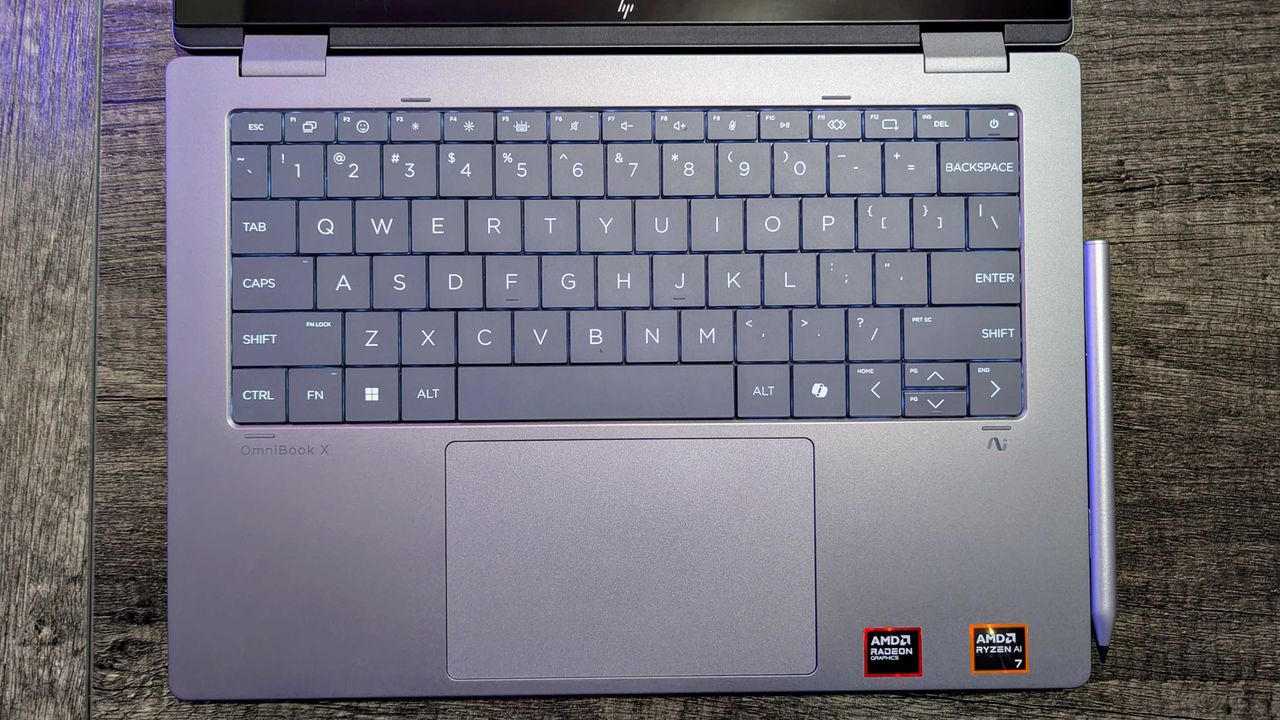
Add on top a comfortable-to-use keyboard, a plethora of USB and HDMI ports, and stylus pen compatibility for easier note-taking or digital art sketching, and you've got a laptop that's worth the price of admission, especially now that it's 50% off for Best Buy's Labor Day Sale.
FAQ
How long will Best Buy's Labor Day Sale last?
Best Buy's Labor Day Sale will last until September 7, 2026.
Can it handle gaming or heavy creative work?
No, mainly because it was designed for light workflow tasks and everyday productivity. Trying to use the HP OmniBook X Flip 16-inch laptop for gaming or heavy creative work will cause its performance to stutter and overheat quickly.
What convertible modes does it support?
The HP OmniBook X Flip 16-inch laptop supports Laptop Mode, Tablet Mode, Tent Mode, and Reserve Mode (a.k.a. Media Mode).
Join us on Reddit at r/WindowsCentral to share your insights and discuss our latest news, reviews, and more.
Over the last several years, the company has become the PC industry's unofficial concept lab, routinely showing off hardware that seems pulled from science fiction. We've seen rollable displays that grow taller, gaming laptops that transform into ultrawide displays, foldable PCs, attachable screens, rotating displays, and enough unusual form factors to make even the most adventurous laptop enthusiast pause for a moment.
Some of those ideas have remained concepts. Others have eventually become real products. The ThinkBook Plus Gen 6 Rollable (yes, they actually ship some of these!) is perhaps the best example, evolving from an eye-catching prototype into an actual shipping device. But even as Lenovo's concepts have become increasingly impressive from an engineering perspective, I've often found myself wondering how many of them actually solve a problem that regular laptop buyers have. Making a display expand is certainly cool. Convincing people they need it is the harder challenge.
That's why Project Swan immediately stood out to me.
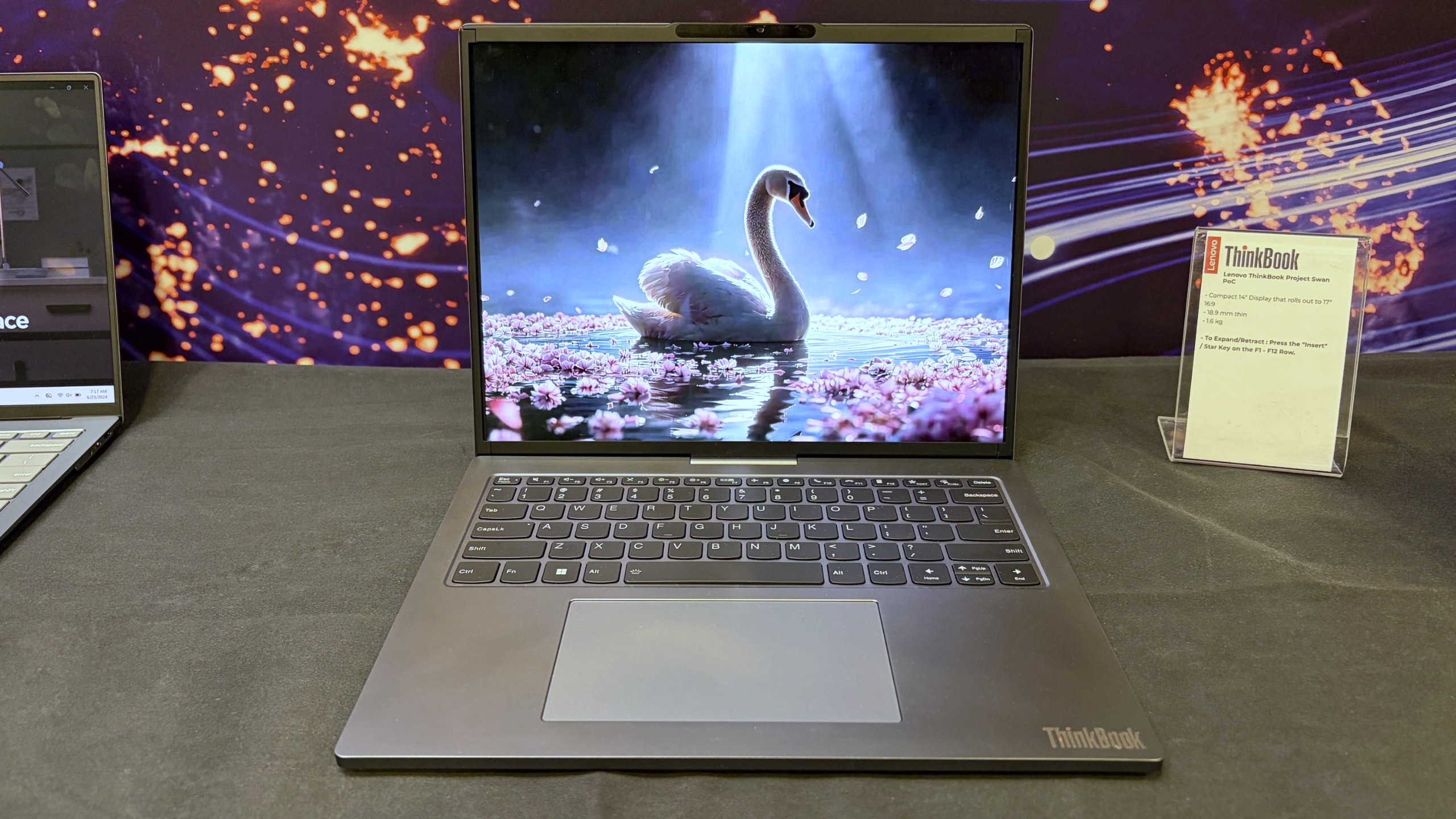
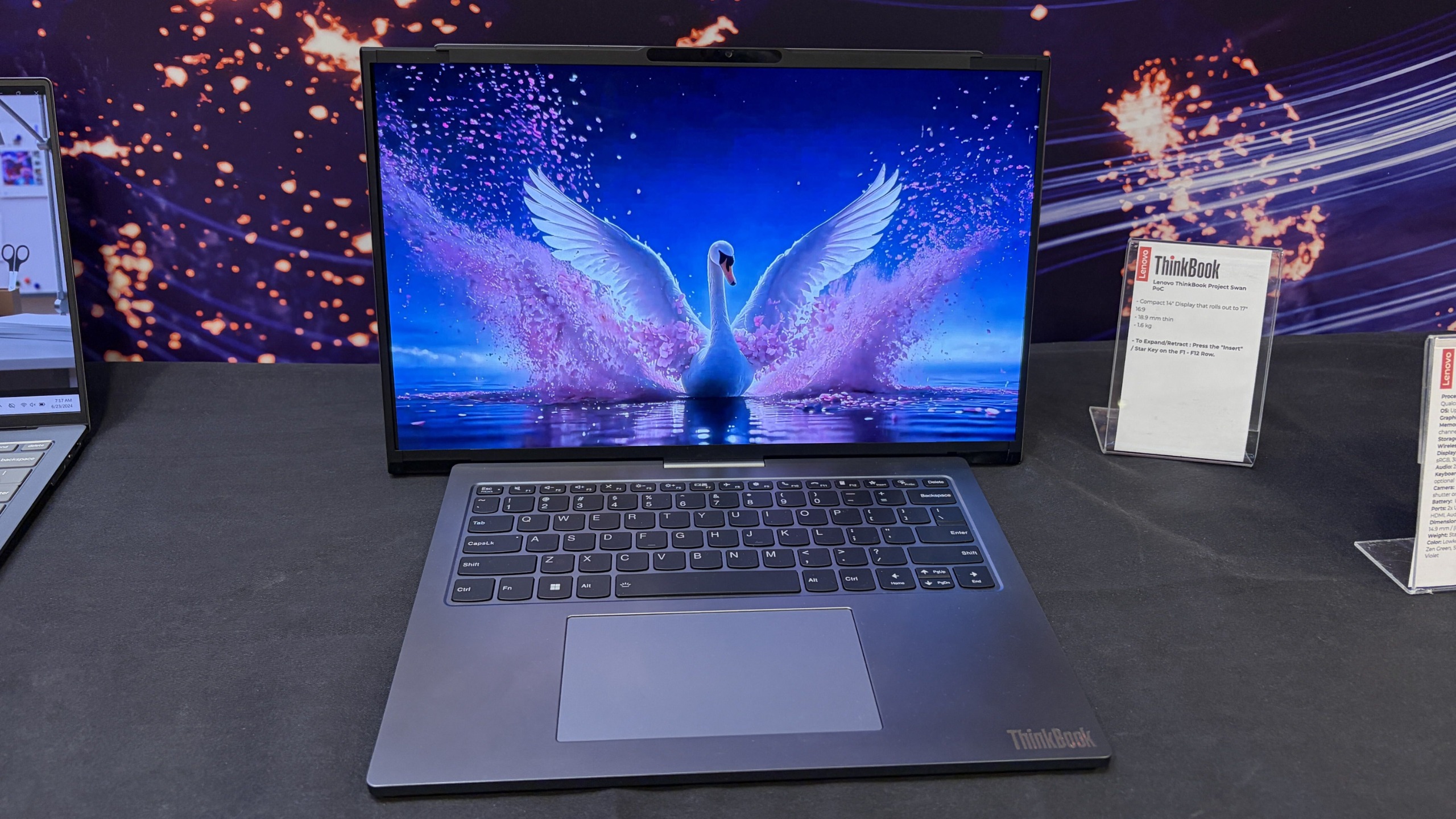
Lenovo's Project Swan laptop in "normal" mode at 14-inches. (Image credit: Future)
Officially, it's another Lenovo proof-of-concept device, but after spending time with it in person, I came away thinking this may be the company's most practical display concept yet. Not because it's the most ambitious, but because it's arguably the least ambitious.
And that's exactly why it works.
Lenovo finally found a sensible use for a rollable display?
The Lenovo ThinkBook Project Swan begins life as a fairly normal-looking 14-inch laptop.
At 17.9mm thick and weighing 1.6kg (3.5lbs), it isn't trying to break weight records or compete with ultra-premium featherweight notebooks (like Lenovo's new AeroBlade concept). Instead, the focus is on creating a laptop that's comfortable to carry throughout the day while offering something extra when users return to their desk, settle into a hotel room, or need more space for serious work.
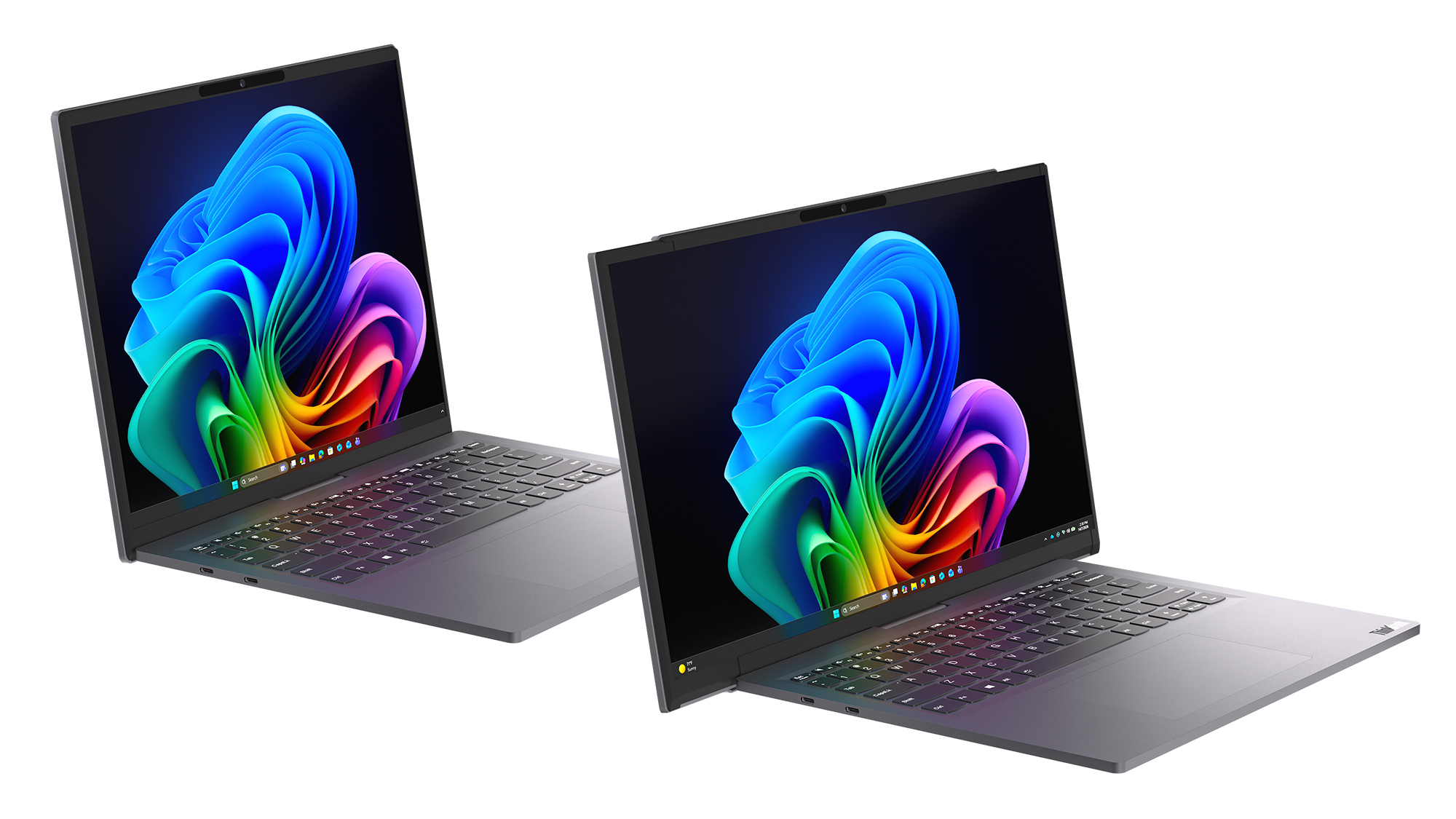
That "something extra" is a rollable display that expands horizontally into a 17-inch 16:9 workspace.
Unlike Lenovo's previous rollable designs, which generally expanded vertically, Project Swan widens itself by extending the display out to the sides. It's all done with a touch of a button (see my video below), and it only takes a few seconds.
The result feels much more like using a traditional external monitor than using an experimental form factor. You suddenly have enough room for side-by-side documents, large spreadsheets, dashboards, presentations, browser windows, Teams chats, and everything else that tends to compete for space on a 14-inch screen.
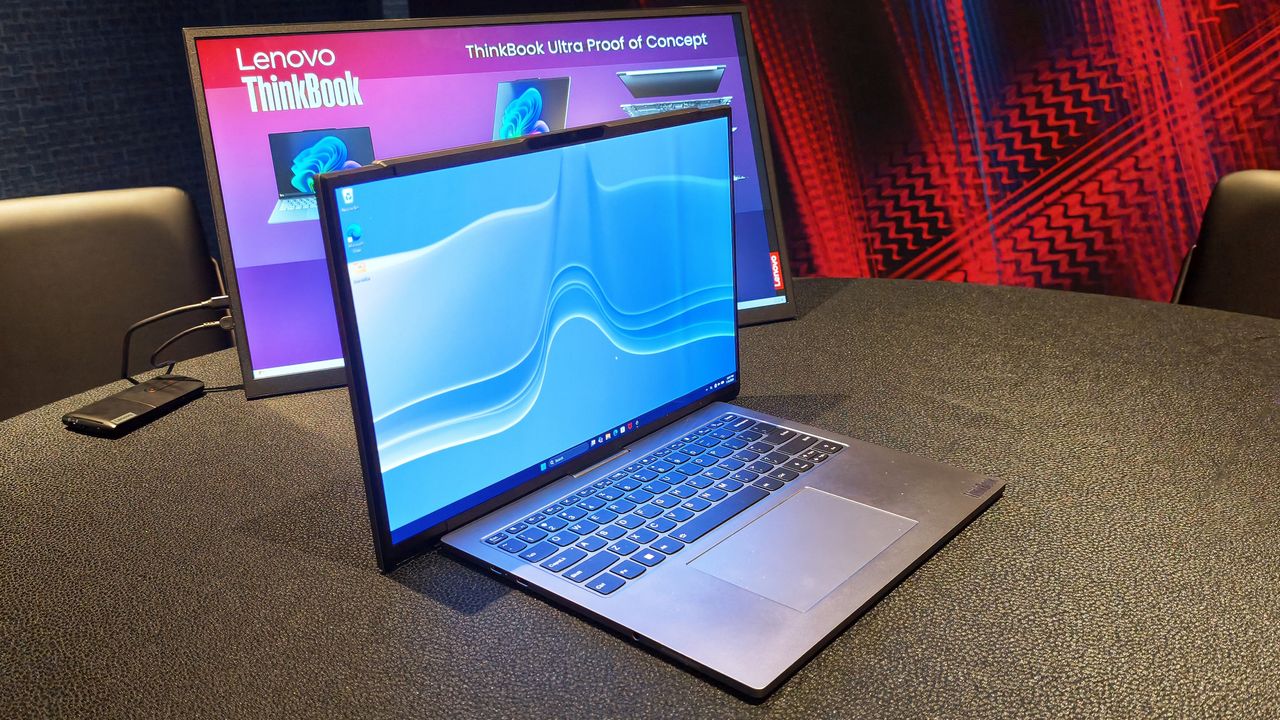
Lenovo's Project Swan laptop in extended mode, where the display reaches 17 inches. (Image credit: Future)
The transformation is dramatic enough to get attention, but conservative enough to feel practical. During my hands-on session, that was the first thing that struck me about the device.
Many of Lenovo's earlier concepts felt designed to answer the question, "Can we do this?"
Project Swan feels far more interested in answering the question, "Would people actually want this?"
That's a subtle distinction, but it's an important one.
This feels like the next step in Lenovo's display experiments
Lenovo Project Swan concept laptops side-by-side, demonstrating the screen in standard view versus expanded rollable view. (Image credit: Lenovo)
Project Swan didn't emerge in a vacuum. In many ways, it feels like the natural evolution of everything Lenovo has been experimenting with over the last few years.
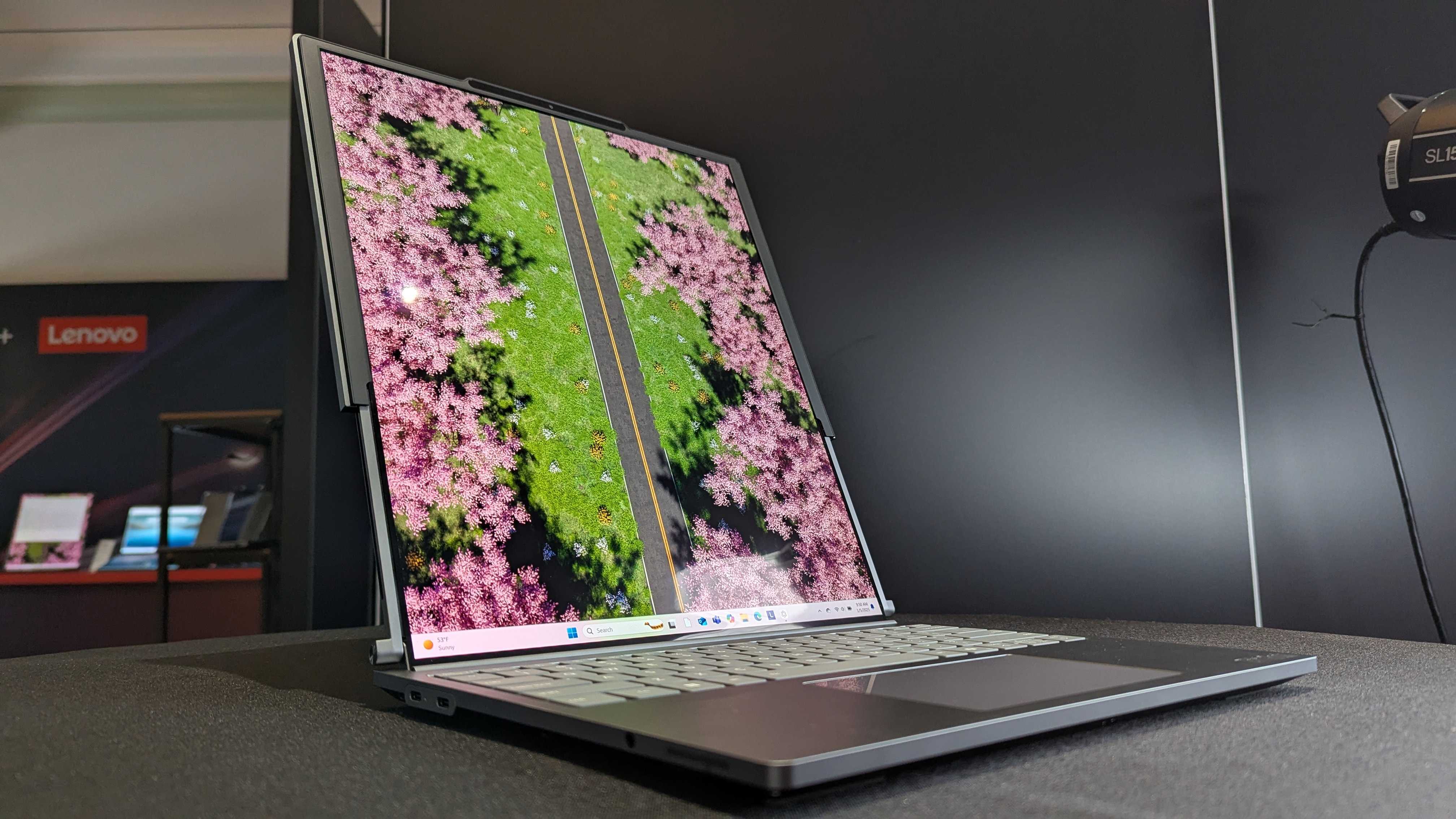
The ThinkBook Plus Gen 6 Rollable demonstrated that expandable OLED displays could successfully transition from concept to commercial product. Lenovo's Legion rollable gaming laptop concept showed how flexible displays could create an ultrawide experience without requiring users to carry an enormous machine. Other projects explored foldable displays, secondary screens, and entirely new ways of interacting with PCs.
As impressive as many of those concepts were, some occasionally felt like technology showcases first and products second.
Project Swan reverses that equation.
Lenovo ThinkBook Plus (Gen 6) laptop and its vertical rollable display at CES 2025. (Image credit: Windows Central | Zachary Boddy)
Rather than dramatically changing how people interact with a laptop, it simply gives them more screen real estate when they need it and gets out of the way when they don't. That's a much easier benefit for consumers to understand and, perhaps more importantly, a much easier benefit to justify paying for.
After all, most people already know the dilemma.
A 14-inch laptop is ideal for travel. A larger display is ideal for work.
Project Swan attempts to deliver both.
The idea makes sense. The challenges are obvious.
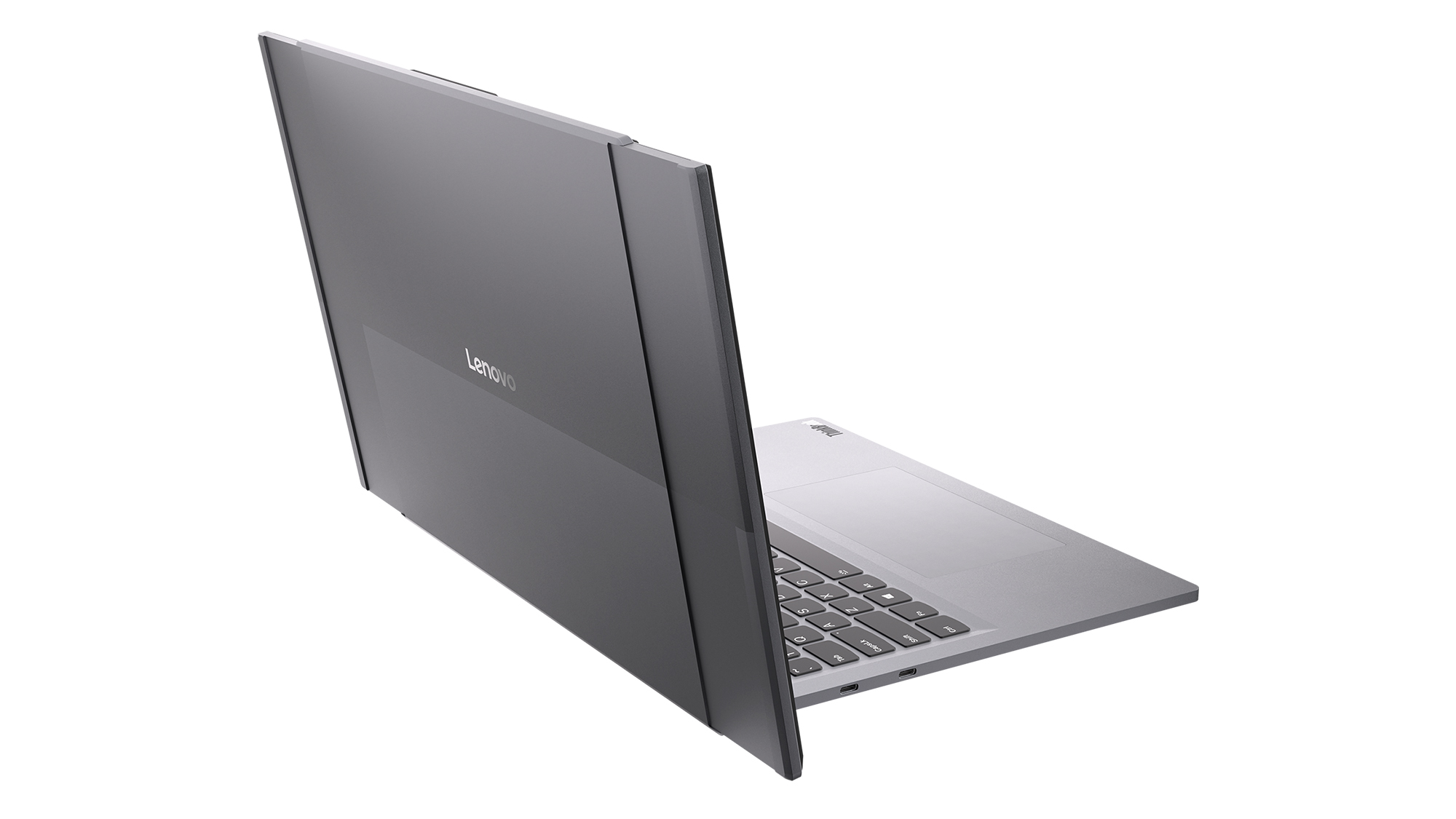
Read image of the Project Swan laptop cover and its motorized rollable display. (Image credit: Lenovo)
That isn't to say there aren't trade-offs.
The first thing I noticed when using the expanded display was that the system becomes somewhat top-heavy. That's hardly surprising given the additional display hardware housed in the lid, but it was noticeable enough that I'd expect Lenovo's engineers to still be looking at ways to refine the balance.
Pricing is another obvious concern.
Rollable OLED displays aren't cheap (it's $3,499 for the ThinkBook Plus Gen 6 Rollable), and if Project Swan ever becomes a commercial product, it's almost certainly going to carry a premium compared to a traditional clamshell laptop. The value proposition may be easier to understand than some other concept devices, but consumers still need to be convinced that expandable screen space is worth the additional cost.
Then there's the question everyone asks whenever a company unveils a rollable or foldable display.
How durable is it?
Flexible OLED technology has improved dramatically over the last few years, but long-term reliability remains an important consideration. How will the mechanism hold up after years of daily use? What happens after thousands of expansion cycles? Will buyers trust a laptop that contains moving display components?
The technology may be ready, but consumer confidence isn't something that can be engineered overnight.
The bigger question is whether people want these new form factors
That's really the challenge facing every laptop manufacturer right now.
The industry has spent years experimenting with alternatives to the traditional clamshell design. Foldable PCs promised tablet-sized displays that fit inside a laptop footprint. Dual-screen systems like the Lenovo Yoga 9i attempted to replace physical keyboards with additional displays. Rollable devices have explored several different directions entirely.
Some enthusiasts love these ideas, but many consumers remain perfectly happy with the laptops they already own.
That's what makes Project Swan so interesting to me. It isn't asking users to learn a new workflow or completely rethink how they use a PC. Instead, it's enhancing something people already understand: bigger screens are often better, but bigger laptops are harder to carry.
Whether that argument ultimately resonates with buyers remains an open question, but it's certainly the clearest pitch Lenovo has made for a rollable display so far.
Lenovo deserves credit for keeping the experimentation alive
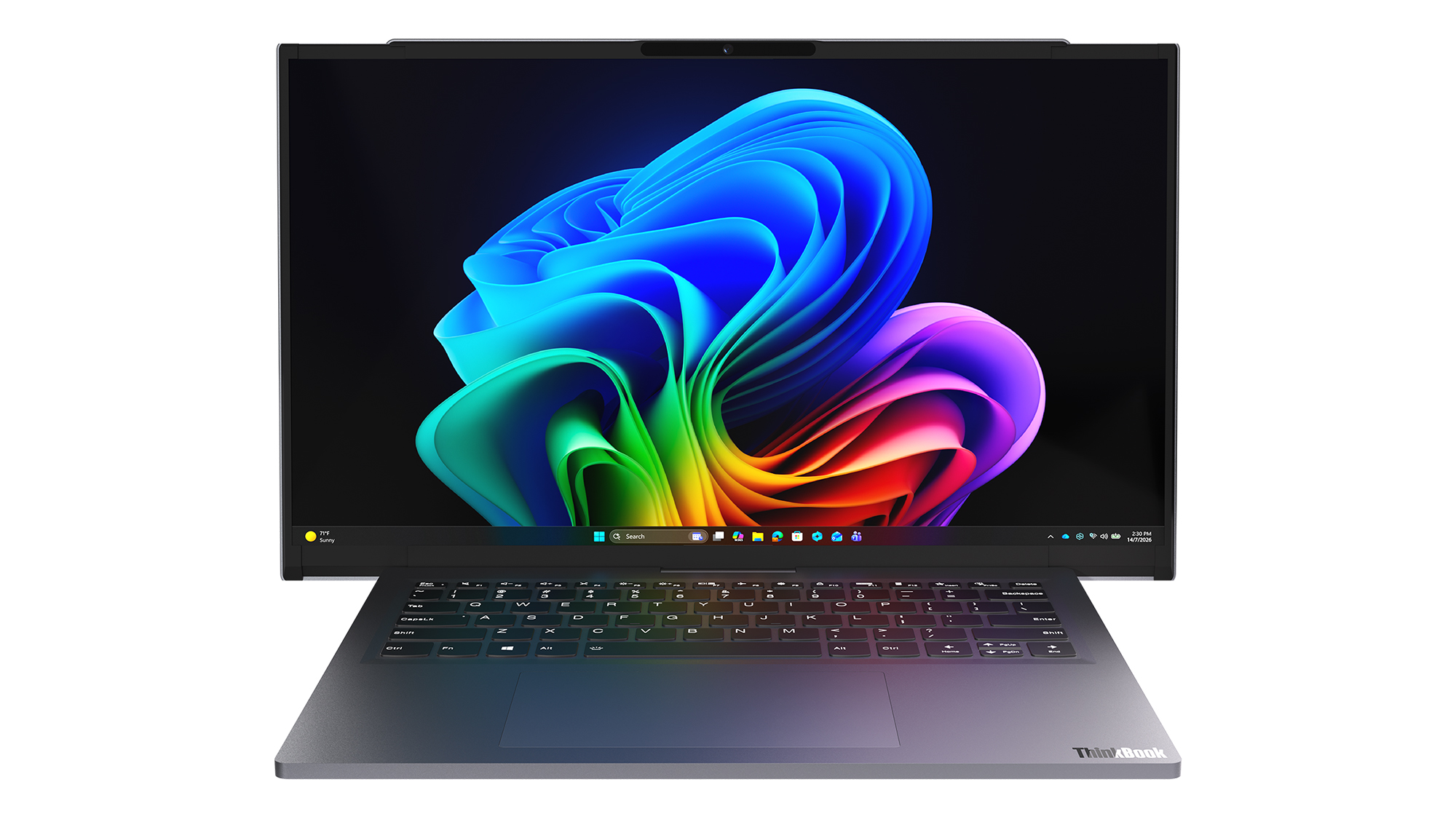
Front view of the open grey Lenovo Project Swan concept laptop with its rollable screen expanded horizontally beyond the keyboard base. (Image credit: Lenovo)
Even if Project Swan never reaches store shelves, I appreciate what Lenovo is doing here.
The PC industry can sometimes become obsessed with processor upgrades, AI features, and specification sheets while overlooking more fundamental questions about how people actually use their devices. Lenovo's concepts consistently ask those questions, even when the answers occasionally seem, well, strange.
What's refreshing about Project Swan is that it feels grounded in reality. The company isn't trying to reinvent personal computing or create an entirely new category. Instead, it's exploring a straightforward idea that almost everyone who has worked on a laptop can relate to.
Sometimes you want a compact machine for travel.
Sometimes you wish that same machine had a much larger screen.
Project Swan is the most convincing attempt I've seen yet to bridge that gap.
I still have concerns about durability, balance, pricing, and whether consumers are truly interested in another alternative laptop design. But after trying it for myself, I'm more optimistic about this concept than many of Lenovo's previous experiments.
Ironically, that's because it feels less ambitious. Rather than trying to change how we work, Project Swan simply gives us a little more room to do it.
And that may be exactly what makes it one of Lenovo's most promising concepts yet.
Let me know in the comments what you think about Project Swan. Should Lenovo continue to push this concept of an expanding display, or focus more on other ideas (and if so, which ones)?
Join us on Reddit at r/WindowsCentral to share your insights and discuss our latest news, reviews, and more.
Competition for Apple's MacBook Neo is heating up.
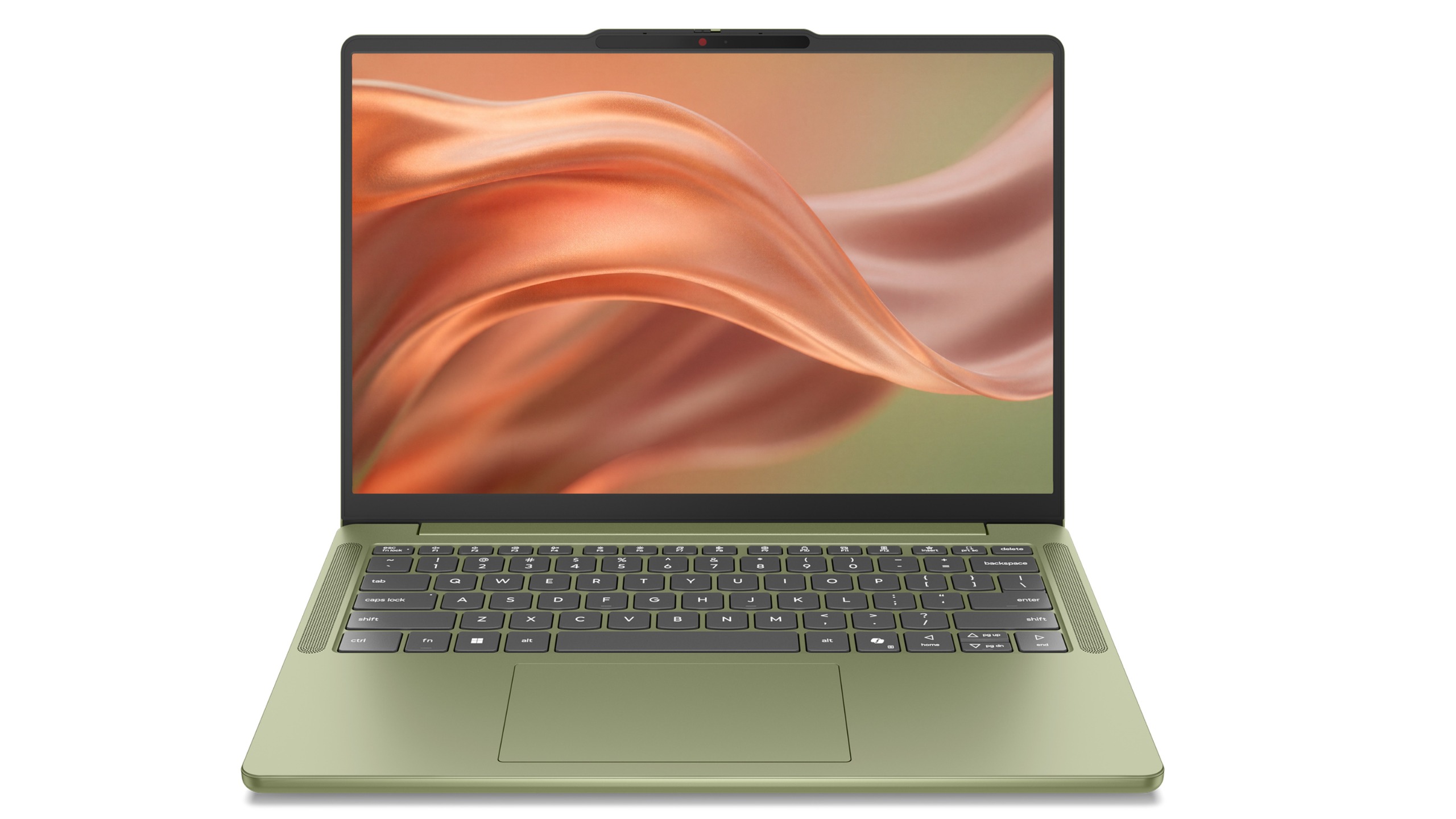
Just days after Dell unveiled a new 14-inch laptop designed to take on Apple's latest mainstream notebook, Lenovo is entering the fight with something considerably more interesting: a laptop that lets you express your personality instead of forcing you to settle for silver, gray, or slightly darker gray.
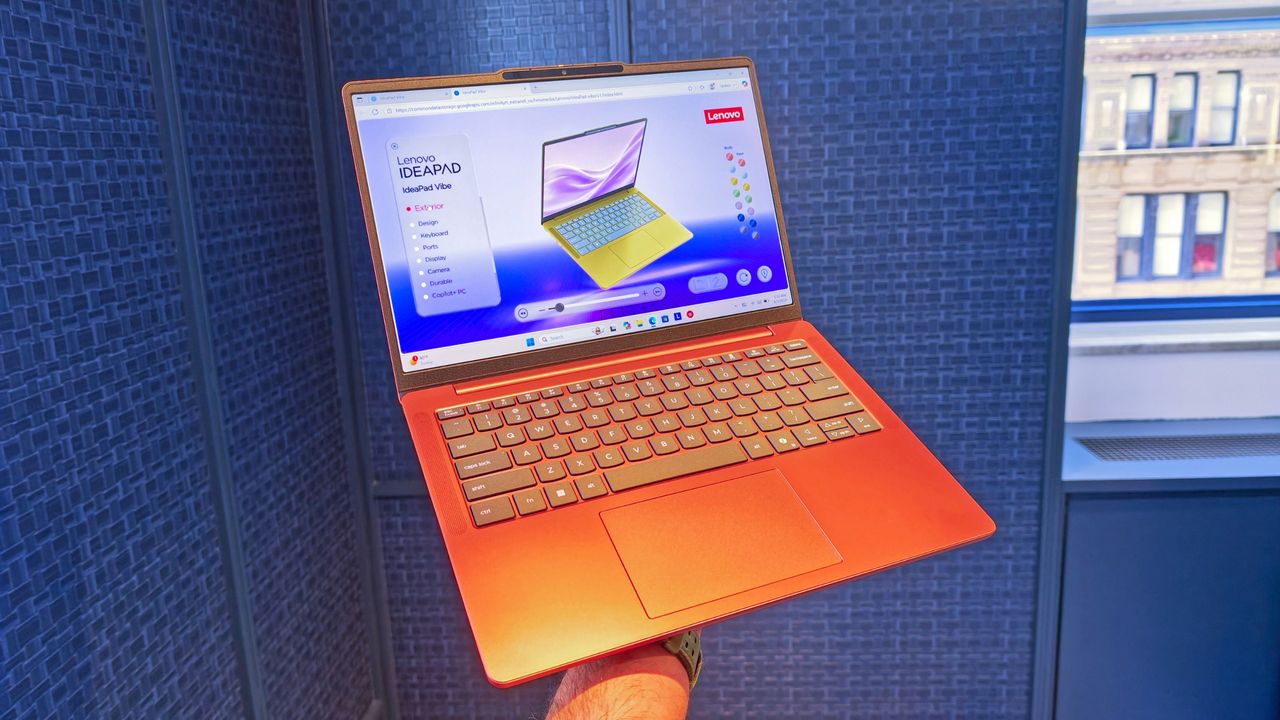
I recently got to see Lenovo's new IdeaPad Vibe lineup in person in New York City, and while the company talked plenty about AI, processors, and battery life, the thing that immediately stood out to me was how different these laptops look compared to almost everything else on the market.
Most PC makers treat color options as an afterthought. Lenovo is making them the product.
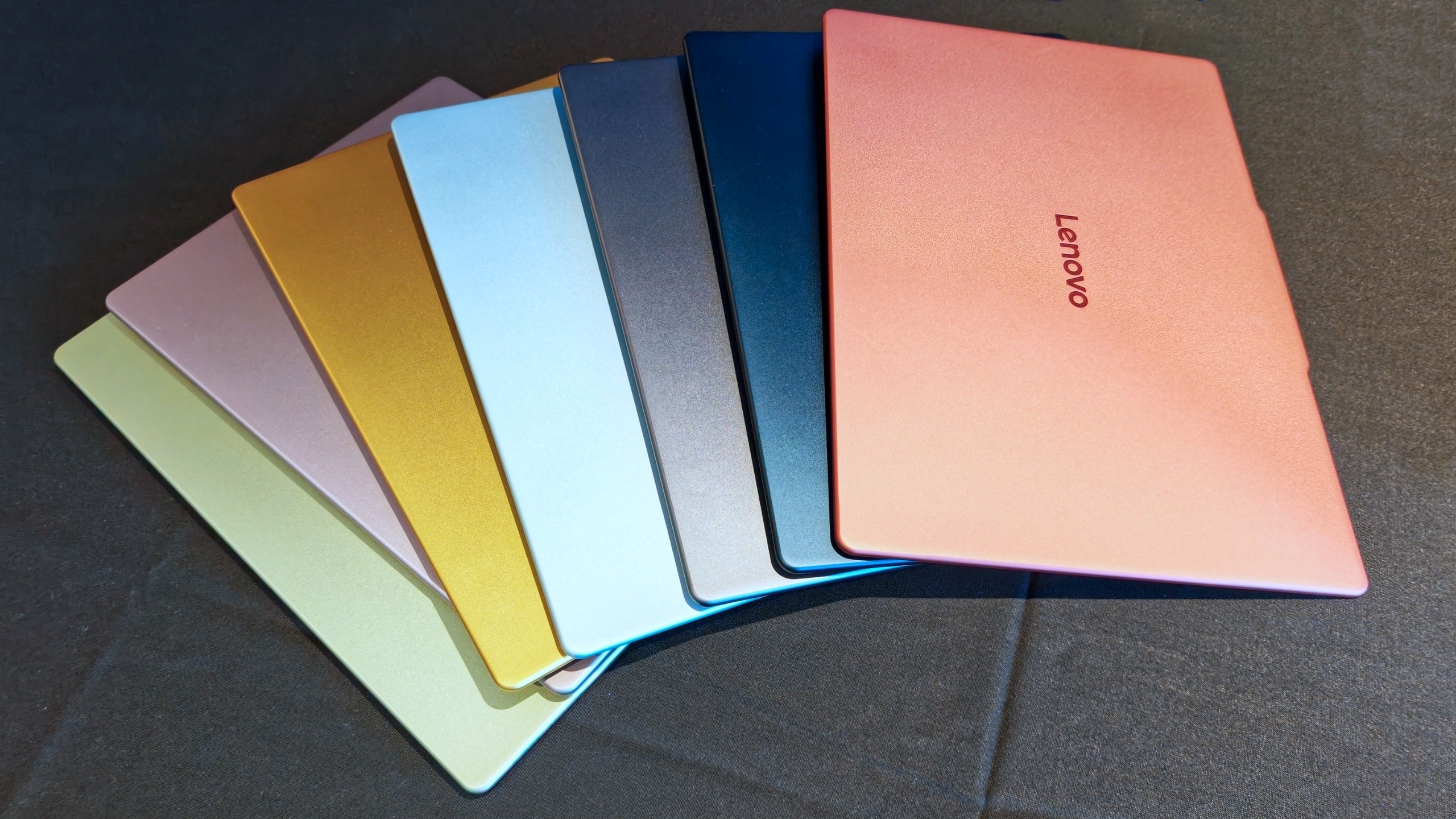
(Image credit: Daniel Rubino)
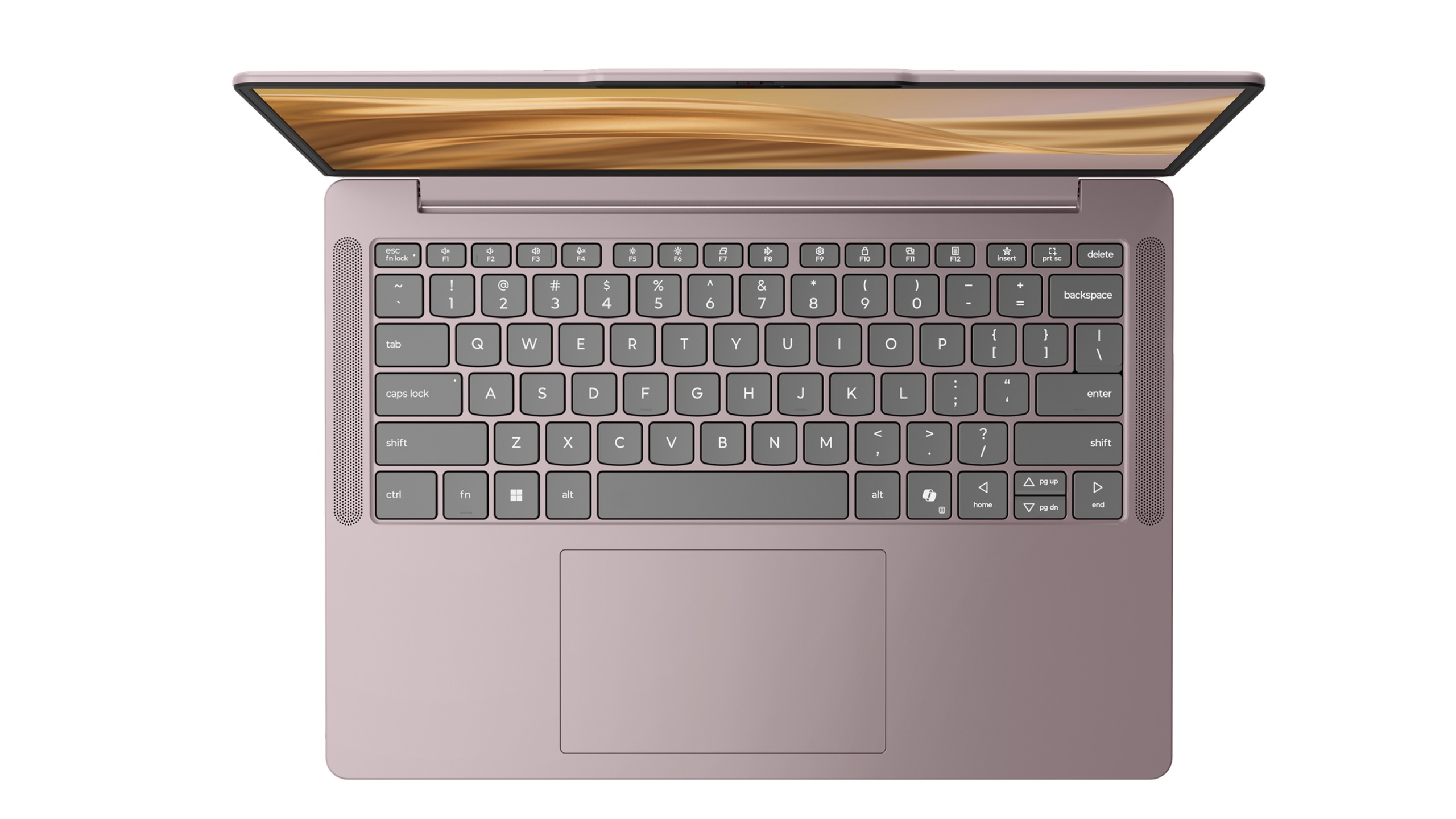
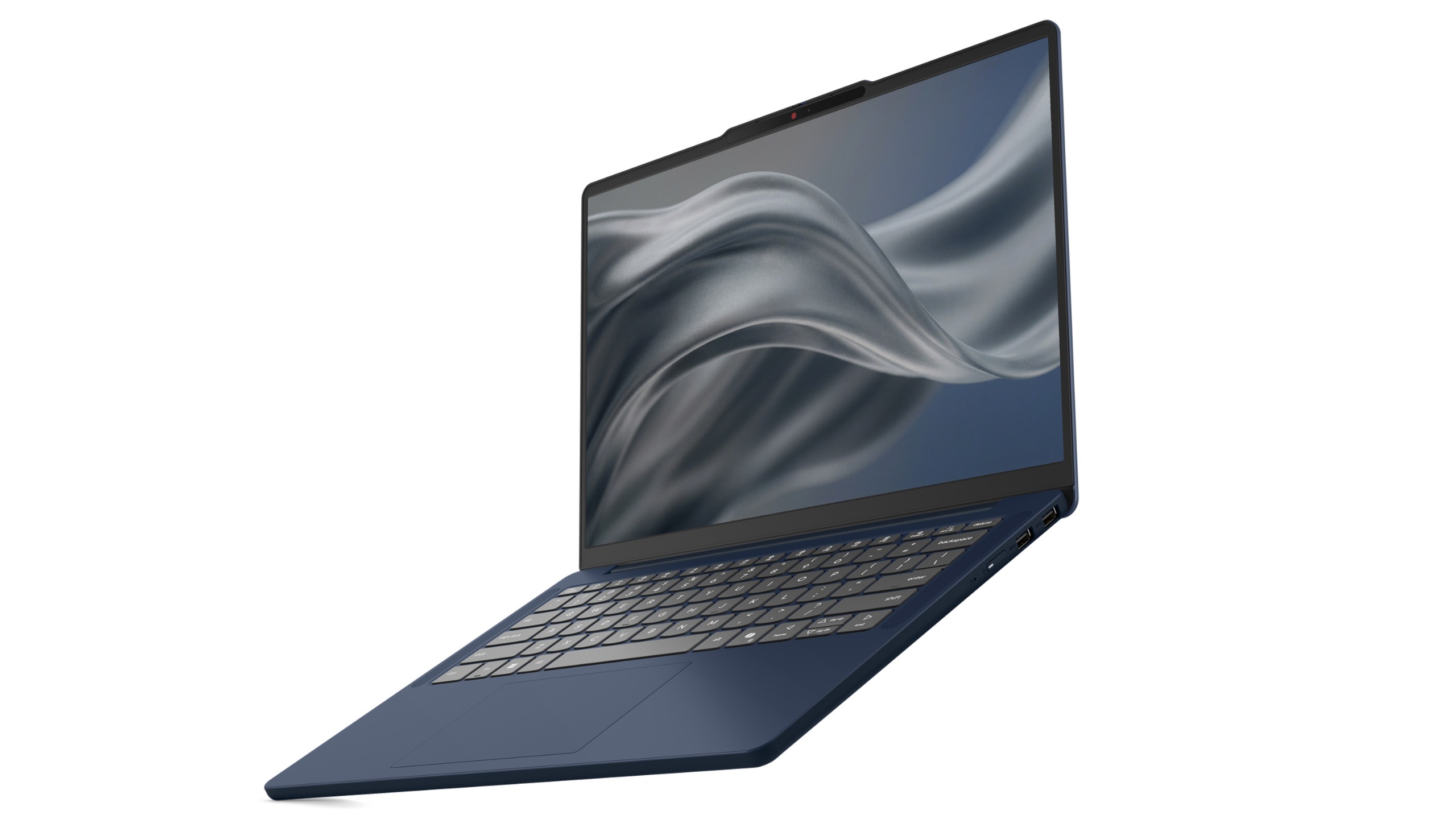
The new IdeaPad Vibe will be available in seven Pantone-developed colors, including Chill Blue, Zen Green, Spicy Gold, Radiant Coral, Dreamy Violet, Lowkey Grey, and Moody Blue. Lenovo says the colors were developed alongside the Pantone Color Institute and are designed to reflect different moods, personalities, and lifestyles.
And that's just the beginning.
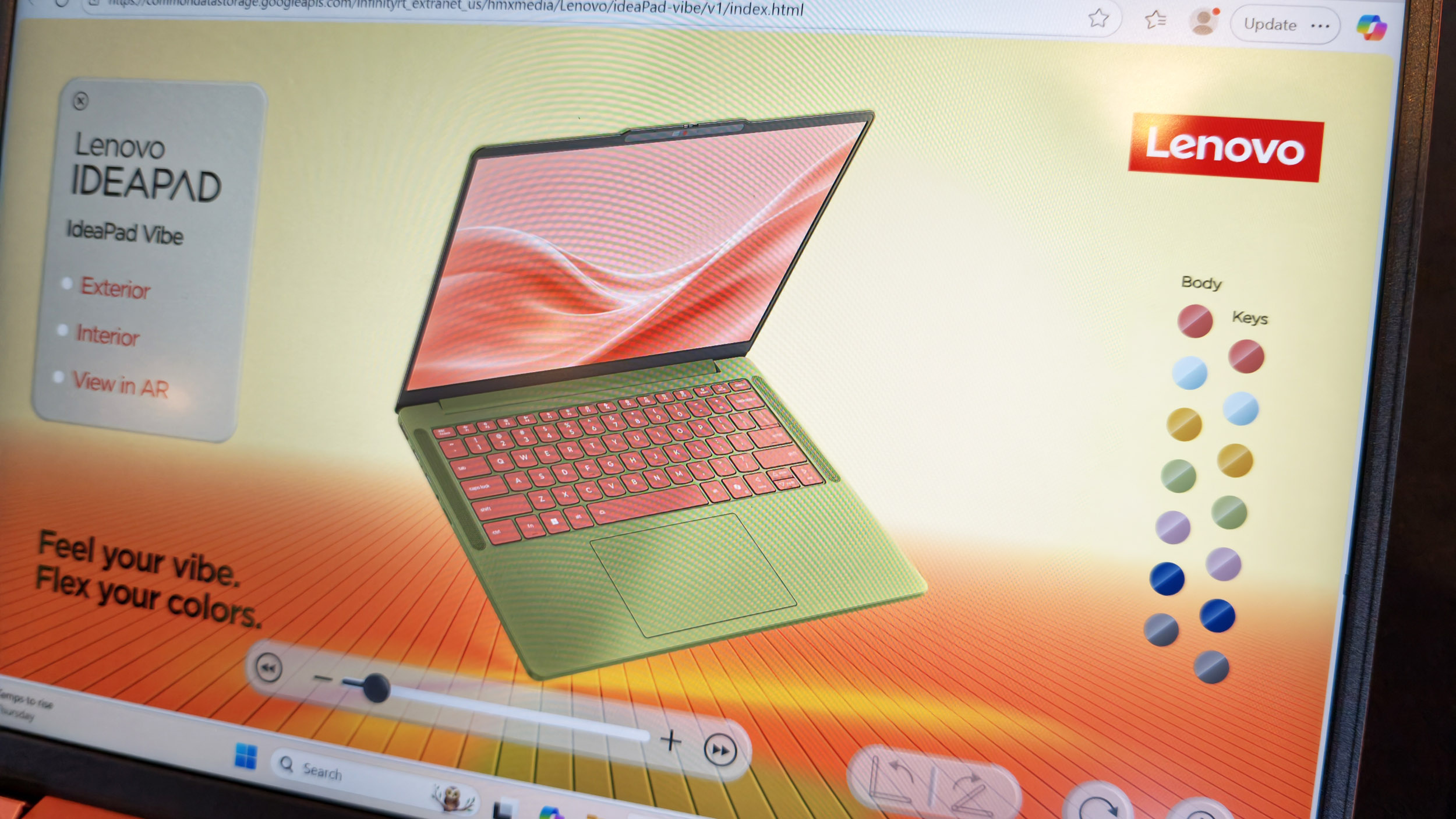
As shown in Lenovo's custom configurator (below), users will be able to mix and match chassis colors and keyboard colors to create something uniquely theirs. The company is also offering swappable custom keycaps, adding another layer of personalization that is virtually unheard of in the mainstream laptop space.
The configurator demo I saw almost felt like building a custom character in a video game rather than buying a laptop, and reminded me of the XBOX Design Lab for custom controllers.
Demo of the web creation tool to let you customize the new IdeaPad Vibe. (Image credit: Daniel Rubino)
In fact, my biggest complaint about the IdeaPad Vibe is that there might be too much choice.
That's obviously a good problem to have, but after looking through the various color combinations, shell finishes, and processor options, I could already imagine spending far too much time trying to decide which configuration to order (I know because I tried).
That's not a sentence I ever expected to write about a Windows laptop.
Lenovo IdeaPad Vibe in Zen Green and black keycaps. (Image credit: Lenovo)
Of course, a laptop can't survive on colors alone, and thankfully Lenovo seems to have put together a genuinely compelling package underneath all that personality.
The IdeaPad Vibe comes in both 14-inch and 15-inch sizes and starts at just 1.3kg (2.87 pounds) for the smaller model. OLED display options are available with up to 100% DCI-P3 color coverage, while IPS models can offer refresh rates up to 120Hz.
Lenovo is also packing in practical features including dual SSD slots, Wi-Fi 7, USB-A and USB-C ports, HDMI, a MicroSD card reader, and a 5MP IR webcam with a privacy shutter.
AMD, Qualcomm or Intel (eventually)
Lenovo IdeaPad Vibe in Dreamy Violet. (Image credit: Lenovo)
Then there's the processor selection.
For launch, buyers can choose between AMD Ryzen AI 400 series configurations and Qualcomm Snapdragon X models (we're not clear on exactly which Snapdragon X chip, or even if it's X2), while Intel-based versions will arrive later. AMD models support up to 32GB of upgradeable memory and up to 1TB of SSD storage, while Snapdragon versions offer up to 24GB of memory and the same dual-slot storage flexibility.
Personally, I'd go Qualcomm.
We've reached a point where Snapdragon X PCs consistently deliver excellent everyday performance while also offering some of the best battery life available in the Windows ecosystem. The combination of a lightweight chassis, Copilot+ PC capabilities on supported configurations, and Qualcomm's efficiency makes the Snapdragon version particularly appealing to me.
That isn't to say AMD isn't tempting. AMD's advantage here is flexibility. The Ryzen AI configurations support memory upgrades up to 32GB and offer optional 50Wh or 65Wh battery configurations, making them attractive for enthusiasts who want more control over their hardware.
What impressed me most during my hands-on time wasn't any single specification. It was how cohesive the overall package felt.
The laptops looked premium, felt solid in the hand, and didn't come across as budget systems despite their surprisingly aggressive pricing. That's important because Lenovo isn't positioning the IdeaPad Vibe as a niche fashion accessory. This is meant to be a mainstream Windows laptop that happens to have far more personality than its competitors.
And right now, that may be enough to help it stand out.
Final thoughts
Lenovo IdeaPad Vibe in Chill Blue. (Image credit: Lenovo)
Apple's MacBook Neo has clearly encouraged PC makers to rethink the mainstream laptop category. Dell has already responded with its own fresh take on the formula with its just-announced Dell 14S, and now Lenovo is bringing something completely different to the table: customization.
Instead of asking buyers which shade of gray they prefer, Lenovo is asking what their "vibe" is.
That's a much more interesting question, even if a bit on the nose and a tad cringey.
The Lenovo IdeaPad Vibe with AMD processorslaunches inOctober 2026 starting at $699.99, while Qualcomm Snapdragon X models will follow in November 2026 with the same $699.99 starting price. Intel is only listed as coming later.
And after seeing them in person, I think Lenovo may have stumbled onto something other PC makers have forgotten: technology can be personal, but it can also be fun.
Join us on Reddit at r/WindowsCentral to share your insights and discuss our latest news, reviews, and more.
Most are fascinating engineering exercises that are never destined for store shelves. They're designed to spark conversation, generate headlines, and give us a glimpse into what might be possible someday. Some do come to market, like rollable display PCs.
Lenovo's new Project AeroBlade concept feels different.
Officially, it's one of the company's latest proof-of-concept devices, unveiled as part of its annual wave of experimental hardware at IFA 2026. Unofficially? I think there's a very good chance we're looking at Lenovo's next big premium laptop platform.
After getting hands-on with AeroBlade, I walked away convinced this isn't some far-future moonshot. If you told me a shipping version appears within the next year, I wouldn't be surprised in the slightest.
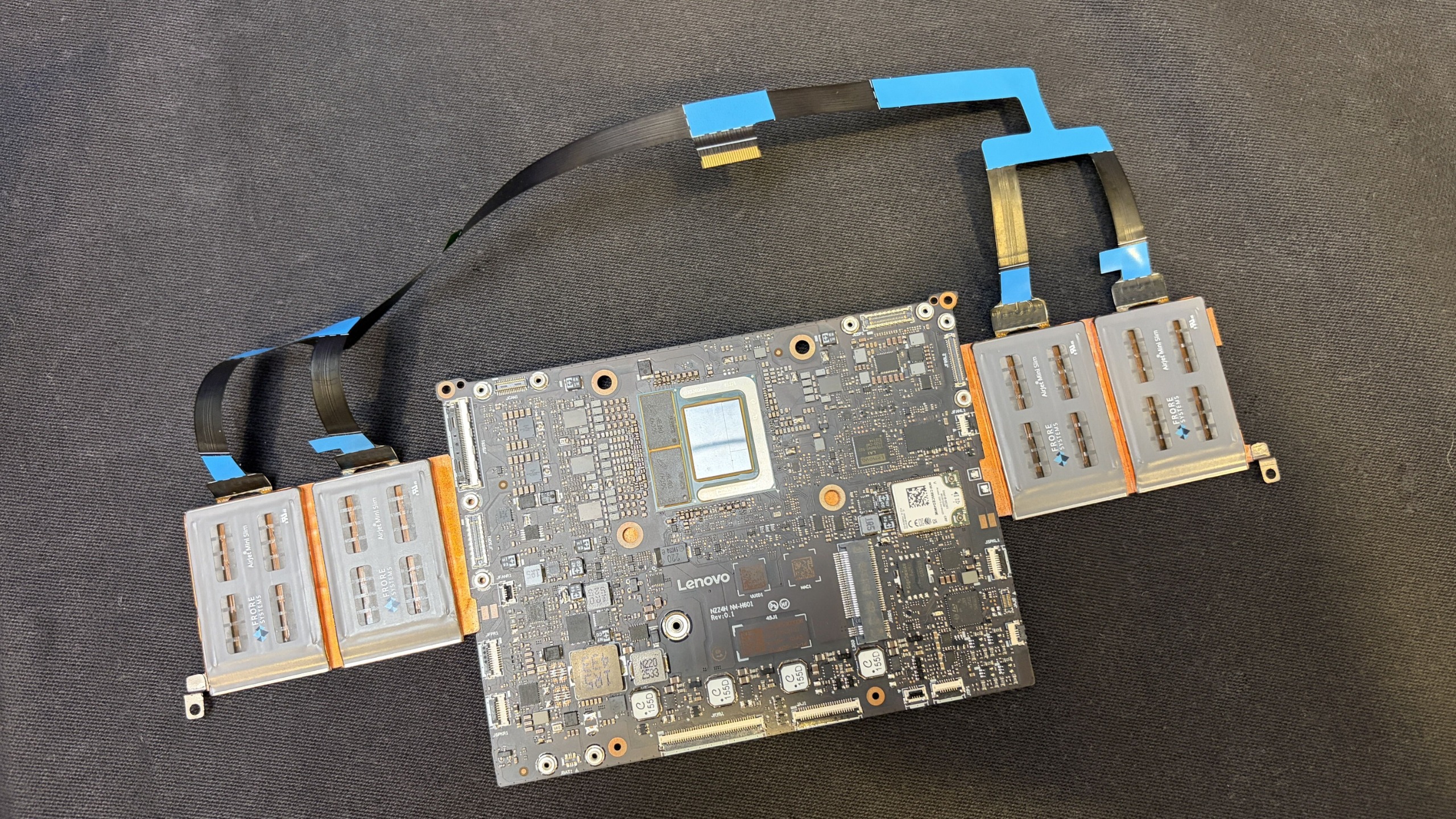
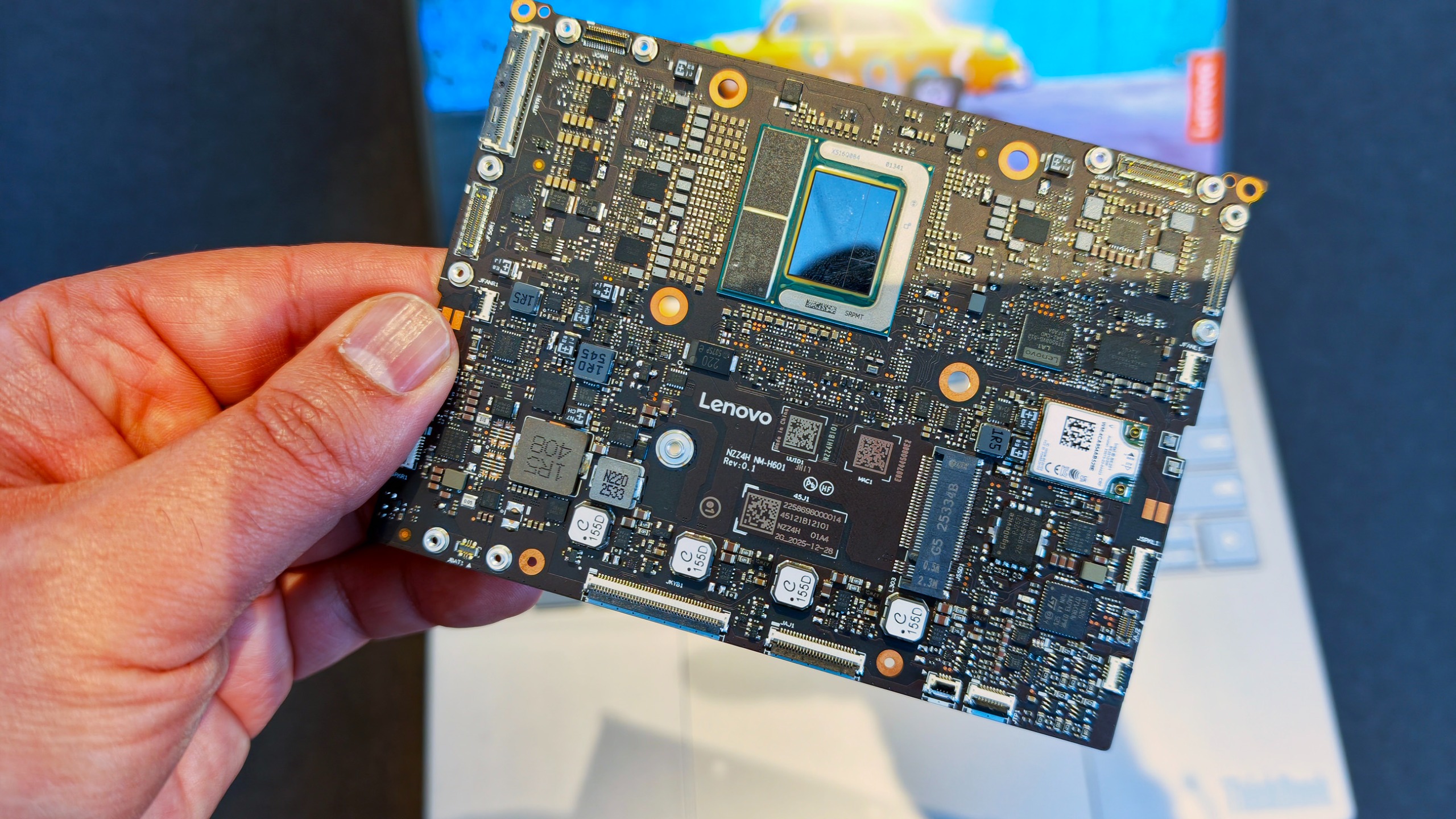
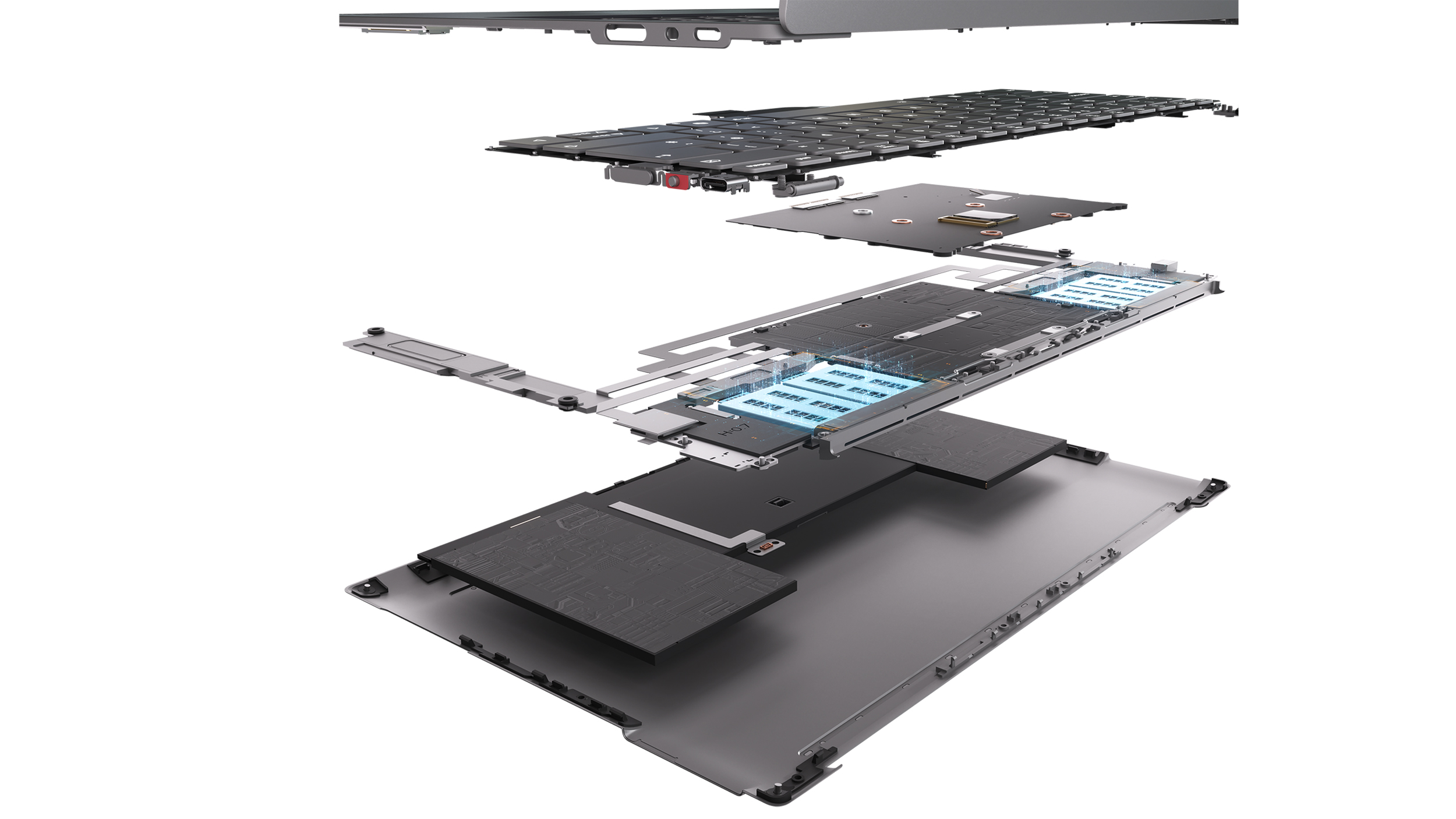
Motherboard and AeroJet cooling system. (Image credit: Future)
And it can't happen soon enough.
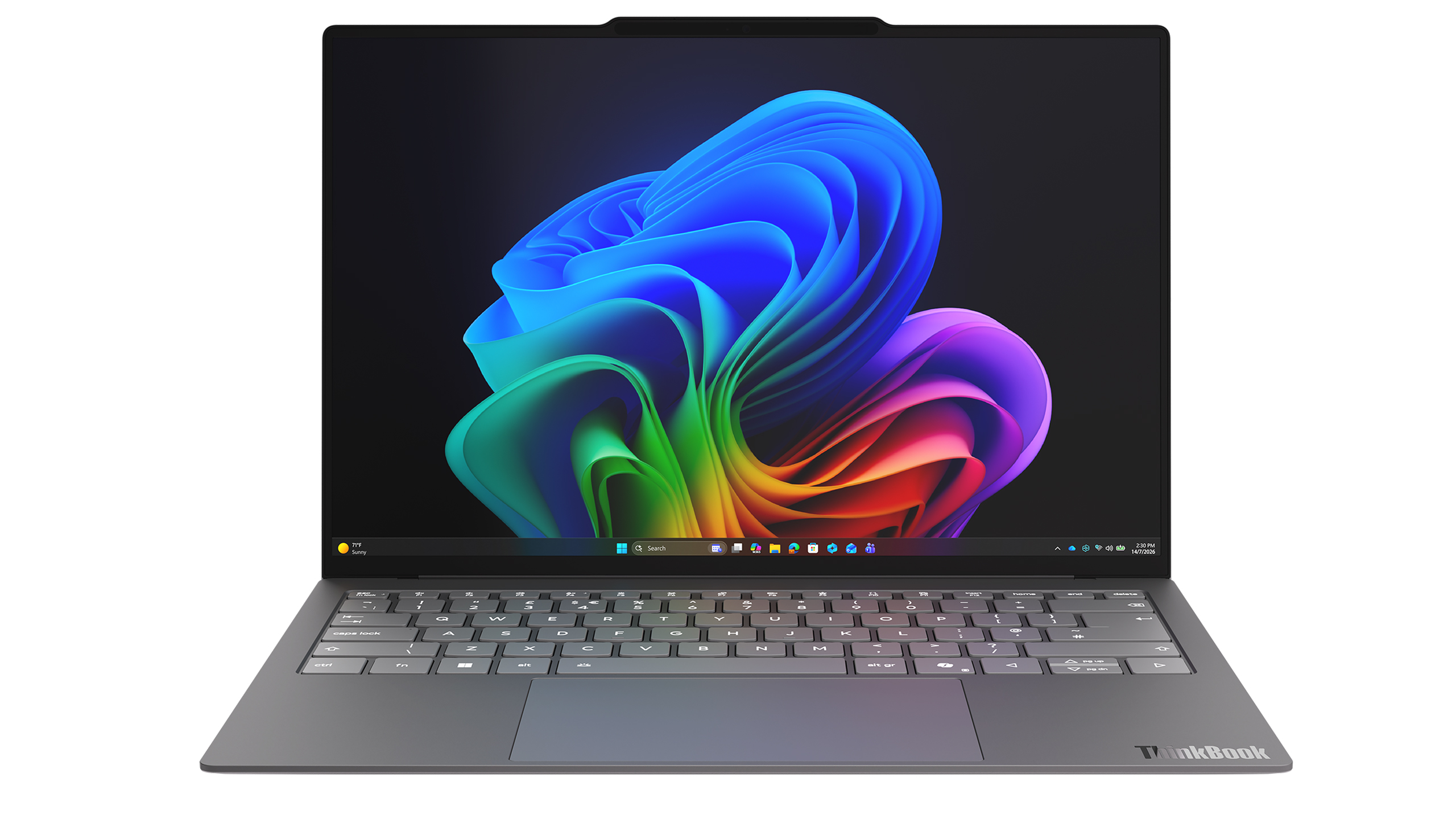
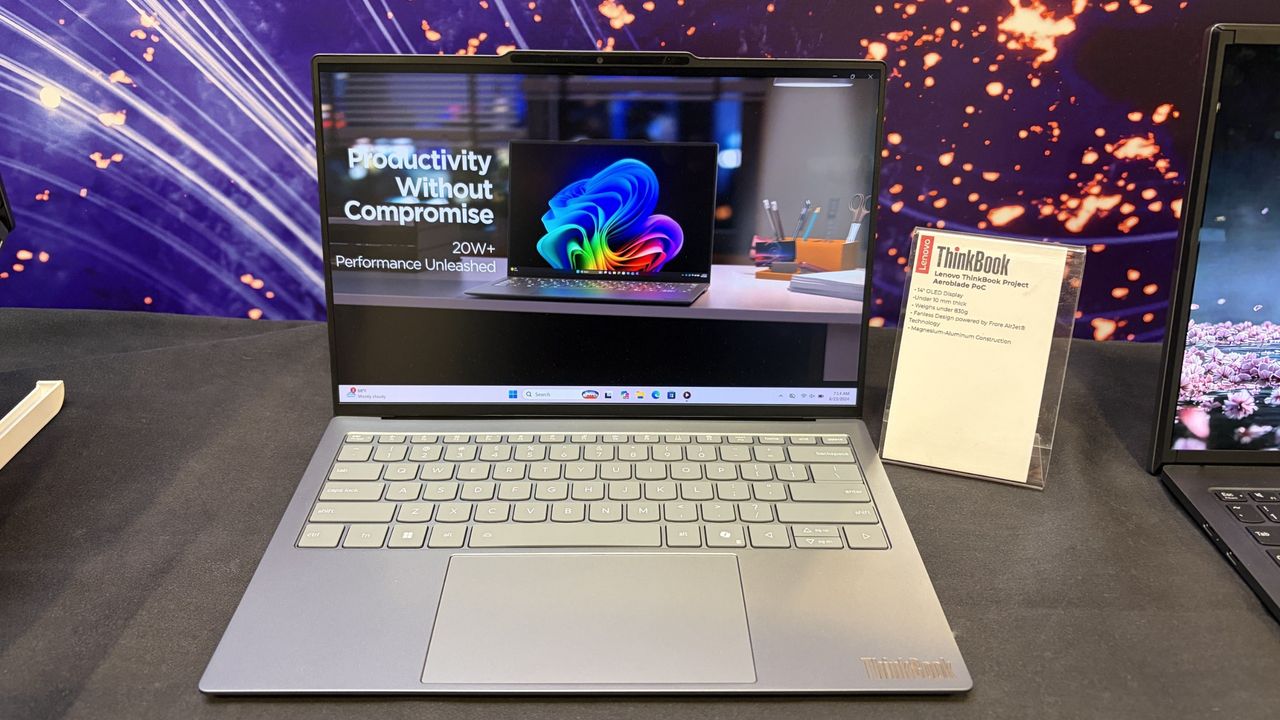
Project AeroBlade is a 14-inch laptop that measures under 10 mm thin and weighs less than 830 grams (1.8lbs). That's lighter than many tablets with keyboard covers attached, yet Lenovo claims performance remains comparable to today's ThinkPad X1 Carbon class of Intel-powered laptops. According to Lenovo, the system achieves this through a completely reimagined thermal design built around its Active Flow cooling architecture developed alongside Frore Systems.
That's the entire motherboad for this laptop👀! (Image credit: Daniel Rubino)
Those numbers don't really hit you until you pick it up.
The first thing that struck me wasn't the thickness. It was the weight. Or rather, the lack of it.
The AeroBlade almost feels unfinished when you lift it because your brain expects more mass. Premium laptops have gotten thinner over the last decade, but reducing weight has become increasingly difficult without introducing compromises. AeroBlade somehow manages to feel substantial and premium while remaining almost shockingly light.
Lenovo says the chassis uses a magnesium-aluminum construction paired with a high screen-to-body OLED display, Thunderbolt 4 connectivity, and Wi-Fi 7. On paper, it sounds like a modern flagship ultrabook. In person, it feels like somebody accidentally removed half the laptop. That's a compliment.
What makes AeroBlade truly interesting, however, isn't how thin it is; it's how Lenovo got there.
The fan is dead. Long live AirJet.
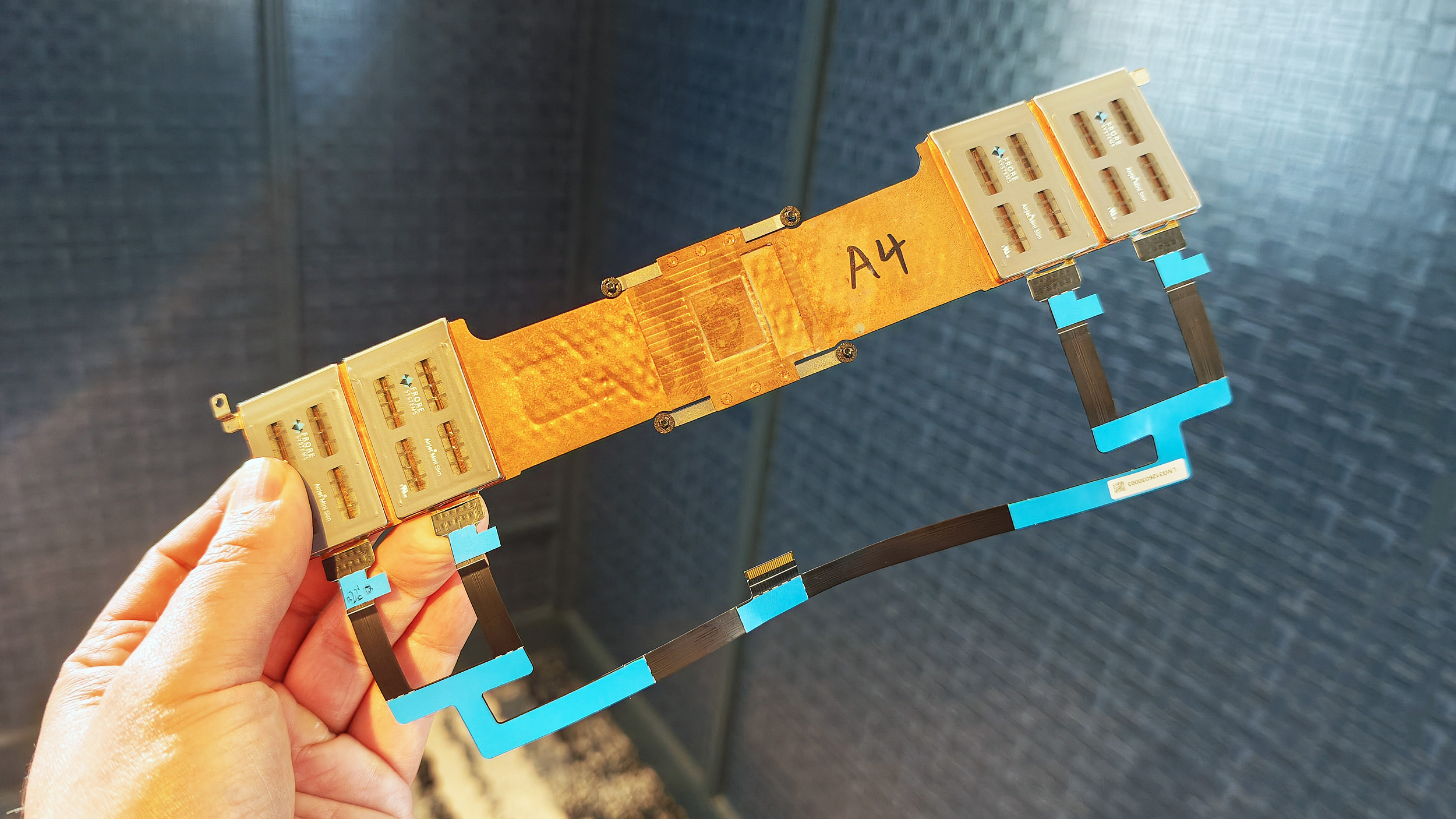
Entire Frore AirJet solid-state cooling strip assembly with copper heat sinks and ribbon cables. (Image credit: Daniel Rubino)
For decades, laptop cooling has largely followed the same formula.
A processor generates heat. Heat pipes move that heat toward a heatsink. One or more fans blow air through the system and out of vents.
The design has evolved, but the fundamentals haven't changed much.
Frore Systems wants to change that.
AirJet is a solid-state active cooling solution that replaces traditional laptop fans with tiny cooling chips that use vibrating membranes to generate airflow. Instead of spinning fan blades, AirJet creates high-velocity pulsating air jets that remove heat while operating at extremely low noise levels. Frore describes it as the world's first solid-state active cooling chip.
One AirJet Mini Slim module is only 2.65mm thick, consumes up to 1 watt of power, removes up to 5.25 watts of heat, and generates significantly higher back pressure than traditional fans. The technology was specifically designed for ultra-thin devices where conventional cooling becomes difficult or impossible.
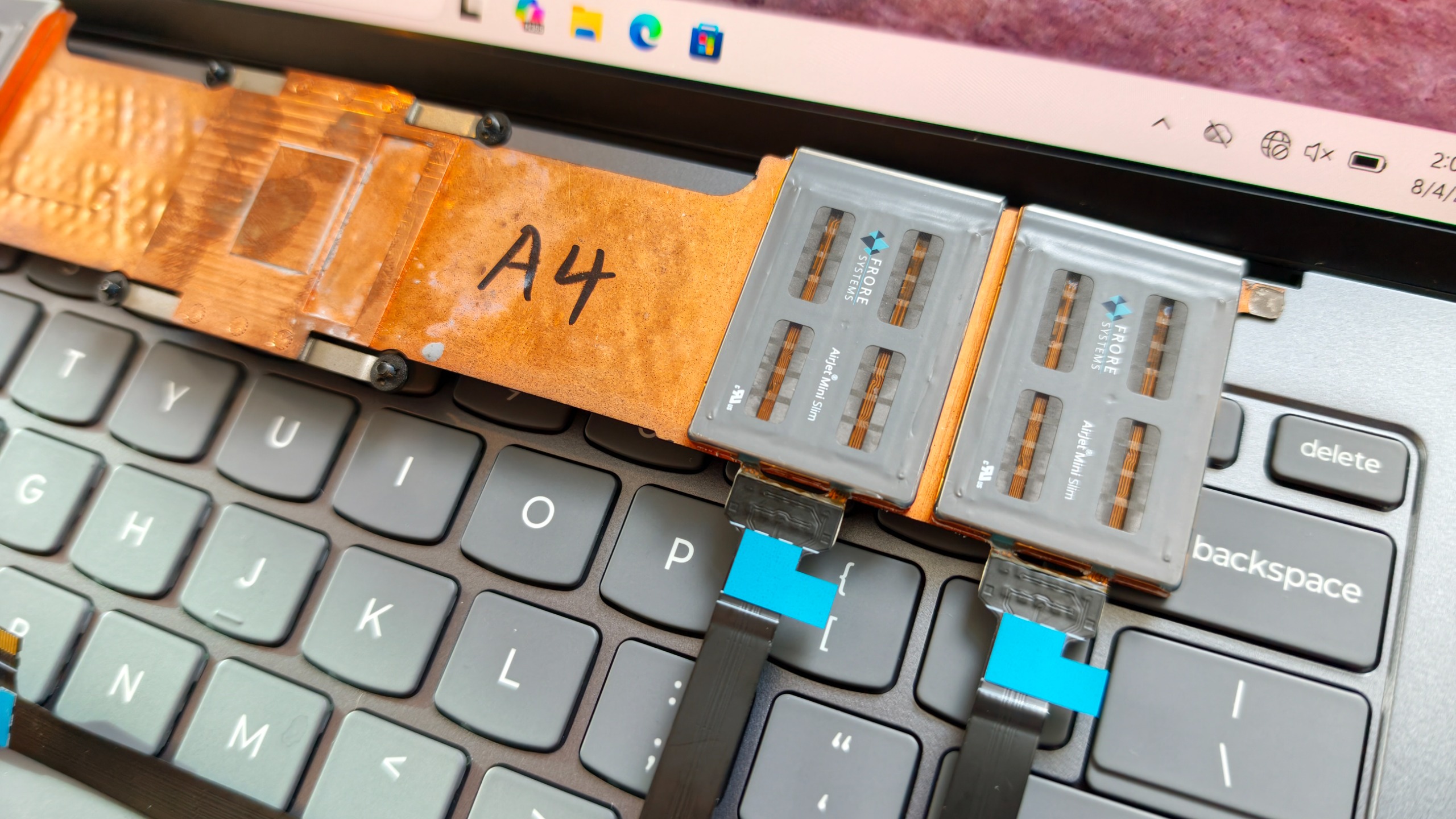
Close-up of two Frore AirJet Mini Slim solid-state cooling chips installed on a copper heat pipe strip above gray laptop keyboard keys showing how they are placed in the laptop. (Image credit: Daniel Rubino)
The clever part is that these modules don't need the large internal spaces required by traditional fans.
Instead of designing a laptop around cooling hardware, manufacturers can distribute AirJet modules throughout the chassis in different locations.
That flexibility is both the technology's greatest strength and its biggest challenge.
During conversations at the event, it became clear why we've seen AirJet demonstrations for a few years but haven't yet seen a flood of mainstream laptops using it.
Exploded diagram revealing the internal layers, motherboard, and Frore AirJet solid-state cooling modules of a Lenovo AeroBlade concept laptop. (Image credit: Lenovo)
This isn't a simple parts swap.
OEMs have spent decades designing motherboards, thermal layouts, and internal structures around conventional fans. AirJet requires engineers to rethink much of that architecture. The cooling solution may be smaller, but integrating it properly involves substantial redesign work throughout the entire system.
That's a lot of engineering investment.
But judging by AeroBlade, the payoff might be worth it.
A laptop with almost no compromises
Rendering of the Lenovo ThinkBook AeroBlade laptop. (Image credit: Lenovo)
The most impressive thing about AeroBlade is that Lenovo doesn't appear to be treating fanless computing as a compromise.
Traditionally, when manufacturers build ultra-thin fanless systems, performance becomes the sacrifice. The device is quiet and portable, but sustained workloads eventually cause thermal throttling.
Lenovo's pitch is essentially the opposite.
Side view of an ultra-thin grey laptop standing open at a 90-degree angle, highlighting its extremely slender display and base. (Image credit: Lenovo)
The company believes Active Flow can deliver sustained AI and productivity performance without the compromises typically associated with fanless PCs. The only noise I noticed during my brief hands-on came under heavier workloads, where there was a faint whooshing sound from moving air. It was subtle enough that I had to actively listen for it.
What I didn't notice were intake vents covering the bottom of the chassis. Hooray!
That's because the cooling system works differently than traditional laptop designs. Air management has largely been pushed toward the rear of the system, creating a cleaner and more minimalist design.
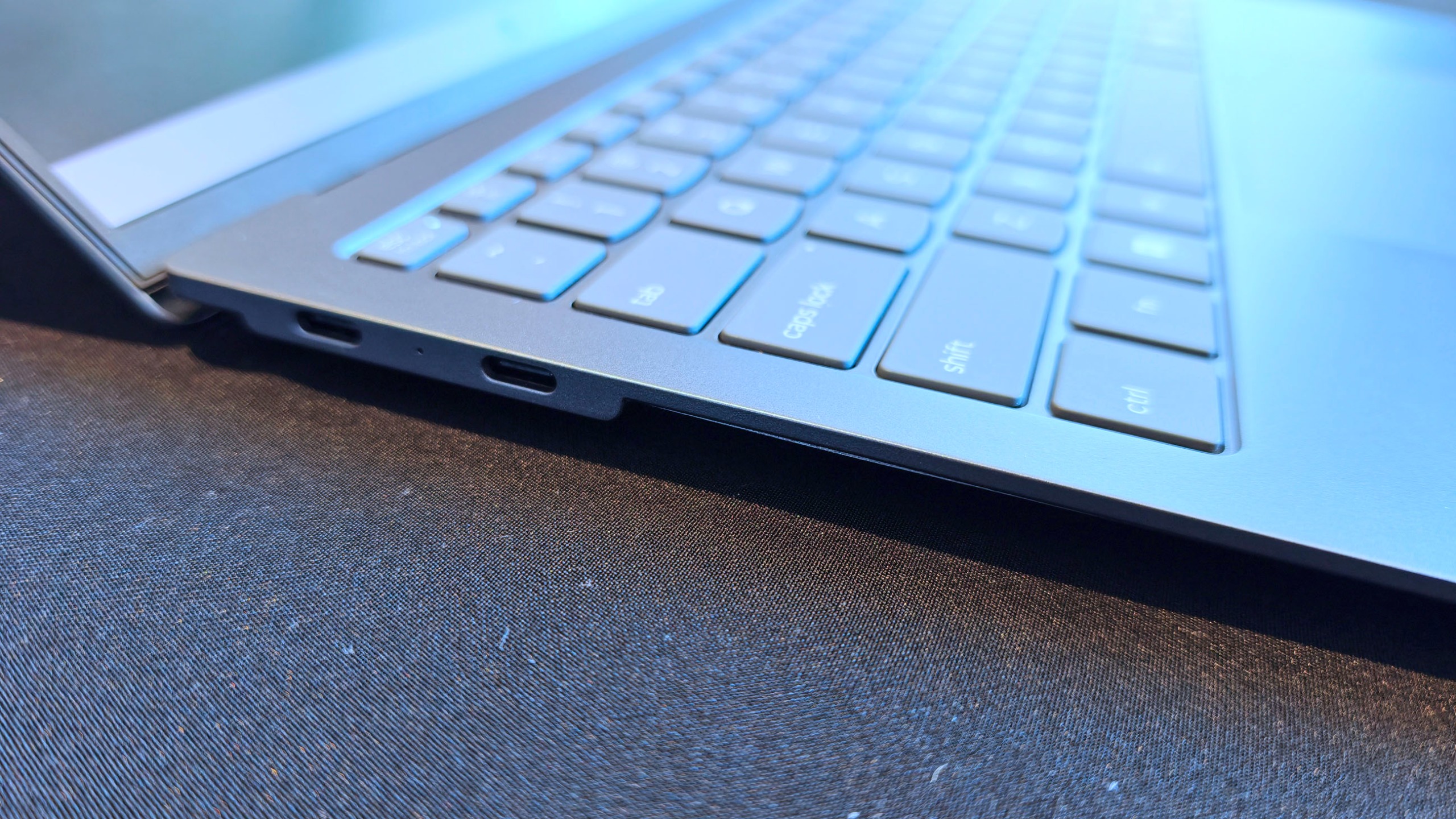
Super thin, but still room for some Type-C ports. (Image credit: Daniel Rubino)
The result is a device that feels almost impossibly refined, and that's why I think AeroBlade is a big deal.
Most laptop innovation over the last few years has focused on AI accelerators, NPUs, display tech, and silicon improvements. Those things are important, but they're largely invisible to users (well, maybe not displays, but still).
In many ways, cooling technology determines what kind of laptop manufacturers can build.
Lenovo could make impossibly thin and light (compared to what we are used to), or use that extra space for a larger battery for absurd laptop longevity. It opens a bunch of engineering doors and options.
The concept that doesn't feel like a concept
Lenovo loves showing proof-of-concept devices, and many never become products.
But the company's track record also shows that some of its most interesting concepts eventually make the jump to production after enough refinement (I'm hoping Lenovo's Legion handheld foldable concept is one of those).
AeroBlade feels like one of those projects. Indeed, this was my first question to Lenovo, as proof-of-concept is often wacky designs, rolling displays, dual displays ... things that look weird but could be useful.
Super thin and light laptop with no vents? Who wouldn't want this? I don't think we really need a focus group to see if it's a good idea!
The hardware already looks polished. The underlying technology exists. The user benefits are immediately obvious. And perhaps most importantly, the industry is constantly searching for ways to make laptops thinner, lighter, quieter, and more efficient.
AirJet checks every one of those boxes.
Will this technology replace fans in gaming laptops with RTX-class graphics anytime soon? Probably not.
But for premium ultraportables, enterprise notebooks, all-in-one desktops, handheld gaming PCs, and productivity-focused systems, I think we're looking at one of the most significant advances in PC design we've seen in years. (We've already openly wondered about Aerojet in a Steam Deck 2).
So, yeah, ironically, the biggest innovation at Lenovo's event wasn't AI.
It was airflow.
Join us on Reddit at r/WindowsCentral to share your insights and discuss our latest news, reviews, and more.
Dell just announced a new laptop to take on Apple's MacBook Neo. The Dell 14S is a colorful laptop designed for college students and young adults, which helps the PC compete with the MacBook Neo's colorful range.
The Dell 14S should be a budget-friendly PC, though Dell has not released pricing for the laptop yet. The laptop has an aluminum body and a nice selection of ports, including two USB 3.2 Type-C ports, an HDMI port, and a 3.5mm headphone jack.
The Dell 14S and the Dell XPS 13 released earlier this year both compete with the MacBook Neo, but they do so in different ways. The XPS 13 has a better display, Wi-Fi 7, a backlit keyboard, and is a more premium device.
The Dell 14S promises all-day battery life, is available in several colors, and has a 16:10 display.
People who were intrigued by the low price of the MacBook Neo but want the look of a premium laptop running Windows 11 will likely prefer the newest XPS 13. Those who like the colorful tone of the MacBook Neo but want a lightweight and affordable device running Windows 11 will probably lean toward the Dell 14S.
Dell's confusing naming scheme
Dell is still struggling with naming its products. The company abandoned the XPS lineup and got rid of its entire consumer-focused strategy but has since backtracked and brought back XPS. But the company seems confused on what XPS means to customers.
If you head over to Dell's webpage about the New Dell 14S, you'll see a comparison chart that includes the New Dell 14, New Dell 14S, and Dell 14S. Incredibly, they are quite different from each other.
Listing two laptops side-by-side and having one labeled as "new" is fine. It's somewhat similar to how car companies handle naming, though the automotive industry often just attaches a year within parentheses.
Sticking with that analogy, if you look at a 2025 Honda Civic and a 2026 Honda Civic, they should be somewhat similar vehicles. Barring a complete overhaul, a new version of a model should resemble its predecessor.
If there is an overhaul, it's usually a linear progression, such as when Dell shifted from the old-old XPS to the once-new-but-now-old XPS.
If you did not already know which of the below PCs were XPS laptops, could you easily guess which are in that family of devices?
Zac Bowden / Windows CentralFuture | Daniel RubinoDell
What is an XPS device in 2026? The new XPS 14 is a premium device featuring an Intel Core Ultra 7 processor or more powerful processor. The not-so-new but still great XPS 14 shares a similar design and also has an Intel Core Ultra 7 chip, albeit an older one.
So, XPS laptops are premium machines with high-end processors and a design resembling the XPS laptops from recent years, correct? Nope. The XPS 13 from this year is a budget-focused PC with options powered by an Intel Core Ultra 3 chip.
Other differences stand out, such as the latest XPS 13 having options with 8GB of RAM compared to the 16GB minimum of the new XPS 14.
Please understand, I think the latest XPS 13 and XPS 14 are excellent laptops. I predict the Dell 14S will also be a solid PC. But I don't understand what Dell is doing with its XPS brand. The company seems to have remembered that consumers value the XPS brand and has chosen to etch the XPS logo onto things willy-nilly.
Join us on Reddit at r/WindowsCentral to share your insights and discuss our latest news, reviews, and more.
The memory crisis continues to get worse, driving the price of gaming laptops to ridiculous extremes while scaring people into buying them despite the price hikes out of fear that their prices will worsen before they get better.
Thankfully, retailers will always continue to offer brief respites from this crisis with generous discounts for the best gaming laptops.
For example, one of our top-rated gaming laptops, the ASUS ROG Strix G16, has had its steep listing price of $2,299.99 brought down to $1,749.99 at Best Buyuntil the end of Best Buy's Labor Day Sale on September 7, 2026.
"The latest ASUS ROG Strix G16 takes full advantage of AMD's most powerful mobile processors to offer excellent performance and a consistent gaming experience, and may end up being an underrated value-play in the premium gaming laptop segment this year." ~ Zachary Boddy, Former Staff Writer
Why buy the ASUS ROG Strix G16 gaming laptop (AMD)?
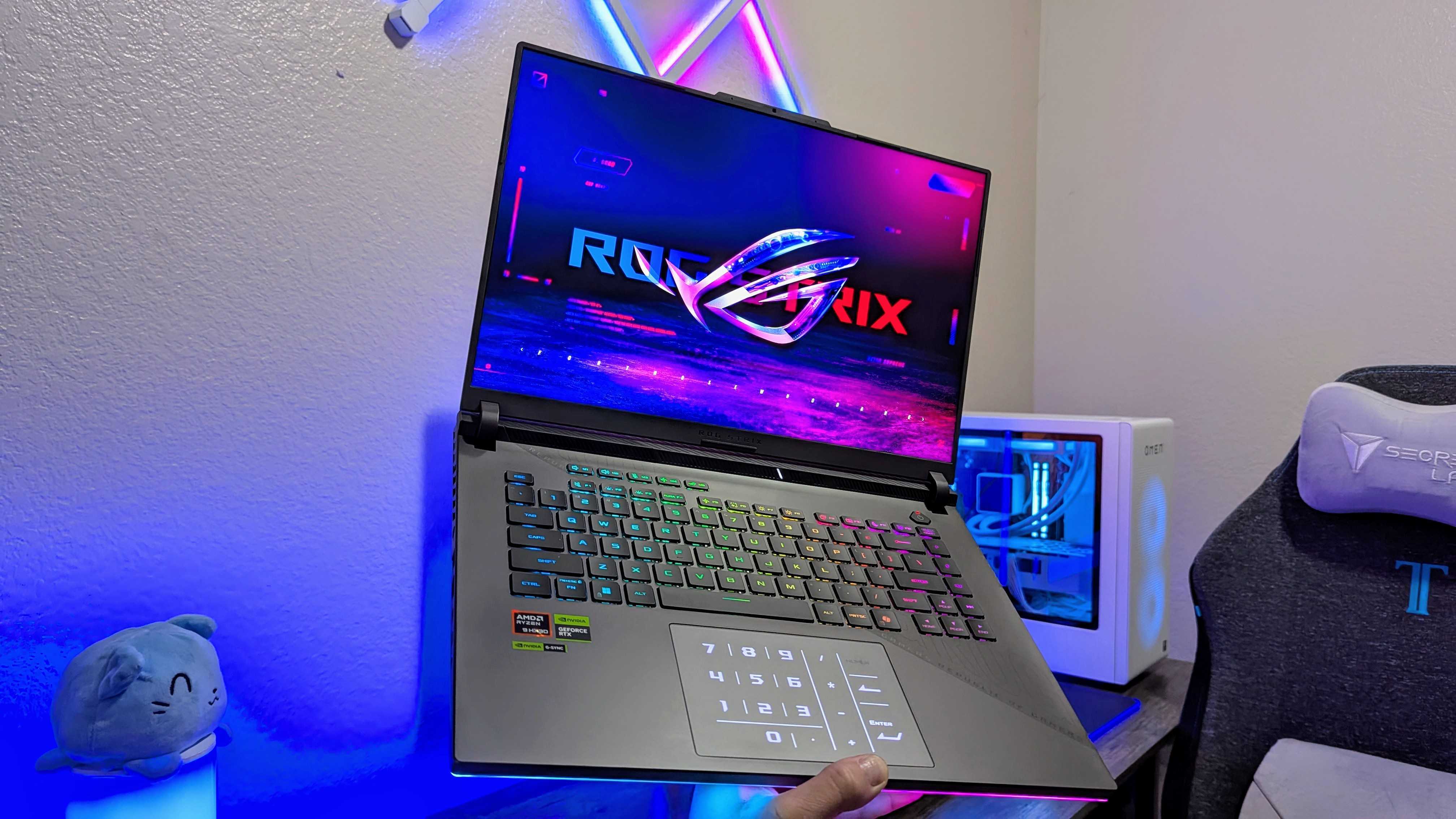
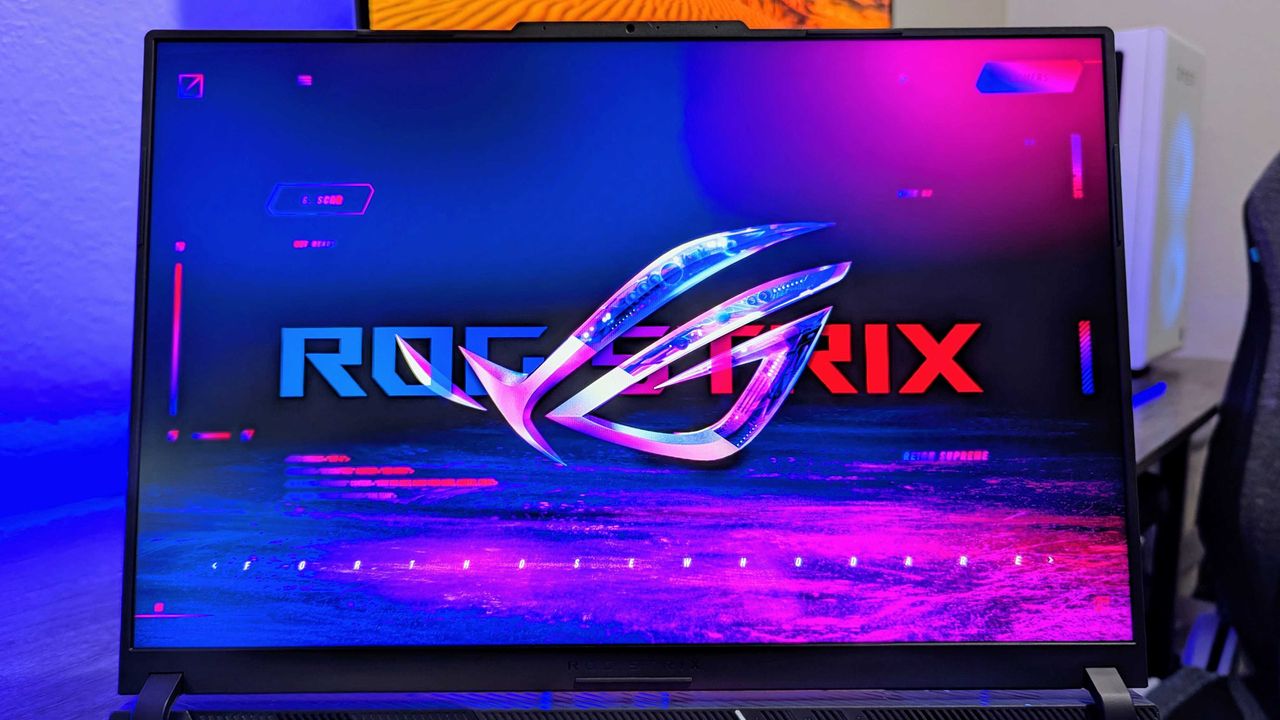
The ASUS ROG Strix G16 in hand. (Image credit: Windows Central (Zachary Boddy) | ASUS)
Of all the best gaming laptops we've personally tested, the ASUS ROG Strix G16 remains one of the finest for those who prefer to outfit their desktops with AMD hardware.
As noted in our 4.5 Star Review of the ASUS ROG Strix G16, it delivers exceptional performance, capable of running graphically demanding games like Cyberpunk 2077 at 69 fps or over 140 fps thanks to its NVIDIA GeForce RTX 5070 TI graphics card, 16GB of RAM, 1TB SSD, and AMD Ryzen 9 8940HX processor.
In addition, this laptop features an LED, FHD, IPS display capable of rendering images and videos at vibrant and colorful 1600p resolutions with refresh rates of 165 Hz and a max brightness of 300 nits.
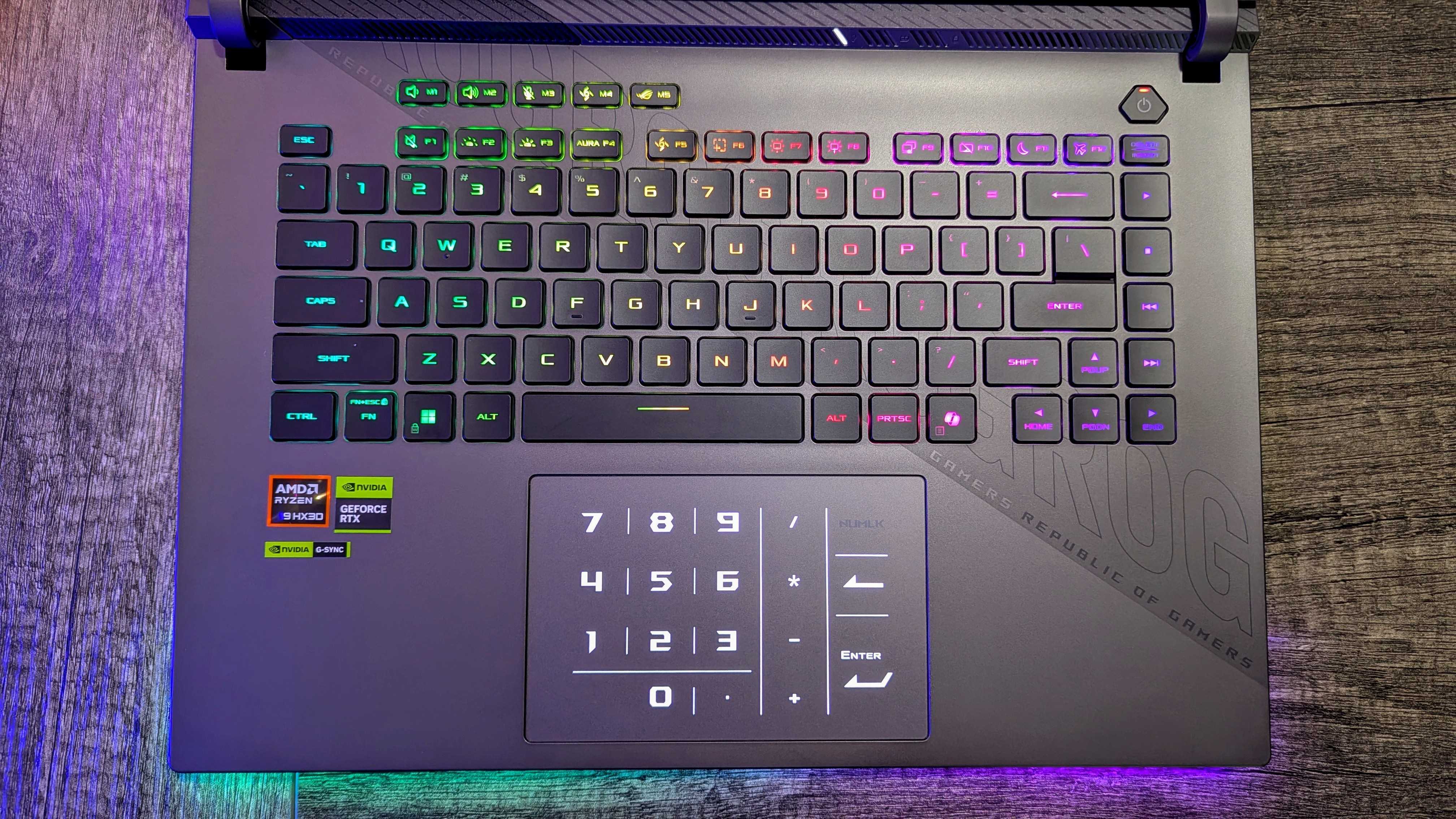
Close-up of the ASUS ROG Strix G16's keyboard. (Image credit: Windows Central (Zachary Boddy) | ASUS)
Combine these specs with a comfy keyboard with extra buttons, and you've got a powerhouse gaming-on-the-go machine that will let you play your favorite games with sublime graphical details and smooth-as-butter gameplay input responsiveness.
So, if you don't mind a laptop with a mostly plastic design and prefer using AMD processors rather than Intel ones, then the ASUS ROG Strix G16 gaming laptop that's now $1749.99 at Best Buy won't steer you wrong.
I know it certainly pleased my former colleague, Zachary Boddy, when he said, "The ROG Strix G16 isn't trying to compete with the most premium devices from Razer or Lenovo, and instead offers a lot of power in a solidly built chassis, paired with a fantastic keyboard and a comfortable display. It could be the underdog of the premium gaming laptop segment."
FAQ
How long will Best Buy's Labor Day Sale last?
Best Buy's Labor Day Sale will last until September 7, 2026
Is its RAM upgradeable?
The ASUS ROG Strix G16 gaming laptop can have its RAM upgraded to a max limit of 64GB via its two DDR5 SODIMM memory slots.
Can its storage space be upgraded?
The ASUS ROG Strix G16 gaming laptop can have its storage upgraded by inserting NVMe PCIe 4.0 SSDs via its two M.2 2280 slots, each of which can support up to 2TB of space for a grand total of 4TB.
Join us on Reddit at r/WindowsCentral to share your insights and discuss our latest news, reviews, and more.
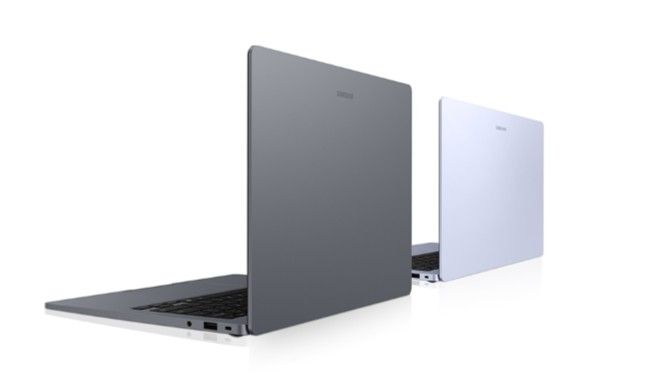
As PC prices continue to rise, seeing a new release at $799 is a welcome sight, and that's where we're at with the new Samsung Galaxy Book6.
It's a decidedly mid-range laptop, but at a mid-range price, and it's not like you're really losing out on much, either.
That is, as long as you're not (for some reason) looking to have Copilot+ since the NPU on the included Intel chips doesn't meet the standard. But it's 2026, so there's still plenty of AI focus on tap, with Samsung's own tools.
Despite the more affordable price, the 14-inch Samsung Galaxy Book6 doesn't skimp on one key spec: Battery life. Samsung claims up to 25 hours, backed by 45W charging that can add 33% charge in half an hour if you do need a top-up.
But in real-world use you're looking at a laptop that will easily get you through a full day off the charger, be that for work or for school. Here's what we're looking at spec-wise:
Dimension
313.0 x 221.0 x 15.7mm
Weight
1.35kg
OS
Windows 11 Pro 25H2 (64-bit) / Windows 11 Home 25H2 (64-bit) Linux (Console only)
Display
14.0″ LCD WUXGA (1920×1200), 350 nits
Processor
Intel® Core™ 5 processor Intel® Core™ 3 processor
NPU
Intel® NPU (up to 15 tops)
Graphic
Intel® Graphics
Network
Wi-Fi 6E, Bluetooth v5.4, 802.11 ax 2×2
Color
Violet Silver, Gray
Memory
8GB/16GB (LPDDR5X)
Storage
256GB/512GB/1TB (PCle)
Camera
2MP (1080p FHD)
Audio
Internal Dual Array Digital Microphones Stereo speaker (2Wx2), Dolby Atmos®
Keyboard
Pro keyboard (Non-Backlit keyboard)
Trackpad
Clickpad
Battery
61.2 Wh (Typical)
Charging
45W USB Type-C Adapter
Port
USB Type-C x 2, USB Type-A, HDMI 1.4 port (Supports 4K@30) Headphone/Microphone
I like that there's anti-glare, and I like that there's a decent array of ports, including a full-sized HDMI output. While the cheapest version will be the Intel Core 3, with the lowest RAM and storage on offer, there is at least an option at an attractive price, and for many, it'll be plenty.
Being a Samsung laptop, if you also use a Galaxy smartphone or tablet, you'll unlock some additional integration, such as second screen support and the ability to use a single keyboard and mouse across multiple devices.
Galaxy AI has a few neat features, too, despite the low-powered NPU on the Galaxy Book6, with some useful tools for images and note summarization.
It's also available in two colors, a dark gray and a "Violet Silver." The Galaxy Book6 isn't going to set performance records, but that's not who it's for. It's for someone who wants a good-quality laptop to do everyday, normal things, and for that, it doesn't look bad at all.
Join us on Reddit at r/WindowsCentral to share your insights and discuss our latest news, reviews, and more.
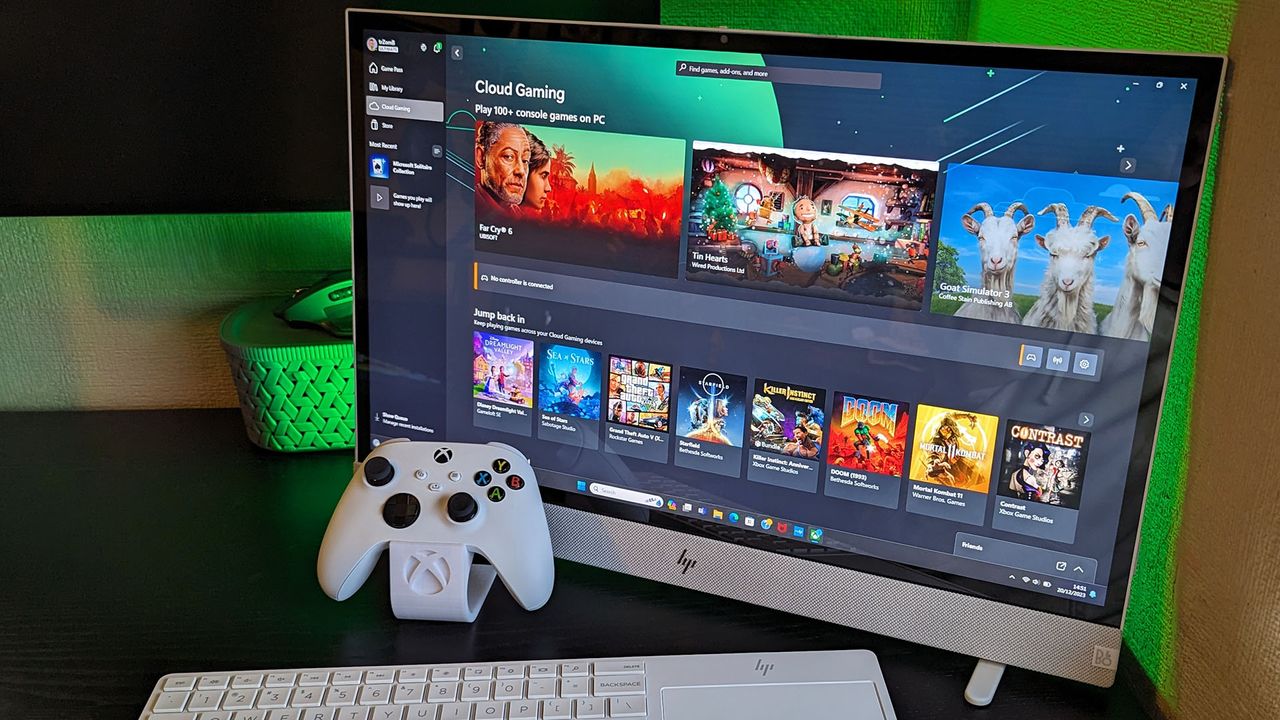
Back in 2023, HP released the Envy Move, an all-in-one (AIO) PC with a clever quirk: It could run wirelessly on battery power. The average lifespan was around 4 hours, but it was enough to watch a movie, join a video call, or have a playful family interaction with its touchscreen on whatever app or website you wanted.
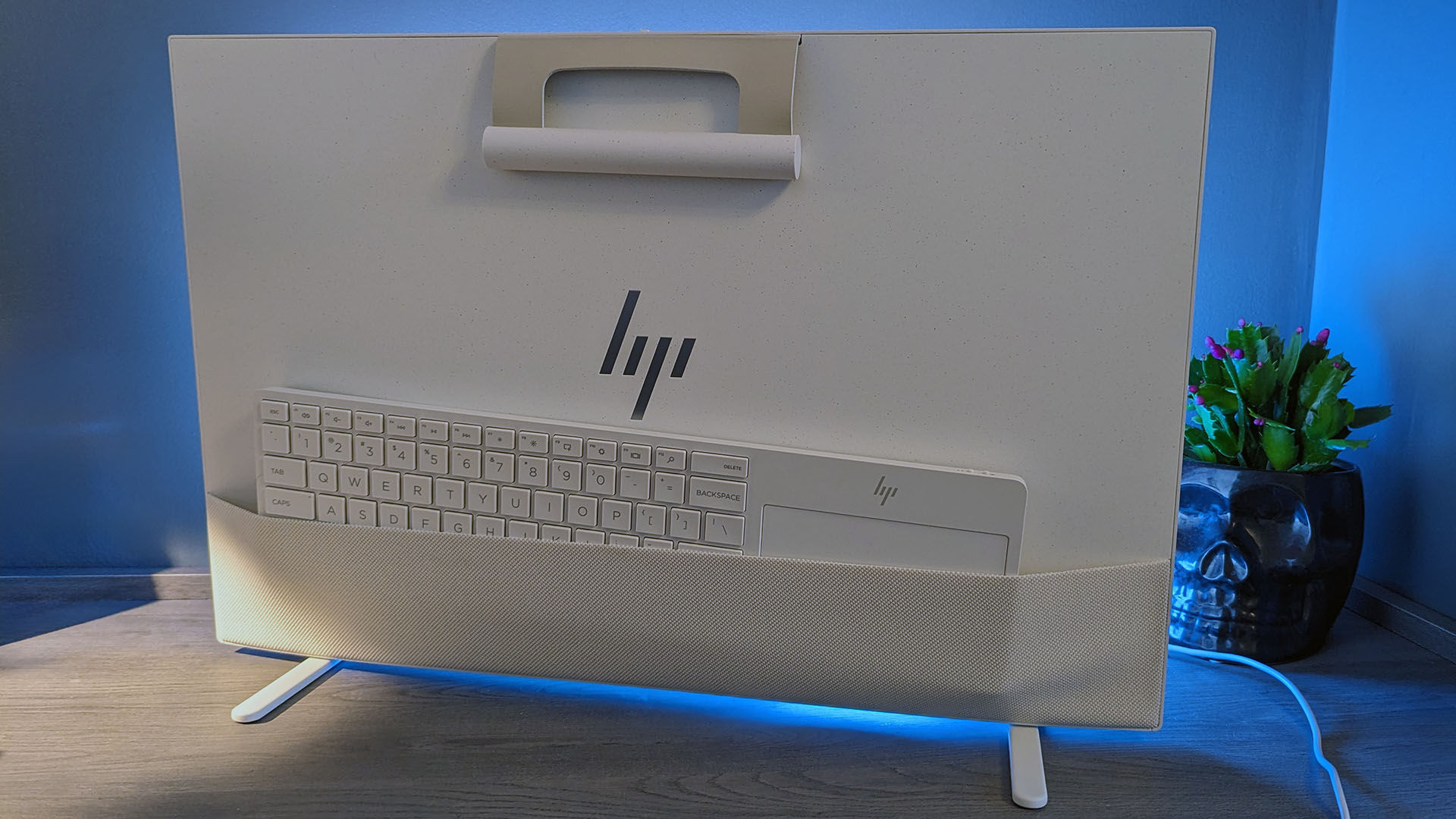
To make it even more portable, HP included a built-in handle attached to a flexible loop on its top side, pop-out feet on its underside, and a rear pouch that held a keyboard with an included touchpad. It was genius; a 24-inch touchscreen PC with great speakers that moved wherever you needed it.
Its design could have used some tweaks, but its downsides didn't feel at all severe, resulting in a perfect score in my Envy Move review. It was the most remarkable sample I'd ever tested, but it quickly became evident that consumers weren't interested enough to choose it over a traditional laptop or desktop.
This portable PC deserved more
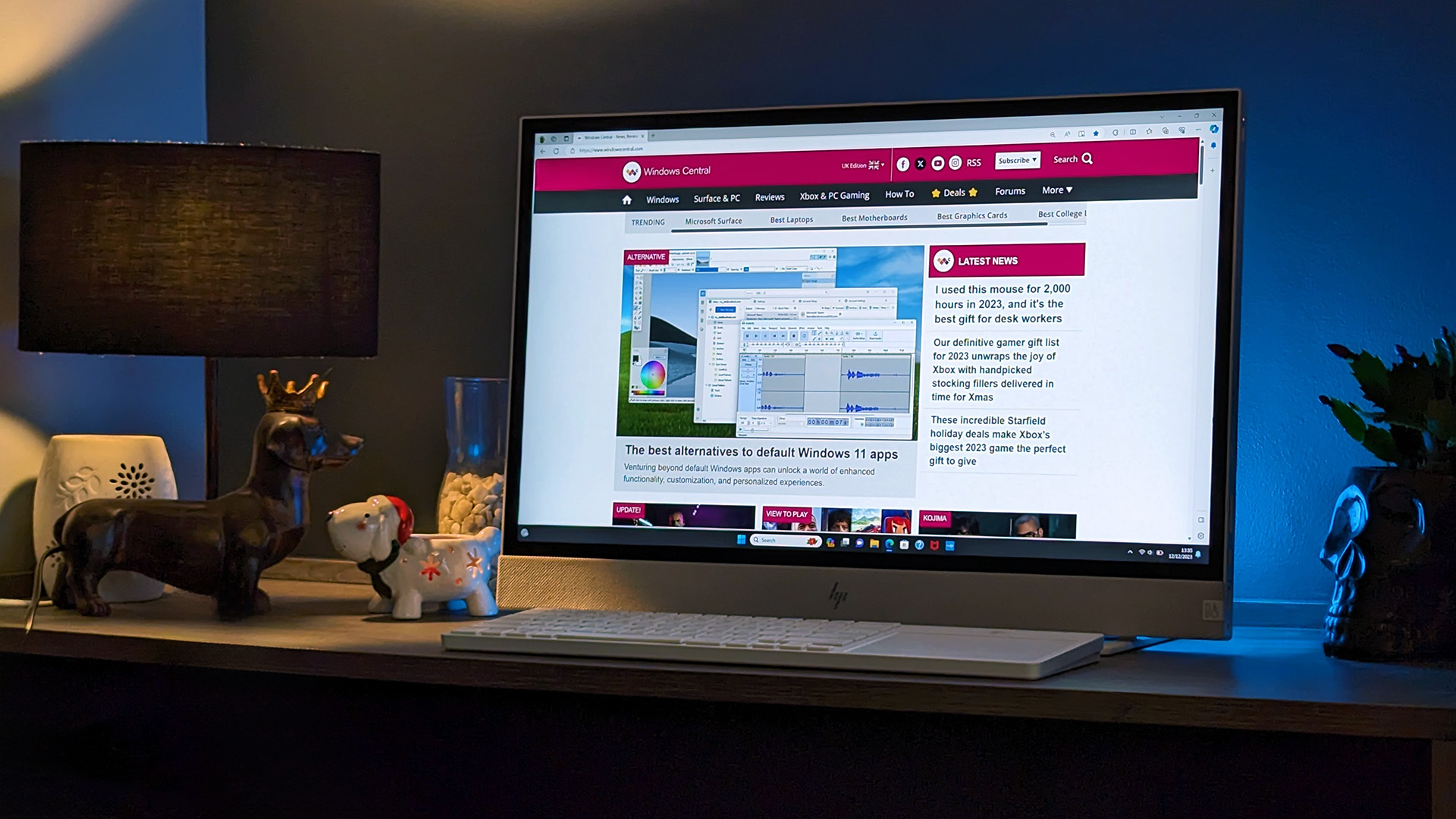
Not quite a desktop, but certainly more than a laptop, HP's Envy Move was a unique AIO PC. (Image credit: Ben Wilson | Windows Central)
Following my review in 2023, the Envy Move was later discontinued from HP's official storefront and third-party retailers across the world, while the broader Envy range itself was dropped alongside the Spectre, Pavilion, and Dragonfly names, in favor of a major HP portfolio overhaul that introduced 'Omni' and 'Elite' PCs to replace them.
HP all-in-ones now sit alongside higher-end models like the impressive OmniStudio X, but nothing replaced the Envy Move, leaving any remaining stock with its already modest Core i7-1355U mobile processor from Intel's 13th generation. It was never intended to be a high-performance machine, but I'm sure modern, efficiency-centric Intel chips would have supercharged it perfectly.
Then again, if previous-generation components could maintain the ~$900 price tag on an Envy Move with 16GB of RAM and 512GB of storage, I'd let it slide. Frankly, I doubt many customers in HP's target audience would care to scrutinize its specific choice of processor, especially when the experience is great nonetheless, but future models could have been even better.
Too quirky to live, too clever to die
Its wireless keyboard and touchpad tucked away for transport in a cute pouch. (Image credit: Ben Wilson | Windows Central)
In the following summer, HP's Envy Move made a few appearances at my family gatherings and various parties, watching UEFA Euro 2024 matches in a shaded garden during BBQs in the best weather. At one point, I even connected an old Guitar Hero controller to its built-in Bluetooth receiver and turned it into a type of arcade machine; it was so much fun.
Everyone who would listen was impressed by what I could demonstrate, but nobody was particularly interested in replacing their long-lasting laptops or self-built desktop PCs. Its appeal should have been clear; anyone looking to share a family PC with their children would surely love its touchscreen and a general theme of collaboration, but it still fizzled out.
It's just the way she goes. Sometimes, brands take a risk and let something unusual escape the concept phase, but it never comes with a guarantee that enough people will buy it. I've seen plenty of oddities at conventions like CES, but they usually come with the understanding that it's just brands flexing their manufacturing muscles, showing what they could do if they wanted to.
The Envy Move felt different, but it ultimately doesn't matter how much I admired it, at least not compared to the sales figures that PCs need to pull in to stand a chance. Instead, I just keep my fingers crossed that it could make a comeback someday, or that the people who helped the Envy Move earn a Good Design award would at least know how much I admired what they made.
To be clear, the only reason I suddenly felt all nostalgic and bubbly about an AIO PC is that I started seeing bizarre knockoffs popping up on TikTok and Instagram Reels. Strange, Android-based screens lampooning the same kind of unique selling point as the Envy Move, pulling in frustratingly positive comments about how good the idea is — I know it's a good idea.
Laptops are great, and custom-built desktop PCs are even more rewarding when you can afford it, but all-in-one PCs still have their place. HP tried something unique with the Envy Move, and it's something I'll still praise in the hopes that it tries again when the timing is right (if that ever happens). Let's see what turns up at CES in 2027.
Join us on Reddit at r/WindowsCentral to share your insights and discuss our latest news, reviews, and more.
I've used Windows PCs for most of my life, and I've tested some of the latest laptops from the most reliable brands for the last half-decade. Even before that, I worked in retail, specifically advising on laptops and helping people spend their money where it makes the most sense. So, despite spending most of my time on desktop PCs, I'm savvy with laptops.
For the most part, my criteria for choosing a laptop relate to how well it travels with me. I take regular trips by plane, train, and car to work from hotels and conventions, all with their own limitations and considerations, which has narrowed my list of must-haves to seven non-negotiables. If you're considering a new Windows laptop, this is what matters the most to me.
1. An OLED display for better contrast
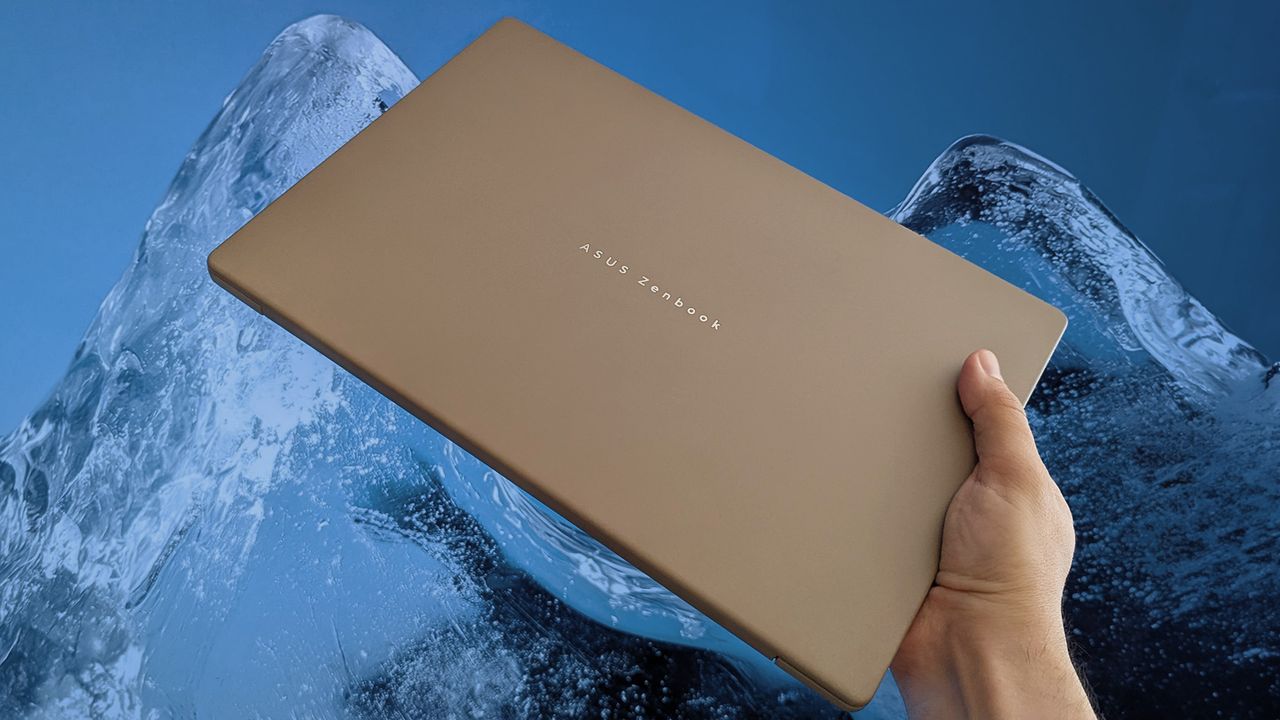
ASUS Zenbook A14 (2026) (Image credit: Ben Wilson | Windows Central)
I was a skeptic for a long time, but OLED laptops have won me over when I'm looking for a new daily driver. Offering better contrast with deeper blacks than traditional IPS screens, many of these color-rich panels also deliver higher-than-average max brightness, though I generally keep mine at around 250 nits. Most of my apps are in dark mode, too, so my average experience looks great.
You can go even more advanced with a mini LED screen, such as the one I tried in Lenovo's Slim Pro 9 a few years ago that reached an incredible 615 nits, but it's far and above anything I've ever needed. OLED is a noticeable improvement over LCD, and many, myself included, will find that anything beyond that yields diminishing returns if you aren't a professional image or video creator.
2. 14-inch chassis (and lightweight)
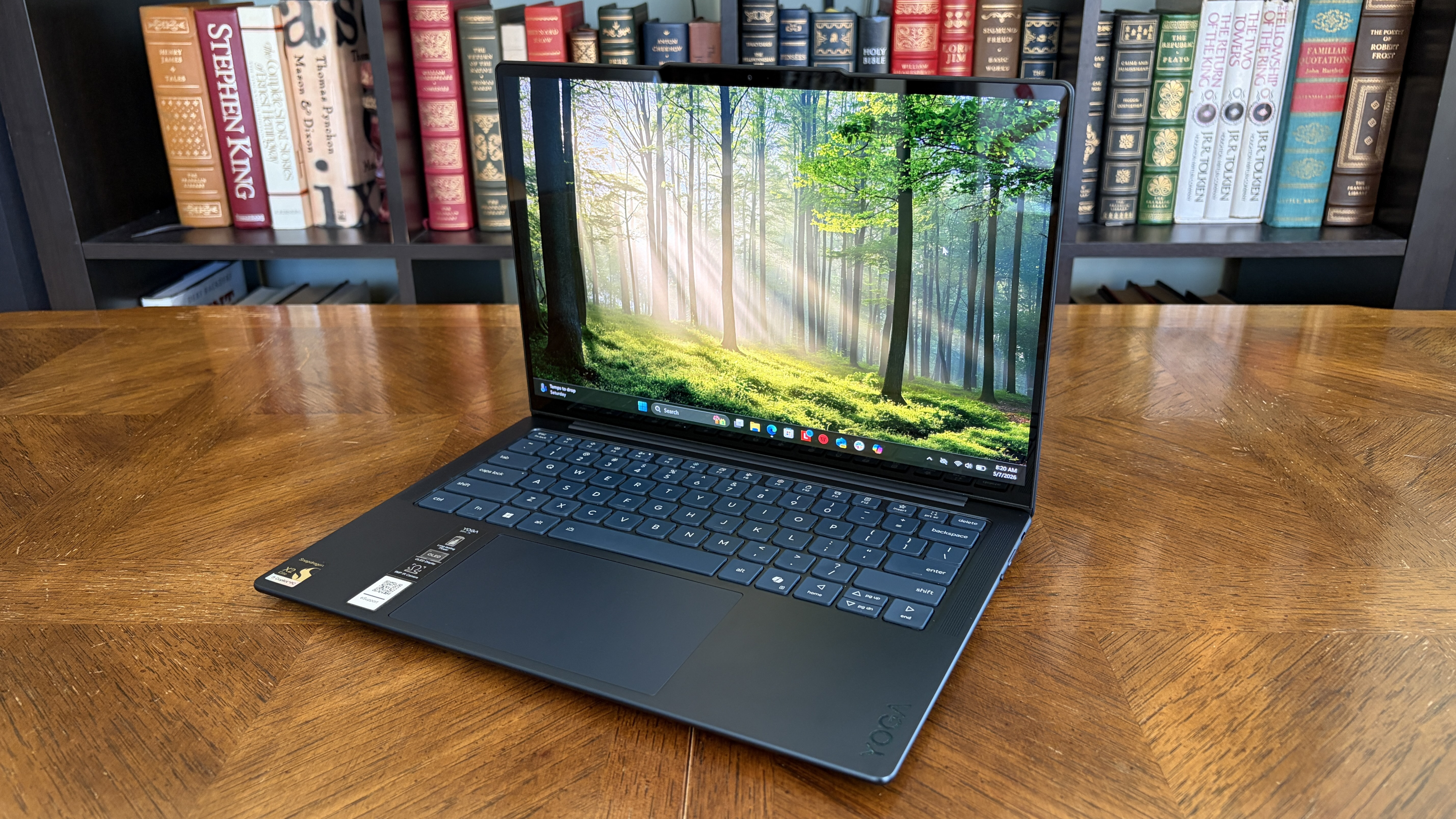
Lenovo Yoga Slim 7i Ultra (Gen 11) Aura Edition (Image credit: Ben Wilson | Windows Central)
It sounds unusually specific, but after traveling with laptops, I found that 14-inch models with 16:10 ratio displays offered me the best experience. They fit perfectly in cramped travel environments with tray tables and tiny tables, yet still feel spacious enough in a hotel room when I can connect an external mouse. A 13.8-inch Surface Laptop 7 with a 3:2 screen also passes.
Anything around or below 2.65 lbs (1.20 kg) is a bonus, as I'm regularly throwing these compact laptops into rucksacks or whatever carry-on I'm lumped with at the time. However, the lightest laptops are rarely the most affordable, as Lenovo's Yoga Slim 7i Ultra Aura Edition I tested clearly demonstrated with its 2.15-lb (975 g) chassis. The trick is to find something within that ideal window.
3. At least 512GB of storage
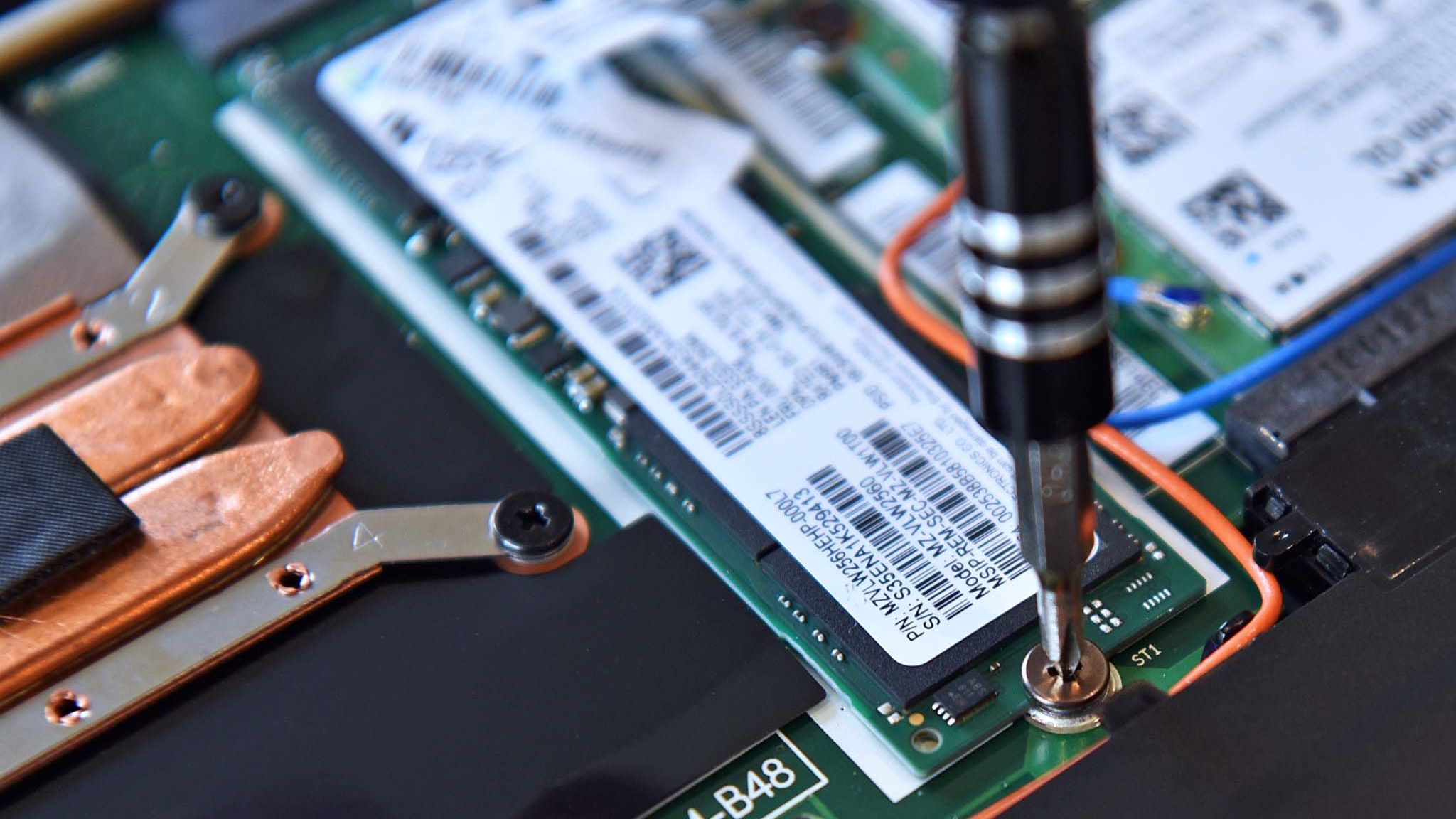
M.2 SSD in a Lenovo ThinkPad X1 Carbon (Image credit: Cale Hunt | Windows Central)
Plenty of Windows laptops are listed by major retailers with 256GB of storage, particularly in budget models. That kind of entry-level drive is aimed firmly at casual users who mostly stick to web browsing, but it's never enough for me. Images and video files build up in my workflow, and I'm often hovering around half capacity on a 512GB drive.
To be transparent, my desktop PC has twin 1TB drives, but that's mostly for games and other gigantic software that I'd never need on the road. Plus, if I tried hard enough, I'm sure I could offload some of my largest files onto external drives, but I'd rather not travel with extra gadgets if I don't have to. 512GB has been perfect for years, and I don't see that changing.
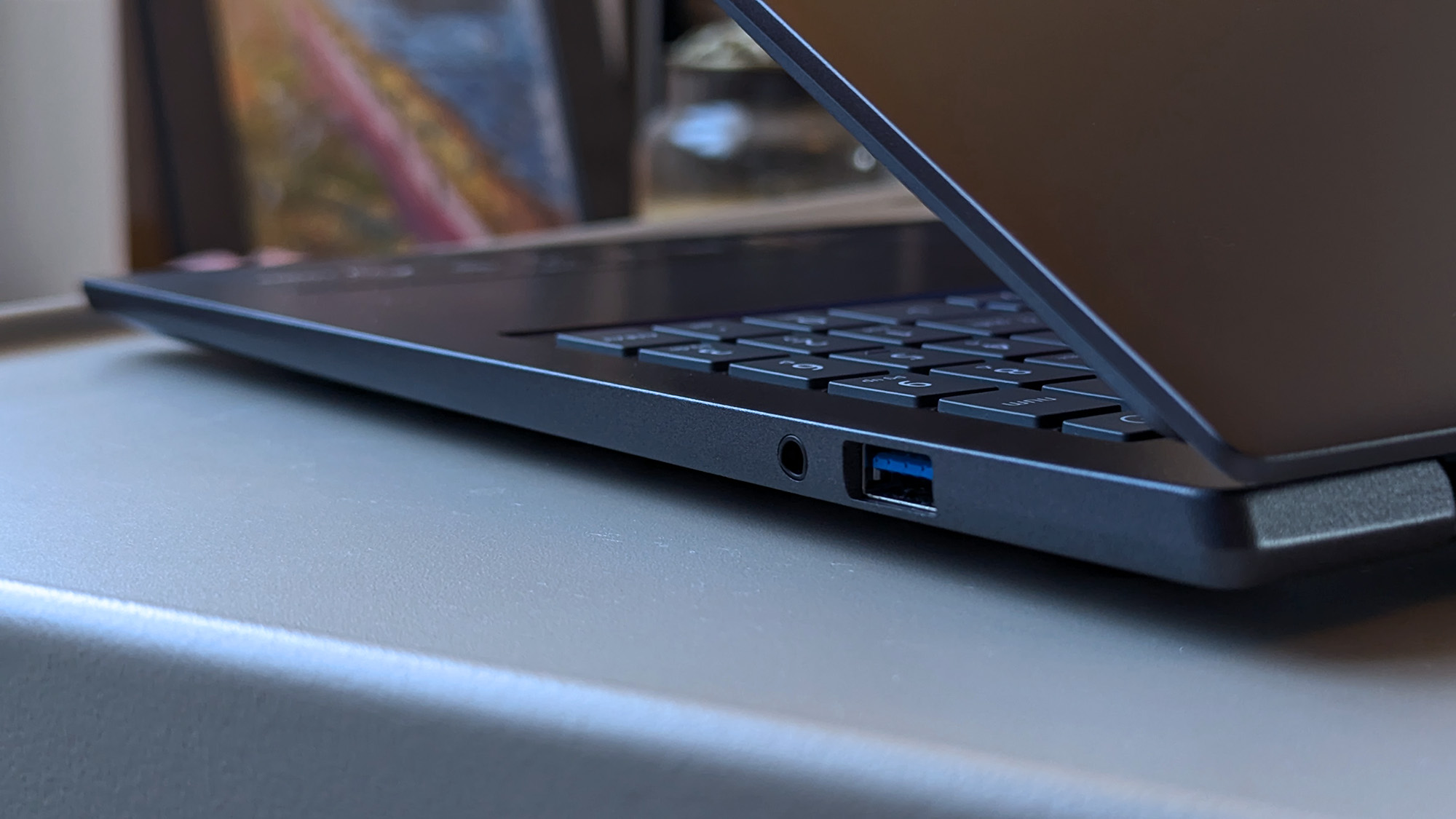
4. At least one USB-A port
Acer Swift Go 16 AI (Image credit: Ben Wilson | Windows Central)
My dinosaur bones are showing. This is mostly about me hanging on to hardware for as long as possible, including my most-used flash drives and dongles for an older mouse. USB-C variants are out there and becoming quite common, but I have too many USB-A accessories that show no sign of wearing out, and I'm keeping them.
If you narrow your search to the absolute thinnest possible laptops, you'll find that USB-A ports disappear. Not a big deal if you have modern peripherals compatible with USB-C ports using popular standards like Thunderbolt 4 and USB4, but at least one full-size offering is a traditional mainstay that I'll always look out for. Wired headphone jacks are a bonus, too.
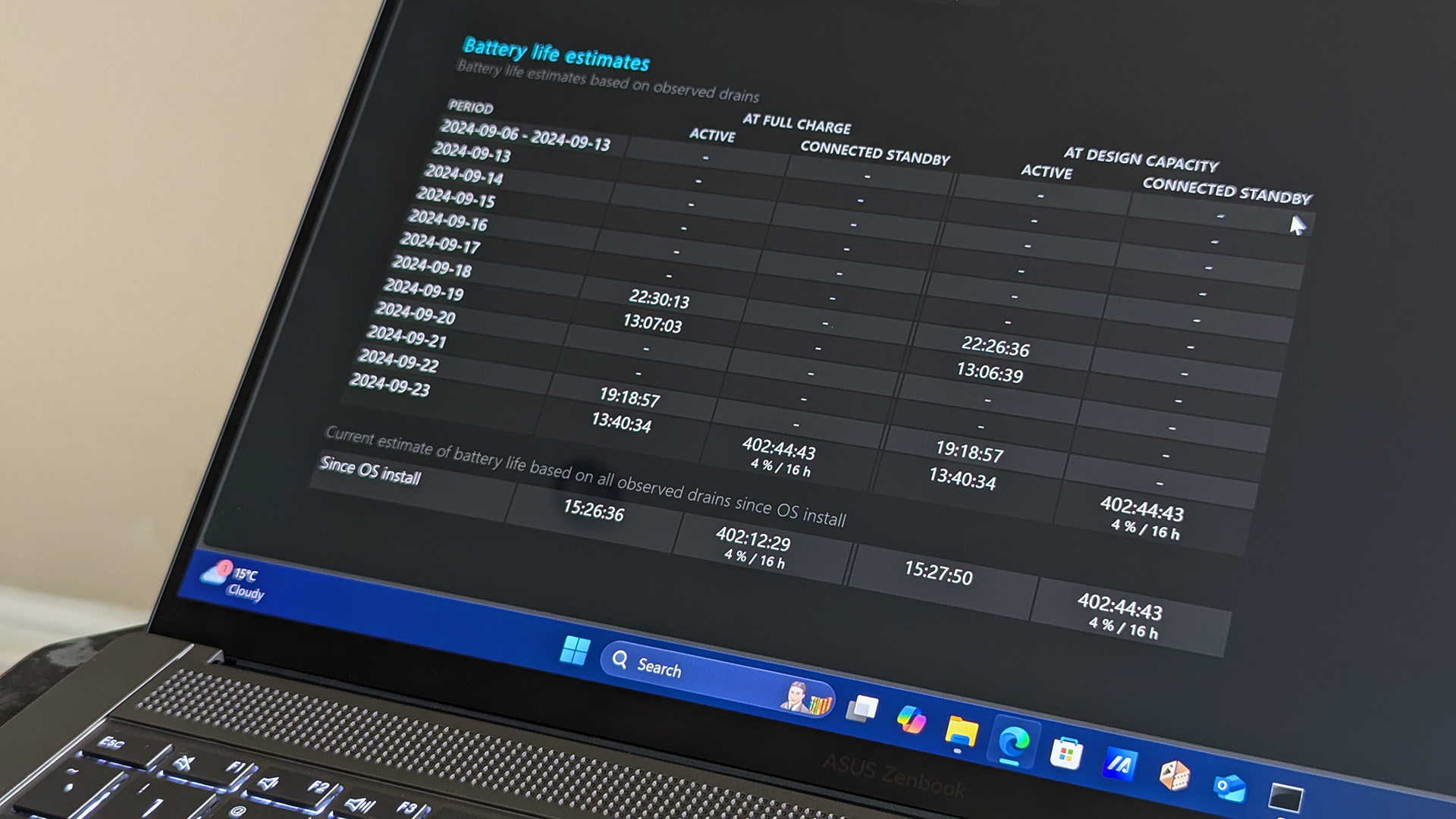
5. Legitimately all-day battery life
ASUS Zenbook S 14 (UX5406S) (Image credit: Ben Wilson | Windows Central)
Essentially, the major x86-64 chip manufacturers escalated a back-and-forth rivalry over battery-life claims around the time Qualcomm launched its first-generation Snapdragon X processors, and consumers have generally been better off for it in recent years. Testing ASUS' Zenbook S 14 proved to me that all-day battery life is now a reasonable expectation that doesn't cost the Earth.
6. Backlit keyboard
Lenovo Yoga Slim 7i Ultra (Gen 11) Aura Edition (Image credit: Ben Wilson | Windows Central)
Typing in the dark has become a pretty regular occurrence at trade shows, whether I'm seated for a glorified PowerPoint presentation in a dim theater or traveling to the event itself on a red-eye flight. To be clear, I've been able to touch type since I was a teenager, but the nuances of switching between US and UK keyboard layouts can still catch me out.
At home, I have desk lamps and plenty of other comfortable light sources, but since my laptops are primarily for travel, I always prefer a backlit keyboard. This generally isn't a difficult criterion to meet, as only entry-level laptops would be likely to sacrifice the backlight to save money, though using the Surface Laptop Go 2 for a few years really made me realize how much it matters.
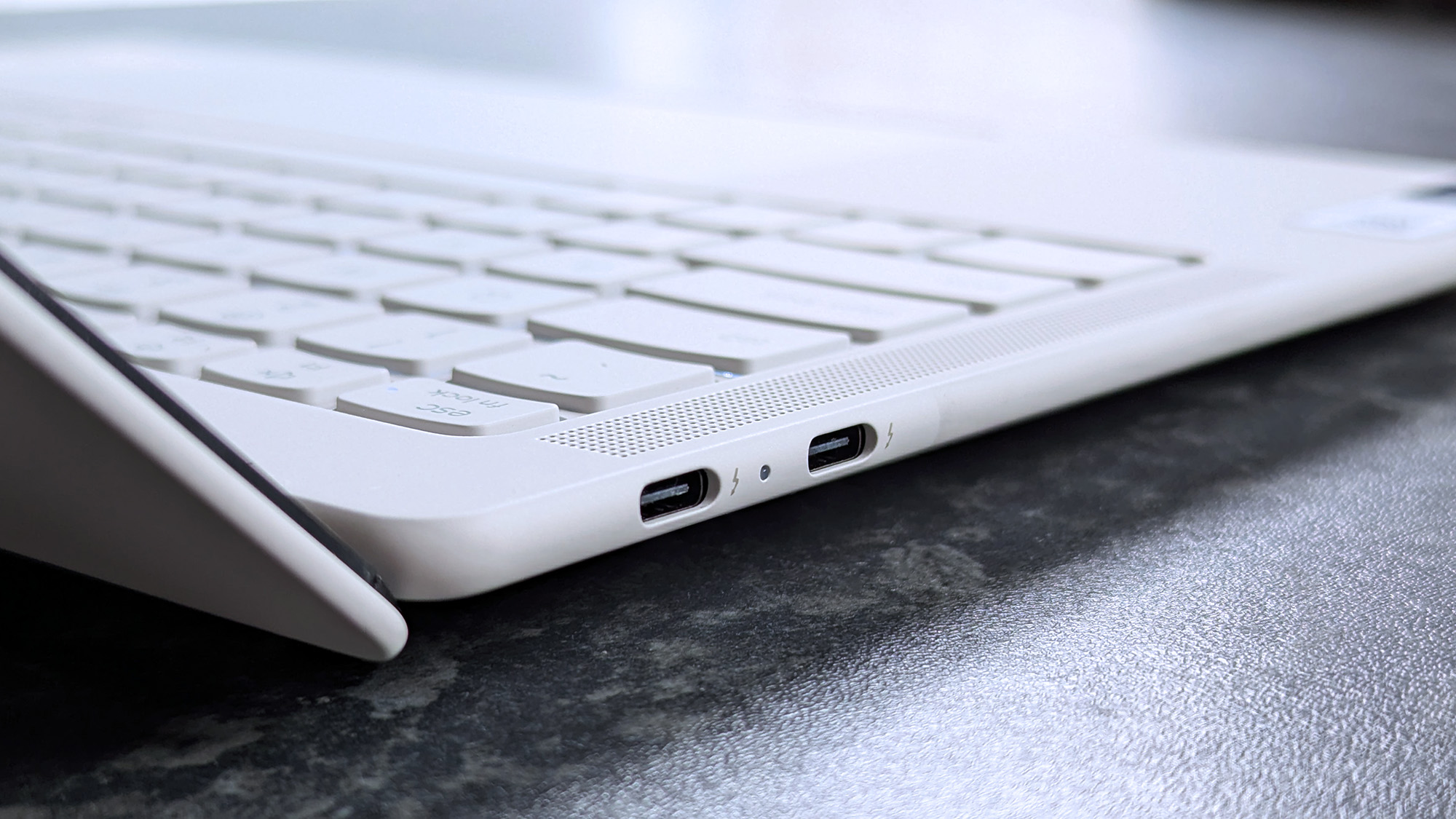
7. No proprietary chargers!
Lenovo Yoga Slim 7i Ultra (Gen 11) Aura Edition (Image credit: Ben Wilson | Windows Central)
I've seen a huge improvement in this area since USB-C chargers became more mainstream, and I have a growing collection of 65W plugs suited for various countries. Even the 45W AC adapter from my Steam Deck is a reliable backup in a pinch, and I don't mind that it charges my laptops more slowly. It's much better than a proprietary barrel jack.
Gaming laptops often sit in limbo between USB-C, tethered to a gigantic power brick, and the old-school barrel jack, because they draw so much power. It's similar with higher-end laptops for creators, as the more powerful CPUs and GPUs inside thirst for the extra juice. I just want to travel with a single USB-C adapter that charges my laptop, phone, and everything else.
So, my ultimatum isn't actually that unreasonable, as plenty of brands offer all of the above. Then again, some might start disappearing soon, since USB-A ports and headphone jacks will probably be seen as fossils in a few years. At least those two aren't too difficult to adapt to, as I've owned pairs of wireless headphones that can connect to multiple Bluetooth devices simultaneously.
Still, these are all problems that can only be solved by spending money, which is a big ask when the laptops themselves are creeping up in price, snared by the ongoing memory crisis affecting RAM and storage availability. As it stands, my taste traps me into a laptop price bracket of at least ~$1,000. Any less than that, and I start to notice some parts of my list disappearing.
Docking stations are an interesting section of the laptop market. There are a lot of options out there, many of them offering the latest Thunderbolt 5 connectivity with an assortment of older and varied ports.
As the market fills up, laptop docks have to set themselves apart with different sub-features. I'm talking about Thunderbolt Share. A built-in M.2 SSD slot. A standout design (as much as that's possible with a small chunk of metal).
In the case of Hyper's HyperDrive NextThunderbolt 5 dock that I've been using for a few weeks, it's the extra features that I'm most excited about. Let me explain so you know if it's right for your desk.
This review was made possible thanks to a review sample provided by HyperDrive. It had no input nor saw the contents of this review prior to publication.
Where can I buy the HyperDrive Next Thunderbolt 5 dock?
The HyperDrive Next Thunderbolt 5 dock is available at major online retailers, including Amazon and B&H. Although it launched with a $399.99 price tag, it seems like it's now permanently available at $319.99.
I'd say that Hyper's HyperDrive Next dock is priced within reason compared to other Thunderbolt 5 hardware, although Wavlink continues to be the best value option out there that I've tested.
What sort of ports does the HyperLink Drive have?
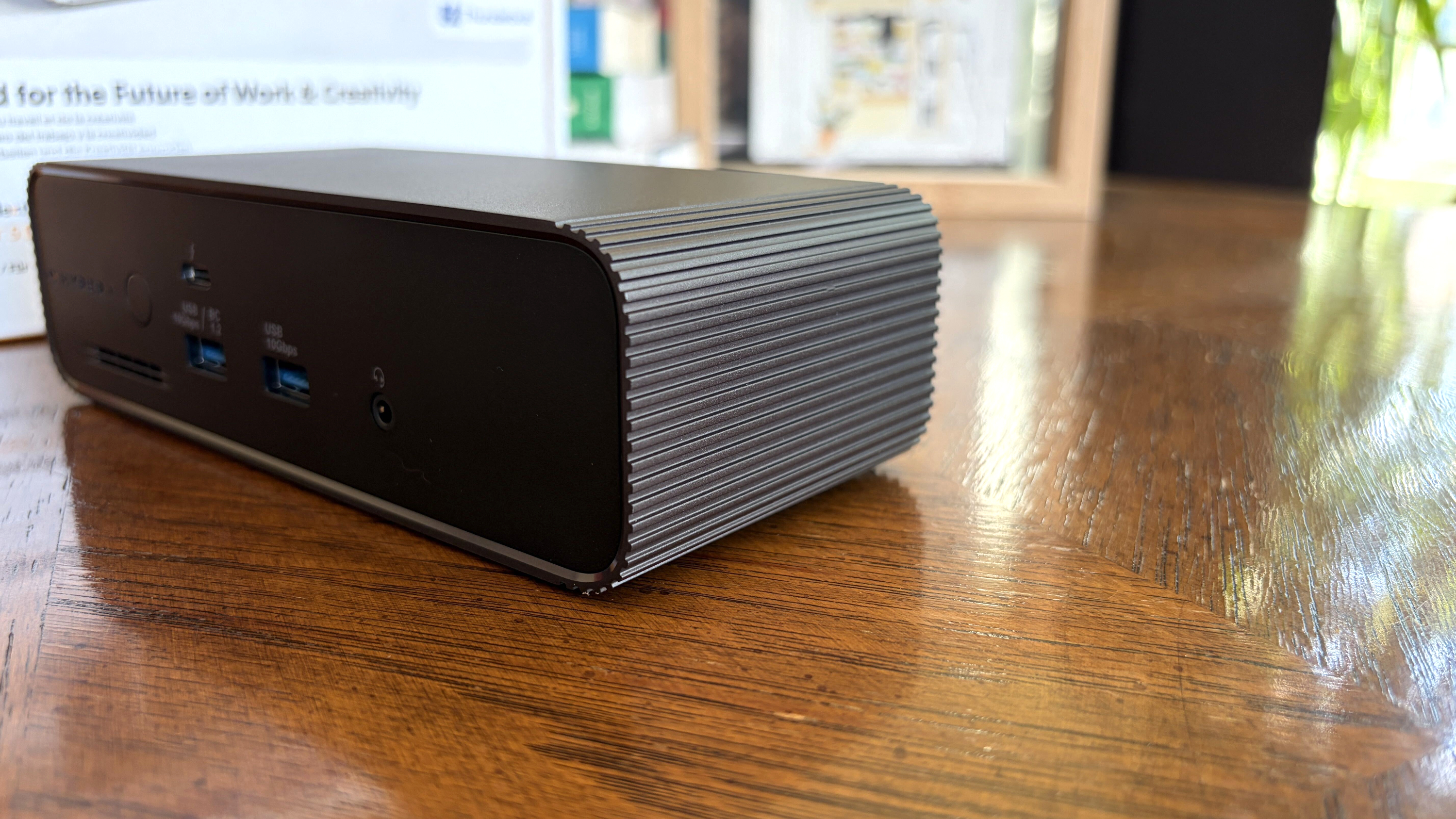
Ribbed edges give the dock's metal chassis a bit of texture and help dissipate heat. (Image credit: Future)
Dock design doesn't usually vary too much, and the HyperDrive Next plays it fairly safe with a chunky aluminum shell and plastic faceplates. I've mentioned plenty of times in other reviews that I prefer an all-metal design for added durability and less chance of scratching.
I like the ribbed corners on the aluminum shell. They add a bit of texture to an otherwise sleek exterior, and they help dissipate heat.
The dock works horizontally only, with rubber pads on the bottom to prevent it from slipping. Measuring 7.64 inches (19.4cm) wide and 3.07 inches (7.8cm) deep, it's thankfully rather compact.
There appear to be some holes drilled for mounting with a bracket, though a permanent setup like that might not be ideal due to the M.2 SSD slot's location (more on that in a moment).
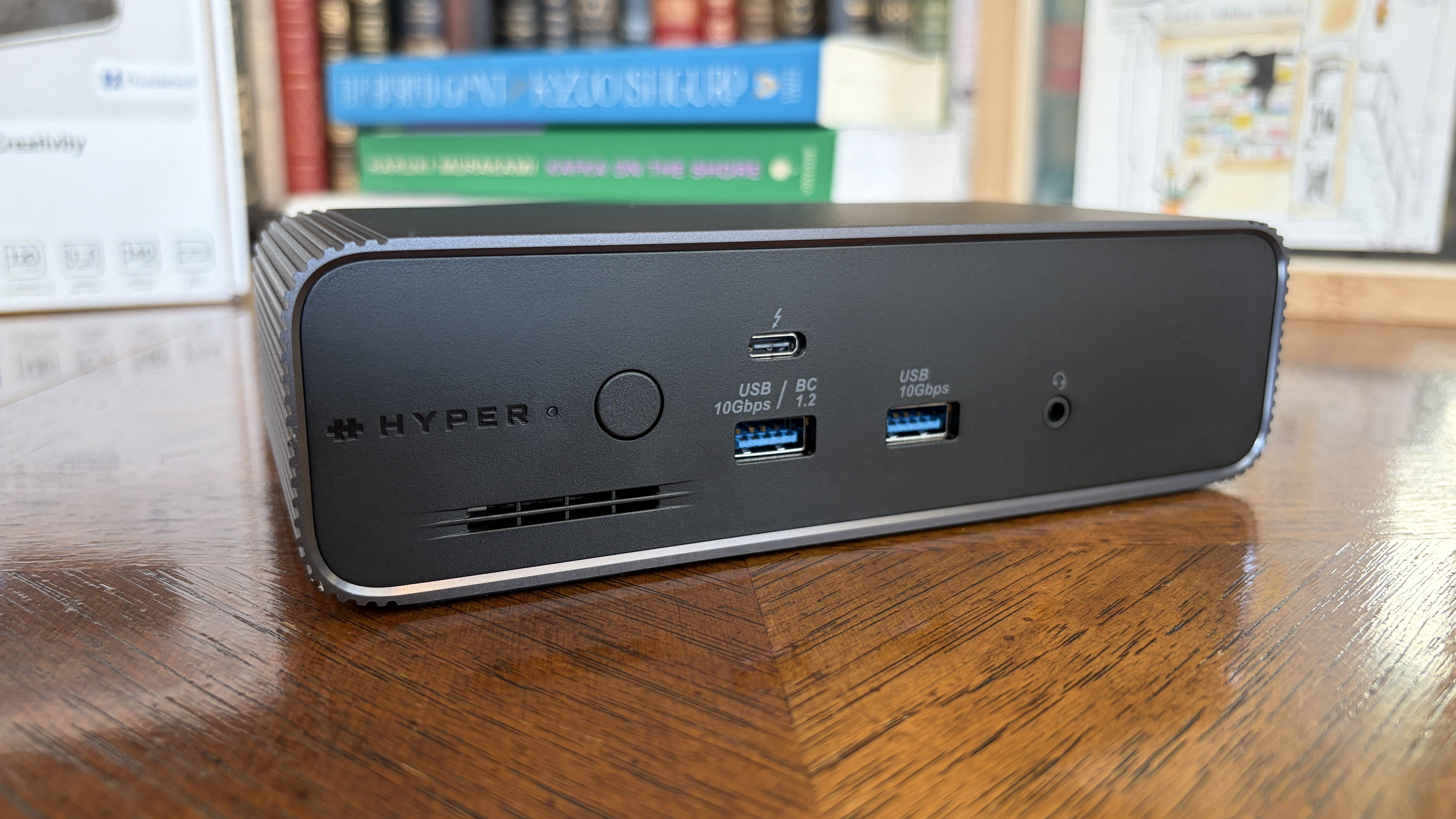
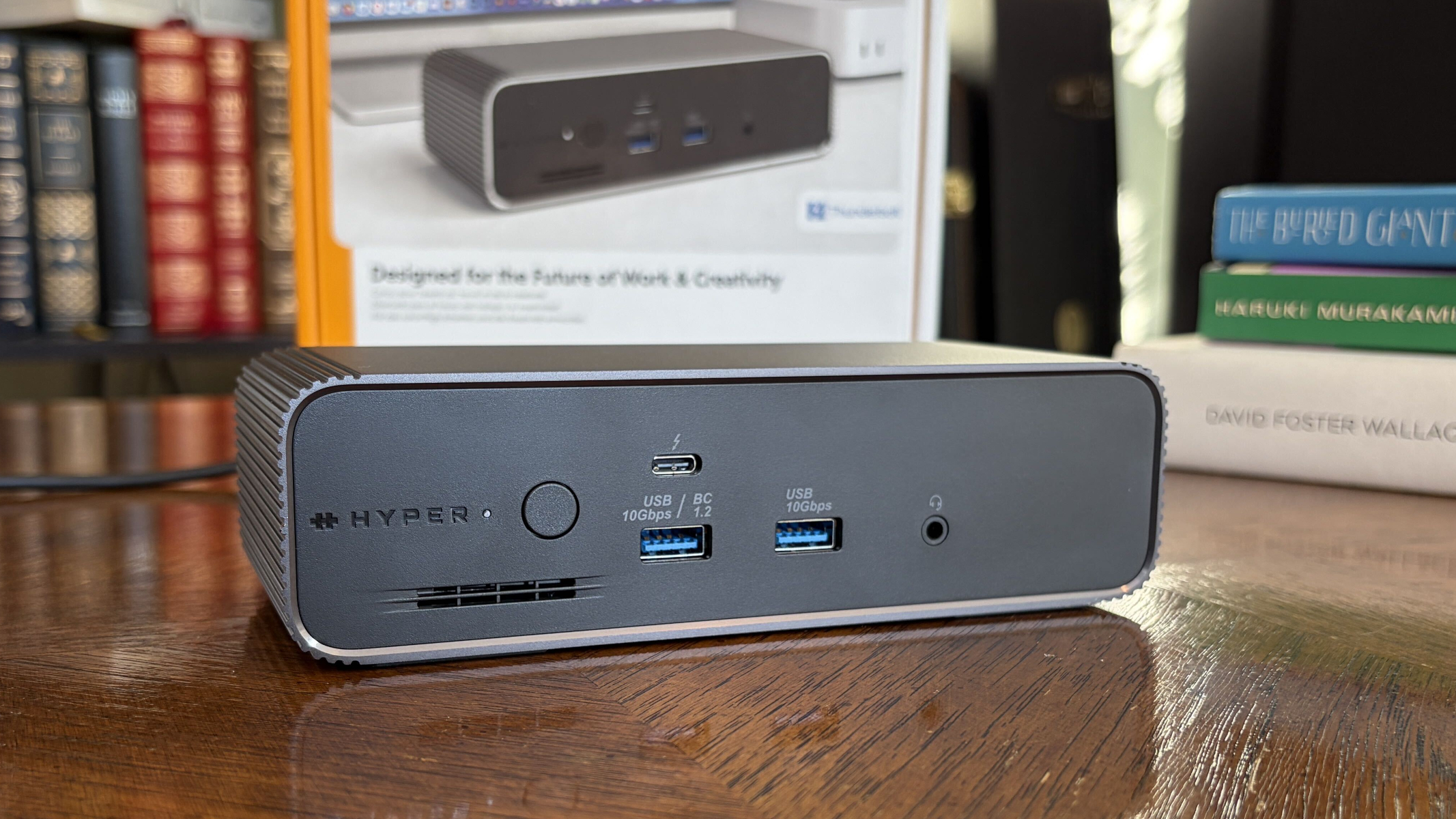
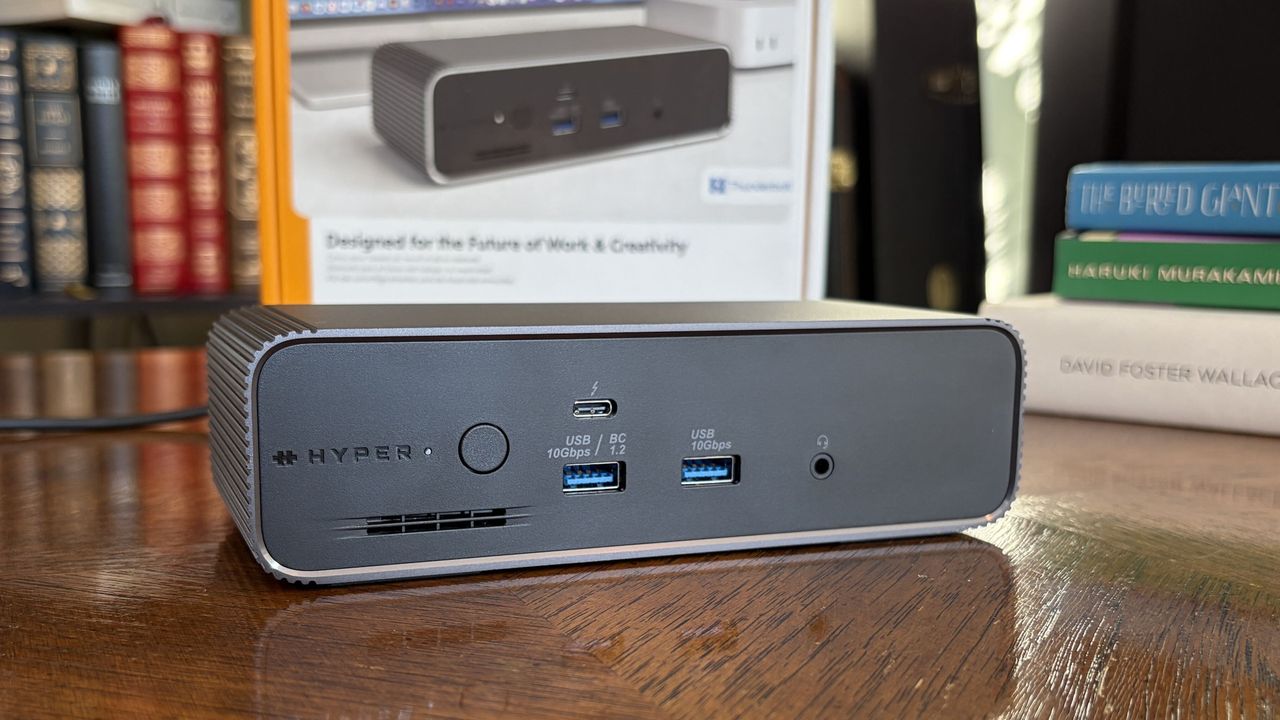
The front of the dock has dual USB-A ports, downstream Thunderbolt 5, and a 3.5mm audio jack. (Image credit: Future)
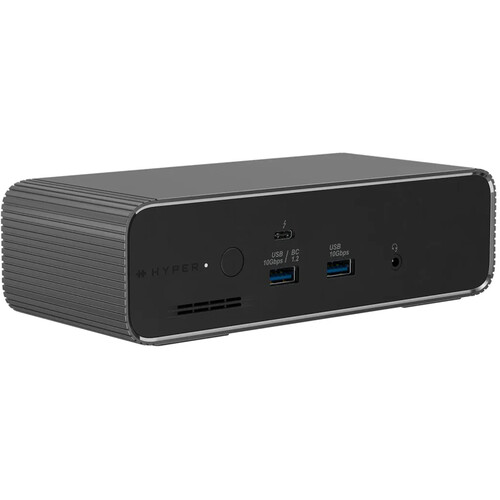
The front of the dock includes dual USB-A ports at 10Gbps each, a 3.5mm audio combo jack, and a single downstream Thunderbolt 5 port.
What you might think at first glance are SD card readers are merely vents cut out to help the built-in cooling fan. The slots sit below the power button and LED status light.
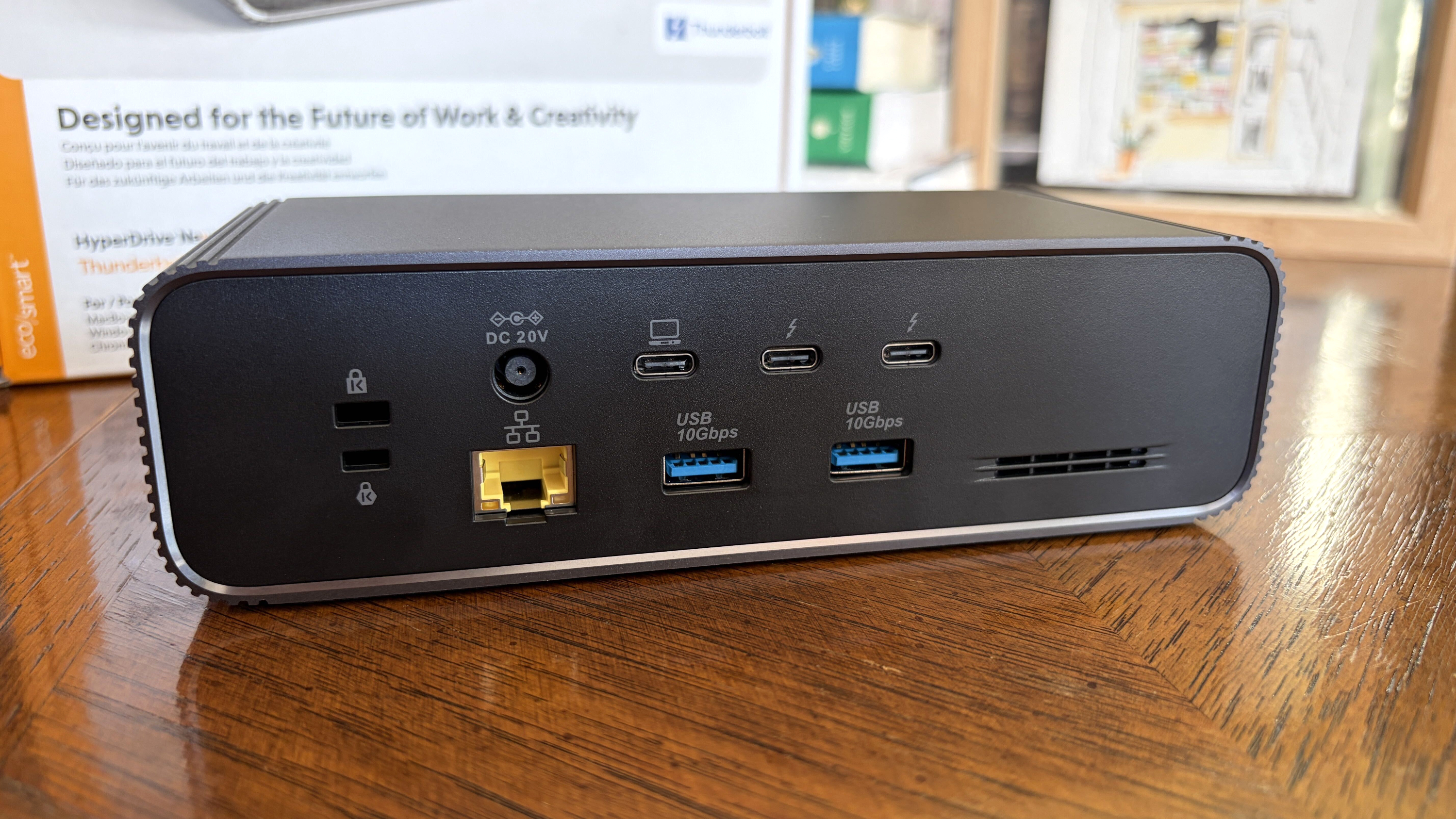
The back of the dock is where you'll find most ports, including downstream Thunderbolt 5, USB-A and 2.5Gb Ethernet. (Image credit: Future)
The back of the dock is where you'll find two more downstream Thunderbolt 5 ports, an upstreamThunderbolt 5 port for connecting your host laptop, two USB-A (10Gbps) ports, a 2.5Gbps Ethernet jack, dual lock slots, and a 20V power hookup.
The upstream host connection supports device charging at up to 140W, which is enough to keep most laptops without a discrete GPU topped up and ready to go.
At this point, you might be asking where the video outputs are located. Well, you're looking at them. The HyperDrive Next relies entirely on Thunderbolt 5 for external monitor support.
If you're using older monitors without USB-C connectivity, you'll need some adapters that switch the USB-C form factor used by Thunderbolt 5 to HDMI or DisplayPort.
The HyperDrive Next relies entirely on Thunderbolt 5 for external monitor support.
The good news is that Thunderbolt 5 is quite capable of handling video, and the dock allows for up to three 4K external displays, each running at a 60Hz refresh rate. If you're targeting a high resolution, it'll go as high as 8K at 144Hz.
It's worth noting that some other Thunderbolt 5 docks support up to three 4K displays each at 144Hz, so there's definitely a bit being left behind due to the other features on board.
I had no problems running one 4K screen and one ultrawide QHD+ screen off the dock, with bandwidth to add more. As mentioned, I've been using this dock on my desk, and I never noticed it get overly hot despite multiple monitors, frequent data transfers, and connected accessories.
HyperDrive Next's additional Thunderbolt 5 features
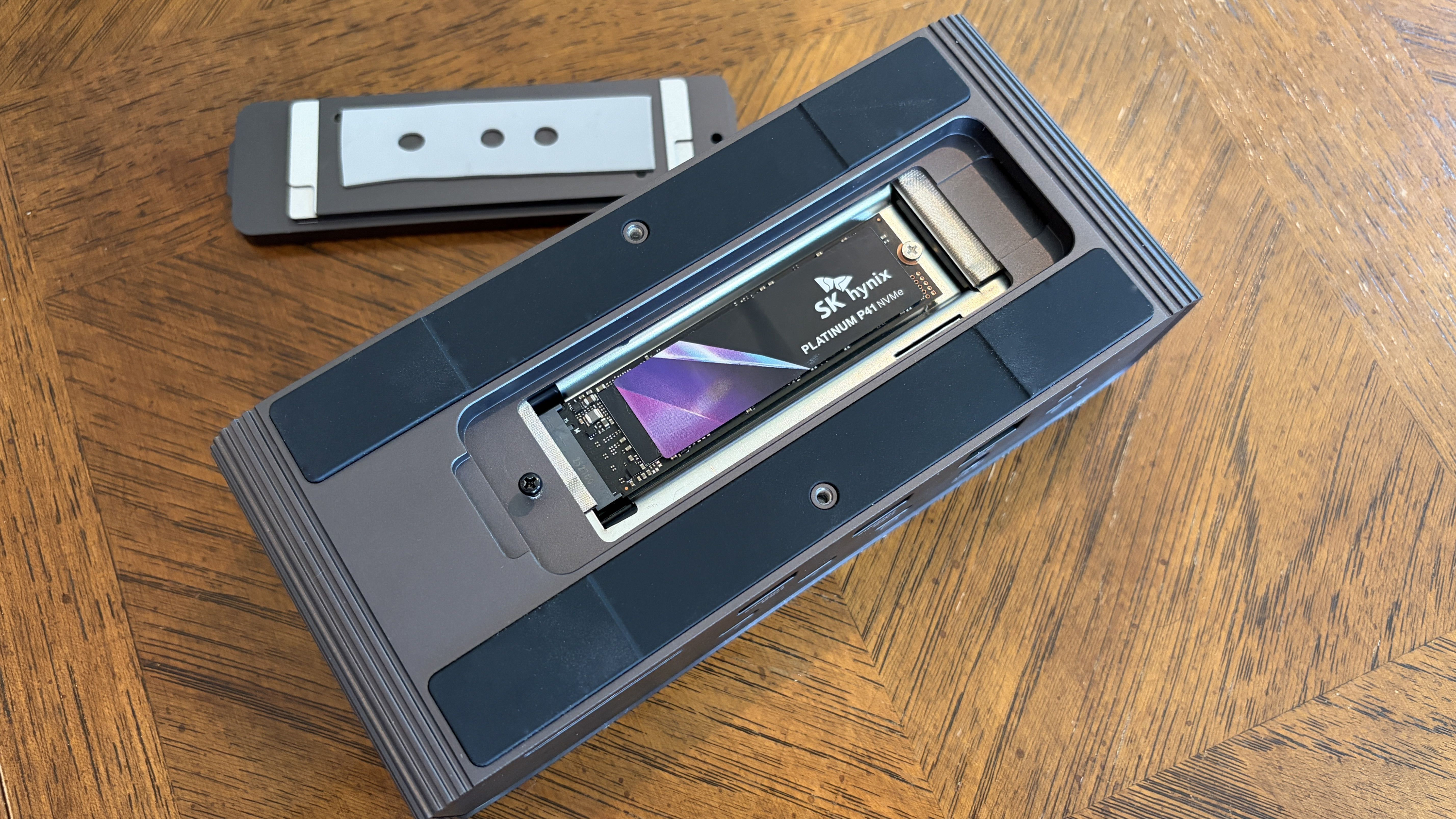
A look at the M.2 SSD slot with an SK hynix drive installed. (Image credit: Future)
Aside from the incredible transfer speeds you get from Thunderbolt 5, the extra bandwidth opens up some extra features that I particularly love.
Like the Razer Thunderbolt 5 Dock Chroma I tested last year, the HyperDrive Next dock comes with a built-in M.2 PCIe 4.0 NVMe SSD slot, with a hatch located on the bottom of the dock.
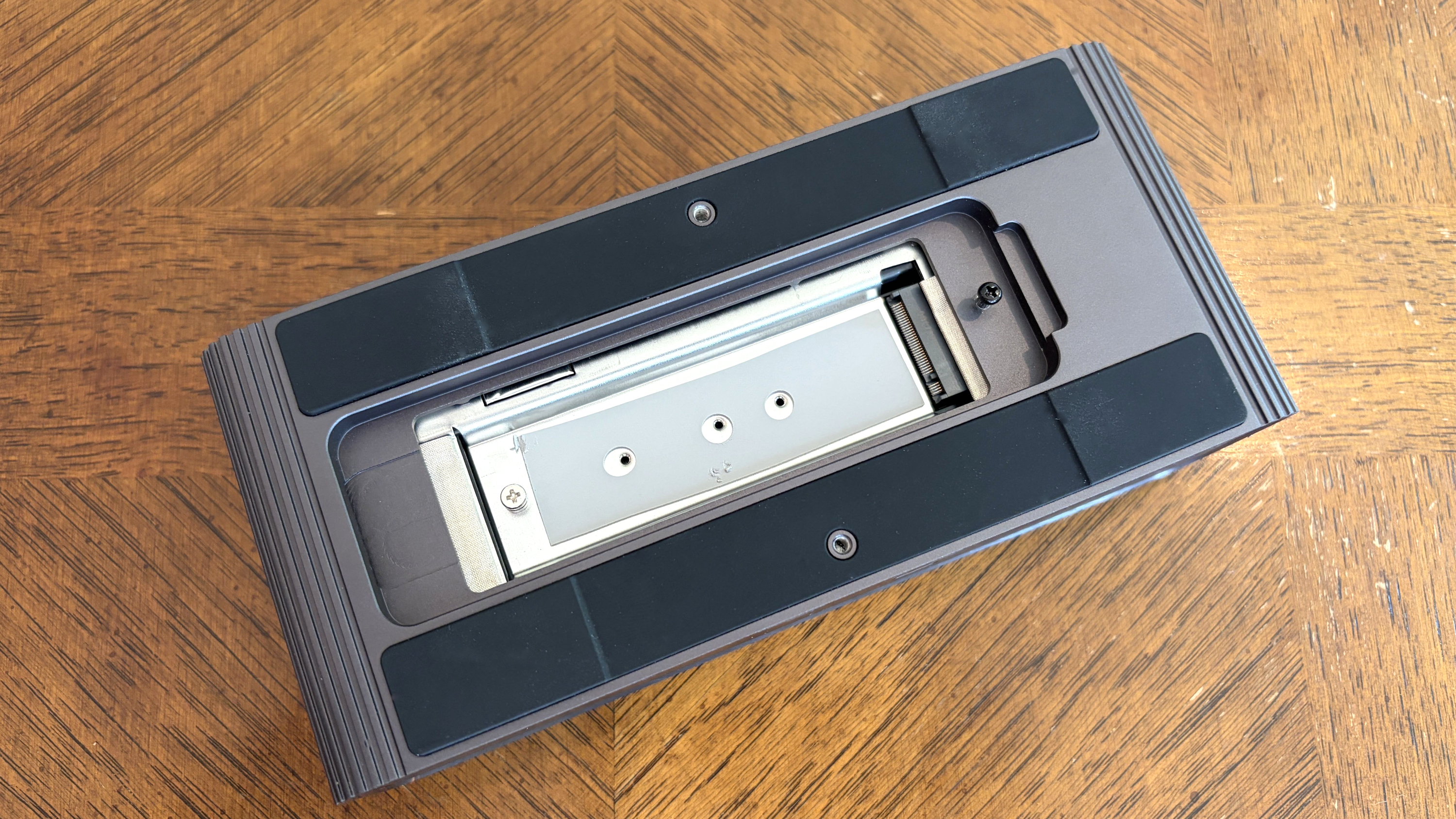
You need a screwdriver to get in, but it's well worth it, with support for full-size 2280 M.2 sticks all the way down to smaller 2230 drives. You should be able to use up to a 16TB drive in here (who can afford that these days?), doubling the capacity of the other docks I've tested.
The built-in M.2 SSD slot fits sizes from 2280 down to 2230. (Image credit: Future)
The other big feature is Intel Thunderbolt Share. It's a tool that allows Thunderbolt 4 and 5 laptops to communicate directly with each other, easing common transfers and making life with multiple laptops that much easier.
File transfers are super easy, requiring just a drag and a drop.
The catch is that at least one of the laptops in use needs to have official Intel Thunderbolt Share certification, unless you have a dock connected in between with the official badge. That's where the HyperDrive Next comes in.
You can connect two separate laptops to the dock and control both from one set of peripherals. File transfers are super easy, requiring just a drag and a drop.
What I don't like about the HyperDrive Next Thunderbolt 5 dock
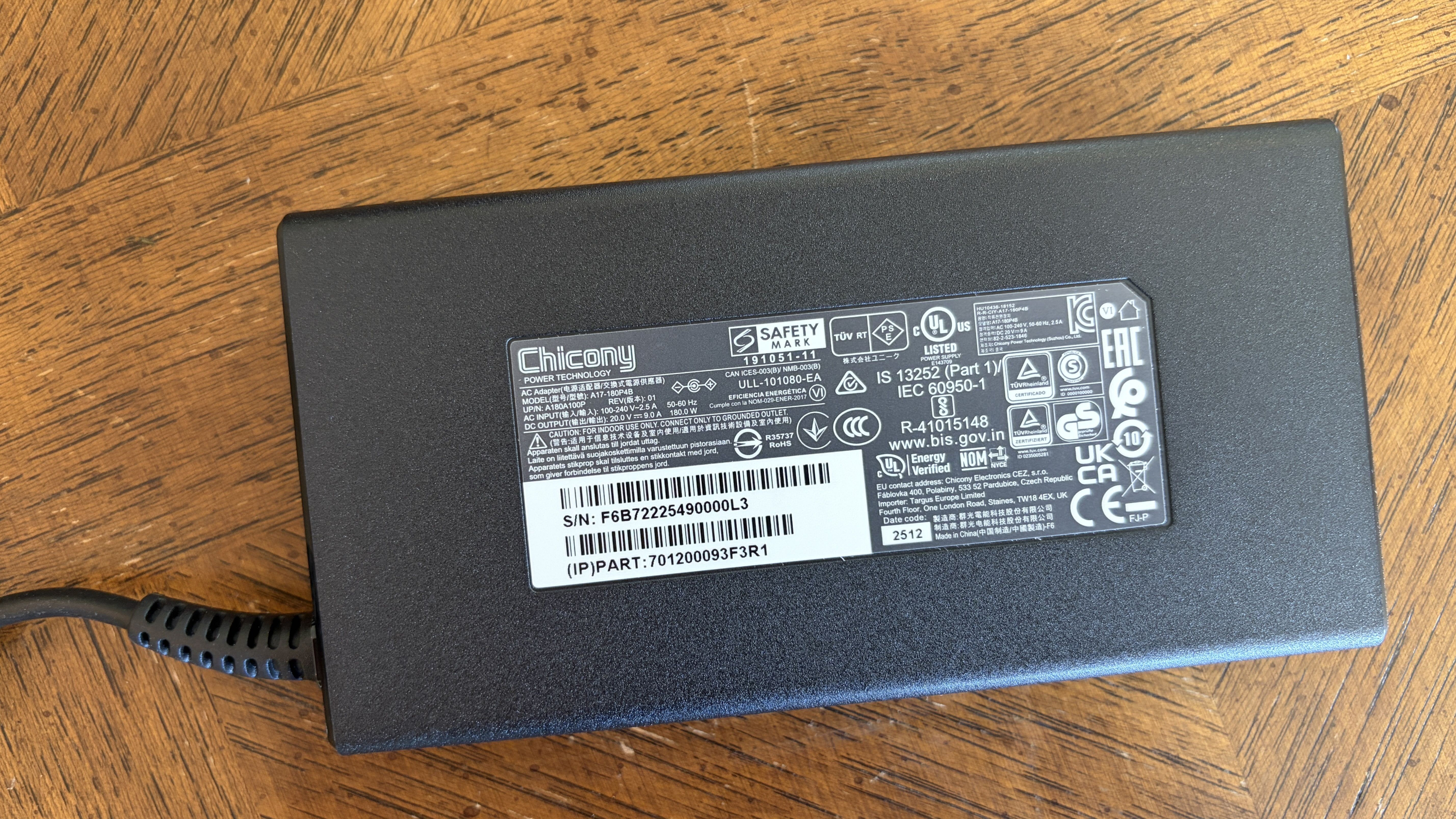
The 180W power adapter is a tad wimpy compared to other docks, but at least it doesn't take up much space. (Image credit: Future)
Depending on how you use your dock, the lack of native video outputs might be a con. However, for others, full Thunderbolt and USB connectivity, paired with an M.2 slot and Thunderbolt Share, might be exactly what's needed.
The only major issue I experienced has to do with how the dock handles heavy workloads. While testing, I noticed drops in SSD and Ethernet speeds when used simultaneously.
I figured this had something to do with power allotment. A 180W adapter isn't that big for a dock that can charge a laptop at 140W. Indeed, this does make some of the charging abilities on ports other than the host connection fairly wimpy.
The dock is super convenient thanks to its built-in features.
The other Thunderbolt 5 ports only charge at 15W, and one USB-A port hits 7.5W. The rest sit at a rather low 4.5W.
However, after doing a bit of research, it seems that the Ethernet/SSD limitation is caused by the actual Intel Barlow Ridge chipset that's used by modern Thunderbolt 5 docks.
So, yes, the dock is super convenient thanks to its built-in features. But you probably won't get as good of performance as if you had a drive and an Ethernet cable connected separately via Thunderbolt 5 ports. It's not exactly Hyper's fault, but it's well worth noting.
Should you buy the HyperDrive Next Thunderbolt 5 dock?
The HyperDrive Next Thunderbolt 5 dock is great for those who want a built-in M.2 SSD slot and Thunderbolt Share capabilities. (Image credit: Future)
✅ You should buy this if ...
You want a Thunderbolt 5 dock with a built-in M.2 SSD slot and Thunderbolt Share.
You have a Thunderbolt 5 laptop that can take advantage of all features (or you plan on buying one soon and can make do with Thunderbolt 4 speeds for the time being).
❌ You should not buy this if ...
You want maximum SSD and Ethernet speeds without requiring any adapters.
You have three external 4K displays and want to run them all at 144Hz.
Hyper's HyperDrive Next Thunderbolt 5 dock is a high-end option that actually competes quite well with the competition in terms of pricing and performance.
For example, the Kensington SD7100T5 EQ Pro comes with a built-in M.2 SSD slot, tons of ports (including SD card readers), and 2.5Gb Ethernet. It does not have Thunderbolt Share. It costs about $340.
If you don't need Thunderbolt Share or a built-in SSD slot, the Wavlink Thunderbolt 5 Thunderlight is probably a better bet, especially at only about $220.
Sitting in between is the HyperDrive Next at about $320, and I'd recommend it to those who want the convenience of external M.2 SSD storage and the ability to quickly share content between two PCs.
The HyperDrive Next Thunderbolt 5 Dock brings a potent combination of a built-in M.2 SSD slot and Thunderbolt Share certification, perfect for busy offices involving multiple PCs. However, its lack of native video output and so-so charging capabilities might have you looking at the competition.
Join us on Reddit at r/WindowsCentral to share your insights and discuss our latest news, reviews, and more.
A Windows 11 update appears to break Microsoft Teams and Outlook on Windows on Arm PCs. Issues started popping up after the rollout of KB5121003, which began shipping this month on Patch Tuesday.
Brian Stringfellow shared details about the problem through a Microsoft Learn report. Several people in that thread have similar issues.
PCs affected by the issue, including Stringfellow's Surface Laptop 7, see Microsoft Teams and Outlook close almost immediately after being opened. Specifically, the new Outlook is affected. Classic Outlook still works on PCs affected by the bug.
The problem seems to affect a variety of Windows on Arm devices. Julius Heng shared their experience:
"I have the exact same issue on Omnibook 3 running snapdragon. After the initial setup, Ms Teams works, but next day it doesnt work. It will have a white screen on teams and it will close right after it open. I tried various method, including reinstall webview 2 etc. None of it works. I tried to roll back all the update and it doesnt work. After did a factory reset Ms Teams works again. But to my dismay, the windows update itself and it breaks Teams again. right now, i'm back to square. Really hope that there's some way to rectify this."
It's not clear at this time why the issue is occuring or why the problem is limited to Windows on Arm PCs.
User Alex-L, who is listed as a moderator and Microsoft External Staff on Microsoft Learn, reported that similar issues are occurring on a variety of Windows on Arm systems:
"At this point, very similar symptoms on different Snapdragon/ARM64 systems. While these reports suggest a possible common factor, no one in this public forum can confirm Microsoft's internal investigations, determine the root cause, or verify whether this is a known issue affecting all ARM64 devices. Microsoft does not currently list a known issue for KB5121003 in the official release notes."
While we wait for official confirmation from Microsoft and a fix for the issue, users with Windows on Arm PCs may have to fall back to other versions of Outlook and Teams that are unaffected by the bug.
Join us on Reddit at r/WindowsCentral to share your insights and discuss our latest news, reviews, and more.
The next evolution of Apple's AirPods is out in the wild after a leaked video was posted online. Known as AirPods Ultra, the new wireless earbuds look basically the same as regular AirPods, albeit with a thicker stem.
Hiding inside the new AirPods Ultra are discrete cameras that enable something called "Visual Intelligence." According to Tom's Guide, these cameras aren't intended to record live video or snap photos, setting AirPods Ultra apart from the likes of Meta's AI Glasses, which are raising some very serious privacy concerns.
What I wasn't expecting next was an announcement from Razer's Min-Liang Tan explaining that the company's Project Motoko, unveiled as a concept at CES 2026, is actually a real product that's "coming soon."
At CES we unveiled Project Motoko: an AI native headset with dual cameras in the earcups. It sees what you see, hears what you hear. No display needed.Started as a concept. Not staying one. Coming soon.What's the first killer use case for wearable AI? pic.twitter.com/MCmrcnUdZMAugust 19, 2026
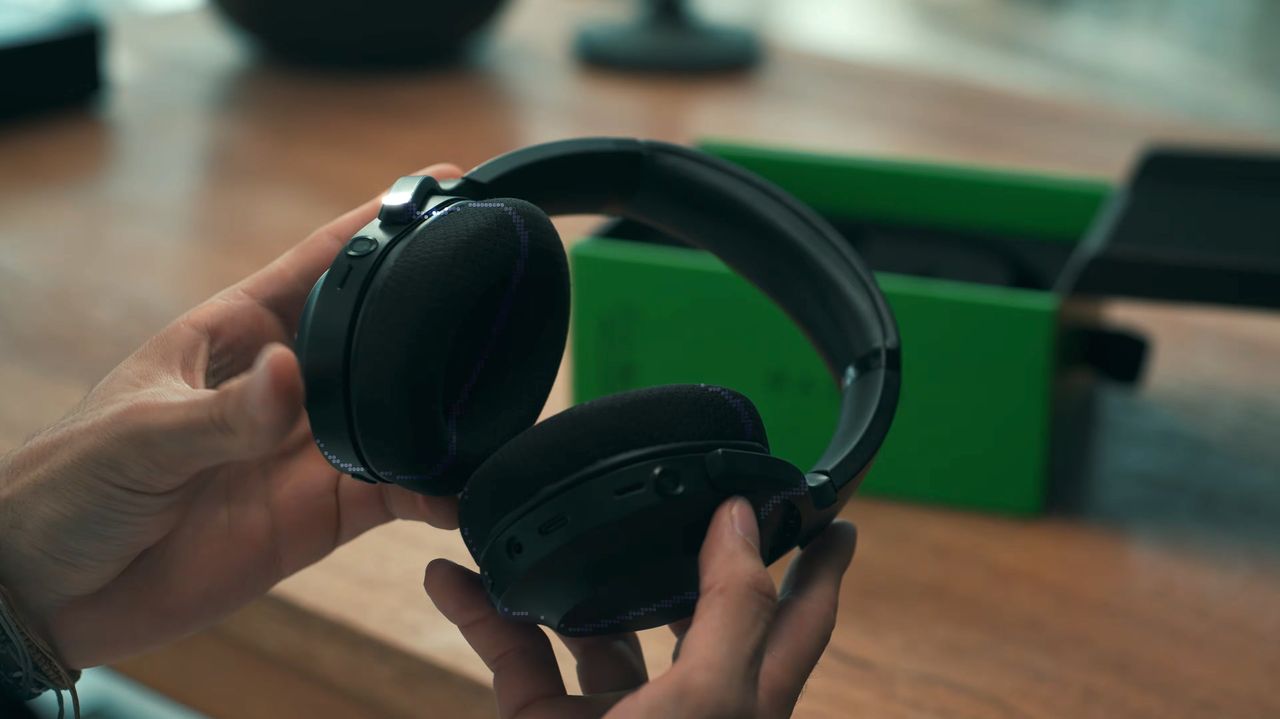
Razer's tackling of this idea involves a full wireless gaming headset with cameras built into the earcups. They're certainly not as hidden as the cameras on Apple's leaked implementation, but I don't think they're aimed at the same end goal.
In the leaked Apple video, a person picks up a book and looks at the cover. Siri (or some other assistant) then says that "your world becomes savable" — all you have to do is whisper into your own ear that you'd like to save what you're looking at.
The new AirPods Ultra are expected to show up at Apple's next special event in September, but already there is a lot of backlash regarding privacy. Glasses (or really any tech) that record everything around you are already being banned due to privacy concerns, and I hope that Apple indeed uses some method that captures info without saving actual photos.
Razer's Project Motoko is not like the rest
Razer is taking a different approach to a video-infused audio device. Rather than hiding the cameras in tiny earbuds, it's slapping them onto what appears to be a rather high-end wireless gaming headset.
Each earcup has an FPV camera designed to sit at eye level, allowing it to better quantify what you're actually looking at. Razer says its cameras offer a wider field of view than is humanly possible, and that they can pick up "symbols, text, and details."
Motoko can use a bunch of different AI models (Grok, OpenAI, and Gemini are mentioned), and Razer says it can be a "powerful data collection tool" to train language models. The headset runs on a Snapdragon chip.
A demo video on the Razer website explains that Motoko "hears, interprets, and answers in the moment." The accompanying video certainly seems to show that the headset's cameras are recording the entire time, much like AI glasses.
Razer pegs it as a "personal full-time AI assistant" that "stays keyed into your schedule, preferences, and habits, while adapting effortlessly to anything else you might ask." I'm reminded immediately of Lenovo's Qira AI assistant.
Privacy concerns aside, who's going to wear a gaming headset all day?
Who the hell wears a gaming headset while they work out? (Image credit: Razer)
Razer makes a lot of concept devices, and not all of them make it into the hands of consumers. The fact that Razer is going ahead with Motoko hot on the heels of the AirPods Ultra leak means the company must truly believe there's something there worth pursuing.
But my first thought was, "Who wants to wear a gaming headset all day?" Never mind the privacy concerns; gaming headsets are great for a few hours at a time, and usually best if you're not active.
Razer's vision for Motoko seems to go against that. A small FAQ section on the official website explains the potential everyday uses for Motoko:
The possibilities are endless. Whether you’re cooking and need step-by-step guidance, traveling and want real-time translations, working and managing tasks hands-free, repairing something with instant audio instructions, or gaming with immersive AI-driven guidance—Motoko adapts to every scenario. Its AI-powered vision and audio awareness make it more than a headset; it’s your always-on companion for smarter living, wherever life takes you.
Razer
Is everyone suddenly going to be wearing a bulky gaming headset everywhere they go? Not likely, especially during any tasks that require a bit of sweat. When Motoko actually launches, it had better be the most comfortable headset ever made if Razer wants it to be successful.
Windows Central's take on Razer Motoko
A screengrab from the Motoko video showing a livestream running from the gaming headset. (Image credit: Razer)
Razer's Motoko headset probably has the best chance of succeeding amongst PC gamers. It is, after all, a gaming headset. But, speaking from a bit of experience, I can say that a lot of PC gamers couldn't care less about letting AI help with video games. Whether or not Motoko's appeal actually goes mainstream remains to be seen.
I want to know if you'd buy something like Razer's Motoko when it launches. Would you use it for gaming? For something else? Are you concerned about eroding privacy due to the prevalence of these video capture devices? Let me know in the comments section below!
Join us on Reddit at r/WindowsCentral to share your insights and discuss our latest news, reviews, and more.
It's about time for a new semester, and upgrading your PC can make the process much easier. You don't need anything excessive to access most of the Windows software and cloud apps you'll need in school or college, and Dell's official store has already reduced prices on some of its best hardware.
Some of Dell's deals go into the weeds (who knew they sold robot vacuums?), so I've handpicked a collection for practically anyone who needs portable tech for studies or even works from home. We've tested hundreds of processors found in its laptops, and traveled the world with devices just like this.
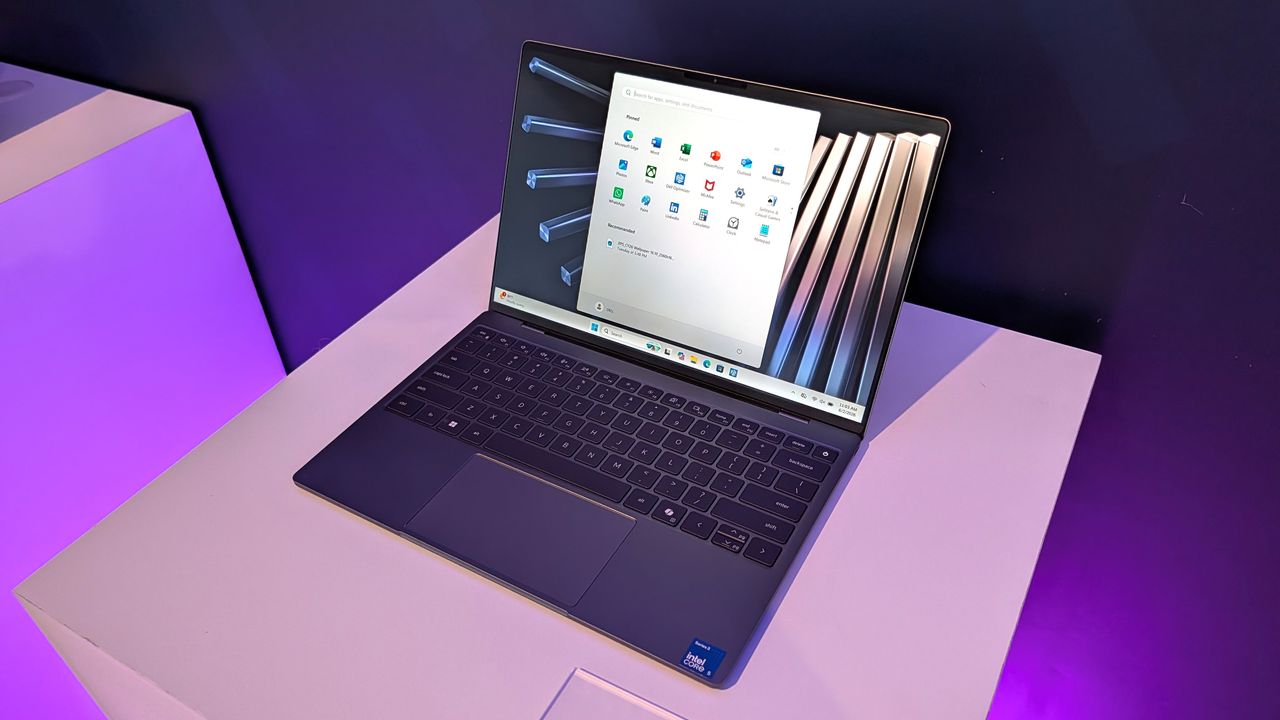
Dell returns to its iconic branding with the "thinnest & lightest XPS laptop ever," and its choice of Intel processor delivers up to 17 hours of battery life.
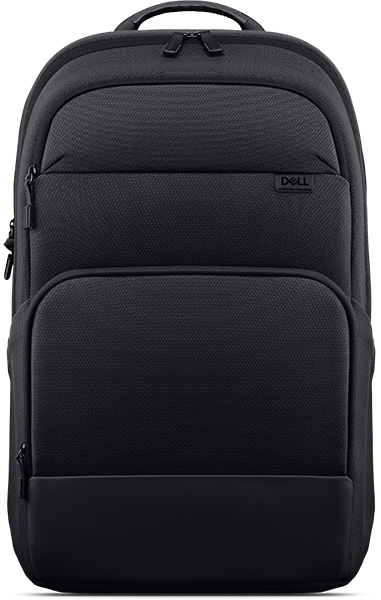
Technically designed for 14-inch laptops and above, this affordable backpack just offers extra space for your laptop's AC adapter and more study materials.View Deal
Is the new Dell XPS 13 a good laptop?
Dell's new XPS 13 impressed us. (Image credit: Zac Bowden / Windows Central)
We saw the revival of Dell's XPS 13 laptop appear at Computex earlier this year, and went hands-on while we attended Taiwan's popular technology convention. There's no denying it's the Windows-centric alternative to Apple's MacBook Neo, but as Dell explained to us in person, it was in development before the Neo ever launched. In that, it stands as more of an affordable flagship than a compromise.
After spending some time with the XPS 13, Senior Editor Zac Bowden said it "still feels every bit as premium and nice to use as the $1,000 XPS 13 before it", which tracks, because this used to be placed as a much more expensive laptop. If you pick one up, you'll get a 120Hz display for a smooth refresh rate on a bright, 2.5K touchscreen, in the thinnest and lightest XPS yet.
I don't think there's another laptop on the market right now that is as good a deal as this new Dell XPS 13 is at $699. It's so much better than the MacBook Neo that it's not even really a contest.
Zac Bowden, Senior Editor
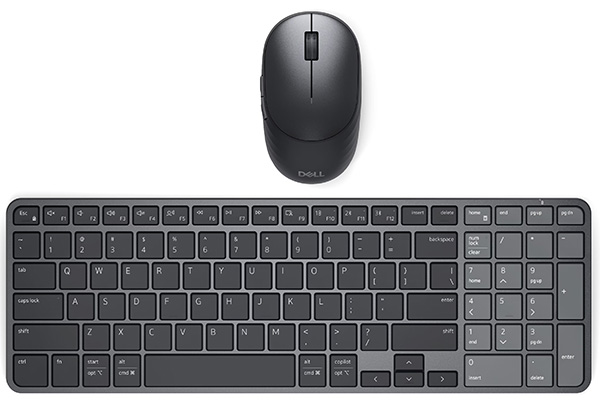
As the name suggests, the XPS 13 offers a 13.4-inch screen in a 2.2-lb chassis, powered by a relatively standard 65W USB-C AC adapter rather than a proprietary cable-and-brick setup. Yes, it's smaller than the EcoLoop backpack was designed for, but the extra inch leaves space for extras like the Pro 7 mouse and keyboard combo.
However, Zac did make it clear that the XPS 13 has "an amazing keyboard and excellent trackpad", so you'll still be able to rely on it in any situations where an external set of peripherals isn't as viable, and they stay in your backpack instead. Plus, the built-in webcam supports Windows Hello face unlock for faster logins, and its powered USB-C 3.2 Gen 2 ports support external displays.
You'll need to verify your education status with Dell to be eligible for the XPS 13's $599.99 student pricing, but $699.99 is still a great price if you're looking for a work companion instead. Otherwise, for students heading back to school for a new semester, this portable PC combo for under $740 is a steal.
Join us on Reddit at r/WindowsCentral to share your insights and discuss our latest news, reviews, and more.
I was at Computex this year when NVIDIA's RTX SparkSystem-on-Chip (SoC) was revealed to the world, and from the start, I had a hunch that it would be a big deal.
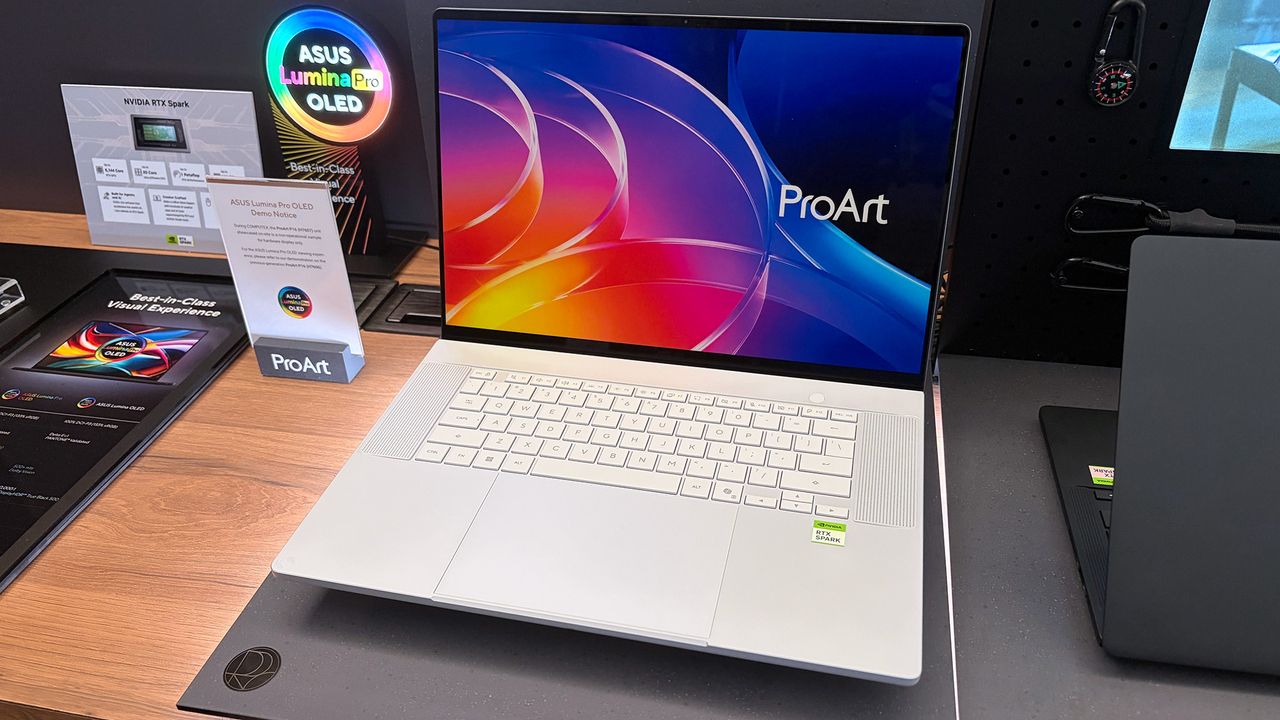
Incredibly sleek and streamlined, these laptops were a smash hit on the show floor. Apparently, they're also far more popular than ASUS was expecting.
In a recent ASUS Q2 earnings call, it was revealed that the company is completely out of ProArt P14 and P16 units to ship to its partners (aka third-party retailers and distributors) as part of pre-order efforts.
As one of the first manufacturers to launch RTX Spark-based systems, the market response to pre-orders for our ProArt notebook P16 and P14 has been intense. They are currently completely sold out. [...] Regarding current demand, the market response has far exceeded our expectations. Essentially, the initial quantities we planned have already been fully pre-ordered by our channel partners. We’re continuing to place additional orders with our partners.
S.Y. Hsu, Co-CEO ASUS (ASUS Q2 earnings call)
More RTX Spark laptops are on the way, of course, and ASUS has some time to shore up supplies before the planned Q4 2026 release of the new Spark-powered ProArt PCs.
It's too bad that the earnings call doesn't mention anything about exact volumes, because it's hard to say exactly how popular these laptops really are. However, ASUS says that it's "very optimistic about next year's sales" thanks to the "high AI computing power relative to its compact size" in the RTX Spark laptops.
What is NVIDIA's RTX Spark?
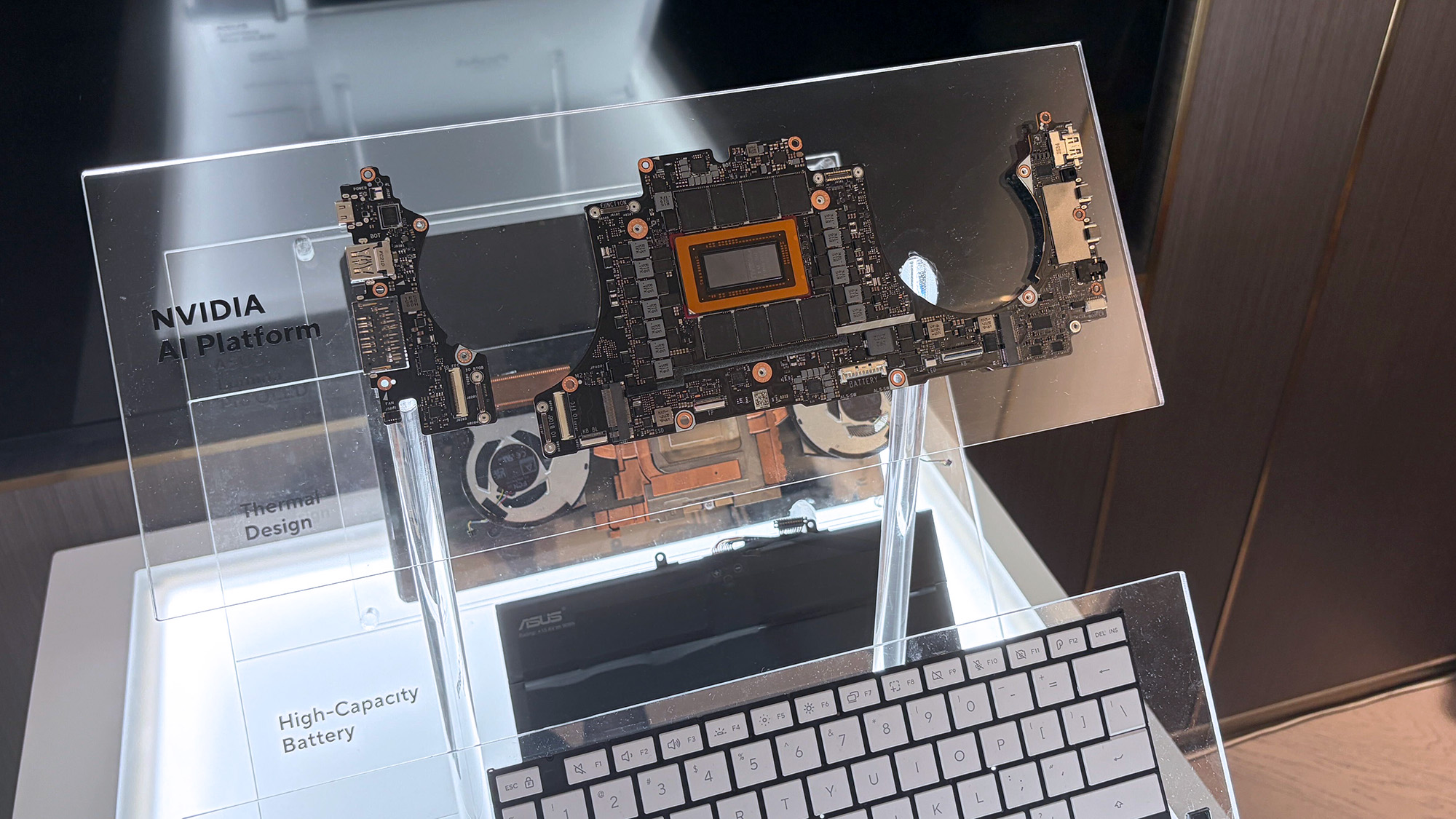
A look at the NVIDIA RTX Spark chip that's (normally) inside the ProArt P16. (Image credit: Cale Hunt | Windows Central)
NVIDIA's RTX Spark is an ARM-powered SoC that's expected to compete directly with the likes of Intel, AMD, and Qualcomm for space in Windows 11 PCs.
I covered rumors of the "N1X" chip for months in the lead-up to Computex 2026, and indeed it seems just as powerful and efficient as pre-announcement estimates.
Spark takes efficient ARM-based CPU cores similar to those found in Qualcomm Snapdragon chips and pairs them with an NVIDIA Blackwell RTX GPU, all while drawing from a unified memory setup that can hit 128GB.
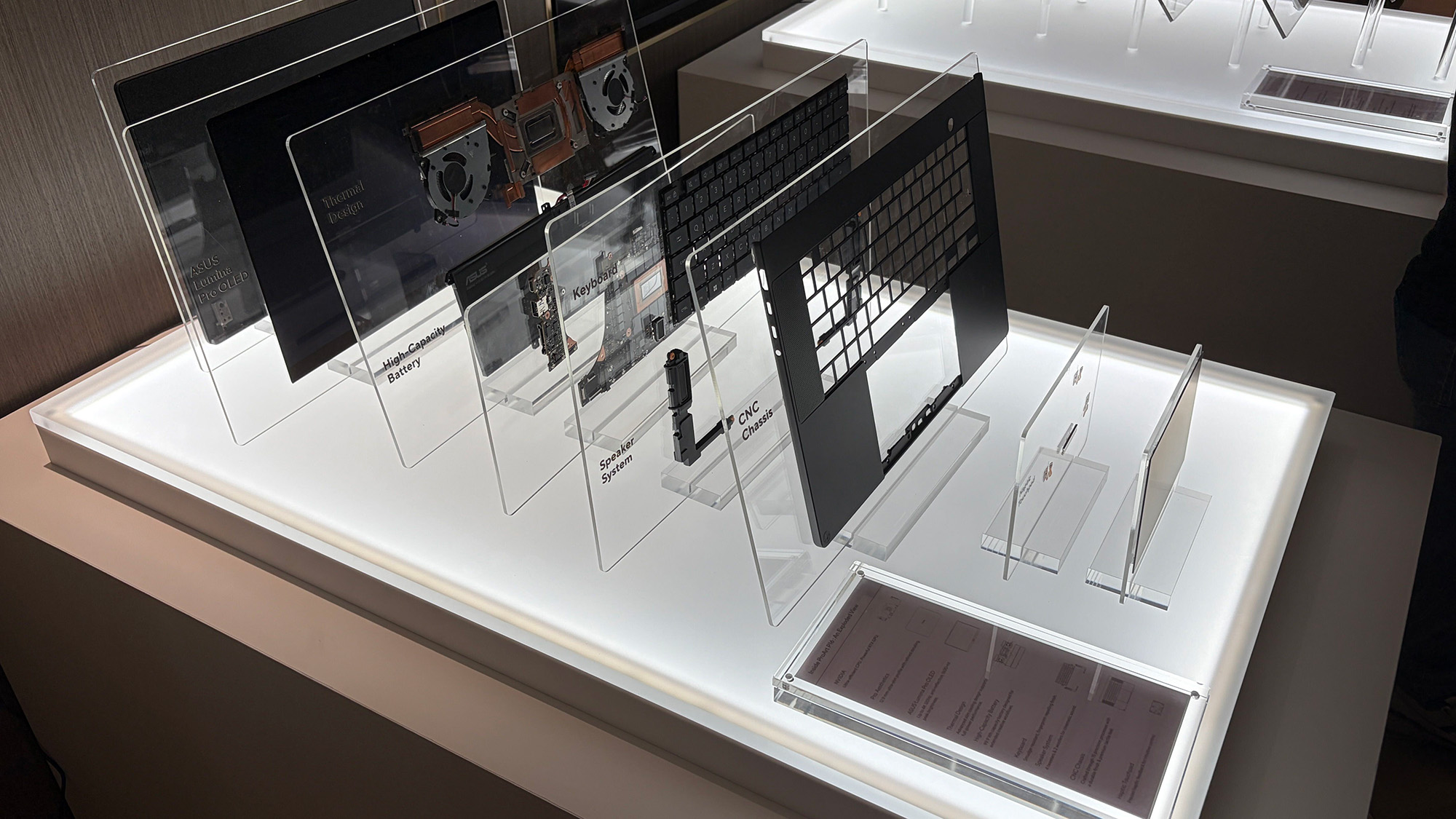
A broken-down example of the ASUS ProArt P16 with RTX Spark. (Image credit: Cale Hunt | Windows Central)
This combination allows for massive performance that can shred standard and AI-related tasks without requiring a bulky discrete GPU.
Throw these chips into ASUS ProArt laptops with "all-day-long" battery life, wide port variety, super slim bodies, and 4K OLED displays, and it's easy to see why there's so much interest from retail partners.
Back in April, Microsoft raised the prices of all of its Surface laptops as a consequence of the ongoing RAM crisis, making these once valuable desktops nearly untenable for most people who can't afford them.
Yet not all hope is lost for these critically acclaimed laptops, as they do occasionally get generous discounts to bring their prices back down to more manageable levels.
Such is the case with the Microsoft Surface Laptop (7th Edition) with the Snapdragon X Plus CPU, 13.8-inch display, 16GB of RAM, and 512GB SSD configuration that's now on sale with a 27% discount for $1099.99 at Best Buy.
"Microsoft's Surface Laptop 7 is the clamshell form factor perfected. With a gorgeous new design, incredible keyboard and trackpad, smooth 120Hz display, good all-day battery life, and excellent Snapdragon X Elite processor under the hood, this is the laptop to beat in 2024." — Zac Bowden, Senior Editor
What makes the Microsoft Surface Laptop (7th Edition) worth the money?
The Microsoft Surface Laptop (7th Edition) on display (Image credit: Windows Central (Zac Bowden) | Microsoft)
Despite current times being the worst time to buy a Surface Laptop, that shouldn't deter you from getting one if it's on sale, as they boast the best specs for conquering daily office workflows or finishing homework on time at school.
The 13.8-inch, 7th Edition Microsoft Surface Laptop is no exception, as it delivers exceptional performance on everyday tasks thanks to its Snapdragon X Plus processor and 16GB of RAM.
It also features a splendid, ultra-thin clamshell design that's pretty to look at, practical enough to carry around while traveling, durable enough to withstand accidental (or intentional) bumps or bruises, and comfy enough to hold in your hands while working.
Other notable features include a 2K touchscreen display with a 120Hz refresh rate to render images with crystal-clear 2304x1536 resolution, a respectable battery life of around 18-19 hours, and a Neural Processing Unit (NPU) with 45 TOPSto efficiently run AI-related programs like Recall or Windows Studio Effects.
If you need to browse the net for research notes fast or write down your work on documents or spreadsheets using Microsoft Office without slowdown, you can't go wrong with the Microsoft Surface Laptop (7th Edition) now that it's on sale, as it's one of the best Windows laptops around.
FAQ
Is it good for AAA PC gaming?
No, the Microsoft Surface Laptop was never designed for AAA PC gaming. As a result, high-end PC games will either barely be able to run at mid-low graphical settings or not function at all.
Is its RAM and SSD replaceable?
The Microsoft Surface Laptop (7th Edition)'s default SSD can be replaced, but its default RAM cannot, as it's soldered into the motherboard. So, you will need to decide how much RAM it will have during checkout while shopping online or locally.
Does legacy software work on this laptop?
Most native apps and internet browsers will function on the Microsoft Surface Laptop (7th Edition). However, specialized or more aged x86/x64 software will need Prism emulation to function properly on this laptop.
Join us on Reddit at r/WindowsCentral to share your insights and discuss our latest news, reviews, and more.
Best Buy's back-to-school sale continues to provide illustrious discounts on all kinds of computers and laptops built to help students succeed in school.
If you're looking for a high-quality laptop with solid performance and a clear display that has vastly benefited from this sale, then look no further than the 2025 edition of HP OmniBook X Flip 14", which is now 30% off for$699.99 at Best Buy.
"The HP OmniBook X Flip 14 (2025) isn't an exciting laptop, but it does tick a lot of boxes for a capable and reliable mid-range 2-in-1 PC." — Zachary Boddy, Former Staff Writer
The HP OmniBook X Flip 14 (2025) in its tablet mode. (Image credit: Windows Central | Zachary Boddy)
The HP OmniBook X Flip 14" (2025) laptop variant that's on sale right now comes configured with an Intel Core Ultra 5 (Lunar Lake) 226V CPU, 16GB of RAM, and a 512GB SSD for storage.
For those who don't speak techno-wizardry, all this means is that this laptop can run software like Microsoft Office, browse the web, email, and multitask with multiple apps at once without any slowdown.
It's also great for creating digital artwork as it features a 14-inch, 1920x1200 touchscreen display capable of loading and rendering images with crisp clarity so you can make out all the details much easier when drawing.
Speaking of drawing, the HP Omnibook X Flip 14" (2025) is compatible with stylus pens (which are sold separately), so you will be able to draw on the screen instead of using a mouse if you prefer drawing that way.
Add to that a respectable battery life of up to 22 hours with its Intel chip, a durable and portable-friendly design, and an HP 5MP IR Camera for video conferencing, and you have a sweet mid-range laptop for work whose value has risen dramatically thanks to Best Buy's 30% discount.
FAQ
Is this a Copilot+ PC?
Yes, the HP Omnibook X Flip 14" (2025) laptop is a Copilot+ PC as it has an NPUcapable of 45 TOPS to help it perform AI-related tasks with fast and stable performance rates.
What parts can be upgraded?
The only part of the HP Omnibook X Flip 14" (2025) laptop that can be upgraded is its 512GB SSD.
Can its RAM be upgraded?
The HP OmniBook X Flip 14" (2025) laptop's 16GB RAM is soldered, so it can't be replaced.
Join us on Reddit at r/WindowsCentral to share your insights and discuss our latest news, reviews, and more.
Join Zac Bowden and Jez Corden on this week’s Windows Central Podcast as they dive deep into unreleased Microsoft hardware, AI developments, and big Xbox announcements!
The Lost "Surface Phone" Prototype: Zach and Jez dissect newly leaked images and video of an unreleased 2013-era Microsoft-built Windows Phone prototype, reminiscing about the Lumia era, Nokia’s acquisition, and what could have been.
Microsoft Copilot’s Super App & AI Disillusionment: A look at the rollout of the new unified Copilot experience (merging consumer and Microsoft 365 features), dropped functionalities (Group Chat, Podcast mode, Deep Research), and a frank discussion on AI hype, practical workflows, and "AI psychosis".
Xbox Backward Compatibility Coming to Windows PC: The hosts break down the official announcement of original Xbox/Xbox 360 emulation on Windows, potential licensing hurdles, Play Anywhere integration, and upcoming achievement support.
Gaming Rumors & Franchise Future: Updates on The Elder Scrolls VI codename rumors (Sentinel), long development cycles across Bethesda/Obsidian, and a candid critique of the state of the Halo franchise following Halo Campaign Evolved and project cancellations.
New Xbox Console Features & Live Q&A: A discussion of the upcoming "Platinum Trophy" achievement equivalent, party/mic audio in Game DVR captures, and a live Q&A touching on Windows K2 progress, mobile shells for Windows on ARM, MSN's automation, and modern foldable vs. slab phones.
This episode of the Windows Central Podcast is sponsored by Surfshark VPN. Unlimited devices, access your content from anywhere, and auto-block malware on Windows, Edge, and other platforms from $2.50/mo, with 3 months extra FREE. Sign up today!
Have a question you want us to answer on the podcast? Send it to us at [email protected]
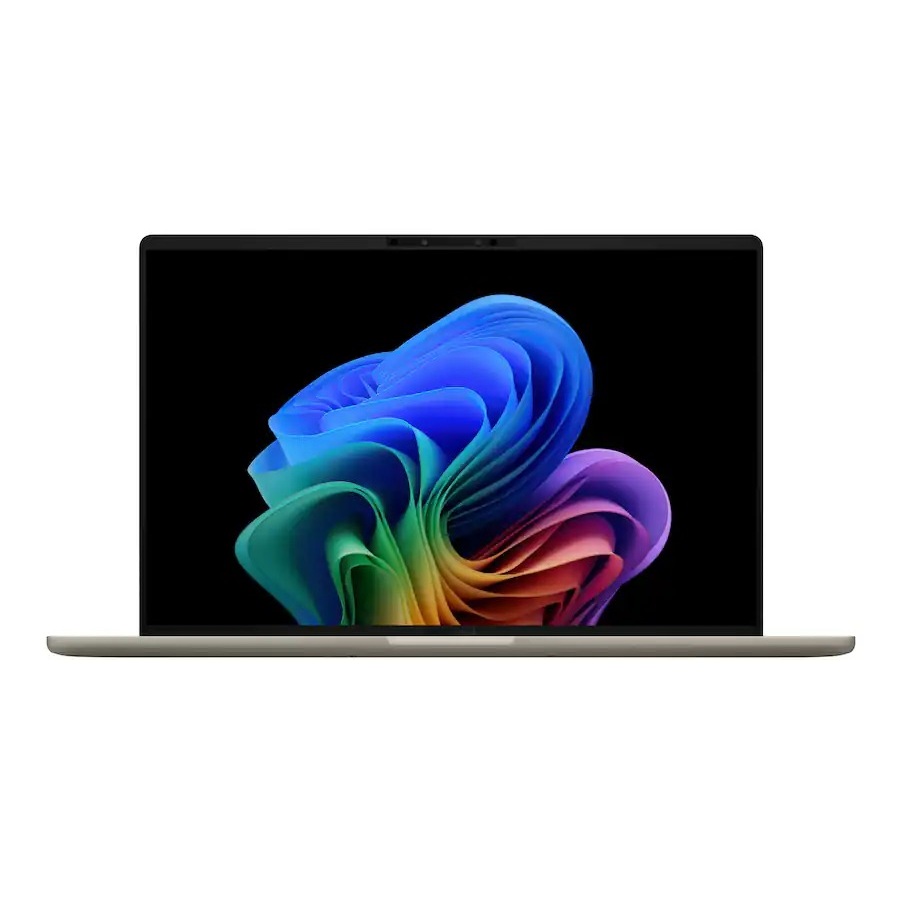
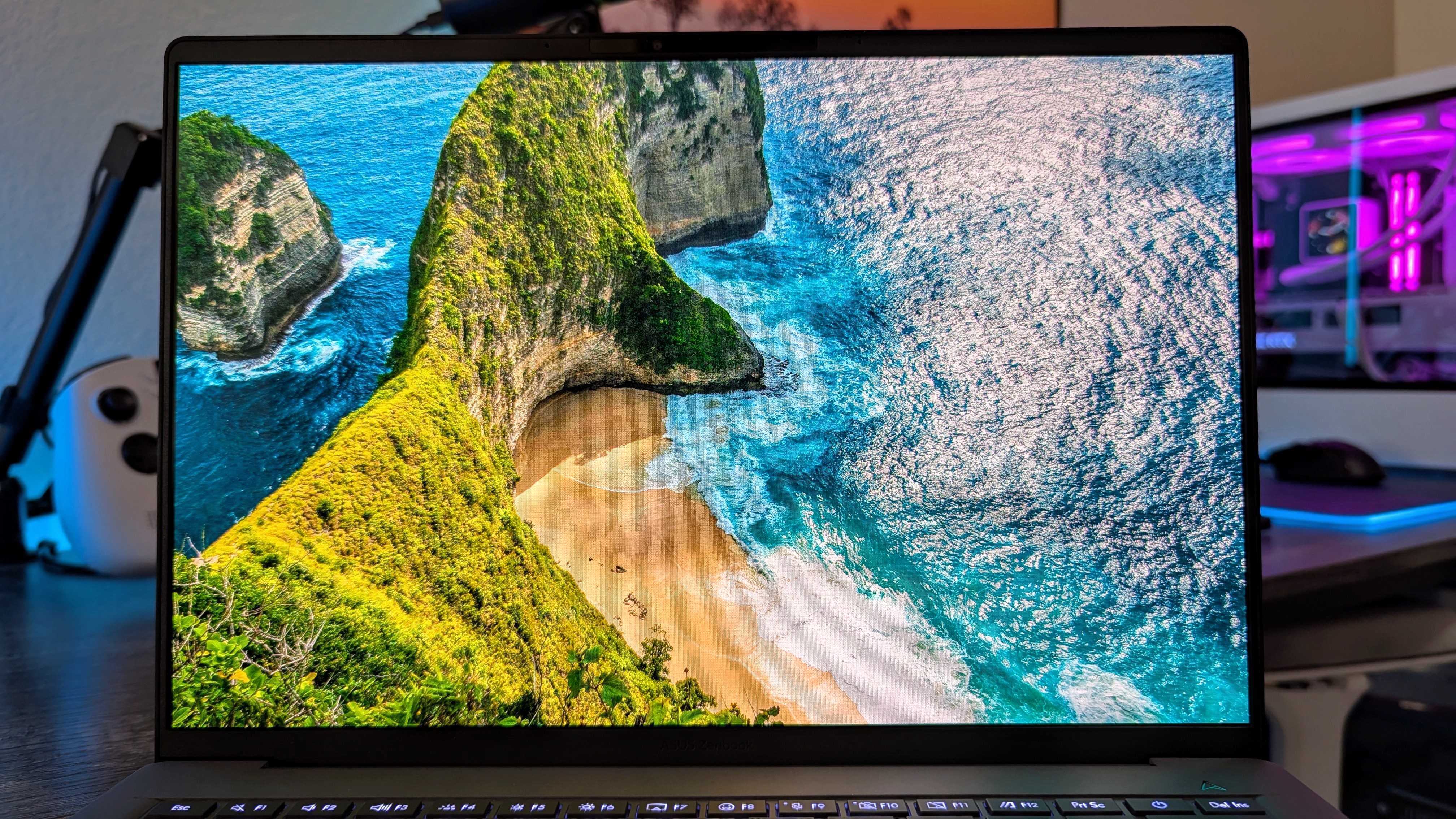
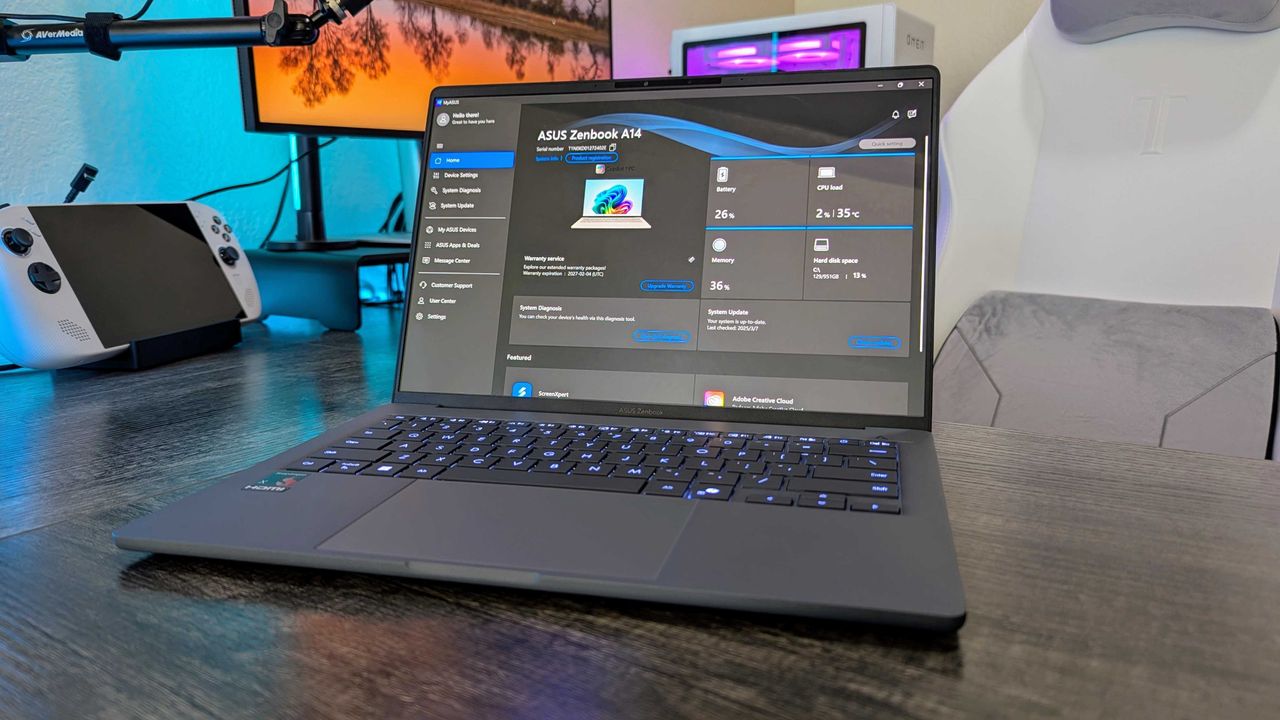
Laptops outfitted with Qualcomm Snapdragon CPUs are some of the best in the market for people looking to crush their daily quotas or survive mountains of schoolwork due to their reliable performance rates. long battery lives and sturdy designs.
Yet, many of them have had their price jacked through the roof thanks to the ongoing memory crisis, making their value not worth the investment for most people with low budgets and incomes.
Fortunately, one of these laptops, the ASUS Zenbook A14 (2025), has managed to snag a sneaky 30% discount to give people an edge in completing their daily workloads for the reduced price of $699.99 at Best Buy (listing price was $999.99).
"With a magnesium chassis as light as air and as tough as stone, Snapdragon X series chipsets that barely sip on the physics-defying massive battery, and a great balance of practical function and aesthetic form, the Zenbook A14 is one of the best laptops of the year." ~ Zachary Boddy, former Staff Writer
The ASUS Zenbook A14's OLED display in action. (Image credit: Windows Central | Zachary Boddy)
If you're looking for a high-quality mid-range laptop that can get homework and work office tasks done fast with no fuss, the ASUS Zenbook A14 is the machine for you.
Why you may? Well, first of all, its performance rates are strong, as it's able to perform productivity activities like browsing the internet for info, opening up hundreds of emails, and running Microsoft Office and AI-empowered programs with great speed with little to no slowdown thanks to its mighty Snapdragon X Plus CPU, 16GB of RAM, and NPU capable of 45 TOPS.
Additionally, it has a clean and beautiful 2K OLED display screen that renders images in crisp detail so you don't miss out on any details when viewing documents or art pieces, an intuitive operating system, and a massive selection of USB and HDMI ports.
Throw in a massive battery life of roughly 32 hours with a sleek, minimalist design that doesn't compromise its durability for the sake of portability, and you have one of the best workhouse laptops in the mid-range spectrum, especially now that it won't cost you $1,000 thanks to this 30% discount at Best Buy.
FAQ
Is this ASUS ZenBook A14 (2025) RAM and SSD upgradeable?
It's RAM is unupgradable to due to being soldered onto the laptop's motherboard. It's factory-installed 512GB SSD, however, can be replaced and upgraded with a larger SSD up to 1TB to fit more data.
What's so special about its Snapdragon X Plus processor?
The Snapdragon X Plus is a very potent ARM-based processor capable of powering up mid-range laptops' battery efficiency and performance rates when multitasking AI programs, web browsing, Microsoft Office apps, and more daily workloads without hiking the price of whatever laptop it's installed in.
How long does its battery life last?
The ASUS ZenBook A14 (2025)'s battery life lasts around 32 hours before needing to recharge or lower, depending on how many intensive programs you run or sustained workloads you put it through.
Join us on Reddit at r/WindowsCentral to share your insights and discuss our latest news, reviews, and more.
ASUS Armoury Crate is but one piece of specialized management software that many of us have installed on our PC, perhaps without even knowing it. It comes preinstalled on ASUS gaming handhelds, including the Xbox Ally X, as well as ASUS gaming laptops.
If that sounds like hardware you use, it's time to check up on Armoury Crate. According to an August 10 update on the official ASUS advisory board, "a component used by Armoury Crate" is vulnerable and could be leaving you open to attacks.
Alongside that unmentioned component of Armoury Crate, ASUS has also released security updates for its GPU Tweak III, GPU Tweak II, and AI Suite 3 software.
This vulnerability, listed as CVE-2026-8917, comes with an 8.4 rating. That's out of a maximum of 10, meaning this isn't an issue you should ignore for long.
What does this ASUS vulnerability entail?
According to the CVE record, an "IOCTL vulnerability allows a local attacker to write a specific value to an arbitrary memory address, potentially leading to privilege escalation."
Although the CVE record doesn't mention Armoury Crate by name, it's clear that ASUS is concerned with that "certain component" alongside its other standalone software.
How do I update the vulnerable ASUS software?
A look at the GPU Tweak III download page at the ASUS support website. (Image credit: ASUS)
Updated versions of GPU Tweak III, GPU Tweak II, and AI Suite 3 software can be directly downloaded from the ASUS support website.
You want to be sure that you're grabbing the most recent version. For GPU Tweak III, I'm seeing version 2.1.7.2. This appears to be a newer version than what's listed as affected on the CVE website.
The GPU Tweak II version on the ASUS support page appears to still be the one affected. (Image credit: ASUS)
For GPU Tweak II, I'm seeing version 2.4.0.0 on the ASUS support page; unfortunately, this version is listed on the CVE page as vulnerable, so I can only guess that ASUS hasn't yet made the necessary updates to its download packages.
It's unclear why ASUS hasn't yet made the secure version of GPU Tweak II available for download. If you're concerned, my best advice is to simply remove the software entirely until it's updated.
And for the actual Armoury Crate software, you can choose to update from within the app itself.
Is there any alternative to ASUS Armoury Crate?
A look at the G-Helper app interface for ASUS laptops and gaming handhelds. (Image credit: Seerge (g-helper.com))
I often use Armoury Crate on my desktop gaming PC to control certain ROG and TUF components, but most of the time it sits idly in the background. It's not the best software, vulnerabilities aside, but it seems to get the job done.
I've read tales of some specific ASUS desktop hardware absolutely requiring Armoury Crate to function properly, but for other ASUS gaming devices, it can be replaced entirely.
Let me introduce you to G-Helper. It's designed to work with ASUS laptops and gaming handhelds, doing what Armoury Crate does in a streamlined, unbloated app that only eats up about 5MB of space.

 Connexion