[Deal du jour] Moins de 700 € pour le Pixel 10 Pro, c'est l'offre du jour de ces Ventes Flash de Printemps d'Amazon. On a rarement vu le smartphone de Google aussi peu cher.
Accusé de cacher les versions PS5 et Xbox de Crimson, jeu ô combien ambitieux de ce premier trimestre, Pearl Abyss a enfin partagé les données techniques des différentes versions. Sans surprise, les propriétaires d'une PS5 Pro vont être aux anges.
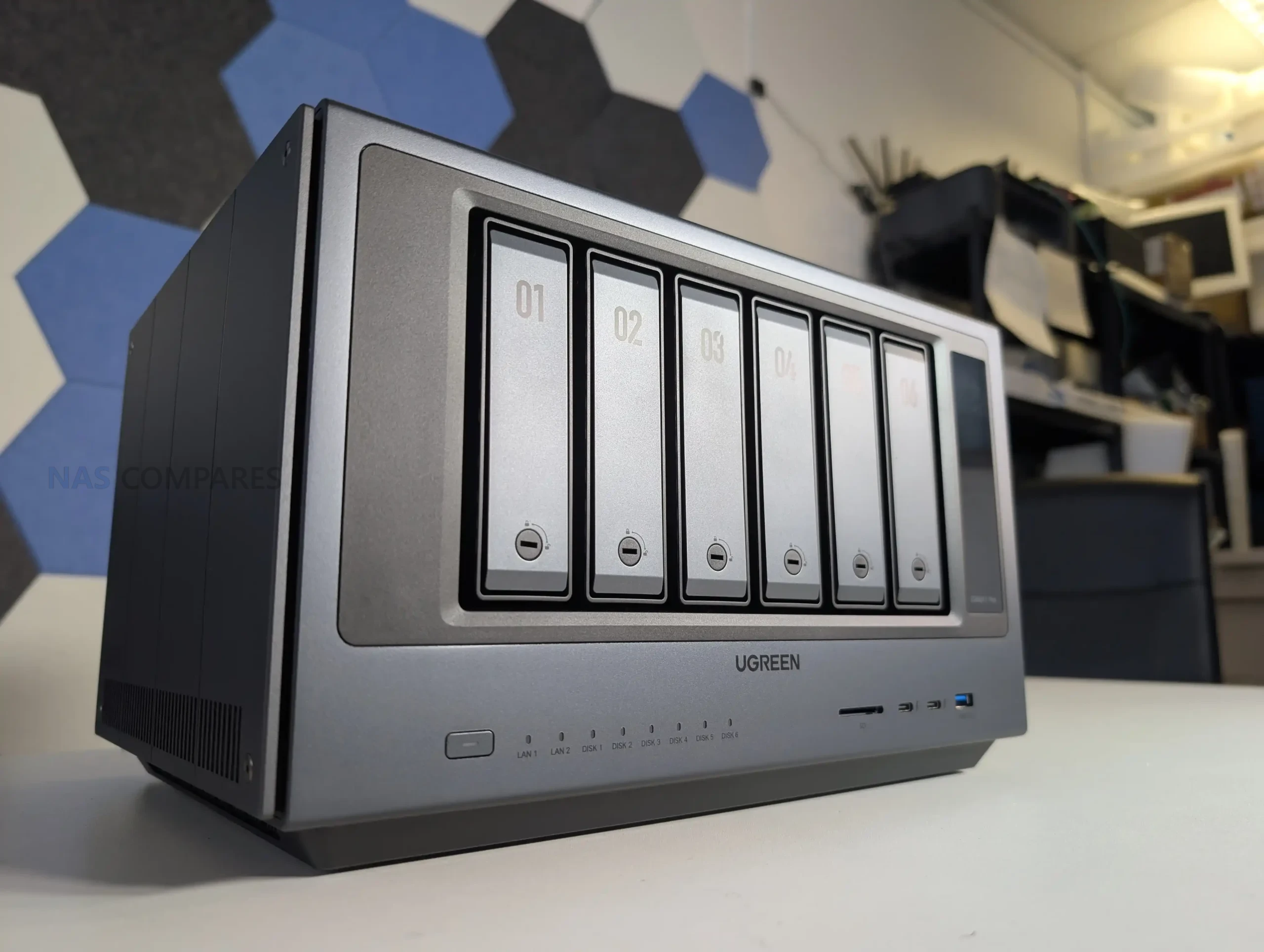
Ugreen continue son offensive sur le marché des NAS avec un nouveau 4 baies ambitieux : UGREEN NASync DXP4800 Pro. Après le DXP4800 Plus de l’an dernier, nous avons pu passer plusieurs jours avec le modèle Pro, une version musclée pensée pour les usages avancés, le multitâches intensif et les environnements exigeants sans compromis sur la simplicité d’utilisation. Sur le papier, la promesse est solide. En pratique, tout n’est cependant pas parfait…
UGREEN NASync DXP4800 Pro
Là où le DXP4800 Plus s’appuie sur un Intel Pentium Gold 8505, le DXP4800 Pro passe sur un processeur Intel Core i3-1315U, offrant plus de puissance brute et une meilleure capacité de traitement pour des charges lourdes : virtualisation, transcodage multimédia, IA, Docker…
Contenu de la boîte
À l’ouverture, on retrouve :
Le DXP4800 Pro en lui-même ;
2 câble réseau RJ45 Cat. 7 ;
L’alimentation externe et son câble ;
Des vis pour les SSD avec un tournevis ;
2 blocs de pâte thermique pour les SSD NVMe ;
Un guide de démarrage rapide en anglais, allemand et chinois ;
Une feuille sur la garantie de 2 ans.
Comme pour son grand frère, l’emballage reste soigné, avec plusieurs niveaux de protection. On note les efforts du fabricant…
Design et connectivité
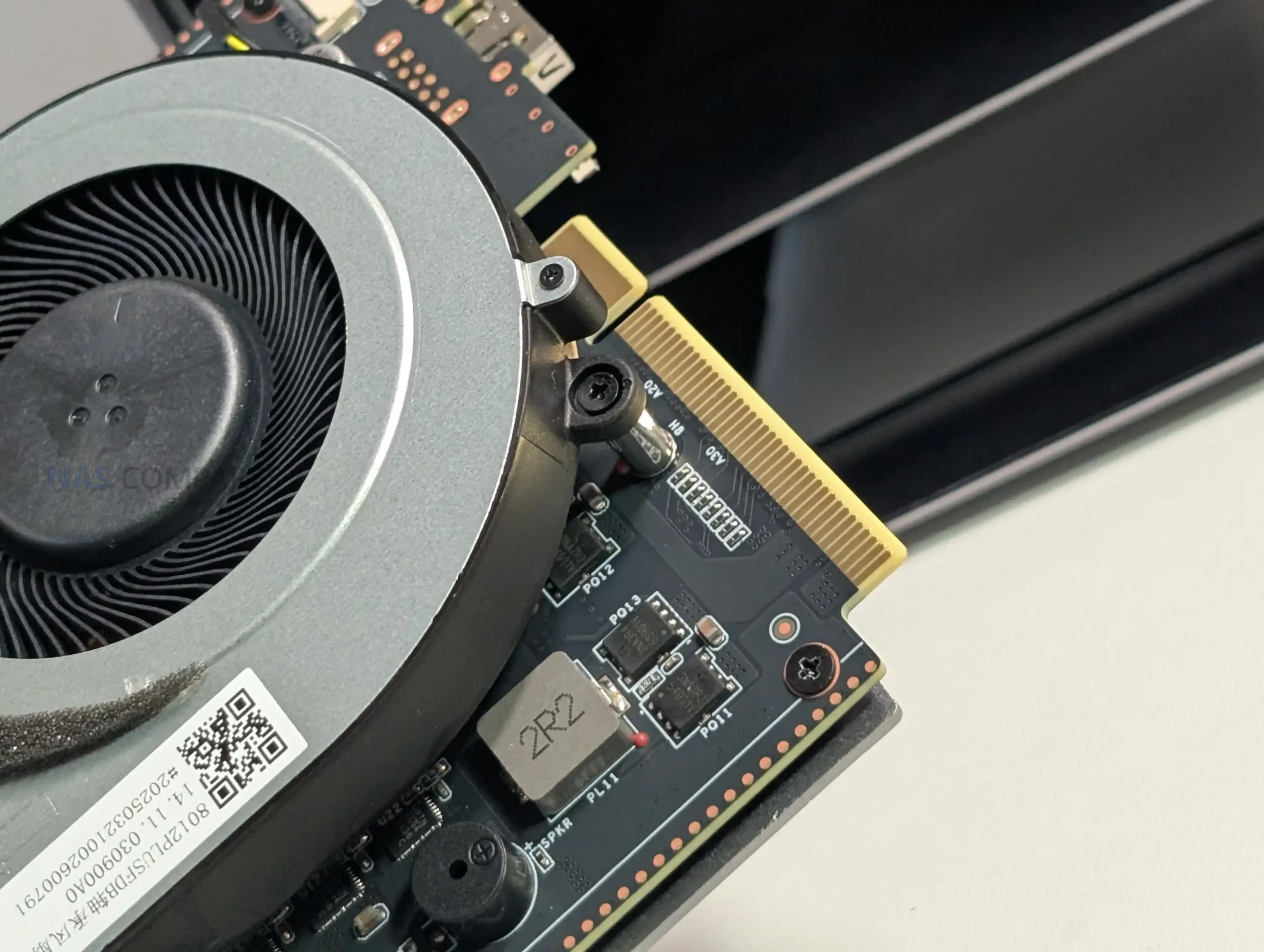
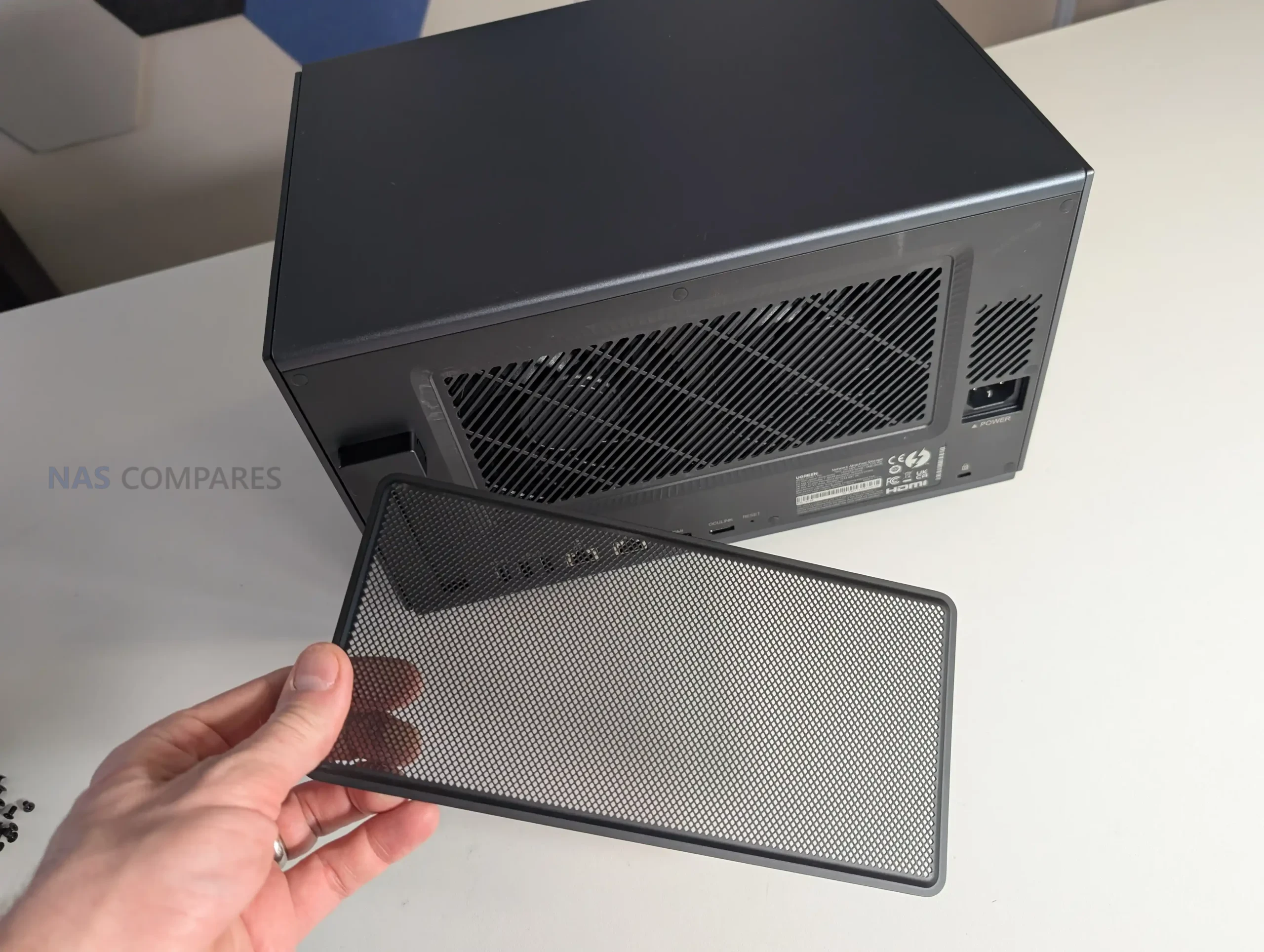
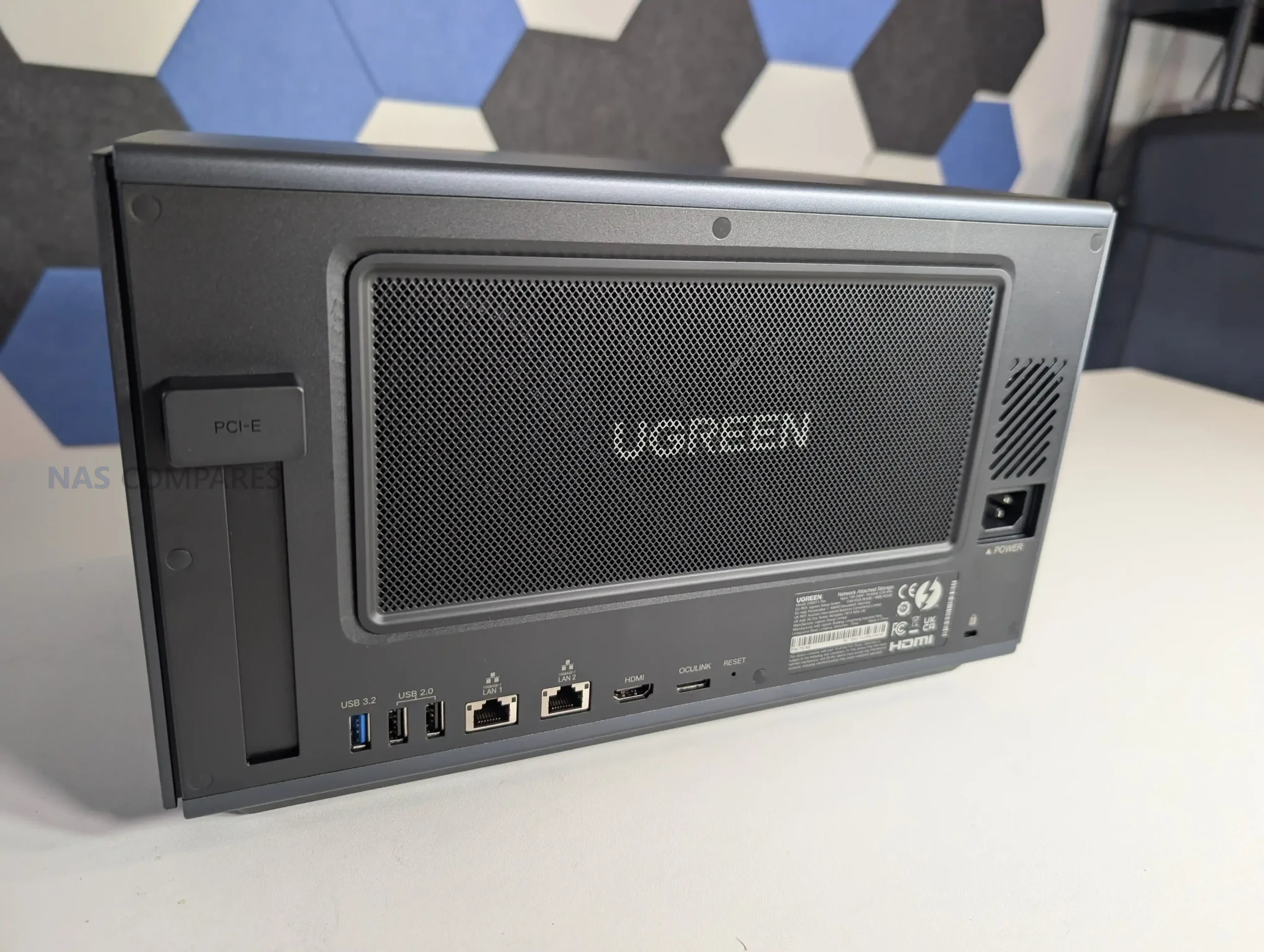
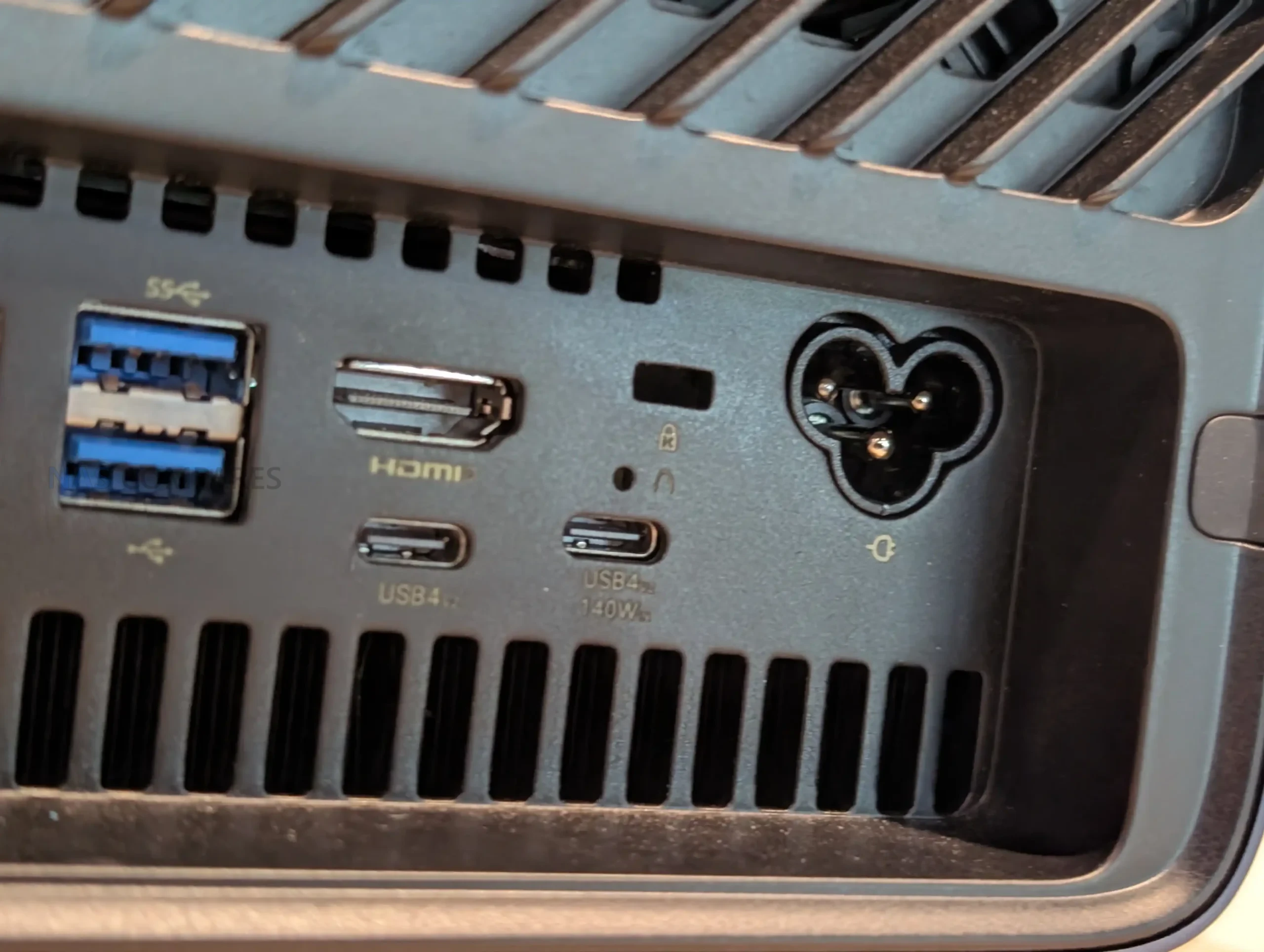
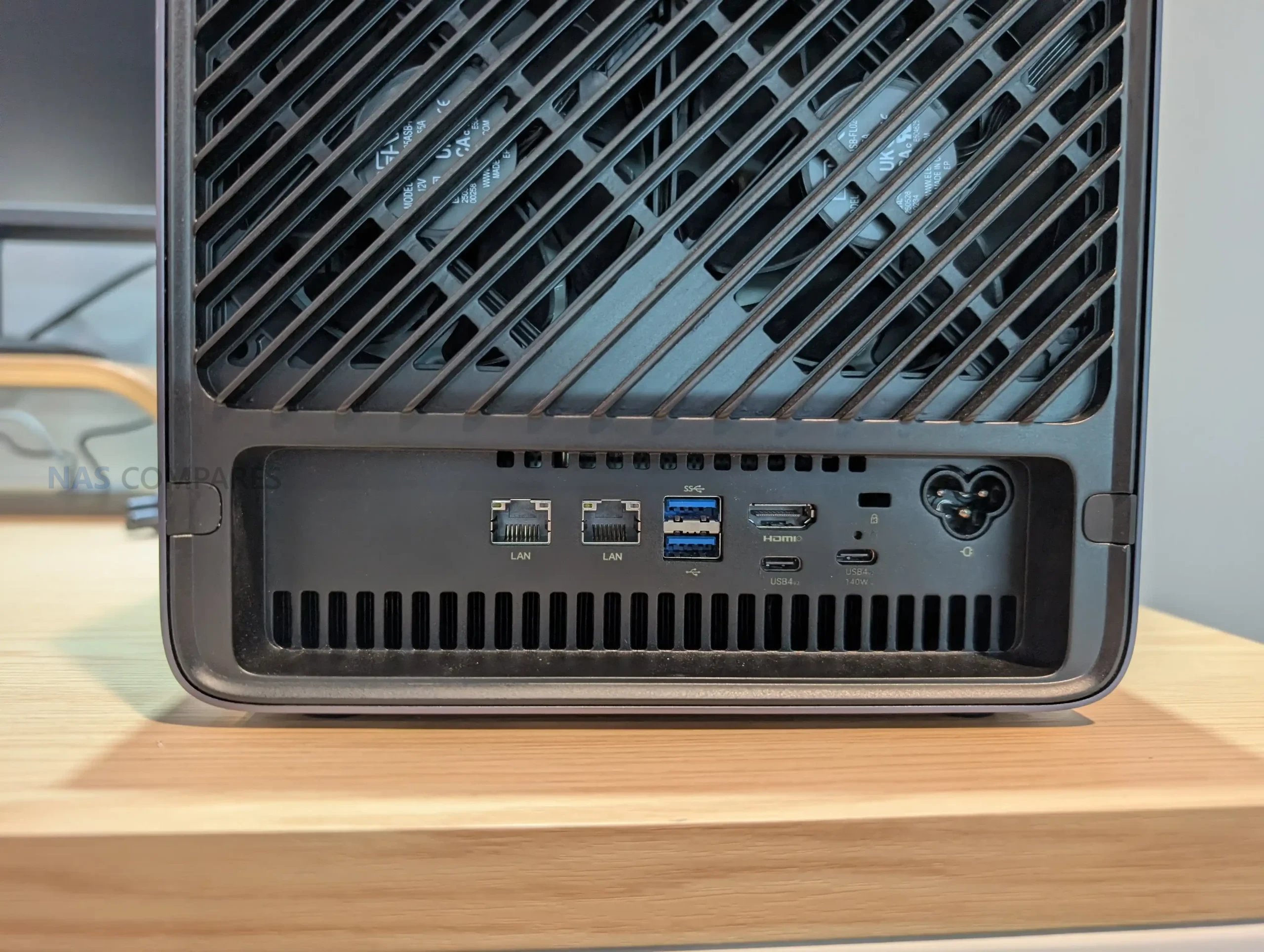
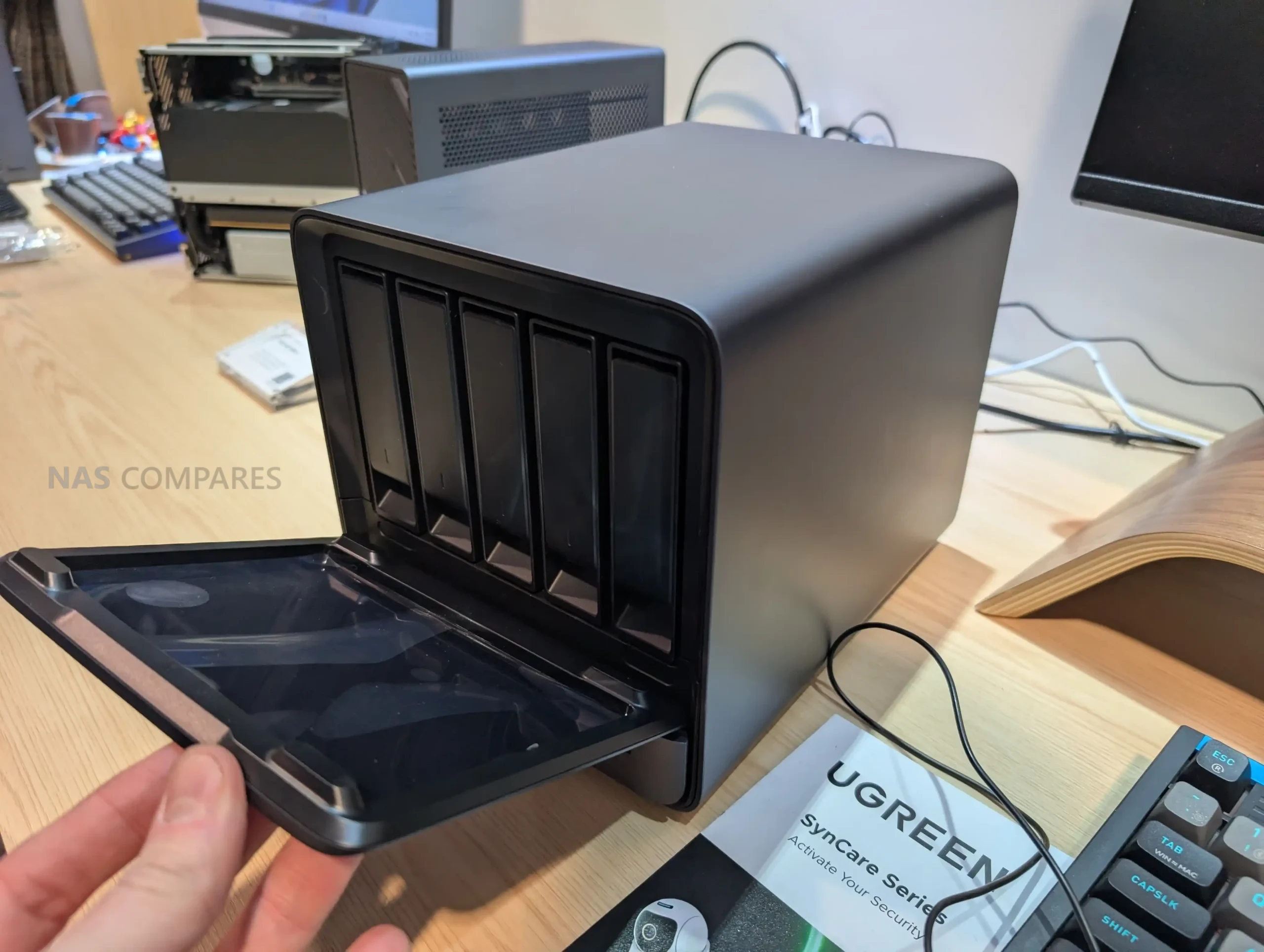
Extérieurement, il ressemble comme 2 gouttes d »eau aux DXP4800 Plus. Nous avons un NAS bien lourd avec un boîtier en aluminium bleu-gris. Son poids sur la balance affiche 4,1 kg. À l’arrière, nous avons toujours un ventilateur de 140 mm. Seul le nom en façade (en bas) diffère…
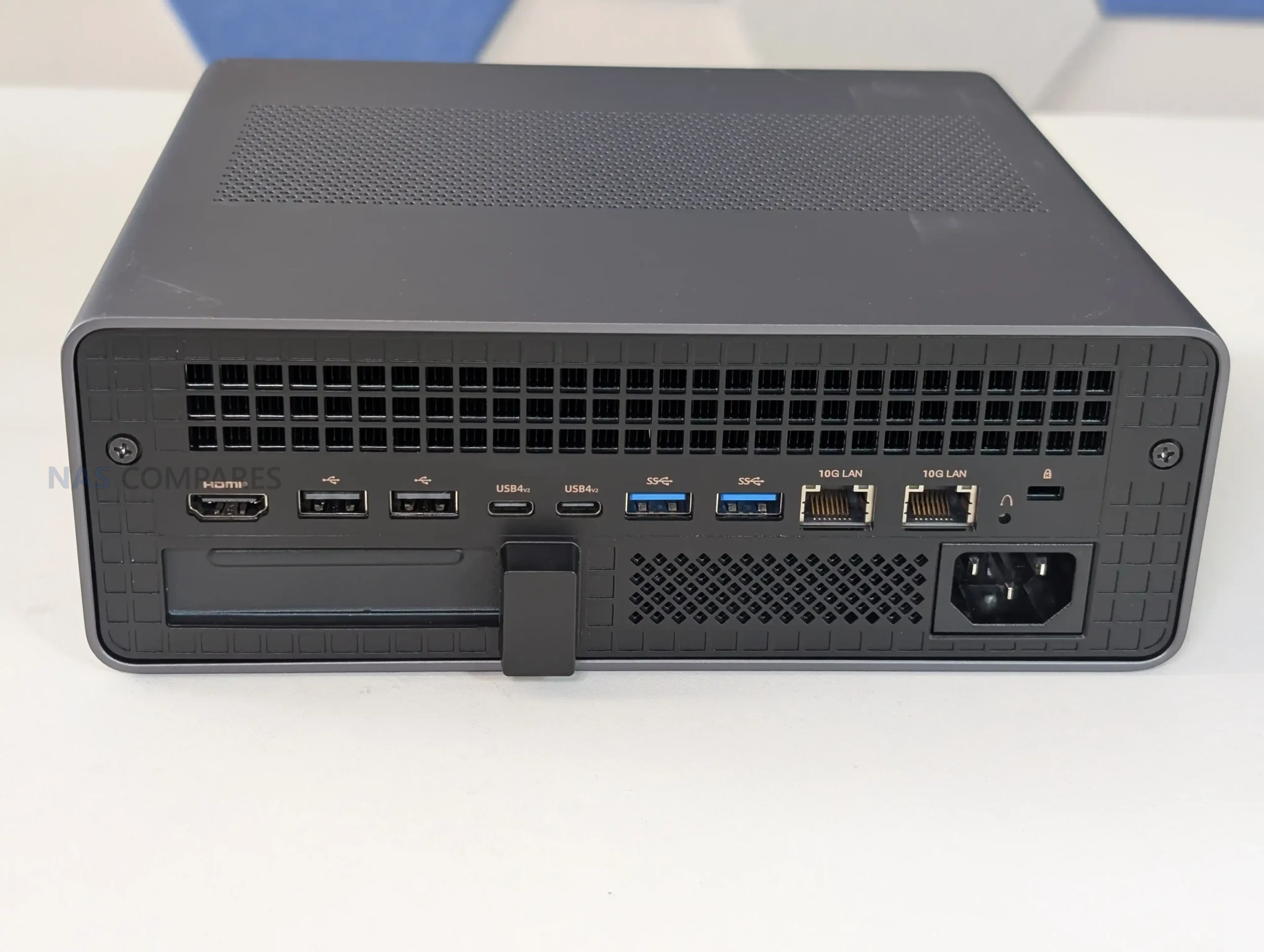
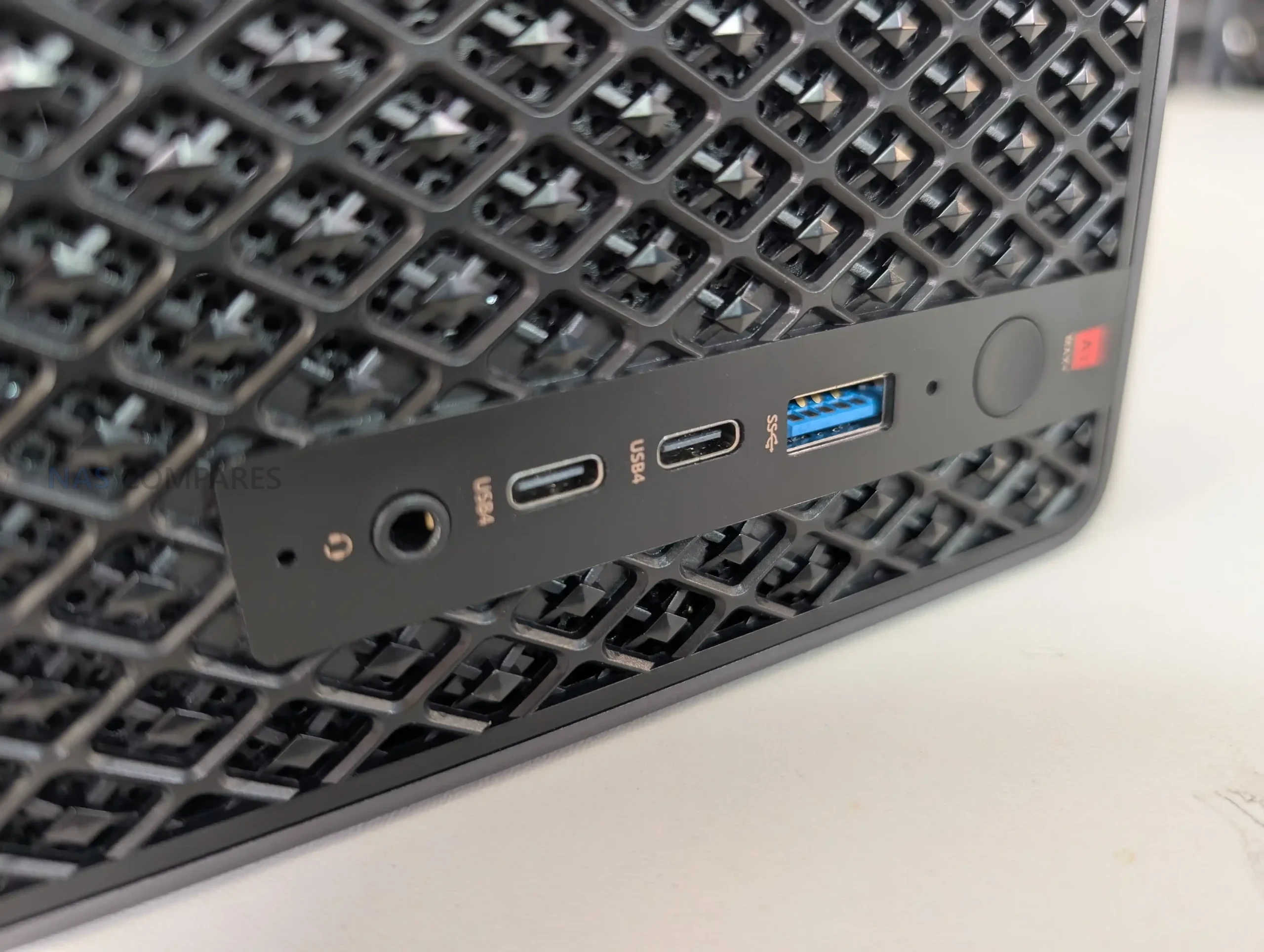
Du côté de la connectique, ce NAS dispose de :
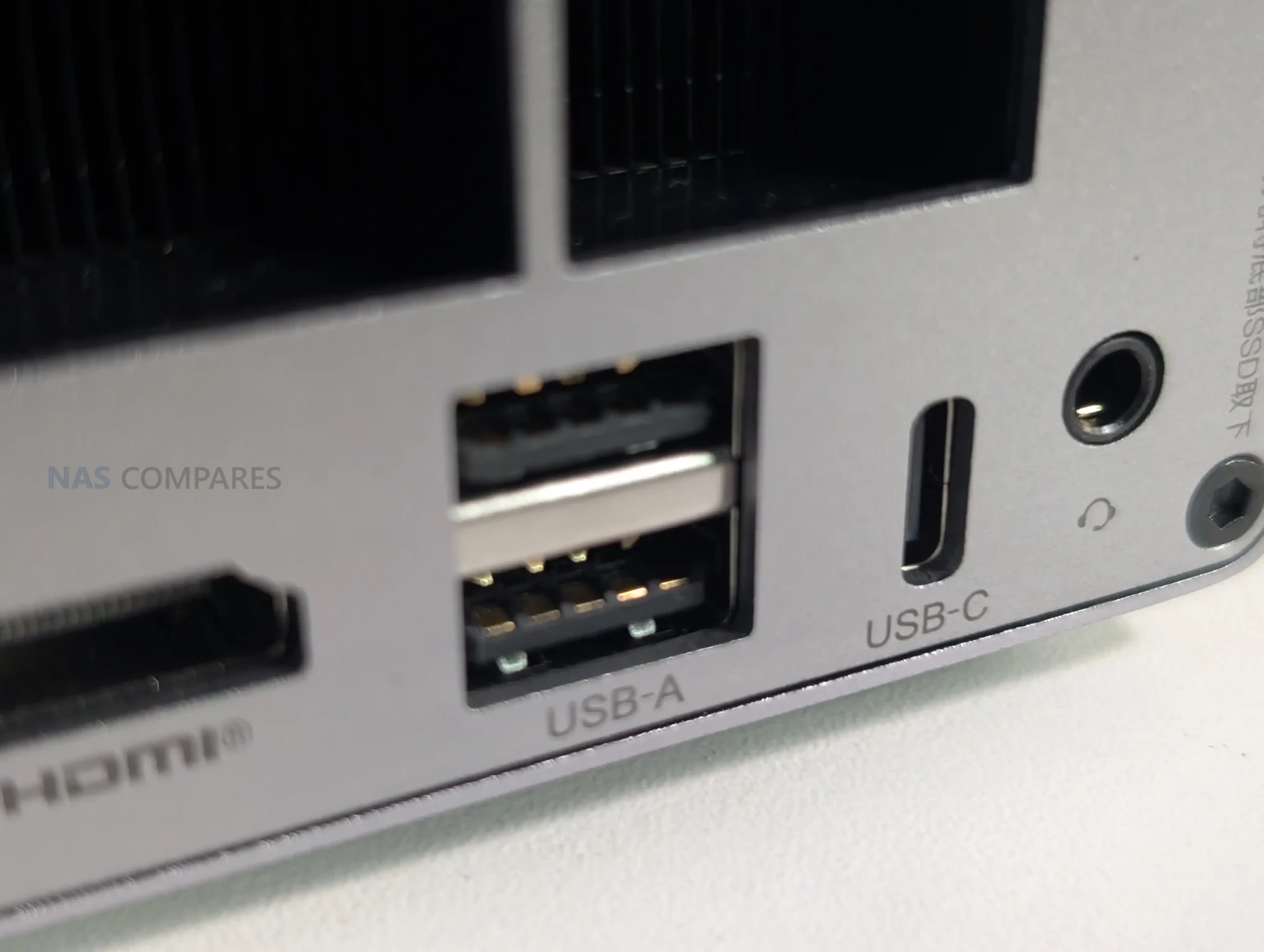
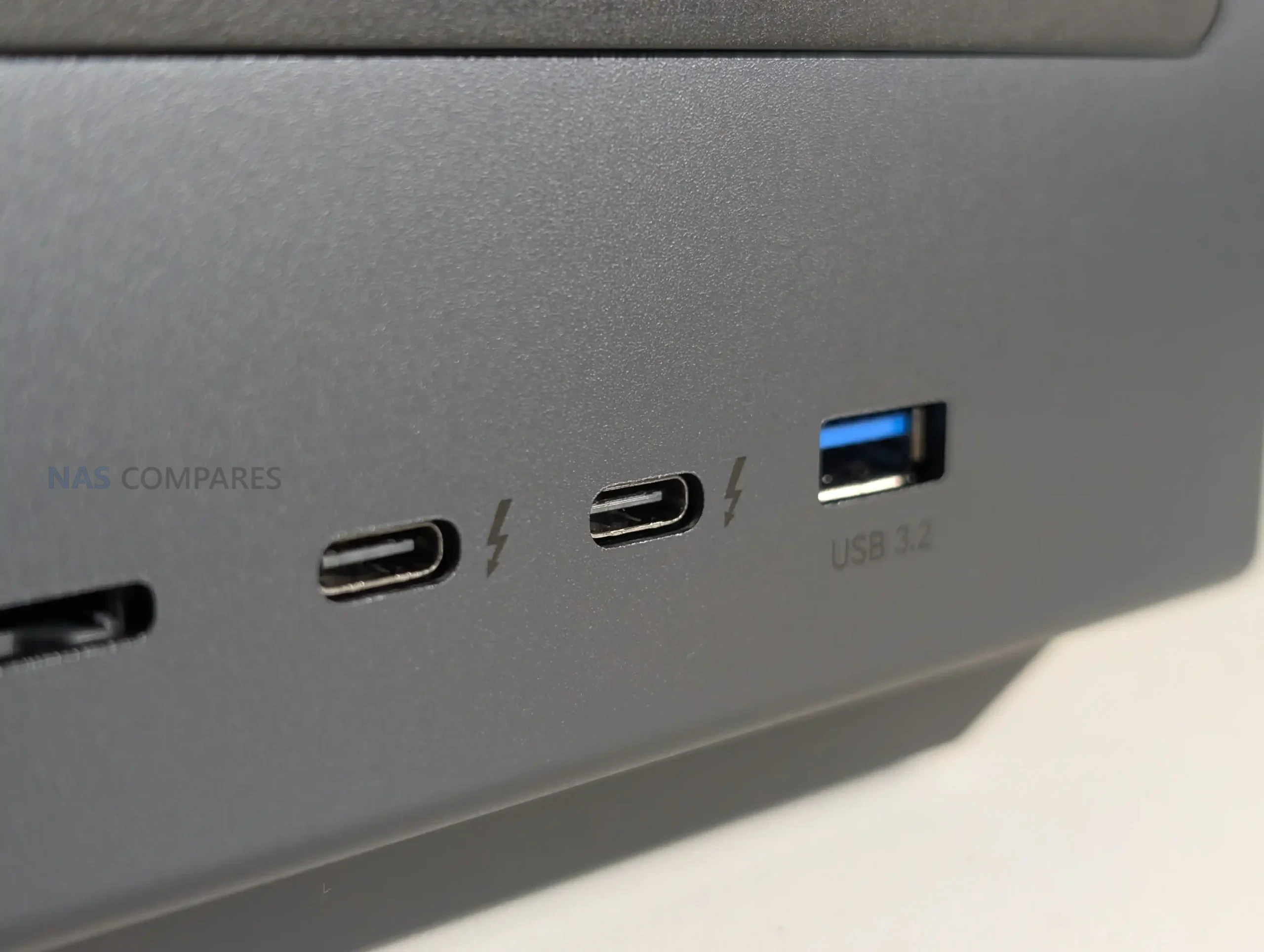
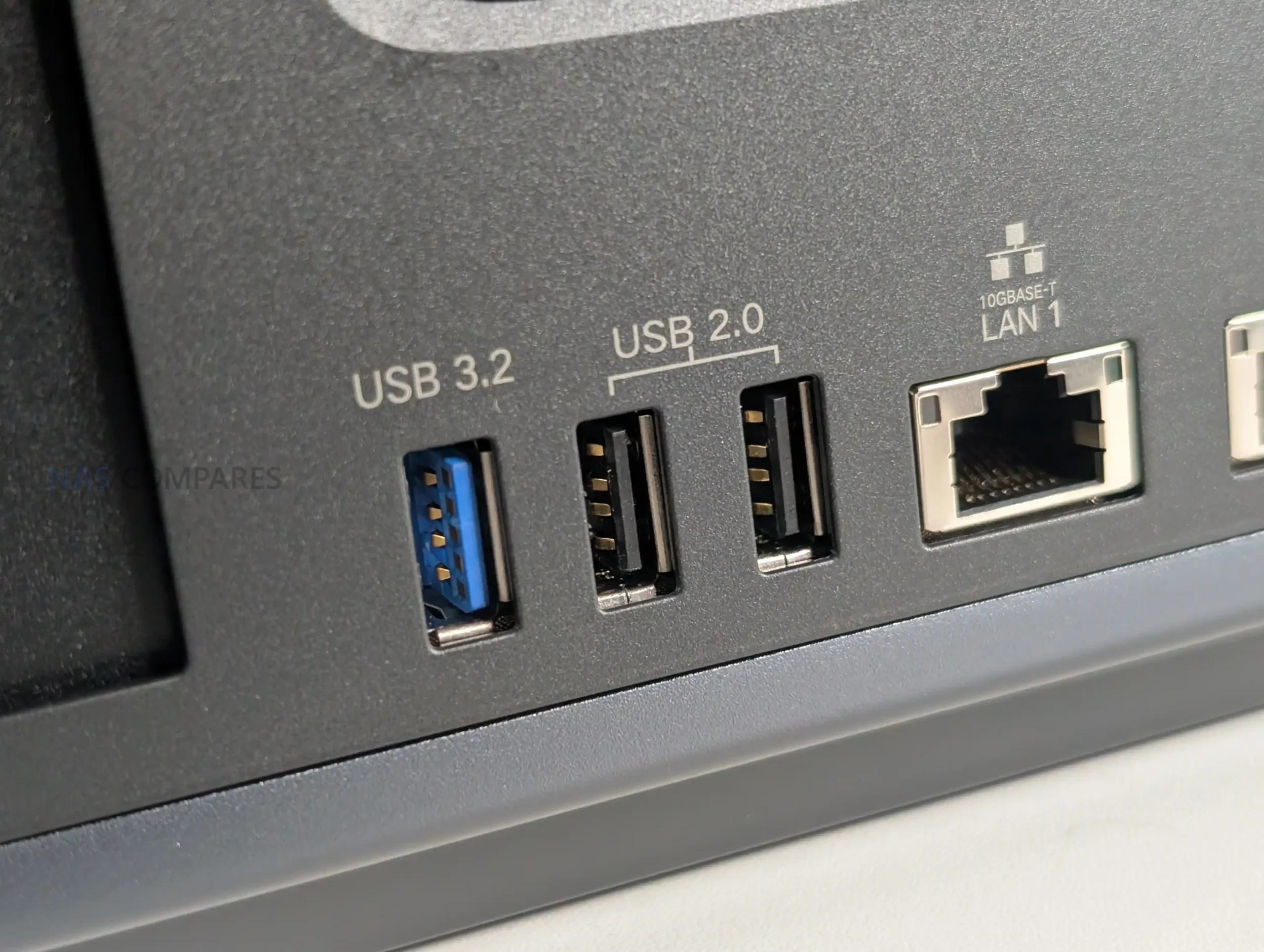
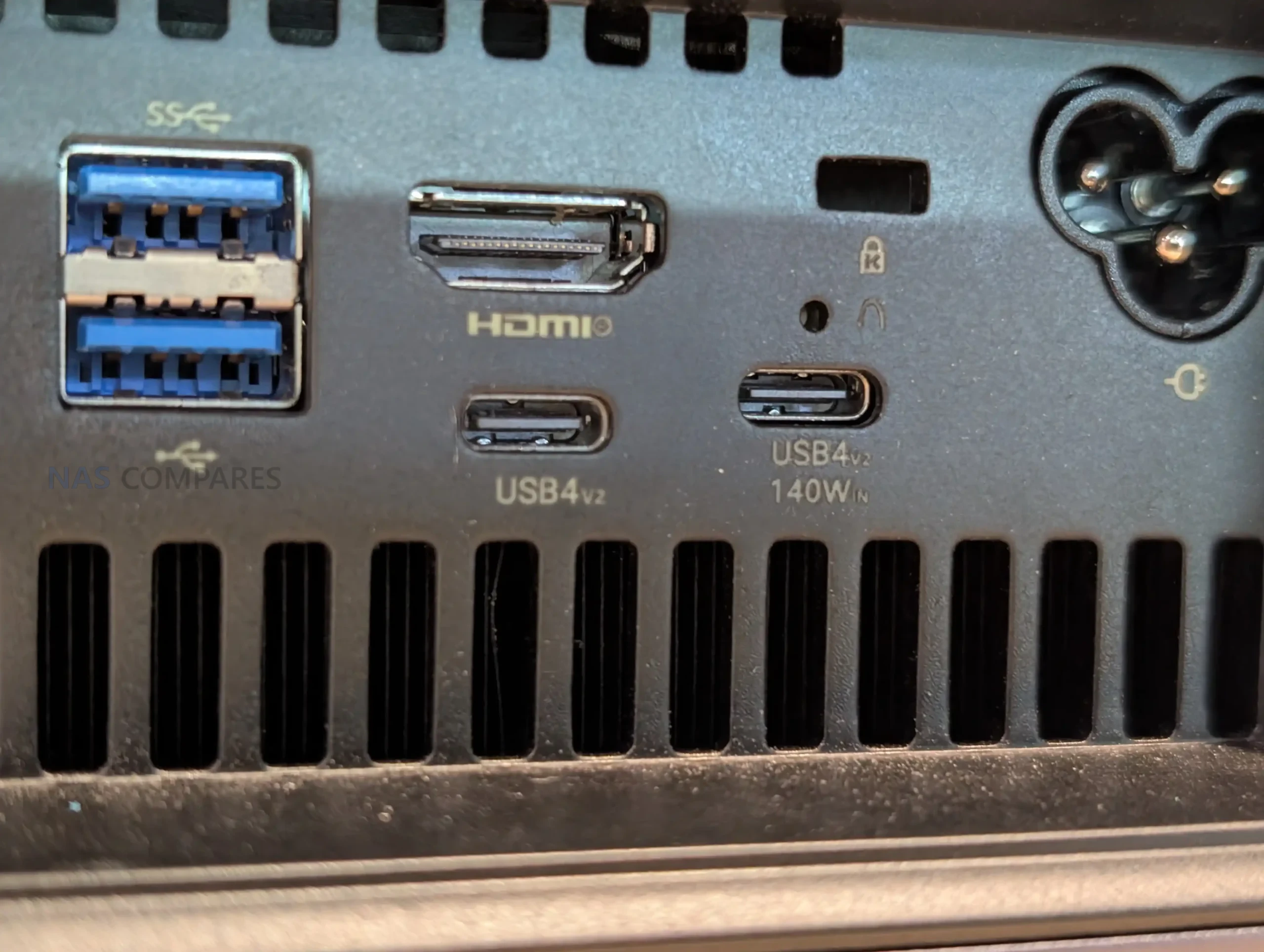
2 ports USB 3.2 Gen 2 (dont 1 Type-C) ;
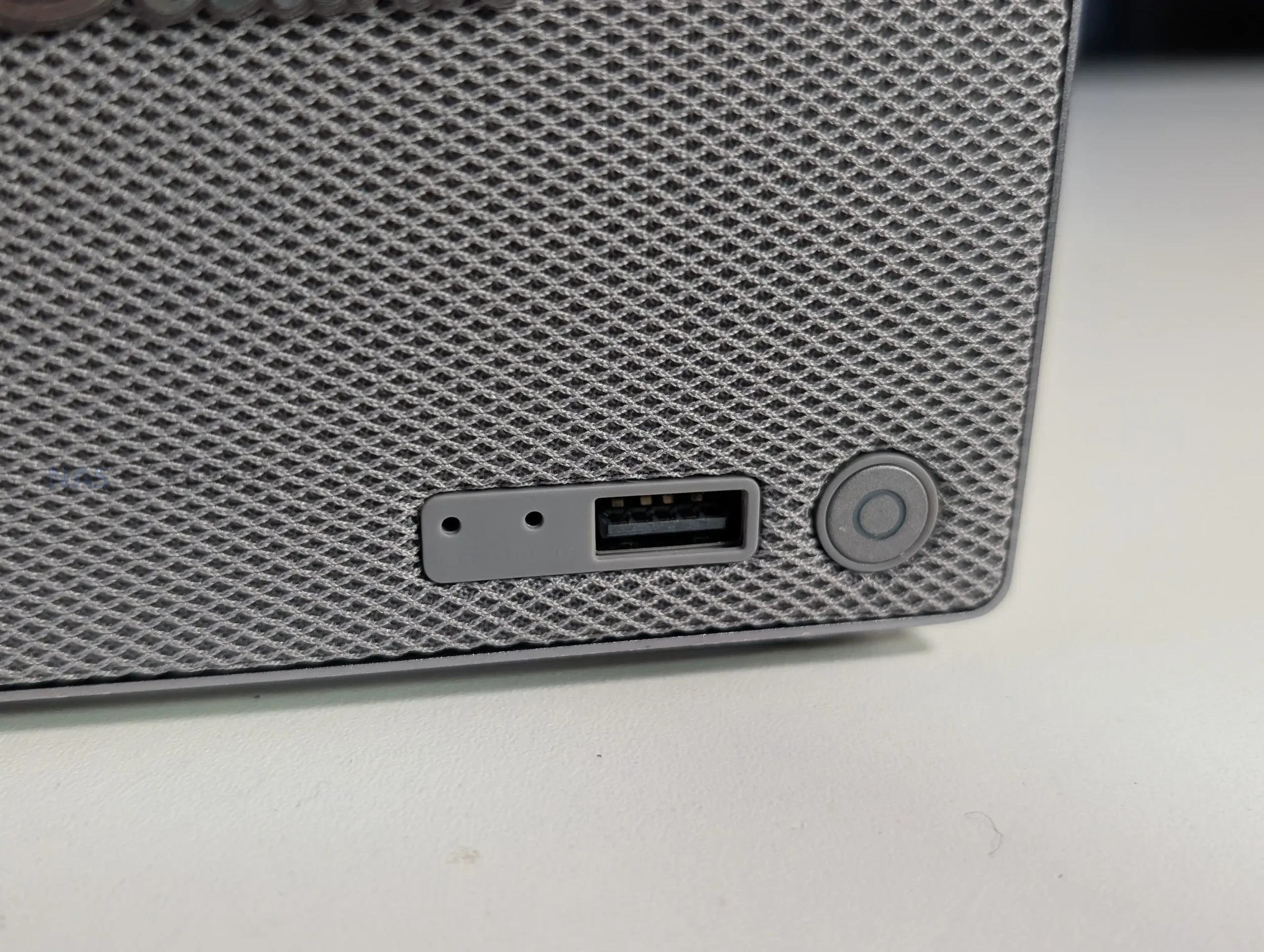
1 port USB 3.0 Type-A ;
2 ports USB 2.0 Type-A ;
1 lecteur de carte SD ;
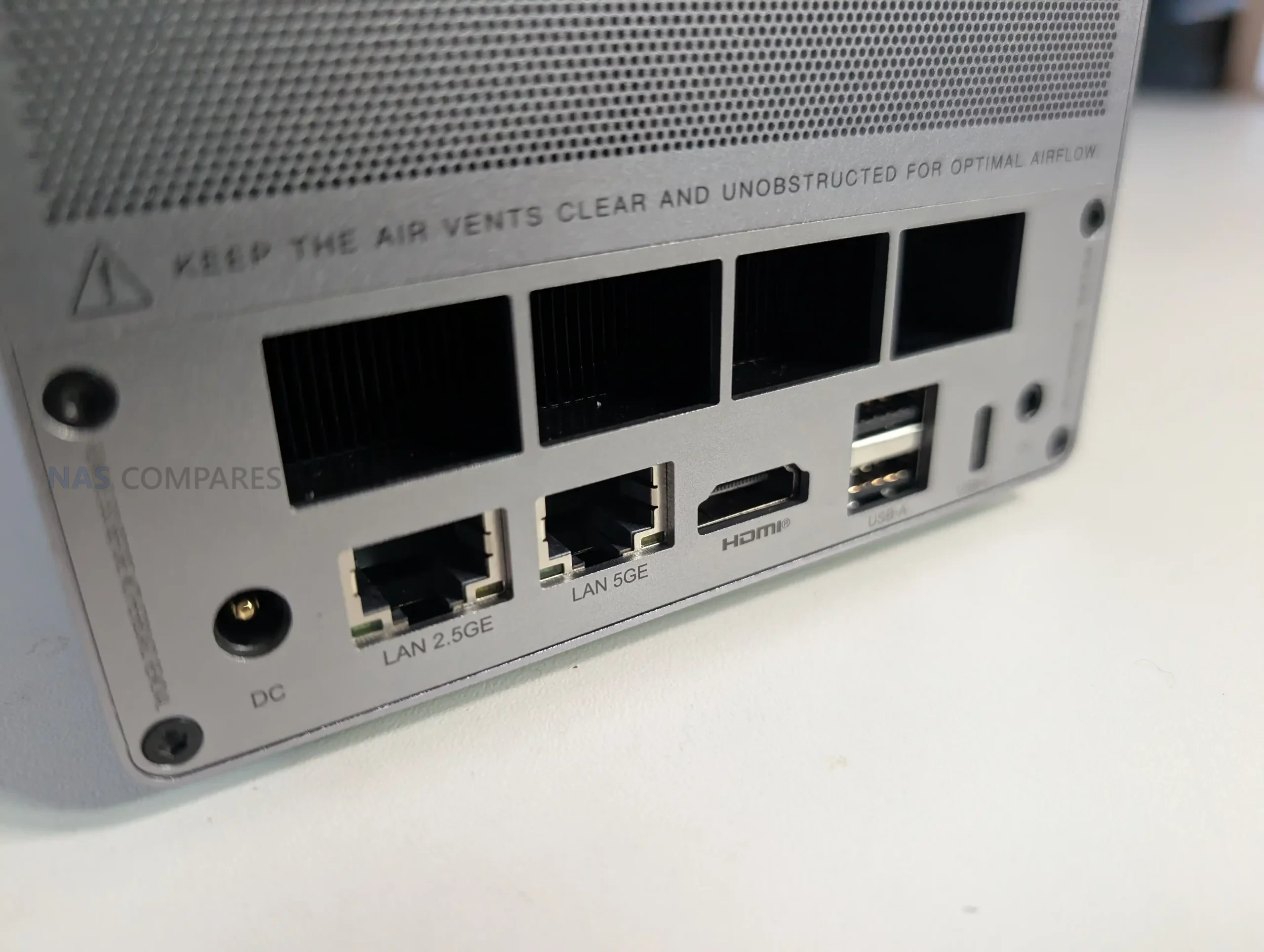
1 sortie HDMI 2.1 ;
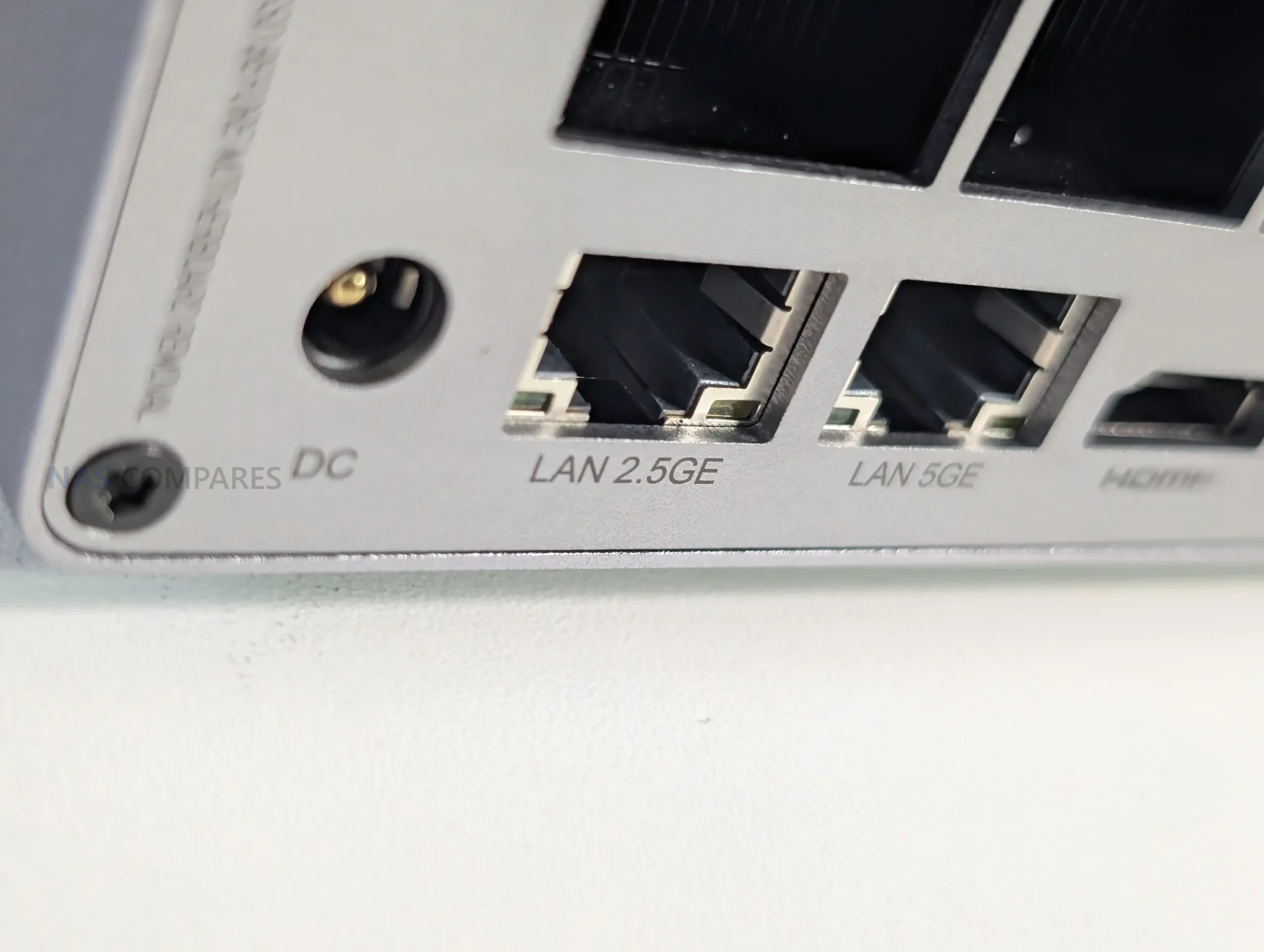
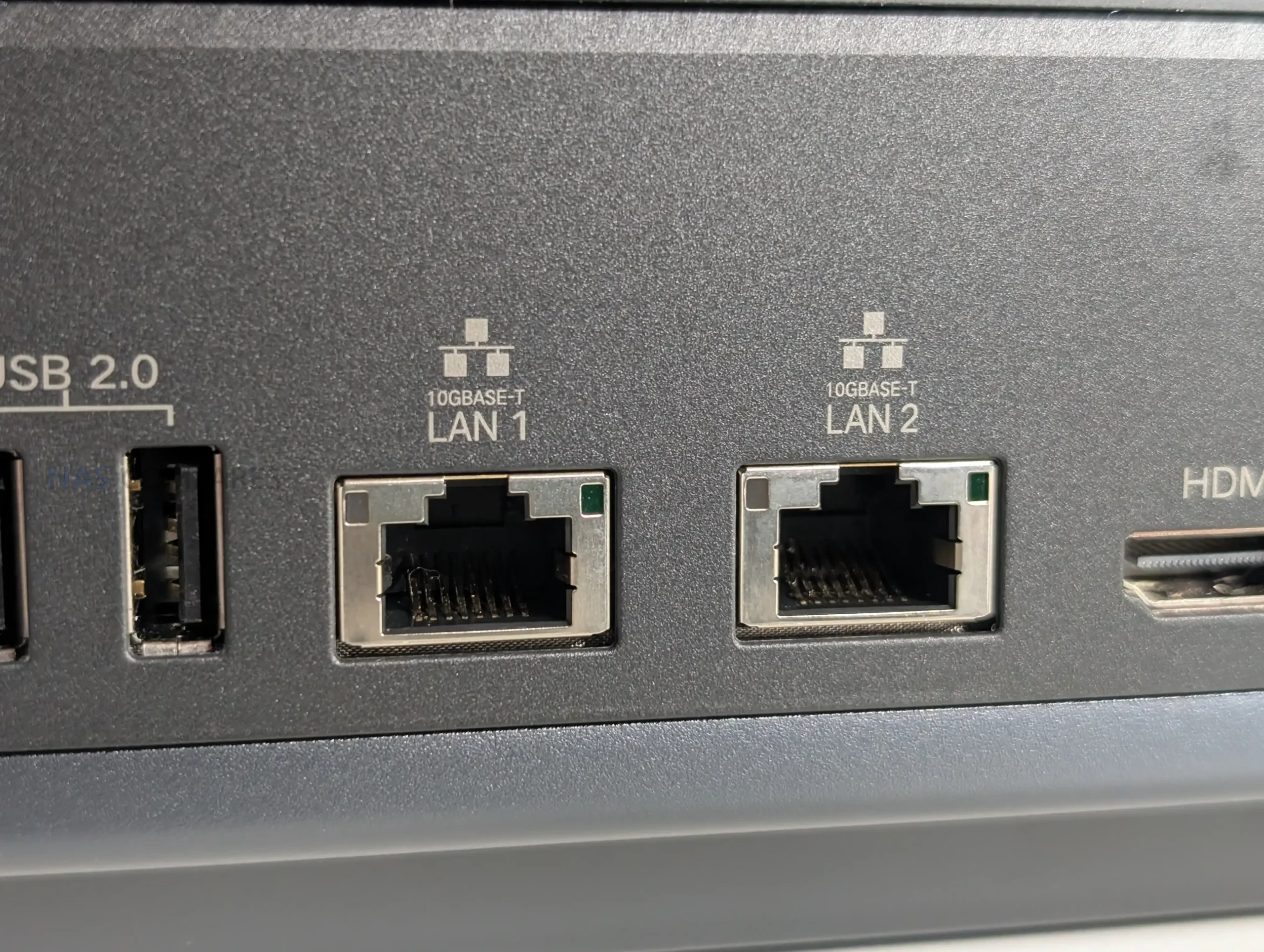
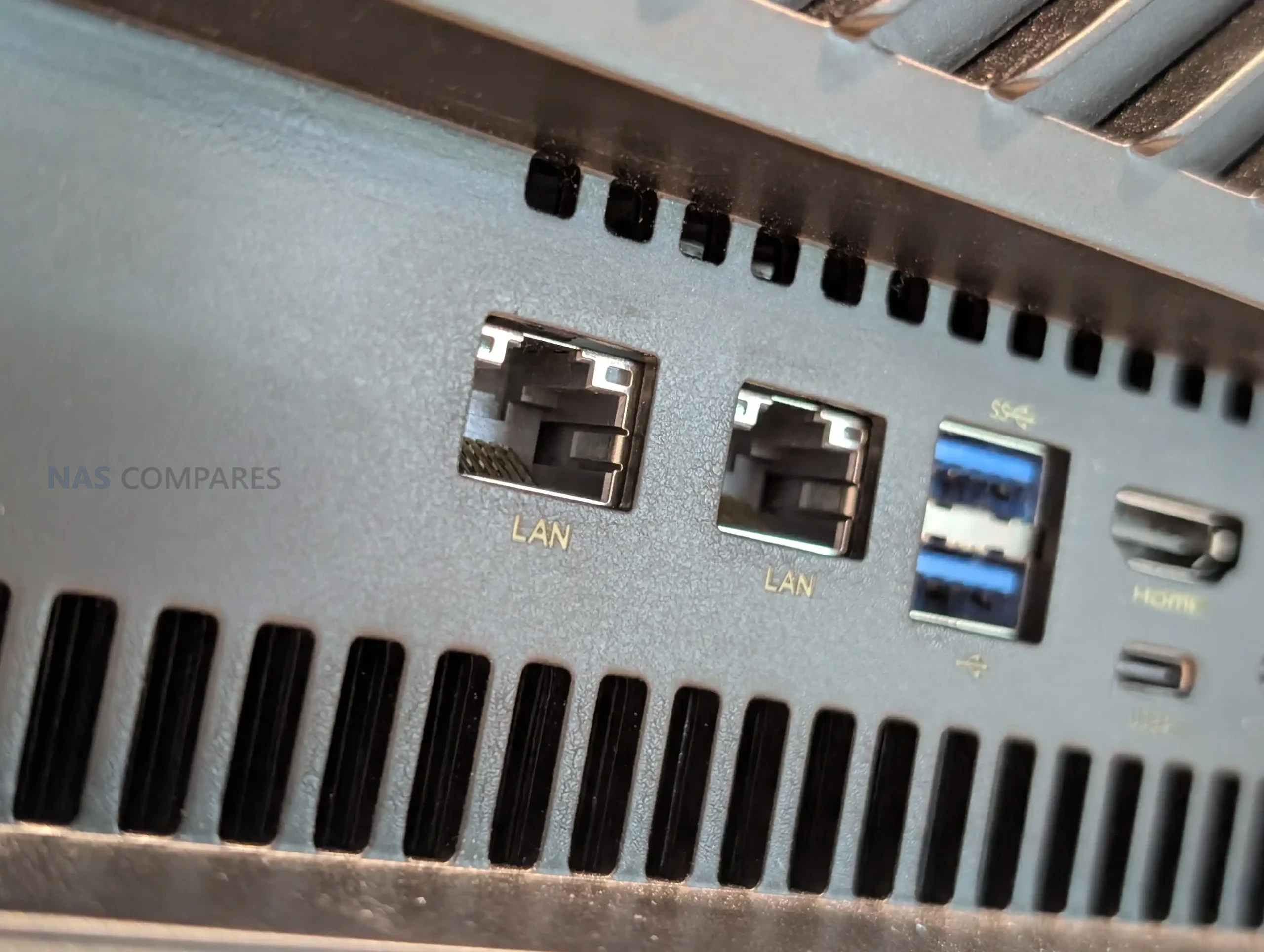
1 port RJ45 2,5 Gb/s ;
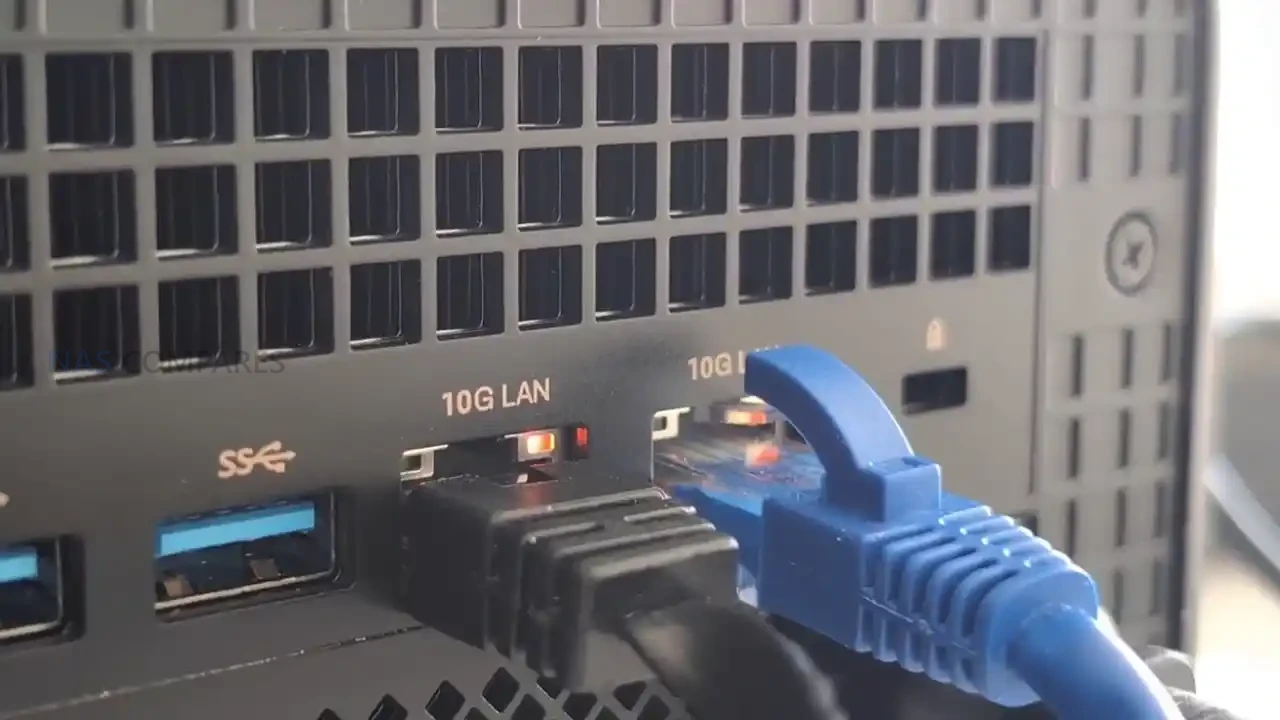
1 port RJ45 10 Gb/s.
Une connectivité bien pensée et complète.
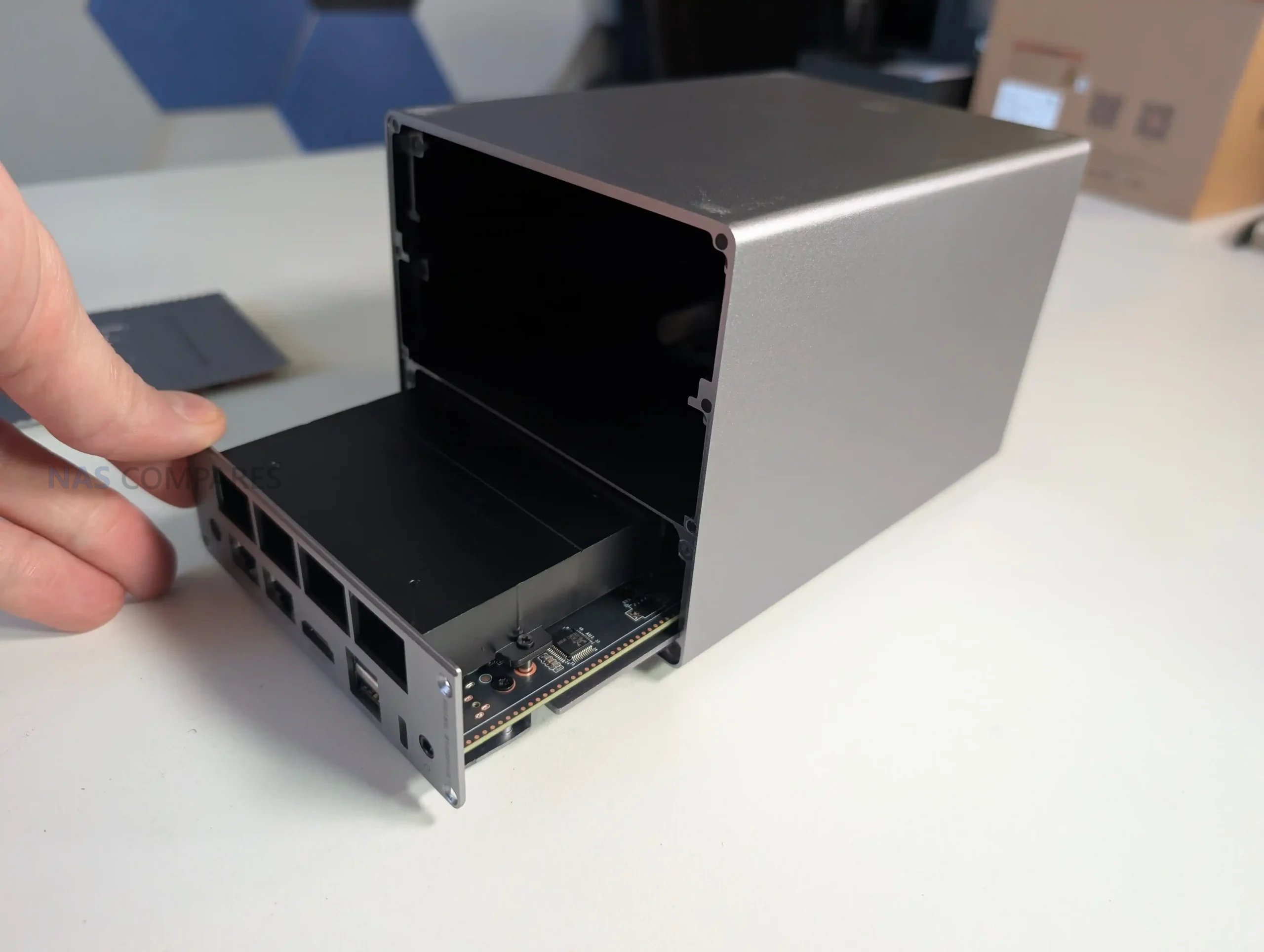
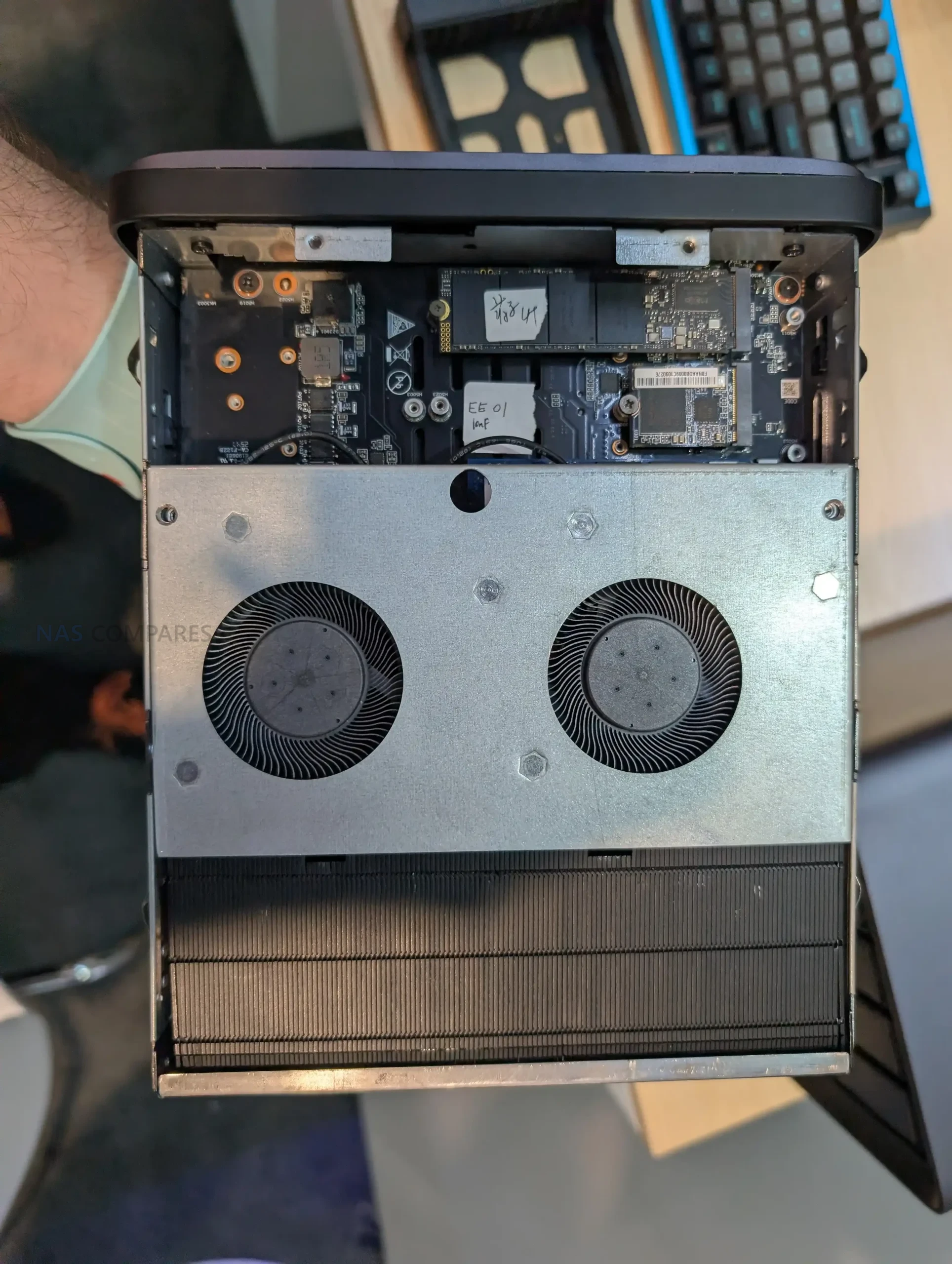
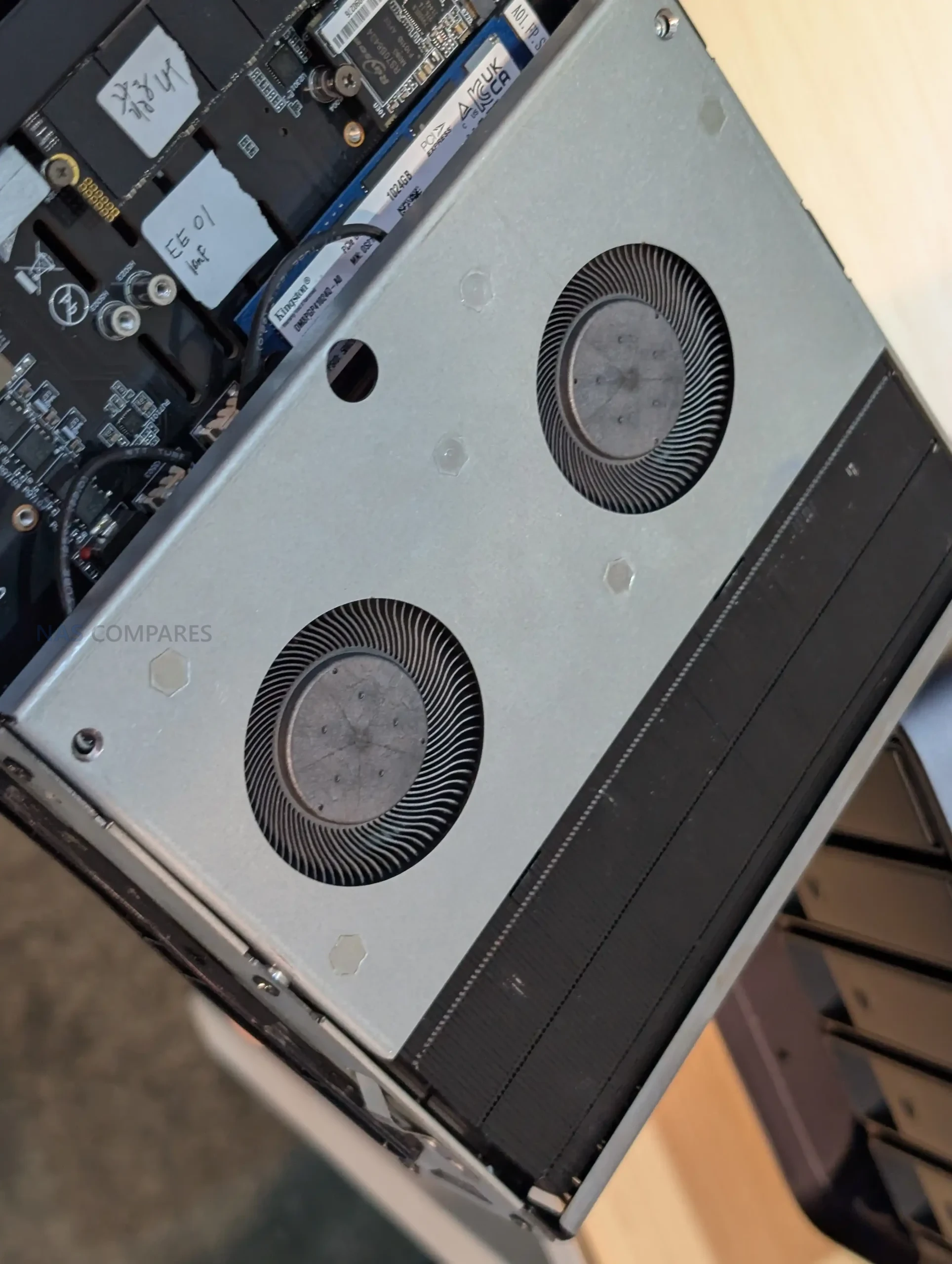
Intérieur du DXP4800 Pro
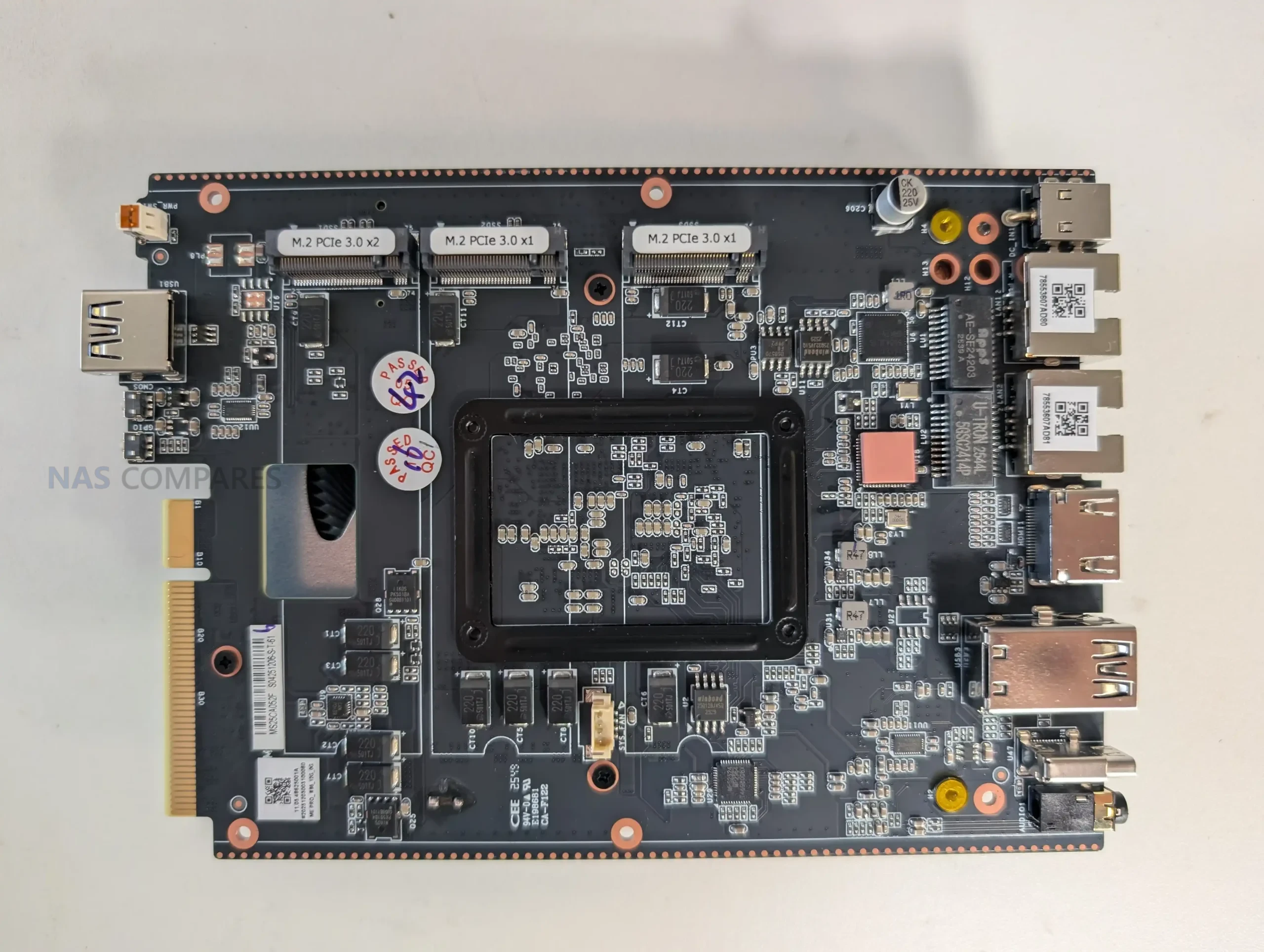
C’est là que les choses changent ! Le DXP4800 Pro est animé par un processeur Intel Core i3-1315U capable d’atteindre 4,50 GHz (6 cœurs, 8 threads) avec iGPU intégré. Il est épaulé par 8 Go de RAM DDR5 (extensibles à 96 Go). On aurait préféré voir 16 Go pour ce modèle Pro. Le score PassMark est de 11 183 points ! Pour ce tarif, il largue tous les concurrents…
Installation des disques et SSD
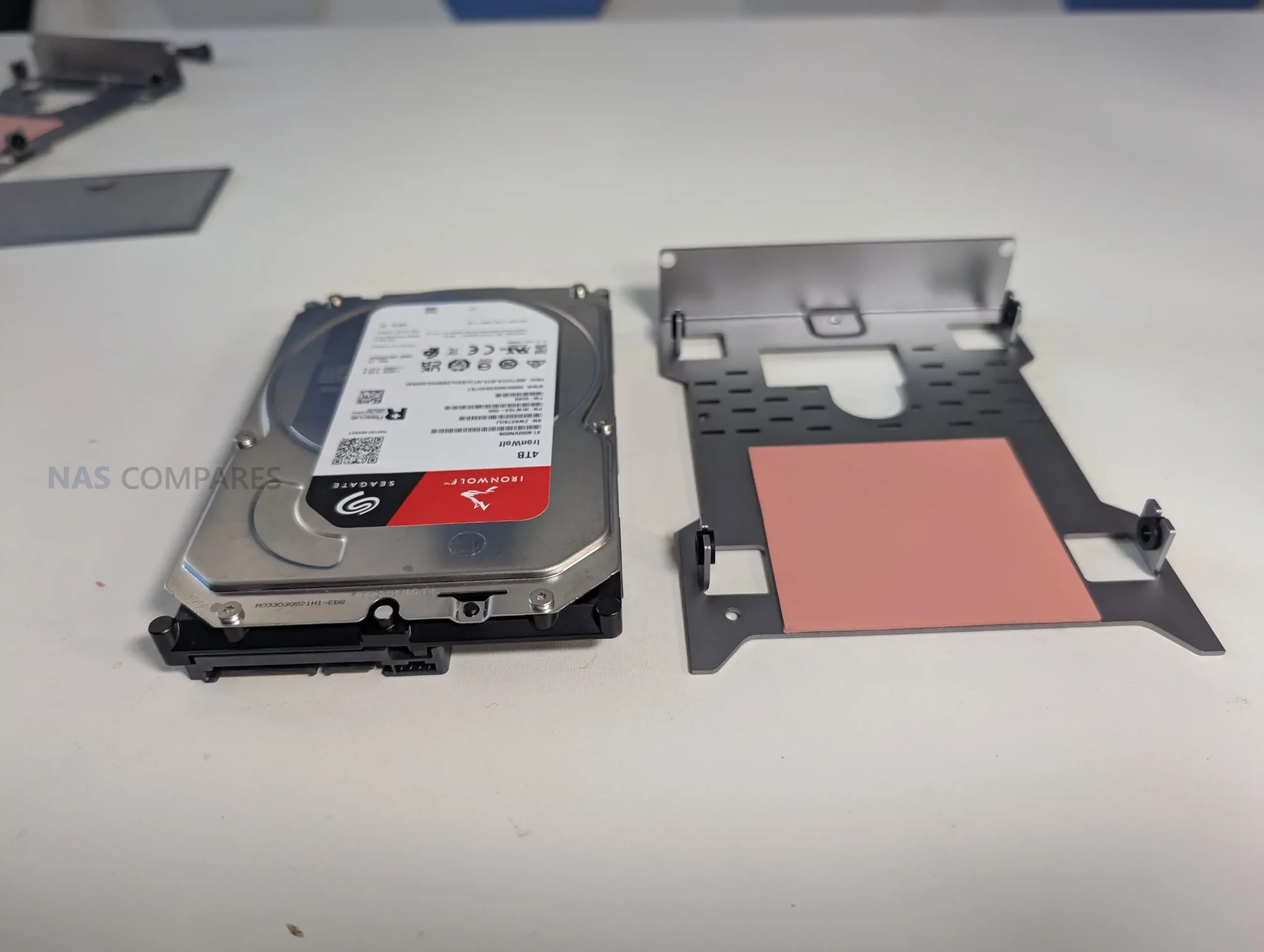
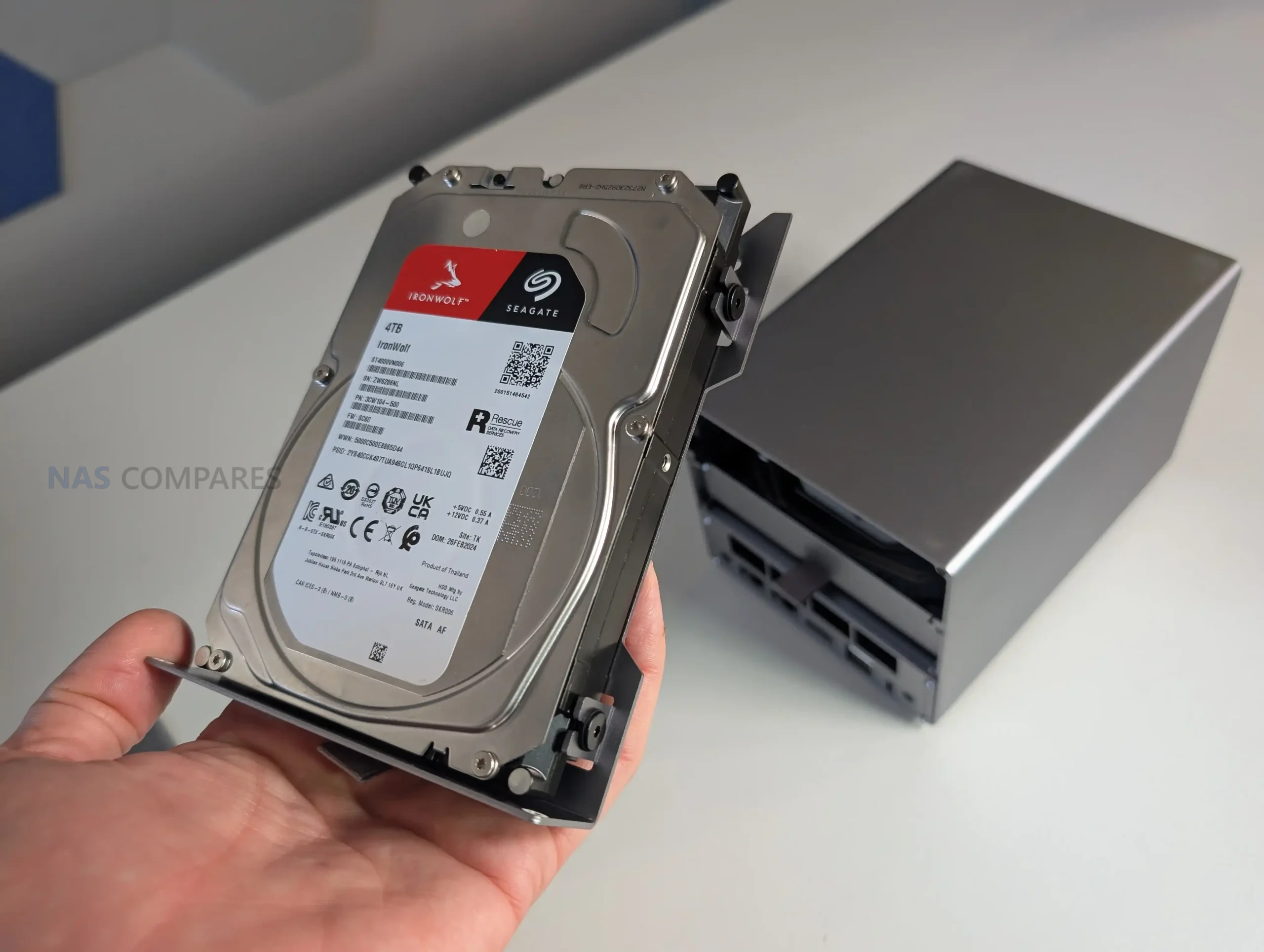
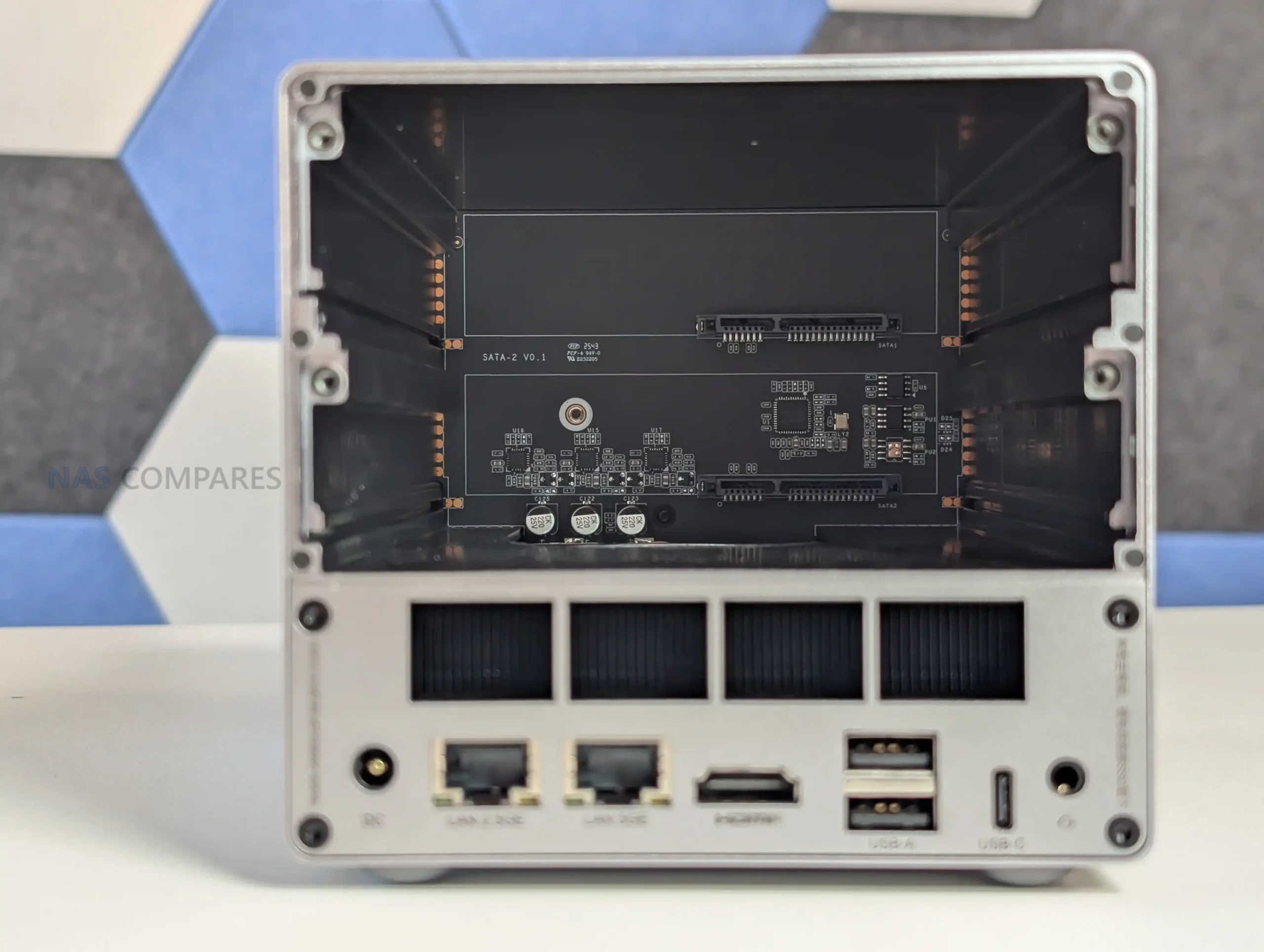
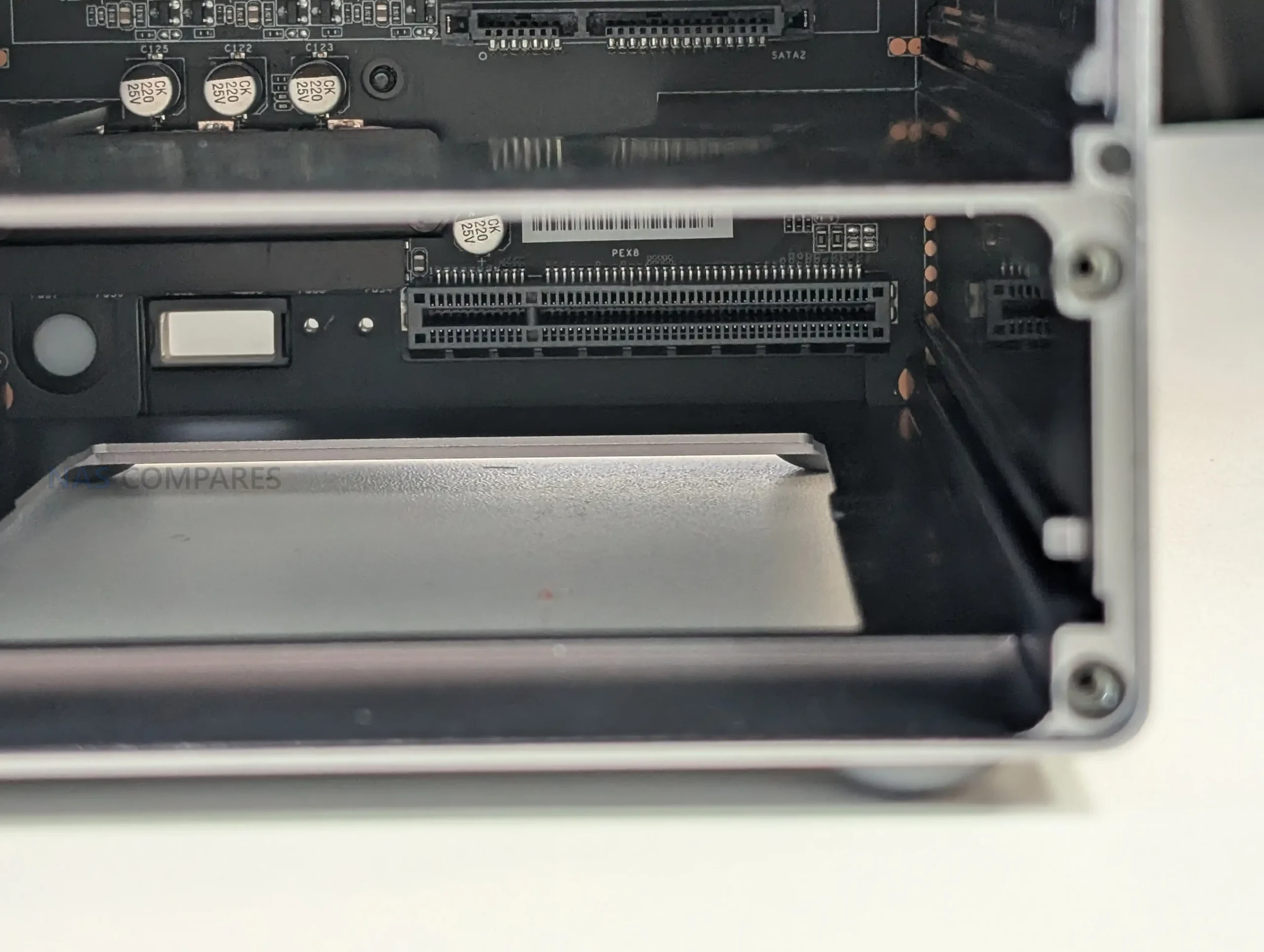
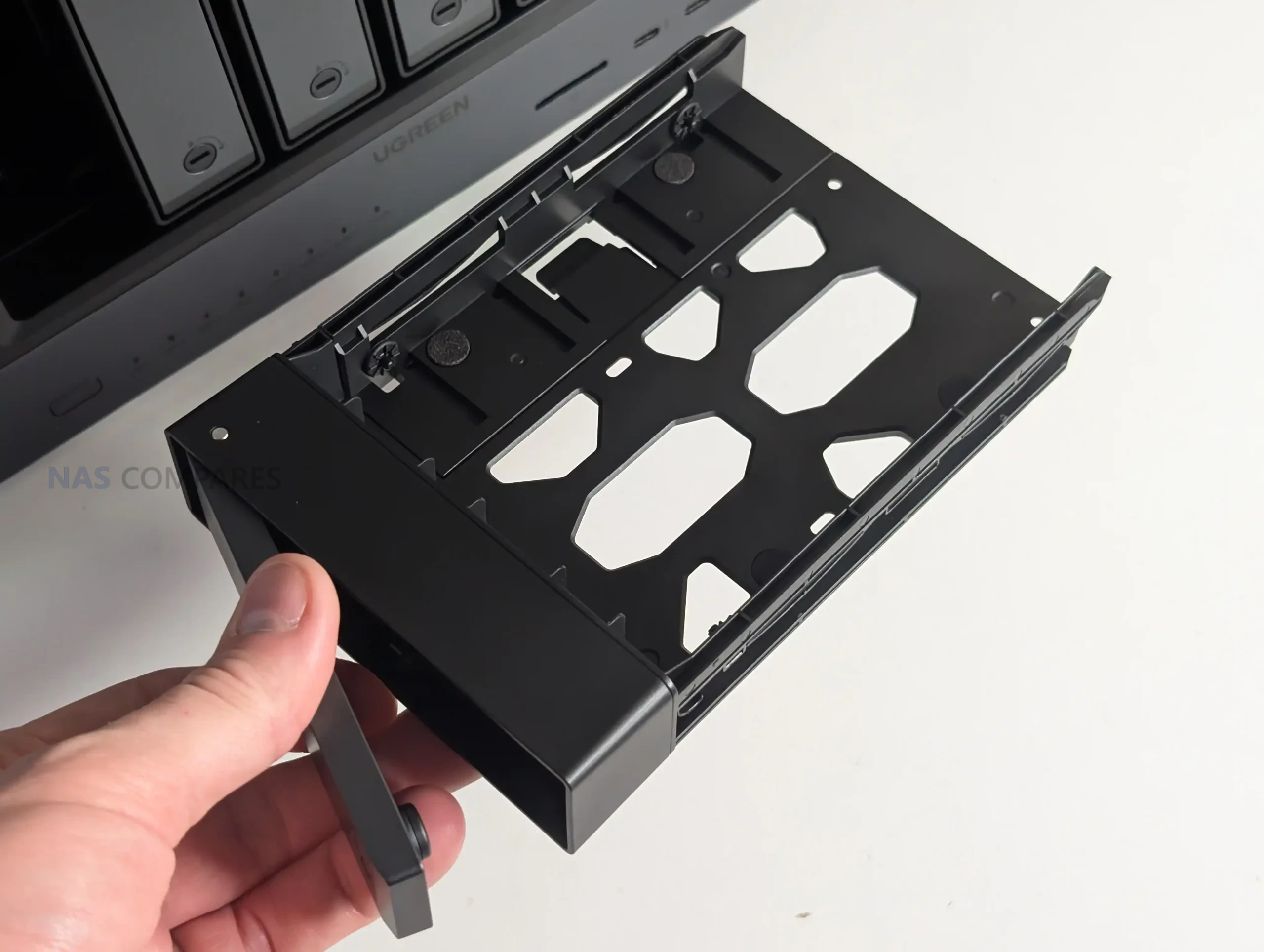
Les disques durs 3,5 pouces s’installent assez facilement, sans outils. Les chariots sont différents de ceux de Synology ou QNAP, mais ils sont fonctionnels.
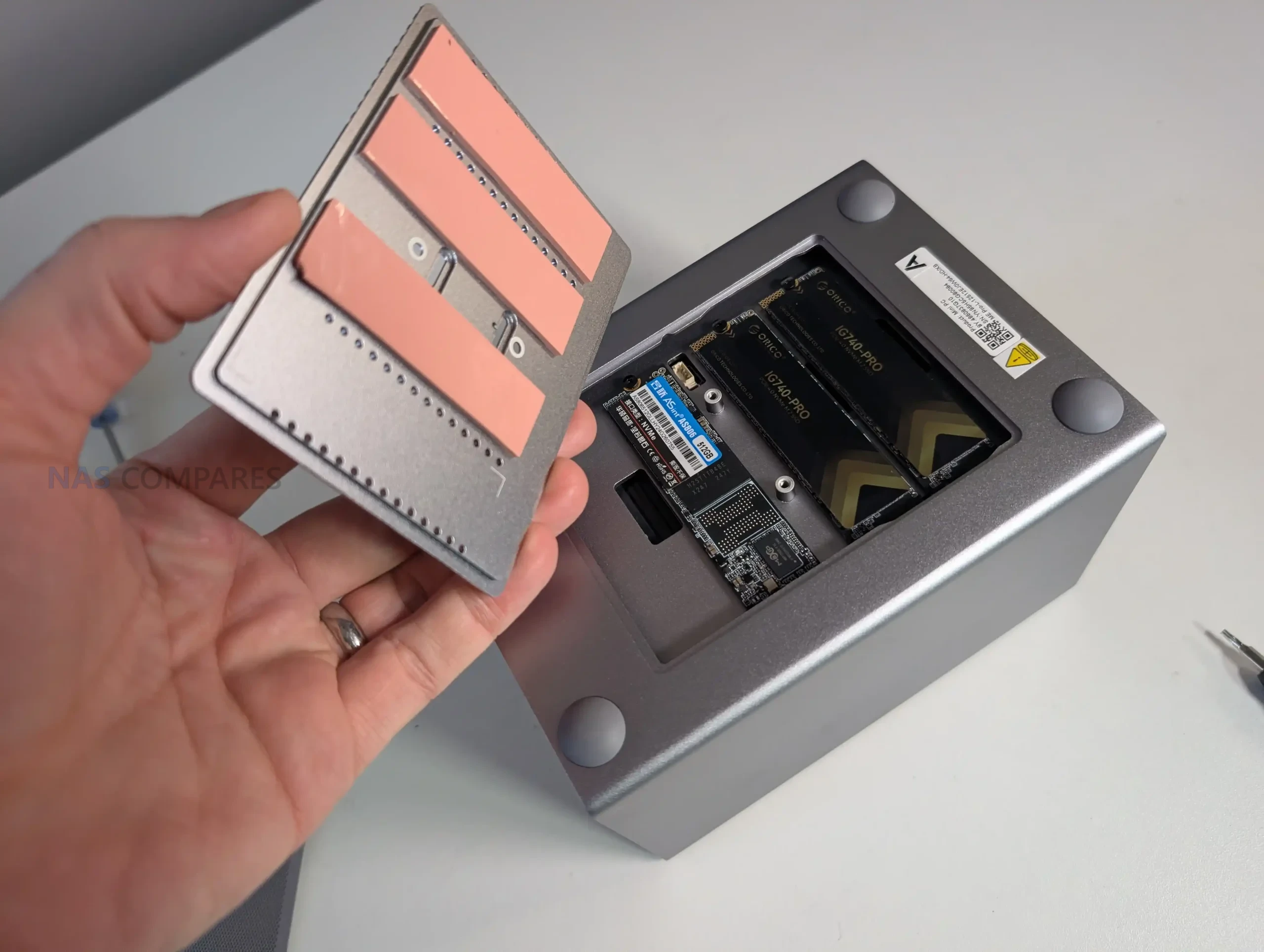
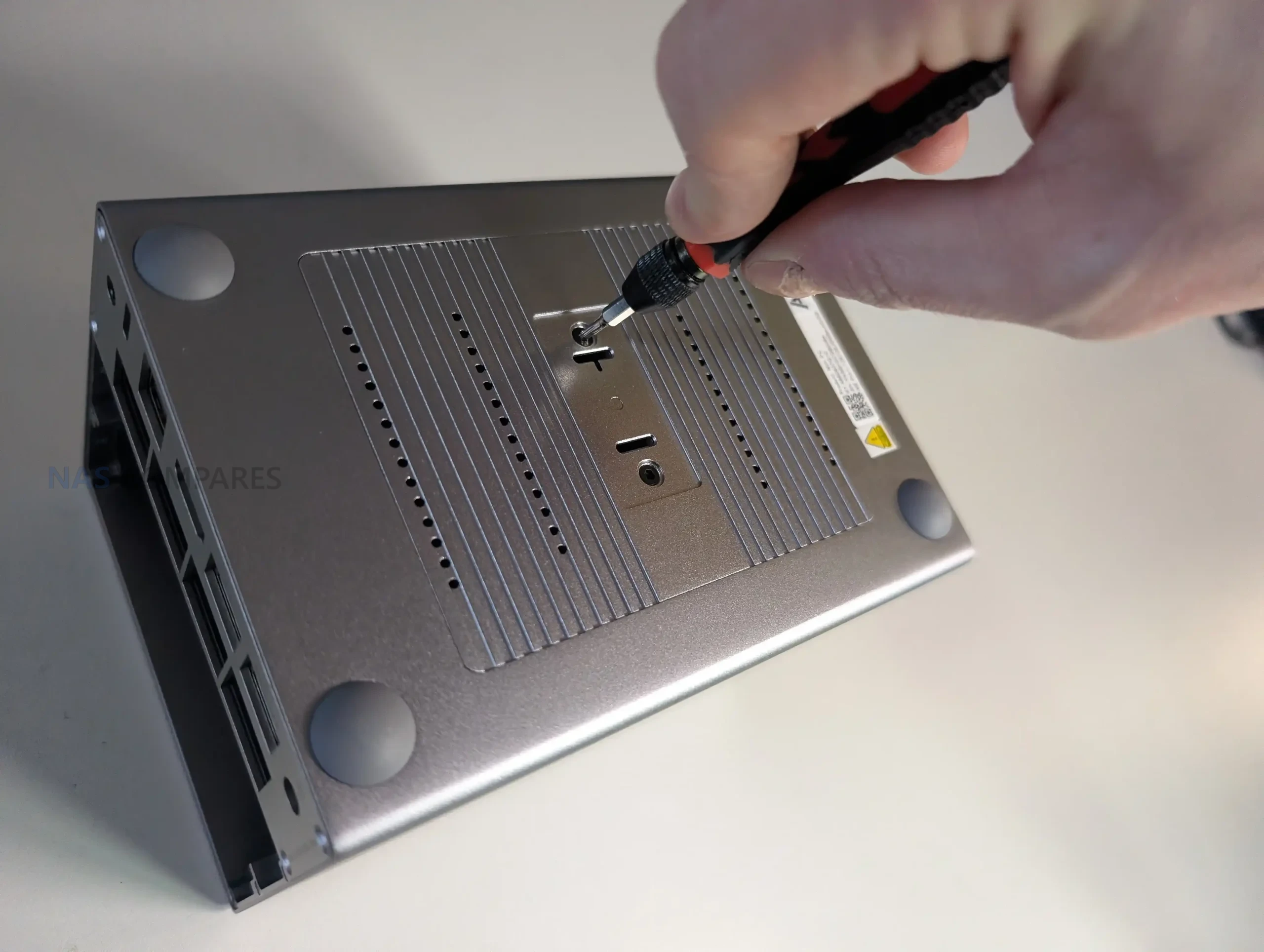
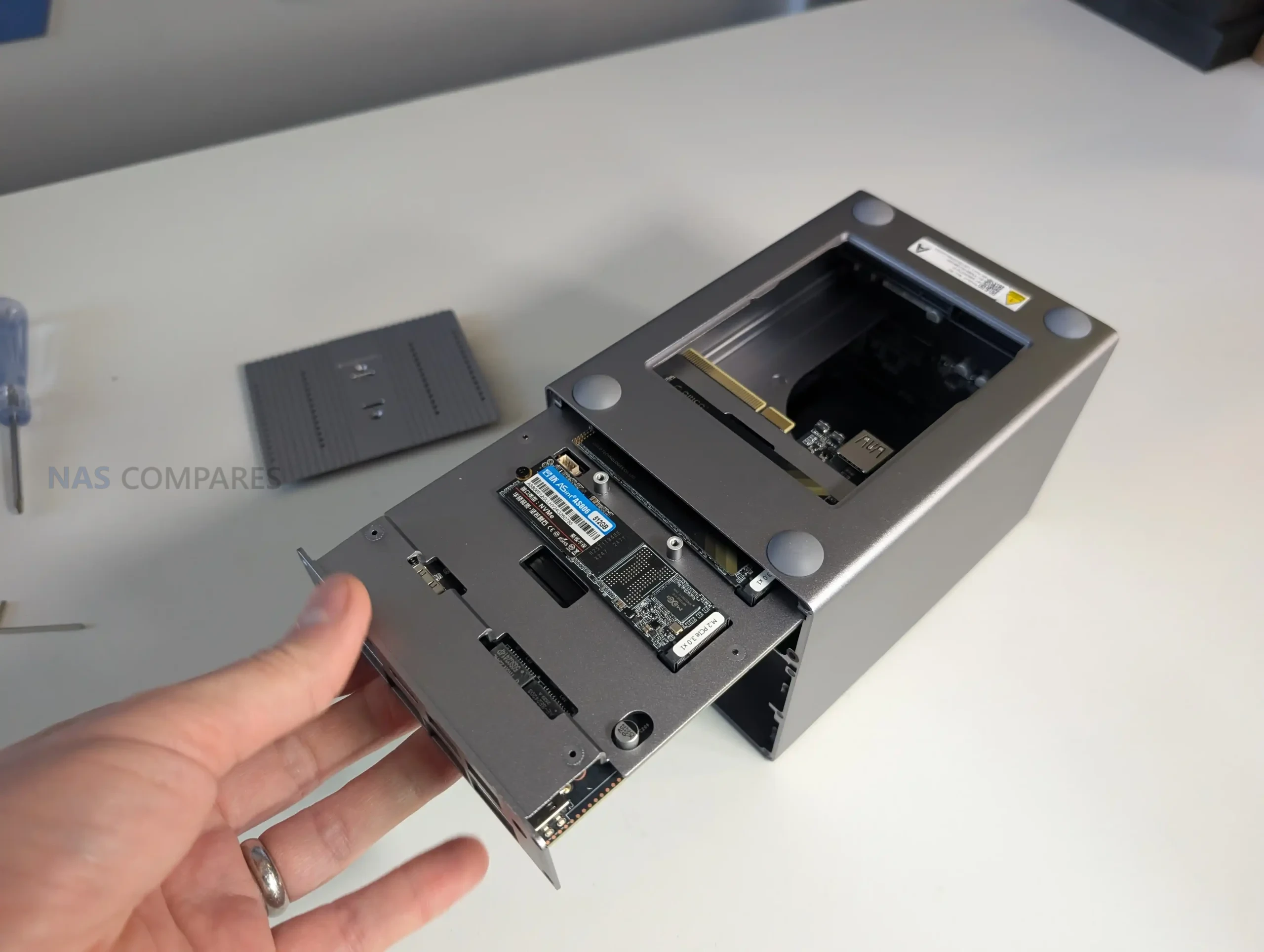
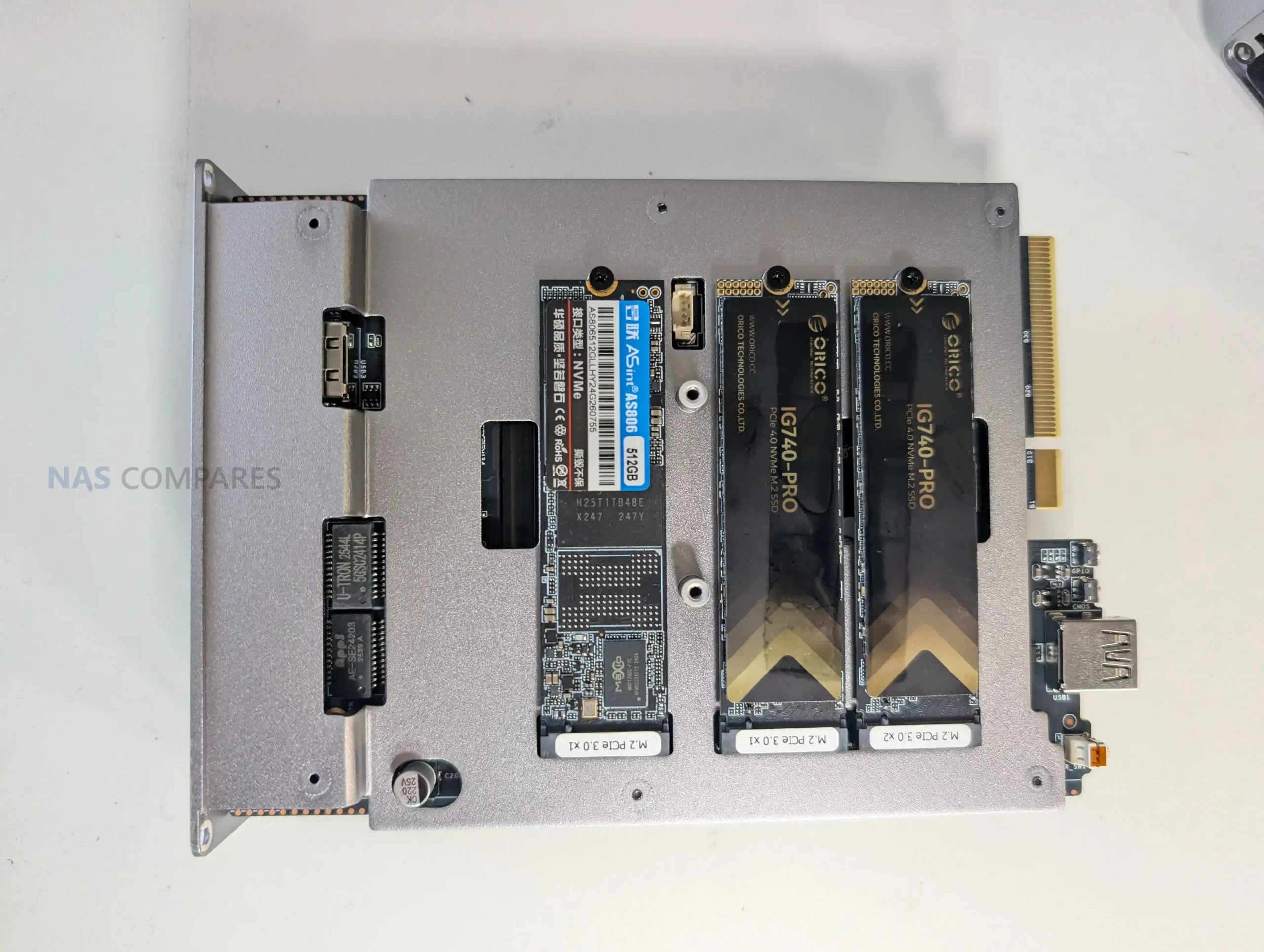
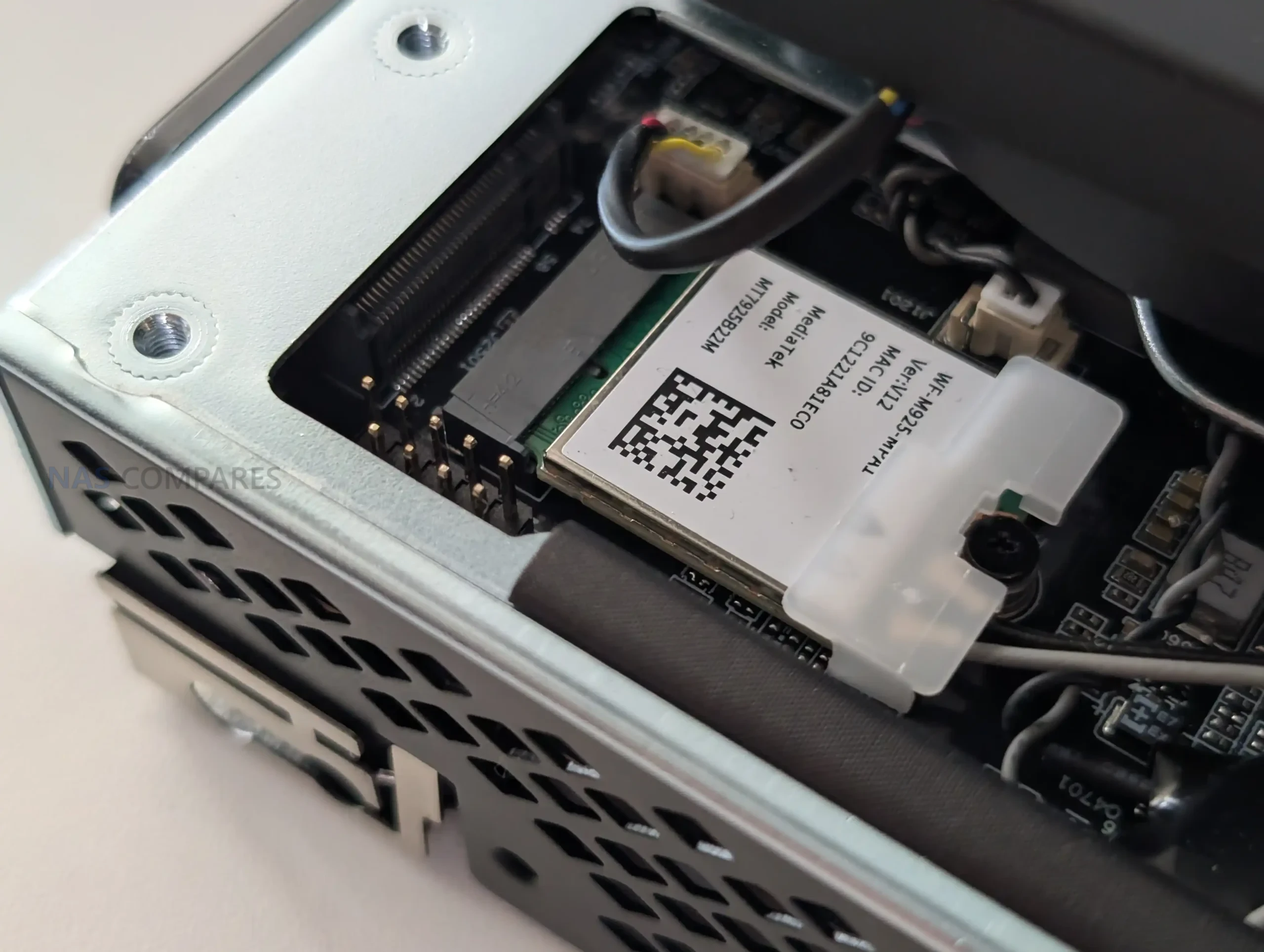
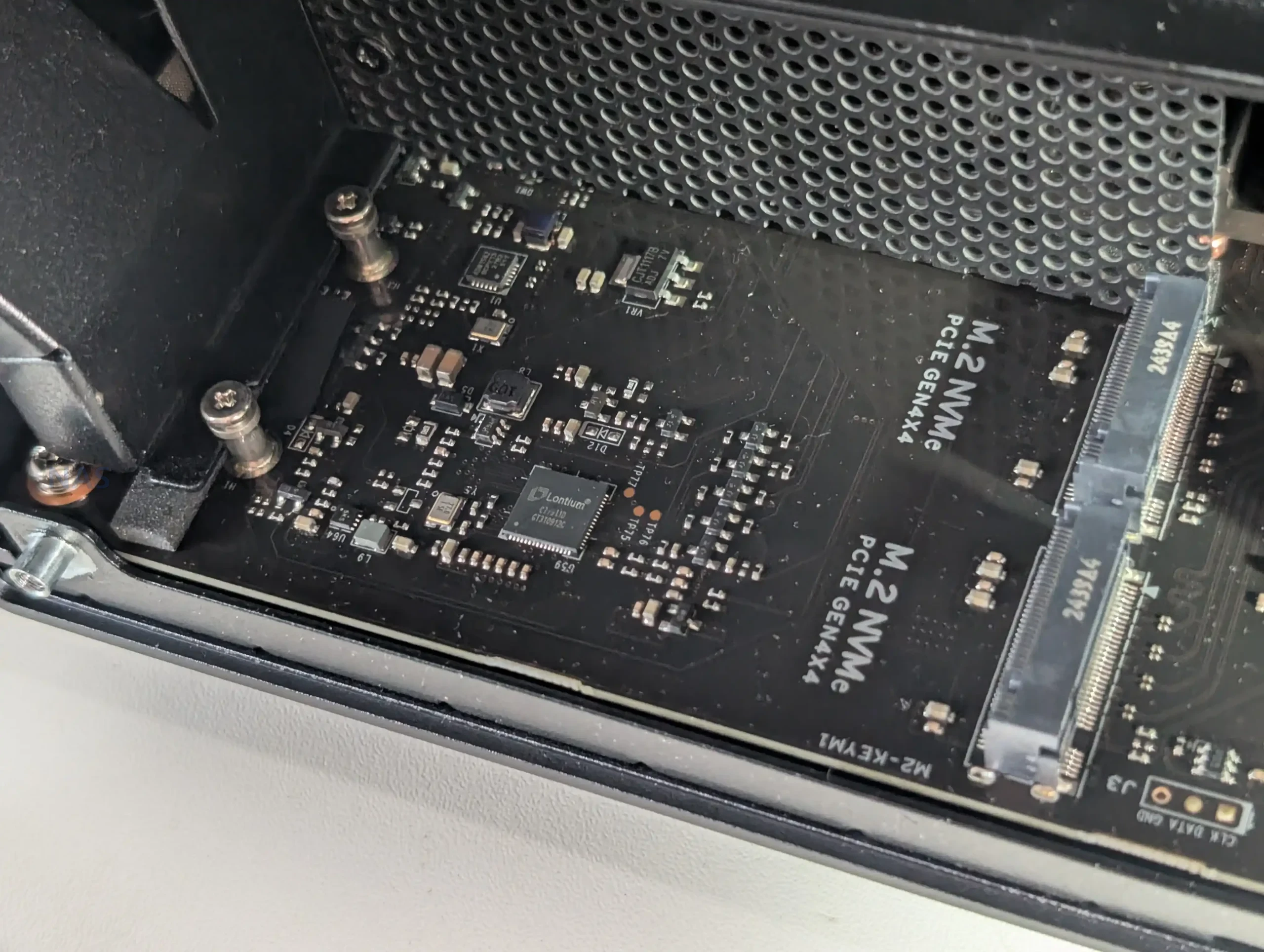
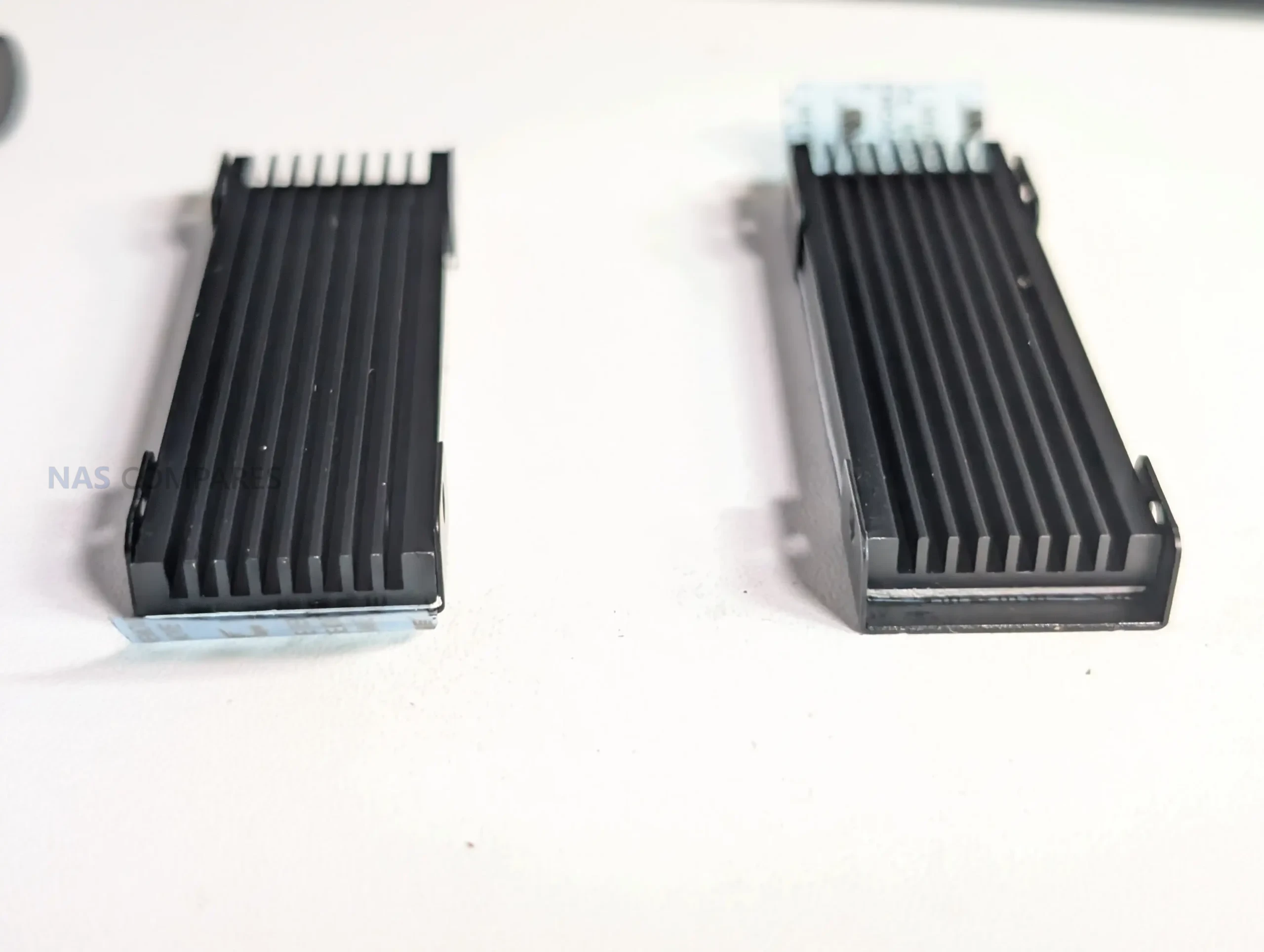
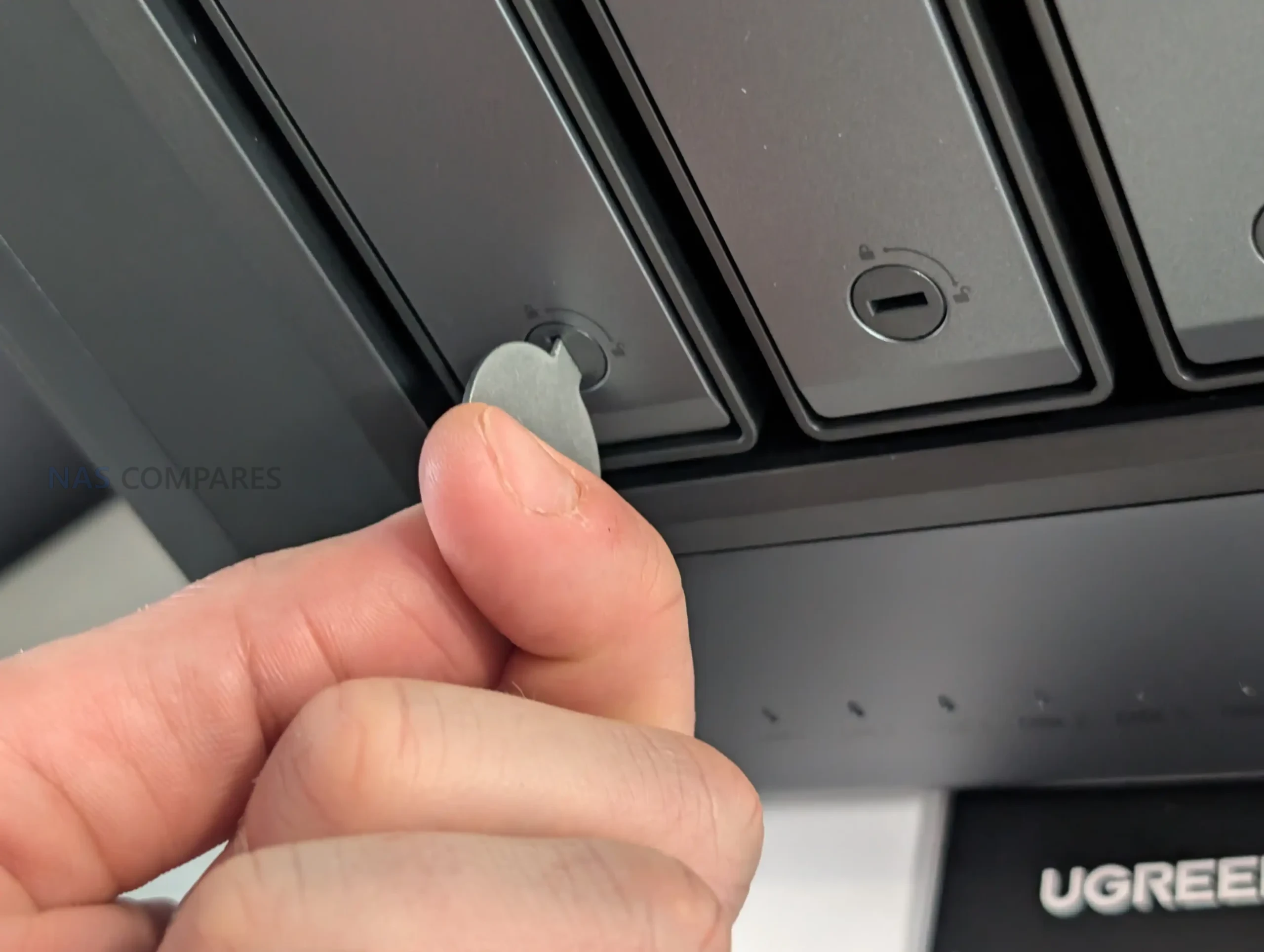
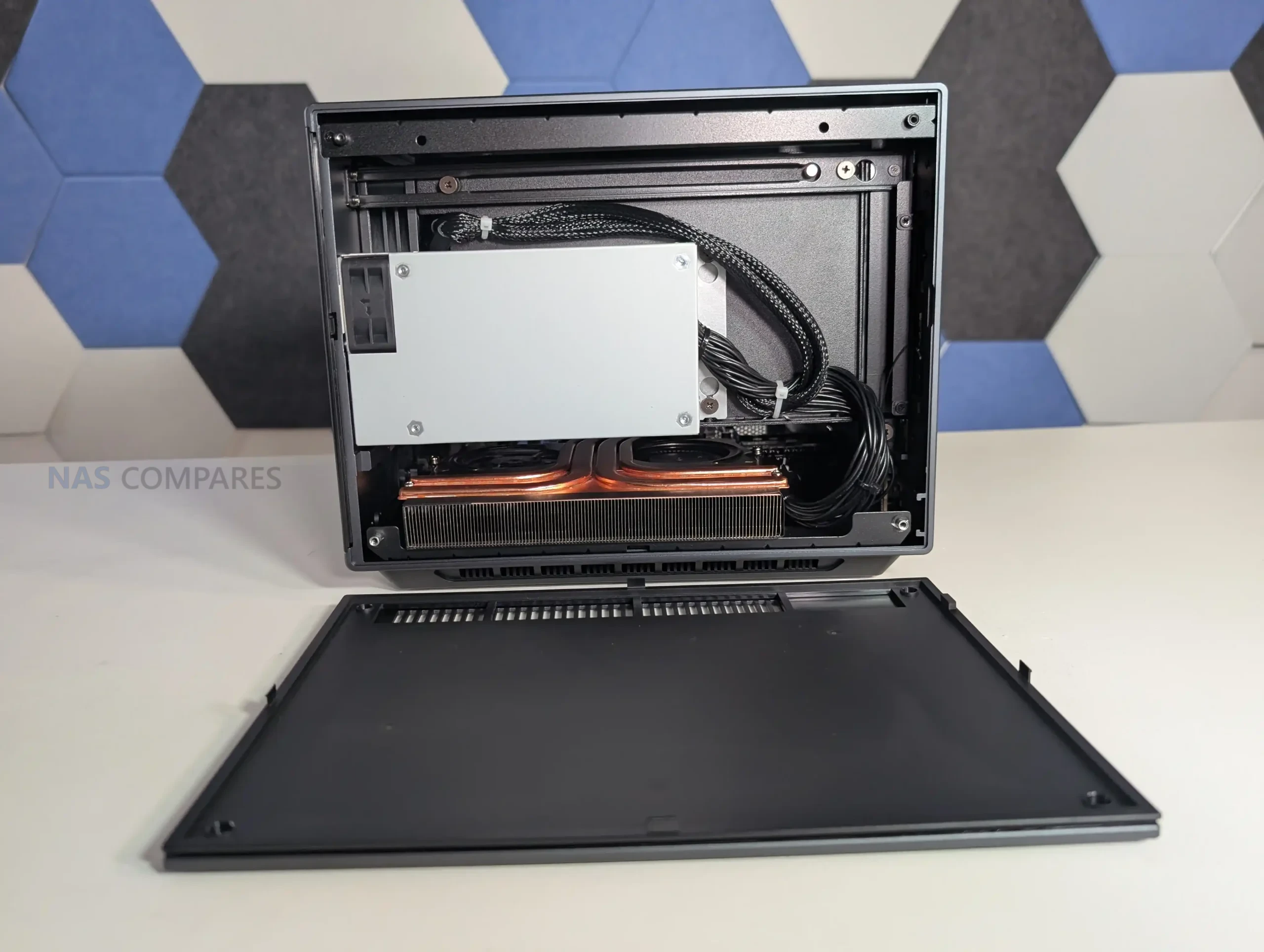
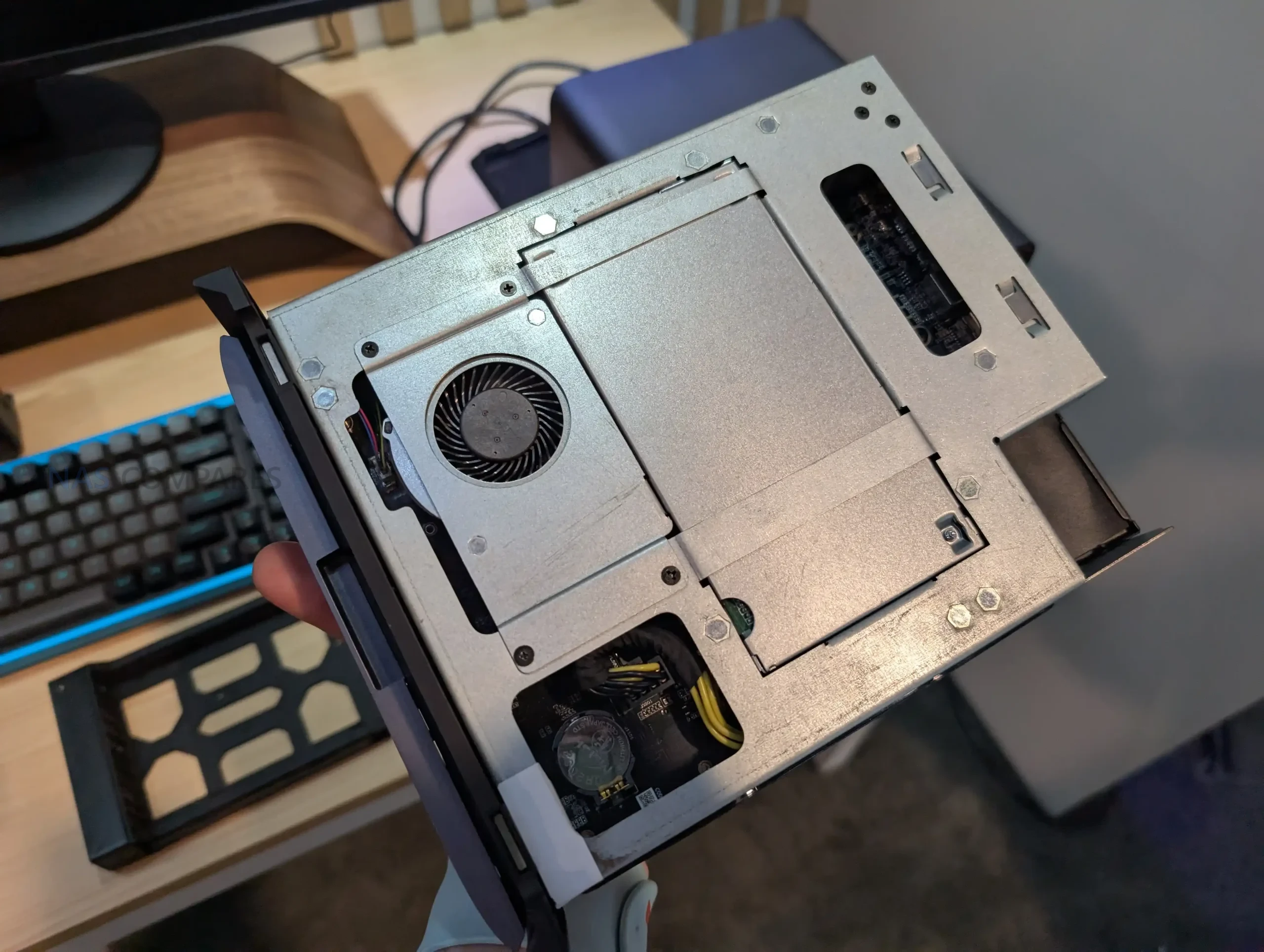
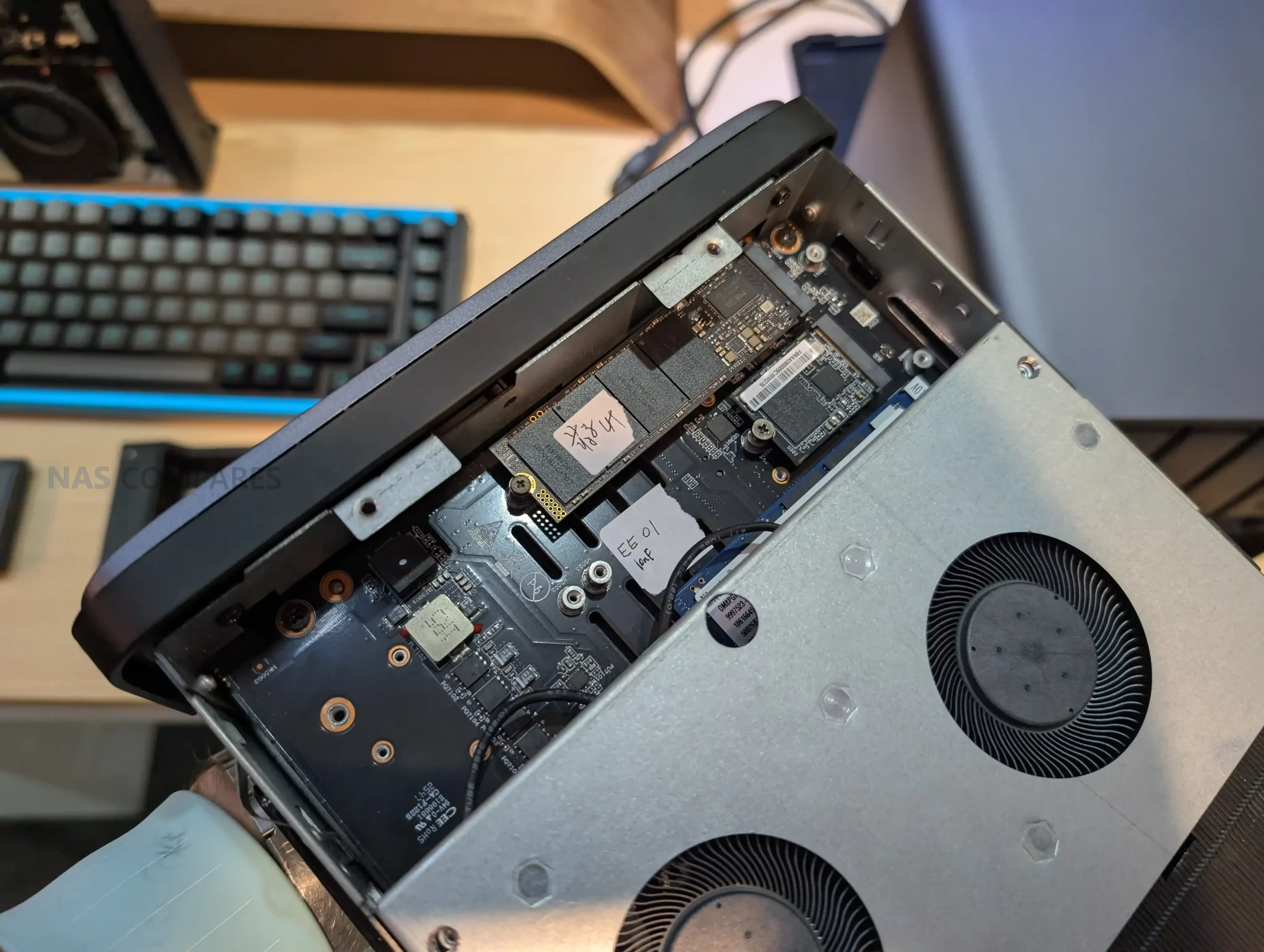
Pour installer un SSD SATA, il faut retirer une fixation en plastique (en bas à droite sur la photo ci-dessus) via un outil fourni. Attention à ne pas forcer trop fort au risque d’abimer la pièce. Le NAS dispose de 2 emplacements pour SSD NVMe, accessibles via une trappe sous l’appareil. C’est également ici que vous pourrez augmenter la RAM. L’ajout de pâte thermique (fournie) et le rôle de dissipateur thermique du capot en aluminium sont des points positifs.
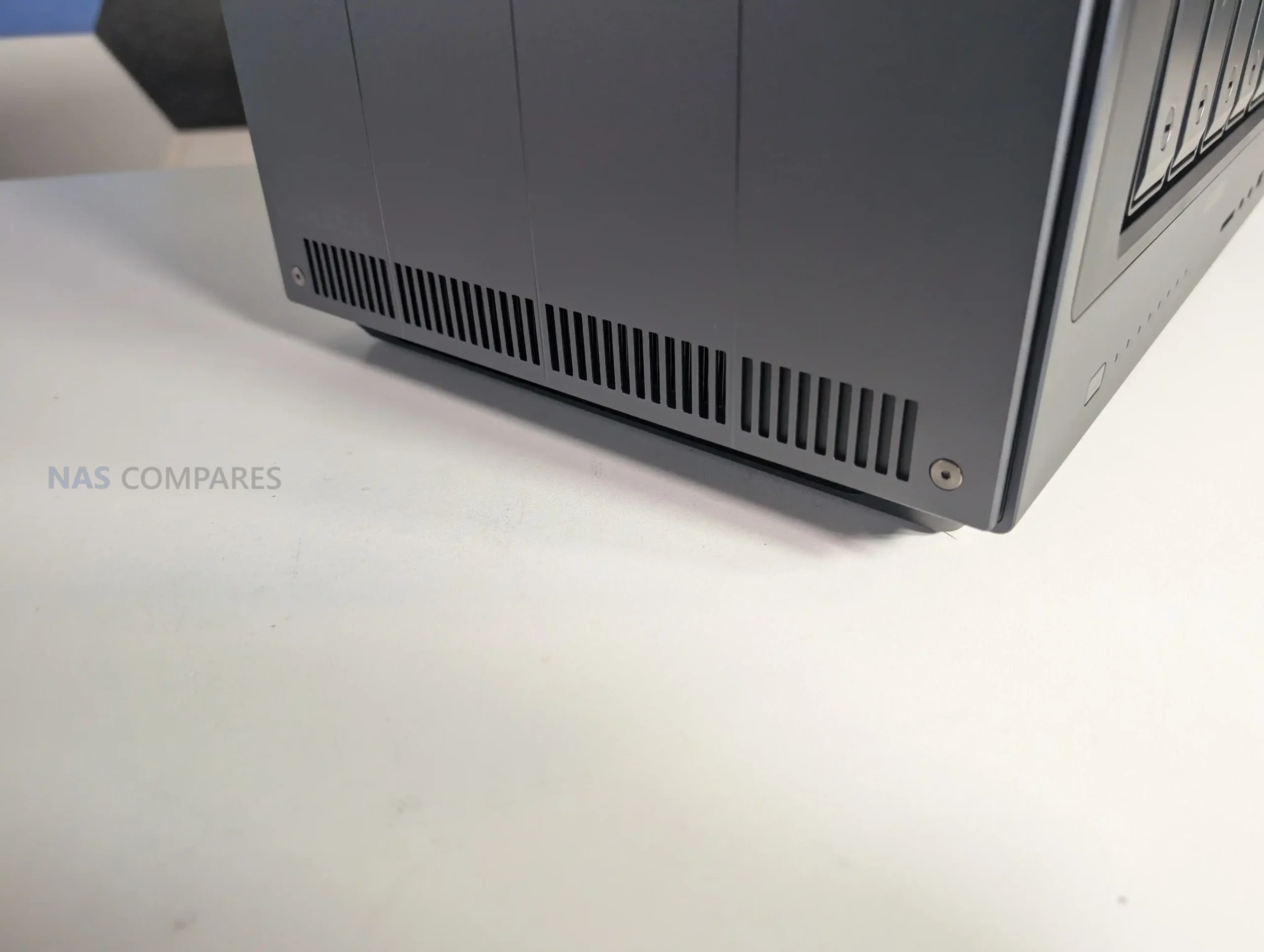
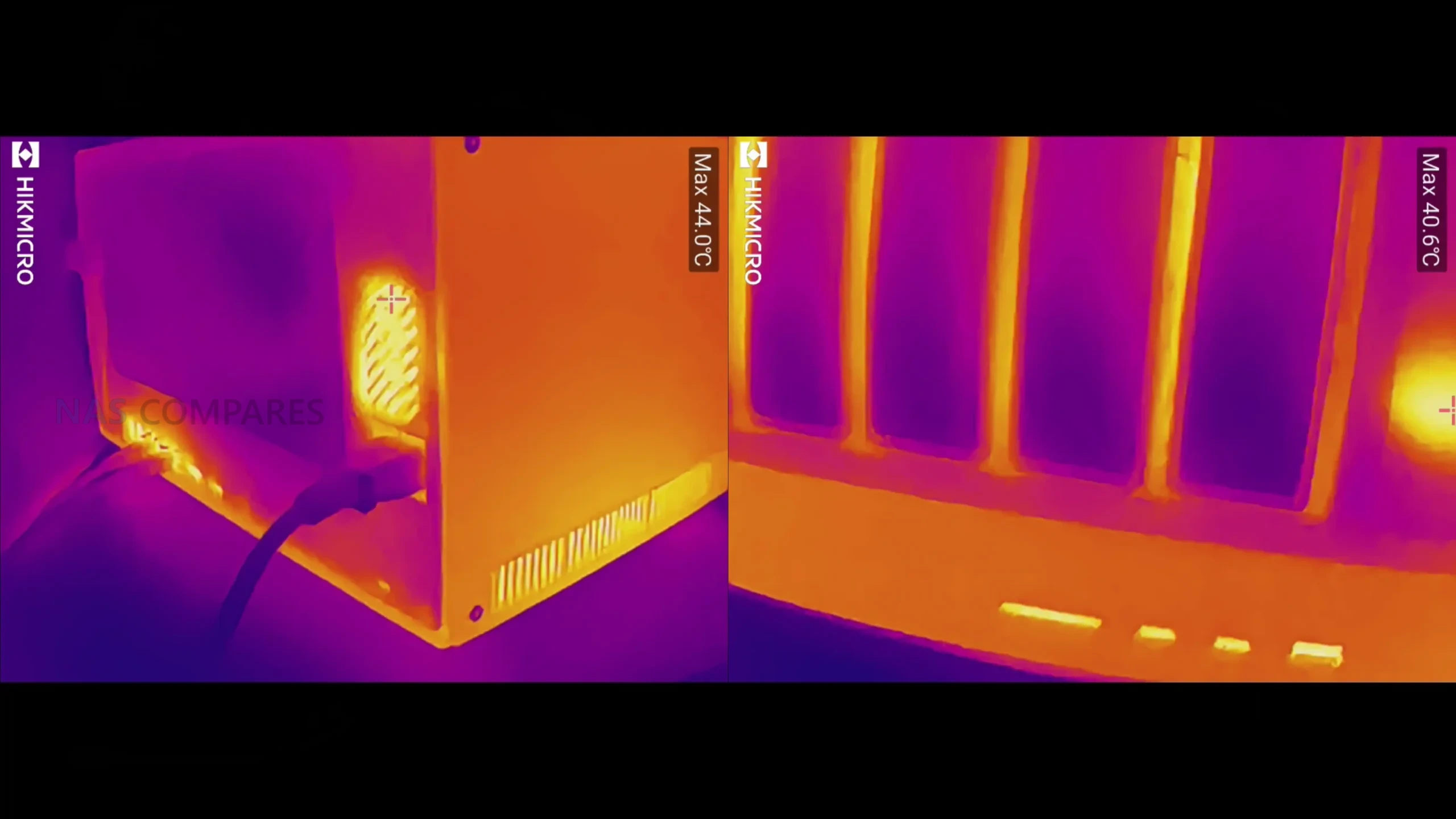
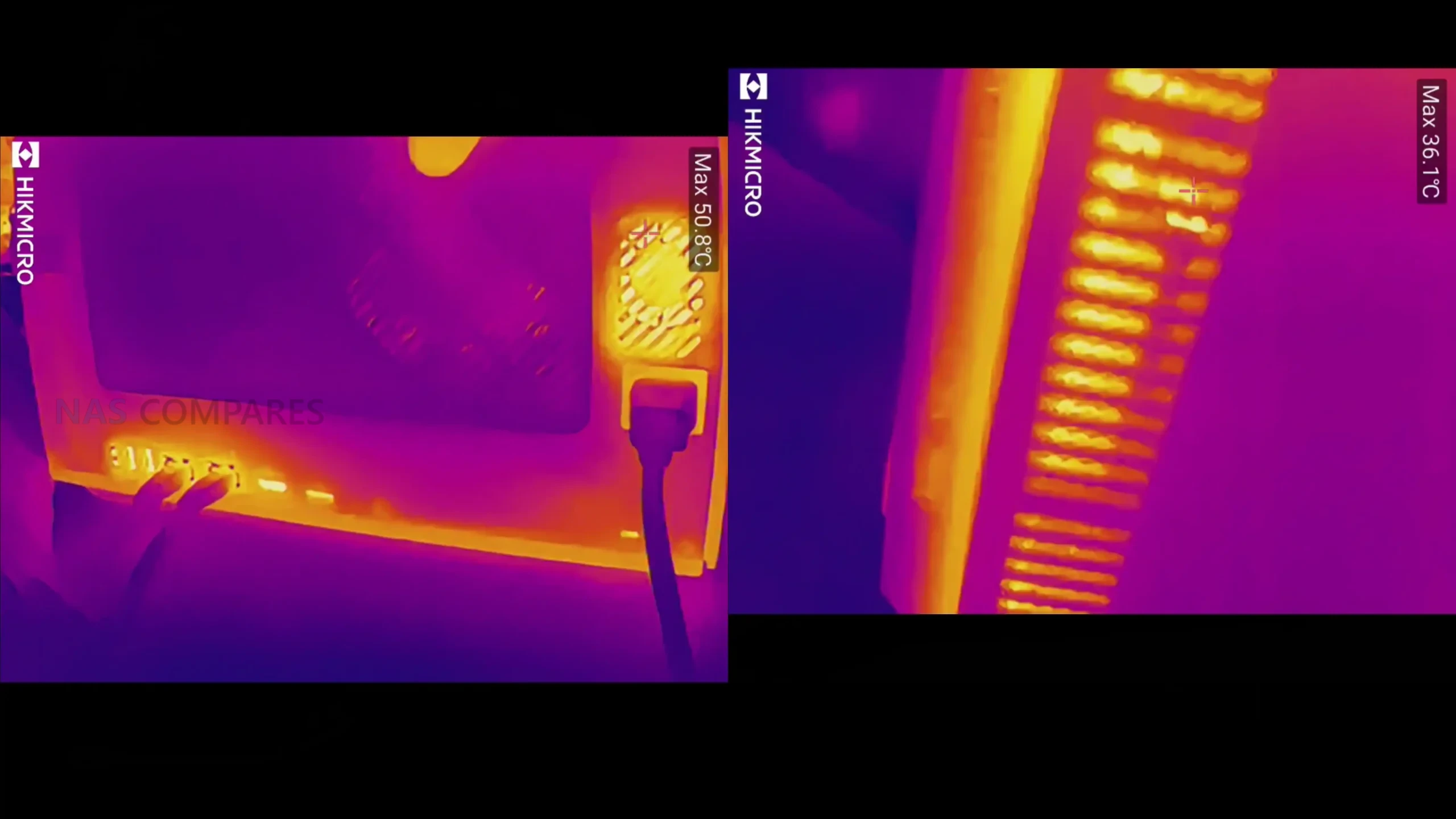
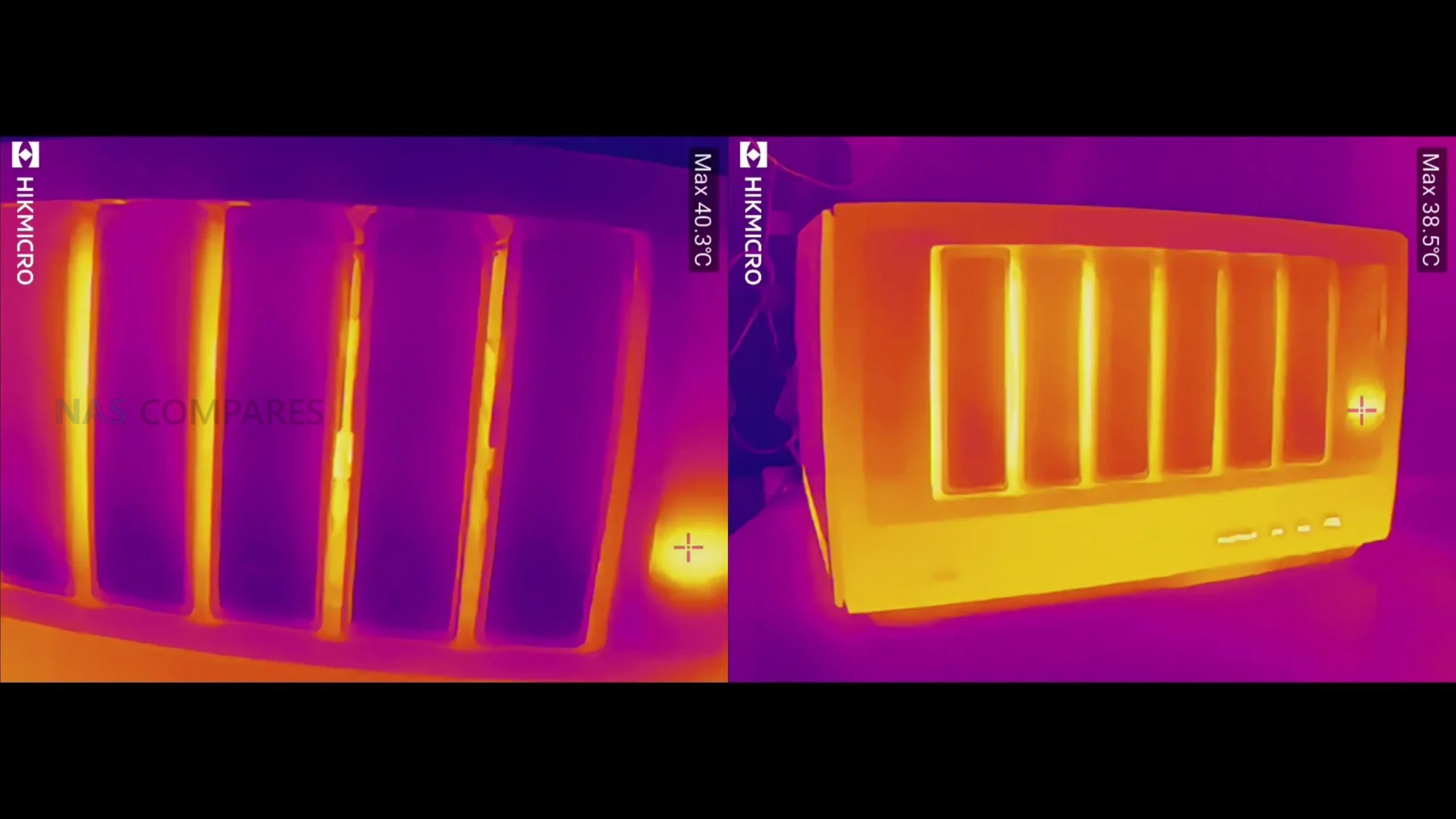
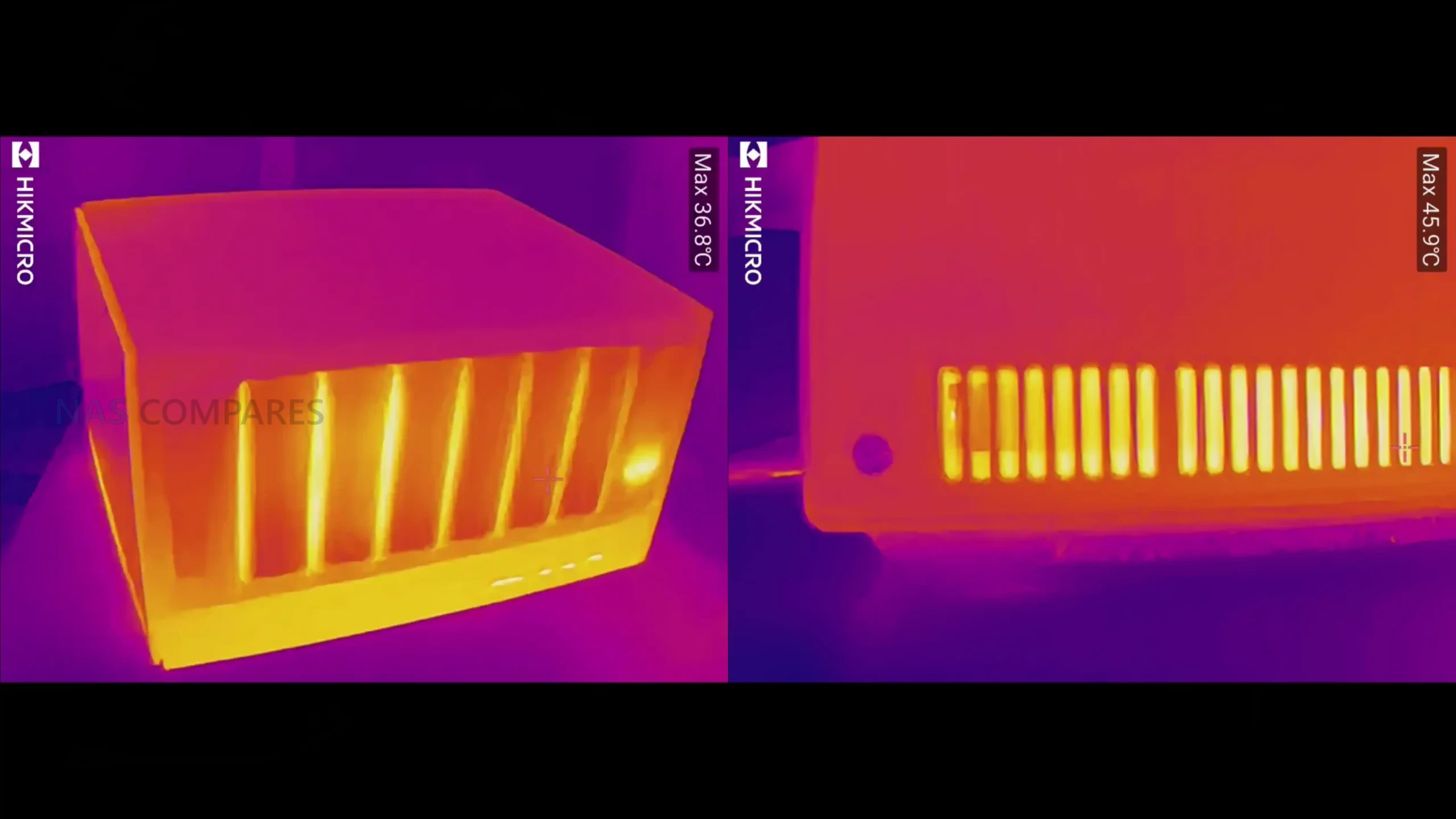
De notre point de vue, le NAS n’est pas suffisamment surélevé. Les patins sous l’appareil ne sont peu assez haut, ce qui limite la circulation de l’air et favorise les vibrations. De nombreux utilisateurs recommandent l’ajout de petits amortisseurs en élastomère pour corriger ce léger défaut. Nous validons ce choix.
UGOS
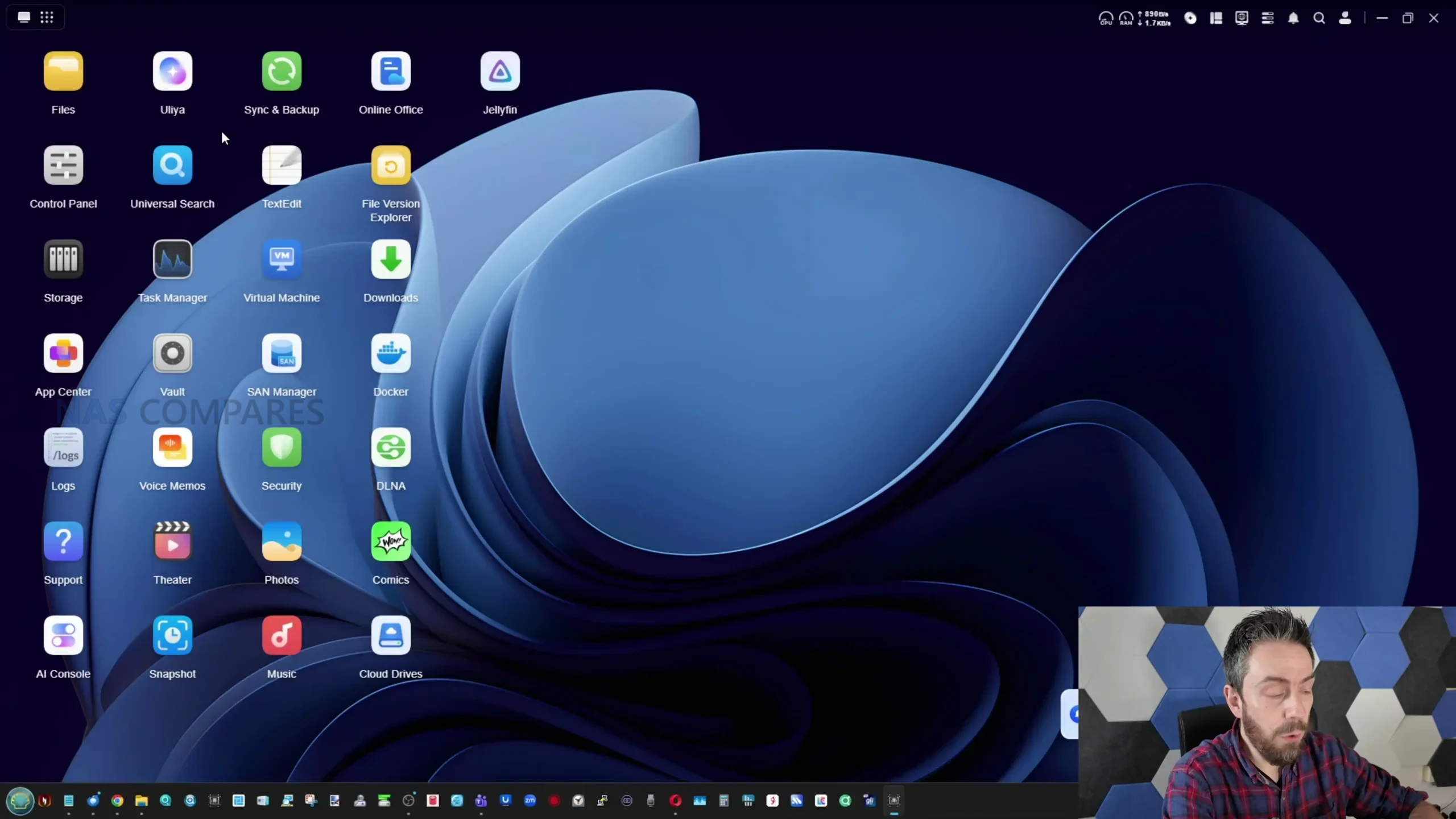
Nous vous avons déjà présenté le système embarqué UGOS précédemment. Nous avons bien conscience que Ugreen est encore jeune sur le marché et il faut savoir être indulgent. Le système évolue régulièrement sans rivaliser pour le moment avec les ténors du marché. Cependant, il n’a pas à rougir, car il sait déjà répondre à de nombreux usages.
Installation d’UGOS
L’utilisateur doit taper dans son navigateur find.ugnas.com pour trouver son NAS sur le réseau. L’installation se fait en 4 étapes (voire ci-dessous) :
Par rapport à notre précédent test, l’interface est désormais bien en français.
Une fois l’installation terminée, le NAS redémarre… il ne reste plus qu’à se connecter avec l’identifiant et le mot de passe saisis précédemment. Un nouveau guide se lance pour accompagner l’utilisateur dans les premières étapes :
Découverte de l’interface ;
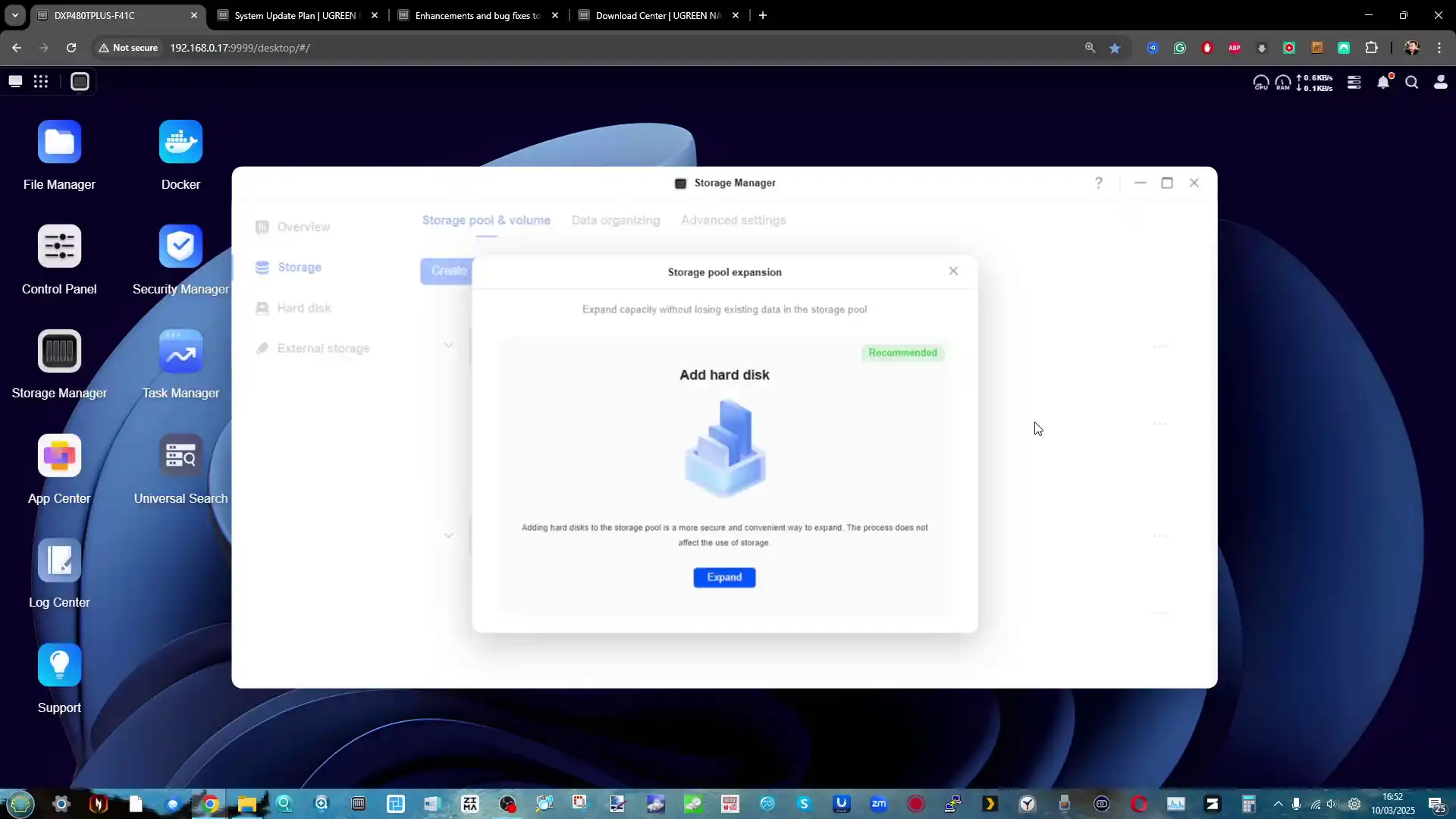
Création d’un volume de stockage ;
Premier dossier partagé ;
Découverte d’UGREENlink pour l’accès à distance.
Note importante : lors du test précédent, nous pensions avoir commis une erreur, mais non… le service SMB (partage réseau) est désactivé par défaut. Cela veut dire que si vous ne faites rien, le NAS n’est pas accessible par le réseau (Windows, macOS ou Linux).
Usage au quotidien
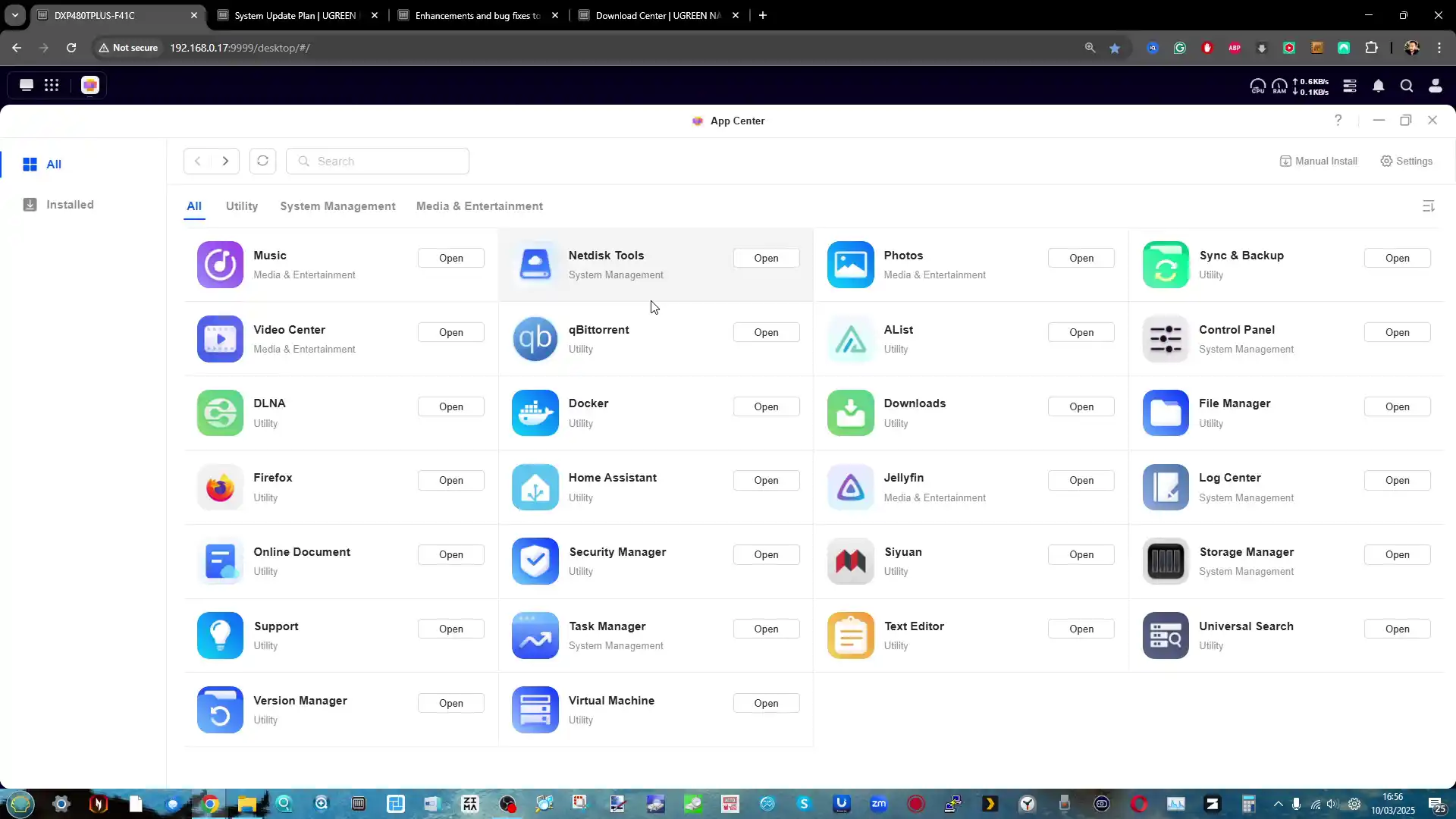
UGOS est un système Linux optimisé pour le stockage en réseau. Il propose un ensemble de paramètres, auquel on peut ajouter des fonctionnalités via le Centre d’applications : Antivirus, Download Center, Text Edit, etc. Ugreen a fait le choix de privilégier Docker pour compléter son environnement applicatif.
Le fabricant propose une application mobile tout-en-un qui permet de profiter de son NAS à distance ou sur son réseau local. Il faut avouer qu’elle est complète et bien pensée. Ugreen propose également une application de bureau (Windows et macOS), ainsi qu’une adapté à Apple TV et Android TV. Elles permettent d’accéder aux fichiers, au statut du NAS, aux notifications… mais aussi au visionnage de vidéo, etc. Tout y est, un véritable couteau suisse !
Ugreen déploie fréquemment des mises à jour pour corriger des bugs et soucis de traductions, mais aussi pour améliorer les performances et ajouter des fonctionnalités. Un NAS, c’est un investissement sur le long terme. Aujourd’hui, les NAS sont régulièrement mis à jour… et surtout pendant de nombreuses années.
Nouvel entrant et tolérance
Ugreen est nouveau sur le marché des NAS, mais ce n’est pas un novice. L’entreprise possède une solide expérience industrielle et maîtrise déjà la conception matérielle et logicielle. Le fabricant connait également très bien ce secteur exigeant, dominé par des acteurs comme Synology et QNAP. Côté matériel, le produit tient la route…
Sur la partie logicielle, UGOS reste limité pour un usage avancé. S’il répond à 90% des particuliers, certains pourraient être déçus. La majorité des utilisateurs parient sur des mises à jour futures pour corriger le tir dans les prochains mois. Ugreen en a bien conscience… À noter qu’il propose également la possibilité d’installer de systèmes alternatifs comme OMV, TrueNAS, Unraid, etc. Une approche ouverte, que beaucoup apprécient.
L’essentiel est là : une base matérielle fiable et une volonté claire d’évoluer.
Performances du DXP4800 Pro
Dans la première partie des tests, nous allons évaluer les performances des transferts à travers un réseau 10 Gb/s (entre le NAS et des ordinateurs). Ensuite, nous regarderons les capacités du processeur, en analysant ses performances globales…
Vitesses dans les transferts
Depuis plusieurs années, nous avons mis en place un protocole de tests rigoureux fournissant des données fiables et comparables avec les performances des autres NAS. Pour cela, nous utilisons 4 applications de mesure différentes (2 sous macOS et 2 sous Windows) et réalisons en plus des transferts de fichiers de tailles variées dans les deux sens (NAS -> Ordinateur puis Ordinateur -> NAS) :
Petites tailles : 100 fichiers de 500 Ko à 12 Mo (MP3, photos, documents Office)
Tailles moyennes : 30 fichiers de 12 à 350 Mo (DivX, images RAW, archives ZIP)
Fichiers volumineux : 10 fichiers avec une taille comprise entre 4 et 10 Go (MKV, ISO)
À la suite des tests, une moyenne des transferts est calculée et nous la représentons sous forme de graphiques exprimée en mégaoctets par seconde (Mo/s). Plus le nombre est élevé, plus le NAS est rapide. Pour notre évaluation du DXP4800 Plus, nous avons configuré un premier volume avec 2 SSD NVMe en RAID 0, puis un second volume avec 3 SSD SATA en RAID 5.
RAID 0
Le NAS propose d’excellentes performances en lecture. Le système est réactif et les transferts solides. On voit tout de suite le gain offert par le nouveau processeur. Si les performances en écriture progressent (par rapport au DXP 4800 Plus), nous restons un peu sur notre faim.
RAID 5
Les débits vous surprennent… nous aussi. En lecture, le RAID 5 SATA assure et nous sommes sur des performances proches du RAID 0 NVMe. En écriture, les SSD SATA font même mieux sur les petits fichiers et ceux de taille moyenne. Par contre, sur les gros fichiers, les choses sont différentes.
Performances générales
Avec son nouveau processeur, Ugreen propose un NAS offrant des capacités bien plus étendues. Comparons rapidement celui-ci
UGREEN
DXP4800 Pro
UGREEN DXP4800 Plus
ASUSTOR FS6806X
Synology DS925+
Processeur
Intel Core
i3-1315U
Intel Pentium
Gold
AMD Ryzen Embedded V3C14
AMD Ryzen Embedded V1500B
iGPU intégré
Intel UHD Graphics
(13th Gen)
Intel UHD Graphics
(12th Gen)
Aucun
Aucun
Score Passmark
(CPU)
11 182
9 080
11 882
4 513
Score Single Thread
3 315
3 226
2 800
1 136
TDP
15 W
(55 W burst)
15 W
15 W
16 W
RAM max supportée
96 Go DDR5
64 Go DDR5
64 Go DDR5
32 Go DDR4 ECC
Vous l’aurez compris, le changement opéré par Ugreen n’est pas anodin. On se retrouve avec un processeur taillé pour les tâches complexes ou il n’aura pas de difficulté : chiffrement des données, virtualisation, conteneurisation ou encore le transcodage vidéo. Il sera difficile de le mettre en difficulté. Seul regret, la présence de seulement 8 Go de RAM par défaut. On ne va pas se mentir, c’est un peu juste pour exploiter pleinement le potentiel de ce NAS : 16 Go auraient été préférables.
IA & DXP 4800 Pro
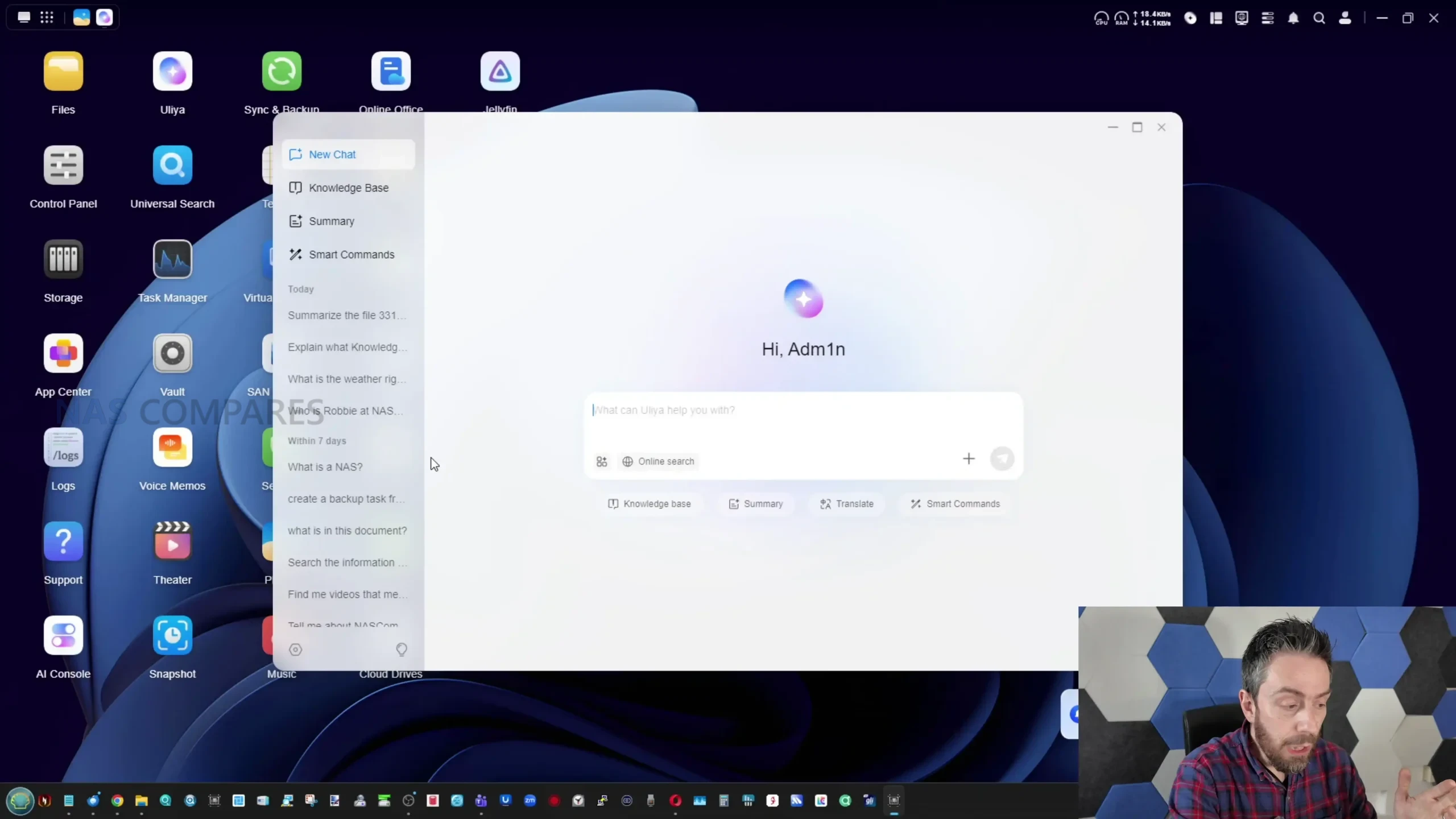
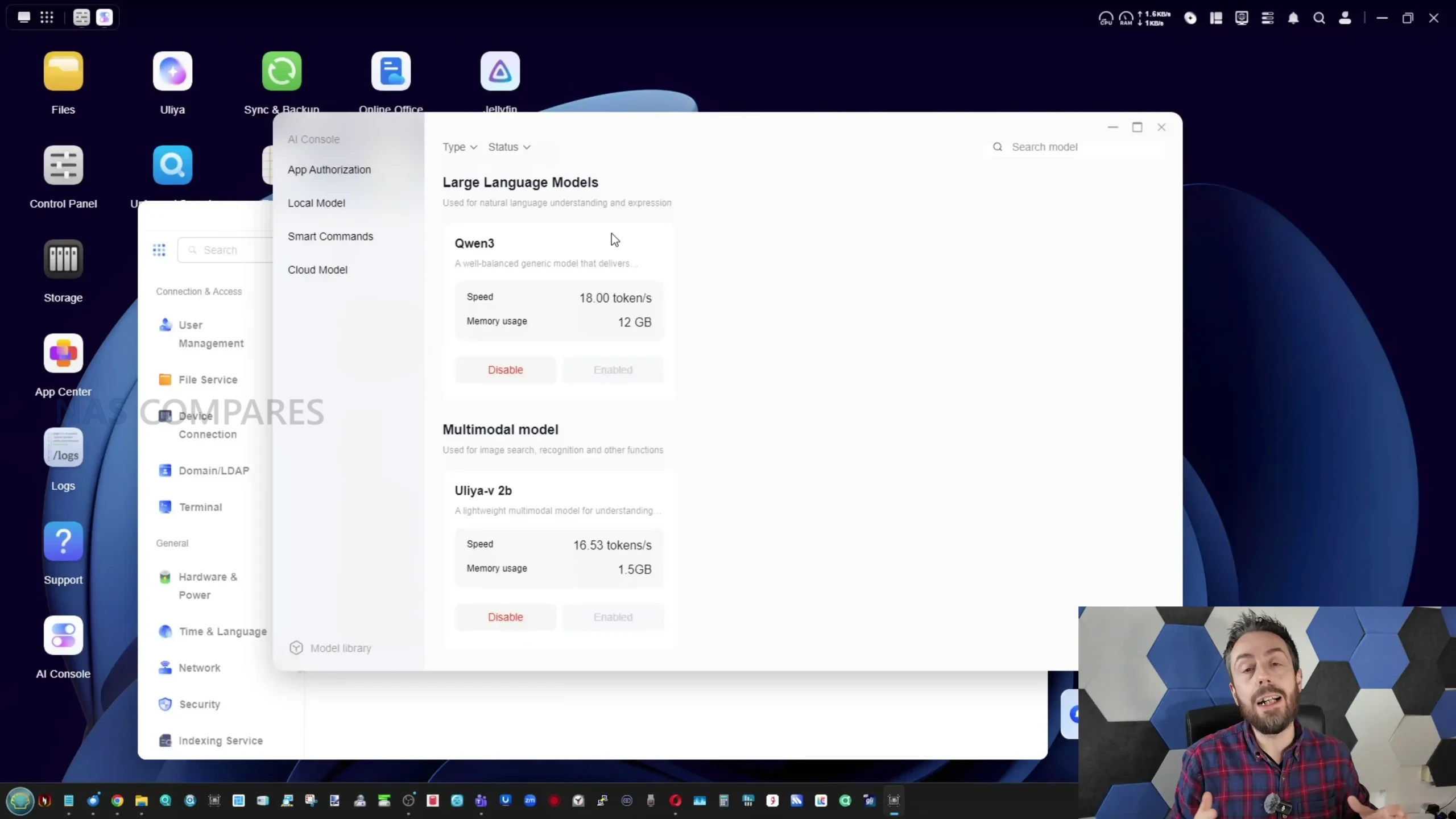
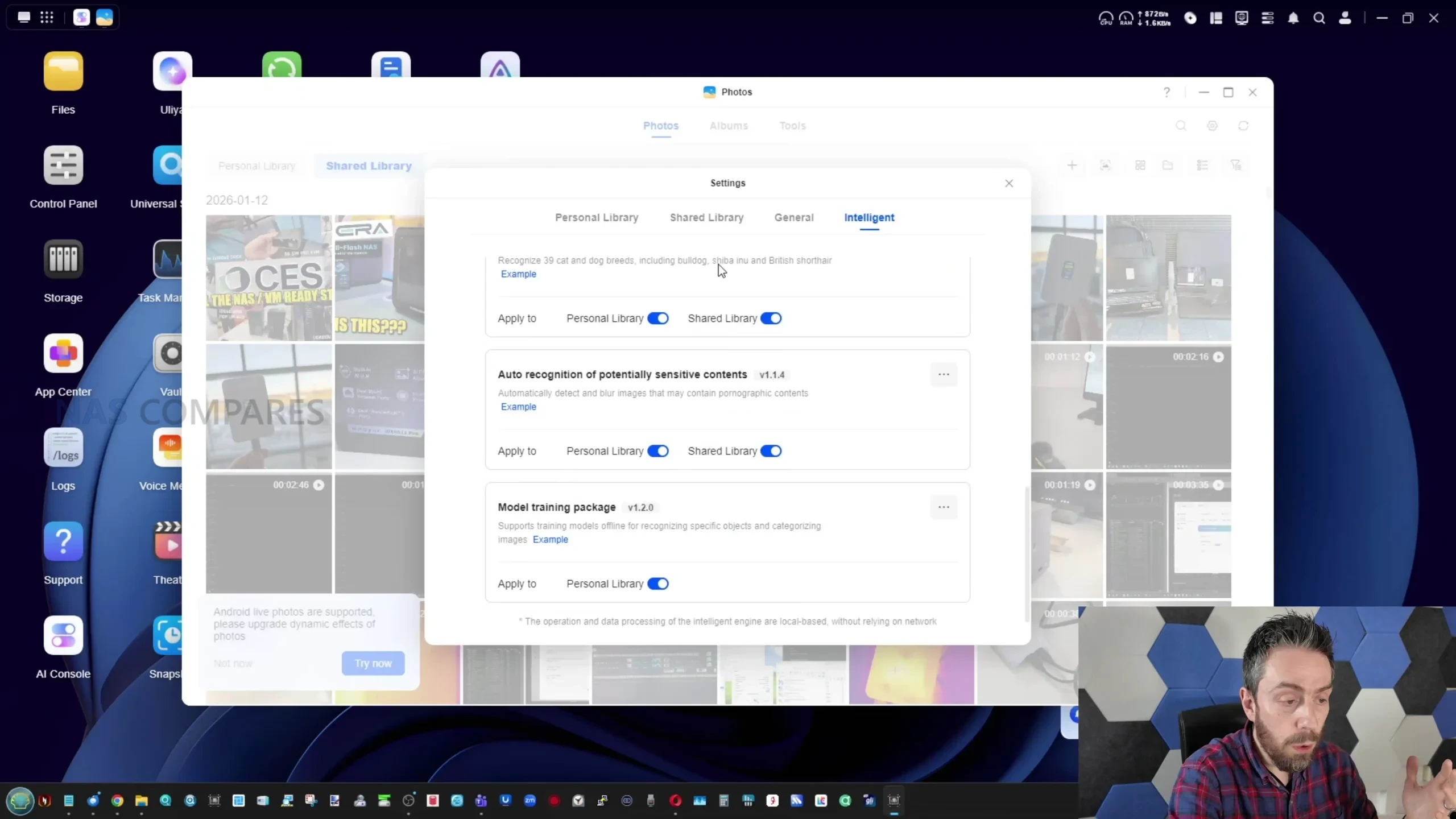
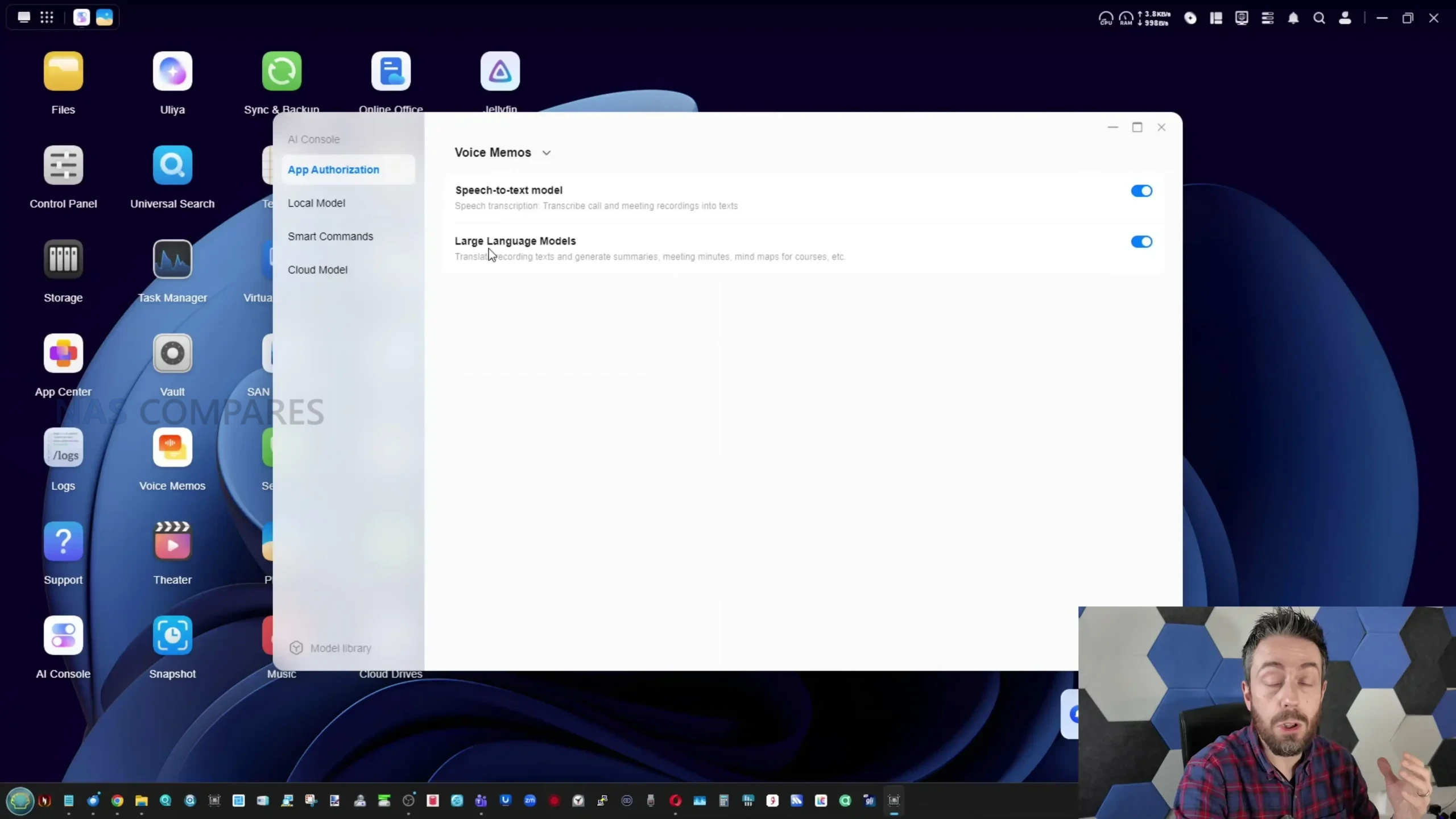
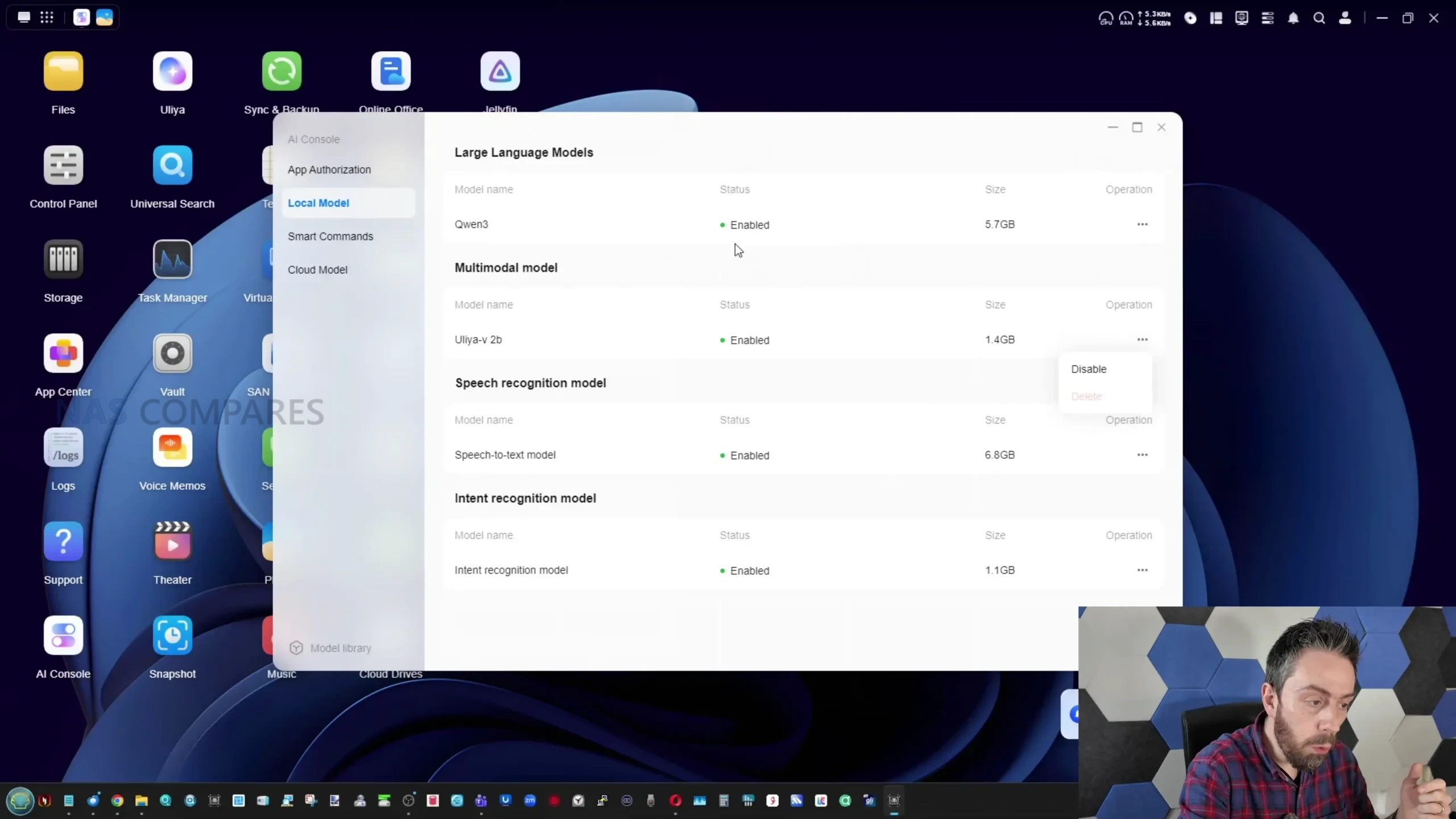
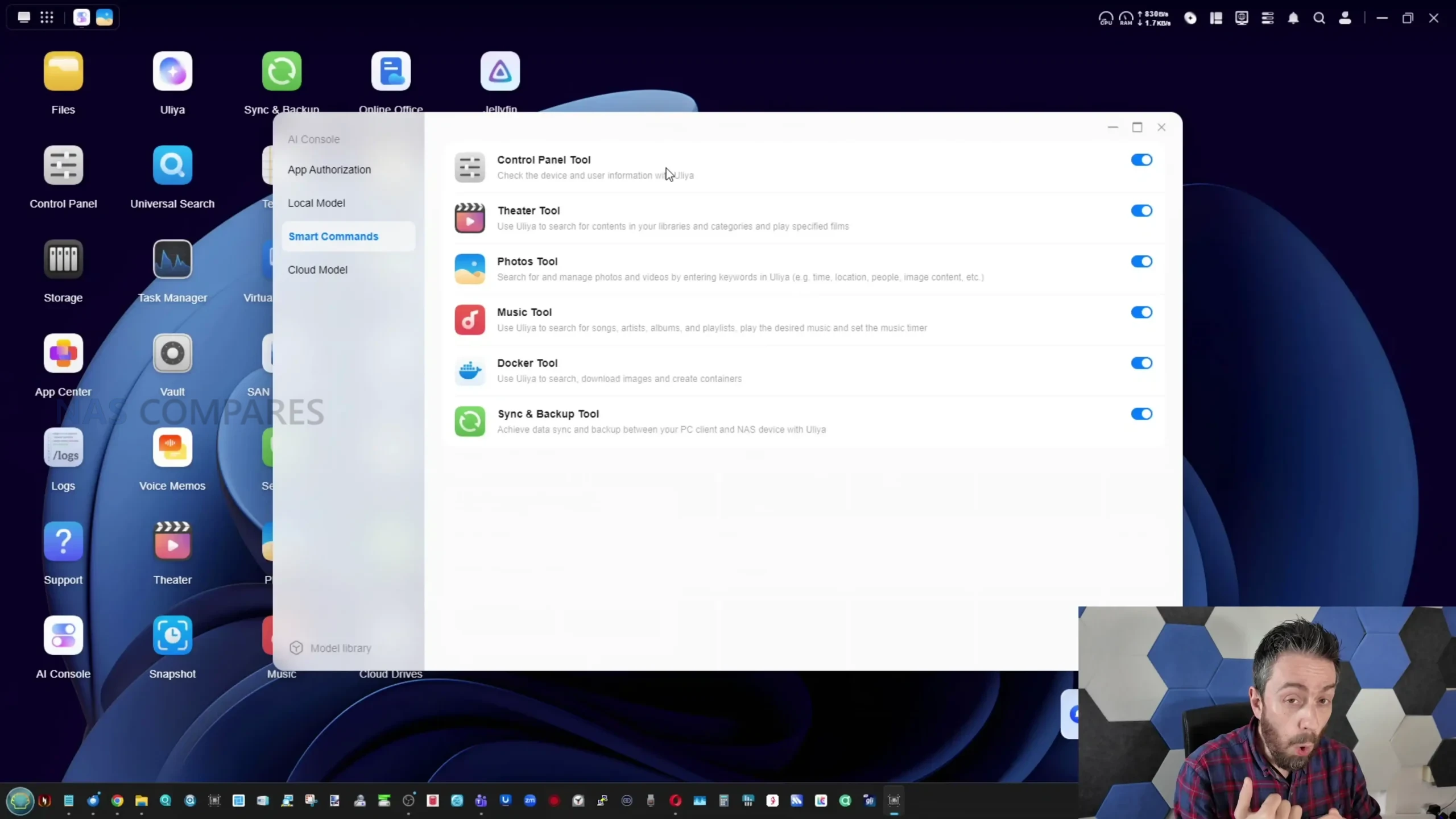
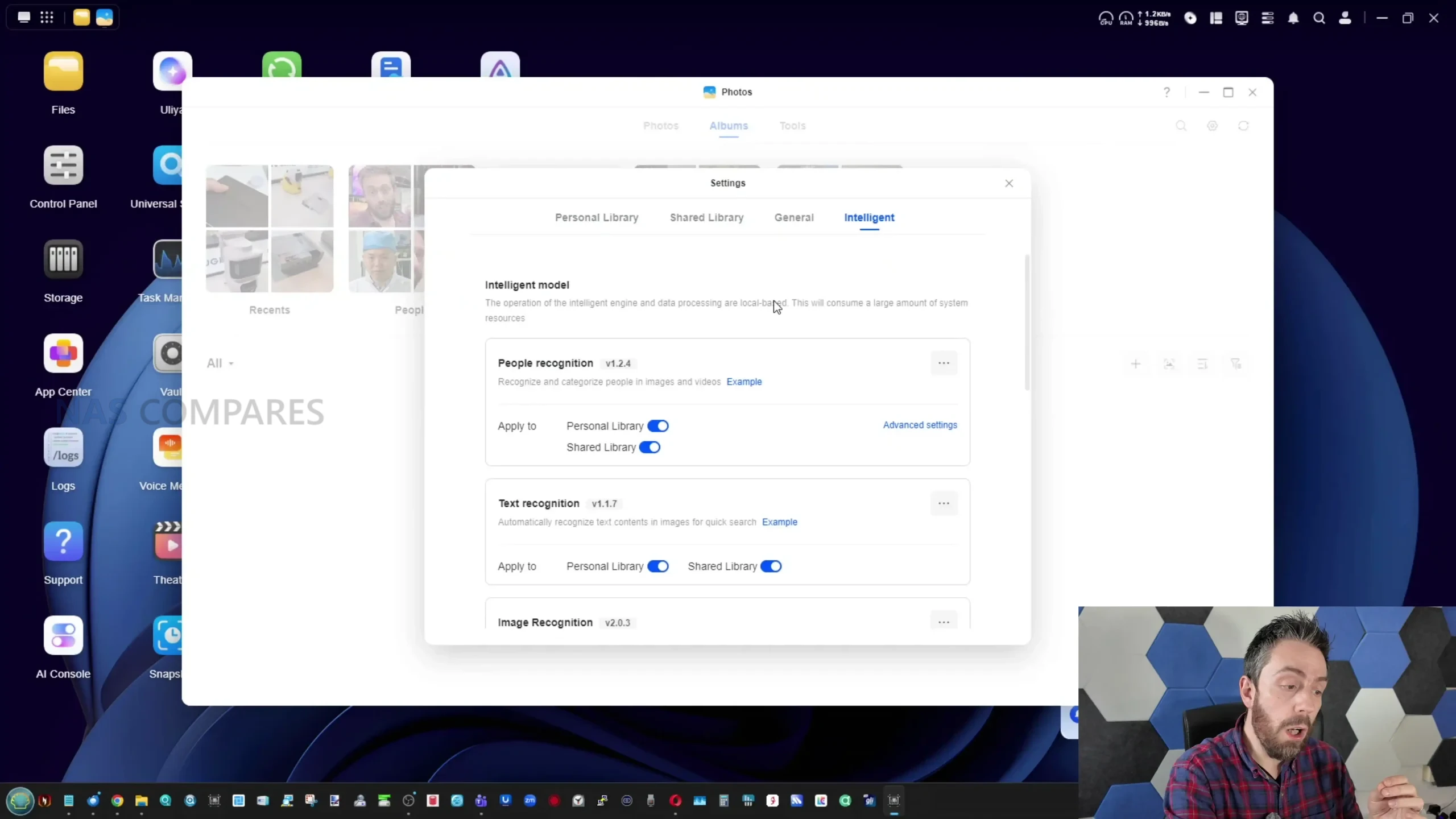
Ugreen a été intégré ici et là quelques touches d’IA dans ses applications maisons (notamment dans son application pour les photos). Mais nous avons voulu aller plus loin et tenté l’expérience des modèles Qwen2.5:3B et Gemma2:2B avec Ollama. Ils fonctionnent très bien avec ce NAS et répondent en quelques secondes. Attention, l’IA consomme beaucoup de ressources : processeur et RAM. Aussi, nous avons constaté une certaine limitation dans la gestion des ressources avec Docker, certainement pour protéger les fonctions de base du NAS.
Consommation électrique et nuisance sonore
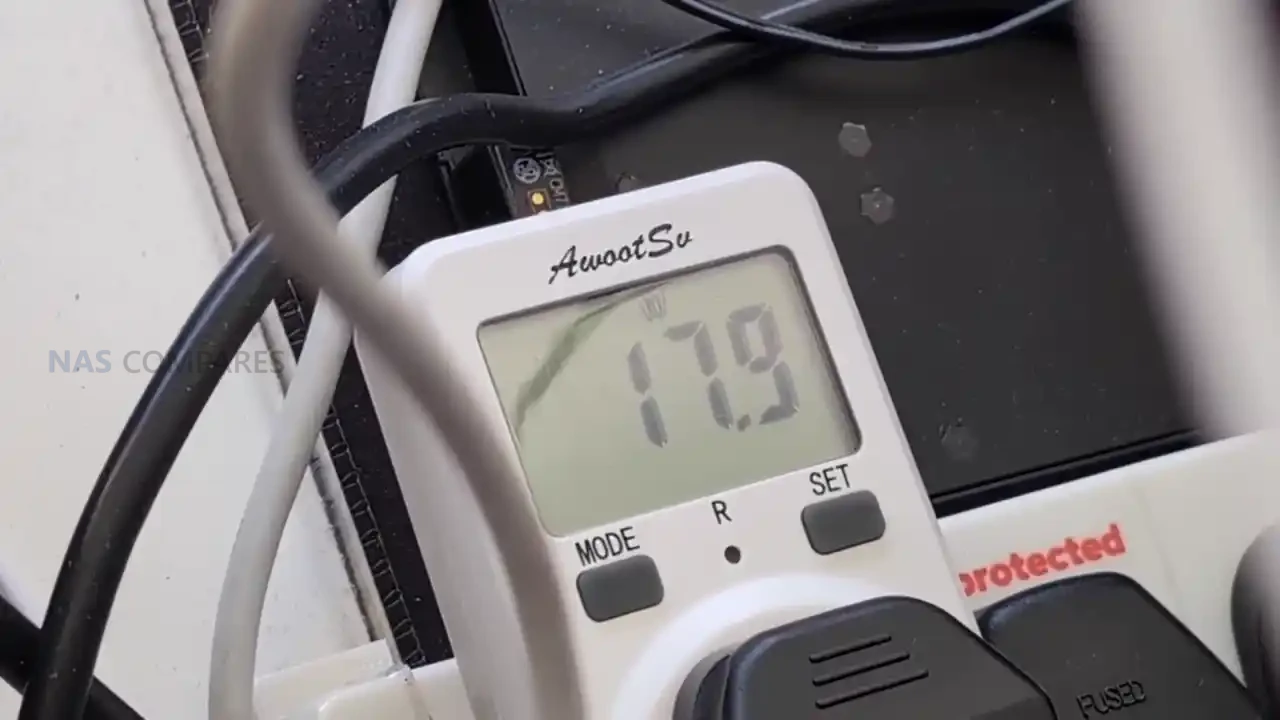
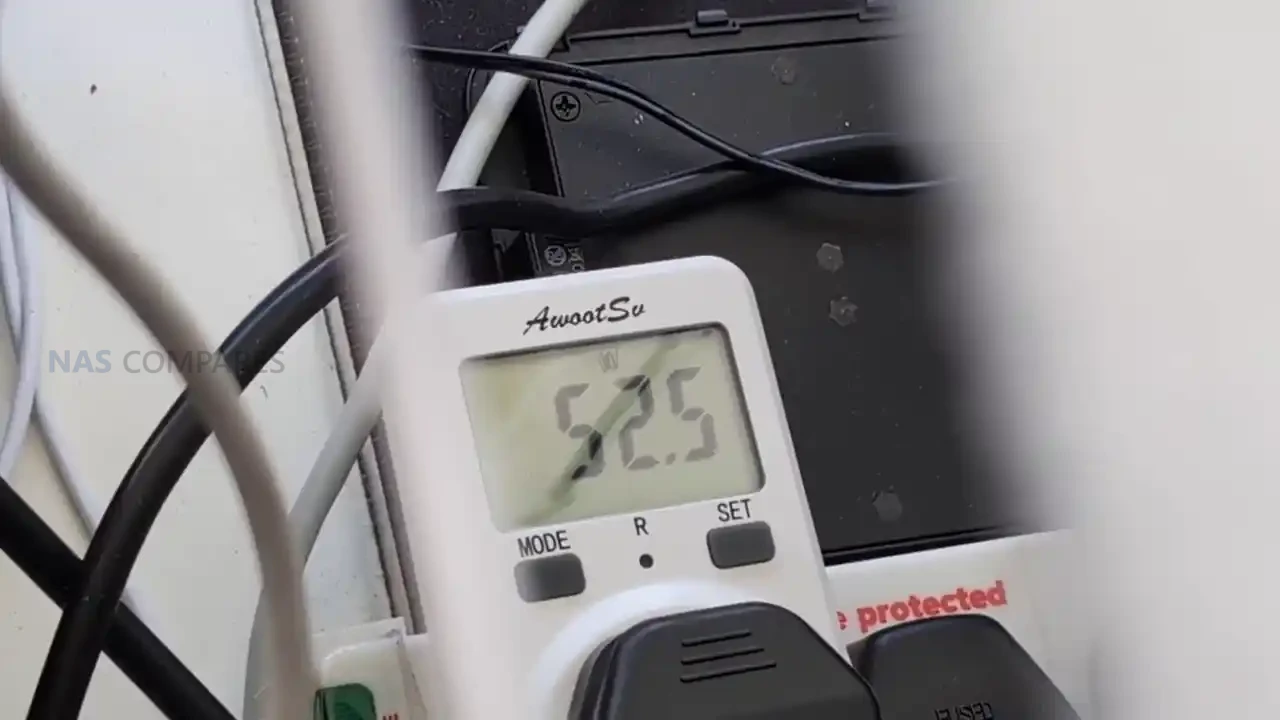
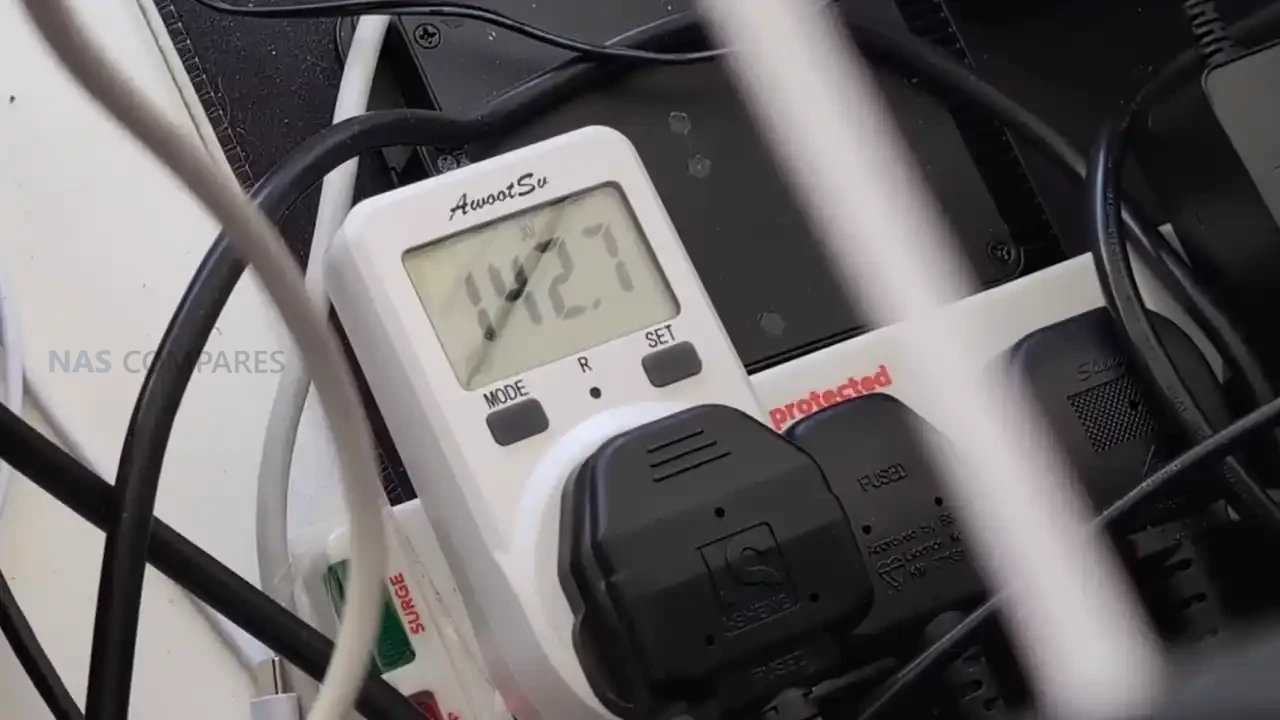
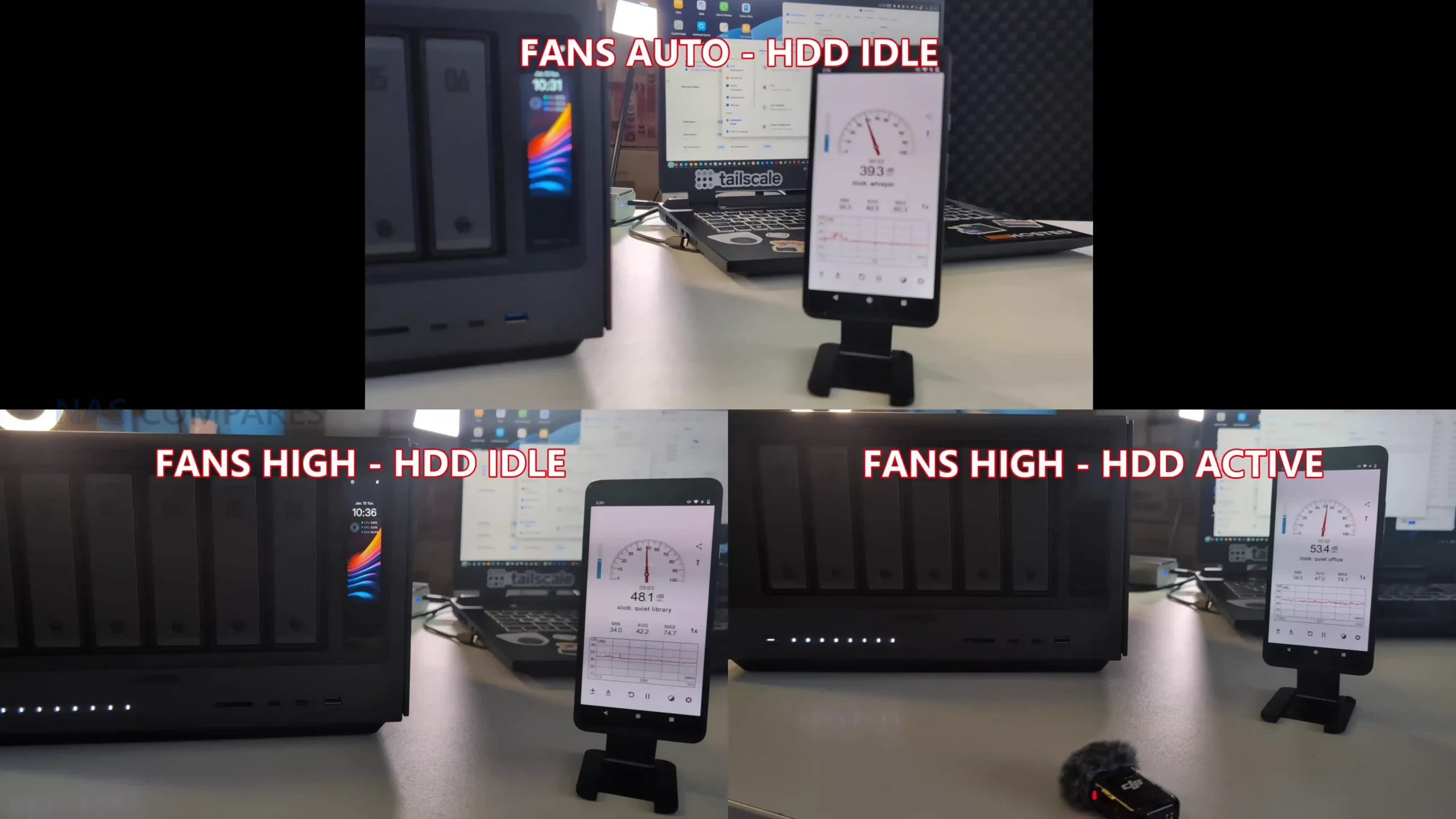
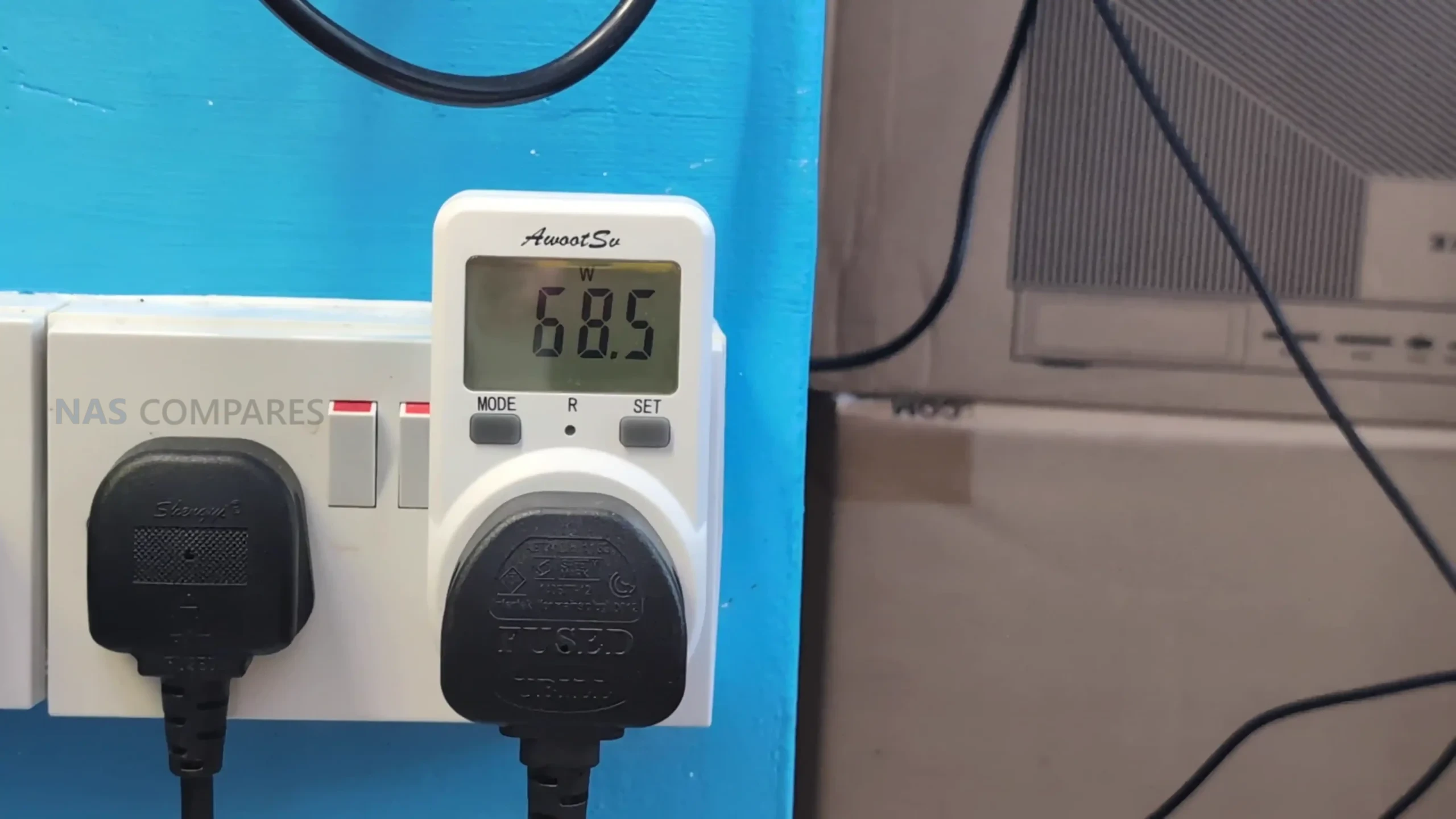
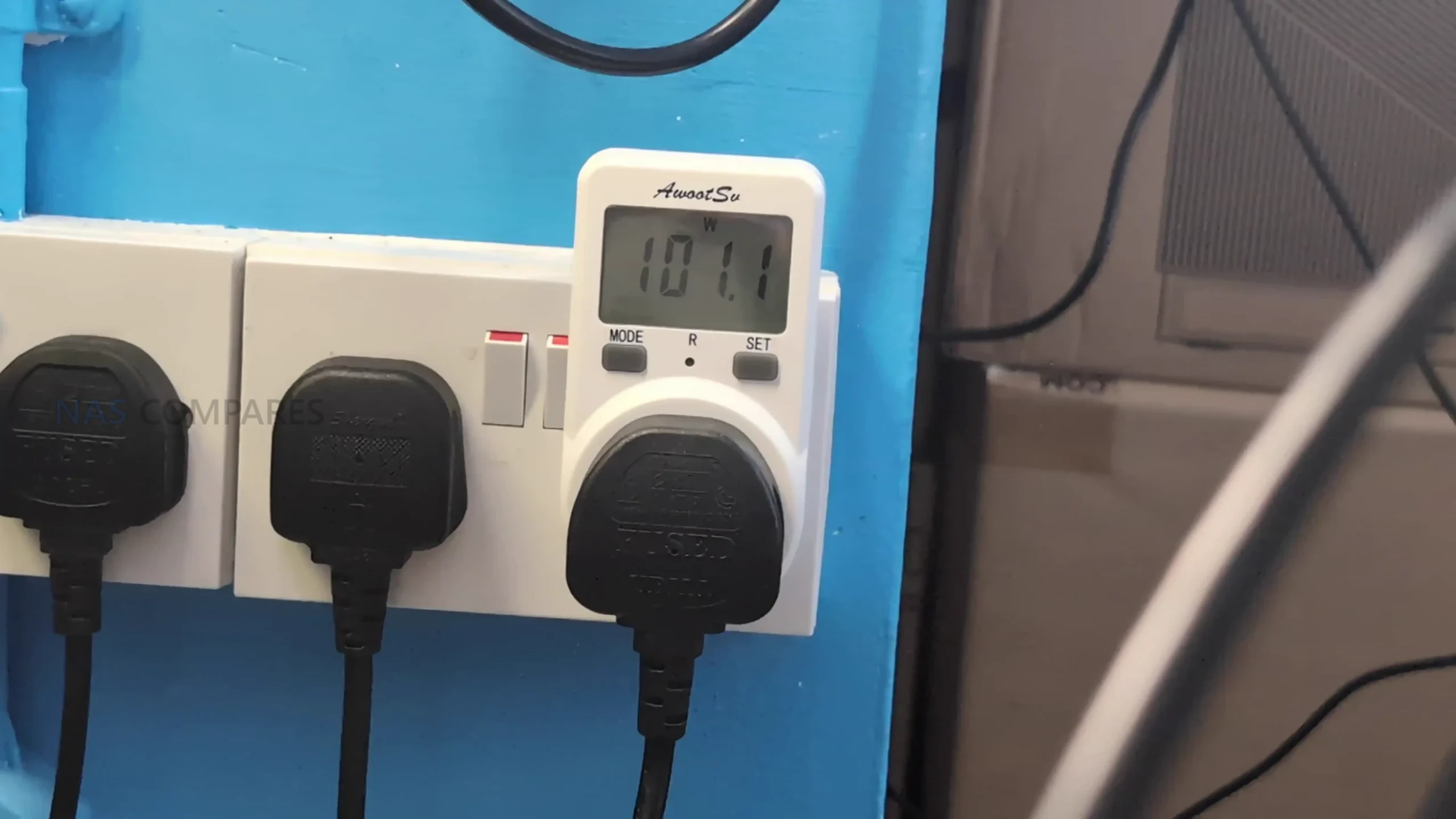
Le ventilateur arrière est relativement discret. Côté consommation électrique, le NAS affiche environ 27 W en usage normal (avec 2 SSD NVMe et 3 SSD SATA) et jusqu’à 45 W en charge plus soutenue.
CONCLUSION
Le UGREEN NASync DXP4800 Pro marque un vrai tournant pour la marque avec une base matérielle puissante et cohérente. Son Intel Core i3 et le 10 GbE natif en font un NAS taillé pour les usages avancés. Les performances sont au rendez-vous !!! En revanche, les 8 Go de RAM par défaut et un UGOS encore en maturation tempèrent légèrement l’ensemble.
Ugreen propose ici une alternative crédible face aux leaders, à condition d’accepter sa jeunesse logicielle.
Gl.iNet Comet 5G Review – The ULTIMATE ALL-ACCESS KVM?
The GL.iNet Comet 5G is a remote KVM built to provide keyboard, video, and mouse control of a connected computer from power on through BIOS, rather than relying on a working operating system like traditional remote desktop tools. It accepts HDMI input from the host and offers HDMI passthrough so a local display can remain connected, with support up to 4K at 30 fps or 1080p at 60 fps, plus 2 way audio. Connectivity is where the Comet 5G differentiates itself most clearly in this product line: it can be managed over Gigabit Ethernet and Wi-Fi 6, but it also includes a nano SIM slot for 5G RedCap with 4G LTE fallback, intended for out of band access when the site network is down, segmented, or simply not trusted. It also supports a local AP mode that broadcasts its own wireless network for nearby management sessions without joining the surrounding LAN. In day to day use, the device is mainly aimed at remote maintenance tasks such as OS installs, recovery and imaging, BIOS changes, and support work on machines that lack built in management like iDRAC or iLO. Compared with the Comet Pro, it keeps the same general platform and interface approach, but adds the cellular path, the AP mode, a larger 3.69 in touchscreen, and 64 GB of eMMC storage for ISO and file staging. The key questions for a review are less about raw compute, since the core platform is similar to the Comet Pro, and more about whether the extra connectivity options, storage capacity, and on device usability justify its higher price for the way it will actually be deployed.
Gli.Net Comet 5G KVM Review – Quick Conclusion
The GL.iNet Comet 5G is essentially the Comet Pro style KVM experience with a stronger connectivity toolkit rather than a major jump in raw performance: you still get reliable BIOS level access, HDMI passthrough so a local screen can stay connected, and flexible access from a browser across different operating systems, but the main reason to choose it is the extra ways it can be reached when the local network is unavailable or not trusted. The nano SIM support (5G RedCap with 4G LTE fallback) gives an out of band route that can keep access available even when Ethernet or Wi-Fi are misconfigured, and the AP mode adds a direct nearby connection for quick point to point management without joining the site LAN, which can be genuinely useful in field work, segmented networks, or recovery situations. It also doubles the internal storage to 64 GB, which makes it easier to keep several ISO images and tools ready to mount remotely, and the larger 3.69 in touchscreen makes local setup and status checks less cramped. The trade offs are mostly about expectations: storage speeds remain modest, so uploading and copying large files is not fast; USB based storage expansion exists but is limited by USB 2.0, can require reboots, and drive compatibility is not always consistent; and while the device supports multiple paths and is marketed around failover, the current interface does not expose deep, router style controls for tuning how those paths behave. If you mostly run KVM over a stable wired or Wi-Fi network, the Comet Pro will usually cover the same core tasks for less money, but if you want a small KVM that gives you more options to regain access when networks are awkward or failing, the Comet 5G is the more complete tool as long as you accept the storage and configuration limitations.
SOFTWARE - 9/10
HARDWARE - 9/10
PERFORMANCE - 8/10
PRICE - 8/10
VALUE - 8/10
8.4
PROS
Cellular out of band access via nano SIM (5G RedCap with 4G LTE fallback) adds a separate path when the site LAN is down or misconfigured Nearby Control via AP mode enables direct point to point access without joining the surrounding network, useful for local BIOS work and isolated environments HDMI passthrough plus capture keeps a local monitor active while still providing remote KVM access (up to 4K 30 fps, 1080p 60 fps) Browser based management and access works across Windows, macOS, and Linux without requiring a dedicated client 64 GB eMMC provides more room for ISO images and utility files than the 32 GB model, reducing how often media needs to be rotated 3.69 in touchscreen makes on device setup and status checks less cramped than smaller panel implementations Multiple remote access approaches are available (LAN, relay, and VPN style options like Tailscale and ZeroTier), allowing different trust and routing models Low complexity deployment with passive cooling and a small footprint makes it viable as a 24/7 appliance when powered independently
CONS
Storage performance is modest, and remains closer to mid range eMMC speeds than fast removable storage External storage expansion has caveats, including USB 2.0 limits, possible reboots, and inconsistent compatibility depending on the USB drive and power draw Failover and cellular controls are not deeply tunable in the current UI, so users expecting router grade policy controls may find configuration limited
Buy the Gl.iNet KVM 5G from Amazon Below:
Buy the Gl.iNet Comet KVM ($219) from the Official Store Below:
Gli.Net Comet 5G KVM Review – Design & Storage
The Comet 5G follows the same general design language as the Comet Pro, but it is physically larger and more deployment focused. It measures 128 × 93 × 33 mm and weighs 285 g, which makes it more of a bag sized tool than something that disappears behind a monitor without planning. The casing relies on passive ventilation rather than active cooling, and in normal use it is intended to be left running continuously, provided it is powered independently rather than from the host machine.
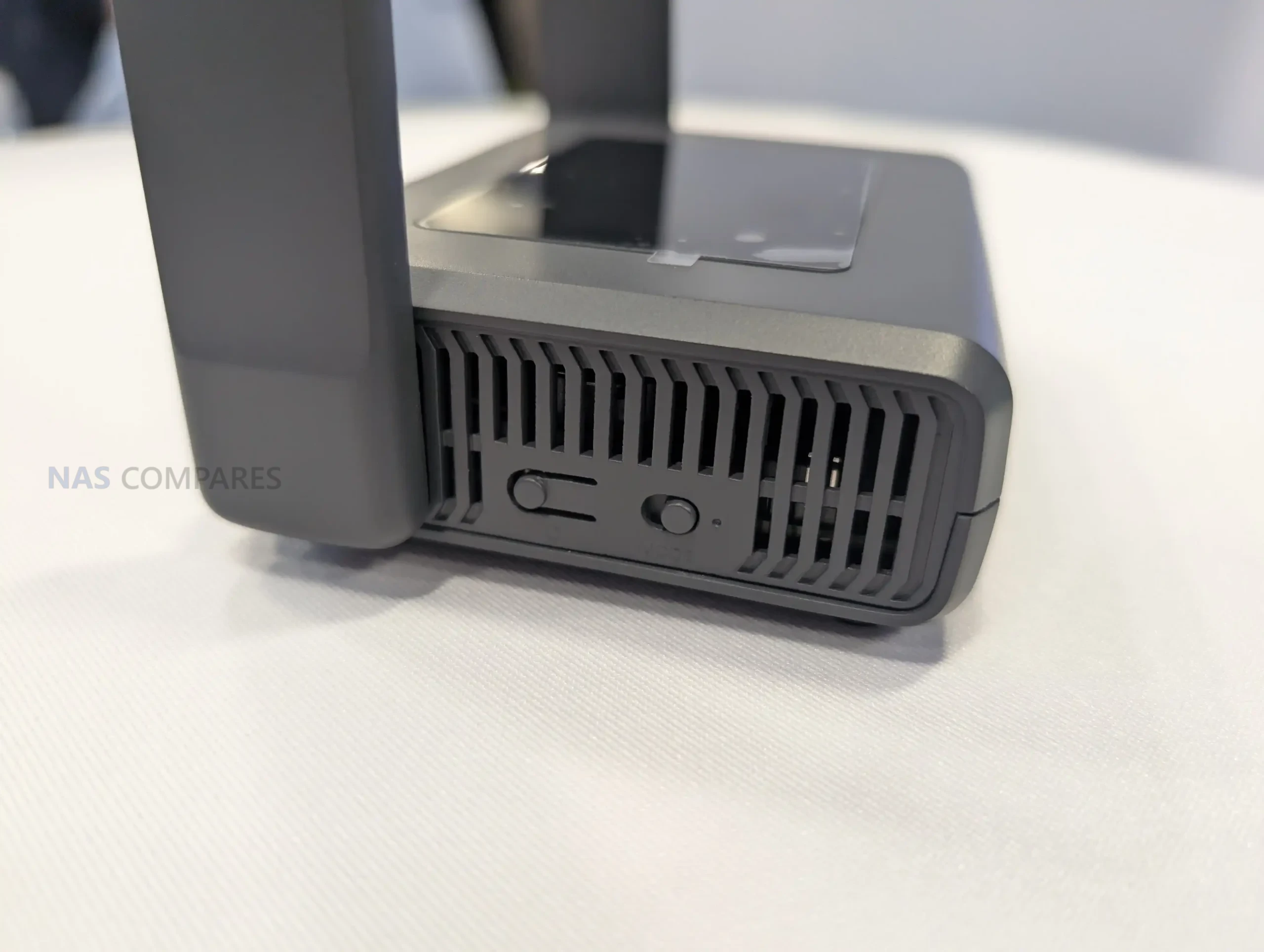
A practical difference in the Comet 5G design is the addition of external antennas to support its wireless roles.
This includes cellular and Wi-Fi antennas, and the unit is clearly built around the expectation that it may be used away from a stable wired network, whether that is via the SIM slot or via a direct nearby wireless connection. In a fixed desk setup the antennas can feel like overkill, but for temporary installs and field support they suit the intended use case.
On the front, the Comet 5G uses a 3.69 in touchscreen, which is notably larger than the Comet Pro’s 2.22 in panel. In practice, that extra size does not materially change the experience of mirroring the host display on the device itself, since you remain limited by the source resolution and scaling.
Where it does help is in the local management interface, where menus and status screens have more room and are less cramped, particularly during setup or when checking network state and service toggles directly on the unit.
Storage is expanded to 64 GB eMMC, and the main advantage is capacity rather than speed. In use, the internal storage is primarily for keeping ISO images, recovery media, and utility files that can be mounted remotely as virtual media or exposed to the host as a remote drive.
File transfers to and from the internal storage typically sit in the same general performance range as the Comet Pro, which means it is functional for staging installers and smaller toolsets, but slow for moving large data sets.
A newer software feature available across the platform also allows external storage via a USB drive, but it comes with constraints that affect how usable it is in practice. Adding a drive can require a reboot, compatibility varies between drives, and the management interface tends to treat partitions individually rather than offering straightforward full disk handling.
Because the port involved is USB 2.0, external storage is more about adding space for additional ISOs than achieving a meaningful improvement in transfer speeds.
Gli.Net Comet 5G KVM Review – Connectivity
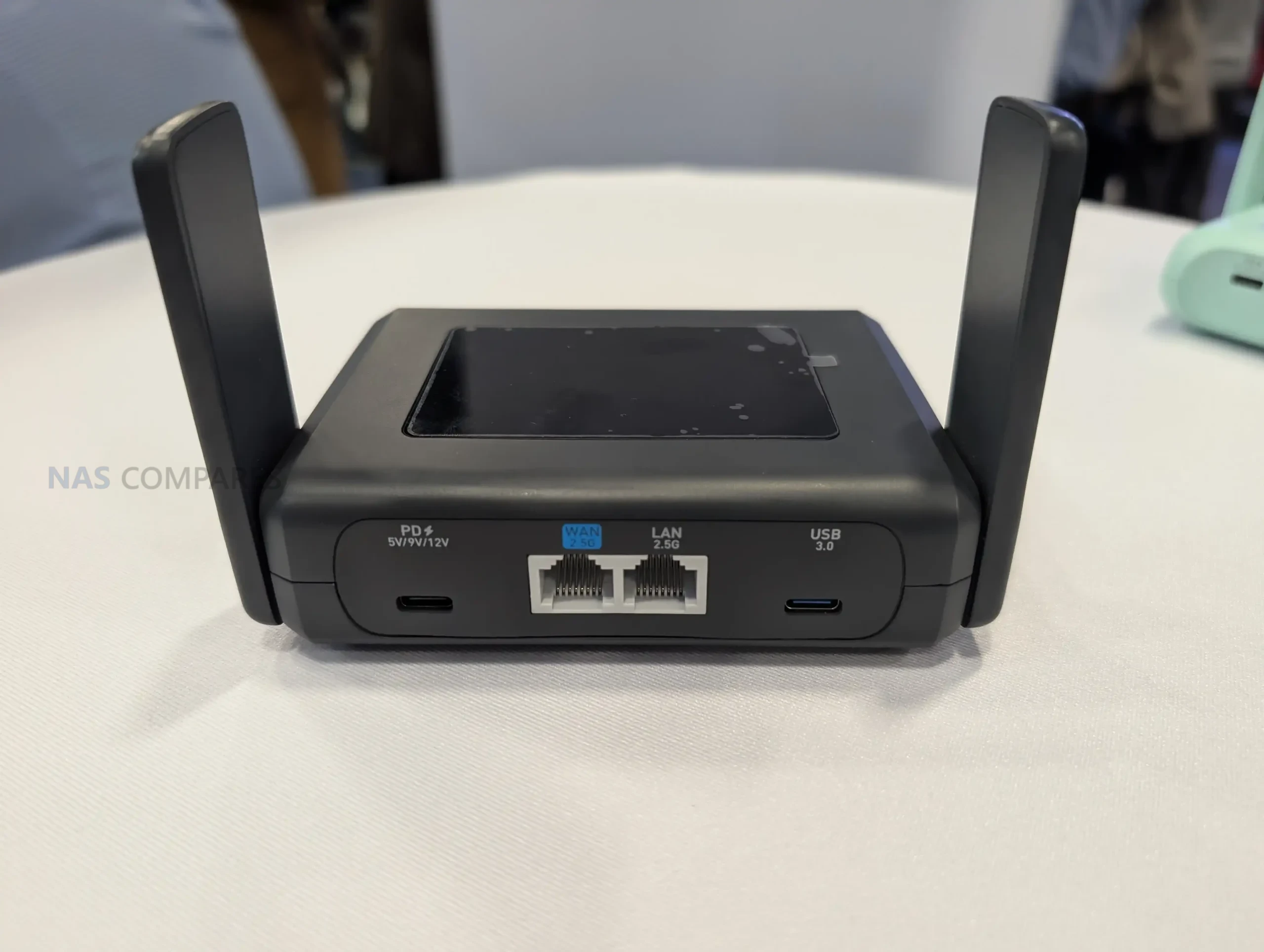
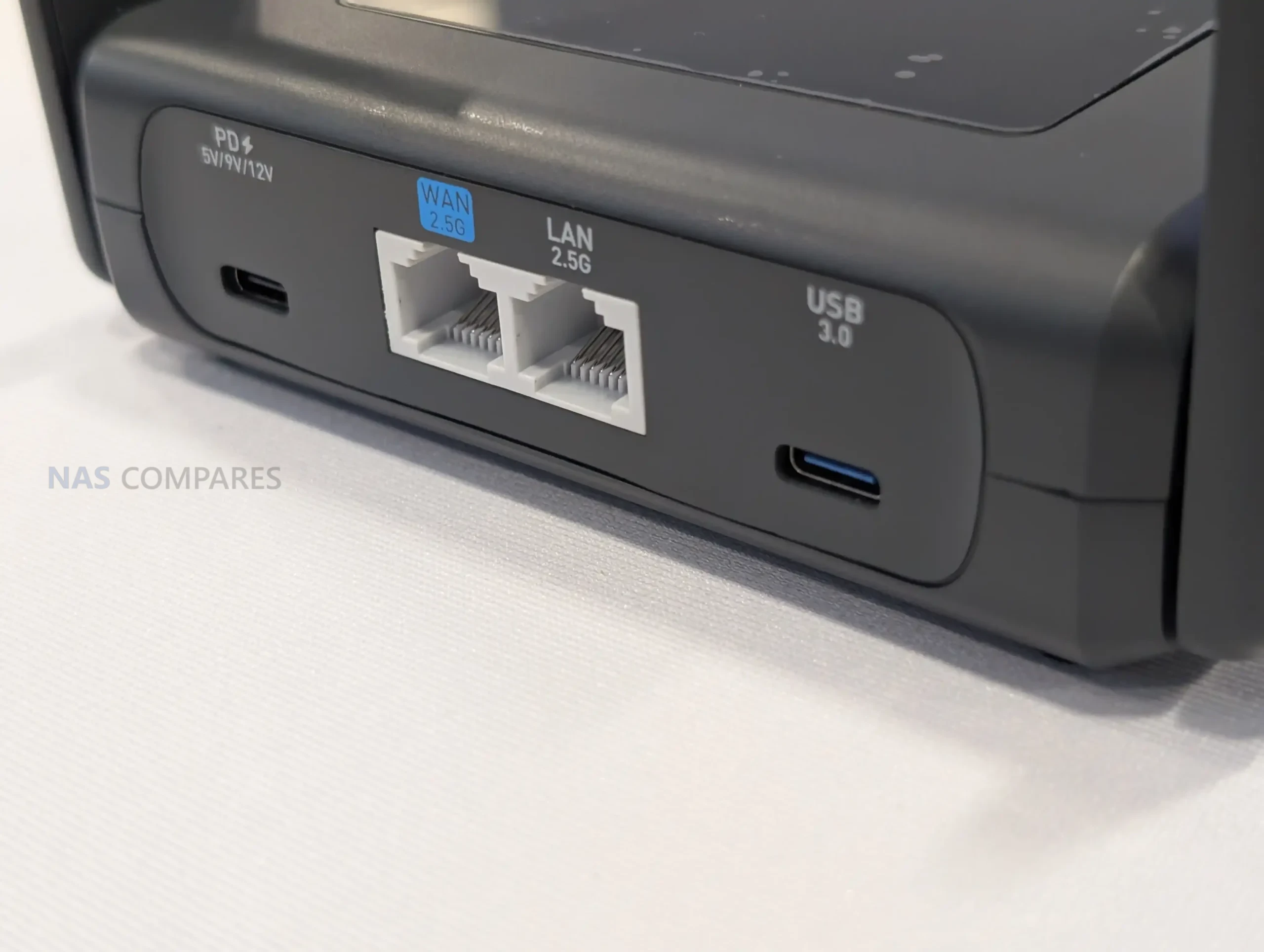
The Comet 5G keeps its I/O layout simple, with the core KVM connections built around full sized HDMI input and HDMI output for passthrough. This avoids adapter reliance and makes it easier to drop into existing setups where monitors and capture paths already use standard HDMI cabling. In a permanent install, passthrough is the more important part of that arrangement, since it allows a local user to keep working on the attached screen while remote access remains available in the background.
For host control, the unit presents USB based keyboard and mouse emulation over its USB-C connection, while power is also supplied via USB-C at 5V/3A with PD compatibility.
In practical terms, powering it from an independent adapter is the safer approach, because drawing power from the host machine can remove KVM access when the host is powered off, rebooting, or in a state where USB power is unstable.
Wired networking is provided by a 1 GbE RJ45 port, which is the most consistent option for image quality and responsiveness when the site network is stable. Alongside this, the Comet 5G supports Wi-Fi 6 on both 2.4 GHz and 5 GHz, and it also includes an AP mode that allows a direct nearby wireless connection without joining the surrounding LAN.
That AP mode is best understood as a local management path rather than a general purpose hotspot, and it is primarily useful when you want a quick point to point session for BIOS work or initial configuration.
The main connectivity addition over the Comet Pro is the nano SIM slot for cellular access, supporting 5G RedCap with 4G LTE fallback. This is positioned as an out of band route that can keep the management channel available when Ethernet and Wi-Fi are unavailable or misconfigured, and it also reduces dependence on VLAN routing rules and other site side constraints.
In the current software experience, the cellular side is exposed through its own configuration section, but it does not offer the same depth of policy and failover tuning found on GL.iNet’s router products.
Gli.Net Comet 5G KVM Review – Internal Hardware
Internally, the Comet 5G is built around a quad core ARM Cortex-A53 SoC paired with 1 GB of DDR3L memory, which is broadly the same class of platform used by the Comet Pro. In review terms, this means the Comet 5G is not trying to win on raw compute, but on connectivity and deployment options, because the core processing headroom is similar. The A53 class CPU is adequate for running the management services, handling multiple control sessions, and keeping the on device UI responsive, but it is not aimed at heavier workloads outside the core KVM functions. The OS is Linux 6.1, and the device behaves like a small embedded appliance rather than a general purpose system you would extend with additional packages and services.
The video path is designed around HDMI ingest and H.264 hardware encoding, with the remote stream adapting to available bandwidth and quality settings in the client interface. Support is listed up to 4K at 30 fps and 1080p at 60 fps, with HDMI passthrough keeping a local monitor active while the unit captures the same signal for remote viewing.
Audio is supported in 2 directions, but the device itself is not treated as a standalone audio endpoint, so the practical experience depends on how the host exposes audio over HDMI or USB and how the client session is configured. Input is handled via USB based HID emulation, which is why copy and paste and keystroke injection can sometimes behave differently between applications depending on how they interpret simulated typing versus clipboard shortcuts.
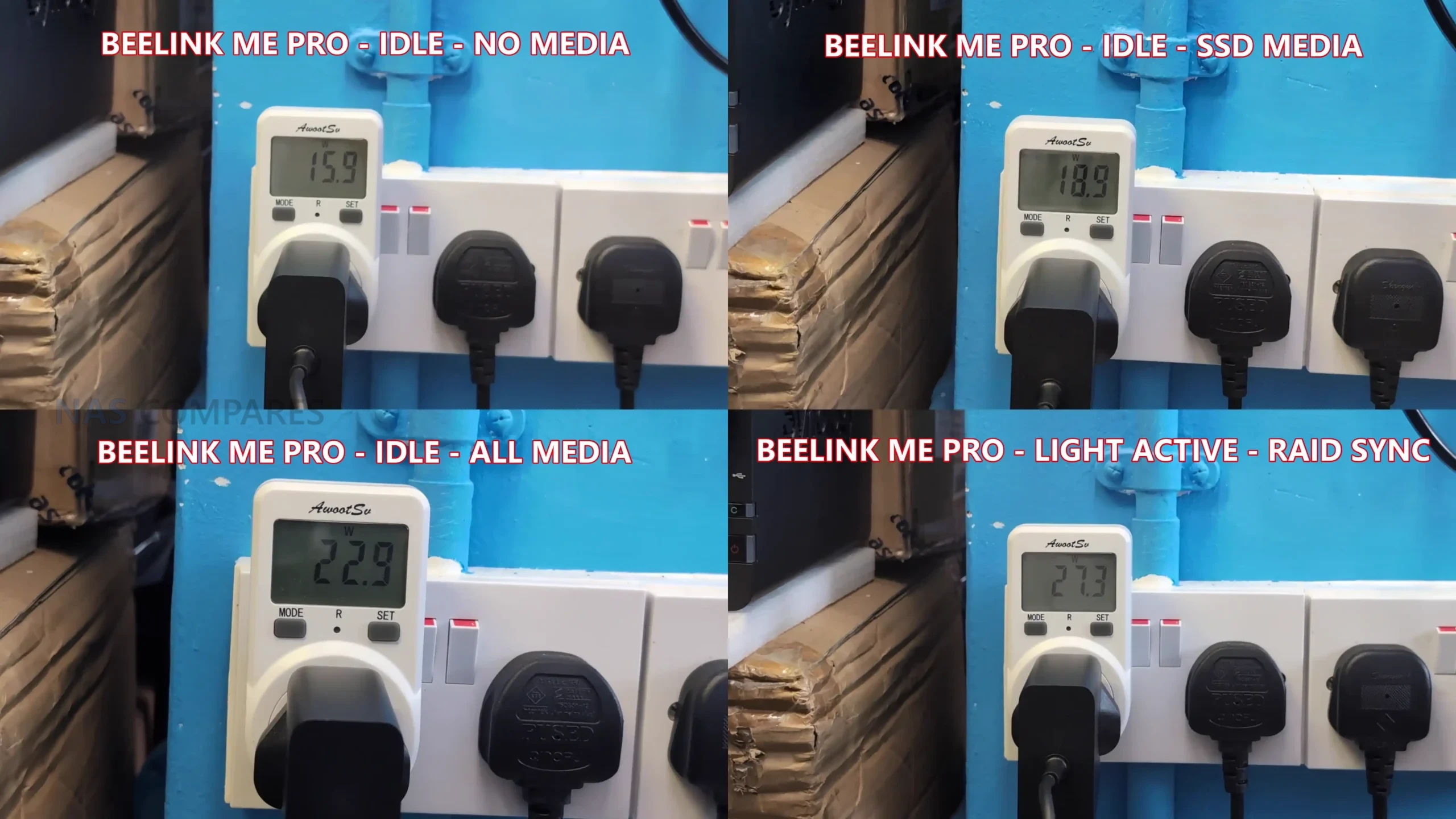
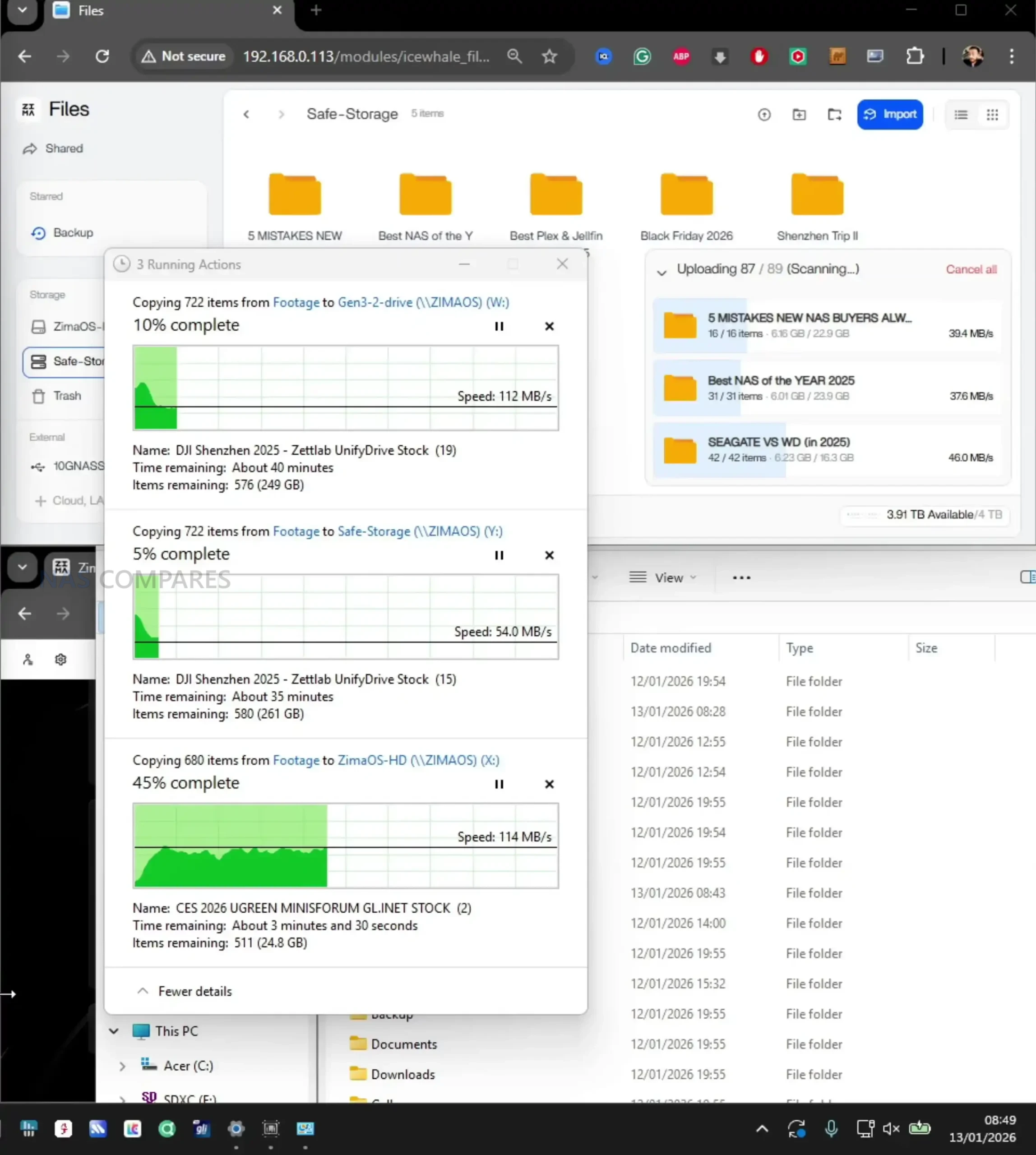
The storage subsystem uses 64 GB eMMC soldered to the board, and in practice it is tuned for predictable, mid range throughput rather than high performance. Real world transfer rates observed during ISO uploads and mounted storage tests typically sit around the mid 20s to mid 30s MB/s range, which aligns with the Comet Pro experience and reflects the limits of the flash and controller rather than a network bottleneck.
That makes it usable for staging installers, recovery media, and driver packs, but not ideal for repeated large image transfers or heavy file shuttling. Expansion is possible via a USB drive using the USB 2.0 Type-A port, but that is primarily a capacity extension, because USB 2.0 limits both bandwidth and available bus power, and drive compatibility can vary depending on the enclosure controller and power draw.
The Comet 5G uses the same GLKVM software family as the earlier Comet devices, with access provided through a browser interface, a desktop client, and a mobile app. In testing, the browser UI is the most straightforward for configuration and for working across different operating systems, and it also exposes most of the device settings without needing to install anything locally.
Firmware maturity differed slightly between units during side by side use, with the Comet Pro running a stable 1.8 release build while the Comet 5G was still presented as beta, though the overall layout and feature set were close enough that the differences felt tied to hardware options rather than a separate software branch.
#
Account and session security options are built into the platform, including 2 factor authentication and passkey support at the account level, plus the ability to apply an additional password gate per device before entering a remote session. Remote access can be handled locally over LAN, through GL.iNet’s relay service, or through peer to peer options. Tailscale support is part of the platform, and newer software revisions have also introduced ZeroTier support, which addresses earlier feedback around relying on a single remote access option.
For users who prefer not to use relay services, these VPN style paths can provide remote reachability without opening ports or depending on the vendor’s cloud beyond account management.
Where the Comet 5G differs in day to day software behavior is how cellular and nearby access are exposed. Cellular configuration appears as a dedicated section for SIM based connectivity, while the Wi-Fi settings include an AP mode that allows direct nearby connections without joining the site WLAN. In practice, these features improve the chances of reaching the device when the surrounding network is misconfigured or inaccessible, but the management interface does not currently provide the same depth of routing, policy control, or visible failover logic that GL.iNet includes in its router products. Multi path behavior is present at a feature level, but there is limited opportunity to tune it beyond selecting the available connection modes.
Performance during remote control sessions depends mainly on the network path and the host workload rather than differences between the Comet 5G and Comet Pro hardware. Video quality controls and stream settings allow the session to be made more stable on weaker links, and the general desktop experience remains usable for BIOS work, OS installs, and troubleshooting.
A copy and paste stress test with a large block of text showed both devices could transfer long input sequences, but the Comet 5G produced fewer odd spacing issues in the final pasted document during that run. On mobile, both devices provide touch mode and cursor mode plus access to a software keyboard, and external Bluetooth keyboards and mice can be used, but fluidity and compression artifacts were more noticeable when the phone was on cellular data compared with a local Wi-Fi or wired path.
The Comet 5G works as a continuation of the Comet Pro platform rather than a clean break. The remote session experience, general interface layout, and core feature set remain familiar, because the underlying compute and encoding approach is broadly the same, and both devices are aimed at the same type of work: BIOS access, OS installs, recovery tasks, and remote troubleshooting where standard remote desktop tools are not enough. The areas that do change the day to day ownership experience are mostly around how you can reach the device when things go wrong. The SIM based 5G RedCap and 4G LTE fallback adds a separate management path, and the AP mode provides a direct nearby connection that avoids relying on the site LAN. The larger 3.69 in screen also makes the on device menus easier to use, even if it does not transform the usefulness of live video mirroring on the panel itself.
On the positive side, the Comet 5G is more adaptable in awkward environments, such as networks with strict VLAN boundaries, unreliable Wi-Fi, or unknown cabling, and it gives you more ways to regain access without a site visit. The 64 GB eMMC storage is also easier to live with if you keep multiple ISO images or toolkits available, although transfer speed remains limited and does not materially improve over the 32 GB model. On the less positive side, the cellular and multi path story is currently presented more as a capability than as a deeply configurable system, so users expecting router style failover policies and detailed controls may find the options relatively basic. The external storage expansion feature helps with capacity, but it is constrained by USB 2.0, requires reboots in some situations, and drive compatibility can be inconsistent, which limits how predictable it is as a long term workflow.
Overall, the Comet 5G is easier to justify when you expect to use the cellular connection or the nearby AP mode regularly, because those are the main reasons it exists and the main differences you will notice. If the device will live on a stable wired network most of the time and you only need a straightforward remote KVM for routine maintenance, the Comet Pro will usually cover the same core tasks for less money. If your priority is having multiple ways to reach the box when the local network is down or not trusted, the Comet 5G is the more complete tool, but its value depends on those deployment realities rather than any large jump in raw performance.
Buy the Gl.iNet KVM 5G from Amazon Below:
Buy the Gl.iNet Comet KVM ($219) from the Official Store Below:
Gl.iNet Comet 5G KVM Pros
Gl.iNet Comet 5G KVM CONs
Cellular out of band access via nano SIM (5G RedCap with 4G LTE fallback) adds a separate path when the site LAN is down or misconfigured
Nearby Control via AP mode enables direct point to point access without joining the surrounding network, useful for local BIOS work and isolated environments
HDMI passthrough plus capture keeps a local monitor active while still providing remote KVM access (up to 4K 30 fps, 1080p 60 fps)
Browser based management and access works across Windows, macOS, and Linux without requiring a dedicated client
64 GB eMMC provides more room for ISO images and utility files than the 32 GB model, reducing how often media needs to be rotated
3.69 in touchscreen makes on device setup and status checks less cramped than smaller panel implementations
Multiple remote access approaches are available (LAN, relay, and VPN style options like Tailscale and ZeroTier), allowing different trust and routing models
Low complexity deployment with passive cooling and a small footprint makes it viable as a 24/7 appliance when powered independently
Storage performance is modest, and remains closer to mid range eMMC speeds than fast removable storage
External storage expansion has caveats, including USB 2.0 limits, possible reboots, and inconsistent compatibility depending on the USB drive and power draw
Failover and cellular controls are not deeply tunable in the current UI, so users expecting router grade policy controls may find configuration limited
This description contains links to Amazon. These links will take you to some of the products mentioned in today's content. As an Amazon Associate, I earn from qualifying purchases. Visit the NASCompares Deal Finder to find the best place to buy this device in your region, based on Service, Support and Reputation - Just Search for your NAS Drive in the Box Below
Need Advice on Data Storage from an Expert?
Finally, for free advice about your setup, just leave a message in the comments below here at NASCompares.com and we will get back to you.Need Help?
Where possible (and where appropriate) please provide as much information about your requirements, as then I can arrange the best answer and solution to your needs. Do not worry about your e-mail address being required, it will NOT be used in a mailing list and will NOT be used in any way other than to respond to your enquiry.
[contact-form-7]
TRY CHAT Terms and Conditions
If you like this service, please consider supporting us.
We use affiliate links on the blog allowing NAScompares information and advice service to be free of charge to you.Anything you purchase on the day you click on our links will generate a small commission which isused to run the website. Here is a link for Amazon and B&H.You can also get me a Ko-fi or old school Paypal. Thanks!To find out more about how to support this advice service checkHEREIf you need to fix or configure a NAS, check FiverHave you thought about helping others with your knowledge? Find Instructions Here
Or support us by using our affiliate links on Amazon UK and Amazon US
Alternatively, why not ask me on the ASK NASCompares forum, by clicking the button below. This is a community hub that serves as a place that I can answer your question, chew the fat, share new release information and even get corrections posted. I will always get around to answering ALL queries, but as a one-man operation, I cannot promise speed! So by sharing your query in the ASK NASCompares section below, you can get a better range of solutions and suggestions, alongside my own.
UniFi UNAS Pro 4 vs Pro vs Pro 8 NAS – WHICH ONE SHOULD YOU BUY?
Within UniFi, the UNAS line is positioned as a straightforward, storage focused, turnkey NAS platform that fits into the same single pane management style as the rest of the ecosystem, prioritizing file storage, sharing, snapshots, and backup workflows over broader server style expandability. In this 3 way comparison, the UNAS Pro (7 bay, Nov 2024), UNAS Pro 8 (8 bay, Nov 2025), and UNAS Pro 4 (4 bay, Feb 2026) look similar on the surface, but they target different deployment constraints and ceiling limits in rack depth, storage scalability, cache options, memory headroom, network redundancy, and power design. Two of the units (Pro 4 and Pro 8) add M.2 NVMe cache support and higher availability 10GbE networking than the original Pro, while the Pro 8 also pushes furthest on RAM capacity and physical redundancy expectations for a rack install.
More 3.5 inch bays than UNAS Pro 4 at the same $499 price (7 vs 4)
1U chassis (smallest height)
Most total bays (8) plus 2x NVMe cache slots
Shallower chassis depth than both (325 mm), easier fit in short depth racks
2x 10G SFP+ instead of 1x 10G SFP+ on UNAS Pro
16 GB memory (double UNAS Pro and UNAS Pro 4)
Front 10G SFP+ and 1G RJ45 placement can suit front of rack cabling
NVMe cache support (absent on UNAS Pro)
3 total 10 GbE ports (2x 10G SFP+ plus 10 GbE RJ45), most flexible networking
1.3 inch touchscreen (absent on UNAS Pro 4 and UNAS Pro 8)
Longer CPU clock than UNAS Pro (2.0 GHz vs 1.7 GHz)
Hot swappable power modules (only model with this design)
Con
No NVMe cache support (both UNAS Pro 4 and UNAS Pro 8 have it)
Lowest bay ceiling and no official expansion path, so it fills up fastest
Highest price up front ($799)
Only 1x 10G SFP+ (UNAS Pro 4 has 2x, UNAS Pro 8 has 2x plus 10 GbE RJ45)
Deeper chassis than UNAS Pro (400 mm vs 325 mm)
Deepest chassis (480 mm), most demanding fit in shallow racks
Lower CPU clock than UNAS Pro 4 and UNAS Pro 8 (1.7 GHz vs 2.0 GHz)
No hot swap PSU design (UNAS Pro 8 is the only one with hot swappable power modules)
No touchscreen (UNAS Pro includes a front touchscreen)
Same 8 GB memory as UNAS Pro 4 and less than UNAS Pro 8 (16 GB)
Same 8 GB memory as UNAS Pro and less than UNAS Pro 8 (16 GB)
Higher power ceiling and max power consumption than the other 2 (250 W max)
At the same time, the lineup is notable for pricing that stays lower than many established rackmount NAS competitors at comparable connectivity, with both the UNAS Pro and UNAS Pro 4 landing at $499, and the UNAS Pro 8 stepping up to $799 for more bays, more memory, and more network paths. The practical decision usually comes down to whether the priority is maximum bays at the lowest buy in, a tighter 1U footprint with newer cache and dual 10GbE links, or a higher ceiling platform with the strongest long term headroom in bays, RAM, and connectivity for users who expect growth rather than a fixed storage target.
IMPORTANT – It is worth highlighting that all three UNAS solutions include the same software and updates in the UniFi Drive and NAS OS services. Alongside the client tools (eg Identity Endpoint and File/Folder services remotely) and can be easily integrated into an existing Ubiquiti/UniFi network landscape. HOWEVER crucially, it is not ‘mandotory’ – you can run any of the UNAS Pro systems completely ‘offline’ (i.e LAN only) and there is no need to already have an existing UniFi network (existing 3rd party network landscapes work perfectly fine) and you also do not need to use/register any kind of UI.com/Ubiquiti account to setup the device.
UniFi UNAS Pro 4 vs Pro vs Pro 8 NAS – Design
At a chassis level, the lineup splits into 2U and 1U designs, and that difference shapes how each unit fits into smaller racks and shallow cabinets.
The UNAS Pro is the shortest depth of the 3, while the UNAS Pro 4 and UNAS Pro 8 extend further back, which matters once you account for cable bend radius and rear clearance.
For compact wall racks and shorter cabinets, the older UNAS Pro tends to be easier to accommodate purely on physical depth, even before you consider anything about performance or features.
UNAS PRO 8 480MM DEPTH
UNAS PRO 325MM DEPTH
UNAS PRO 4 400MM DEPTH
DON’T FORGET RAILS!!!
The UNAS Pro also stands apart on the front panel experience, because it includes a 1.3″ touchscreen that can surface live status information without needing to log into the UI. That is not present on the UNAS Pro 4 or UNAS Pro 8, which lean into a more conventional rack appliance faceplate focused on bay access and basic indicators. In day to day use, the screen is mainly a convenience feature for quick checks and basic local interaction, rather than something that changes how the system is deployed.
Another practical design difference is port placement philosophy. The UNAS Pro places its primary network connectivity on the front, while the UNAS Pro 4 and UNAS Pro 8 move connectivity to the rear, matching the typical layout most rackmount NAS systems follow. Front facing ports can reduce visible cabling in front of a rack and shorten patch runs in some UniFi heavy layouts, but rear mounted ports are generally easier to route cleanly in deeper cabinets with rear cable management.
Power implementation also affects the physical serviceability profile of each unit. The UNAS Pro 8 uses hot swappable power modules, which changes how you handle failure or planned maintenance compared with the fixed internal power approach used by the UNAS Pro and UNAS Pro 4.
All 3 use a steel enclosure and ship as purpose built rack devices rather than desktop conversions, but the UNAS Pro 8 is the one that most closely matches what many buyers expect from a higher end rack appliance in terms of field replacement for key physical components.
UniFi UNAS Pro vs Pro 4 vs Pro 8 NAS – Storage
The most obvious storage difference is the bay count and what that does to capacity planning. The UNAS Pro provides 7 front accessible 2.5 inch or 3.5 inch bays in a 2U chassis, the UNAS Pro 4 offers 4 bays in a 1U chassis, and the UNAS Pro 8 increases that to 8 bays in 2U. If you expect to grow into larger pools over time, the 7 bay and 8 bay models give more headroom before you are forced into drive replacements, a second NAS, or a new storage tier. With no official expansion chassis support referenced here, the physical bay count is effectively the ceiling for each system.
The UNAS Pro 4 and UNAS Pro 8 add 2 M.2 NVMe slots intended for SSD caching, while the UNAS Pro does not include NVMe slots. This changes how you can approach mixed workloads, because cache can reduce latency for repeated small file access and help smooth bursts of writes, depending on how the platform applies caching. It does not change the underlying reality that the main capacity tier is still the SATA bay set, but it gives the Pro 4 and Pro 8 a path to improve responsiveness for specific access patterns without committing to full SSD storage across all bays.
RAID flexibility also varies, not in the list of RAID levels available, but in how storage can be organized. All 3 units support RAID 5, RAID 6, and RAID 10, but the UNAS Pro 4 is listed as supporting a single RAID group, while the UNAS Pro and UNAS Pro 8 are listed with multiple RAID groups. In practice, the single group limitation matters if you prefer separating workloads or isolating different retention policies into distinct pools, rather than placing everything into 1 volume. On the larger models, multiple groups give more options for structuring storage around different priorities, such as performance versus redundancy, or shared storage versus dedicated project space.
Operational features tied to storage protection are also not identical across the range. Hot spare support is listed on the UNAS Pro and UNAS Pro 8, but not on the UNAS Pro 4, which affects how you plan for unattended recovery after a drive failure. All 3 support snapshots, file encryption, share links, Time Machine backup, and cloud and network backup targets, which makes baseline data protection and recovery workflows broadly consistent regardless of bay count.
The larger differentiation is therefore less about whether core protection features exist and more about how much flexibility you have in pool layout and drive management within the limits of each chassis.
Storage Feature
UNAS Pro
UNAS Pro 4
UNAS Pro 8
Form factor
2U rack
1U rack
2U rack
SATA bays
7x 2.5/3.5 inch
4x 2.5/3.5 inch
8x 2.5/3.5 inch
M.2 NVMe slots
0
2
2
SSD cache support
No
Yes
Yes
Max NVMe capacity supported
N/A
4 TiB
4 TiB
RAID types listed
RAID 5, RAID 6, RAID 10
RAID 5, RAID 6, RAID 10
RAID 5, RAID 6, RAID 10
RAID group support
Multiple
Single
Multiple
Hot spare support
Yes
No (not listed)
Yes
Snapshots
Yes
Yes
Yes
File encryption
Yes
Yes
Yes
UniFi UNAS Pro 8 vs Pro vs Pro 4 NAS – Internal Hardware
All 3 systems are built around a quad core ARM Cortex A57 platform, but they are not configured identically. The UNAS Pro runs the Cortex A57 at 1.7 GHz, while the UNAS Pro 4 and UNAS Pro 8 are listed at 2.0 GHz. In day to day use, this tends to show up less as a dramatic jump in peak throughput and more as extra headroom when the system is handling several background jobs at once, such as indexing, snapshots, and multi user access, while still servicing file activity. The architecture choice is aligned with lower draw compared with typical x86 NAS hardware, but it also sets a ceiling on heavier compute workloads that some buyers associate with higher end NAS platforms.Memory is where the split is clearer. The UNAS Pro and UNAS Pro 4 ship with 8 GB, while the UNAS Pro 8 steps up to 16 GB. The practical impact is less about basic file sharing and more about how much concurrent activity the system can absorb before responsiveness drops, particularly when you add more users, larger file operations, more snapshot activity, and cache related behavior on models that support it. None of these systems are positioned as memory expandable platforms in the provided specifications, so the installed capacity is effectively the long term limit.
Power delivery and serviceability differ meaningfully between the range. The UNAS Pro and UNAS Pro 4 use internal AC to DC power supplies with an additional USP RPS DC input for redundancy, and their overall platform power limits are lower, matching their smaller scale.
The UNAS Pro 8 uses hot swappable power modules and is designed to support more demanding configurations, reflected in the higher maximum power consumption and the larger drive power budget. This does not automatically translate into higher idle power, but it does indicate how much overhead the chassis is designed to tolerate when fully populated and under sustained activity.
Internal Hardware Detail
UNAS Pro
UNAS Pro 4
UNAS Pro 8
Processor
Quad Core ARM Cortex A57
Quad Core ARM Cortex A57
Quad Core ARM Cortex A57
CPU clock
1.7 GHz
2.0 GHz
2.0 GHz
Memory
8 GB
8 GB
16 GB
Power supply design
Internal AC DC, 200W
Internal AC DC, 150W
2x hot swappable AC DC modules, 550W
Power inputs
1x AC, 1x USP RPS DC input
1x AC, 1x USP RPS DC input
2x AC inputs via hot swap modules
Max power consumption
160W
150W
250W
Max drive power budget
135W
125W
225W
Management and setup radios
Bluetooth 4.1
Bluetooth 4.1
Bluetooth 4.1
Display
1.3 inch touchscreen
None listed
None listed
Operating environment
-5 to 40 C, 5 to 95 percent noncondensing
-5 to 40 C, 5 to 95 percent noncondensing
-5 to 40 C, 5 to 95 percent noncondensing
Weight
9.2 kg without brackets, 9.5 kg with brackets
6.7 kg
11.5 kg
UniFi UNAS Pro 4 vs Pro vs Pro 8 NAS – Ports and Connections
Across the 3 systems, the shared theme is 10 GbE as the primary path for file access, but the implementation differs. The UNAS Pro provides a single 10G SFP+ port plus a 1 GbE RJ45 port, which typically ends up used either for management traffic or as a slower access fallback. The UNAS Pro 4 shifts to a dual 10G SFP+ layout, giving more flexibility for link aggregation or failover planning, even if the practical benefit depends on the storage configuration and client support. The UNAS Pro 8 goes further with 2x 10G SFP+ and adds a 10 GbE RJ45 port that supports multi speed negotiation, which makes it easier to drop into networks that are already built around copper 10 GbE.
Port placement is also part of the decision, because the UNAS Pro uses front mounted networking, while the UNAS Pro 4 and UNAS Pro 8 keep network connections on the rear. Front mounted ports can simplify short patch runs in racks that are set up around front facing switching, while rear mounted ports follow the more common rack NAS convention and can be cleaner in racks that route cabling at the back. None of the 3 is positioned as a platform for network expansion cards, so what you buy is the long term connectivity ceiling.
In day to day operation, the multi port models are mainly about resiliency and network design options rather than guaranteeing linear scaling for a single user. You can plan for redundancy across switches, use bonding where your environment supports it, or segment traffic patterns in a more controlled way.
The UNAS Pro 8 is also the only model here with 10 GbE available on both SFP+ and RJ45 in the base hardware, which reduces the need for media converters or additional transceiver planning if your network is not SFP+ centric.
Connectivity
UNAS Pro
UNAS Pro 4
UNAS Pro 8
10 GbE SFP+
1 (10G/1G)
2 (10G only)
2 (10G only)
10 GbE RJ45
0
0
1 (10G/5G/2.5G/1G/100M)
1 GbE RJ45
1 (1G/100M/10M)
1 (1G/100M/10M)
0
Total high speed 10G ports
1
2
3
Network port location
Front
Rear
Rear
UniFi UNAS Pro 4 vs Pro 8 vs Pro NAS – Price and Value
At list pricing, the UNAS Pro and UNAS Pro 4 sit at the same $499, but they are selling different priorities. The UNAS Pro concentrates its value in raw bay count and a shorter 2U chassis, trading away NVMe cache support and additional 10 GbE links to keep the platform simple. The UNAS Pro 4 is priced the same while reducing the HDD bay count and moving to a 1U chassis, but it adds 2x NVMe cache slots and a second 10G SFP+ port, positioning it more as a “small but fast access” rack NAS rather than a capacity first box.
The UNAS Pro 8 steps up to $799and is priced like a higher tier option, but the spec sheet shows where that uplift is meant to land: more drive bays than either $499 model, NVMe cache capability like the Pro 4, more total 10 GbE ports, and a jump to 16 GB memory. It is also the only one of the 3 with a 10 GbE RJ45 port alongside SFP+, which can reduce friction in mixed copper and fiber environments. If the goal is to keep the same platform longer term, the Pro 8 is the only one here with both the capacity headroom and the memory ceiling to match it.
Using the simplified “price per bay” and “price per element” approach, the headline result is that the Pro 8 looks strongest once you count all the included hardware features rather than only the number of drive bays. The UNAS Pro has the lowest cost per bay because it is a 7 bay system at the same price as the 4 bay model, but the Pro 4 catches up when the NVMe slots and dual 10 GbE are treated as part of the value calculation. The Pro 8 is not the cheapest upfront, but it ends up close to the Pro 4 on cost per bay and is the lowest on cost per element because it stacks more of the “platform” features in one chassis.
The UNAS Pro 4, UNAS Pro, and UNAS Pro 8 are close enough in naming to look like simple capacity steps, but they are positioned more like 3 different takes on the same UniFi Drive appliance idea. The UNAS Pro is the most capacity oriented at $499, giving 7 bays in a shorter depth 2U chassis with a built in 1.3 inch touchscreen and a straightforward port layout that suits some front of rack workflows. The UNAS Pro 4 shifts the emphasis away from bay count and toward “newer platform features” at the same $499 price, combining a 1U form factor with 2x 10G SFP+ and 2x NVMe cache slots, at the cost of a deeper chassis and fewer total drive bays. The UNAS Pro 8 is the most complete hardware package in the lineup, adding more bays, NVMe cache, more total 10 GbE connectivity including 10 GbE RJ45, and 16 GB memory, while also being the only one of the 3 to use hot swappable power modules. None of the 3 supports an official expansion shelf approach, so the bay count you buy on day 1 is effectively the long term ceiling unless you plan a separate NAS later.
Choosing between them mostly comes down to which ceiling matters first in your deployment: total bays, total network options, or overall platform headroom. If you want the most bays at $499 and the chassis depth is a priority, the UNAS Pro remains the obvious pick, with the tradeoffs being no NVMe cache path and a simpler network layout than the newer units. If you want the $499 option that aligns most with modern expectations for a small rack NAS, the UNAS Pro 4 has the cleanest argument, because dual 10G and NVMe cache can matter more than extra bays in smaller, faster working sets, even if those cache slots are not usable as standalone storage pools. If you are planning for longer retention cycles, heavier multi user access, or you simply want the most complete feature set in a single chassis, the UNAS Pro 8 is the one that most clearly justifies its higher price, particularly once memory, network flexibility, and the power module design are considered together. The main limitation across the lineup is that the ARM platform and fixed memory approach sets expectations about the long term performance ceiling, but within that constraint, the decision is primarily about how you want the hardware budget divided between capacity, connectivity, and overall platform resources.
This description contains links to Amazon. These links will take you to some of the products mentioned in today's content. As an Amazon Associate, I earn from qualifying purchases. Visit the NASCompares Deal Finder to find the best place to buy this device in your region, based on Service, Support and Reputation - Just Search for your NAS Drive in the Box Below
Need Advice on Data Storage from an Expert?
Finally, for free advice about your setup, just leave a message in the comments below here at NASCompares.com and we will get back to you.Need Help?
Where possible (and where appropriate) please provide as much information about your requirements, as then I can arrange the best answer and solution to your needs. Do not worry about your e-mail address being required, it will NOT be used in a mailing list and will NOT be used in any way other than to respond to your enquiry.
[contact-form-7]
TRY CHAT Terms and Conditions
If you like this service, please consider supporting us.
We use affiliate links on the blog allowing NAScompares information and advice service to be free of charge to you.Anything you purchase on the day you click on our links will generate a small commission which isused to run the website. Here is a link for Amazon and B&H.You can also get me a Ko-fi or old school Paypal. Thanks!To find out more about how to support this advice service checkHEREIf you need to fix or configure a NAS, check FiverHave you thought about helping others with your knowledge? Find Instructions Here
Or support us by using our affiliate links on Amazon UK and Amazon US
Alternatively, why not ask me on the ASK NASCompares forum, by clicking the button below. This is a community hub that serves as a place that I can answer your question, chew the fat, share new release information and even get corrections posted. I will always get around to answering ALL queries, but as a one-man operation, I cannot promise speed! So by sharing your query in the ASK NASCompares section below, you can get a better range of solutions and suggestions, alongside my own.
Review of the UniFi UNAS Pro 4 NAS – Possibly the Best Value 1U Rack Ever?
Over the last 18-24 months, Ubiquiti has shifted the ‘UniFi’ label from being a networking and bridging ecosystem into a wider storage hardware and software platform that now includes a steadily expanding NAS line under UniFi Drive. Early UniFi UNAS storage products leaned heavily on simple file sharing and basic backup, but the pace of updates and the broader product rollout in 2025/2026 pushed the range closer to what small business buyers expect from an entry level NAS platform: clearer storage management, stronger snapshot and backup tooling, and tighter integration with the UniFi account and identity layer for remote access and user control (with the recent Drive 4.0 Update really uping their game considerably). The UniFi UNAS Pro 4 sits within that context as a compact 1U, 4 bay rack mount system designed mainly for file storage and sharing over SMB and NFS, rather than running third party applications, containers, or virtual machines. At $499, it is priced noticeably lower than many competing 1U rack NAS products at broadly comparable “headline” hardware, particularly where dual 10Gb networking and NVMe caching are concerned, which makes it hard to ignore if the goal is simple, high bandwidth storage in a rack footprint without moving into significantly higher spend.
UniFi UNAS Pro 4 Review – Quick Conclusion
The UniFi UNAS Pro 4 is a 1U, 4 bay rack mount NAS aimed at straightforward SMB and NFS file storage, and its main differentiator is value: at $499 it undercuts many comparable 1U rack units while still offering 2x 10Gb SFP+ plus a separate 1GbE management port, 4 hot swap bays for 3.5 inch or 2.5 inch drives, and 2 M.2 NVMe slots for read and write caching. In testing with 4 HDDs in RAID 5 over 10GbE, it delivered strong real-world file transfer results for a small SATA array, with synthetic benchmarks showing high peak throughput but some variability depending on the tool used, and the platform’s power draw and noise profile were heavily influenced by drive choice and fan mode, including very loud output if maximum cooling is forced. UniFi Drive covers the core fundamentals expected at this level, including snapshots, encrypted volumes, and a wide range of backup targets (NAS, SMB, and multiple cloud services, with Microsoft 365 direction evident in recent updates), but the interface still limits deeper tuning in places and the feature set remains focused on storage rather than apps. The main downsides are structural and easy to identify up front: NVMe can only be used for cache rather than storage pools, the NVMe carriers are an extra purchase, there are no USB ports for local copy tasks, the PSU is internal and not a hot swap module, and missing features like iSCSI, ECC, and RAM upgradability place a clear ceiling on more advanced workloads, though those trade-offs are broadly consistent with a $499 ‘turnkey’ NAS appliance in 2026 though and hard to criticise!
BUILD QUALITY - 9/10
HARDWARE - 7/10
PERFORMANCE - 7/10
PRICE - 9/10
VALUE - 10/10
8.4
PROS
Dual 10Gb SFP+ networking is unusual in a 1U 4 bay NAS at this price point + failover will not result in bandwidth throttle A separate 1GbE port is useful for management or fallback connectivity 1U chassis with relatively short depth is easier to fit in smaller racks and cabinets Rails and rack hardware included, reducing extra setup cost and friction Ubiquiti and UniFi online/brand services are optional (i.e pure offline/LAN is possible)+ no need for a Ubiquiti/UniFi network setup to use NVMe read and write caching support can improve responsiveness in mixed workloads UniFi Drive provides snapshots, encryption, and a broad set of backup targets (NAS, SMB, and multiple cloud providers) Setup and management are streamlined, especially for users already running UniFi infrastructure Drive 4.0 Update scales up the Business Utilities notably
CONS
NVMe is cache only, with no option to use M.2 drives as primary storage pools NVMe trays or carriers are not included, adding extra cost and an extra purchase step Single PSU (no redundency) and non-slide removable SFX/ATX PSU (relies on propriatary UniFi Battery Backup rack module or external UPS) No NAS Expansion Support, so 4 HDDs are your limit
Here are all the current UniFi NAS Solutions & Prices:
You can buy the UniFi UNAS Pro 4 NAS via the link below – doing so will result in a small commission coming to me and Eddie at NASCompares, and allows us to keep doing what we do!
UniFi UNAS Pro 4 Review – Design & Storage
The UNAS Pro 4 uses a conventional 1U rack mount layout, with a plain, functional front panel and an all metal enclosure intended for permanent installation rather than desktop use. It ships with rails and rack handles, which removes the usual extra step of sourcing mounting hardware separately. The chassis depth is about 400 mm, so it is not in the “full depth server” category, and that helps in smaller cabinets where rear clearance and cable management space can be limited.
Across the front are 4 hot swap bays supporting both 3.5 inch and 2.5 inch SATA drives. The trays are set up for tool-less 3.5 inch HDD installation with a click-in fit, while 2.5 inch SSDs still require screws to secure them properly. Each bay has status lighting, and the front panel also provides system level indicators so you can identify basic state and drive activity at a glance without logging into the interface. The trays feel rigid and spring-loaded, but they are not lockable, which is a practical consideration if the unit is placed in a shared rack or anywhere physical access is not strictly controlled.
From a capacity and planning perspective, this system is defined by its fixed 4 bay layout. You can configure a conventional RAID group within those bays, but there is no built-in path to scale beyond the internal slots, and there is no supported external expansion shelf option to push the same chassis further later on. That means the decision on drive sizes and redundancy level matters upfront, because the ceiling is reached quickly compared with higher bay count rack units. In a small rack deployment, it also means the unit is either a compact standalone store or part of a broader multi-NAS approach rather than a single box that grows over time.
In addition to the SATA bays, the chassis supports 2 M.2 NVMe slots intended specifically for SSD caching. The caching model is designed to accelerate HDD-based storage by using SSDs as a performance layer, rather than allowing NVMe drives to become their own primary pool for general file storage. Practically, that positions the NVMe feature as a supplement for mixed workloads, such as improving responsiveness for frequently accessed data and smoothing write behavior, rather than a route to running the system as a small all flash NAS.
A design detail that affects the storage experience is the physical NVMe mounting method. Instead of a simple screw-down slot on a board, the NVMe drives are installed via a tray or carrier mechanism, and that carrier is not included with the base unit. The carrier itself is neatly engineered with a clip-in style insertion and thermal padding, and it supports common M.2 lengths including 2280 and 22110, but requiring an additional part adds friction if caching is part of the plan from day 1. It is a small issue, but it is the kind of detail that can slow down an otherwise straightforward deployment.
UniFi UNAS Pro 4 Review – Internal Hardware
The UNAS Pro 4 is built around a quad core ARM Cortex-A57 CPU clocked at 2.0 GHz and paired with 8 GB of memory, which sets expectations for the type of workloads it is designed to handle. This is not a platform aimed at heavyweight compute tasks, but for file services and scheduled backup activity it has enough headroom to keep the system responsive, particularly when multiple users are accessing shared folders and snapshots are being taken in the background.
The CPU choice also reflects a focus on predictable appliance behavior and lower overall platform complexity rather than maximum expandable performance.
Internally, the power system is a single 150 W unit mounted inside the chassis rather than a hot swap module, which influences servicing and downtime planning. If the PSU fails, replacement is more involved than swapping an external canister, and that is a meaningful difference compared with rack systems that use easily replaceable redundant modules.
The unit does, however, support UniFi’s USP-RPS DC input as an alternative redundancy method, which changes the redundancy approach from “dual PSU in the chassis” to “centralized redundant supply for multiple devices,” with different trade-offs in cost, cabling, and rack layout.
A further internal design choice is how the system treats its software environment as a dedicated appliance rather than an OS sharing space with user storage. The system software runs on its own internal storage rather than living on the same disks that hold your data. In practical terms, that reduces the chance of the OS being affected by changes to the main array, and it can make maintenance tasks like drive replacement or pool rebuilds feel more self-contained, because the unit remains manageable even while the primary storage is under stress.
ARM-based NAS platforms typically bring some efficiency advantages, and this model follows that general pattern. The CPU class and memory configuration are aligned with lower baseline overhead than many x86 NAS designs, which can help keep idle draw and sustained power use in check relative to equivalent rack hardware, though drive choice still dominates the total. The trade-off is a lower performance ceiling compared with modern x86 systems for certain workloads, plus the usual limitations seen in this category: no practical RAM upgrade path, no ECC support, and fewer options for buyers who want to push beyond file services into heavier compute. At $499, those omissions are consistent with the target price bracket in 2026 rather than being unexpected corner cutting.
UniFi UNAS Pro 4 Review – Ports and Connections
The rear connectivity is centered on 2x 10Gb SFP+ ports, and that is the defining hardware choice for this NAS in a 1U, 4 bay format. It allows the unit to be placed into a 10Gb environment without adapters, and it also opens up practical options beyond raw throughput, such as separating traffic types, connecting into different switches, or keeping a second path available for failover. The choice of SFP+ over 10GBase-T will suit users already running fiber or DAC links in a rack, but it can be less convenient for small setups built around copper RJ45.
Alongside the 10Gb ports is a separate 1GbE RJ45 port that can be used for management or for general connectivity in networks where 10Gb is not available everywhere. In a mixed UniFi environment, this is useful because it avoids tying basic onboarding and administration to a 10Gb port that might be better reserved for file traffic. It also gives a simple fallback path for access and troubleshooting if the 10Gb side is being reconfigured, moved between switches, or temporarily taken offline.
What is missing is just as relevant as what is included. There are no USB ports for quick ingest, offline copy tasks, or attaching temporary media, which some rack NAS platforms still provide for convenience even in 1U designs. Wireless is not a focus here, though Bluetooth is present for initial setup workflows, which fits the product’s “appliance onboarding” approach more than it does ongoing connectivity. The result is a port layout that prioritizes network-first storage and rack integration, while leaving out local expansion and quick-access I/O features that some users expect on a NAS.
However, (and I am sounding like a broken record at this point) at $499, these ports and connections are a notable degree more than most other turn-key NAS solutions from Synology, QNAP and even Terramaster (the more budget end of the NAS market already) are offering at under 500! So, what is presented here is a great value Day 1 solution in terms of base connectivity, but there is no denying that it might well feel the pinch in 5 years down the road when your storage is filling and your storage speeds begin to bottleneck vs your other equipment bandwidth.
UniFi UNAS Pro 4 Review – Testing Noise, Temps, Power Consumption & Speed
Performance here needs to be framed around the physical limits of 4 SATA bays and the role of SSD caching. Even with dual 10Gb networking available, a 4 drive HDD array has a throughput ceiling that will be reached long before the network becomes the bottleneck in most single-client scenarios. The value of 10Gb in this context is less about hitting theoretical maximums and more about maintaining higher transfer rates consistently, handling multiple simultaneous users, and keeping latency lower when lots of smaller operations are happening alongside big file moves.
In testing with 4 HDDs in a RAID 5 configuration over a 10Gb link to a Windows 11 client, measured throughput landed in the range expected of a well-tuned 4 disk array. Using AJA with a repeated 1 GB test file, results sat around 680 to 730 MB/s for download and 520 to 600 MB/s for upload. A real-world Windows file transfer of 101 GB made up of 1,231 mixed files completed in 3 minutes and 57 seconds, which works out at an average of about 426 MB/s across the transfer, reflecting the usual drop from synthetic peak results when file variety and filesystem overhead are introduced.
Synthetic benchmarking results varied depending on the tool used, which is not unusual when caching behavior and test patterns differ. CrystalDiskMark with a 1 GB test file reported 353 MB/s read and 429 MB/s write in this run, with write coming out higher than read, which is atypical enough to treat as an outlier pending further retesting. ATTO produced stronger peak figures of 860 MB/s read and 570 MB/s write at the top end, which aligns more closely with the best-case behavior seen in sequential-focused tests on multi-drive arrays.
Noise, power draw, and thermal behavior were also measured because they affect rack placement and operating cost. With the fan profile set to auto and drives idle, noise sat around 42 to 44 dBA, dropping to roughly 38 to 40 dBA in the lowest RPM mode. Manually forcing maximum cooling pushed noise to around 56 to 57 dBA, and that level remained dominant even when drive activity increased, suggesting the cooling system prioritizes aggressive airflow when pushed. Power consumption with 4 enterprise HDDs measured roughly 49 to 50 W at idle and 60 to 62 W under activity, while swapping to 4 SATA SSDs reduced that to around 32 W during synchronization, underlining how drive choice can change the overall profile as much as the base platform.
UniFi UNAS Pro 4 Review – Software and Services
The UNAS Pro 4 runs UniFi Drive and is managed through the same style of web interface used across the broader UniFi portfolio, with system status, storage, backups, and user access presented in a single dashboard. For basic NAS use, the core functions are in place: creating storage pools, managing shares, enabling file services, and monitoring drive health. The interface is generally structured around doing common tasks quickly rather than exposing every possible tuning option, which keeps setup approachable but also limits deeper control in areas that some experienced NAS users look for.
File access is centered on SMB and NFS, with browser-based file management available for basic upload, download, and folder navigation. The browser file manager covers the essentials and includes sharing link creation, but it is not positioned as a full productivity layer with advanced file handling or rich collaboration features. Remote access and identity-based access tools are tied into UniFi’s account and identity layer, and while local-only deployment is possible, the most integrated remote workflow is clearly designed around UniFi’s own services rather than third party remote networking tools.
Storage protection features include snapshot support, encrypted volumes, and configurable retention policies, which addresses most common rollback and recovery needs for file storage. Backup tooling covers several targets, including backing up to another UniFi NAS, to SMB targets, and to cloud services such as Google Drive, OneDrive, Dropbox, Amazon S3, Backblaze B2, and Wasabi, with Microsoft 365 backup support also part of the broader UniFi Drive direction. These features reflect the brand’s recent focus on strengthening data protection rather than expanding into application hosting or media server style functionality.
The gaps are consistent with the product’s current scope. There is no iSCSI target support, which limits certain virtualization and block-storage workflows, and there is no container or VM layer for running third party services directly on the NAS. NVMe usage remains limited to caching rather than becoming its own storage pool, which narrows the performance paths available if the goal is to build a small all-flash volume.
Client-side tooling is also still limited compared with platforms that provide a dedicated sync-and-pin application, with access leaning on standard network shares and UniFi’s identity-driven access methods rather than a full drive-style client experience.
UniFi UNAS Pro 4 Review – Conclusion & Verdict
The UNAS Pro 4 is a focused 1U, 4 bay NAS that prioritizes networked file storage and straightforward deployment over broader application support. The hardware choices align with that goal: dual 10Gb SFP+ connectivity, 4 hot swap bays, and optional NVMe caching provide a platform that can deliver strong file transfer rates for a small array, while the ARM-based design keeps the system positioned as an appliance rather than a general-purpose server. Its main compromises are largely structural rather than hidden: fixed bay count with no expansion path, NVMe limited to cache, no USB I/O for local tasks, and a single internal PSU rather than a hot swap redundant design.
At $499, the value case is driven by how much rack-oriented networking is included at a price that undercuts many comparable 1U NAS systems, especially those offering 10Gb as standard. The software is usable for core storage tasks and has clearly improved over the last year in areas like snapshots and backup targets, but it still leaves out features that matter to some buyers, including iSCSI and a fuller client sync experience. For users who want a compact rack NAS primarily for SMB or NFS file storage with modern backup and snapshot features, it fits its role well; for users expecting a broader NAS app ecosystem or more hardware serviceability, the limitations are likely to be decisive. But, as Delboy once said, at this price, “what do you want? Jam on it?”. This system is giving more at this price than anyone else right now and for its limitations, for many these will be paletable in the grand scheme of things. 1U 4Bay rackmounts has always been something that most turnkey NAS brands treat poorly, due to the low saturation point of four SATA drives and why waste more capable hardware on that? In that sense, Ubiquiti is really piling on the hardware here at this price – and I for one applaud this.
Here are all the current UniFi NAS Solutions & Prices:
You can buy the UniFi UNAS Pro 4 NAS via the link below – doing so will result in a small commission coming to me and Eddie at NASCompares, and allows us to keep doing what we do!
PROs of the UniFi UNAS Pro 4 NAS
PROs of the UniFi UNAS Pro 4 NAS
Dual 10Gb SFP+ networking is unusual in a 1U 4 bay NAS at this price point + failover will not result in bandwidth throttle
A separate 1GbE port is useful for management or fallback connectivity
1U chassis with relatively short depth is easier to fit in smaller racks and cabinets
Rails and rack hardware included, reducing extra setup cost and friction
Ubiquiti and UniFi online/brand services are optional (i.e pure offline/LAN is possible)+ no need for a Ubiquiti/UniFi network setup to use
NVMe read and write caching support can improve responsiveness in mixed workloads
UniFi Drive provides snapshots, encryption, and a broad set of backup targets (NAS, SMB, and multiple cloud providers)
Setup and management are streamlined, especially for users already running UniFi infrastructure
Drive 4.0 Update scales up the Business Utilities notably
NVMe is cache only, with no option to use M.2 drives as primary storage pools
NVMe trays or carriers are not included, adding extra cost and an extra purchase step
Single PSU (no redundency) and non-slide removable SFX/ATX PSU (relies on propriatary UniFi Battery Backup rack module or external UPS)
No NAS Expansion Support, so 4 HDDs are your limit
This description contains links to Amazon. These links will take you to some of the products mentioned in today's content. As an Amazon Associate, I earn from qualifying purchases. Visit the NASCompares Deal Finder to find the best place to buy this device in your region, based on Service, Support and Reputation - Just Search for your NAS Drive in the Box Below
Need Advice on Data Storage from an Expert?
Finally, for free advice about your setup, just leave a message in the comments below here at NASCompares.com and we will get back to you.Need Help?
Where possible (and where appropriate) please provide as much information about your requirements, as then I can arrange the best answer and solution to your needs. Do not worry about your e-mail address being required, it will NOT be used in a mailing list and will NOT be used in any way other than to respond to your enquiry.
[contact-form-7]
TRY CHAT Terms and Conditions
If you like this service, please consider supporting us.
We use affiliate links on the blog allowing NAScompares information and advice service to be free of charge to you.Anything you purchase on the day you click on our links will generate a small commission which isused to run the website. Here is a link for Amazon and B&H.You can also get me a Ko-fi or old school Paypal. Thanks!To find out more about how to support this advice service checkHEREIf you need to fix or configure a NAS, check FiverHave you thought about helping others with your knowledge? Find Instructions Here
Or support us by using our affiliate links on Amazon UK and Amazon US
Alternatively, why not ask me on the ASK NASCompares forum, by clicking the button below. This is a community hub that serves as a place that I can answer your question, chew the fat, share new release information and even get corrections posted. I will always get around to answering ALL queries, but as a one-man operation, I cannot promise speed! So by sharing your query in the ASK NASCompares section below, you can get a better range of solutions and suggestions, alongside my own.
Le 17 février 2026, le fournisseur d'accès internet Free a annoncé offrir la fonctionnalité Cybersécurité Essentielle sans surcoût à tous ses clients Freebox Pro. Une offre déjà incluse pour les nouveaux abonnés, désormais accessible à l'ensemble des anciens clients.
– Article invité, rédigé par Vincent Lautier, contient des liens affiliés Amazon –
Tiens, et si on parlait de NAS aujourd’hui ? On va même parle d’une nouveauté qui est sortie il y a quelques jours, le
UGREEN NASync DXP4800 Pro
. On ne parle pas de la version "Plus", mais bien du modèle "Pro" qui commence à avoir de sérieux arguments pour lui.
Pour tout vous dire, j'ai profité du besoin d’un couple d'amis pour leur faire une installation propre, avec ce modèle, et c’est vraiment un super produit. Lui est sur PC, elle sur Mac, et ils bossent tout les deux dans la création audiovisuelle. Sauf que voilà, comme souvent dans ces métiers, avec des centaines de gigas de russes qui trainent un peu partout, la gestion des données devient vite un sujet sensible et d'inquiétude, avec plein de disques durs externes un peu partout, en vrac, rien de pratique.
Si on regarde dans les détails son équipement c'est vraiment pas mal du tout. Le bouzin est équipé d'un processeur Intel Core i3-1315U avec 6 cœurs, de 8 Go de RAM DDR5 (qu'on peut pousser jusqu'à 96 Go) et surtout d'un port 10GbE et d'un port 2,5GbE. On a aussi deux emplacements M.2 NVMe pour le cache, c'est complètement optionnel mais ça peut servir pour booster les accès aux petits fichiers. Alors oui, vous allez me dire que ce NAS est peut-être un peu surdimenssioné pour un usage à la maison, mais quand on a aussi un usage pro ou semi-pro, c'est quand même rassurant d'avoir une machine qui ne sera pas à genoux dans trois ans, et qui est évolutive.
Pour l'installation des disques, on a essayé d'être stratégiques en optimisant au mieux les 4 baies. On a monté les deux premiers disques en RAID 1 pour tout ce qui touche au boulot : sauvegarde des projets, rushs originaux et documents administratifs. C'est la ceinture et les bretelles, si un disque lâche, le travail est en sécurité. Pour les deux autres baies, on est partis sur du RAID 0 dédié à Plex. Pourquoi ? Parce que leur bibliothèque de films, on s'en fiche un peu de la perdre. Si un disque fini par décéder, ce n'est pas un drame national, on re-télécharge les fichiers et c'est reparti.
Ce qui m'a vraiment bluffé, c'est la rapidité de la mise en route. En quelques minutes, l'UGOS Pro, le système d'exploitation maison basé sur Debian, était opérationnel. UGREEN a fait un boulot assez dingue sur l'interface : c'est propre, c'est fluide et on n'est pas perdu dans des menus labyrinthiques. On sent que la marque veut venir chasser sur les terres de Synology en proposant une expérience utilisateur léchée tout en gardant une puissance matérielle brute supérieure. L’installation de Plex n’est pas encore proposée nativement sur l’OS de UGREEN (ça reste possible, en passant par Docker). Mais très franchement, même sur mon Synology je préfère avoir Plex qui tourne sur une machine déporté (en l’occurrence un Mac mini dans mon cas). Pour eux, ça sera sur le PC de la maison. Le NAS servant uniquement pour le stockage et le partage de données.
Ce NAS est disponible pour sa sortie à 699,99€ en promo (au lieu de 779,99€, il faut cocher le coupon sur Amazon), ça n’est pas donné, mais c’est vraiment un NAS très solide, bien fini, et qui doit faire le job pendant au moins 7-8 ans. Puis quand on regarde la qualité de fabrication en aluminium et la connectivité réseau, le rapport performance-prix est vraiment bon. C'est une machine de guerre silencieuse qui s'intègre parfaitement dans un bureau ou un salon. Mes amis ont maintenant un système où le PC et le Mac communiquent sans friction, avec une vitesse de transfert qui permet de monter directement depuis le NAS.
Si vous voulez un NAS solide, qui tiendra dans le temps, et que vous n'avez pas à bidouiller dans tous les sens, c'est franchement un très bon choix, et pour tout vous dire j'ai même envie d'en prendre un pour moi ha ha.
UGREEN DXP4800 PRO Review – Step Up, or Side Step?
The UGREEN NASync DXP4800 Pro is a 4 bay desktop NAS that builds on the existing DXP4800 Plus rather than replacing it outright. From a hardware and design perspective, the system remains very familiar, but it introduces a newer Intel Core i3 1315U processor and increases the maximum supported memory to 96GB. Networking remains unchanged, with both 10GbE and 2.5GbE available, and the unit continues to support dual NVMe SSDs for caching or dedicated storage pools. These updates position the DXP4800 Pro as a slightly more capable option for users who want additional CPU headroom without moving into a larger and more expensive multi bay platform.
Category
Specification
Model
UGREEN NASync DXP4800 Pro
Drive Bays
4 x SATA (2.5 inch and 3.5 inch)
CPU
Intel Core i3 1315U
Memory
8GB DDR5 5600MHz, expandable to 96GB
ODECC
Supported
M.2 Slots
2 x M.2 NVMe
System Drive
128GB SSD (flash memory system disk)
RAID
JBOD, Basic, RAID 0, 1, 5, 6, 10
Max Storage
136TB (4 x 30TB plus 2 x 8TB)
LAN
1 x 2.5GbE, 1 x 10GbE
USB Front
1 x USB C 10Gbps, 1 x USB A 10Gbps
USB Rear
1 x USB A 5Gbps, 2 x USB A 480Mbps
SD Card
SD 3.0
HDMI
4K (60Hz mentioned in product overview)
OS
UGOS Pro
Dimensions
10.1 inch x 7.0 inch x 7.0 inch
Power
42.36W drive access, 18.12W drive hibernation
Warranty
2 years
Price
$699.99 (diskless, listed sale price)
At launch, the DXP4800 Pro is listed as a diskless system at $699.99 and is aimed at home power users, creators and small offices looking for a turnkey NAS that can handle container workloads, virtual machines and media workloads more comfortably than entry level models. While the hardware changes are relatively contained, they directly affect performance scaling and long term flexibility. This makes the DXP4800 Pro less of a generational leap and more of a mid cycle refinement, intended for buyers who want modest improvements in processing capability and memory capacity while keeping the same overall form factor and feature set.
UGREEN DXP4800 PRO Review – Quick Conclusion
The UGREEN NASync DXP4800 Pro is a 4 bay NAS that focuses on incremental improvement rather than major change, pairing an Intel Core i3 1315U with up to 96GB of DDR5 memory, dual NVMe slots and 10GbE plus 2.5GbE networking in the same compact metal chassis as the DXP4800 Plus. It delivers solid real world performance for file transfers, SSD caching, media workloads and container use, with good NVMe throughput and reliable 10GbE performance, but power consumption is noticeably higher than lower power NAS alternatives and internal SSD to SSD transfers do not always reach their theoretical limits. Build quality and storage flexibility are strong, noise levels are generally reasonable but rise under heavy load, and thermals remain under control despite limited underside clearance. UGOS Pro offers a broad feature set with Docker, virtualization, snapshots and AI assisted photo tools, though its security scanning remains focused on malware rather than wider system hardening and application availability is still maturing. Overall, the DXP4800 Pro is a capable and well balanced mid tier NAS best suited to users who want extra CPU headroom and long term flexibility, but it does not represent a compelling upgrade for existing DXP4800 Plus owners and its value depends largely on how much the added performance will actually be used.
SOFTWARE - 8/10
HARDWARE - 8/10
PERFORMANCE - 8/10
PRICE - 8/10
VALUE - 9/10
8.2
PROS
Intel Core i3 1315U provides noticeably more CPU headroom than the DXP4800 Plus, particularly for multitasking, containers and light virtualization Supports up to 96GB of DDR5 memory, offering strong long term flexibility for advanced workloads Dual network ports with both 10GbE and 2.5GbE included, enabling high speed transfers without link aggregation Dual M.2 NVMe slots support SSD caching or dedicated SSD storage pools alongside SATA drives Dedicated 128GB system SSD keeps the operating system separate from main storage volumes. Plus, usable with TrueNAS, UnRAID, OMV etc Solid metal chassis with good overall build quality and effective passive heat dissipation Good real world performance over 10GbE for both SATA RAID arrays and NVMe storage UGOS Pro includes Docker, virtualization, snapshots and AI assisted photo management without subscription fees
CONS
Higher power consumption than low power NAS systems, particularly under sustained CPU and disk load Hardware changes are incremental, making it a limited upgrade for existing DXP4800 Plus owners - and the DXP6800 is only a smaller spend away! Security scanning tools focus mainly on malware and lack deeper configuration or exposure analysis
The DXP4800 Pro continues to use the same compact metal chassis as the DXP4800 Plus, with no structural redesign to the enclosure itself. The overall dimensions and layout remain unchanged, which makes it easy to place alongside other desktop NAS systems in this class. While the external appearance is largely identical, the surface finish feels slightly different to the touch compared with the earlier model. This change does not affect durability or rigidity, but it does subtly distinguish the Pro from the Plus when handled directly. The metal construction also plays a functional role by assisting with passive heat dissipation across the enclosure.
On the front of the unit, four SATA drive bays are arranged vertically and support both 2.5 inch and 3.5 inch drives. The trays are tool free and lockable, with keys included, which provides a basic level of physical drive security.
Each bay connects to a shared backplane that feeds into an ASMedia 1164 SATA controller running over a PCIe Gen3 x2 link. This controller configuration is typical for a 4 bay NAS and provides adequate bandwidth for RAID 5 and RAID 6 arrays without becoming an immediate bottleneck under normal workloads.
Additional storage options are located on the underside of the chassis. Removing a small access panel reveals two M.2 NVMe slots along with two DDR5 SODIMM memory slots. This placement keeps the top and sides of the enclosure clean but requires the system to be powered down and removed from its location for upgrades. The two user accessible NVMe slots operate at PCIe Gen4 x4 speeds and can be used for SSD caching or for creating dedicated SSD storage pools, depending on workload requirements.
Thermal handling for the NVMe drives is addressed through the use of thick thermal pads that make direct contact with the metal base panel. Once installed, the base of the chassis effectively acts as a large passive heat spreader. Clearance between the bottom of the NAS and the desk surface is limited, which restricts airflow underneath the unit. However, during typical usage this design appears sufficient to keep NVMe temperatures within reasonable operating ranges, particularly when combined with the system’s active rear fan.
From a storage flexibility standpoint, the DXP4800 Pro offers a conventional but well rounded setup. Users can combine large capacity SATA drives with high speed NVMe SSDs, configure multiple RAID types, or separate workloads across different storage pools. While there is no support for external expansion units or PCIe add in cards, the internal layout covers the needs of most home and small office users looking for a balance between capacity, performance and simplicity.
UGREEN DXP4800 PRO Review – Internal Hardware
At the core of the DXP4800 Pro is the Intel Core i3 1315U, a 13th generation processor that replaces the Pentium Gold used in the DXP4800 Plus. This CPU brings a higher core and thread count, along with slightly higher boost frequencies and improved integrated graphics capability. In practical terms, this provides more headroom for parallel workloads such as Docker containers, background indexing tasks and light virtual machine use. While it is still a mobile class processor, it represents a measurable step up in sustained performance compared with the previous model.
The system ships with 8GB of DDR5 memory running at 5600MHz and supports expansion up to 96GB across two SODIMM slots. This increased memory ceiling is one of the more meaningful hardware changes, particularly for users running multiple services simultaneously or experimenting with virtualization. ODECC support is listed, although this remains dependent on compatible memory modules. Accessing the memory slots requires removing the base panel, which is straightforward but not tool free.
Internally, the DXP4800 Pro also includes a dedicated 128GB SSD used as the system drive for UGOS Pro. This drive operates independently of the two user accessible NVMe slots and ensures the operating system does not consume space from the main storage pools. The presence of a separate system disk also allows users to repurpose the NAS with alternative operating systems if desired, without interfering with the primary storage configuration or voiding the hardware warranty.
UGREEN DXP4800 PRO Review – Ports and Connections
The DXP4800 Pro offers the same port layout as the DXP4800 Plus, with no changes to the overall external connectivity. On the networking side, it includes both a 2.5GbE port and a 10GbE port on the rear of the unit. This dual network setup allows the system to integrate easily into standard home or office networks while also supporting higher bandwidth workflows where compatible switches and clients are available. Link aggregation is not required to access higher speeds, as the 10GbE port operates independently.
USB connectivity is split between the front and rear panels. On the front, there is one USB C and one USB A port, both operating at up to 10Gbps. These are suited for fast external storage, temporary backups or quick data transfers without needing to access the rear of the system. The rear panel includes one USB A port running at 5Gbps, along with two USB 2.0 ports intended for lower bandwidth peripherals such as UPS connections or input devices.
Additional I O options include an SD 3.0 card reader on the front panel and an HDMI output on the rear. The SD slot is primarily aimed at photographers and videographers who regularly offload media directly to the NAS, while the HDMI port supports local display output at up to 4K resolution. Together, these ports allow the DXP4800 Pro to function not only as a network storage device but also as a basic local media or management system when connected directly to a display.
UGREEN DXP4800 PRO Review – Noise, Heat, Power and Performance Tests
In network file transfers using four SATA hard drives configured in RAID 5, the DXP4800 Pro delivers performance in line with expectations for a 4 bay NAS equipped with 10GbE. Sequential read speeds during testing typically fell in the 450 to 500MB/s range, while write speeds were closer to 300 to 350MB/s. These figures reflect the limits of mechanical drives rather than any immediate system bottleneck, and represent a noticeable uplift compared with single drive performance when accessed over a high speed network connection.
NVMe performance is stronger, particularly when the two user accessible M.2 slots are configured as an SSD storage pool. Synthetic benchmarks conducted within the system reported read speeds in the 5.5 to 6GB/s range, while real world transfers over a 10GbE connection sustained approximately 660 to 680MB/s when copying large media files.
These results are consistent with the constraints of the network interface and show that the NVMe subsystem is not the limiting factor during external transfers.
1GB x 100 – SSH Read/Write Test over SSH – SSD Bay #1 (Gen 3×4 Slot)
1GB x 100 – SSH Read/Write Test over SSH – SSD Bay #2 (Gen 4×4 Slot)
Internal SSD testing via SSH revealed some variation depending on which drives were involved. The system SSD, operating over PCIe Gen3 x4, delivered around 3.1GB/s read and 2.4GB/s write in repeated tests.
Transfers between the two PCIe Gen4 NVMe drives reached higher raw throughput in isolation, but inter SSD transfers were lower than expected (AROUND 1-2 to 1.5Gb/s, suggesting that some operations may still route through system level processes rather than achieving full peer to peer speeds.
Power consumption is higher than that of entry level NAS models using low power CPUs. With four hard drives installed and both network ports connected, idle power draw measured around 28W. Under moderate load with active disks and light CPU usage, consumption increased to approximately 58 to 59W. At sustained full load, including CPU intensive tasks, active hard drives, NVMe access and network activity, power draw peaked in the low to mid 80W range. Noise levels remained modest at idle, but increased noticeably under heavy drive or cooling loads, particularly when the fan profile was set to prioritize cooling over acoustics.
During extended testing, the DXP4800 Pro maintained generally stable operating temperatures across the chassis and internal components, even under mixed workloads. After a 24 hour period with intermittent access and background activity, external surface temperatures measured in the mid to high 30°C range across most of the enclosure, with the front drive area and drive bays reaching the low 40°C range. The rear fan area and network ports remained cooler, typically in the high 30°C range. Particular attention was paid to the underside of the chassis, where the NVMe SSDs are thermally coupled to the metal base panel using thick thermal pads. Despite the relatively low clearance between the NAS and the desk surface, temperatures at the base remained around 34 to 35°C, indicating that heat dissipation through the chassis was effective. Overall, thermal behavior was well controlled for a compact metal 4 bay NAS, with no signs of excessive heat buildup during sustained operation.
Multimedia testing with Jellyfin showed that the DXP4800 Pro handles both playback and transcoding tasks efficiently for a system in this class. When playing high bitrate 4K HEVC content with hardware transcoding enabled, GPU utilization remained low, typically in the mid single digit percentage range, indicating effective use of Intel Quick Sync. Scaling up to 8K content, hardware transcoding continued to perform reliably, with GPU usage generally staying below the low teens and CPU utilization remaining modest.
Native playback of multiple 8K files without transcoding placed limited strain on the system, while simultaneous transcoding of several 8K streams pushed CPU usage higher but still within manageable limits. Overall, Jellyfin performance on the DXP4800 Pro demonstrates that the upgraded CPU and integrated graphics provide sufficient headroom for demanding media workloads, particularly when hardware acceleration is used, without causing system instability or excessive resource contention.
UGREEN DXP4800 PRO Review – Software and Services
The DXP4800 Pro runs UGREEN’s UGOS Pro operating system, which is accessed through a web browser, desktop client or mobile app. Initial setup is straightforward, with the desktop and mobile applications able to automatically detect the NAS on the local network. Most day to day management tasks are handled through a centralized web interface that groups storage, users, services and security settings in a way that is generally easy to navigate, even when multiple features are enabled at the same time.
User and security management are handled through the control panel, where password policies, account permissions and two factor authentication can be configured. The system supports individual users and groups, allowing access rights to be defined at both the folder and application level.
Basic security tools such as IP blocking rules and login attempt limits are included, although the built in security scanning focuses primarily on malware detection rather than broader configuration audits, such as identifying weak passwords or exposed services.
Storage and backup functionality is spread across several integrated tools. Users can create and manage RAID arrays, SSD caches or NVMe storage pools directly from the storage manager. Both EXT4 and BTRFS are supported, with BTRFS enabling snapshot based protection and file versioning. Backup options include local backups, synchronization between folders, backups to other NAS systems and support for iSCSI targets, which may be of interest to users running virtual machines or editing workloads from external systems.
Application support covers a range of common NAS use cases, including Docker containers, a built in virtual machine manager and a growing selection of multimedia tools. Photo management includes AI assisted features such as face recognition, object detection and duplicate filtering, all of which can be enabled or restricted on a per folder basis.
Video playback can be handled through the built in media tools or via third party applications such as Jellyfin, which supports hardware accelerated transcoding. While the platform continues to evolve, the software experience on the DXP4800 Pro is largely defined by the same strengths and limitations seen across the wider UGREEN NAS lineup.
UGREEN DXP4800 PRO vs DXP4800 PLUS – What Is The Difference?
The primary difference between the DXP4800 Pro and the DXP4800 Plus is the processor. The Plus model uses the Intel Pentium Gold 8505, a 12th generation x86 CPU with 5 cores and 6 threads that operates at a variable clock speed and delivers moderate performance for general NAS tasks. The Pro upgrades this to the Intel Core i3 1315U, a 13th generation processor with 6 cores and 8 threads that generally offers higher base and boost clock speeds. In addition to more cores and threads, the i3 benefits from a broader instruction set and enhanced power management, allowing it to sustain higher performance under load without excessive thermal or power draw penalties.
While both CPUs are built on Intel’s “Intel 7” process and share similar TDP behaviour, the Core i3 has a higher turbo frequency ceiling and stronger integrated graphics. This translates to improved performance in parallel workloads, multimedia tasks and certain GPU assisted processes. The integrated graphics in the i3 are also more capable than those in the Pentium Gold, which can assist in hardware accelerated transcoding and UI responsiveness, though neither CPU is designed for heavy graphical workloads. In practical use, the i3’s combination of higher clocks, additional threads and more robust graphics support results in more headroom for Docker, indexing, virtual machines or sustained multi service usage than the Pentium Gold.
Specification
Intel Pentium Gold 8505
Intel Core i3 1315U
Generation
12th Gen Alder Lake
13th Gen Raptor Lake
CPU Cores
5 cores (1P + 4E)
6 cores (2P + 4E)
Threads
6 threads
8 threads
Base Clock
1.2GHz
1.2GHz
Max Turbo Clock
Up to 4.4GHz
Up to 4.5GHz
Cache
8MB Intel Smart Cache
10MB Intel Smart Cache
Memory Support
Up to 64GB DDR5
Up to 96GB DDR5
Memory Channels
Dual channel
Dual channel
Integrated Graphics
Intel UHD Graphics
Intel Iris Xe Graphics
GPU Execution Units
48 EUs
64 EUs
Max GPU Frequency
Up to 1.10GHz
Up to 1.25GHz
TDP Range
15W base, configurable
15W base, configurable
Memory is the second meaningful distinction between the two systems. Both ship with 8GB of DDR5 RAM, support ODECC and use a dual SODIMM layout, but the maximum supported capacity differs. The DXP4800 Plus supports up to 64GB, while the DXP4800 Pro increases this limit to 96GB, allowing more room for virtual machines, larger container stacks or memory intensive applications over time. Outside of CPU and memory, the two models are effectively identical. They share the same chassis, 4 bay SATA layout, dual M.2 NVMe slots, dedicated 128GB system SSD, identical RAID options, dual Ethernet ports (10GbE plus 2.5GbE), front and rear USB connectivity, SD 3.0 card reader and an HDMI output. Power consumption figures and physical dimensions are also the same on paper. As a result, the Pro model is best viewed as a performance focused refinement rather than a broader feature upgrade, with its value tied almost entirely to the stronger CPU performance and higher memory ceiling rather than any changes to storage, networking or overall platform design.
UGREEN DXP4800 PRO Review – Verdict & Conclusions
The UGREEN NASync DXP4800 Pro positions itself as a careful update to the existing DXP4800 Plus rather than a clear generational replacement. The transition to the Intel Core i3 1315U brings tangible improvements in CPU capability, particularly for users running multiple background services, Docker containers or occasional virtual machines. The higher memory ceiling also improves long term flexibility, especially for workloads that scale gradually over time. At the same time, the unchanged chassis, storage layout and connectivity mean that day to day usage will feel very familiar to anyone who has used earlier DXP models. From a broader perspective, the DXP4800 Pro sits in a narrow space within UGREEN’s lineup.
It offers more processing headroom than the Plus model, but it does not fundamentally change what the platform can do. Network performance, storage expandability and external I O remain the same, and the gains are most noticeable under heavier or more sustained workloads rather than light file serving. This makes the system better suited to users who already know they will push the CPU or memory harder, rather than those simply looking for basic network storage. For new buyers, the DXP4800 Pro can be a sensible choice if the price difference over the DXP4800 Plus is reasonable and the additional CPU capacity is likely to be used. For existing Plus owners, the case for upgrading is limited unless current workloads are already CPU constrained. Overall, the DXP4800 Pro is a competent and well executed 4 bay NAS that emphasizes incremental improvement over innovation. Its appeal lies in refinement and stability rather than standout features, and its value ultimately depends on whether those refinements align with the intended use case.
This description contains links to Amazon. These links will take you to some of the products mentioned in today's content. As an Amazon Associate, I earn from qualifying purchases. Visit the NASCompares Deal Finder to find the best place to buy this device in your region, based on Service, Support and Reputation - Just Search for your NAS Drive in the Box Below
Need Advice on Data Storage from an Expert?
Finally, for free advice about your setup, just leave a message in the comments below here at NASCompares.com and we will get back to you.Need Help?
Where possible (and where appropriate) please provide as much information about your requirements, as then I can arrange the best answer and solution to your needs. Do not worry about your e-mail address being required, it will NOT be used in a mailing list and will NOT be used in any way other than to respond to your enquiry.
[contact-form-7]
TRY CHAT Terms and Conditions
If you like this service, please consider supporting us.
We use affiliate links on the blog allowing NAScompares information and advice service to be free of charge to you.Anything you purchase on the day you click on our links will generate a small commission which isused to run the website. Here is a link for Amazon and B&H.You can also get me a Ko-fi or old school Paypal. Thanks!To find out more about how to support this advice service checkHEREIf you need to fix or configure a NAS, check FiverHave you thought about helping others with your knowledge? Find Instructions Here
Or support us by using our affiliate links on Amazon UK and Amazon US
Alternatively, why not ask me on the ASK NASCompares forum, by clicking the button below. This is a community hub that serves as a place that I can answer your question, chew the fat, share new release information and even get corrections posted. I will always get around to answering ALL queries, but as a one-man operation, I cannot promise speed! So by sharing your query in the ASK NASCompares section below, you can get a better range of solutions and suggestions, alongside my own.
Cela fait maintenant plusieurs jours que nous utilisons le dernier NAS Beelink ME Pro. Un produit hybride, à mi-chemin entre un NAS traditionnel et un mini-PC. Comme vous allez le constater dans ce test, le tableau est globalement très positif, malgré quelques points perfectibles. Disponible à moins de 400€, que vaut vraiment ce nouveau produit…
Test Beelink ME Pro
Beelink est un acteur bien connu du marché des mini-PC. La marque s’est forgé une solide réputation grâce à des produits fiables, performants et proposés à des tarifs compétitifs. En 2025, le constructeur a franchi une nouvelle étape en se lançant sur le marché des NAS avec le ME mini, un modèle équipé de 6 emplacements NVMe. En toute fin d’année 2025, Beelink a dévoilé un concept encore plus original : un NAS doté d’un bloc matériel interchangeable intégrant carte mère, processeur et mémoire. C’est précisément ce modèle(le ME Pro) que nous testons aujourd’hui.
Contenu de la boîte
La boite est vraiment très petite, mais on trouve à l’intérieur :
Le NAS Beelink ME Pro ;
1 câble réseau RJ45 Cat.6 ;
1 câble HDMI ;
Des vis de fixation pour les SSD et HDD ;
Une alimentation externe ;
Un guide de démarrage rapide.
Beelink a eu la bonne idée d’optimiser l’espace en rangeant les câbles et les vis directement dans les chariots des disques (voir photo ci-dessous).
Une solution simple et efficace.
Construction du NAS et design
Le ME Pro affiche un design sobre et élégant. Le boîtier, entièrement en métal gris, mesure 166 × 121 × 112 mm pour un poids de 2,1 kg. La façade avant est recouverte d’un tissu gris, apportant une touche discrète et moderne. L’ensemble inspire confiance et s’intègre facilement dans un environnement domestique ou professionnel.
Connectique
Côté connectique, le Beelink ME Pro est plutôt bien doté :
2 ports USB 3.2 Gen 2 (10 Gb/s), dont un port USB-C à l’arrière;
2 port USB 2.0 ;
1 sortie audio-video HDMI Ultra HD/4K ;
1 sortie audio jack 3,5mm ;
1 port réseau 2,5 Gb/s ;
1 port réseau 5 Gb/s.
Beelink n’a clairement pas lésiné sur le nombre de ports. Un point mérite d’être signalé, le port USB-C est compatible avec la sortie vidéo (« Supports video output »).
À noter également la présence du Wi-Fi 6 et du Bluetooth 5.4, ce qui reste assez rare sur un NAS.
Intérieur du Me Pro
Le Beelink ME Pro repose sur un processeur Quad-Core Intel N95 cadencé à 2 GHz (jusqu’à 3,4 GHz en mode turbo). Un CPU bien connu, parfaitement adapté à un usage NAS polyvalent. Selon PassMark, il obtient un score d’environ 5 299 points, ce qui le place dans la moyenne des NAS commercialisés en 2026.
La mémoire vive est fixée à 12 Go de RAM, un choix plutôt généreux. En revanche, elle n’est pas évolutive, ce qui pourra en freiner certains. Notre modèle de test était livré avec un SSD NVMe WD SN540 de 512 Go, sur lequel Windows 11 Home est préinstallé.
Bloc interchangeable
L’une des particularités intéressantes du ME Pro réside dans son bloc interchangeable (carte mère, processeur et mémoire). En théorie, cela permet de faire évoluer la machine sans changer tout le châssis. Dans la pratique, l’intérêt reste à confirmer pour un usage domestique. Cela reste néanmoins une option appréciable, que peu de fabricants proposent aujourd’hui.
Disque dur et SSD
Le NAS dispose de 2 emplacements pouvant recevoir des disques dur (3,5 ou 2,5 pouces) ou des SSD SATA (débit théorique : 768 Mo/s). L’installation nécessite l’utilisation d’un tournevis pour installer les disques. J’avoue que je n’ai compris l’utilité de la pâte thermique sur les chariots.
Sous le boîtier, on retrouve le SSD NVMe (PCIe 3.0 x2 : 1 969 Go/s théorique) système, ainsi que 2 emplacements NVMe (PCIe 3.0 x1 : 985 Mo/s théorique) supplémentaires. Une configuration flexible, offrant de nombreuses possibilités de stockage dans un format aussi compact.
Système et applications
Beelink fait le choix d’intégrer Windows 11 Home par défaut. Une décision que nous avons du mal à justifier dans le cadre d’un NAS. Il s’agit d’une version standard, sans outils dédiés au stockage réseau. Aucun assistant, aucun logiciel spécifique ne guide l’utilisateur dans la création de partages, la gestion des utilisateurs ou la configuration du système. Après avoir consulté le site officiel, nous n’avons trouvé aucune documentation réellement utile à ce sujet. C’est clairement le principal point faible du ME Pro. Cela pourra intéresser ceux qui veulent en faire un Mini PC avec un gros stockage et non pas un NAS.
Heureusement, Beelink annonce une compatibilité complète avec des systèmes alternatifs tels que TrueNAS, Unraid ou Proxmox. Pour nos tests, nous avons opté pour TrueNAS, bien adapté à ce type de matériel.
Dans la première partie de nos tests, nous allons évaluer les performances des transferts à travers un réseau 5 Gb/s (entre le NAS et des ordinateurs). Ensuite, nous regarderons les capacités du processeur, en analysant ses performances dans la virtualisation et le transcodage vidéo.
Vitesses dans les transferts
Depuis plusieurs années, nous avons mis en place un protocole de tests rigoureux fournissant des données fiables et comparables avec les performances des autres NAS. Pour cela, nous utilisons 4 applications de mesure différentes (2 sous macOS et 2 sous Windows) et réalisons en plus des transferts de fichiers de tailles variées dans les deux sens (NAS -> Ordinateur puis Ordinateur -> NAS) :
Petites tailles : 100 fichiers de 500 Ko à 12 Mo (MP3, photos, documents Office)
Tailles moyennes : 30 fichiers de 12 à 350 Mo (DivX, images RAW, archives ZIP)
Fichiers volumineux : 10 fichiers avec une taille comprise entre 4 et 10 Go (MKV, ISO)
À partir de ces tests, nous calculons une moyenne des transferts que nous représentons sous forme de graphiques, exprimée en mégaoctets par seconde. Plus le nombre est élevé, plus le NAS est rapide. Pour notre évaluation du ME Pro, nous avons configuré un premier volume avec 2 SSD NVMe en RAID 0 (mode STRIPE), puis avec le chiffrement des données et enfin avec 2 SSD en RAID 1 (MIROIR).
RAID 0
Nous avons pu profiter pleinement de la connexion 5 Gb/s… même si on aurait aimer aller au-delà. Le maximum que nous avons pu atteindre : 564 Mo/s en lecture séquentielle.
RAID 0 avec chiffrement des données
Le N95 a montré toute son efficacité, le chiffrement des données a réduit très légèrement la vitesse d’écriture.
RAID 1
En RAID 1, si la lecture est peu impactée. Cependant, l’écriture qui a montré quelques signes de ralentissement. Cela reste bien entendu une moyenne, dans une configuration ZFS.
Performances générales
Avec TrueNAS, le Beelink ME Pro s’est montré particulièrement convaincant. Le système est fluide, riche en options et parfaitement stable. La virtualisation ne pose aucun problème, tout comme l’utilisation de conteneurs Docker avec plusieurs services actifs simultanément. Grâce à son iGPU intégré, le NAS gère sans difficulté le transcodage matériel vidéo, notamment avec Jellyfin. Plusieurs flux simultanés peuvent être lus sans ralentissement…
En résumé, les performances sont au rendez-vous.
Consommation électrique et nuisance sonore
Le ventilateur interne est très discret, au point d’être quasiment inaudible. Côté consommation électrique, le ME Pro affiche environ 20 W en usage normal (avec cinq SSD installés) et jusqu’à 32 W en charge plus soutenue. Des chiffres tout à fait normal pour un NAS de cette catégorie.
CONCLUSION
Le Beelink ME Pro s’impose comme une solution NAS atypique, pensée pour les utilisateurs avancés à la recherche de performances, de flexibilité et d’un format compact. Son processeur Intel N95, sa connectique réseau 5 Gb/s, sa compatibilité avec TrueNAS, Unraid ou Proxmox, ainsi que ses multiples emplacements pour le stockage en font une base très solide pour un serveur domestique ou un petit environnement professionnel.
En revanche, l’intégration de Windows 11 Home n’apporte aucune réelle valeur ajoutée dans un usage NAS et nécessitera presque systématiquement une réinstallation vers un système plus adapté. Le concept de bloc matériel interchangeable reste intéressant sur le papier, mais son intérêt réel dépendra de l’évolution future de la gamme.
Au final, le Beelink ME Pro est un excellent NAS pour utilisateurs avertis, capable d’assurer du stockage réseau rapide, de la virtualisation et du transcodage vidéo, à condition d’accepter une phase de configuration plus technique.
The Beelink ME Pro is a 2-bay NAS-style mini PC that aims to deliver a full home or small office storage setup in a much smaller chassis than most traditional 2-bay systems. It is sold in 2 main versions, based on the Intel N95 or Intel N150, and both ship with pre-attached LPDDR5 memory and a bundled NVMe SSD as the system drive. Storage expansion is a mix of 2 SATA bays for 2.5-inch or 3.5-inch drives, plus 3 internal M.2 NVMe slots (1 running at PCIe 3.0 x2 and 2 running at PCIe 3.0 x1), and networking includes 5GbE plus 2.5GbE alongside WiFi 6 and Bluetooth 5.4. This review is based on several weeks of use and a set of structured tests covering temperatures over extended uptime, noise in idle and active states, power draw across different drive and workload combinations, and storage and network performance over both HDD and NVMe, with additional notes on the system’s internal layout and the practical limitations that come from its compact design.
Beelink ME Pro NAS Review – Quick Conclusion
The Beelink ME Pro is a very compact 2-bay NAS-style mini PC that combines 2 SATA bays with 3 M.2 NVMe slots and multi-gig connectivity, aiming to deliver a small footprint system without dropping features that are often reserved for larger enclosures. It is sold in N95 and N150 versions, both with pre-attached LPDDR5 memory (12GB or 16GB) and a bundled system SSD, and its internal layout uses 1 PCIe 3.0 x2 NVMe slot plus 2 PCIe 3.0 x1 slots, with 5GbE plus 2.5GbE Ethernet, WiFi 6, USB-C 10Gbps (with video output), HDMI 4K60, and a barrel-powered 120W PSU. In testing over extended uptime, external chassis temperatures stayed broadly in the mid-30C range with the rear around 38C, HDDs sat around 34C to 36C with modest 4TB drives installed, and NVMe temperatures rose sharply if the base thermal panel was removed, indicating the thermal pads and chassis contact are part of the cooling design and leaving no practical clearance for NVMe heatsinks. Noise in the tested setup remained in the mid-30 dBA range both at idle and under mixed access, power draw ranged from around 15W to 16W with no drives installed, 18W to 19W with only NVMe, about 22W to 23W with HDDs and NVMe idle, and peaked around 41W to 42W under a combined heavy workload. Performance was consistent with the hardware layout: HDD RAID1 throughput landed around 250MB/s to 267MB/s and will not saturate 5GbE, while NVMe could saturate the 5GbE link and internal testing showed about 1.5GB/s to 1.6GB/s reads and 1.1GB/s to 1.2GB/s writes on the PCIe 3.0 x2 slot, with the PCIe 3.0 x1 slots closer to roughly 830MB/s reads and 640MB/s to 670MB/s writes; media server use handled 4 simultaneous high bitrate 4K playback streams with CPU usage in the teens using Jellyfin. The main drawbacks are tied to the compact design choices: the RAM is not upgradeable, the chassis and storage fitting are very tight during installation, fan control outside BIOS was not straightforward in early testing, the NVMe slots are mixed speed by design, and the CPU options are closely spaced, meaning the upgrade decision is often about the bundled memory and SSD tier as much as the processor. Official messaging also says hot swapping is not supported, yet it worked during testing in a RAID1 scenario, suggesting a support-position limitation rather than a strict hardware block.
DESIGN - 9/10
HARDWARE - 8/10
PERFORMANCE - 8/10
PRICE - 8/10
VALUE - 8/10
8.2
PROS
Very compact footprint for a 2-bay NAS class system (166 x 121 x 112mm, metal chassis) 2x SATA bays (2.5-inch or 3.5-inch) plus 3x M.2 NVMe slots in the same enclosure Multi-gig wired networking: 5GbE + 2.5GbE, plus WiFi 6 and Bluetooth 5.4 Strong idle efficiency in testing with drives installed and idle (about 22W to 23W) Noise stayed in the mid-30 dBA range in the tested HDD and NVMe configuration NVMe performance is sufficient to saturate the 5GbE link, with the PCIe 3.0 x2 slot clearly faster than the x1 slots Chassis thermal design appears effective under typical always-on use, with external temps broadly in the mid-30C range Practical service access features: magnetic rear cover, base access for M.2, stored tool in the base, reset and CLR CMOS available
CONS
RAM is fixed (no SO-DIMM), so memory cannot be upgraded after purchase Very tight internal tolerances make drive and bracket insertion less forgiving during installation and changes Mixed NVMe slot speeds (1x PCIe 3.0 x2 and 2x PCIe 3.0 x1) and no 10GbE option
The ME Pro is built around an all-metal unibody chassis that prioritizes footprint over easy internal spacing. In physical terms it sits noticeably smaller than many mainstream 2-bay enclosures, and in my comparisons it looked roughly 20% to 25% smaller next to typical 2-bay units from brands like Synology and TerraMaster. The front panel styling leans into a speaker-like look, and it has been compared to a Marshall speaker design, which is likely intentional given the mesh and badge layout. Functionally, that front area is not a speaker, and the design choice is mostly about appearance and airflow rather than adding any front-facing audio hardware.
From a storage perspective, the ME Pro is a hybrid layout rather than a traditional “2-bay only” NAS. It supports 2 SATA bays for 2.5-inch or 3.5-inch drives, and Beelink positions it as supporting up to 30TB per SATA bay, giving a stated 60TB HDD ceiling. Alongside that, it has 3 internal M.2 NVMe slots with a stated 4TB per slot limit, which Beelink frames as up to 12TB of SSD capacity. Taken together, that is the basis for the commonly quoted 72TB maximum figure, although most buyers will treat that as an upper boundary rather than a typical real-world configuration due to drive cost and heat considerations.
The SATA bays are accessed from the rear by removing a magnetic cooling mesh cover, then sliding out the drive bracket assembly. The trays are screw-mounted rather than tool-less, and the manual specifies different screw types depending on whether you are installing 2.5-inch or 3.5-inch drives. In practice, it is possible to physically place a drive in a tray without fully fastening it, but the design clearly expects proper screw mounting for stability and vibration control. The device also includes silicone plugs intended to reduce vibration and protect the drives, and the overall bay system is designed to sit very flush once reassembled.
One unusual design detail is that each HDD tray includes a thermal pad intended to draw heat away from the drive’s underside. That is not common on many 2-bay systems, and it suggests Beelink is trying to compensate for the compact enclosure by using direct contact points for heat transfer. The tradeoff is that this design pushes the product toward precision fitting, and it aligns with the wider theme of the ME Pro being tightly engineered rather than roomy.
If you typically choose NAS hardware where drive swaps are quick and frequent, this approach will feel more like a compact appliance that expects occasional changes, not a platform designed around constant drive rotation.
The compact chassis also affects how storage installation feels in the hands. Because clearances are tight, inserting the drive bracket and getting everything seated can feel less smooth than on larger 2-bay boxes, even though it looks clean once it is in place. This tightness is likely part of how Beelink is managing airflow paths and vibration control in such a small enclosure, but it still means you have less margin for error during installation. Overall, the storage design is best described as space-efficient and deliberate, but it asks for patience during assembly and it rewards users who install drives once and leave the configuration largely unchanged.
Beelink ME Pro NAS Review – Internal Hardware
The ME Pro is sold in 2 CPU variants, based on Intel’s N95 or N150, both 4-core and 4-thread chips with integrated graphics. In practical NAS terms, these CPUs sit in the low power mini PC category rather than the heavier desktop class, so the platform is designed around efficiency and compact integration rather than raw compute headroom. In your testing and general use, that design target showed up as stable day-to-day responsiveness for typical NAS tasks, plus enough iGPU capability for common media server workloads when paired with the right software stack.
Memory is integrated rather than socketed. The configurations pair the N95 with 12GB LPDDR5 4800MHz and the N150 with 16GB LPDDR5 4800MHz, and there is no user-accessible SO-DIMM slot to expand it later. In the context of a small NAS, this matters less for basic file serving and backups, but it becomes more relevant if the device is expected to run multiple containers, heavier indexing, or virtual machines. Because the memory is fixed at purchase, the CPU choice is also effectively tied to your long-term memory ceiling.
Internally, the platform is constrained by limited PCIe resources, which affects how the storage and networking are wired. In the review you noted the CPU platform has 9 lanes available, and the device uses a split approach across its internal components rather than giving every subsystem the same bandwidth. The NVMe area reflects this most clearly, with 1 slot operating at PCIe 3.0 x2 while the other slots operate at PCIe 3.0 x1, which makes slot choice part of performance planning for any workload that leans heavily on NVMe. This lane budgeting also helps explain why the system lands at 5GbE plus 2.5GbE rather than a single 10GbE port, since 10GbE would typically add pressure to an already tight allocation.
Controller choices are mixed rather than uniform, and you called that out as unusual. The 5GbE port uses a Realtek RTL8126 controller and the 2.5GbE port uses an Intel i226-V controller, which is not a common pairing in the same chassis. On the storage side, the SATA side is handled by an ASMedia ASM2116 controller, and in your notes you referenced it operating on a PCIe 3.0 x1 link, which is still sufficient for 2 SATA bays in most real-world use. These choices are relevant for OS compatibility and driver maturity, particularly if the unit is being used with NAS focused platforms rather than the included Windows 11 installation.
Cooling is one of the main internal design decisions that enables the smaller enclosure. Instead of a traditional rear fan placed at the drive backplane, the system uses a CPU fan working with a vapor chamber arrangement, and airflow is routed so that it also passes over other internal heat sources rather than treating the CPU as a separate cooling zone. In your thermal testing, you observed that the front panel area ran warmer than the rest of the chassis due to the WiFi hardware placement, and you also saw a noticeable rise in NVMe temperatures when the base thermal panel was removed, which supports the idea that the chassis panels and pads are intended to be part of the heat management system. Power is delivered via a barrel connector using a 120W external PSU, which provides headroom for spin-up and load, but it also means this is not a USB-C powered design.
Beelink ME Pro NAS Review – Ports and Connections
Up front, the ME Pro keeps things simple: a power button and a single front-mounted USB port for quick access. This suits the NAS-first intent, where most interaction is remote, but it also sets expectations for local use. If you plan to attach multiple peripherals directly to the unit, you are quickly pushed toward using a hub or relying on network-based management rather than treating it like a conventional mini PC with generous front I/O.
Most connectivity is placed at the rear and along the base section of the chassis, which also helps keep cables routed in one direction when the unit is placed on a desk or shelf. Wired networking is split across 2 Ethernet ports, a 5GbE port and a 2.5GbE port, and the unit also includes WiFi 6 plus Bluetooth 5.4. That mix allows both a standard single-cable setup and more flexible layouts such as separating traffic across the 2 wired links, or keeping WiFi available for temporary placement, troubleshooting, or scenarios where pulling Ethernet is not straightforward.
For general external connectivity, the ME Pro includes a USB-C port rated at 10Gbps for data and it supports video output, but it is not used for power input. Power is delivered through a barrel connector and the unit ships with a 120W external PSU, which provides comfortable headroom and removes any questions around USB-C PD negotiation. Alongside USB-C, it includes 1 USB 3.2 port rated at 10Gbps and 2 USB 2.0 ports at 480Mbps, which covers basic keyboard, mouse, UPS signalling, or low bandwidth accessories, but it is still a small selection compared with many mini PCs.
For local display and basic audio, there is 1 HDMI output rated up to 4K 60Hz and a 3.5mm audio jack. The manual also calls out a reset hole and a CLR CMOS function, which is useful context for users who intend to experiment with different operating systems, boot media, or BIOS settings, since recovery options are clearly exposed rather than being hidden inside the chassis. Overall, the port selection feels intentionally weighted toward networking and core connectivity, with enough display and USB support for setup and troubleshooting, but not a layout aimed at heavy local peripheral use.
Beelink ME Pro NAS Review – Noise, Heat, Power and Speed Tests
Testing was done over several weeks of general use and targeted measurements, with a focus on temperatures, noise, power draw, and storage and network throughput. The typical configuration used for the core measurements included 2 SATA HDDs and 3 installed NVMe drives, with the system left running for extended periods and accessed regularly throughout the day. In addition to network file transfers, I also checked internal storage performance directly over SSH to separate storage limits from network limits.
On thermals, external chassis temperatures after a 24-hour period of operation with regular hourly access sat around 34C to 35C across most sides. The base area was a little warmer at roughly 34C to 38C, and the rear section around the motherboard and vapor chamber area was around 38C. The installed HDDs sat around 34C to 36C in that same period, using 4TB IronWolf drives, so not high power enterprise class media. The front panel area peaked higher than the rest of the enclosure, which aligned with the internal placement of the WiFi hardware near the front of the chassis.
The NVMe area showed the clearest example of how much the chassis panels and pads matter. With the base thermal panel in place, the panel itself sat around 36C over the same extended uptime. When that panel was removed, temperatures on the NVMe drives rose noticeably, with the PCIe 3.0 x2 slot drive reaching around 45C to 46C and the PCIe 3.0 x1 slot drives sitting around 38C to 41C. The difference suggested that the base panel and thermal pad contact are doing meaningful work as part of the heat path, and it also reinforces that there is no practical clearance for NVMe heatsinks in this chassis.
Noise levels were measured in a modest drive configuration, and they stayed in the mid-30 dBA range in the test environment. With the HDDs idle and the system otherwise sitting in standby, noise came in around 36 dBA to 37 dBA. With both HDDs being accessed simultaneously and NVMe activity occurring, it sat around 35 dBA to 38 dBA. The system uses a compact fan approach tied to the CPU cooling path, and one limitation I ran into is that I did not find a straightforward way to control the fan outside the BIOS during early testing, including attempts via SSH, which reduces fine tuning options for users who want tighter acoustics control.
Power consumption was tested in several stages to isolate the impact of installed storage. With no HDDs or NVMe installed and the system powered on, it drew around 15W to 16W. With 3 NVMe installed and no HDDs, it rose to around 18W to 19W. With 2 HDDs and 3 NVMe installed but all media idle, it sat around 22W to 23W.
Under a heavy combined workload with HDD and NVMe activity plus the CPU at full utilization, power draw reached around 41W to 42W, which reflects a worst case state rather than typical idle or light service operation.
For throughput, 2 HDDs in a RAID1 style setup were able to deliver around 250 MB/s to 267 MB/s, which is consistent with what you would expect from 2-bay HDD performance and means the HDD side will not saturate a 5GbE link.
NVMe storage over the 5GbE connection was able to reach full saturation of the network link in testing, so the network became the limiting factor rather than the SSD. Internal NVMe testing over SSH showed the expected split between slots, with the PCIe 3.0 x2 slot delivering roughly 1.5 GB/s to 1.6 GB/s reads and 1.1 GB/s to 1.2 GB/s writes, while the PCIe 3.0 x1 slots delivered around 830 MB/s to 835 MB/s reads and roughly 640 MB/s to 670 MB/s writes with more variability.
On media server use, 4 simultaneous high bitrate 4K playback streams ran with CPU usage in the teens, using Jellyfin. One extra operational note from testing is that while official messaging indicates hot swapping is not supported, I was able to remove and replace a drive in a RAID1 environment without powering down and continue the rebuild process, which suggests the limitation may be a support stance rather than an absolute hardware block.
Beelink ME Pro NAS Review – Conclusion & Verdict
The ME Pro’s main practical strengths are the space-efficient chassis, the combination of 2 SATA bays with 3 internal NVMe slots, and a connectivity set that includes 5GbE plus 2.5GbE and WiFi 6. In measured testing it delivered controlled external temperatures under typical always-on use, mid-30 dBA noise levels in the tested configuration, and power draw that stayed in the low-20W range at idle with drives installed, rising into the low-40W range under a full combined workload. Storage performance matched the internal design limits: HDD throughput was solid but not enough to saturate 5GbE, while NVMe performance split clearly between the PCIe 3.0 x2 slot and the PCIe 3.0 x1 slots, with the faster NVMe slot capable of saturating the 5GbE link in network transfers.
The main limitations are tied to the same compact, integrated approach that makes it unusual. Memory is fixed at purchase with no SO-DIMM upgrade path, NVMe cooling relies on chassis contact and leaves no clearance for heatsinks, and the lane allocation results in mixed NVMe slot speeds rather than uniform bandwidth across all 3 slots. The launch CPU options also remain close enough that the decision is often as much about bundled memory and SSD tier as it is about a clear performance tier shift. For buyers who want a small, always-on NAS with mixed SATA and NVMe storage, multi-gig networking, and reasonable thermals, noise, and power characteristics, the ME Pro aligns with that goal, but it is less suitable for users who expect frequent hardware changes, want expandability in RAM, or prefer a more conventional 10GbE-first network design.
PROs of the Beelink ME Pro NAS
CONs of the Beelink ME Pro NAS
Very compact footprint for a 2-bay NAS class system (166 x 121 x 112mm, metal chassis)
2x SATA bays (2.5-inch or 3.5-inch) plus 3x M.2 NVMe slots in the same enclosure
Multi-gig wired networking: 5GbE + 2.5GbE, plus WiFi 6 and Bluetooth 5.4
Strong idle efficiency in testing with drives installed and idle (about 22W to 23W)
Noise stayed in the mid-30 dBA range in the tested HDD and NVMe configuration
NVMe performance is sufficient to saturate the 5GbE link, with the PCIe 3.0 x2 slot clearly faster than the x1 slots
Chassis thermal design appears effective under typical always-on use, with external temps broadly in the mid-30C range
Practical service access features: magnetic rear cover, base access for M.2, stored tool in the base, reset and CLR CMOS available
RAM is fixed (no SO-DIMM), so memory cannot be upgraded after purchase
Very tight internal tolerances make drive and bracket insertion less forgiving during installation and changes
Mixed NVMe slot speeds (1x PCIe 3.0 x2 and 2x PCIe 3.0 x1) and no 10GbE option
This description contains links to Amazon. These links will take you to some of the products mentioned in today's content. As an Amazon Associate, I earn from qualifying purchases. Visit the NASCompares Deal Finder to find the best place to buy this device in your region, based on Service, Support and Reputation - Just Search for your NAS Drive in the Box Below
Need Advice on Data Storage from an Expert?
Finally, for free advice about your setup, just leave a message in the comments below here at NASCompares.com and we will get back to you.Need Help?
Where possible (and where appropriate) please provide as much information about your requirements, as then I can arrange the best answer and solution to your needs. Do not worry about your e-mail address being required, it will NOT be used in a mailing list and will NOT be used in any way other than to respond to your enquiry.
[contact-form-7]
TRY CHAT Terms and Conditions
If you like this service, please consider supporting us.
We use affiliate links on the blog allowing NAScompares information and advice service to be free of charge to you.Anything you purchase on the day you click on our links will generate a small commission which isused to run the website. Here is a link for Amazon and B&H.You can also get me a Ko-fi or old school Paypal. Thanks!To find out more about how to support this advice service checkHEREIf you need to fix or configure a NAS, check FiverHave you thought about helping others with your knowledge? Find Instructions Here
Or support us by using our affiliate links on Amazon UK and Amazon US
Alternatively, why not ask me on the ASK NASCompares forum, by clicking the button below. This is a community hub that serves as a place that I can answer your question, chew the fat, share new release information and even get corrections posted. I will always get around to answering ALL queries, but as a one-man operation, I cannot promise speed! So by sharing your query in the ASK NASCompares section below, you can get a better range of solutions and suggestions, alongside my own.
Ever Wanted a Modern Mac Mini, but Windows? And for AI? The MS-S1 Max Review
The Minisforum MS-S1 Max is one of those mini workstations that looks straightforward on paper, but starts to feel unusual once you look at how it is put together and who it seems to be aimed at. It is built around AMD’s Ryzen AI Max+ 395, pairing a 16C/32T CPU with Radeon 8060S integrated graphics and an NPU that contributes to a quoted platform total of up to 126 TOPS. The big differentiator is the memory design: 128GB of LPDDR5x-8000 UMA, shared between the CPU and GPU, which changes the usual limits you hit on iGPU systems where VRAM is the first bottleneck. Minisforum also leans into “serious deployment” features here, including dual 10GbE, WiFi 7, USB4 v2, a slide-out chassis for maintenance, and even references to clustering and 2U rack mounting. The result is a machine that can make sense for creators, power users, and AI-focused workloads, but it also comes with a price level that forces the obvious question: what are you actually getting for that money beyond raw specs.
Spec
Details
Model
MS-S1 Max (128GB + 2TB bundle)
Price (USD)
$2,639
CPU
AMD Ryzen AI Max+ 395 (16C/32T, up to 5.1GHz)
GPU
AMD Radeon 8060S (40 CUs, up to 2900MHz)
AI performance
NPU up to 50 TOPS; total up to 126 TOPS
Memory
128GB LPDDR5x-8000, 256-bit UMA (shared CPU/GPU)
Storage included
2TB SSD (bundle listing)
M.2 expansion
2x M.2 2280 (1x PCIe 4.0 x4 up to 8TB, 1x PCIe 4.0 x1 up to 8TB)
PCIe expansion
PCIe x16 physical slot (PCIe 4.0 x4 electrical)
Wired networking
2x 10GbE RJ45 (Realtek RTL8127)
Wireless
WiFi 7, Bluetooth 5.4
Front I/O
2x USB4 (40Gbps, DP Alt Mode, 15W PD), 1x USB 3.2 Gen2 (10Gbps), 1x 3.5mm TRRS combo, 2x DMIC, power button (LED)
Rear I/O
2x USB4 v2 (80Gbps, DP Alt Mode, 15W PD), 2x USB 3.2 Gen2 (10Gbps), 2x USB 2.0, 2x 10GbE RJ45, 1x HDMI 2.1 FRL, BIOS reset hole
Video output
HDMI 2.1 FRL (up to 8K@60Hz / 4K@120Hz), DP Alt Mode over USB4/USB4 v2
The Minisforum MS-S1 Max is best understood as a compact Strix Halo workstation rather than a conventional mini PC, because its value is tied to the Ryzen AI Max+ 395 APU, the Radeon 8060S iGPU, and especially the 128GB LPDDR5x-8000 UMA memory pool that helps avoid the usual iGPU VRAM ceiling in creation, GPU-accelerated work, and local AI experimentation. It pairs that core platform with unusually strong external connectivity for its size, including dual 10GbE RJ45, WiFi 7, and a mix of USB4 and USB4 v2 ports that make high-bandwidth docks and storage setups practical, while the internal 320W PSU and heavy cooling stack are clearly built for sustained loads rather than short bursts. In testing, the system’s behavior has a few quirks that matter in daily use, particularly the way the chassis can feel hot to the touch in idle until the fan profile becomes more reactive under load, and the fact that noise ramps into the low 50 dBA range once the cooling really gets going, even if idle acoustics are more modest. Expandability is also a mixed bag: the slide-out design is convenient, but the storage layout includes a PCIe 4.0 x4 M.2 slot alongside a second M.2 limited to PCIe 4.0 x1, and the PCIe x16 slot is PCIe 4.0 x4 electrically, so it rewards buyers who already know what they plan to add. The price is the real gatekeeper here, because it only makes sense if you will actually use the UMA memory capacity, the iGPU performance, and the high-speed networking and USB bandwidth, but for that narrower audience, it offers a rare combination of compact form factor, strong APU compute, and connectivity that is difficult to match without moving to a much larger desktop or adding a discrete GPU.
BUILD QUALITY - 10/10
HARDWARE - 10/10
PERFORMANCE - 9/10
PRICE - 6/10
VALUE - 7/10
8.4
PROS
Ryzen AI Max+ 395 (16C/32T) delivers workstation-class CPU performance in a compact chassis Radeon 8060S (40 CUs) iGPU is capable enough for 1080p gaming and GPU-accelerated workloads without a dGPU 128GB LPDDR5x-8000 UMA reduces typical iGPU VRAM limitations for creation and local AI tasks Strong idle efficiency with power draw observed around 13 to 16W in light desktop use Dual 10GbE RJ45 enables high-throughput workflows without needing add-in NICs WiFi 7 and Bluetooth 5.4 provide fast wireless connectivity for setups where wired is not practical 4 total USB4-class ports (2x USB4 40Gbps + 2x USB4 v2 80Gbps) support high-speed docks and storage Slide-out chassis design improves serviceability compared with many compact desktops Multiple power and fan modes (Performance/Balanced/Quiet/Rack) allow tuning for noise vs sustained load
CONS
High price puts it outside typical mini PC value expectations Storage expansion is uneven (1x M.2 PCIe 4.0 x4 + 1x M.2 PCIe 4.0 x1), limiting the second slot for high-performance SSD use Exterior can feel very hot at idle, with fan response seeming less aggressive until load begins PCIe x16 slot is PCIe 4.0 x4 electrically, and physical space constraints limit card choices
Check Amazon in Your Region for the Minisforum MS-S1 Max
Check AliExpress or the Minisforum MS-S1 Max
Minisforum MS-S1 Max Review – Design & Storage
The MS-S1 Max feels like Minisforum took the general “mini workstation” idea and then built a thicker, more industrial version of it to cope with the Strix Halo platform. The chassis is metal and noticeably more substantial than the smaller MS-series boxes, with ventilation cut across multiple sides rather than relying on a single intake and exhaust path. It can be used vertically or horizontally thanks to feet on more than one face, which makes sense given how much of the marketing leans toward desk use one day and rack or shelf use the next.
Minisforum also keeps the slide-out structure here, and it is clearly intended to make maintenance less annoying than a traditional small desktop. In practice, it is still a compact, dense build, but you are not dismantling the entire enclosure just to access the main service areas. The system also has a couple of physical touches that make it feel more “deployment aware” than most mini PCs, like the mounting points underneath and the general emphasis on stacking, shelving, or grouping more than 1 unit together.
Storage is one of the areas where the MS-S1 Max shows both its strengths and its compromises. You get 2 internal M.2 2280 slots, but they are not equal: 1 is PCIe 4.0 x4 and the other is PCIe 4.0 x1. That means you can have a fast primary NVMe for OS and active work, but the second slot is better treated as capacity storage, warm data, or a secondary pool where peak throughput matters less. Minisforum ships the reviewed configuration with a 2TB Gen 4 SSD, so you can start testing immediately, but once you begin planning expansion, that lane split becomes a real consideration.
Physically, the M.2 placement is functional but not especially convenient. The slots sit low in the chassis near the base and tucked behind a lot of the cooling hardware, which makes upgrades feel more fiddly than they need to be. There is airflow down there, but it is not the kind of open, easy-access layout you get in a larger desktop. It also does not really encourage tall, pre-fitted heatsinks on SSDs, since clearance is limited and the space around the cooling assembly is tight. If you plan to run heavy sustained writes, you will probably end up choosing low-profile drives or slim heatsinks simply because it is the easiest fit.
On the expansion side, the MS-S1 Max includes a full-length PCIe x16 physical slot, but it is PCIe 4.0 x4 electrically, and that matters if you are buying cards based on the x16 shape alone. The form factor also pushes you toward half-height, half-length cards in most practical installs, and even then it can get cramped depending on cabling and where the PSU wiring runs.
In other words, the slot is useful for NICs, storage adapters, capture cards, and some compact accelerators, but it is not a “drop in any x16 card” situation, and the system rewards planning ahead before you buy hardware for it.
Minisforum MS-S1 Max Review – Internal Hardware
At the heart of the MS-S1 Max is AMD’s Ryzen AI Max+ 395, and the main thing to understand is that it is an APU platform built to behave more like a compact workstation than a typical integrated-graphics mini PC. You are getting a 16C/32T Zen 5 CPU with boost up to 5.1GHz, paired with an on-die Radeon 8060S GPU with 40 CUs and up to 2900MHz. In real use, that combination shifts the expectations around what “no discrete GPU” actually means, because the compute and graphics capability are designed to scale together rather than feeling like a strong CPU with an afterthought iGPU.
The most defining hardware choice is memory, because you do not get SODIMM slots here at all. The system uses up to 128GB LPDDR5x-8000 on a 256-bit bus, and it is shared between CPU and GPU via UMA. That has practical implications in workloads that normally hit VRAM limits first, like GPU-accelerated creative work or local AI inference, where the ability to allocate a much larger pool to the GPU can matter more than raw shader count. It also means your “upgrade path” is basically decided at purchase, so the value proposition depends heavily on whether 128GB UMA is something you will genuinely use, rather than just admire on a spec sheet.
On the AI side, the platform is marketed around a combined figure of up to 126 TOPS, with the NPU itself rated up to 50 TOPS. In day-to-day terms, that does not automatically translate into every app running faster, because it depends on whether your software actually targets the NPU, the GPU, or the CPU. What is clear from the positioning, and from how similar Strix Halo systems are being used, is that this design is meant to handle local model work without immediately forcing you into a discrete GPU purchase. That also explains why Minisforum leans into “run large models locally” messaging more than it usually does on its mainstream mini PCs.
Cooling and power delivery are tightly linked to the internal hardware decisions. Minisforum rates the system at 130W in Performance mode, 95W in Balanced, and 60W in Quiet, and the cooling stack is built around a copper base, 6 heat pipes, phase change material, and dual turbine fans, with a max fan speed of 3600 RPM. The PSU is internal and rated up to 320W, which helps explain why the chassis is thicker than many of Minisforum’s earlier workstations. In practice, that internal PSU choice also supports the idea that this box is expected to hold higher sustained loads than a typical mini PC without relying on a large external power brick.
There are also a few platform-level details that shape how “workstation-like” it feels. The system supports Windows 11 Pro and Windows 11 24H2 Pro/Home, and the BIOS is positioned as feature-rich, with fan monitoring and tuning options plus platform toggles that matter to power users. This is relevant because the MS-S1 Max is not just built for one narrow purpose, it is built for people who will switch between modes, tweak profiles, and repurpose it across different roles over time. If you treat it like a sealed appliance, you will still get high performance, but you are leaving a lot of what the platform is trying to offer on the table.
Minisforum MS-S1 Max Review – Ports & Connections
The MS-S1 Max is one of the more connectivity-heavy systems Minisforum has put out, and it is clearly designed around the assumption that it will sit in a workstation or lab environment rather than acting as a living-room mini PC. On the front, you get 2 USB4 ports at 40Gbps, a USB 3.2 Gen2 Type-A at 10Gbps, and a 3.5mm TRRS combo jack, plus 2 built-in DMIC mics that are pitched for voice and AI-assisted capture use. In practice, that front layout feels aimed at day-to-day convenience: fast external storage, a dock or capture device, and simple headset or mic options without needing to reach around the back.
On the rear, Minisforum doubles down on bandwidth. There are 2 USB4 v2 ports at 80Gbps, which is the kind of future-proofing that only really makes sense if you plan to use high-speed docks, external storage, or potentially GPU enclosures over time. The review experience lines up with that idea: the ports work as normal USB4 for most peripherals, but the value is really in the headroom, because 80Gbps devices and adapters are still not common in most studios. Alongside those, you get 2 USB 3.2 Gen2 ports at 10Gbps and 2 USB 2.0 ports, which is a more practical mix than it sounds, because it means you are not “wasting” high-speed ports on low-speed peripherals like keyboards, UPS management cables, or dongles.
Networking is a major selling point here, but it is also a slightly divisive one depending on your setup. The MS-S1 Max provides 2 10GbE RJ45 ports, both using Realtek RTL8127 controllers, and it also includes WiFi 7 and Bluetooth 5.4. In use, the wired ports are straightforward and do what you would expect in a compact workstation, including saturating 10GbE when paired with storage that can keep up.
WiFi 7 is also immediately usable, and the practical takeaway is that you can get multi-gig wireless performance without much effort if you already have a WiFi 7 router, but it is still not a replacement for wired 10GbE if you are treating this as part of a storage or production workflow.
Video output is handled through 1 HDMI 2.1 FRL port plus DisplayPort Alt Mode over USB4 and USB4 v2, which makes multi-display setups easy without any additional hardware. Minisforum rates these outputs up to 8K@60Hz and 4K@120Hz, and in the real world that means you can run high-refresh 4K displays or multiple monitors with less compromise than most iGPU-based mini PCs. The only real caveat is that the system leans heavily on USB4 for flexible display and peripheral expansion, so the people who get the most out of the port selection are the ones already planning to use docks, external storage, or high-bandwidth accessories, rather than just plugging in a keyboard and a single monitor.
Minisforum MS-S1 Max Review – Performance & Tests
In day-to-day use, the MS-S1 Max feels less like a typical mini PC and more like a compact workstation that happens to have an iGPU. General desktop operation is consistently responsive, and the platform’s bandwidth-heavy design shows up most clearly when you start stacking tasks that normally push integrated graphics systems into obvious slowdown. One thing that stood out early is how “hot to the touch” the exterior can feel when the system is sitting idle, with thermal imaging showing roughly 55 to 60°C around sections of the chassis and vents in that state. At the same time, internal sensor readings were not presenting anything alarming, which suggests the metal body is doing what it is meant to do as part of heat dissipation, but the idle fan curve behavior did not feel especially reactive until a workload actually kicked in.
Once the system is put under load, the cooling behavior becomes easier to understand and, in practice, more reassuring. During active workloads, the external readings dropped notably in many areas, with measurements around 31 to 34°C being observed on parts of the casing once sustained tasks were running, and internal hot spots that had looked extreme during idle did not remain in that range once the fan profile ramped. Noise levels followed the same pattern: at idle the system sat around 39 to 41 dBA, but under heavier load it ramped to roughly 51 to 53 dBA. It is not silent, but it is also not unexpectedly loud for a high-power APU system with multiple fans and a chassis that is clearly built to move air.
Power draw is one of the more interesting parts of the MS-S1 Max story because it is unusually low when the system is doing very little, then rises quickly once the GPU side is engaged. Idle consumption landed around 13 to 16 W, which is striking given the CPU, GPU, memory bandwidth, and overall positioning of the device. More moderate CPU-oriented workloads pushed consumption into roughly the 45 to 58 W range, with brief spikes into the 70 to 80 W area depending on thread behavior in the test. Once the Radeon 8060S was hit hard in GPU-heavy testing, total system power moved into triple digits, with figures around 141 to 158 W being recorded, which lines up with the idea that this chassis is designed to translate a lot of electrical budget into sustained APU performance rather than short bursts.
Benchmarking results were strong, but the platform’s newness made comparison data less useful than usual in several tools. PCMark produced a score of 8,353, and a run through 3DMark showed a wide spread depending on the test: Solar Bay scored 5,200, Speedway landed at 1,900 with frame rates around 18 to 19 FPS, and Steel Nomad Light cleared 11,000 with an average of 82.3 FPS. Night Raid, which is a better fit for integrated graphics platforms, came in at 70,000 overall, with a graphics score of 130,522 and a CPU score of 19,312. The practical takeaway from these results is that the MS-S1 Max can behave like a “real” gaming-capable APU system in the right workloads, but it also sits in a strange middle ground where some benchmark suites still struggle to place it cleanly against older mini PCs or discrete-GPU desktops.
Minisforum MS-S1 Max Review – Verdict & Conclusion
The MS-S1 Max is easier to understand once you stop thinking of it as a “mini PC with good specs” and instead treat it as a purpose-built Strix Halo workstation in a compact chassis. The big wins are the APU design and the 128GB UMA memory pool, because that combination changes what is practical on integrated graphics, especially for workloads that normally fall over due to VRAM limits. In use, it shows up as a system that can handle serious creative and compute tasks without immediately forcing you into a discrete GPU upgrade path, while still giving you enough connectivity to fit into faster workflows through dual 10GbE, WiFi 7, and USB4 v2. It is not flawless though: the system can feel surprisingly hot to the touch in idle despite internal sensors looking fine, and the fan behavior seems more tuned for “react under load” than “stay cool at rest,” which is a real-world usability detail you notice when it is sitting on a desk near you.
Where things get more complicated is the value discussion. At pricing around the mid/high $2,000 range depending on configuration, this is not competing with mainstream mini PCs at all, and it is not trying to. The audience is much narrower: people who want a high-bandwidth APU platform, who will actually use the memory capacity and fast external connectivity, and who are comfortable paying for that kind of compact engineering. If your workload is mostly general office, light creation, or basic homelab tasks, it is difficult to justify over more conventional systems, including Minisforum’s own smaller workstations. But if you are specifically chasing a compact workstation that can credibly do gaming, content work, and local AI experimentation without a discrete GPU, the MS-S1 Max is one of the few systems that makes that argument feel realistic, even if it comes with the usual early-platform quirks and a price tag that will still put off most buyers.
Check Amazon in Your Region for the Minisforum MS-S1 Max
Check AliExpress or the Minisforum MS-S1 Max
Minisforum MS-S1 Max PROs
Minisforum MS-S1 Max CONs
Ryzen AI Max+ 395 (16C/32T) delivers workstation-class CPU performance in a compact chassis
Radeon 8060S (40 CUs) iGPU is capable enough for 1080p gaming and GPU-accelerated workloads without a dGPU
128GB LPDDR5x-8000 UMA reduces typical iGPU VRAM limitations for creation and local AI tasks
Strong idle efficiency with power draw observed around 13 to 16W in light desktop use
Dual 10GbE RJ45 enables high-throughput workflows without needing add-in NICs
WiFi 7 and Bluetooth 5.4 provide fast wireless connectivity for setups where wired is not practical
4 total USB4-class ports (2x USB4 40Gbps + 2x USB4 v2 80Gbps) support high-speed docks and storage
Slide-out chassis design improves serviceability compared with many compact desktops
Multiple power and fan modes (Performance/Balanced/Quiet/Rack) allow tuning for noise vs sustained load
High price puts it outside typical mini PC value expectations
Storage expansion is uneven (1x M.2 PCIe 4.0 x4 + 1x M.2 PCIe 4.0 x1), limiting the second slot for high-performance SSD use
Exterior can feel very hot at idle, with fan response seeming less aggressive until load begins
PCIe x16 slot is PCIe 4.0 x4 electrically, and physical space constraints limit card choices
This description contains links to Amazon. These links will take you to some of the products mentioned in today's content. As an Amazon Associate, I earn from qualifying purchases. Visit the NASCompares Deal Finder to find the best place to buy this device in your region, based on Service, Support and Reputation - Just Search for your NAS Drive in the Box Below
Need Advice on Data Storage from an Expert?
Finally, for free advice about your setup, just leave a message in the comments below here at NASCompares.com and we will get back to you.Need Help?
Where possible (and where appropriate) please provide as much information about your requirements, as then I can arrange the best answer and solution to your needs. Do not worry about your e-mail address being required, it will NOT be used in a mailing list and will NOT be used in any way other than to respond to your enquiry.
[contact-form-7]
TRY CHAT Terms and Conditions
If you like this service, please consider supporting us.
We use affiliate links on the blog allowing NAScompares information and advice service to be free of charge to you.Anything you purchase on the day you click on our links will generate a small commission which isused to run the website. Here is a link for Amazon and B&H.You can also get me a Ko-fi or old school Paypal. Thanks!To find out more about how to support this advice service checkHEREIf you need to fix or configure a NAS, check FiverHave you thought about helping others with your knowledge? Find Instructions Here
Or support us by using our affiliate links on Amazon UK and Amazon US
Alternatively, why not ask me on the ASK NASCompares forum, by clicking the button below. This is a community hub that serves as a place that I can answer your question, chew the fat, share new release information and even get corrections posted. I will always get around to answering ALL queries, but as a one-man operation, I cannot promise speed! So by sharing your query in the ASK NASCompares section below, you can get a better range of solutions and suggestions, alongside my own.
UGREEN AI NAS Review – Is the iDX6011 Pro NAS a Kind of Greatness or Gimmick?
UGREEN has moved from being a peripheral brand in storage accessories to a recognisable name in turnkey NAS hardware in a relatively short time, helped in part by the NASync range that arrived via crowdfunding in 2024 and then transitioned into regular retail availability. The NASync iDX6011 series is the company’s next step, and it is a bigger swing than the earlier systems because it is trying to appeal to 2 different audiences at once. On one side, it is a high spec 6 bay NAS with features typically aimed at heavier workloads, including dual 10GbE, dual Thunderbolt 4, PCIe Gen4 expansion, and NVMe slots for caching or SSD volumes. On the other side, it is being marketed as a “local AI NAS” built around an on device assistant and offline processing, intended for people who like the idea of using natural language to search, summarise, and organise large private libraries without sending data to a public cloud. The practical question is whether buyers actually need an AI layer on a NAS, since many users simply want reliable storage, backups, and fast access, and will judge it on fundamentals like performance, noise, power, and software stability first. Based on hands on testing of the iDX6011 Pro hardware and the early UGOS Pro plus AI implementation, the platform looks close to finished on the hardware side, while the AI layer feels more like a developing feature set that is not yet consistently polished, which raises the possibility that UGREEN is attempting to deliver a full “appliance plus assistant” experience before every part of that assistant workflow is fully mature.
This product is being sold through a crowdfunding campaign rather than as a conventional retail NAS, and that changes the risk profile regardless of brand size or prior success. Pricing is tied to a refundable reservation deposit system and early bird tiers, and delivery timing is based on stated production and dispatch windows rather than the predictable stock availability that comes with established retail channels. Even though UGREEN has previously completed a large NAS crowdfunding campaign and later moved those products into normal retail, that track record does not remove the usual Kickstartervariables, such as software features changing between prototype and shipping units, performance tuning continuing during the campaign window, and schedules shifting due to manufacturing or regional fulfilment constraints. In this case, the hardware shown appears close to final, but the software, particularly the AI layer, is explicitly described as still in active optimisation, so any evaluation should treat feature completeness as provisional until the campaign is live, the final software build is confirmed, and post launch updates show what is actually delivered at scale.
UGREEN iDX6011 Pro Review – Quick Conclusion
The UGREEN NASync iDX6011 Pro is a high spec 6 bay NAS that, in hardware terms, behaves more like a compact workstation class storage appliance than a typical consumer NAS, with dual 10GbE, dual Thunderbolt 4, PCIe Gen4 x8 expansion, OCuLink, 8K HDMI, 2 x M.2 NVMe slots, and a dedicated 128GB system SSD, backed by an Intel Core Ultra 7 255H and 64GB fixed LPDDR5X memory. In testing, the fundamentals were generally strong, including RAID 5 throughput around 950 MB/s read and 670 MB/s write with SSD caching, internal NVMe performance around 5.5 to 6.0 GB/s, acceptable sustained thermals for a metal chassis under long access periods, and noise and power figures that tracked with a 6 drive high performance platform rather than a low power home NAS. The main performance concern was that SMB multichannel scaling was uneven, with reads around 2200 to 2300 MB/s but writes closer to 1300 to 1500 MB/s in a dual 10GbE client setup, suggesting software or tuning limits that may or may not improve by launch. UGOS Pro is broadly feature complete for mainstream NAS use, with Docker, VMs, snapshots, iSCSI, and comprehensive backup and sync options, but it still lacks some ecosystem level elements that established competitors deliver, including ZFS and a more comprehensive security posture scanner, and the app catalogue gap around Plex remains notable. The local AI layer, marketed as a key differentiator, is currently the least mature part of the product, with useful building blocks like document summarisation, audio transcription, and photo recognition, but inconsistent workflows that rely on manual uploads rather than directory level crawling, limited smart commands, and permission controls that can be too rigid for practical assistant use, while also not offering generative photo or video creation. Overall, the iDX6011 Pro looks close to finished on hardware and competitive on capability at its early campaign pricing, but the AI experience still feels in development, and the Kickstarter purchase route adds risk for buyers who expect fully polished features on day 1.
SOFTWARE - 7/10
HARDWARE - 9/10
PERFORMANCE - 8/10
PRICE - 8/10
VALUE - 9/10
8.2
PROS
High bandwidth connectivity as standard, including 10GbE x2 and Thunderbolt 4 x2 Strong expansion options for a turnkey NAS, with PCIe Gen4 x8 and OCuLink on the Pro model 6 bay capacity design with a quoted 196TB maximum raw storage ceiling Dedicated 128GB system SSD keeps the OS separate from the main storage pool NVMe support via 2 x M.2 Gen4 slots with tested performance around 5.5 to 6.0 GB/s RAID support includes 0, 1, 5, 6, 10 plus JBOD and Basic for flexible storage layouts Tested RAID 5 plus SSD cache throughput was close to the practical limits of 10GbE class networking in many scenarios Cooling design and sustained thermal readings remained within normal bounds during extended access testing UGOS Pro covers mainstream NAS needs, including Docker, VMs, snapshots, iSCSI, and broad backup and sync options
CONS
Crowdfunding purchase path adds delivery and feature risk compared with conventional retail availability AI layer feels unfinished, with limited pre crawling, uneven knowledge base behaviour, and incomplete integration across file types Fixed LPDDR5X memory limits future upgrade options, so configuration choice is permanent UGOS ecosystem gaps remain, notably no ZFS support and no native Plex app at the time of testing
UGREEN iDX6011 Pro Review – Design and Storage
The iDX6011 Pro is physically a more industrial looking unit than UGREEN’s earlier NAS designs, with a full metal outer chassis that feels closer to workstation gear than living room appliance styling. It is not a sealed box either, as the side panels are removable and intended to give access to internal expansion areas, though the process uses a hex key rather than a simple tool free latch. That approach is functional and keeps the exterior clean, but it also makes routine access slightly slower if you expect to swap SSDs or a PCIe card regularly. Ventilation is distributed around the sides rather than concentrated in a single grille, and the chassis is raised off the surface to allow airflow beneath, which matters in a system designed to host 6 hard drives plus NVMe storage and a higher performance CPU class than entry NAS models.
Storage capacity is built around 6 front loading SATA bays, with UGREEN quoting 196TB maximum raw capacity for the platform. Drive insertion uses the same general tray approach seen on the company’s recent NAS units, including lockable bay fronts and a plastic click and load mechanism intended to speed up installation without tools. It is a conventional arrangement for a 6 bay desktop NAS, but the metal enclosure can make drive acoustics more noticeable depending on the HDD model and rotational behaviour, which becomes relevant when users populate the unit with larger capacity drives that often have more platters and more audible seek patterns. The front bay layout is straightforward, prioritising density and serviceability, with the expectation that this is a system meant to hold a large primary library rather than act as a small secondary backup target.
Alongside the 6 bays, UGREEN separates the operating system onto a dedicated 128GB internal SSD, which avoids consuming any of the user’s drive pool for the system partition and aligns with how most modern NAS vendors isolate OS storage. In practical terms, that makes initial setup cleaner and reduces the chance that a storage rebuild or volume reconfiguration impacts the boot environment, though it also means the overall platform depends on an internal system SSD that is not part of the RAID group. Two internal M.2 NVMe slots are available for SSD cache or SSD volumes, and in testing they behaved like high performance local storage rather than token add ons, which fits the broader design goal of making this NAS suitable for heavier workflows and not just cold storage. The storage story here is therefore split into 3 layers, hard drive bays for capacity, M.2 for performance acceleration, and a separate system SSD for OS stability.
The Pro model also adds a front mounted 3.71 inch LCD, which provides real time status visibility such as usage and system state at a glance. As implemented in early hardware, it appears more like a monitoring and basic control surface than a full management interface, and it is not treated as a secure console with authentication, so it is best understood as a convenience feature rather than an administrative tool. In a shared environment, that trade off matters because a display that is easy to use is also easy to interact with physically, so the value depends on where the unit is placed and who has access to it. For some users it will be useful simply to confirm system health without opening the web UI, but it does not replace normal management, and it is not aimed at the same kind of on device control that some touchscreen equipped NAS systems attempt.
Maintenance and long term usability are supported by design choices such as accessible cooling and a removable rear panel area, which makes it easier to clean and service the main fans compared with fully enclosed designs. The unit includes an internal power supply, reducing external power brick clutter, and cooling is built around a combination of rear system fans and a dedicated CPU cooling assembly using copper heat piping and a dual fan arrangement. User control in software focuses on the rear fans, while the CPU fan behaviour is not exposed in the same way, which is typical for compact systems where CPU thermals are managed automatically. Overall, the enclosure and storage layout suggest UGREEN is treating this as a high duty appliance expected to run continuously, host large volumes, and remain serviceable, even if some access choices like hex key panels are more conservative than tool free designs.
UGREEN iDX6011 Pro Review – Internal Hardware
At the centre of the iDX6011 lineup is a split CPU strategy, with the Pro model using Intel Core Ultra 7 255H and the non Pro models using Intel Core Ultra 5 125H, both in a 28W class envelope but with different core layouts and advertised AI compute capability. In practical terms, the Pro is the higher headroom option for simultaneous workloads, including heavier multitasking, more concurrent services, and more demanding local indexing or analysis tasks, while the Ultra 5 models are positioned as a lower cost entry that still retains the broader platform features. The Core Ultra family also brings an integrated graphics and NPU component, which matters here because UGREEN’s “local AI” positioning depends more on on device acceleration and sustained compute than on a simple low power NAS CPU. The important point from testing is that the system behaves like a higher performance appliance than the entry level NAS class, with clear implications for throughput, thermals, and power draw once you start adding drive count, caching, and background services.
Memory is LPDDR5X across all configurations, offered at 64GB on the Pro and one of the Ultra 5 models, and 32GB on the lower tier Ultra 5 model. This memory is fixed rather than modular, so there is no user upgrade path later, and buyers need to decide upfront how much headroom they want for containers, virtual machines, caching, and AI services. Fixed memory can bring benefits in bandwidth and power efficiency, but it also removes one of the typical ways NAS owners extend lifespan as demands grow. In the context of UGOS Pro, 32GB is likely to be workable for mainstream file services and lighter container use, but 64GB is the safer fit if the system is intended to run multiple applications at once, keep more services resident, or handle heavier indexing tasks, particularly when the AI layer is enabled and models are loaded into memory during use.
Storage connectivity inside the chassis is arranged so that the M.2 NVMe slots operate as high speed local devices rather than secondary add ons, and the system’s design encourages using them for caching or fast volumes alongside the 6 drive array. Beyond storage, the platform includes a PCIe Gen4 x8 expansion slot, which gives the unit a more flexible upgrade path than many turnkey NAS systems that are limited to fixed networking and fixed I O. The Pro model also includes an OCuLink port, which in practical testing allowed attachment of external PCIe devices such as a GPU dock, and the system recognised the hardware when connected, even though this is not the typical way consumer NAS boxes expand capability. This internal and external PCIe story is one of the defining hardware traits of the Pro model, because it creates options for future add ons that extend beyond storage, even if most buyers will never use it.
From an internal power and cooling perspective, the unit uses an internal PSU and a cooling layout that separates general chassis airflow from CPU cooling, with software fan control focused on the rear fans rather than the CPU fan assembly. That matters because the system’s CPU class, NVMe support, and expansion options can create load scenarios that are closer to small server behaviour than basic home NAS idle patterns, particularly during sustained indexing, RAID rebuilds, or heavy file operations across fast links like 10GbE and Thunderbolt.
The hardware review unit is described as a pre release prototype, and while the physical build appears close to final, some behaviour, especially around performance tuning and software integration, should be treated as subject to change before shipping. The overall internal hardware direction is clear though: this is not designed around the low power NAS CPU segment, and the component choices indicate UGREEN is targeting users who want workstation class connectivity and compute inside a NAS form factorAM, rather than a minimal file server.
UGREEN iDX6011 Pro Review – Ports and Connections
The iDX6011 Pro is configured around higher bandwidth connectivity than most mainstream 6 bay NAS units, and the port layout reflects an intention to sit closer to a workstation or small office backbone rather than being limited to standard home networking. Dual 10GbE is present across all configurations, providing both higher single link throughput and the option for link aggregation or segmented network roles depending on the user’s environment. In practice, dual 10GbE also opens the door to multichannel SMB performance in supported client setups, and the platform is clearly built with large file workflows in mind, where sequential transfer speed and low friction access matter as much as raw storage capacity. Unlike NAS designs that reserve high speed networking for optional add in cards, the iDX6011 platform treats 10GbE as baseline rather than upgrade.
Thunderbolt 4 appears as 2 ports, and in your testing this mattered because it enabled direct high speed attachment use cases and compatibility with external adapters and docks. The most obvious implication is fast ingest and offload for users working from laptops or mobile workstations where Thunderbolt is a primary high speed interface, but it also intersects with the Pro model’s expansion story because external PCIe style docks become viable. The unit also includes USB connectivity split between faster USB 3 class ports and USB 2 ports for lower bandwidth peripherals, plus an SD 4.0 card slot that is front placed for frequent media ingest. That placement is relevant because it avoids reaching behind the unit for daily tasks, which is more aligned with content creation workflows than with the typical NAS assumption of mostly remote file transfer.
Video output is handled through an 8K capable HDMI port, which supports the idea of using the NAS as a directly attached media endpoint as well as a server, though this is a secondary function compared with network access. The presence of HDMI also ties into the software layer you described, where the system can be used for local playback and controlled through the broader UGOS environment, but it is still a NAS first device rather than a dedicated media box. For users who want the NAS to sit near a display and act as a playback source, the port is present, but the value depends heavily on application availability and the user’s preferred media stack.
Expansion is where the Pro model separates itself, because it combines an internal PCIe Gen4 x8 slot with an external OCuLink port, while the non Pro models omit OCuLink. In testing, the OCuLink path successfully recognised an attached GPU dock, which indicates that UGREEN is not treating this as a purely decorative specification, even if most of the AI positioning is currently built around CPU and NPU resources rather than discrete GPU acceleration. The PCIe slot provides additional flexibility for add in networking or other cards within the physical constraints of the chassis, and together these interfaces make the iDX6011 Pro less locked to its factory I O than typical turnkey NAS appliances. That said, the practical value of these ports depends on driver support, how UGOS exposes attached hardware, and whether users plan to run third party operating systems where PCIe device support can be more familiar.
UGREEN iDX6011 Pro Review – Speed, Temp, Noise and Power Tests
In file transfer testing, the iDX6011 Pro showed performance that aligns with its connectivity and internal storage design, but also revealed at least one area where optimisation may still be needed. With 6 HDDs configured in RAID 5 and SSD caching enabled for read and write, throughput reached roughly 950 MB/s read and 670 MB/s write, which is consistent with a well tuned array benefitting from cache acceleration and a fast network path. The larger point is that the platform can make practical use of 10GbE class throughput without feeling artificially capped by an entry level CPU, and the results suggest the system is capable of handling sustained large file movement without immediately falling behind. The caveat is that this was tested on a pre release unit, and the way UGOS configures caching and network services can materially affect the final numbers.
The internal NVMe performance was strong, and importantly it was consistent whether measured through the UGOS interface or via SSH testing. In the built in NVMe benchmark, both drives returned around 6 GB/s reads and writes after repeated testing, and additional 1GB SSH tests also clustered around 5.5 to 6.0 GB/s. Those figures suggest the M.2 implementation is not a token feature and can support either aggressive caching configurations or fast SSD volumes for workloads that benefit from low latency access. This matters in the context of the iDX6011 Pro’s target audience because the NVMe layer is a primary tool for keeping responsiveness high when multiple services are active, when many small files are being indexed, or when a user wants a high performance workspace alongside bulk HDD capacity.
Where results were less ideal was in a dual 10GbE client scenario using SMB multichannel, where reads scaled well but writes did not. Using a USB4 laptop connected through a dual 10GbE to USB4 adapter, 2x 10GbE connections were visible and green-for-go on both ends! So, the system SHOUD saturate more than a single 10GbE link and make real use of multichannel behaviour to use both (with the right media!) – which is exactly what we saw in sequential Read speed tests. Writes, however, sat around 1300 to 1500 MB/s, often behaving closer to a single 10GbE stream, with occasional dips that suggested the second link was not being fully utilised for upstream traffic in that setup. Jumbo frames were enabled with MTU set to 9000, and alternative approaches were tested, so the remaining explanation could be software overhead, SMB tuning, client limitations, or an area of UGOS optimisation that is not yet final in the pre release software build.
Thermally, the unit behaved within expected bounds for a metal chassis hosting multiple high capacity HDDs and sustained access patterns. After roughly 36 hours of continuous activity, surface readings showed around 35C at the top, roughly 38C around the drive bay area and side ventilation panels, and around 41 to 44C in lower vent channel areas where airflow is concentrated. The rear fan region was around 44 to 45C, the PSU region hovered around 38C, and the LCD area reached around 45C, with most of the base sitting around 35 to 38C. Importantly, internal software did not raise thermal warnings in normal testing, and the only notable heat related stress occurred during repetitive synthetic SSD write loops that are not representative of typical mixed use.
Noise and power draw reflect the fact that this is a higher performance NAS platform with 6 drive density and a stronger CPU class than low power appliances. With fans set to the lowest mode and drives idling after RAID setup and synchronisation, noise landed around 39 to 40 dBA, rising to around 40 to 43 dBA on automatic fan mode. With fans set to maximum, idle noise increased to around 48 dBA, and with active drive access plus high fan mode, measurements were around 50 to 51 dBA using 64TB NAS class HDDs, with the reminder that a metal chassis can transmit drive vibration and seek noise more readily than plastic enclosures. Power draw in a heavily populated configuration with 6 x 64TB drives, 2 x 1TB NVMe, and both 10GbE links active was around 67 to 68W at idle, rising to around 93 to 100W plus under active access, with the expectation that sustained CPU intensive AI tasks and any external GPU usage could push consumption substantially higher than typical home NAS patterns.
Test specification summary
RAID and cache test: 6 HDDs in RAID 5, SSD read/write cache enabled
NVMe internal performance: ~5.5 to 6.0 GB/s read and write (UGOS benchmark and SSH tests)
Dual 10GbE SMB multichannel via USB4 adapter: ~2200 to 2300 MB/s read, ~1300 to 1500 MB/s write
Noise: ~39 to 40 dBA (low, idle), ~40 to 43 dBA (auto, idle), ~48 dBA (max, idle), ~50 to 51 dBA (high, active)
Power: ~67 to 68W (idle with populated drives), ~93 to 100W plus (active access)
Thermals after ~36 hours sustained access: top ~35C, bays ~38C, vents ~38C, lower channels ~41 to 44C, rear ~44 to 45C, LCD ~45C
UGREEN iDX6011 Pro Review – UGOS Software and Services
UGOS Pro on the iDX6011 Pro presents a broadly familiar turnkey NAS experience, with the same general design language and application structure used across UGREEN’s recent NAS products, and most of the mainstream services expected in a current platform. Initial setup and day to day navigation are oriented around a unified web interface and companion apps, with storage management, user permissions, and application deployment consolidated into a single environment rather than split across multiple tools. In practical use, this matters because the value of a higher end NAS is not just the hardware, but the ability to configure it quickly and maintain it without constant manual intervention, particularly once you start adding multiple shares, remote access rules, and background services that need to run reliably without ongoing tuning.
Core storage features cover the standard RAID modes offered by the platform, along with typical NAS file systems used here, and the ability to configure M.2 SSDs either as cache or as separate storage volumes depending on the desired balance between speed and simplicity. Snapshot support and file versioning are included, which is a baseline requirement for protecting against accidental deletion and some ransomware scenarios, and the system also provides a dedicated encrypted vault style storage area for data that needs an additional password protected layer beyond normal share permissions. For users building a general purpose private cloud, the platform includes the expected file sharing and access tools and supports the usual network protocols, reducing the need for third party add ons for basic file serving and multi device access.
On the services side, UGOS Pro supports Docker and virtual machine deployment, which expands the platform beyond file storage into general application hosting and light server roles. The presence of both container support and VM support is relevant in a system with fixed memory configurations, because it encourages buyers to evaluate the 32GB versus 64GB models based on their intent to run multiple services concurrently. In addition, iSCSI support is integrated and in testing could be set up in a straightforward manner, allowing the NAS to present block storage to client machines for workflows where mapped drives are not ideal. Backup and synchronisation features include multi target options, including NAS to NAS, NAS to cloud, and other scheduled operations with filtering and policy controls, which is the foundation most users will rely on rather than the newer AI layer.
Where UGOS Pro still shows gaps is less about missing basic NAS features and more about the absence of certain mature ecosystem level tools that established competitors provide. There is no ZFS option in the platform’s storage stack, which will matter to users who specifically want ZFS features and workflows, and the application ecosystem still lacks certain expected first party packages, with Plex media server being the most obvious omission in your evaluation despite alternatives like Jellyfin being possible. Security tooling is also mixed, with useful features such as 2FA, firewall controls, and automatic blocking, but without a comprehensive security posture scanner that audits weak passwords, exposed services, open ports, and other common misconfigurations in a way that guides less technical owners. The end result is a software platform that can cover the core NAS job for many users, but may still push power users toward third party operating systems or additional manual administration depending on priorities.
UGREEN iDX6011 Pro Review – What the AI Can and Cannot Do?
The AI layer on the iDX6011 Pro is built around Uliya, which functions as the interface for local model use and a set of assistant driven tools that sit alongside the normal UGOS experience. AI features are disabled by default on first use, and the local models are not pre installed, which means users must actively opt in and download what they want, rather than having the system continuously analyse data out of the box. Once enabled, the AI console exposes model choices and basic operational details such as estimated resource requirements, and it also includes permission style controls that determine which AI services are active, for example speech to text or large language model usage. There is also an option to connect cloud based AI providers via API key, and a separate option to allow online search as a supplement to responses, but the platform’s primary selling point is that most of its AI functions can run locally without transmitting content to a third party service.
What it can do in its current form is focused on analysis, summarisation, and retrieval rather than creation. Uliya supports conversational queries that can operate offline using local resources, with optional online search when enabled, and it can accept uploaded files for analysis, including images that it can describe at a basic content level. Document handling is one of the more practically useful parts, because the system can summarise documents and PDFs and then allow follow up questions based on that output, and this capability is integrated into the file manager via right click actions for supported file types. The voice memo tool extends this into audio, allowing recordings or imported audio files to be transcribed, summarised, and represented as a basic topic map, with export and translation options available using local processing for supported languages. Separately, UGREEN’s existing photo management features include recognition and categorisation that can identify people and other elements in photo libraries, and this part of the platform appears more mature than the newer assistant workflows.
What it cannot do is equally important, because some of the expected behaviours associated with “AI NAS” marketing are either absent or only partially implemented. There is no generative photo or video creation feature set, so the AI functionality is limited to text generation, transcription, and content analysis rather than producing new media. The system also does not currently provide broad pre scraping of user libraries in the way some users might expect, where a chosen directory is crawled in the background so that later conversational queries can pull from an already indexed knowledge store. Instead, several workflows rely on manual file uploads into a knowledge base, and the knowledge base itself feels under explained and inconsistent, sometimes returning incomplete or incorrect results when it cannot find enough relevant material within the data it is allowed to access. There is also limited visibility into how responses are formed, and no clear built in way to observe what portion of an answer is derived from local data versus general model knowledge when online search is disabled.
A recurring limitation in testing was the balance between privacy controls and usefulness. Permission settings exist, but they are comparatively rigid, and there is not yet the level of directory by directory or user by user access scoping that would allow an owner to confidently grant the assistant deeper access to some datasets while keeping other areas restricted. In practice, that can lead to cases where the assistant refuses or fails to answer a question because it lacks access, even when the user would prefer to grant broader permissions for a specific folder or project. Smart commands are present and can trigger a small set of device actions, but the command library is limited, and some attempts showed contextual confusion where a request was handled as a conversational prompt rather than an actionable instruction.
Across these areas, the underlying direction is clear, but the current implementation behaves more like an early stage feature set that needs expansion, better background indexing options, and broader integration across file types such as images, video, and spreadsheets before it matches the implied promise of a fully “assistant ready” NAS.
UGREEN iDX6011 Pro Review – Review and Conclusion
As a hardware platform, the iDX6011 Pro presents a clear step up in UGREEN’s NAS range, with a configuration that prioritises high bandwidth I O, expansion options, and enough CPU class performance to avoid feeling constrained in common multi service scenarios. The combination of 6 bays, NVMe support, dual 10GbE, dual Thunderbolt 4, PCIe expansion, and OCuLink creates a NAS that can serve both as large capacity storage and as a faster workspace tier when configured with caching or SSD volumes, and measured results generally reflect that intent. Thermals and acoustics were within expected limits for a dense metal chassis populated with high capacity drives, and while power draw is higher than low power NAS designs, it tracks with the component class and connectivity. In short, the hardware side looks close to finished and competitive on specification and practical performance, with the main open question being how much final tuning will improve edge cases such as multichannel write behaviour.
The AI services are the less settled part of the product, not because the core idea is unclear, but because the current workflows still require too much manual direction and the assistant is not yet integrated deeply enough across data types and system control. The most useful elements today are transcription, document summarisation, and the existing photo recognition features, while the larger “AI NAS” promise is limited by the absence of directory level pre crawling, a knowledge base that can feel incomplete, smart commands that are not yet extensive, and permission controls that do not provide fine grained scoping. For buyers primarily interested in a high spec NAS at early campaign pricing, and who view AI as optional or developing, the platform may be straightforward to justify if crowdfunding risk is acceptable. For buyers whose purchase decision depends on a polished local assistant experience that is ready to analyse and retrieve information from large libraries with minimal setup, the current AI layer suggests waiting to see how the feature set and optimisation mature by the time the campaign software build is final.
PROs of the UGREEN AI NAS
CONs of the UGREEN AI NAS
High bandwidth connectivity as standard, including 10GbE x2 and Thunderbolt 4 x2
Strong expansion options for a turnkey NAS, with PCIe Gen4 x8 and OCuLink on the Pro model
6 bay capacity design with a quoted 196TB maximum raw storage ceiling
Dedicated 128GB system SSD keeps the OS separate from the main storage pool
NVMe support via 2 x M.2 Gen4 slots with tested performance around 5.5 to 6.0 GB/s
RAID support includes 0, 1, 5, 6, 10 plus JBOD and Basic for flexible storage layouts
Tested RAID 5 plus SSD cache throughput was close to the practical limits of 10GbE class networking in many scenarios
Cooling design and sustained thermal readings remained within normal bounds during extended access testing
UGOS Pro covers mainstream NAS needs, including Docker, VMs, snapshots, iSCSI, and broad backup and sync options
Crowdfunding purchase path adds delivery and feature risk compared with conventional retail availability
AI layer feels unfinished, with limited pre crawling, uneven knowledge base behaviour, and incomplete integration across file types
Fixed LPDDR5X memory limits future upgrade options, so configuration choice is permanent
UGOS ecosystem gaps remain, notably no ZFS support and no native Plex app at the time of testing
This description contains links to Amazon. These links will take you to some of the products mentioned in today's content. As an Amazon Associate, I earn from qualifying purchases. Visit the NASCompares Deal Finder to find the best place to buy this device in your region, based on Service, Support and Reputation - Just Search for your NAS Drive in the Box Below
Need Advice on Data Storage from an Expert?
Finally, for free advice about your setup, just leave a message in the comments below here at NASCompares.com and we will get back to you.Need Help?
Where possible (and where appropriate) please provide as much information about your requirements, as then I can arrange the best answer and solution to your needs. Do not worry about your e-mail address being required, it will NOT be used in a mailing list and will NOT be used in any way other than to respond to your enquiry.
[contact-form-7]
TRY CHAT Terms and Conditions
If you like this service, please consider supporting us.
We use affiliate links on the blog allowing NAScompares information and advice service to be free of charge to you.Anything you purchase on the day you click on our links will generate a small commission which isused to run the website. Here is a link for Amazon and B&H.You can also get me a Ko-fi or old school Paypal. Thanks!To find out more about how to support this advice service checkHEREIf you need to fix or configure a NAS, check FiverHave you thought about helping others with your knowledge? Find Instructions Here
Or support us by using our affiliate links on Amazon UK and Amazon US
Alternatively, why not ask me on the ASK NASCompares forum, by clicking the button below. This is a community hub that serves as a place that I can answer your question, chew the fat, share new release information and even get corrections posted. I will always get around to answering ALL queries, but as a one-man operation, I cannot promise speed! So by sharing your query in the ASK NASCompares section below, you can get a better range of solutions and suggestions, alongside my own.
Gl.iNet Slate 7 Pro (GL-BE10000) Travel Router Revealed
GL.iNet used CES 2026 to show an early prototype of the Slate 7 Pro, described as a larger, more capable follow-up to the Slate 7 travel router released in 2025. The prototype presentation suggests the company is keeping the core Slate concept intact, meaning a compact router designed for use on the move with an emphasis on quick status checks and practical networking features, while addressing some of the limitations that shaped opinions on the original model. At this stage, the Slate 7 Pro should be treated as a work-in-progress product rather than a finalized retail device, so details like wireless band support, storage capacity, and final performance targets may still change before launch.
Gl.iNet Slate 7 Pro – Internal Hardware
The Slate 7 Pro prototype is described as staying on a Qualcomm-based platform, retaining the general performance profile expected from GL.iNet’s higher-end travel routers. In the prototype coverage, this is framed as a continuation rather than a redesign, with the expectation that routing, firewall rules, and typical travel use cases such as hotel network sharing remain the primary focus. If the platform remains closely related to the Slate 7, performance should be oriented around consistent throughput and stability rather than pushing peak numbers that are difficult to realize in real-world travel environments.
Memory is described as 1 GB of DDR4, matching the Slate 7’s baseline configuration. That amount is generally sufficient for common workloads like basic routing, ad blocking, and running a VPN client, but it can become a limiting factor in more complex setups, such as heavier logging, multiple concurrent tunnels, or add-on packages. Because the Slate 7 Pro was shown in prototype form, the practical expectation is that CPU, RAM, and firmware feature support will be confirmed closer to release, including whether GL.iNet adjusts hardware targets based on final thermal, power, or cost constraints.
Gl.iNet Slate 7 Pro – Design
The Slate 7 Pro prototype shown at CES 2026 appears to follow the same general design language as the Slate 7, but in a larger chassis intended to support more functionality. The most visible change is the display, described in the prototype coverage as bigger and brighter for at-a-glance monitoring while traveling. Physical controls also remain part of the concept, including a side-mounted VPN button and a separate toggle switch, aligning with GL.iNet’s usual approach of making common actions accessible without opening the web interface.
Storage is one of the areas where the prototype is discussed as an upgrade rather than a confirmed specification. The Slate 7 uses 512 MB of NAND flash for the operating system, which has been viewed as limited for users who install additional packages or run heavier VPN configurations. In the CES prototype discussion, the Slate 7 Pro is suggested to increase internal OS storage substantially, with an estimate around 8 GB, but this has not been formally finalized in the available prototype details. Until GL.iNet publishes a full spec sheet, the most accurate framing is that expanded storage is expected, but the exact capacity and implementation remain subject to change.
Gl.iNet Slate 7 Pro – Ports and Wireless Connectivity
On the wired side, the Slate 7 Pro is presented as a step up from the Slate 7’s 2-port layout. The CES-facing information points to 2 x 2.5 GbE Ethernet ports, which would allow more flexibility for setups that need a dedicated WAN feed plus multiple wired clients, or for separating devices by role when traveling. If that port count is retained for retail, it would be one of the more practical upgrades for users who rely on wired backhaul to a laptop, streaming box, or a small switch.
USB and power are also positioned as part of the scaled-up design. The prototype discussion references USB Power Delivery input over USB-C, consistent with the travel-router approach of using common chargers and power banks. There is also mention of USB support alongside the Ethernet upgrades, which matters for users who tether storage, phone-based WAN, or other peripherals, but the prototype details do not yet fully lock down the final USB data specification and how GL.iNet intends users to prioritize power vs peripheral use in real deployments.
Wireless capability is the area with the most uncertainty based on currently available information. The prototype is described as adding 6 GHz to become tri-band Wi-Fi 7, with headline class figures referenced as 688 Mbps (2.4 GHz) + 2882 Mbps (5 GHz) + 5764 Mbps (6 GHz), plus MLO support to combine links where supported. At the same time, public CES material has described the Slate 7 Pro as dual-band in a few locations, so the safest conclusion is that band support and final Wi-Fi configuration were still in flux at the time upto the point the unit was shown. Until GL.iNet publishes the full retail spec sheet, it is best to treat tri-band and 6 GHz support as prototype-indicated rather than fully confirmed. However, REALISTICALLY it would be rather underwhelming to label this system as a ‘PRO’ model to the existing non-6Ghz Slate 7, especially when the recently revealed MUDI 7 mobile Router supports the 6Ghz band. Nevertheless, I would treat this as 90% confirmed for now.
Gl.iNet Slate 7 Pro Travel Router – Conclusion
Based on what has been shown so far, the Slate 7 Pro looks like an attempt to push the Slate 7 concept further rather than replace it with a different class of device. The prototype focus is on practical upgrades: more visible real-time status via a larger screen, more flexible wired networking through 2.5 GbE ports alongside the increased band coverage, and a likely increase in internal storage intended to better accommodate modern firmware features and optional add-ons. These changes align with the needs of users who treat a travel router as a primary networking tool rather than an occasional accessory. The main limitation in evaluating the Slate 7 Pro at this stage is that it is still a prototype, and key details remain inconsistent between early reporting and CES-facing descriptions, particularly around dual-band versus tri-band operation and 6 GHz support. Until GL.iNet publishes a finalized specification sheet, the Slate 7 Pro is best viewed as an indicator of direction: a larger, more capable travel router with a higher likely price point, but with enough unresolved details that purchase decisions are better based on the confirmed Slate 7 specification rather than assumptions about the Pro model’s final feature set.
This description contains links to Amazon. These links will take you to some of the products mentioned in today's content. As an Amazon Associate, I earn from qualifying purchases. Visit the NASCompares Deal Finder to find the best place to buy this device in your region, based on Service, Support and Reputation - Just Search for your NAS Drive in the Box Below
Need Advice on Data Storage from an Expert?
Finally, for free advice about your setup, just leave a message in the comments below here at NASCompares.com and we will get back to you.Need Help?
Where possible (and where appropriate) please provide as much information about your requirements, as then I can arrange the best answer and solution to your needs. Do not worry about your e-mail address being required, it will NOT be used in a mailing list and will NOT be used in any way other than to respond to your enquiry.
[contact-form-7]
TRY CHAT Terms and Conditions
If you like this service, please consider supporting us.
We use affiliate links on the blog allowing NAScompares information and advice service to be free of charge to you.Anything you purchase on the day you click on our links will generate a small commission which isused to run the website. Here is a link for Amazon and B&H.You can also get me a Ko-fi or old school Paypal. Thanks!To find out more about how to support this advice service checkHEREIf you need to fix or configure a NAS, check FiverHave you thought about helping others with your knowledge? Find Instructions Here
Or support us by using our affiliate links on Amazon UK and Amazon US
Alternatively, why not ask me on the ASK NASCompares forum, by clicking the button below. This is a community hub that serves as a place that I can answer your question, chew the fat, share new release information and even get corrections posted. I will always get around to answering ALL queries, but as a one-man operation, I cannot promise speed! So by sharing your query in the ASK NASCompares section below, you can get a better range of solutions and suggestions, alongside my own.
Minisforum New Minisforum N5 Max and N5 Air NAS Revealed
Minisforum used CES 2026 to extend its 5 bay N5 NAS lineup with 2 new models, the N5 Max and the N5 Air, building on the original N5 and the better known N5 Pro that arrived in Summer 2025. The N5 Pro drew a lot of attention in the small form factor NAS space because it combined a compact 5 drive chassis with higher end AMD mobile silicon, 10 GbE plus 5 GbE networking, and expansion options like OCuLink and a PCIe slot, all in a system that was positioned as approachable for homelab and prosumer storage. That visibility also meant its weaker points were discussed publicly, including practical items such as drive tray security and the use of an external power brick, alongside broader questions about how far the platform could scale without changing the chassis concept.
The CES 2026 announcements read as an attempt to answer those conversations while keeping the core N5 identity intact. The N5 Max is framed as the scale up option, keeping the modular approach but shifting to a higher tier CPU platform, moving to 128 GB of onboard LPDDR5x at 8000 MT/s, expanding internal NVMe options, and switching to a built-in 250 W PSU rather than an external adapter. Minisforum also points to a larger internal thermal solution, which fits the idea of sustaining heavier compute and storage workloads. In parallel, the N5 Air effectively replaces the originally positioned base N5, keeping the same overall layout and I/O concept but aiming at a more cost conscious configuration while still retaining features that defined the series, including multi-gig Ethernet and the same general expansion philosophy.
Category
Minisforum N5 Max
Minisforum N5 Air
CPU
Up to AMD Ryzen AI Max+ 395 (16C/32T)
AMD Ryzen 7 255 (8C/16T)
GPU
Radeon 8060S (per CPU platform)
Radeon 780M
NPU / AI
AMD specs: up to 50 TOPS NPU, up to 126 TOPS overall
N/A listed
Memory
128 GB LPDDR5x, 256-bit, 8000 MT/s (soldered)
2x DDR5 SO-DIMM (non-ECC)
SATA bays
5x 3.5 inch or 2.5 inch SATA 3.0, up to 30 TB each
5x 3.5 inch or 2.5 inch SATA 3.0, up to 22 TB each
NVMe / U.2 storage
1x M.2 2280 NVMe PCIe 4.0 x4 (capacity listed as “BTB”); 1x M.2 2230/2280 NVMe up to 8 TB PCIe 4.0 x1; 3x M.2 2280 NVMe up to 8 TB each PCIe 4.0 x1
1x M.2 2230/2280/22110 NVMe up to 4 TB PCIe 4.0 x1; 1x U.2 or M.2 2280/22110 NVMe up to 15 TB PCIe 4.0 x1; 1x U.2 or M.2 2280/22110 NVMe up to 15 TB PCIe 4.0 x2
HDMI up to 8K 60 Hz or 4K 144 Hz; USB4 up to 8K 60 Hz or 4K 144 Hz
Audio
Via HDMI and Type-C (Alt DP)
Via HDMI and USB4
Power
Built-in 250 W PSU; secondary input USB-C PD 140 W (20 V 7 A)
DC 5525, 19 V 14.73 A, 280 W
OS listed
Linux, Windows 11
MinisCloud OS, Windows 11 Pro, Linux
Size
199 x 202.4 x 252.3 mm
199 x 202 x 252 mm class
Minisforum N5 Max and N5 Air NAS Design & Storage
Across the N5 family, the core physical concept remains a compact 5 bay enclosure designed around 3.5 inch or 2.5 inch SATA drive trays, with the internal platform arranged to keep compute, cooling, and expansion in a relatively dense footprint. The N5 Max keeps that same overall direction but applies several practical design revisions that align with feedback around the earlier models. One visible change is the inclusion of lockable drive trays, addressing a small but commonly noted omission on the original implementation. Minisforum also continues to lean into a modular internal layout, where key components and storage areas are organized around a pull-out or service-friendly mechanism rather than a fully fixed internal frame.
For bulk storage, the N5 Max increases the stated per-bay ceiling to 30 TB per drive across its 5 SATA bays, compared with 22 TB per drive on the N5 Air, N5 Pro, and original N5 specifications. In practical terms, that suggests the Max is being positioned for higher raw capacity targets without changing the 5 bay limit, which keeps it in the same general footprint category as the earlier systems. The N5 Air retains the same 5 bay arrangement and chassis approach as the prior N5 tier, intended to preserve the basic storage layout while shifting the internal bill of materials. The N5 Pro and N5 remain closely aligned on the SATA side, both being specified for 5 bays and the same 22 TB per disk guidance (realistically, this is just a compatibility on HDDs that needs updating on the docs!).
The larger differentiation in this generation is on flash storage density and placement. The N5 Pro and original N5 were defined by a mix of 1 standard M.2 slot and 2 additional high capacity NVMe positions that could be populated via U.2 or longer M.2 formats, allowing up to 15 TB on those larger bays depending on configuration. The N5 Air keeps that general storage strategy, with an M.2 slot plus 2 NVMe positions that can be used as U.2 or longer M.2, including a PCIe 4.0 x2 lane allocation on 1 of those slots. The N5 Max shifts the emphasis toward multiple M.2 placements instead, listing 5 total NVMe positions across 2230 and 2280 formats with PCIe 4.0 lanes spread between x4 and multiple x1 links, and also highlighting that the additional NVMe options are split across both sides of the internal assembly rather than being confined to a single board-facing area.
Minisforum N5 Max and N5 Air Internal Hardware
The main divider between these systems is the compute platform. The N5 Max moves to an AMD Ryzen AI Max+ 395, a 16 core, 32 thread Zen 5 processor with boost up to 5.1 GHz and a default 55 W TDP, with configurable TDP listed at 45 to 120 W. It also integrates Radeon 8060S graphics with 40 compute units and advertises an AI engine capability up to 126 TOPS overall, including up to 50 TOPS on the NPU. By comparison, the N5 Air is specified with an AMD Ryzen 7 255 and Radeon 780M graphics, matching the original N5 tier orientation rather than the higher end Pro or Max positioning. The earlier N5 Pro used an AMD Ryzen AI 9 HX PRO 370, pairing a higher class CPU with Radeon 890M graphics and an NPU rating up to 50 TOPS, while the original N5 stayed in the Ryzen 7 255 class without an NPU listed.
Memory design is also handled differently across the lineup. The N5 Max is specified with 128 GB of LPDDR5x on a 256-bit interface running at 8000 MT/s, and it is described as soldered rather than socketed. That approach fixes capacity at the factory but aligns with the CPU platform’s native support for LPDDR5x-8000 and the 128 GB maximum in AMD’s published specifications. The N5 Pro and original N5 both used 2 DDR5 SO-DIMM slots with a stated ceiling of 96 GB at up to 5600 MT/s, with the key difference being ECC support on the N5 Pro and non-ECC on the N5. The N5 Air follows the same SO-DIMM approach and is specified as non-ECC, aligning it more closely with the original N5 than the N5 Pro.
Power delivery and thermals are presented as a direct area of revision on the N5 Max. It is specified with a built-in 250 W PSU, replacing the external power brick approach used on the N5 Air, N5 Pro, and original N5, which are listed with a DC 5525 19 V 14.73 A 280 W adapter. The N5 Max also adds a secondary power input option via USB-C PD at up to 140 W (20 V 7 A), which is described separately from the internal PSU. On cooling, the N5 Max is described as having a larger heatsink and a scaled-up cooling solution compared with earlier N5 designs, positioned to better match the higher tier CPU platform and the denser NVMe configuration.
Minsforum N5 Max and N5 Air – Ports and Connections
Minisforum keeps a consistent external I/O layout across the N5 family, centered on a mix of high speed USB, direct display output, and storage or expansion links. The N5 Max and N5 Air are both listed with a rear HDMI 2.1 FRL output and USB4 Type C that supports DisplayPort Alt Mode (DP 2.0). Both also retain OCuLink on the rear, which is typically used for attaching external PCIe storage or expansion hardware, plus additional USB ports split between rear and front for local peripherals and service access. Audio output is handled through HDMI and USB-C DisplayPort Alt Mode rather than separate analog jacks.
Networking is positioned as a key feature, but the exact N5 Max configuration depends on which source you reference. The show floor description referenced 2 copper 10 GbE ports, while the specification set provided lists 1x 10 GbE (Realtek RTL8127) and 1x 5 GbE (Realtek RTL8126). The N5 Air matches the broader series approach with 1x 10 GbE (Realtek RTL8127) plus 1x 5 GbE (Realtek RTL8126). For the earlier N5 Pro and N5, the published configuration is also dual ports at 10 GbE plus 5 GbE, with the 10 GbE module listed as Marvell AQtion AQC113 and the 5 GbE module as Realtek RTL8126. Functionally, all of these configurations target multi-gig wired networking for faster client access, direct workstation links, or higher throughput to a switch.
USB4 capability is another differentiator on the N5 Max. The general port list shows USB4 on both the front and rear panels, while the additional connectivity notes for the Max indicate a combination of 2x USB4 v2 Type C ports capable of 80 Gbps or 120 Gbps operation, plus 1x USB4 Type C at 40 Gbps. Alongside USB4, the rear I/O includes USB 3.2 Gen 2 and USB 2.0, and the front adds another USB 3.2 Gen 2. Internally, all the N5 variants listed include a PCIe x16 physical slot wired for PCIe 4.0 x4, plus an internal USB 3.2 Gen 2 header or port, keeping the option open for add-in cards or internal devices without relying only on external ports.
Specification
Minisforum N5 Max
LAN: 1x 10 GbE (RTL8127) + 1x 5 GbE (RTL8126) listed, 2x 10 GbE described in show floor discussion
Rear: 1x USB4 (Alt DP 2.0), 1x HDMI 2.1 FRL, 1x OCuLink, 1x USB 3.2 Gen 2, 1x USB 2.0
Front: 1x USB4 (Alt DP 2.0), 1x USB 3.2 Gen 2
Internal: 1x PCIe x16 slot (PCIe 4.0 x4), 1x USB 3.2 Gen 2 header/port
Video notes: HDMI 2.1 (4K 60), USB4 Type C 40 Gbps (Alt DP 2.0), USB4 v2 Type C up to 80/120 Gbps (Alt DP 2.0)
Minisforum N5 Air
LAN: 1x 10 GbE (RTL8127) + 1x 5 GbE (RTL8126)
Rear: 1x USB4 (Alt DP 2.0), 1x HDMI 2.1 FRL, 1x OCuLink, 1x USB 3.2 Gen 2, 1x USB 2.0
Front: 1x USB4 (Alt DP 2.0), 1x USB 3.2 Gen 2
Internal: 1x PCIe x16 slot (PCIe 4.0 x4), 1x USB 3.2 Gen 2 header/port
Video notes: HDMI up to 8K 60 Hz or 4K 144 Hz, USB4 up to 8K 60 Hz or 4K 144 Hz
Minsforum N5 Max vs N5 Air vs N5 Pro NAS
For a straightforward view of where the lineup sits now, I compare the N5 Max, N5 Air, and the earlier N5 Pro side by side because they represent the clearest tiering of the platform. The N5 Max is the top spec option, built around the Ryzen AI Max+ 395 and a fixed 128 GB LPDDR5x-8000 memory configuration, with a built-in 250 W PSU and a storage layout that shifts toward multiple M.2 slots alongside the 5 SATA bays. The N5 Air stays closer to the original N5 concept with a Ryzen 7 255 and 2 DDR5 SO-DIMM slots (non-ECC), while keeping the same general chassis approach, dual multi-gig networking, and the same style of rear I/O and expansion features. The N5 Pro remains the point of reference from Summer 2025 because it pairs a higher tier Ryzen AI 9 HX PRO 370 with 2 DDR5 SO-DIMM slots that support ECC, while retaining the same 5 bay layout and the same overall connectivity concept. Where there are spec conflicts in early CES coverage, such as how many 10 GbE ports the N5 Max ultimately ships with, I treat the provided spec sheet values as the baseline and note the discrepancy separately.
Category
Minisforum N5 Max
Minisforum N5 Air
Minisforum N5 Pro
CPU
Up to AMD Ryzen AI Max+ 395 (16C/32T)
AMD Ryzen 7 255 (8C/16T)
AMD Ryzen AI 9 HX PRO 370 (12C/24T)
GPU
Radeon 8060S (per CPU platform)
Radeon 780M
Radeon 890M
NPU / AI
AMD specs: up to 50 TOPS NPU, up to 126 TOPS overall
N/A listed
Up to 50 TOPS
Memory
128 GB LPDDR5x, 256-bit, 8000 MT/s (soldered)
2x DDR5 SO-DIMM (non-ECC), up to 96 GB, up to 5600 MT/s
2x DDR5 SO-DIMM (ECC supported), up to 96 GB, up to 5600 MT/s
SATA bays
5x 3.5 inch or 2.5 inch, up to 30 TB each
5x 3.5 inch or 2.5 inch, up to 22 TB each
5x 3.5 inch or 2.5 inch, up to 22 TB each
NVMe layout
5x M.2 total: 1x 2280 PCIe 4.0 x4 (capacity listed as “BTB”), 1x 2230/2280 up to 8 TB PCIe 4.0 x1, 3x 2280 up to 8 TB each PCIe 4.0 x1
1x M.2 2230/2280/22110 up to 4 TB PCIe 4.0 x1; 1x U.2 or M.2 2280/22110 up to 15 TB PCIe 4.0 x1; 1x U.2 or M.2 2280/22110 up to 15 TB PCIe 4.0 x2
1x M.2 2230/2280/22110 up to 4 TB PCIe 4.0 x1; 1x U.2 or M.2 2280/22110 up to 15 TB PCIe 4.0 x1; 1x U.2 or M.2 2280/22110 up to 15 TB PCIe 4.0 x2
HDMI up to 8K 60 Hz or 4K 144 Hz; USB4 up to 8K 60 Hz or 4K 144 Hz
HDMI up to 8K 60 Hz or 4K 144 Hz; USB4 up to 8K 60 Hz or 4K 144 Hz
Power
Built-in 250 W PSU; secondary input USB-C PD 140 W (20 V 7 A)
DC 5525, 19 V 14.73 A, 280 W
DC 5525, 19 V 14.73 A, 280 W
OS listed
Linux, Windows 11
MinisCloud OS, Windows 11 Pro, Linux
MinisCloud OS, Windows 11 Pro, Linux
Size
199 x 202.4 x 252.3 mm
199 x 202 x 252 mm class
199 x 202 x 252 mm
Minsforum N5 Max and N5 Air – Conclusion
Taken together, the CES 2026 updates split the N5 lineup into clearer tiers than before. The N5 Max is positioned as the upper configuration, combining a higher class CPU platform with a fixed 128 GB memory design and a stronger emphasis on internal NVMe density. The N5 Air sits closer to the original N5 tier in processor class and upgrade flexibility, while keeping the same general chassis direction and expansion approach that defined the earlier models. The practical tradeoffs follow from those choices. The N5 Max concentrates capability into a more integrated build, which can simplify ownership but reduces user control over memory configuration and may increase base cost due to the included LPDDR5x. The N5 Air, N5 Pro, and original N5 retain socketed DDR5 and a more traditional external power arrangement, which can be easier to service or adjust over time. The series overall remains defined by a compact 5 bay layout paired with multi-gig networking and expansion options, with the main differences now centered on compute tier, memory strategy, and how far the platform is intended to scale.
This description contains links to Amazon. These links will take you to some of the products mentioned in today's content. As an Amazon Associate, I earn from qualifying purchases. Visit the NASCompares Deal Finder to find the best place to buy this device in your region, based on Service, Support and Reputation - Just Search for your NAS Drive in the Box Below
Need Advice on Data Storage from an Expert?
Finally, for free advice about your setup, just leave a message in the comments below here at NASCompares.com and we will get back to you.Need Help?
Where possible (and where appropriate) please provide as much information about your requirements, as then I can arrange the best answer and solution to your needs. Do not worry about your e-mail address being required, it will NOT be used in a mailing list and will NOT be used in any way other than to respond to your enquiry.
[contact-form-7]
TRY CHAT Terms and Conditions
If you like this service, please consider supporting us.
We use affiliate links on the blog allowing NAScompares information and advice service to be free of charge to you.Anything you purchase on the day you click on our links will generate a small commission which isused to run the website. Here is a link for Amazon and B&H.You can also get me a Ko-fi or old school Paypal. Thanks!To find out more about how to support this advice service checkHEREIf you need to fix or configure a NAS, check FiverHave you thought about helping others with your knowledge? Find Instructions Here
Or support us by using our affiliate links on Amazon UK and Amazon US
Alternatively, why not ask me on the ASK NASCompares forum, by clicking the button below. This is a community hub that serves as a place that I can answer your question, chew the fat, share new release information and even get corrections posted. I will always get around to answering ALL queries, but as a one-man operation, I cannot promise speed! So by sharing your query in the ASK NASCompares section below, you can get a better range of solutions and suggestions, alongside my own.
New IP Cameras and AI Surveillance for NAS Coming Soon
UGREEN has outlined a SynCare lineup of IP surveillance devices that focuses on edge processing, on-device multimodal AI detection, and local recording, rather than a cloud-first model with recurring fees. The range, shown publicly around CES 2026, includes indoor cameras, an outdoor camera, and a video doorbell, with a separate Smart Display hub positioned as an optional central screen and Wi-Fi hub. UGREEN’s messaging also points to broader ecosystem ambitions, including compatibility with local storage today and later integration with UGREEN NAS systems in H2 2026 for longer retention, organization, and multi-camera management.
What is the UGREEN SynCare Series
The UGREEN SynCare Series is a planned smart home surveillance lineup built around IP cameras and a video doorbell, introduced as UGREEN’s entry into home security hardware. The set includes 2 indoor camera variants (ID500 Plus and ID500 Pro), an outdoor bullet-PTZ camera (OD600 Pro), and a video doorbell (DB600 Pro). UGREEN has positioned the range for release in H2 2026, with pricing expected to be disclosed later, including around IFA 2026. A defining theme across the range is edge AI, with UGREEN describing on-device multimodal recognition that can classify people, pets, and other events, and then translate those detections into more descriptive alerts. The intent is to reduce reliance on cloud processing and minimize subscription requirements, with an emphasis on local storage and privacy controls. In practical terms, the cameras are presented as doing much of their analysis at the camera level, while still supporting broader system coordination. UGREEN has also described SynCare as an ecosystem rather than isolated devices, including cross-camera awareness and a Smart Display D500 that can act as a central monitoring screen and connectivity hub. The system-level features described include event sharing between devices, multi-zone monitoring outdoors, and “risk-based” escalation behaviors such as warning lights and alarms. While the full surveillance software stack has not been fully detailed yet, UGREEN has repeatedly referenced NASync support and later NAS integration as part of the intended trajectory for the platform.
UGREEN SynCare Indoor 2K Cam ID500 Plus
The SynCare Indoor Cam ID500 Plus is positioned as the lower resolution indoor model in the lineup, pairing a 2K-class image sensor with dual-band Wi-Fi and on-device multimodal AI for identifying common subjects such as people and pets, along with event-based detection. It is described as using local recording rather than mandatory cloud storage, with support for internal SD-based storage and stated compatibility with UGREEN NASync systems for users who want longer-term retention or centralized storage outside the camera itself.
Specification
UGREEN SynCare Indoor Cam ID500 Plus
Resolution
2K+
Connectivity
2.4GHz / 5GHz dual-band Wi-Fi
Night Vision
UltraColor Night Vision
Storage
Local storage (SD), no mandatory cloud fees
NAS Support
Compatible with UGREEN NASync systems
AI Features
On-device multimodal AI (people, pets, event recognition)
UGREEN SynCare Indoor 4K Cam ID500 Pro
The SynCare Indoor Cam ID500 Pro is the higher tier indoor option and is described with 4K capture plus motorized pan and tilt for coverage beyond a fixed viewpoint. UGREEN also associates this model with an f1.0 aperture and a color-focused low-light mode branded as UltraColor Night Vision, alongside on-device multimodal recognition intended to classify subjects and incidents for more specific notifications. In system descriptions, it is also linked to cross-camera awareness and risk-based alert behavior when used alongside other SynCare devices.
Specification
UGREEN SynCare Indoor Cam ID500 Pro
Resolution
4K
Pan and Tilt
Yes
Aperture
f1.0
Connectivity
2.4GHz / 5GHz dual-band Wi-Fi
Night Vision
UltraColor Night Vision
Storage
Local storage with no mandatory cloud fees
AI Features
On-device multimodal AI (people, pets, incidents)
System Features
Cross-camera awareness, smart risk-based alerts
UGREEN SynCare Video Doorbell DB600 Pro.
The SynCare Video Doorbell DB600 Pro is the entry-point camera in the range that is designed specifically for front-door coverage, using a dual-camera setup to capture both a primary view and a lower secondary view for head-to-toe framing. UGREEN positions it for identifying visitors and deliveries, with multimodal AI intended to separate people, pets, and packages into distinct detection types so alerts can be tied to what is actually happening at the doorstep. In the pre-release descriptions, it is presented as a Wi-Fi doorbell solution rather than a PoE device, and availability is expected in H2 2026.
Specification
UGREEN SynCare Video Doorbell DB600 Pro
Imaging
4K + 2K dual-camera
Field of View
Head-to-toe
Wi-Fi
2.4GHz / 5GHz dual-band
Storage
Local storage with no cloud fees
AI Features
Multimodal recognition for people, pets, packages
Availability
H2 2026
UGREEN SynCare Outdoor PoE Cam OD600 Pro
The SynCare Outdoor Cam OD600 Pro is the exterior-focused model and is described as a triple-lens bullet-PTZ design that combines a fixed wide view with pan-tilt coverage for tracking activity across a larger area. UGREEN has highlighted 18MP imaging, optical zoom, and 24/7 continuous recording, alongside on-device multimodal AI aimed at differentiating people, vehicles, and pets for more targeted alerts. Unlike the indoor models and doorbell, this camera is also presented with Power over Ethernet support in addition to dual-band Wi-Fi, and UGREEN has described multi-zone monitoring behavior that escalates from capture and notification to lights and audible alarms as a subject moves closer.
Specification
UGREEN SynCare Outdoor Cam OD600 Pro
Imaging
18MP triple-lens bullet-PTZ
Pan and Tilt
Yes (PTZ)
Optical Zoom
Yes
Connectivity
2.4GHz / 5GHz dual-band Wi-Fi, PoE
Recording
24/7 continuous recording
Storage
Local storage with no cloud fees
AI Features
On-device multimodal AI (human, vehicle, pet detection)
Monitoring
Multi-zone detection with escalating alerts
UGREEN SynCare Smart Display D500 hub
The SynCare Smart Display D500 is described as a central control screen for the SynCare lineup that can aggregate camera feeds, show events in real time, and act as a connectivity hub within the home. UGREEN’s positioning suggests it can simplify monitoring when multiple cameras are deployed, while still keeping core features available through the mobile app without requiring the display for functionality. In other words, it is presented as an optional hardware dashboard rather than a mandatory controller for the cameras.
Specification
UGREEN SynCare Smart Display D500
Role
Central monitoring display and home hub
Connectivity
2.4GHz / 5GHz dual-band Wi-Fi
Camera Support
Connects with SynCare cameras and doorbell
Monitoring
Real-time viewing and event reporting
Control Method
App-based control, on-device interface
Required for Features
No (positioned as optional)
Included Surveillance Services
SynCare is presented as more than basic video capture, with UGREEN describing a set of edge AI and ecosystem features intended to reduce irrelevant alerts, improve low-light usability, and coordinate behavior across multiple cameras. The emphasis is on on-device recognition and local storage, with additional automation features that depend on having more than 1 SynCare device in the same setup.
On-device multimodal AI recognition for people, pets, vehicles, packages, and general events
Human-language style alerts that describe what was detected rather than only motion notifications
Behavior analysis concepts, with examples such as identifying an approaching stranger by appearance
UltraColor Night Vision and low-light color correction for clearer nighttime footage
Local recording with no mandatory cloud subscription, including SD-based storage support
Cross-camera awareness, where one device can trigger announcements or actions on another
Multi-zone outdoor monitoring with escalating responses such as recording triggers, warning lights, phone notifications, and audible alarms
Smart risk-based alerts that vary response intensity based on proximity or severity
UGREEN NASync Support?
UGREEN has positioned SynCare around local recording and on-device processing, but has also repeatedly tied the cameras to its NAS ecosystem through references to NASync compatibility and later integration. The implication is that SynCare can operate as standalone devices first, then gain more centralized storage and management options when paired with a UGREEN NAS.
What is directly stated so far is limited but consistent: SynCare devices are described as supporting local storage without mandatory cloud fees, and multiple product descriptions refer to supporting or being compatible with UGREEN NASync. In the broader SynCare overview text, UGREEN also links privacy to encrypted local storage via NASync, which frames the NAS as a destination for retained footage rather than a required cloud account.
What remains undefined is the software side of that relationship. In your video, the open question is whether UGREEN’s eventual surveillance platform will be limited to the newer AI-focused NAS models or will also be delivered to the wider NAS lineup, and there are no concrete details yet on what the camera to NAS workflow looks like in practice. Until UGREEN publishes the surveillance application details, the NAS portion should be treated as planned ecosystem support rather than a fully specified NVR feature set.
UGREEN’s newest AI NAS hardware is relevant mainly because it suggests where the company expects heavier workloads to land, including multi-camera retention, indexing, and any future server-side analytics. The iDX6011 and iDX6011 Pro, as described, combine high-end Intel Core Ultra processors, large LPDDR5/x memory configurations, dual 10GbE networking, and up to 196TB raw capacity across 6 SATA bays plus 2 NVMe slots, which is a plausible foundation for sustained recording and longer retention, even if the cameras themselves handle primary detection at the edge.
This description contains links to Amazon. These links will take you to some of the products mentioned in today's content. As an Amazon Associate, I earn from qualifying purchases. Visit the NASCompares Deal Finder to find the best place to buy this device in your region, based on Service, Support and Reputation - Just Search for your NAS Drive in the Box Below
Need Advice on Data Storage from an Expert?
Finally, for free advice about your setup, just leave a message in the comments below here at NASCompares.com and we will get back to you.Need Help?
Where possible (and where appropriate) please provide as much information about your requirements, as then I can arrange the best answer and solution to your needs. Do not worry about your e-mail address being required, it will NOT be used in a mailing list and will NOT be used in any way other than to respond to your enquiry.
[contact-form-7]
TRY CHAT Terms and Conditions
If you like this service, please consider supporting us.
We use affiliate links on the blog allowing NAScompares information and advice service to be free of charge to you.Anything you purchase on the day you click on our links will generate a small commission which isused to run the website. Here is a link for Amazon and B&H.You can also get me a Ko-fi or old school Paypal. Thanks!To find out more about how to support this advice service checkHEREIf you need to fix or configure a NAS, check FiverHave you thought about helping others with your knowledge? Find Instructions Here
Or support us by using our affiliate links on Amazon UK and Amazon US
Alternatively, why not ask me on the ASK NASCompares forum, by clicking the button below. This is a community hub that serves as a place that I can answer your question, chew the fat, share new release information and even get corrections posted. I will always get around to answering ALL queries, but as a one-man operation, I cannot promise speed! So by sharing your query in the ASK NASCompares section below, you can get a better range of solutions and suggestions, alongside my own.
After the surprising hit that was the Beelink ME Mini NAS in 2025, a lot of users were looking forward to seeing what the brand would do next in the NAS space. In January 2026, the brand responded with the launch of the Beelink ME Pro: an Intel N95/N150 powered system with DDR5 memory, 5GbE plus 2.5GbE connectivity, 2 SATA HDD bays, 3 M.2 NVMe bays, and one of the smallest physical footprints in this device class that I have seen. I have a full detailed review in progress on the ME Pro, but even after several days of use, several pros and cons have already emerged that may influence whether this is the right purchase for a homelab. While the review comes together, this article will outline the good, the bad, and the weird aspects of the Beelink ME Pro NAS.
This is a minor point, but it is worth noting how the ME Pro arrives. The chassis box is unusually small for a 2-bay NAS, and at first glance it can look like the packaging contains little more than the unit itself. In practice, the accessory items are stored inside the drive bracket area in small internal boxes, which helps avoid loose parts moving around in transit and reduces wasted packaging volume.
The device also arrives with the M.2 thermal pads already positioned in place, so the initial storage installation process is more direct. It is not a major buying factor, but it is a practical packaging decision that avoids the excessive empty space and material waste that is common in this product category.
Reasons you Should Buy the Beelink ME Pro NAS
The ME Pro is positioned as a compact, high-connectivity 2-bay NAS that also provides NVMe expansion and local display capability, with hardware aimed at users who want more than basic file serving in a small footprint. It combines dual-port networking, integrated wireless connectivity, and multiple internal storage options in a chassis designed for straightforward access and cleaning, while also introducing a motherboard drawer concept that Beelink claims will support future platform upgrades. If those priorities match your setup goals, the ME Pro has several practical advantages that can justify its price and design choices.
#1 Man alive – this 2 Bay NAS is TINY!
The ME Pro’s most immediate differentiator is its physical footprint. The chassis measures 166 x 121 x 112mm and uses an all metal unibody design, which is notably smaller than most 2-bay NAS boxes that also include NVMe storage and dual network ports. In person it reads closer to a compact mini PC enclosure than a traditional NAS, and that difference matters if you are placing it on a crowded desk, a media shelf, or anywhere you are trying to keep cabling and hardware out of the way.
That compactness is not just cosmetic, it directly shapes how the hardware is arranged and how it feels to work with. Storage bays, the NVMe area, networking, and the cooling hardware are densely packed, so clearances are tight and the device is designed around precision fit rather than roomy access. The upside is that it is easy to place in small spaces without needing the usual NAS sized footprint. The tradeoff is that installations and maintenance are likely to feel more constrained than they would on a larger, more conventional 2-bay enclosure.
#2 Arrives with 5GbE and WiFi6, when everyone else is still on 2.5GbE
On networking, the ME Pro ships with 2 wired Ethernet ports and integrated wireless. The wired setup is a 5GbE Realtek RTL8126 port alongside a 2.5GbE Intel i226-V port, and the unit also includes WiFi 6 plus Bluetooth 5.4. For a compact 2-bay NAS, that is a broader mix of connectivity than the many systems that still top out at dual 2.5GbE, and it gives you more options for how the device fits into an existing home or small office network.
In practical terms, this provides flexibility rather than guaranteeing a specific performance outcome. A 5GbE port can be useful for faster transfers if you already have compatible switching or direct attach options, while the 2.5GbE port can serve as a secondary link for a different subnet, failover, or a separate device path depending on the OS and network configuration you choose. WiFi 6 is not a replacement for wired networking in a NAS role, but it can be relevant for temporary placement, initial setup, or use cases where running a cable is not straightforward, and the manual indicates the antenna is integrated into the front panel design rather than using an external antenna.
#3 Maintenance and Internal Access is a work of art!
The ME Pro is built around user access rather than treating the internals as a sealed appliance. The manual’s process is simple: remove the magnetic cooling mesh cover, unscrew and pull out the hard drive bracket, and use the bottom access panel to reach the M.2 slots. A screwdriver is stored in the base under a silicone pad, so the tool required for basic access is physically included with the device. The ports and recovery related features also acknowledge user servicing, with items like a reset hole and a CLR CMOS function shown in the manual.
In day to day handling, the layout is designed to slide out and reassemble in a specific order, and it generally supports the idea of quick cleaning and drive installation without full disassembly. At the same time, access relies on small screws and tight tolerances, so it is not a tool-less experience. In your first impressions, the mechanism for sliding the internal assembly out felt solid and precisely aligned, but you also noted that the included tool is very small and can be fiddly to use. The result is a design that prioritizes compact service access, but still expects careful handling during installation and maintenance.
#4 Great Base Memory Quantity at a time when RAM costs are BONKERS
From the start, the ME Pro is configured with either 12GB LPDDR5 4800MHz on the N95 models or 16GB LPDDR5 4800MHz on the N150 models, rather than shipping with a minimal memory pool that immediately pushes users toward an upgrade. In practical NAS use, that baseline capacity is relevant because it can influence how comfortably the system handles common add-ons such as containers, light virtualization, background indexing, and multiple concurrent services, depending on the operating system and workload. It also reduces the likelihood that memory becomes the first immediate bottleneck for typical home and small office setups.
The tradeoff is that this approach is linked to the way the memory is implemented. In your inspection of the unit, you noted there is no SO-DIMM slot and the RAM appears soldered to the board, which means users are effectively choosing their memory tier at purchase rather than treating it as a later upgrade (more on that in a bit). This makes the initial configuration choice more important, especially for buyers who already know they will run heavier applications or multiple VMs over time.
#5 Genuinely unique modularisation and upgradability in a pre-built solution, which I have ever seen
The ME Pro’s most unusual design claim is the swappable modular motherboard. Beelink markets the system as supporting interchangeable boards across Intel, AMD, and ARM options, using a drawer style layout intended to let the main compute board slide out rather than being permanently fixed inside the chassis. The product page frames this as a way to avoid replacing the entire enclosure when you want a different CPU platform, and instead treat the chassis, drive housing, and general structure as the long-term part of the purchase.
In practical terms, this concept will only matter if Beelink actually sells the alternative boards at sensible pricing and maintains availability over time, but the physical architecture appears to be built around the idea. Your first look showed a clear internal separation between the board assembly and the rest of the enclosure, and you also observed hints of planned scale-up hardware, such as layout markings that suggest different future storage or platform variants. For buyers who like the idea of extending a system’s usable life without a full rebuild, the ME Pro is one of the few pre-built NAS style devices currently trying to formalize that upgrade path rather than leaving it to a full case swap.
Reasons You Might Want to Skip the Beelink ME Pro NAS
The ME Pro’s compact design and connectivity focused feature set come with tradeoffs that will matter to some buyers more than others. Several of the core choices are linked together, meaning you get the small chassis, the storage density, and the modular drawer approach, but you also accept limits around upgrades, physical handling, and how the platform is configured from the factory. This is not a device where every part is meant to be user replaceable or easily swapped in the way a DIY small form factor build would be.
It is also worth treating the launch configuration and roadmap as part of the buying decision. The product is being introduced with very similar Intel CPU options and fixed memory tiers, while the company is already pointing toward future AMD and ARM variants and possible expanded layouts. For some buyers, that is a reason to wait until the wider range exists and the upgrade parts are actually available. For others, the current design constraints are enough to prefer a more conventional 2-bay NAS that is larger, simpler to work on, and has clearer long-term upgrade paths.
The RAM is FIXED (i.e cannot be upgraded or changed)!!!
The ME Pro uses LPDDR5 memory (12GB on the N95 models, 16GB on the N150 models), and based on the internal layout you inspected, there is no SO-DIMM slot for user upgrades. In other words, the memory appears to be soldered to the motherboard rather than installed as a replaceable module. That makes the initial purchase configuration more important than on many small NAS builds where memory can be upgraded later as needs change.
The practical impact shows up when your usage grows beyond basic file storage. If you plan to run multiple containers, heavier indexing tasks, or virtual machines, memory headroom can become a limiting factor long before CPU or network does, depending on the OS and services you deploy. With this platform, there is no simple path to increase RAM after purchase, so anyone unsure about future requirements may prefer a system with upgradeable memory, or may want to treat the 16GB model as the safer long-term option by default.
The design is so, so very tight!
The ME Pro’s small enclosure is achieved through very tight internal tolerances. That is visible in how the drive bracket, motherboard drawer area, and storage zones are packed together, and it influences the overall experience during installation and servicing. The system relies on screw mounting for drives rather than a click-in tray approach, and while the manual provides clear steps, the process assumes careful alignment rather than quick, tool-less handling. This level of precision fit is likely part of how Beelink is trying to control airflow and improve thermal transfer in a compact space, and it also aligns with their noise and vibration messaging around tightened mounting and silicone dampening.
In the first impressions, that tightness showed up most clearly when inserting and removing components. Slotting the hard drive bracket and drives could feel rough at times, with very little clearance to work with, and the internal assembly can require a firmer push to seat correctly. Even if the compact fit is helping with heat dissipation and vibration control, it remains a very tight build, and it is less forgiving if you are frequently swapping drives, testing different storage combinations, or repeatedly opening the chassis. The end result is a device that looks clean and flush when assembled, but can feel constrained during hands-on work compared with a larger enclosure with more physical margin.
Launching the N95 version and N150 version was an odd choice (i.e very similar processors)
At launch, the ME Pro is offered in N95 and N150 variants, and on paper these CPUs sit very close to each other. Both are 4-core, 4-thread Intel N-series parts with 6MB cache, and the headline frequency difference is modest: up to 3.4GHz on the N95 and up to 3.6GHz on the N150. For many NAS workloads that are constrained by storage or network throughput rather than CPU, this kind of gap may not translate into a clearly different experience, especially once real world thermal and power limits are applied.
This tight spacing makes the product stack less clear than it could be, because the pricing difference between the entry and higher tier configurations is not simply paying for a meaningfully different platform. In practice, buyers are also paying for the memory and SSD tier attached to each CPU option, and in your case the non-upgradeable memory makes that choice more permanent. If the goal is to segment the lineup, the N95 and N150 pairing may feel like a small step that leaves some users waiting for a more distinct higher performance option rather than choosing between two closely related CPUs. Given the noise that Beelink has made about this expanding range, that only further encourages some users who think these CPUs a little timid, to remain on the fence a bit longer….
There are other CPU/Architecture versions coming
As mentioned, Beelink is already signalling that the ME Pro chassis is intended to outlive the initial Intel configurations. The official product messaging highlights a swappable modular motherboard concept and explicitly references future boards beyond the current Intel N-series options, including AMD and ARM. In your first look, you also noted visible hints inside the unit that suggest the internal layout has been planned with other variants in mind, rather than being a one-off design limited to the launch hardware.
For buyers, this creates a timing question. If those alternative boards and models arrive soon, they may offer clearer performance separation, different feature priorities, or a better match for specific workloads. At the same time, the current purchase decision depends on what is available today, not what is promised, and the value of the modular approach only becomes real once the upgrade boards can actually be bought at reasonable pricing. Until the roadmap becomes a shipping product line, some users may prefer to wait, while others will simply evaluate the current N95 and N150 models on their own merits.
Mixed M.2 Speeds at PCIe 3.0 x2 and PCIe 3.0 x1? Was 10GbE and uniform lanes discussed instead?
The ME Pro’s 3 M.2 NVMe slots are not equal. Slot 1 is PCIe 3.0 x2, while slots 2 and 3 are PCIe 3.0 x1, and the manual specifically recommends using slot 1 for the system drive because it is the fastest slot. In practical terms, this creates a tiered NVMe layout where one drive has higher potential bandwidth than the other 2, which can influence how you plan cache, containers, VM storage, or scratch workloads. It also means peak NVMe performance depends heavily on which slot you choose, not just the SSD you buy.
That design choice raises an obvious tradeoff question: whether the platform would have been better served by a different allocation, such as keeping all 3 M.2 slots at PCIe 3.0 x1 in exchange for other connectivity, or prioritizing a different network tier such as 10GbE (though arguably, it might well have to sit at 3×1 and potentially be bottlenecked to 800-900MB/s, unless that lowered the m.2 to x2 bays). The ME Pro already includes 5GbE plus 2.5GbE, so the networking is not low end, but the mixed NVMe lane widths still make the storage side feel uneven by design. For a NAS focused build, the practical impact will depend on real testing: whether the internal topology causes contention under mixed loads, and whether the faster slot meaningfully benefits common tasks once network and SATA throughput are considered.
Conclusion & Verdict – Should You Buy the Beelink ME Pro NAS?
The Beelink ME Pro is a compact 2-bay NAS platform that combines SATA storage with 3 M.2 NVMe slots, dual wired networking, and integrated wireless in an enclosure that prioritizes density and internal access. It also introduces a modular motherboard drawer concept that, if supported with real upgrade boards over time, could change how long the chassis remains useful compared with typical pre-built NAS systems. As a hardware package, it is aimed at users who want high connectivity and mixed storage options without moving to a larger box.
At the same time, several of its main limitations are set at purchase and cannot be easily changed later. The memory appears fixed, the internal fit is very tight during drive and bracket handling, and the launch CPU options are closely spaced rather than clearly separated performance tiers. The NVMe layout is also mixed speed by design, which affects how you should plan drive placement and workloads. Whether these tradeoffs are acceptable depends largely on how much you value the enclosure size, the network ports, and the promised modular roadmap versus the more conventional upgrade flexibility of larger or more established NAS designs.
This description contains links to Amazon. These links will take you to some of the products mentioned in today's content. As an Amazon Associate, I earn from qualifying purchases. Visit the NASCompares Deal Finder to find the best place to buy this device in your region, based on Service, Support and Reputation - Just Search for your NAS Drive in the Box Below
Need Advice on Data Storage from an Expert?
Finally, for free advice about your setup, just leave a message in the comments below here at NASCompares.com and we will get back to you.Need Help?
Where possible (and where appropriate) please provide as much information about your requirements, as then I can arrange the best answer and solution to your needs. Do not worry about your e-mail address being required, it will NOT be used in a mailing list and will NOT be used in any way other than to respond to your enquiry.
[contact-form-7]
TRY CHAT Terms and Conditions
If you like this service, please consider supporting us.
We use affiliate links on the blog allowing NAScompares information and advice service to be free of charge to you.Anything you purchase on the day you click on our links will generate a small commission which isused to run the website. Here is a link for Amazon and B&H.You can also get me a Ko-fi or old school Paypal. Thanks!To find out more about how to support this advice service checkHEREIf you need to fix or configure a NAS, check FiverHave you thought about helping others with your knowledge? Find Instructions Here
Or support us by using our affiliate links on Amazon UK and Amazon US
Alternatively, why not ask me on the ASK NASCompares forum, by clicking the button below. This is a community hub that serves as a place that I can answer your question, chew the fat, share new release information and even get corrections posted. I will always get around to answering ALL queries, but as a one-man operation, I cannot promise speed! So by sharing your query in the ASK NASCompares section below, you can get a better range of solutions and suggestions, alongside my own.

 Connexion

 Apple vient d’officialiser sa nouvelle génération de MacBook Pro 14 et 16 pouces, désormais animée par les puces M5 Pro et M5 Max.
 Apple annonce deux nouveaux processeurs, les puces M5 Pro et M5 Max pour MacBook Pro. L'architecture Fusion entre en action


 Aucun
Aucun


 Cellular out of band access via nano SIM (5G RedCap with 4G LTE fallback) adds a separate path when the site LAN is down or misconfigured
 Storage performance is modest, and remains closer to mid range eMMC speeds than fast removable storage


 SUBSCRIBE TO OUR NEWSLETTER


 TRY CHAT






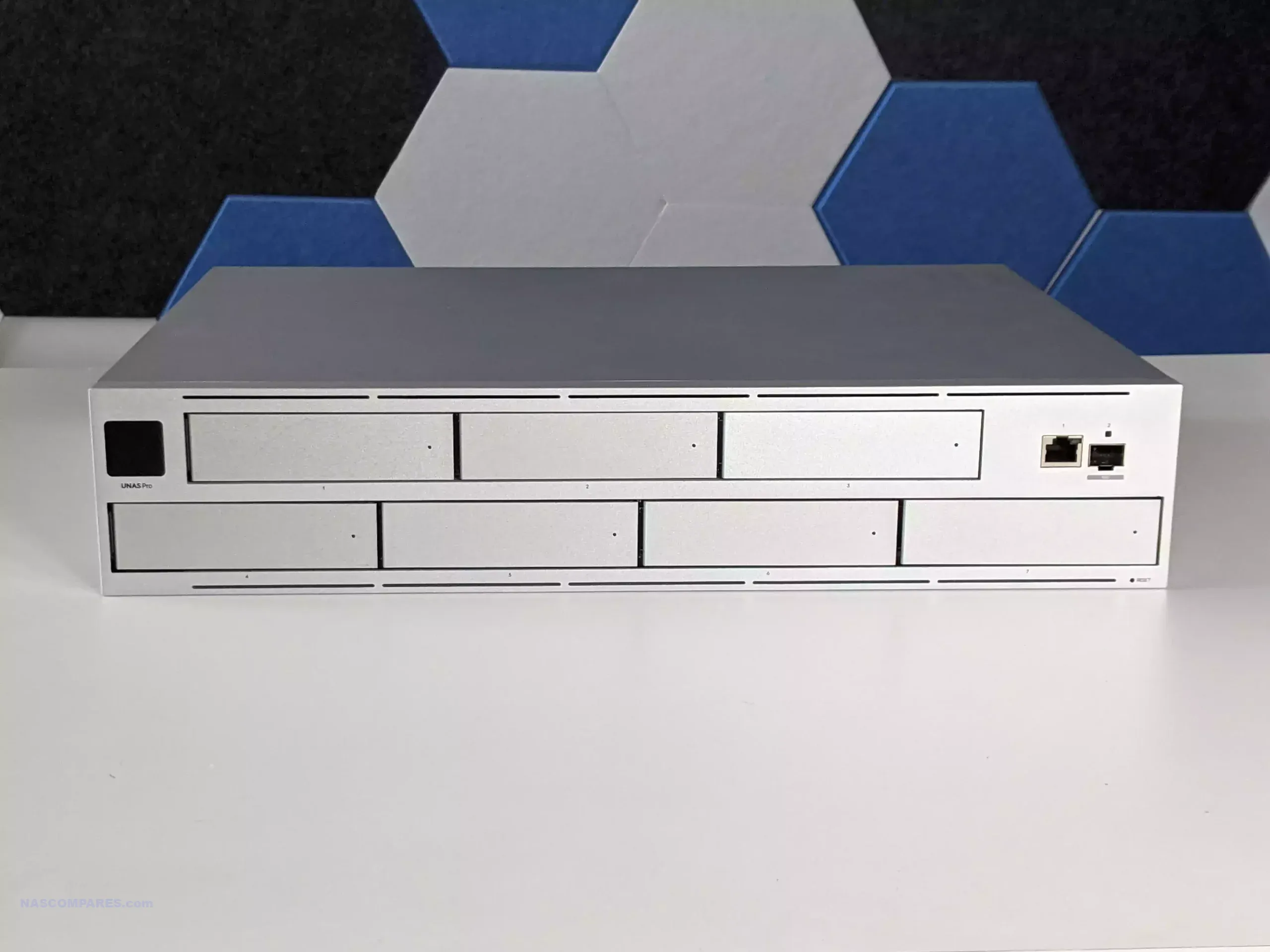





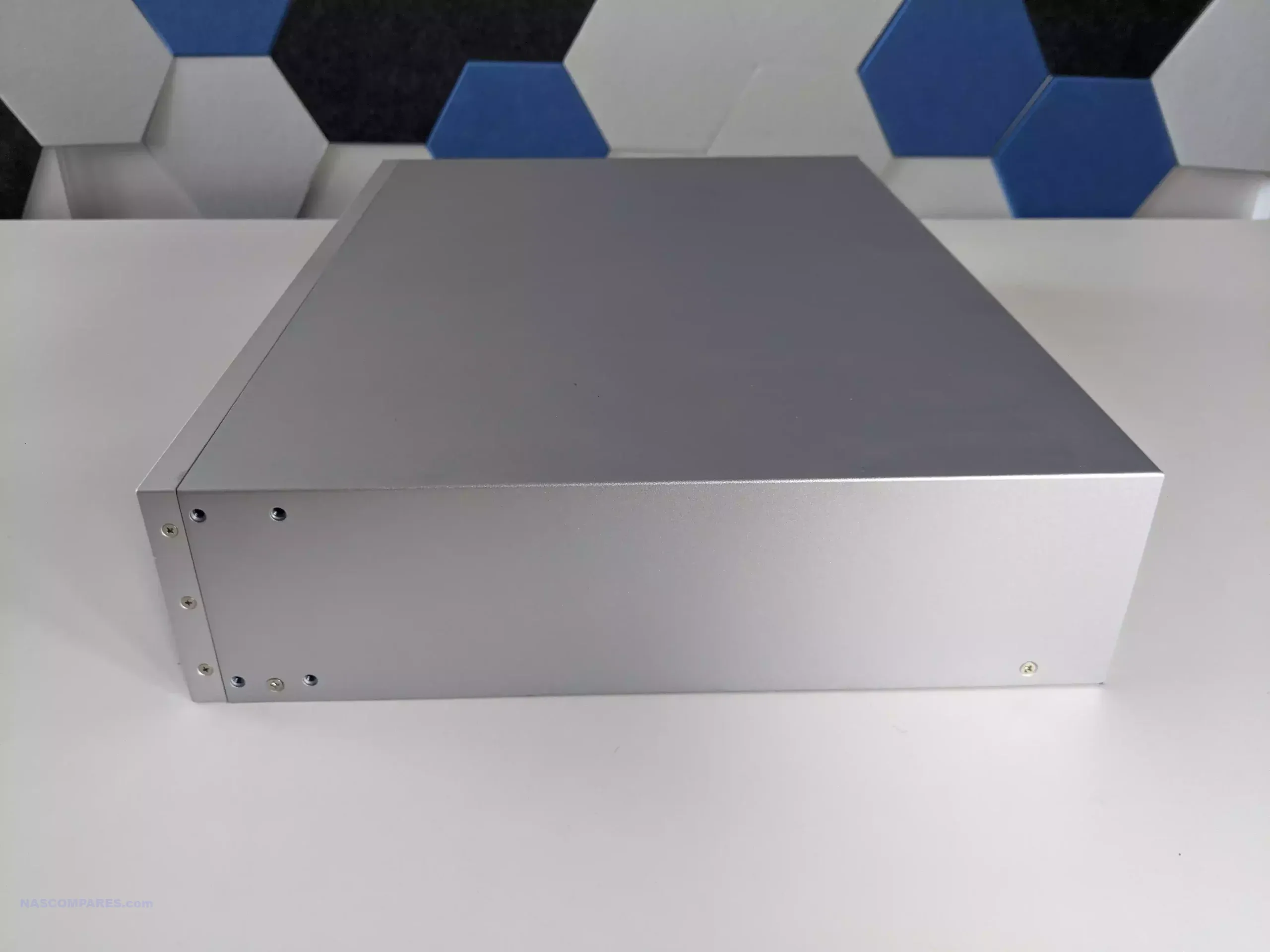


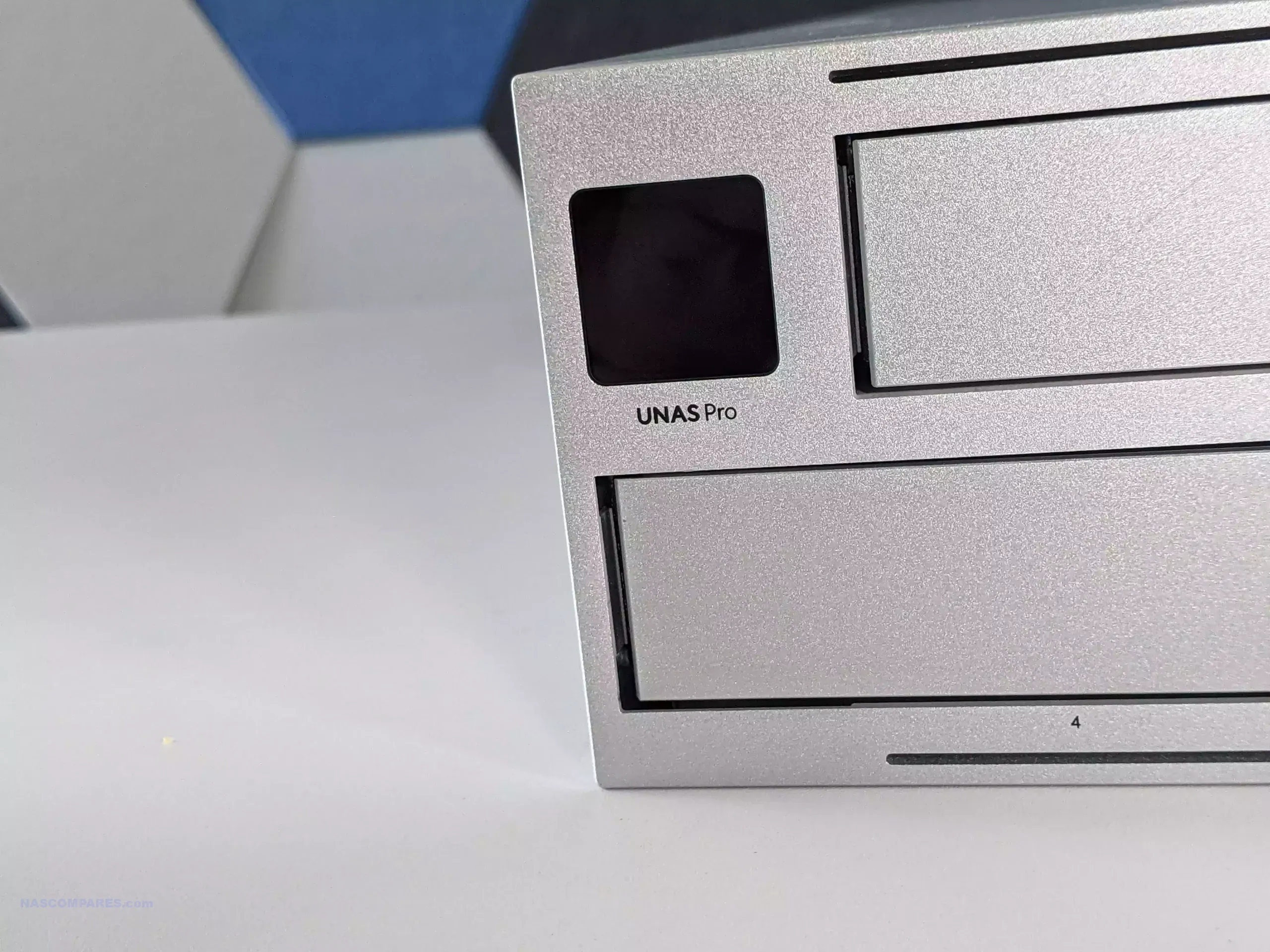
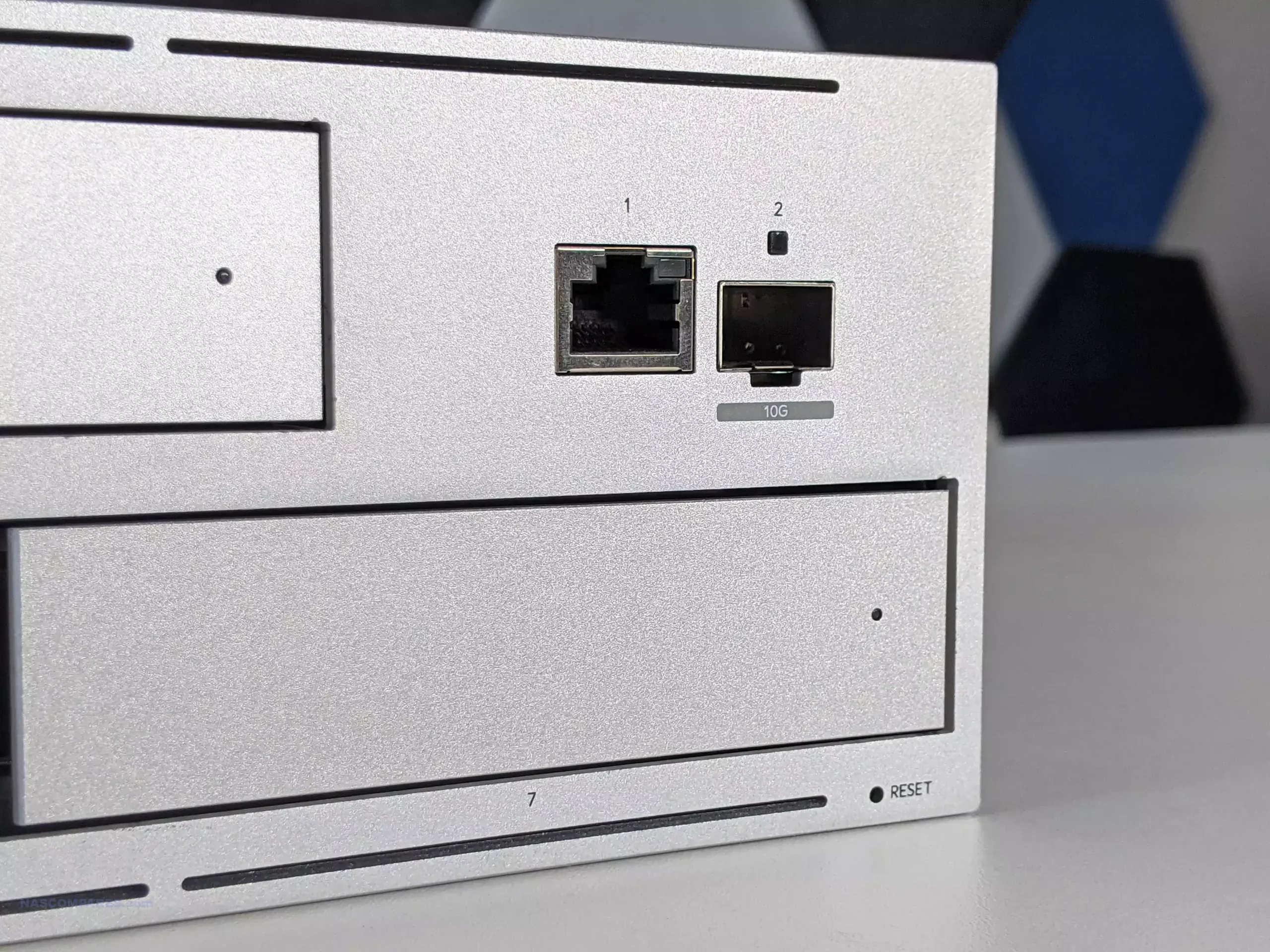
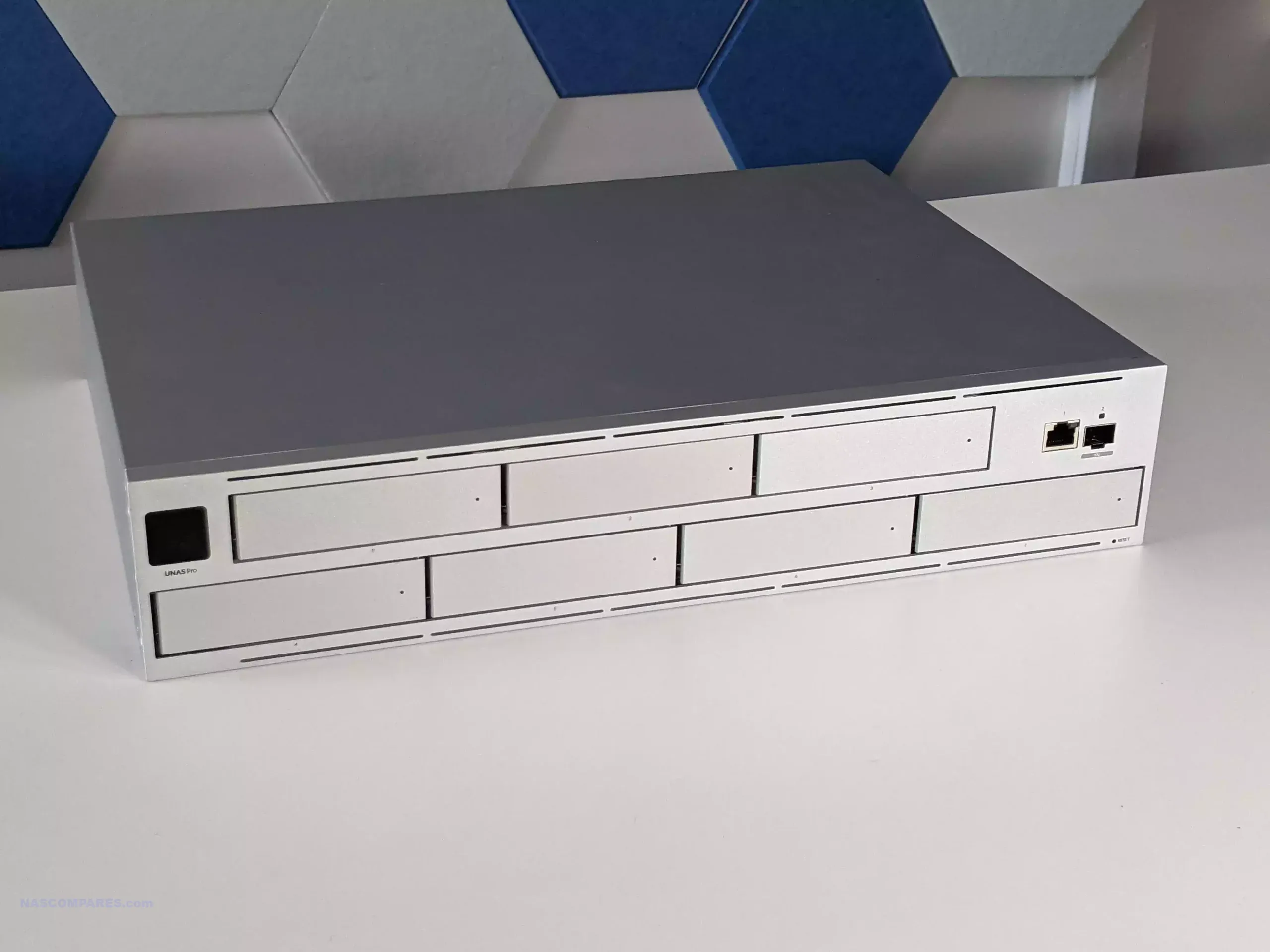


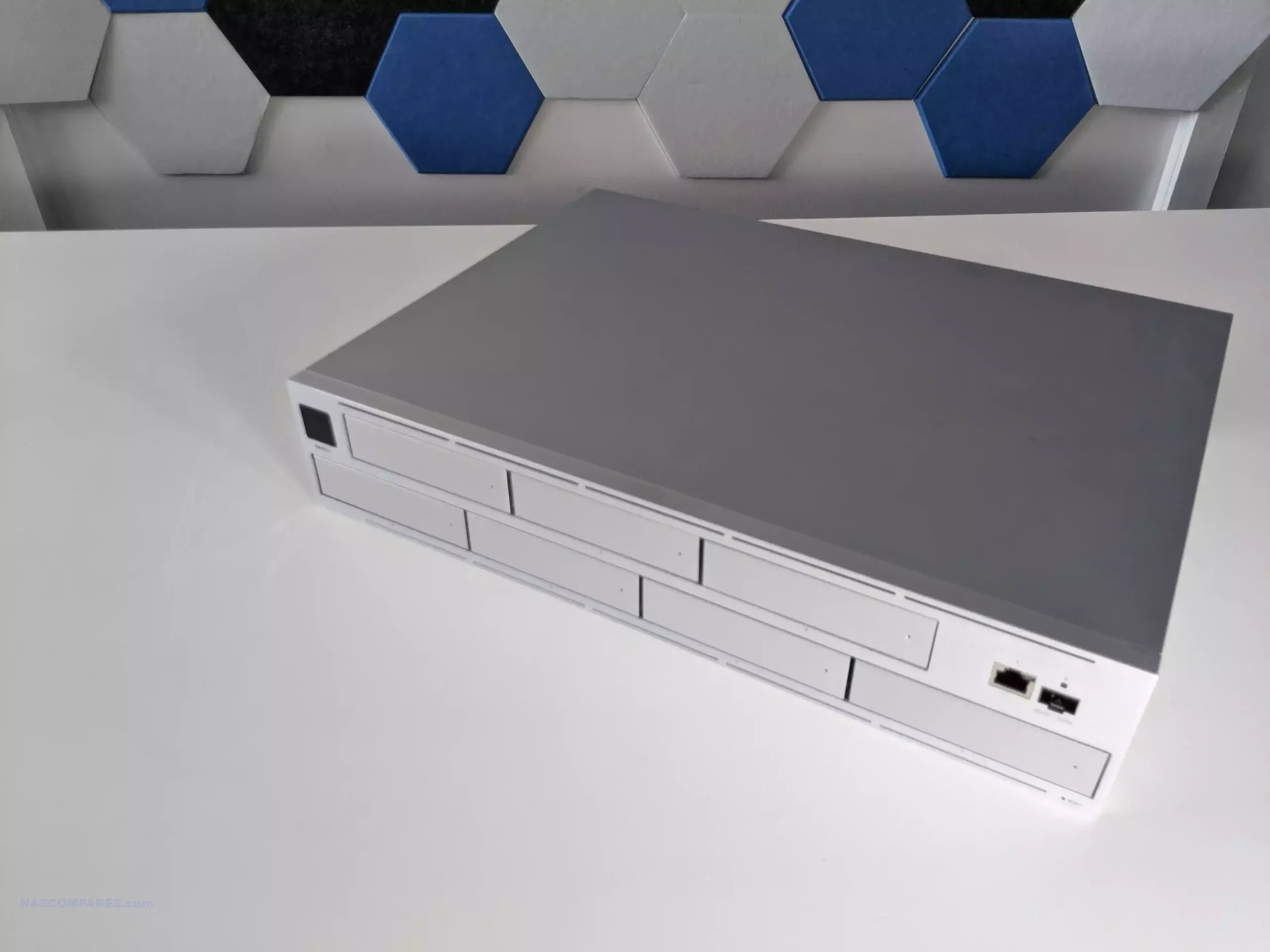
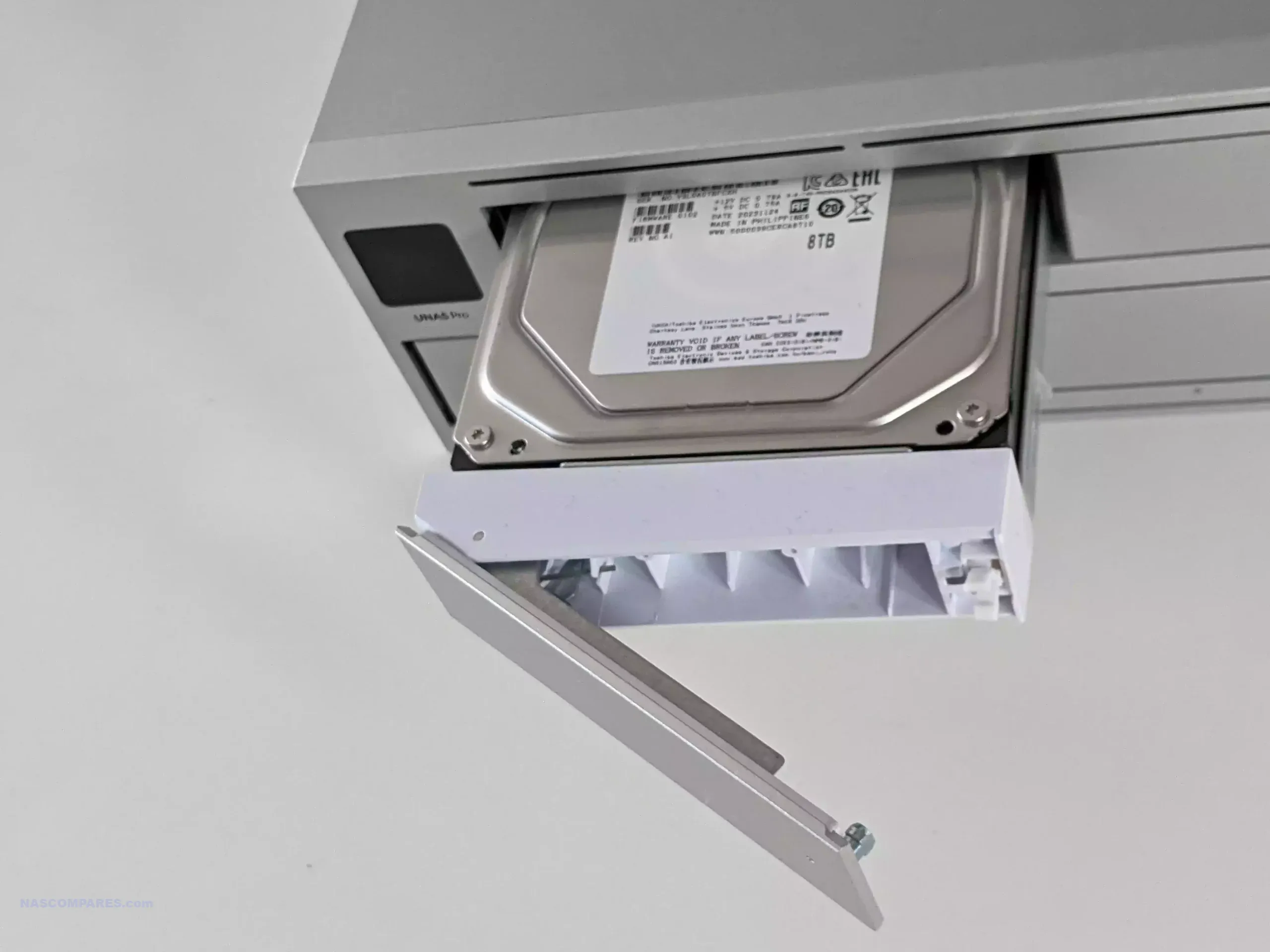


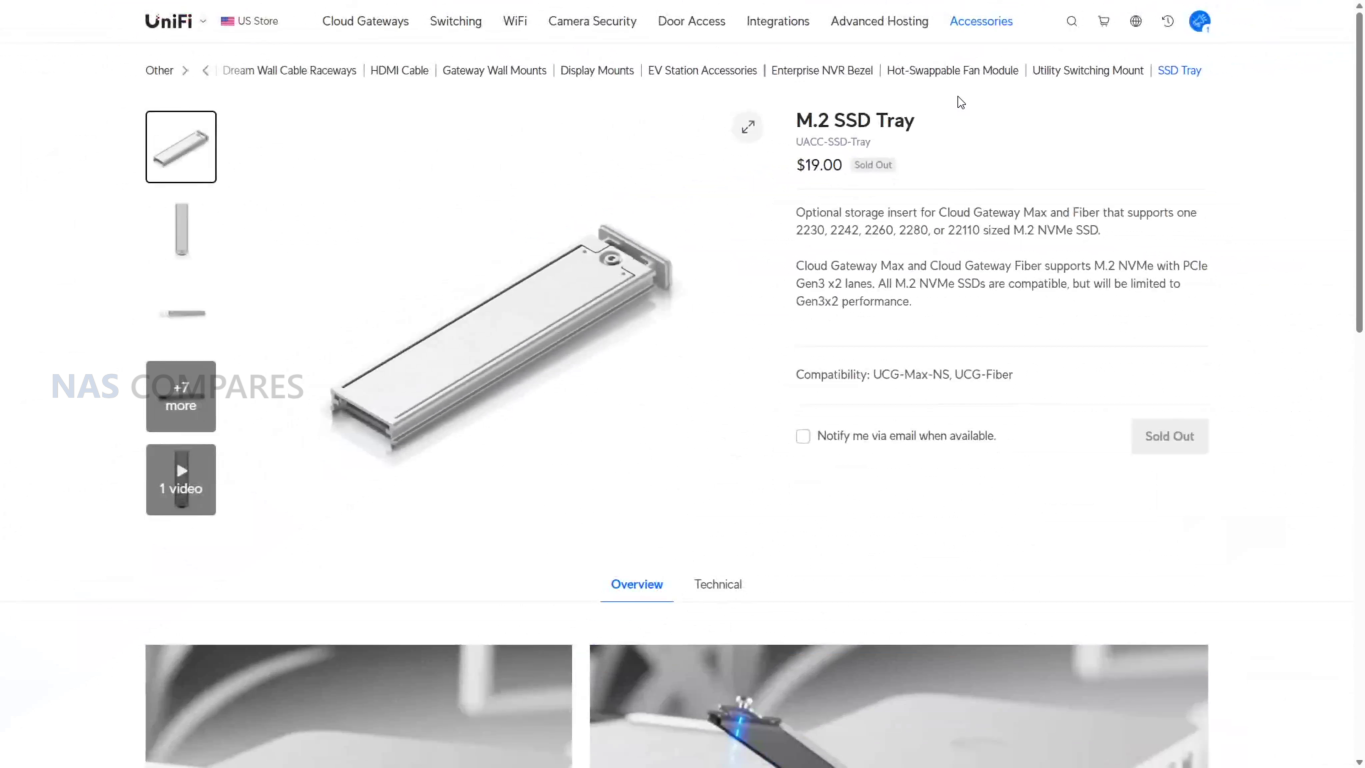
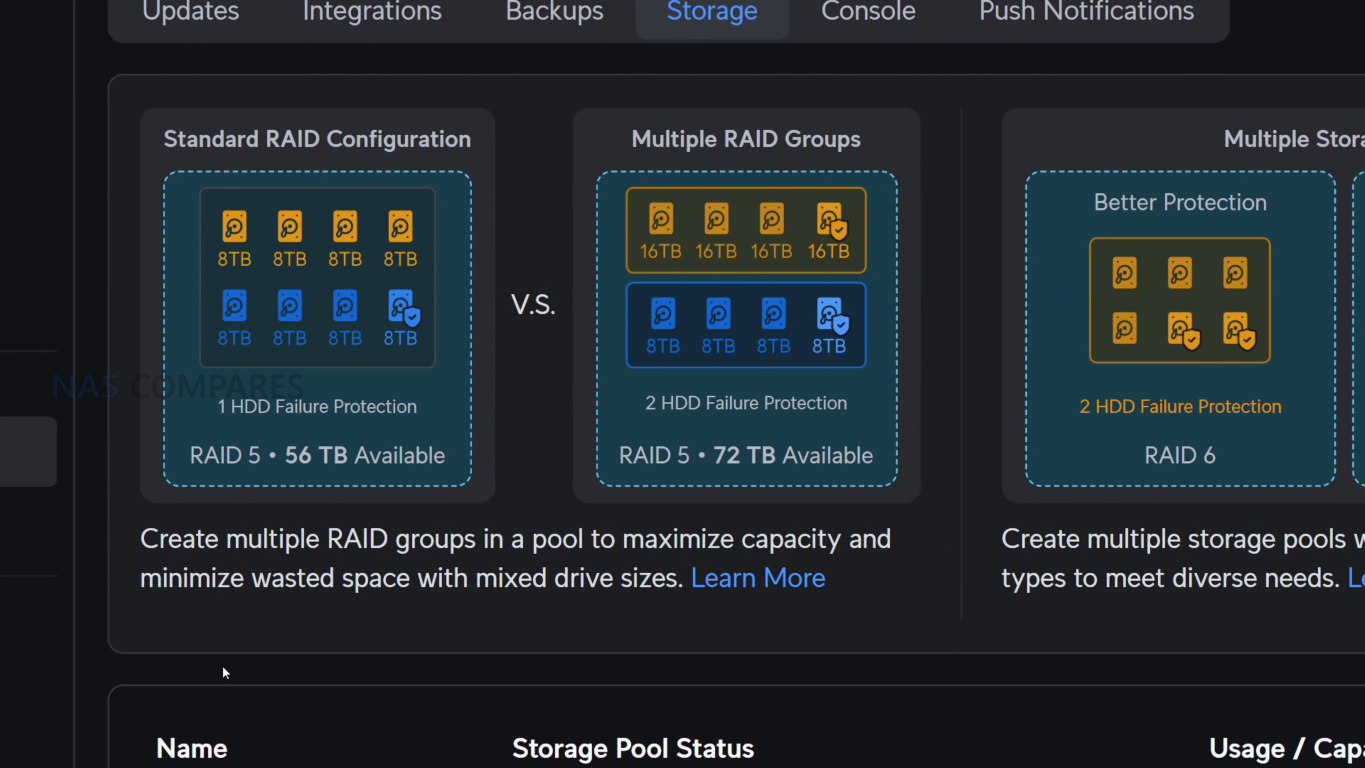
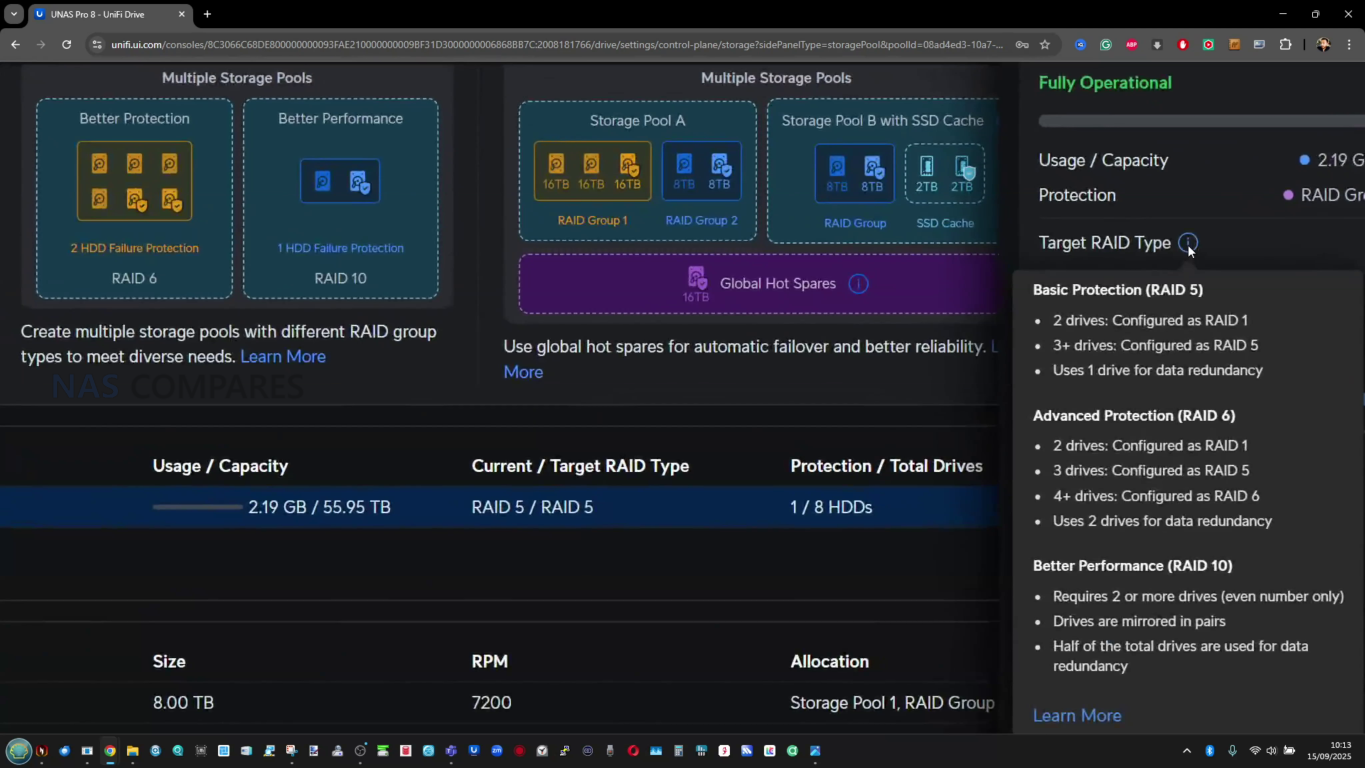
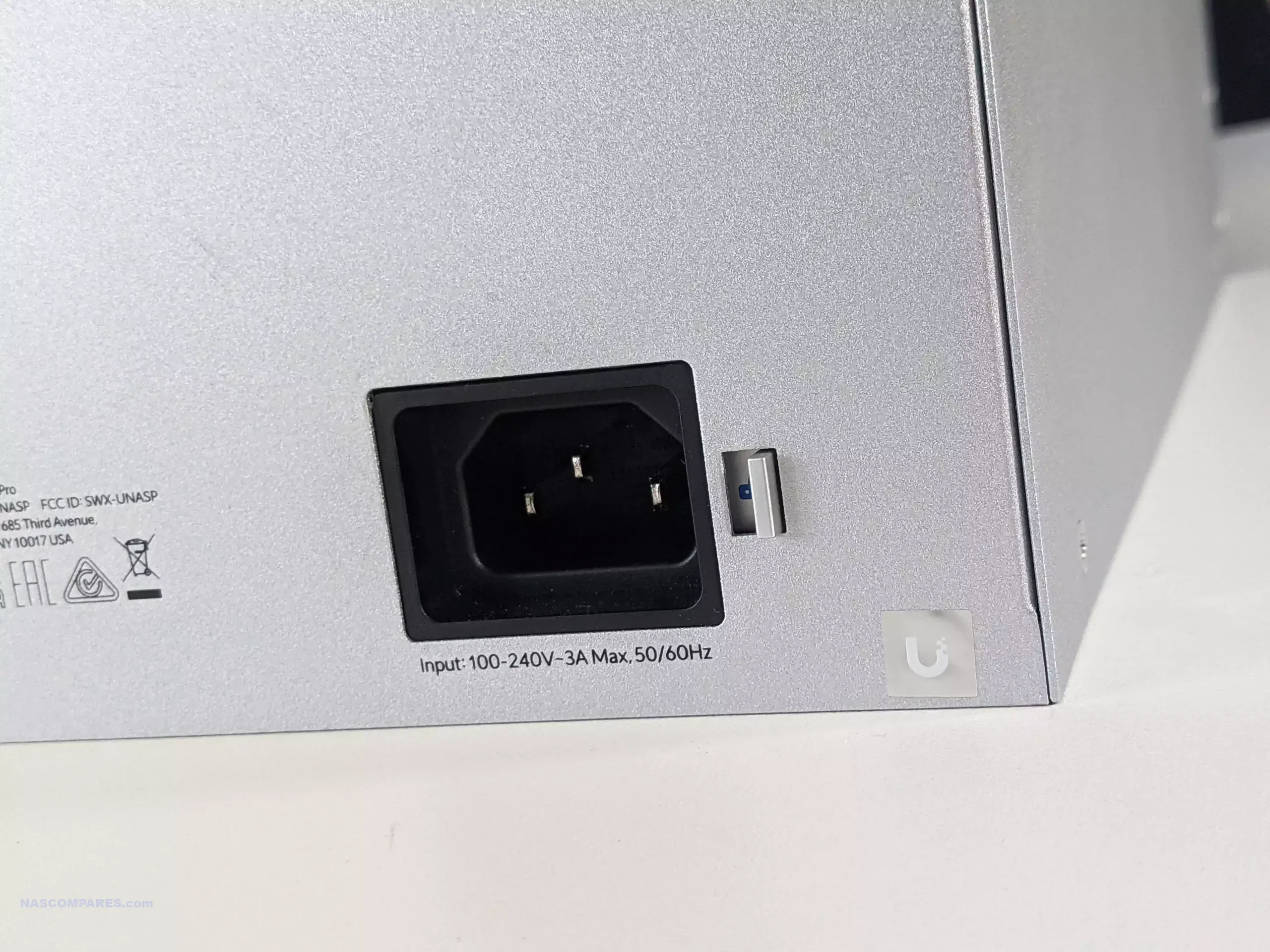


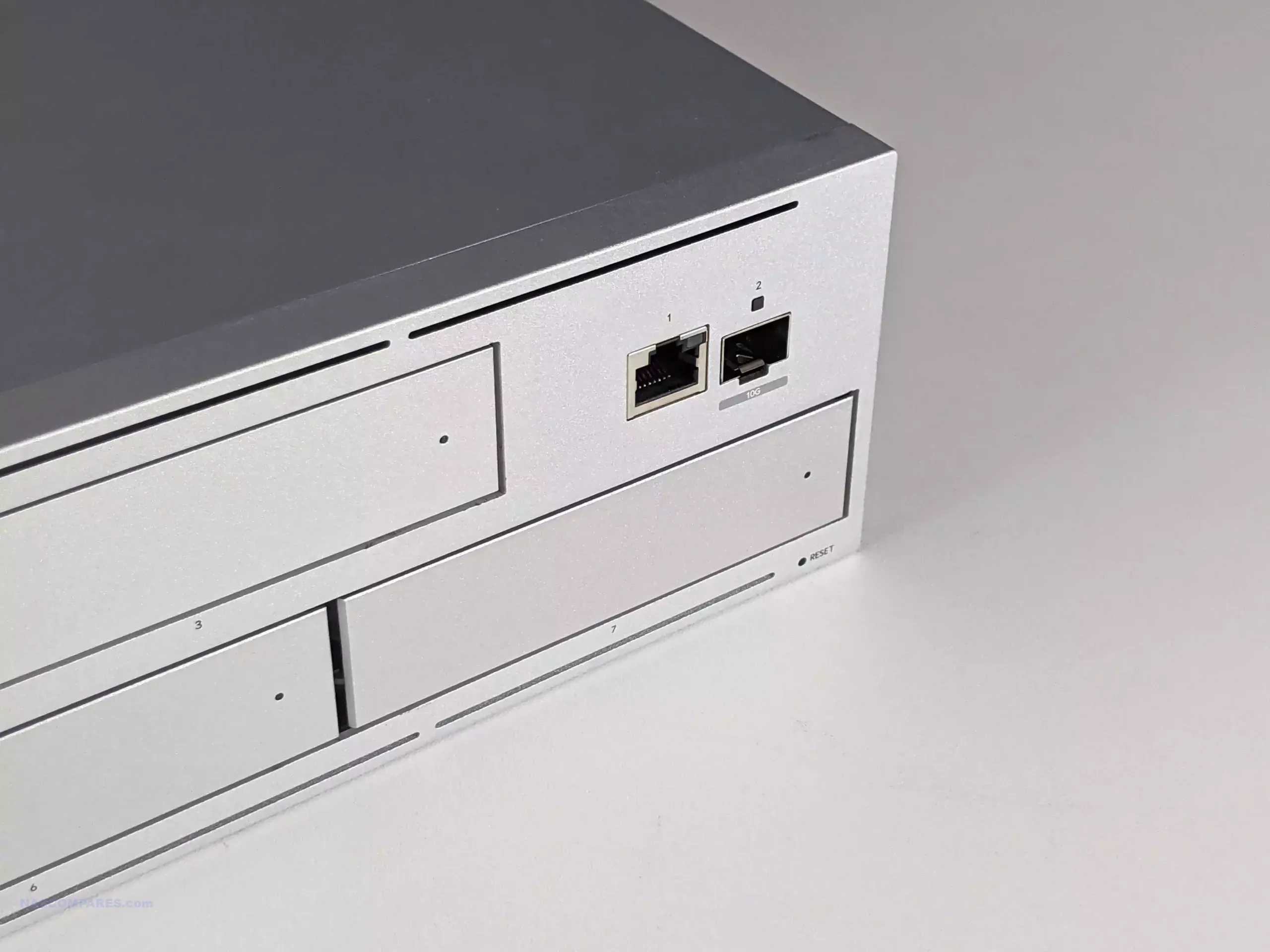


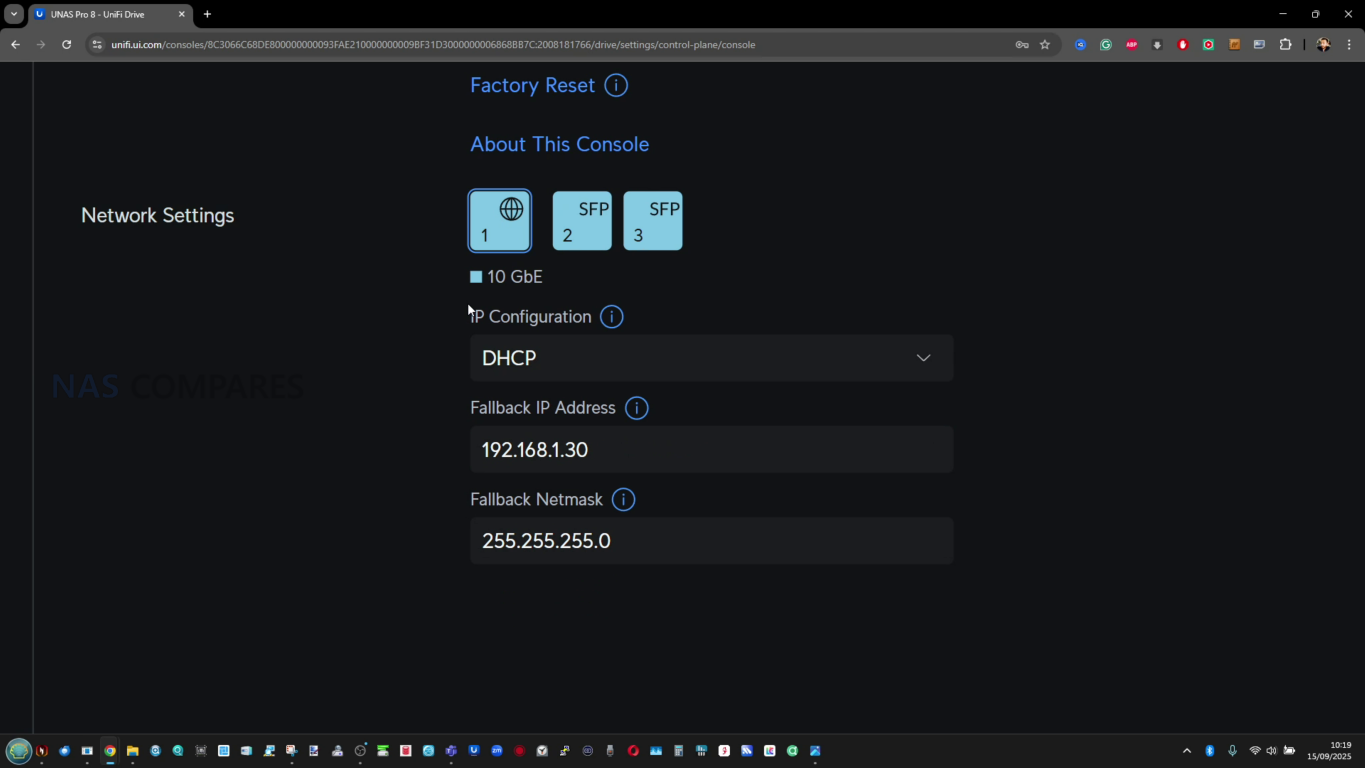





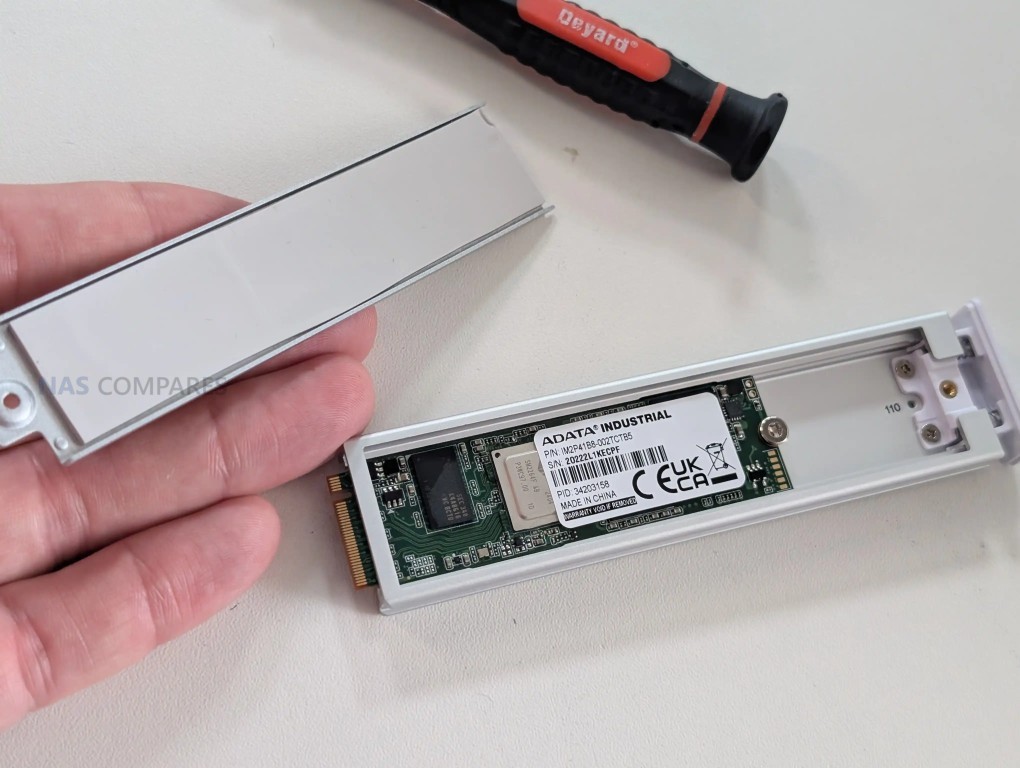




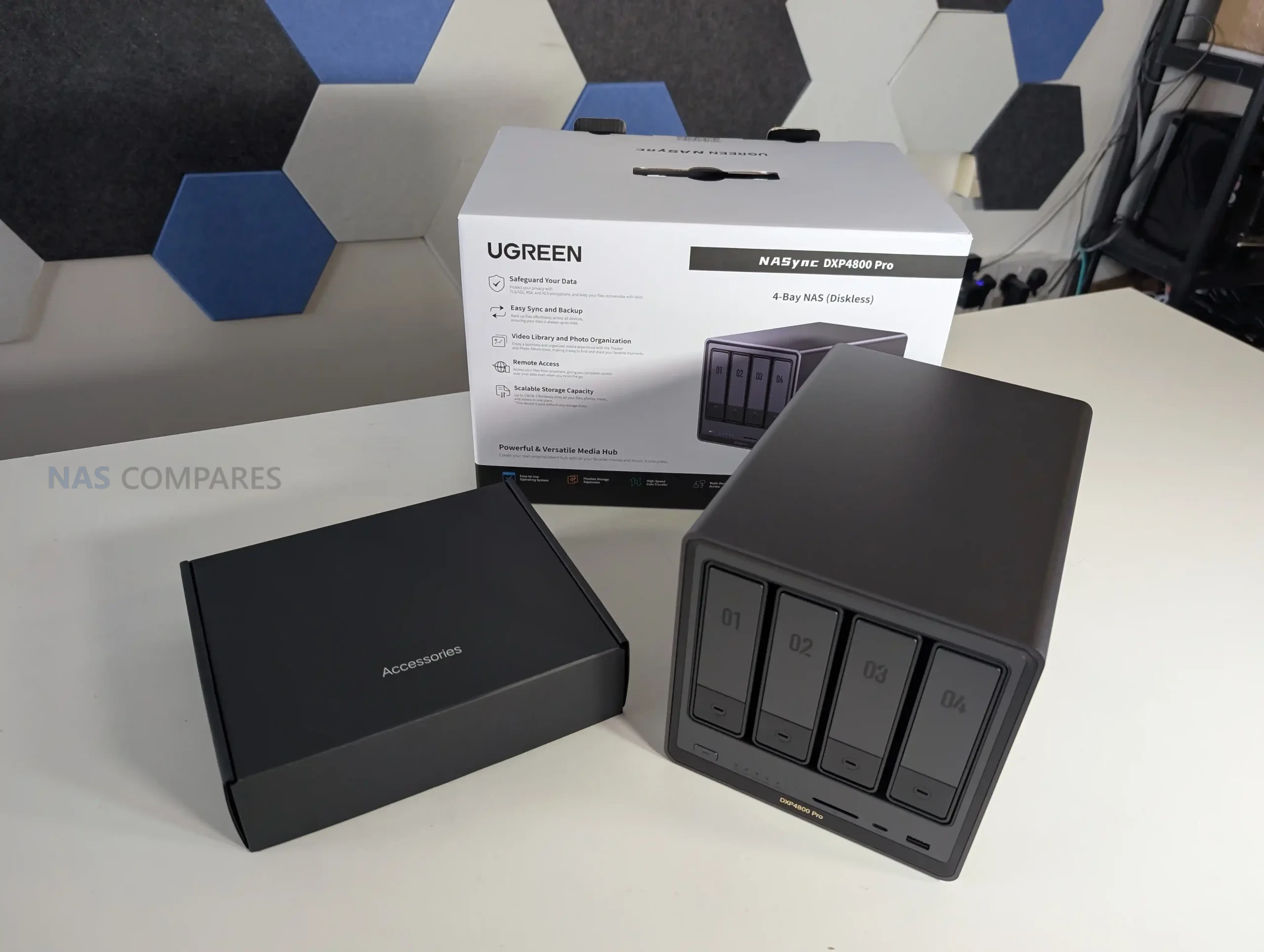
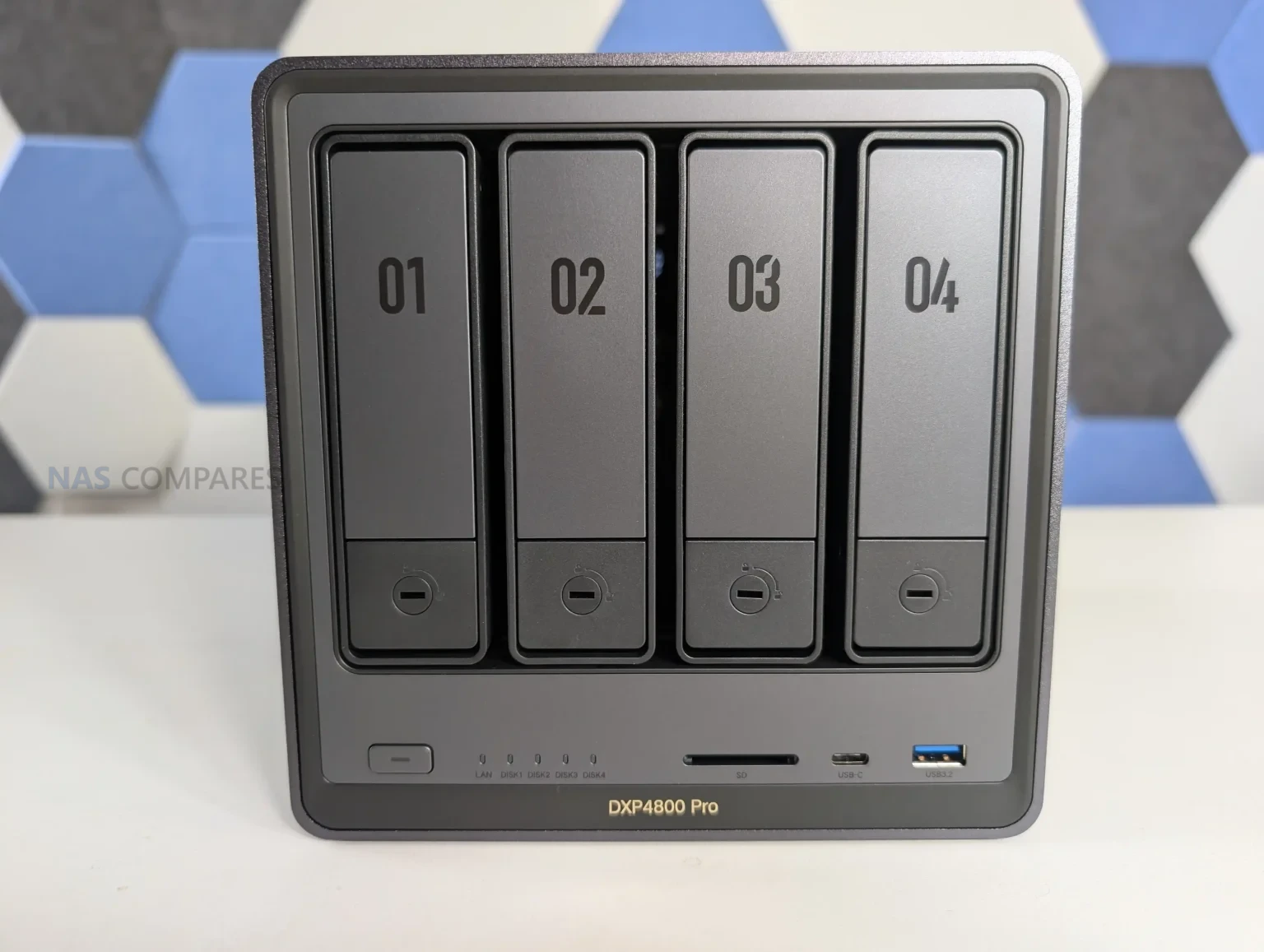


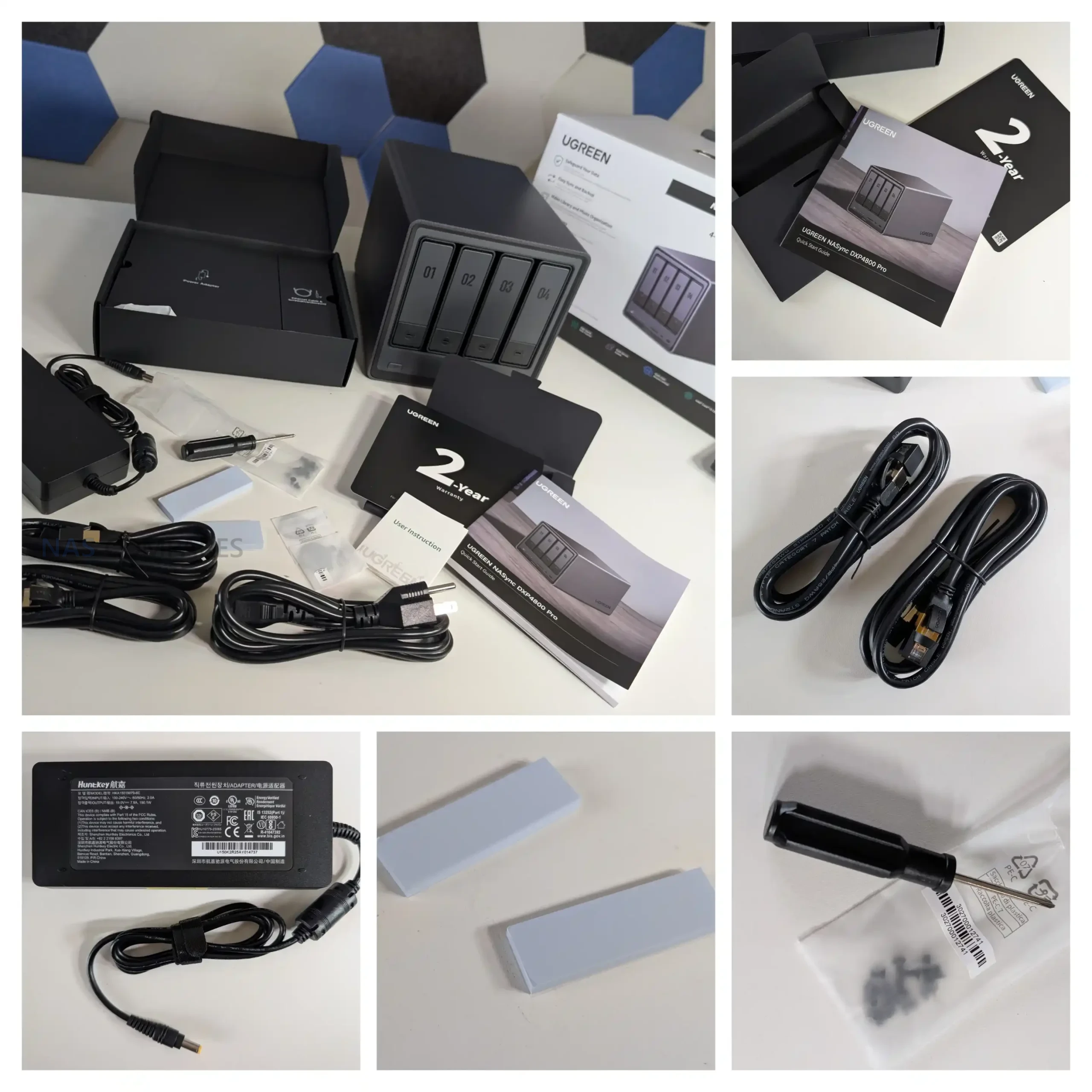
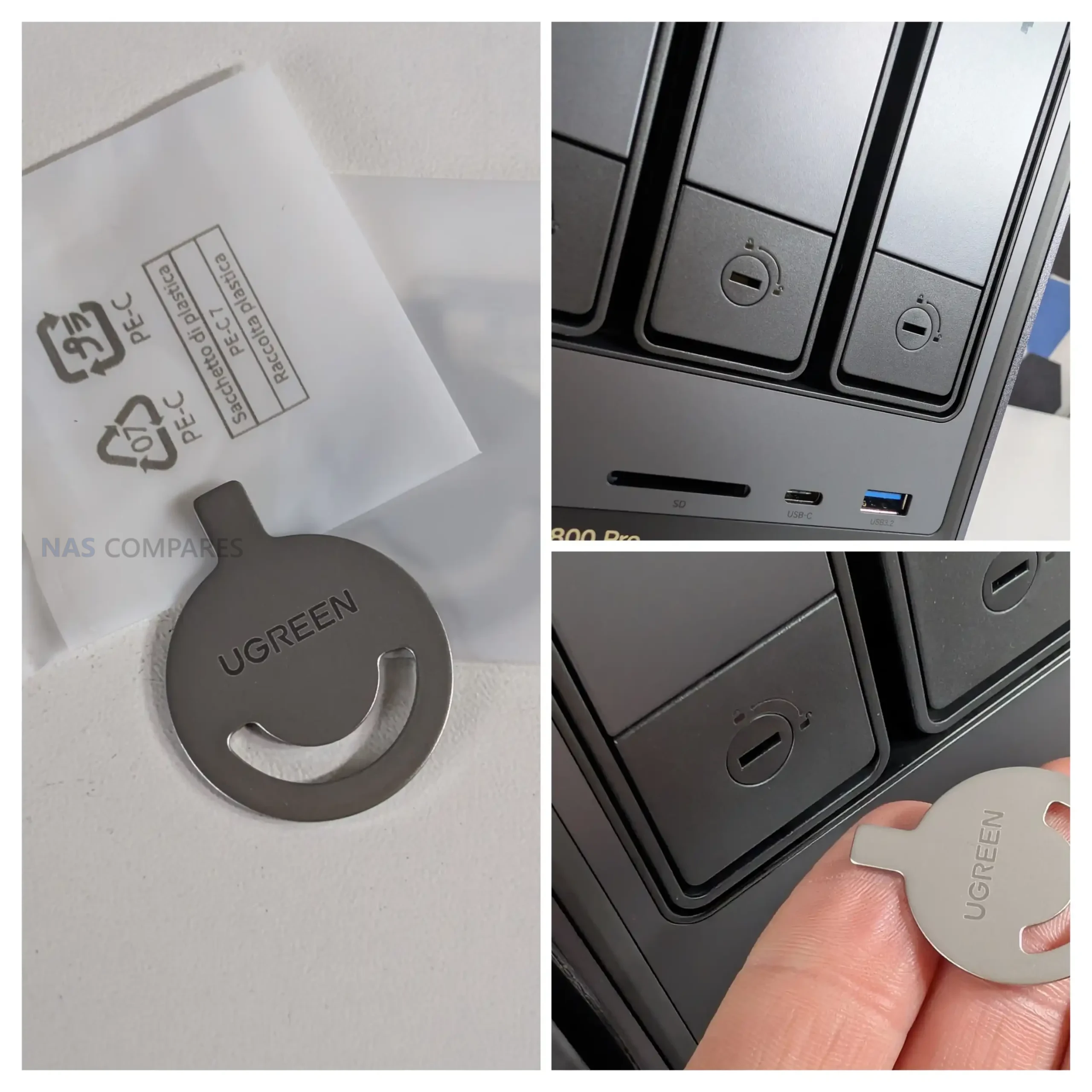
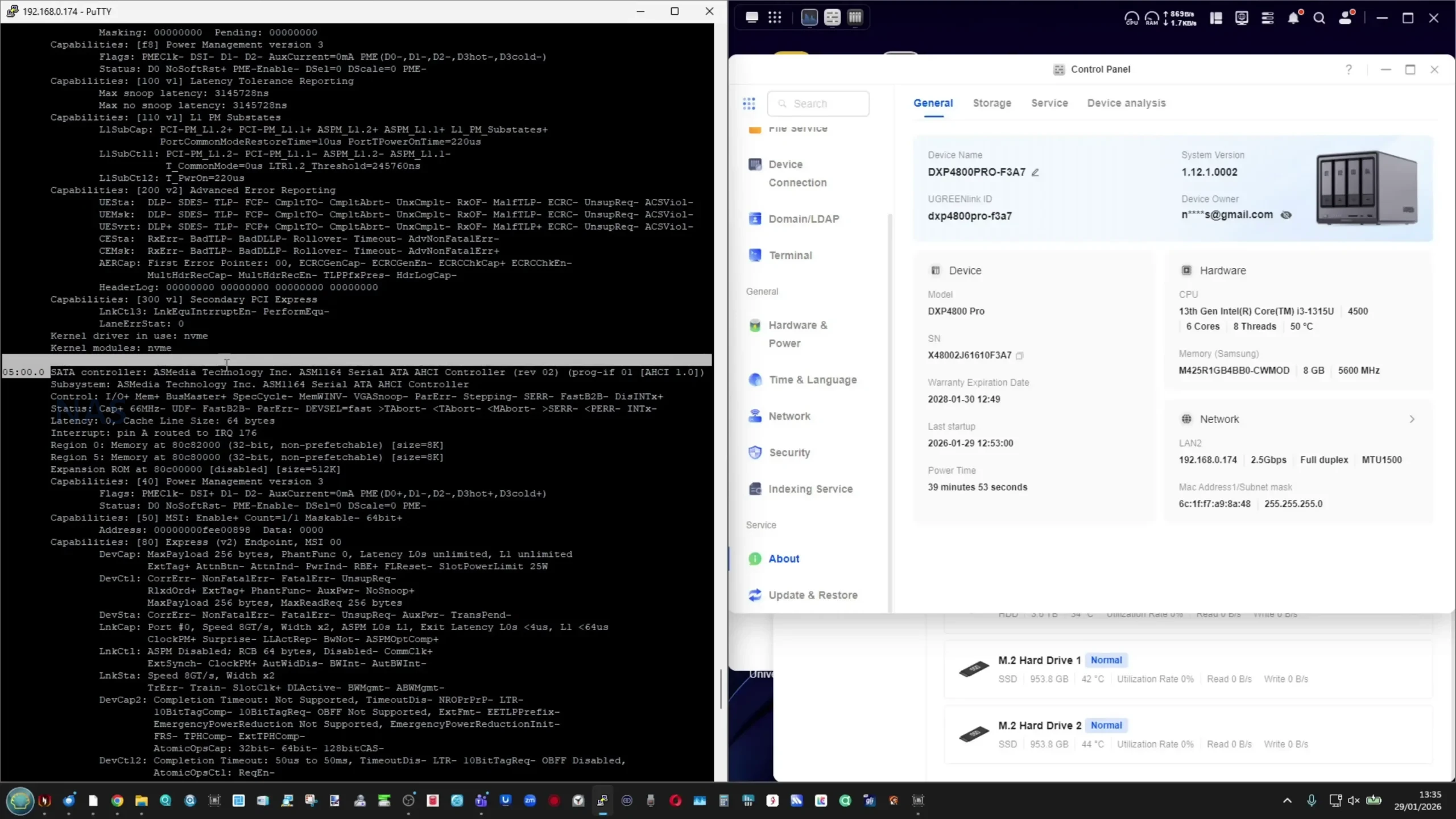
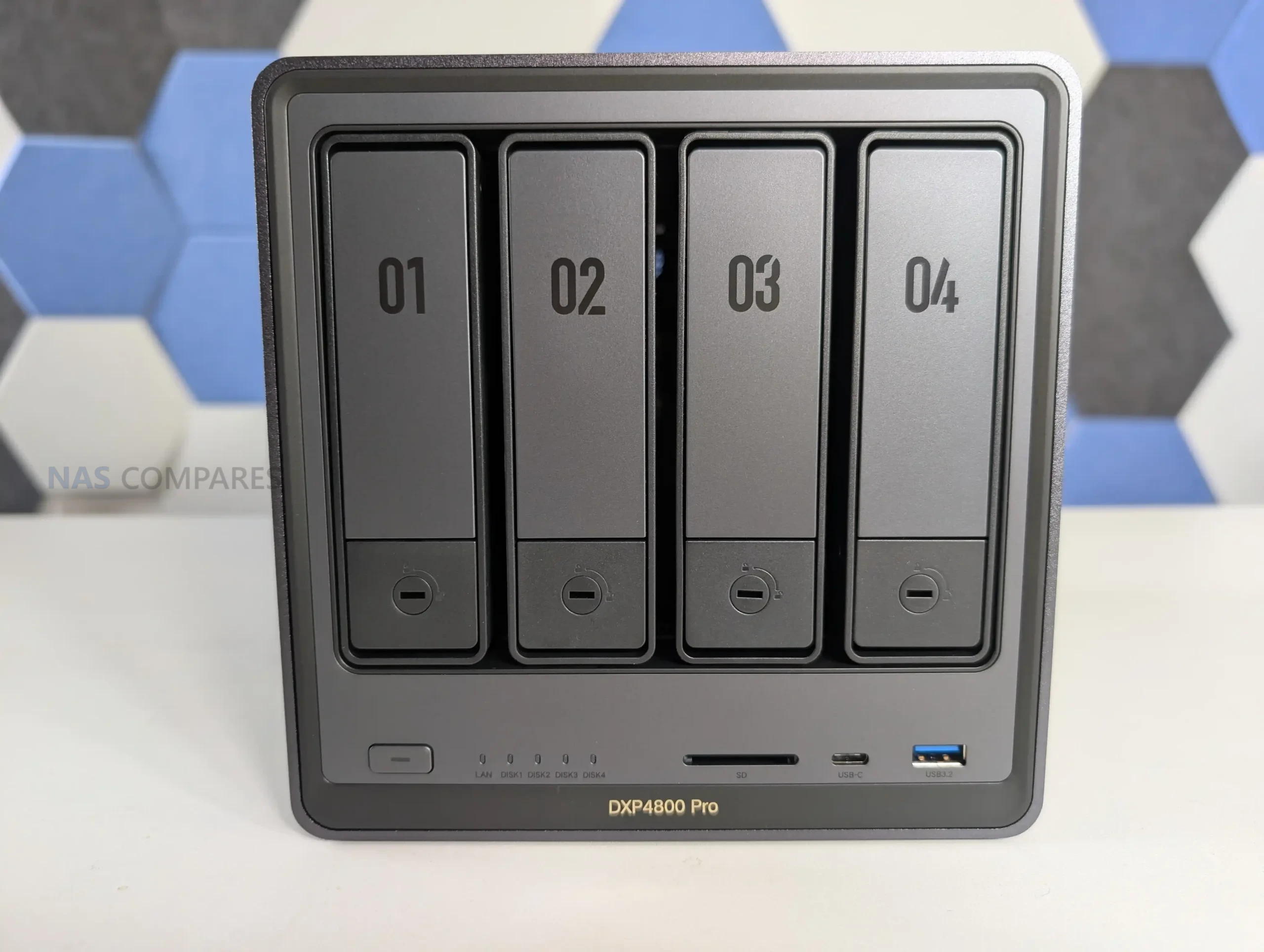
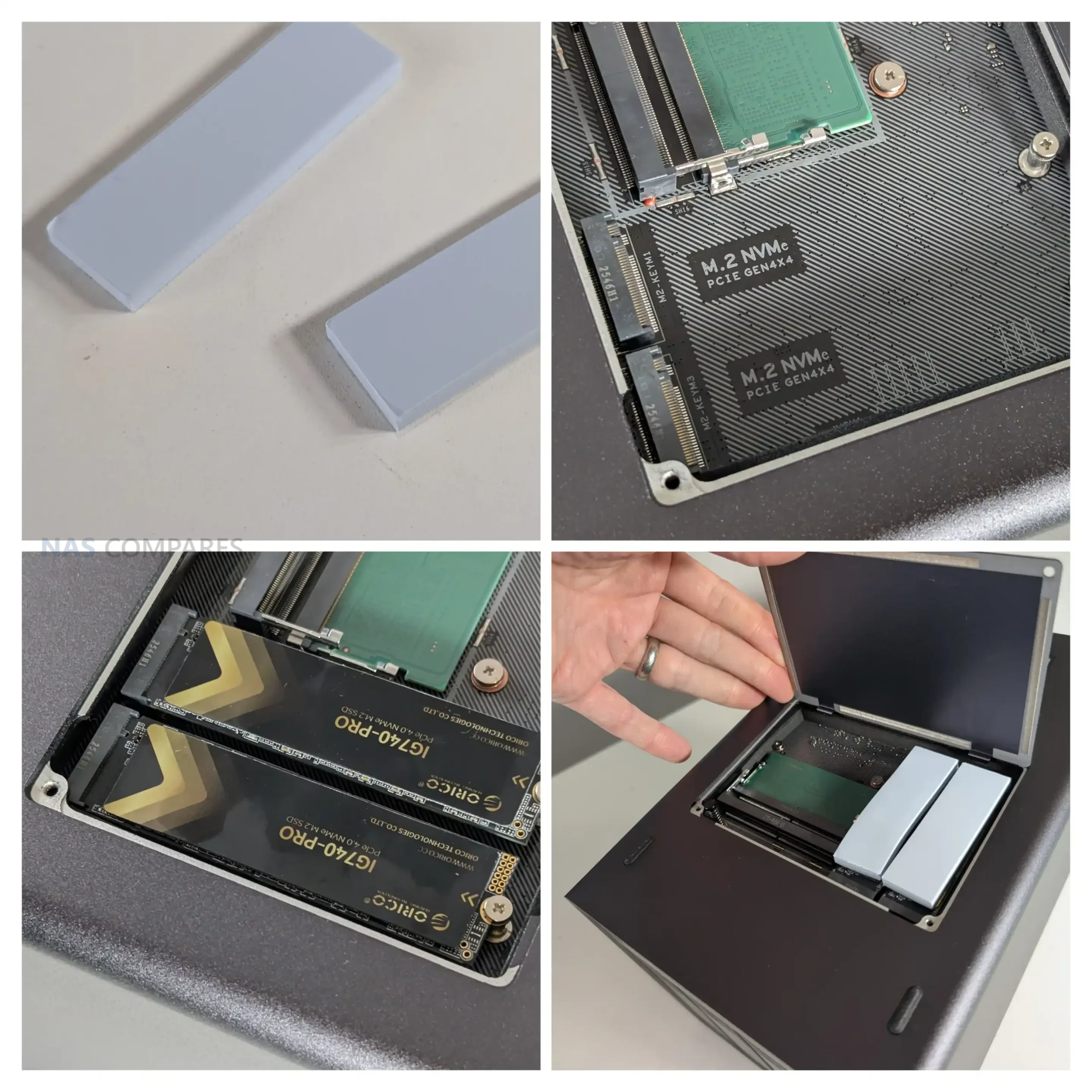
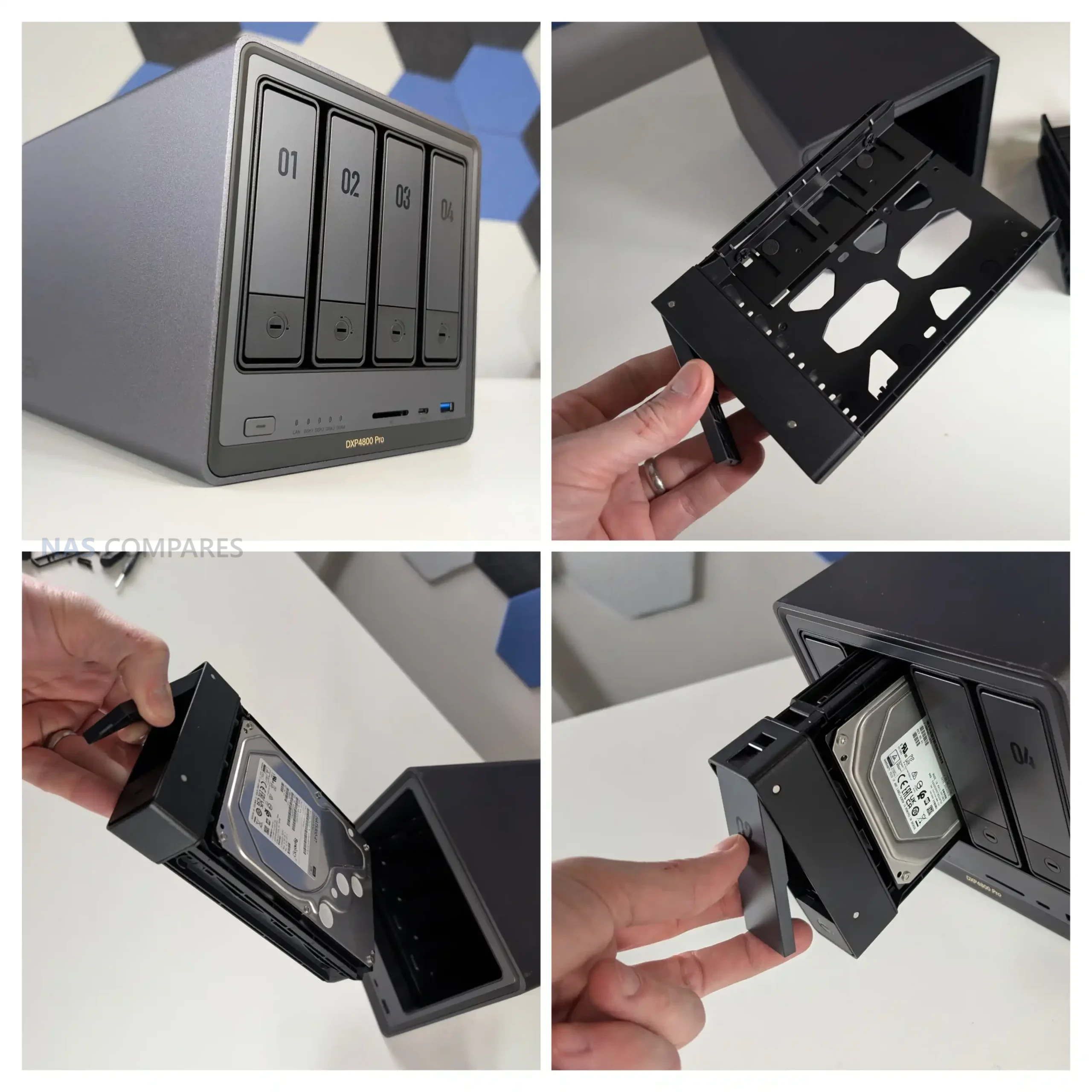
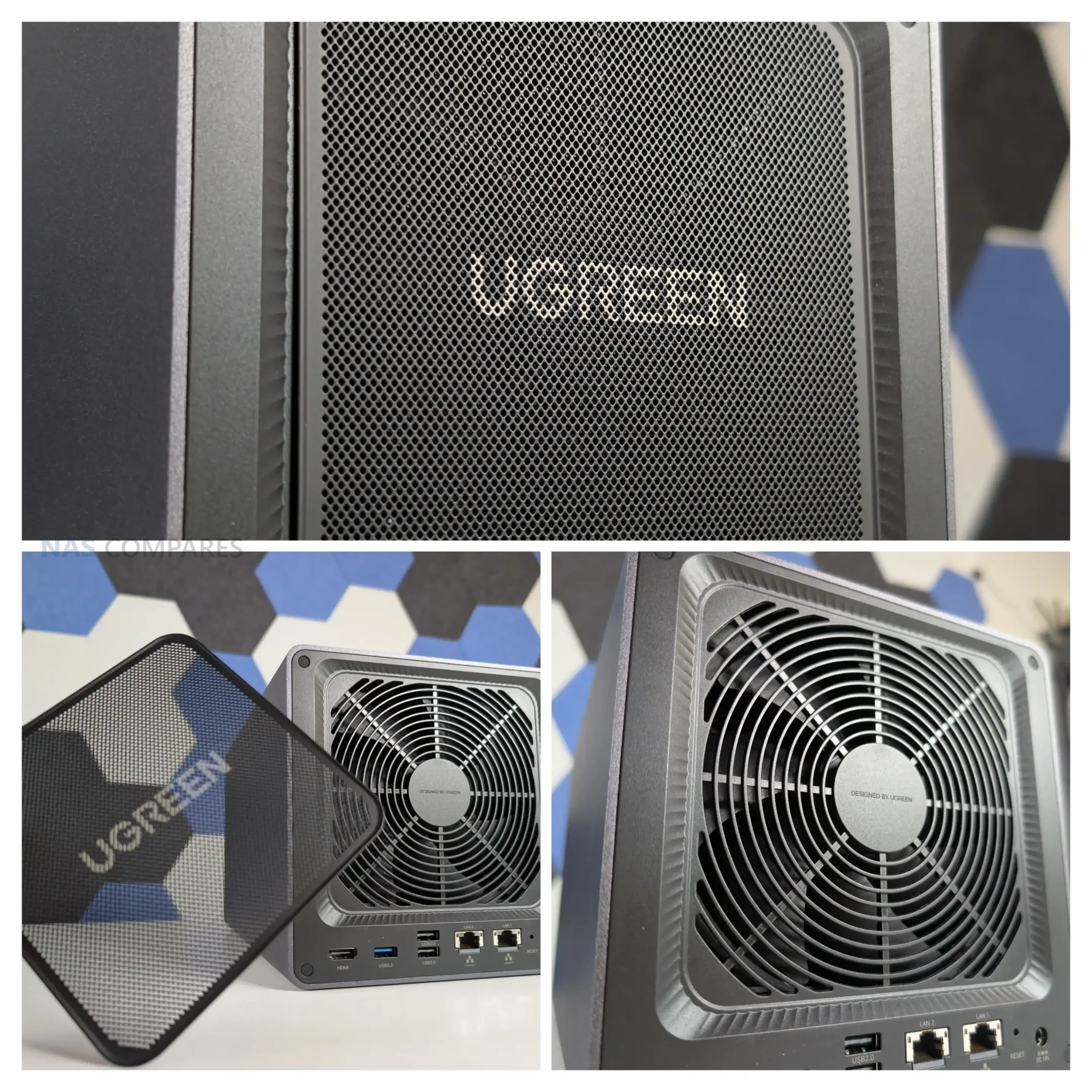
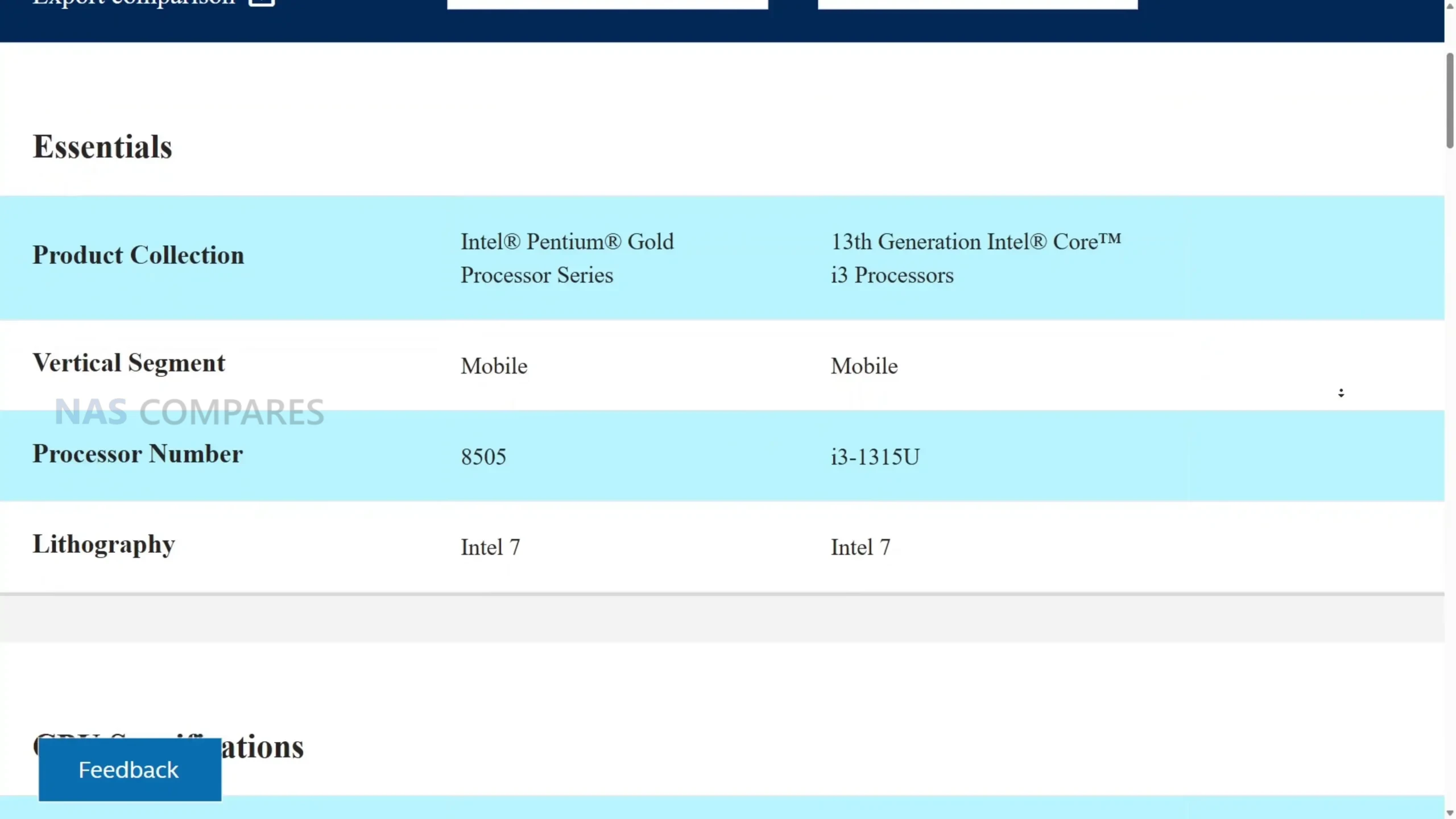
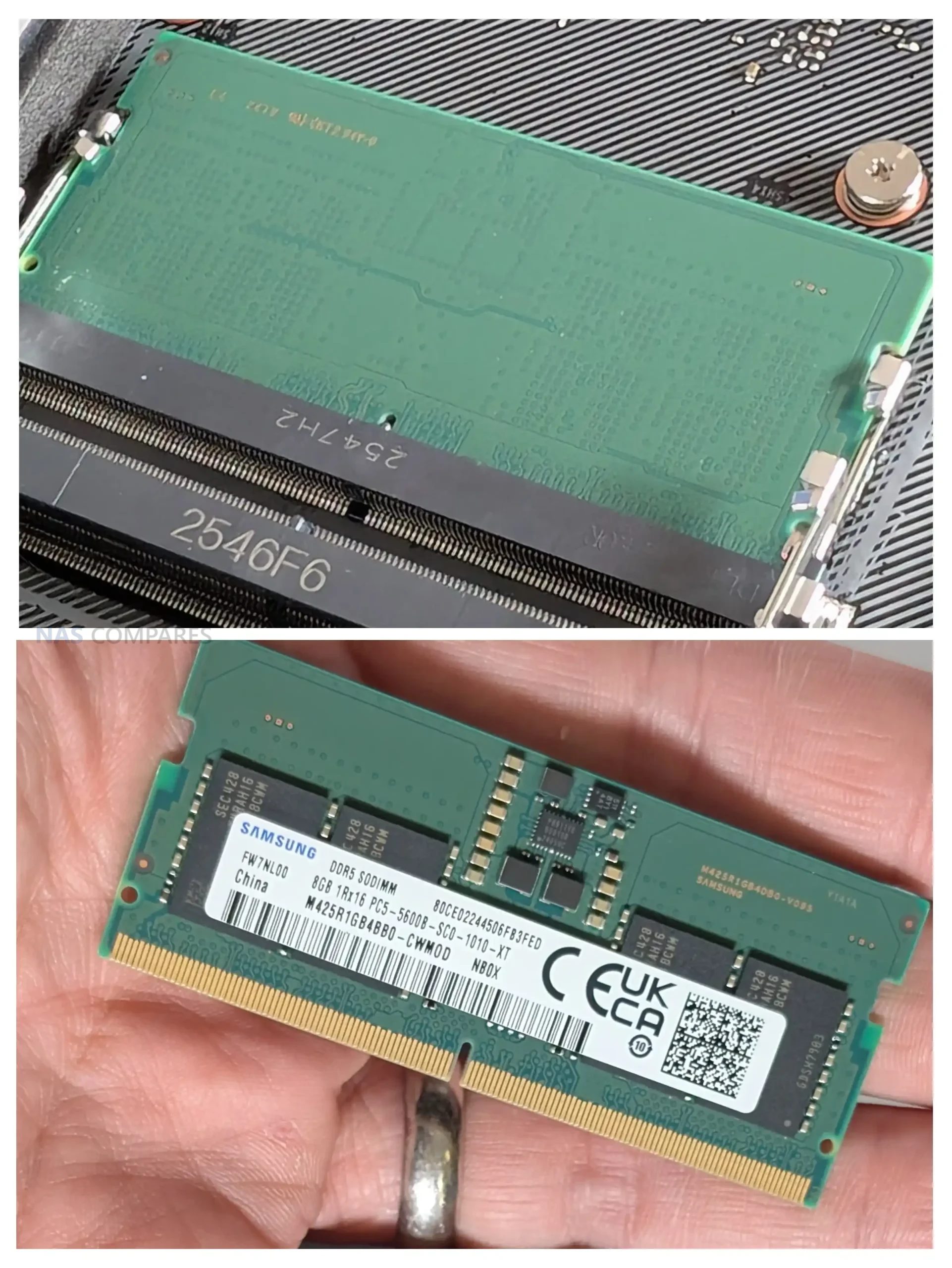
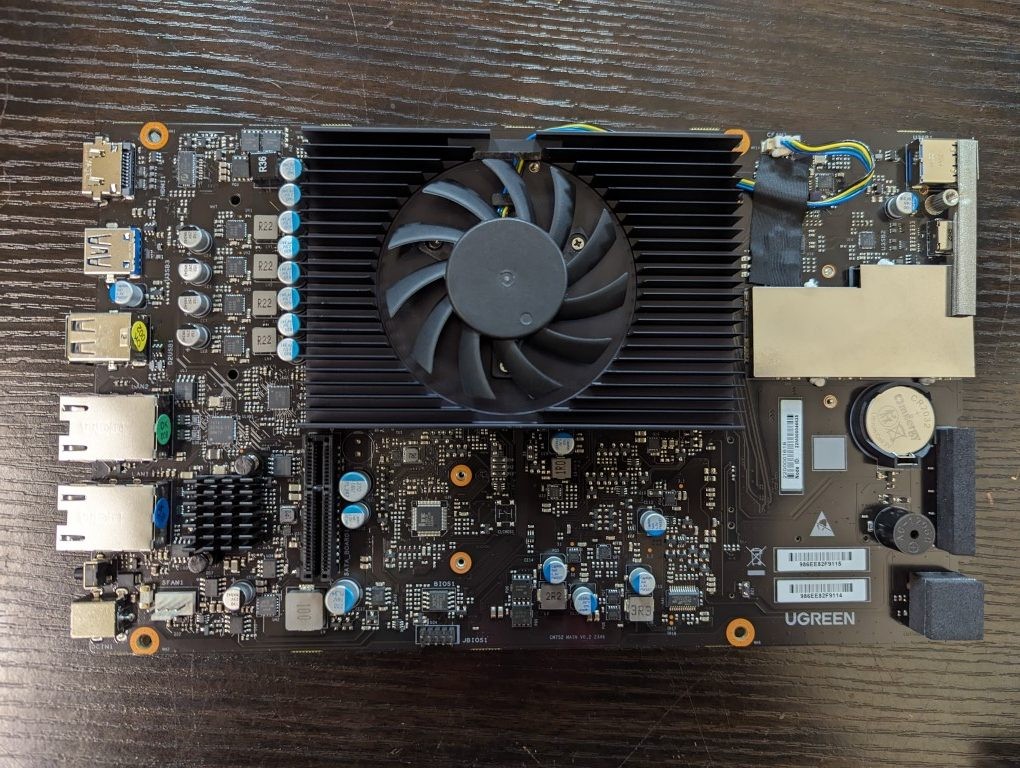
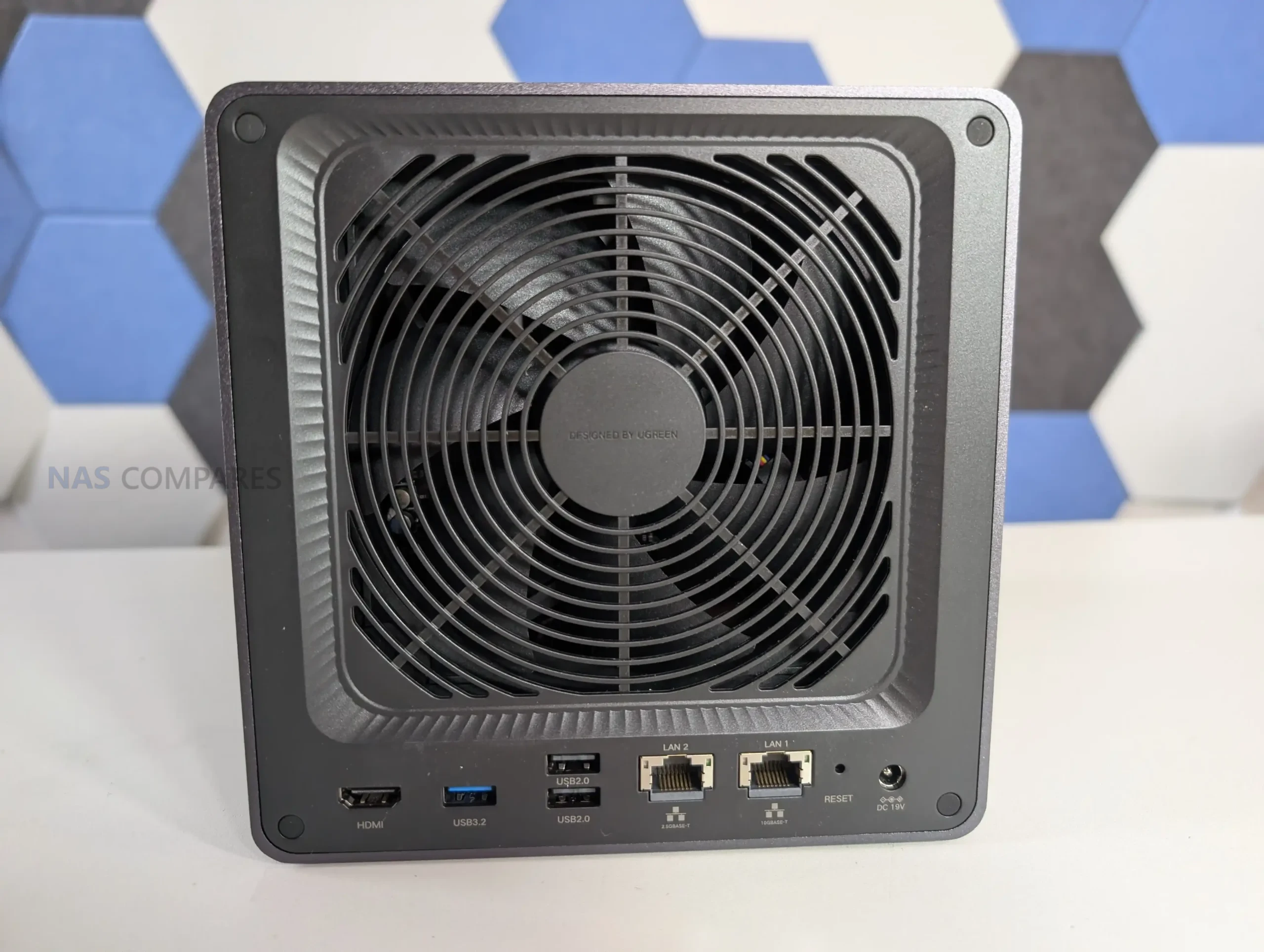
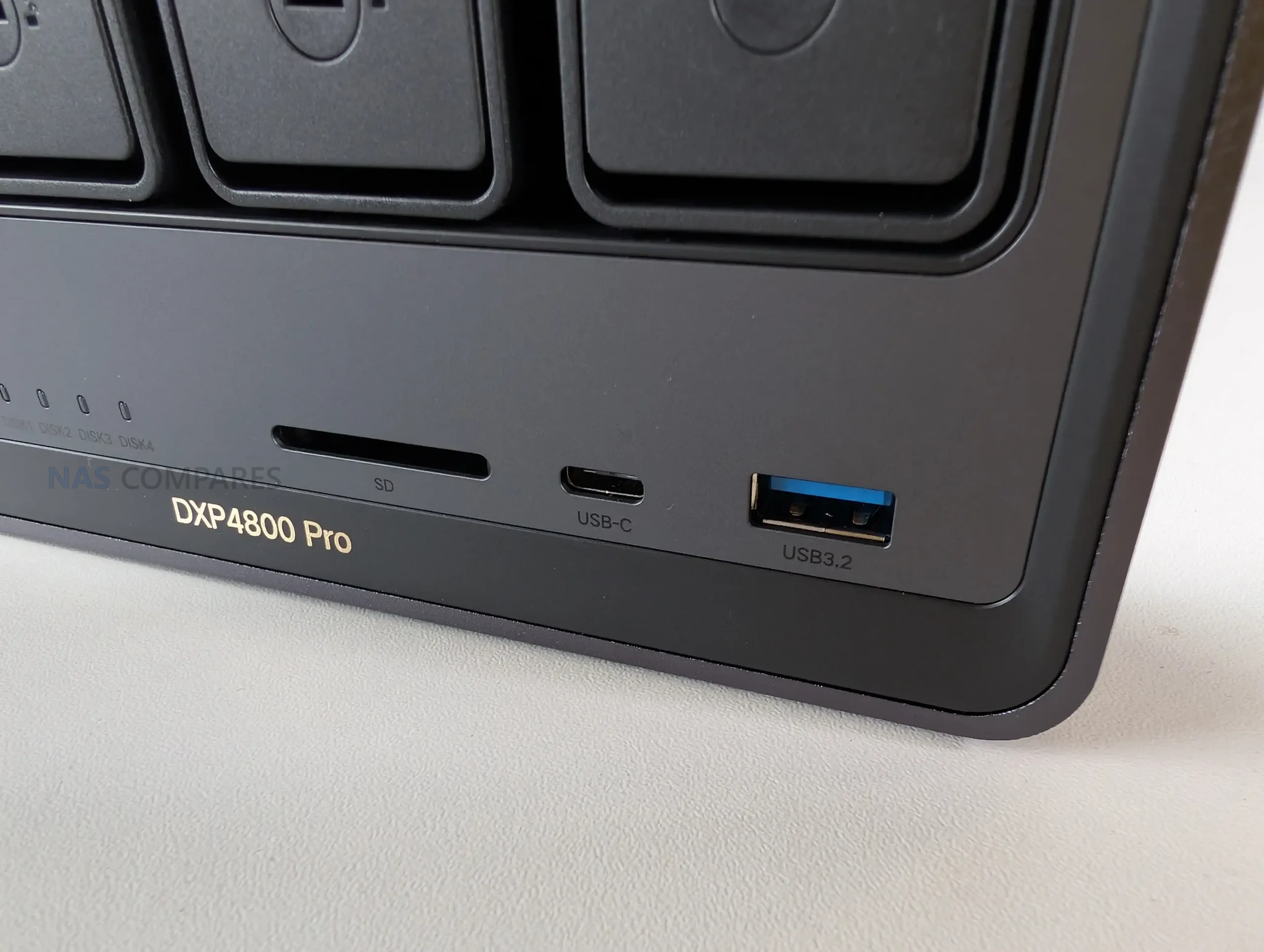
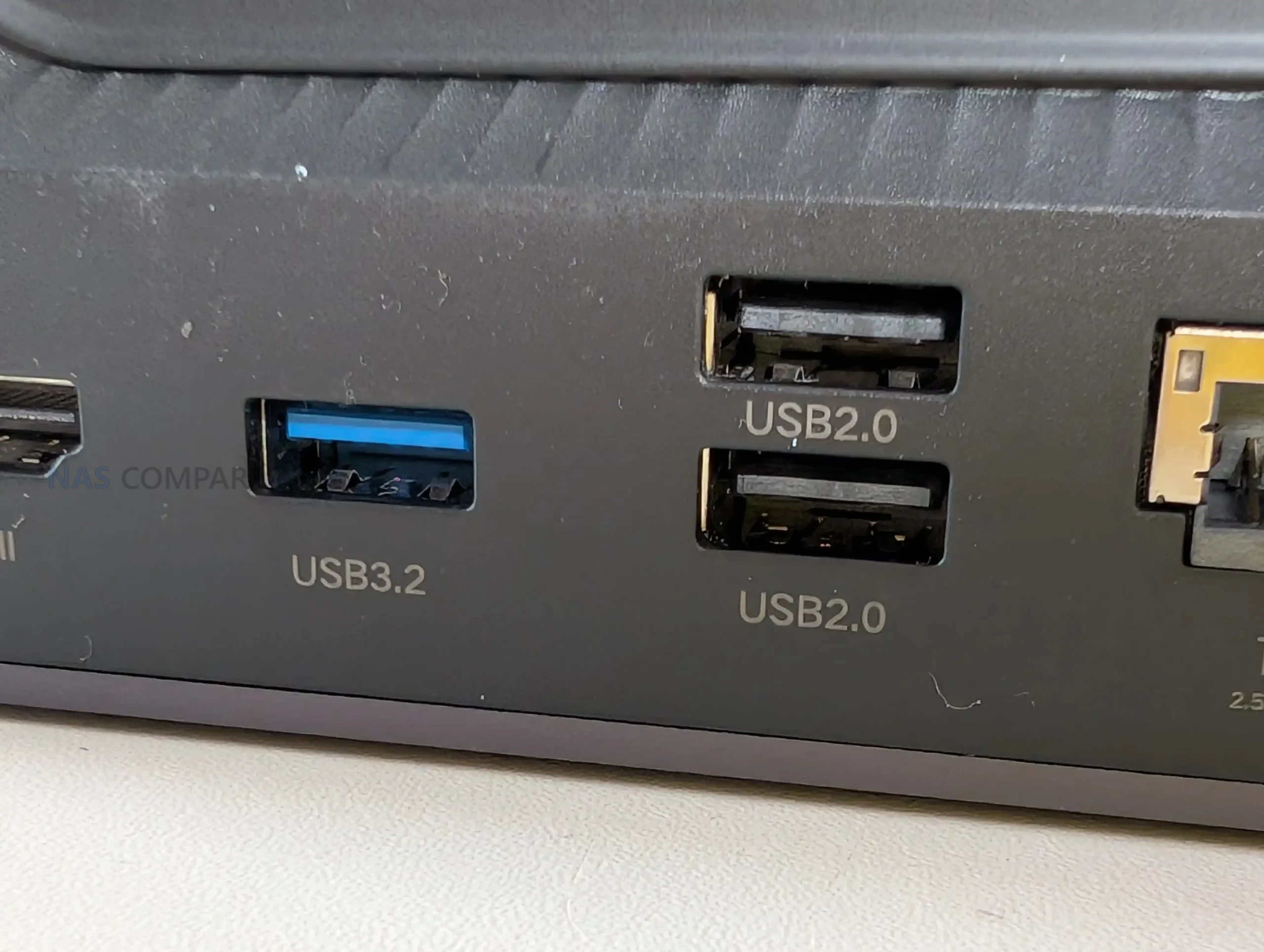
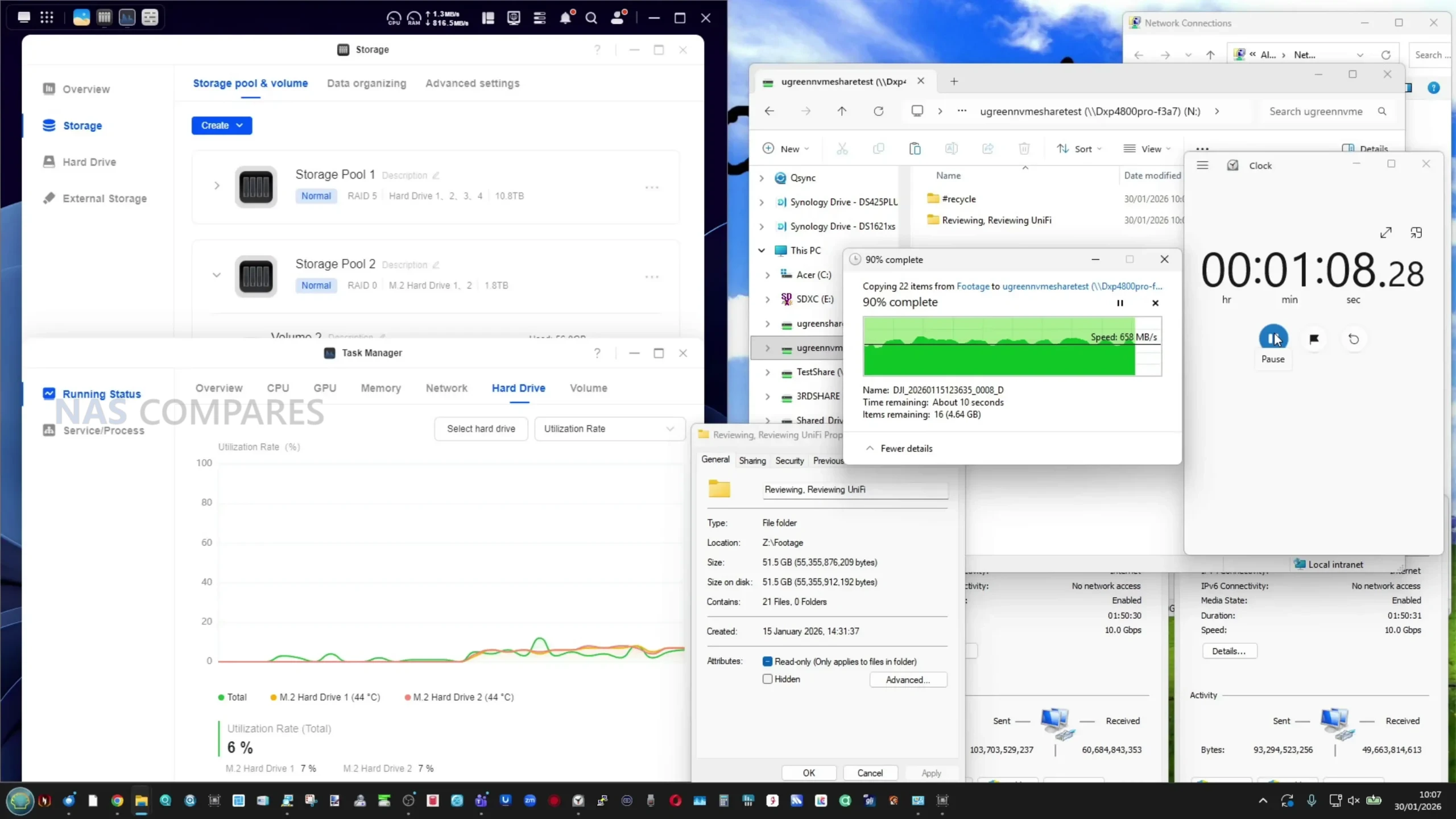
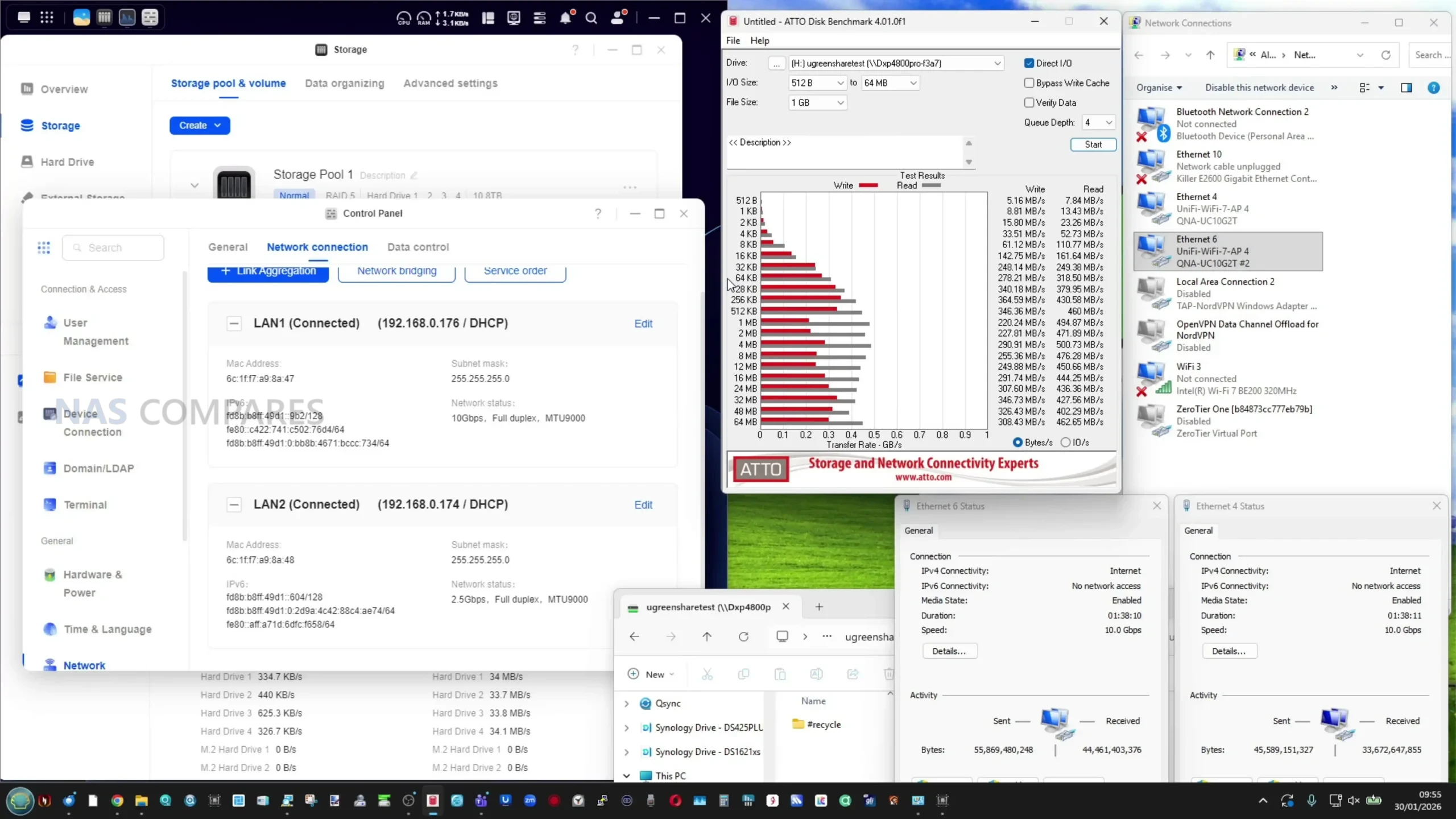
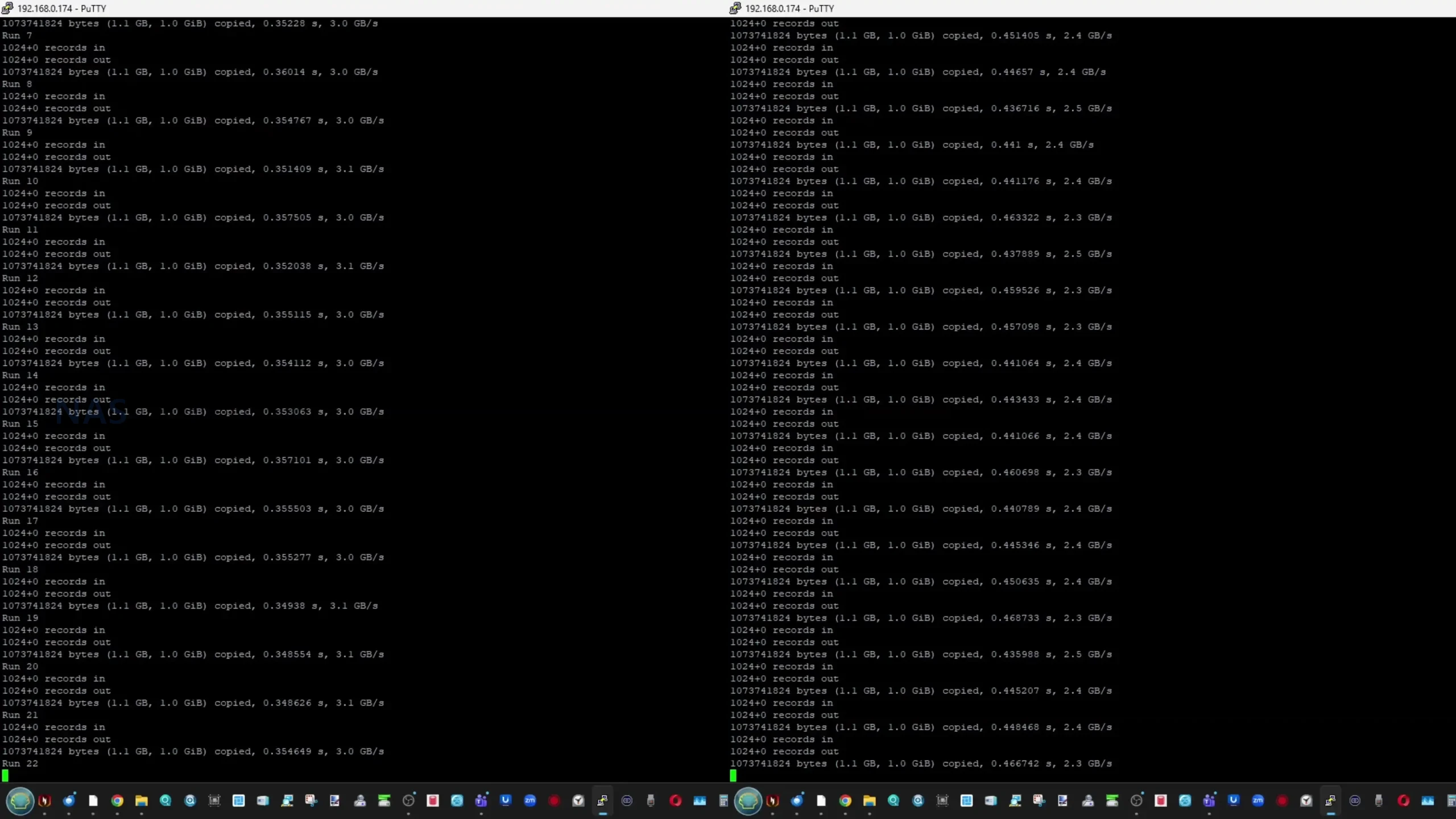
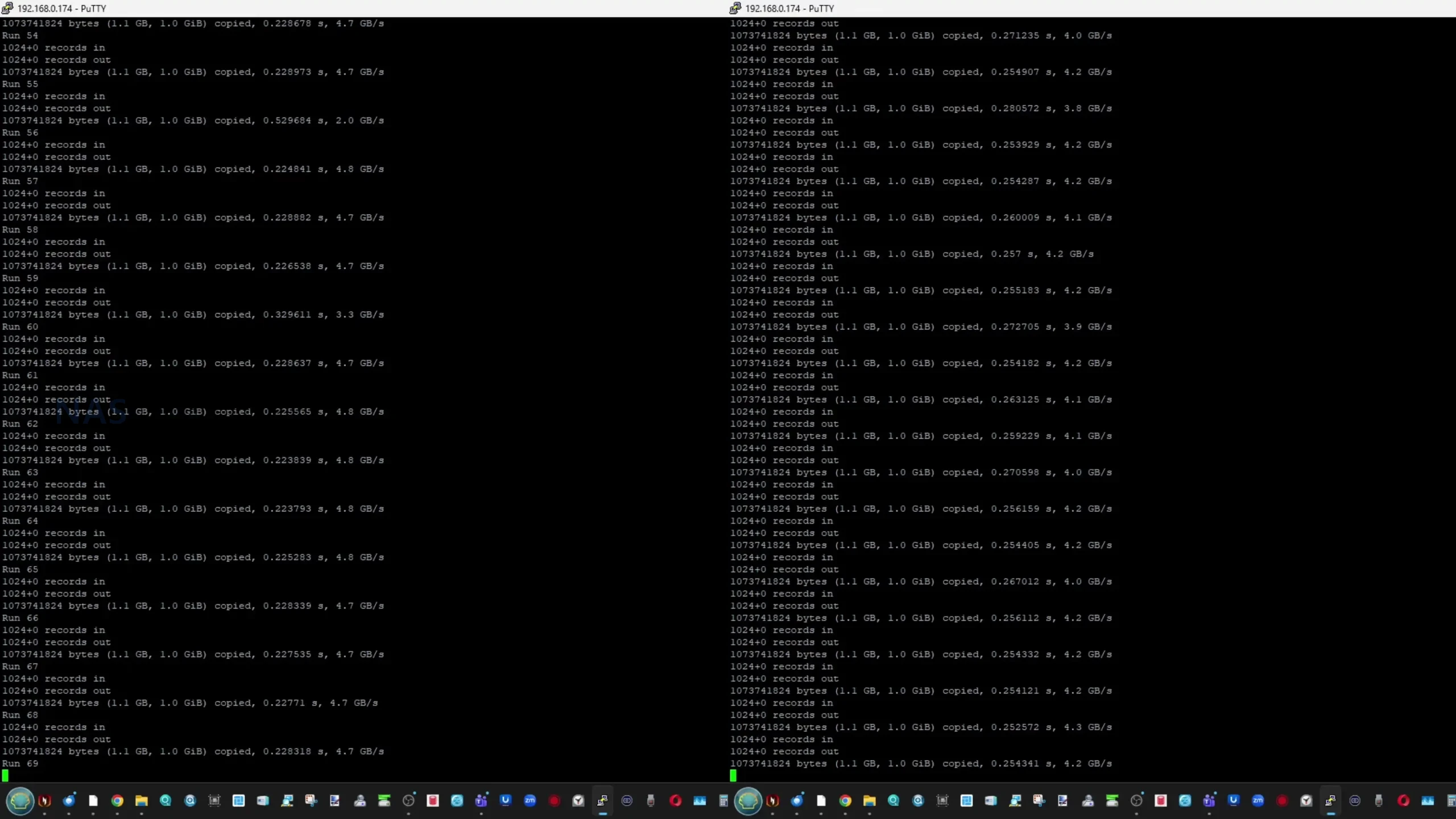
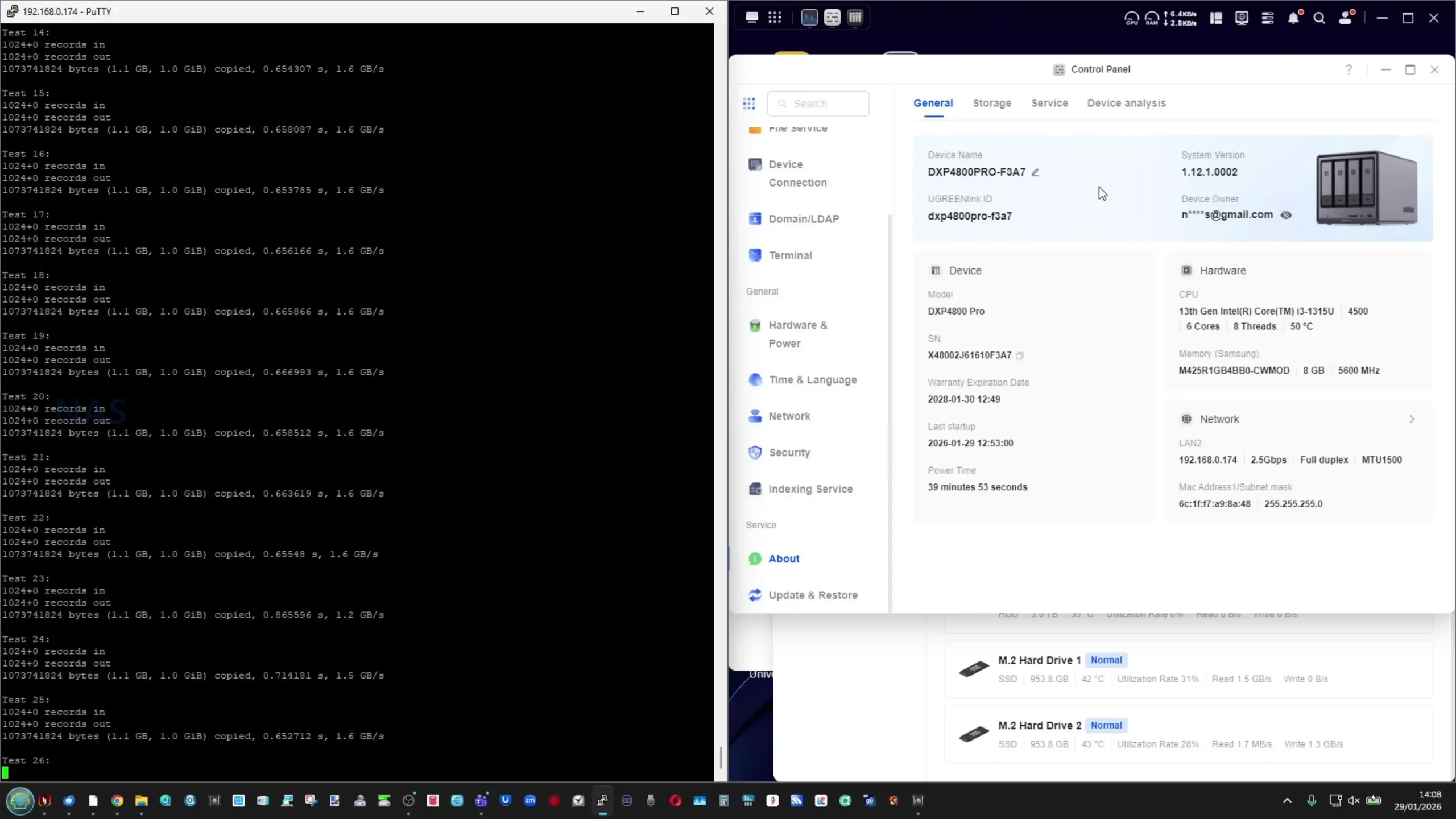
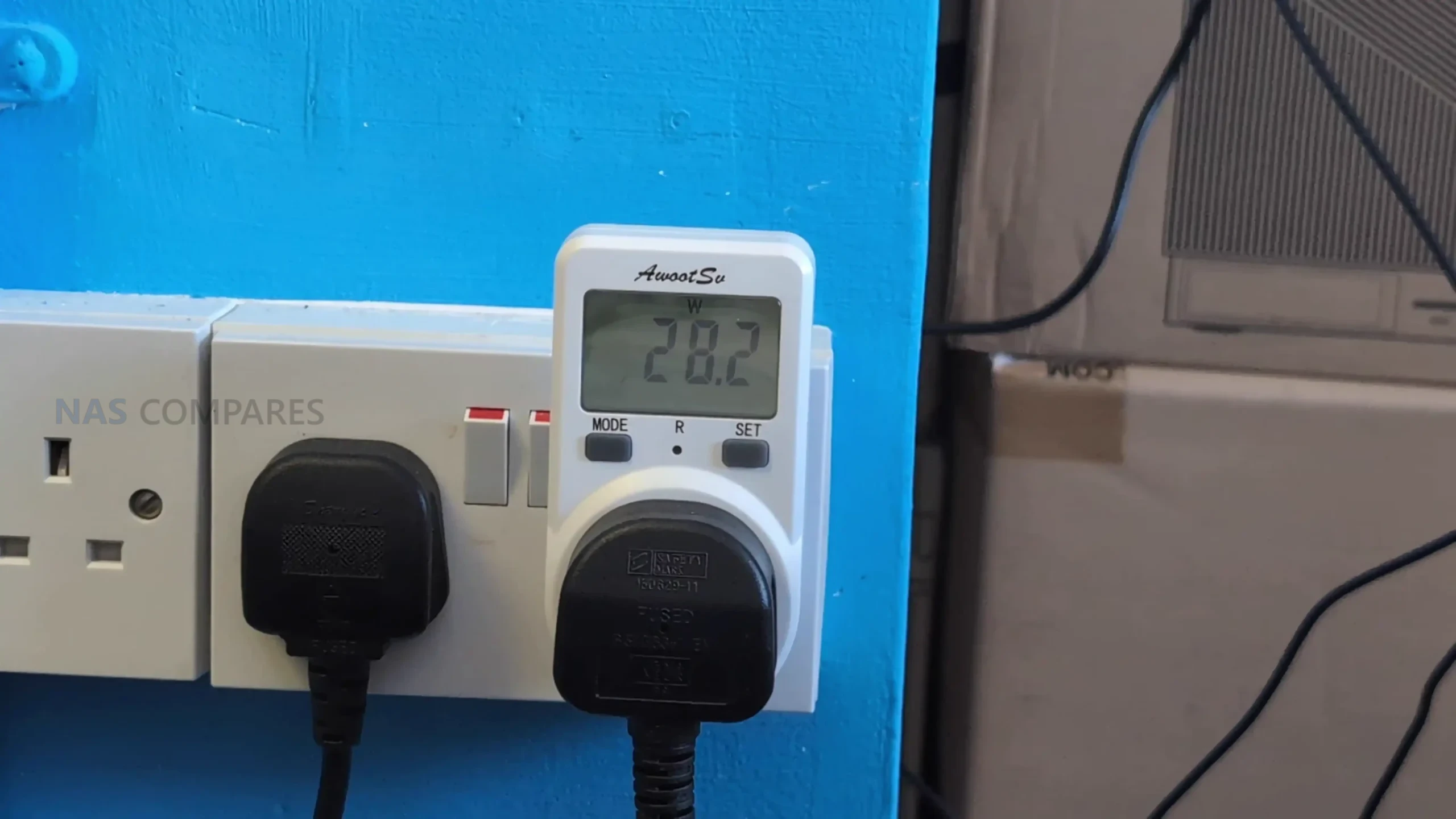
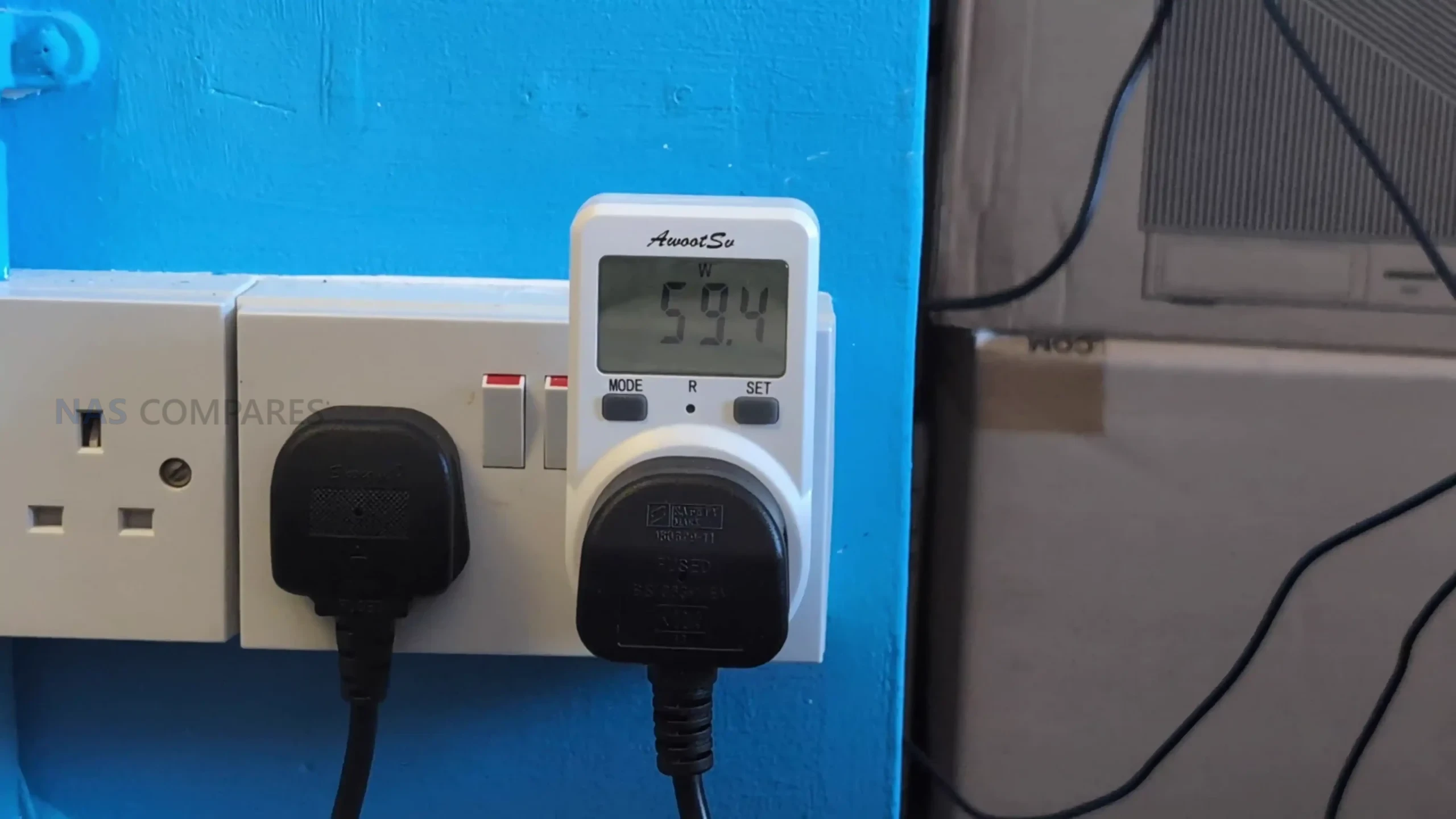
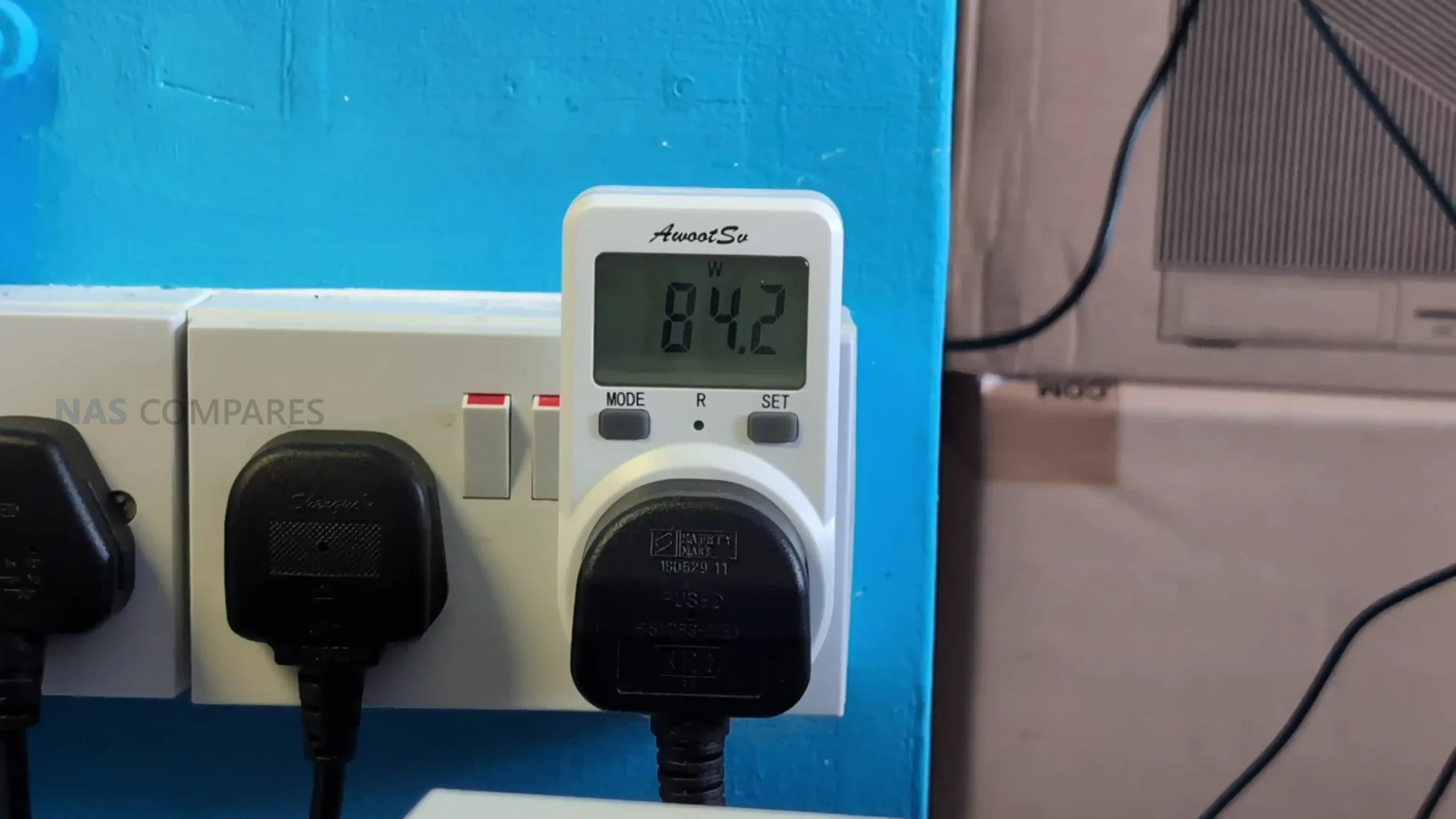
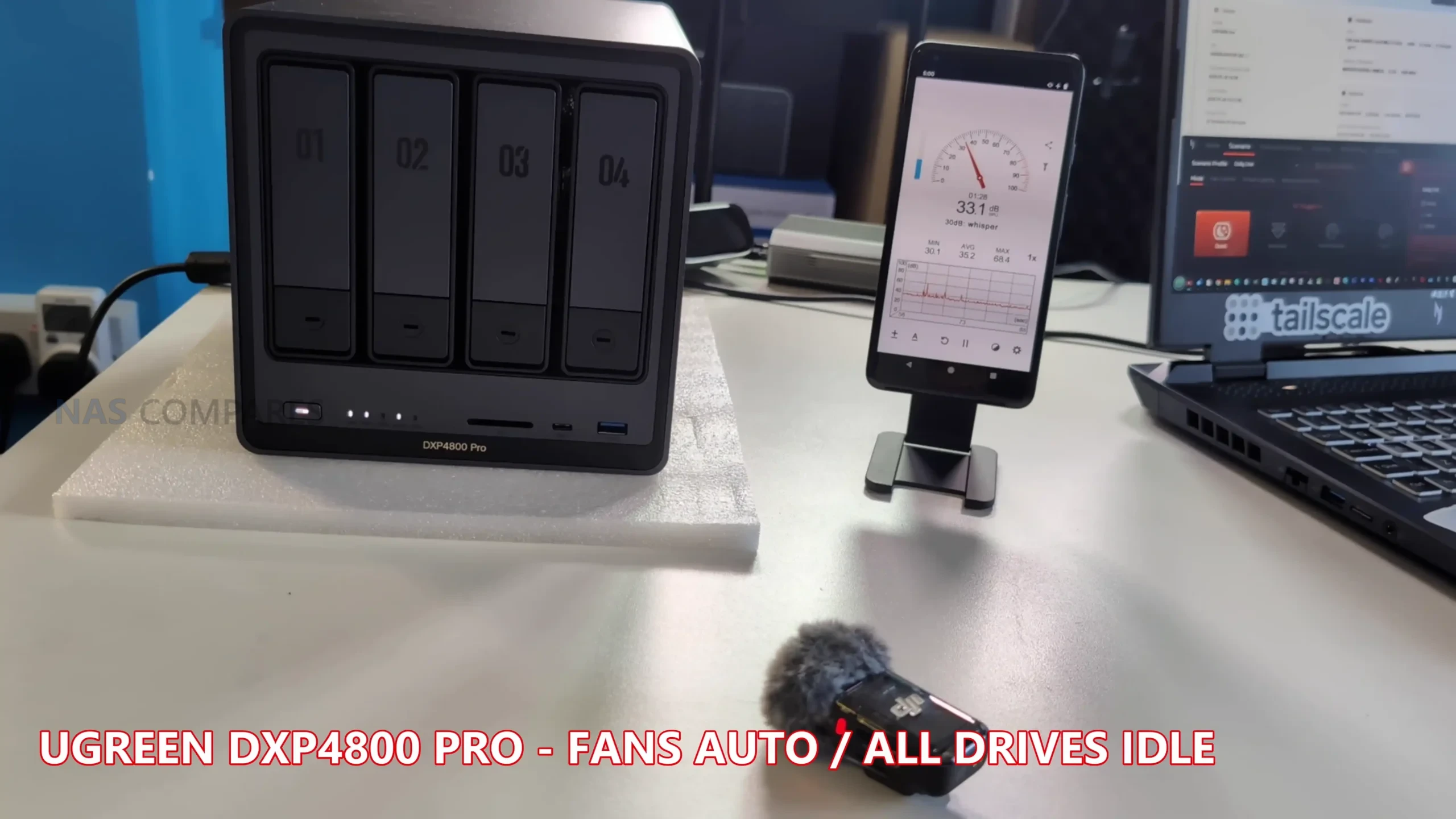
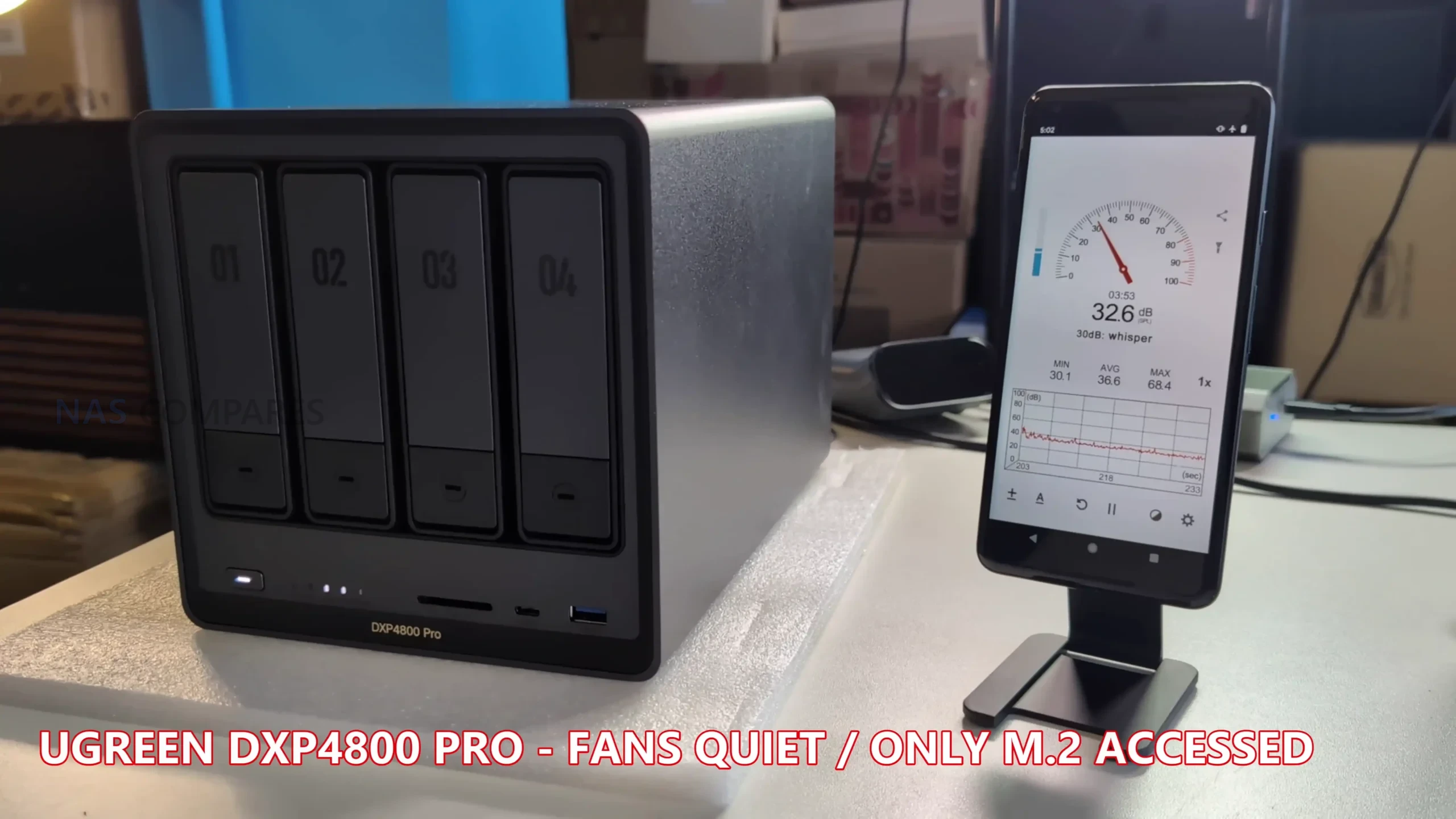
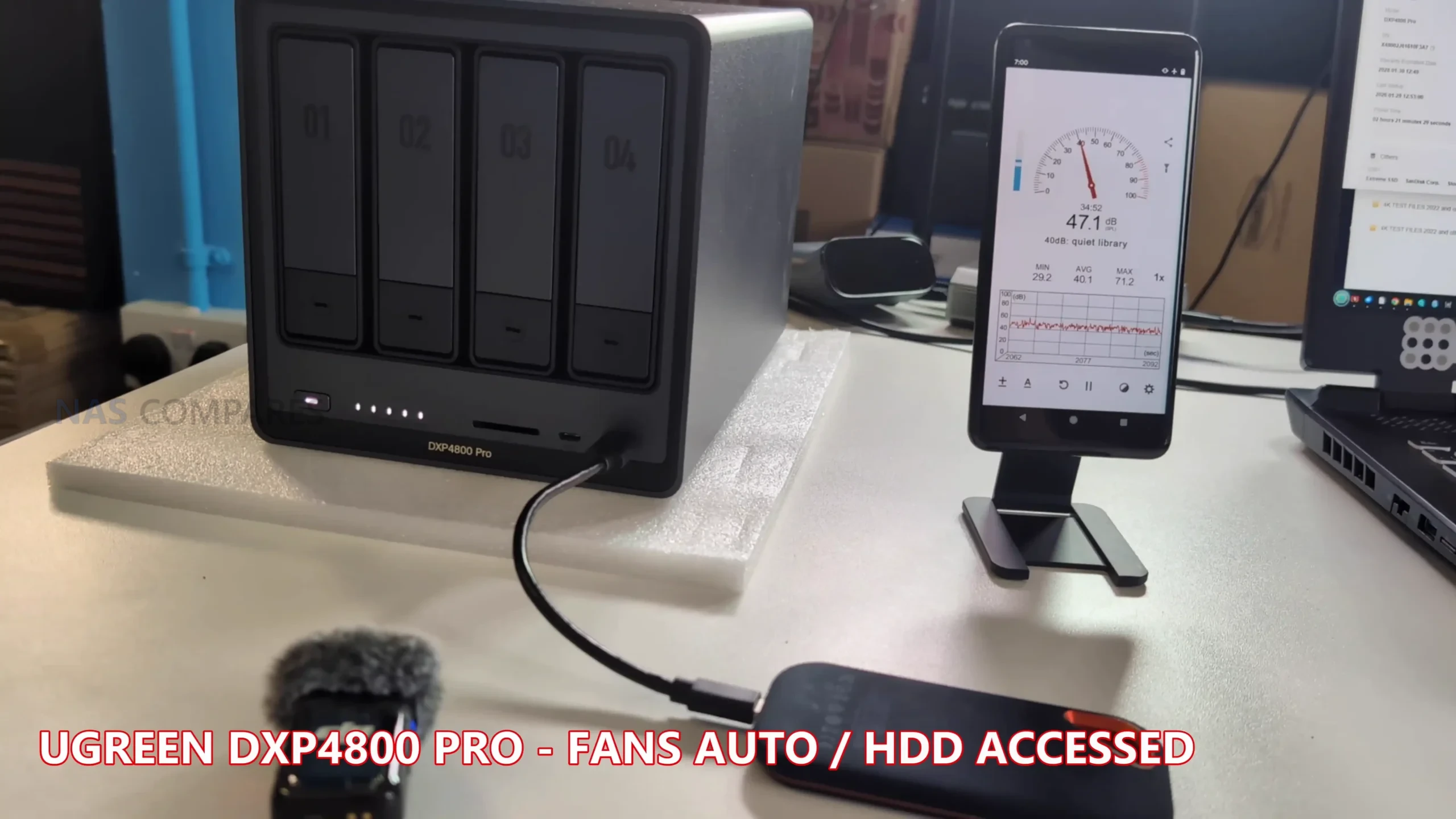
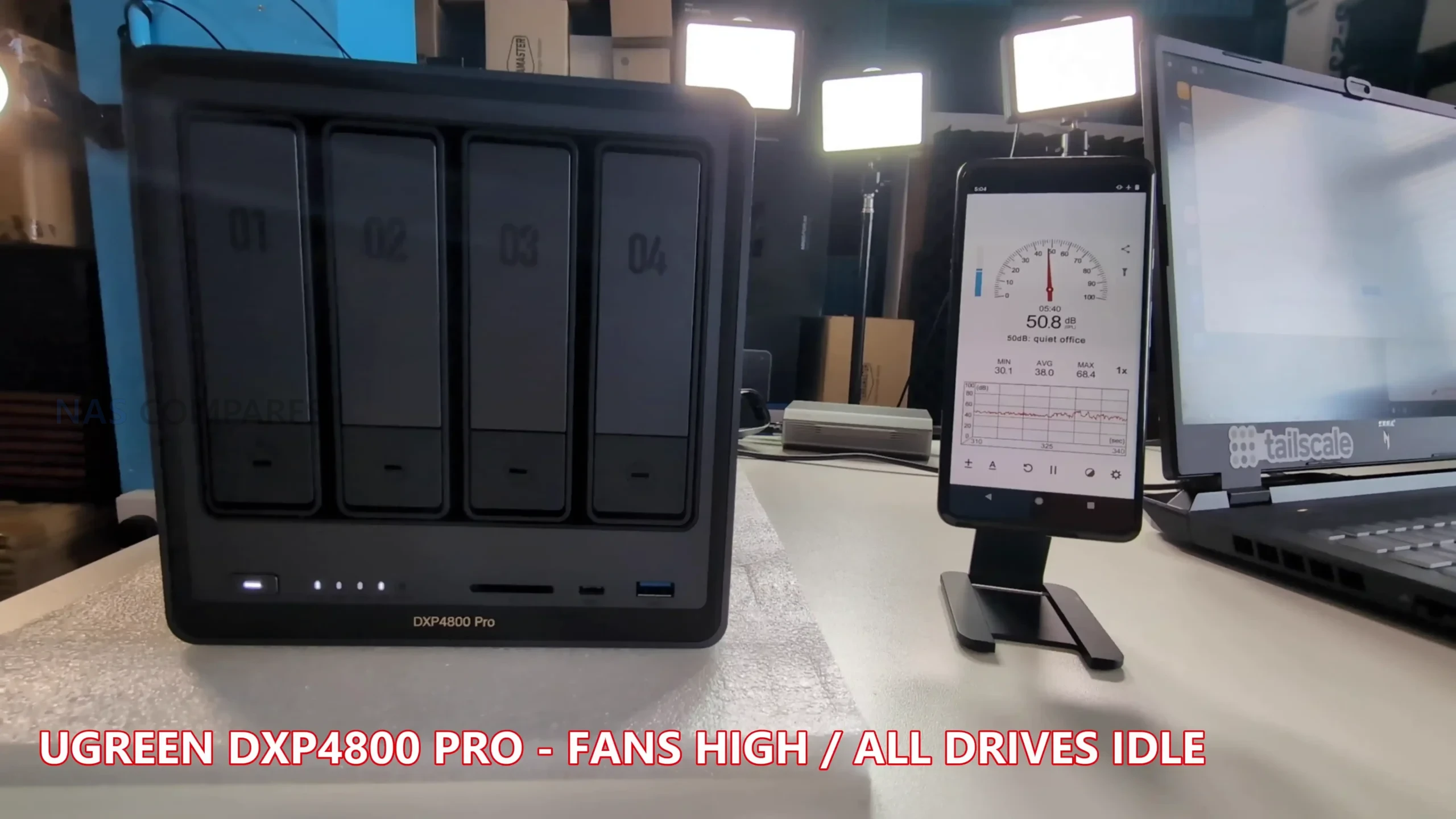
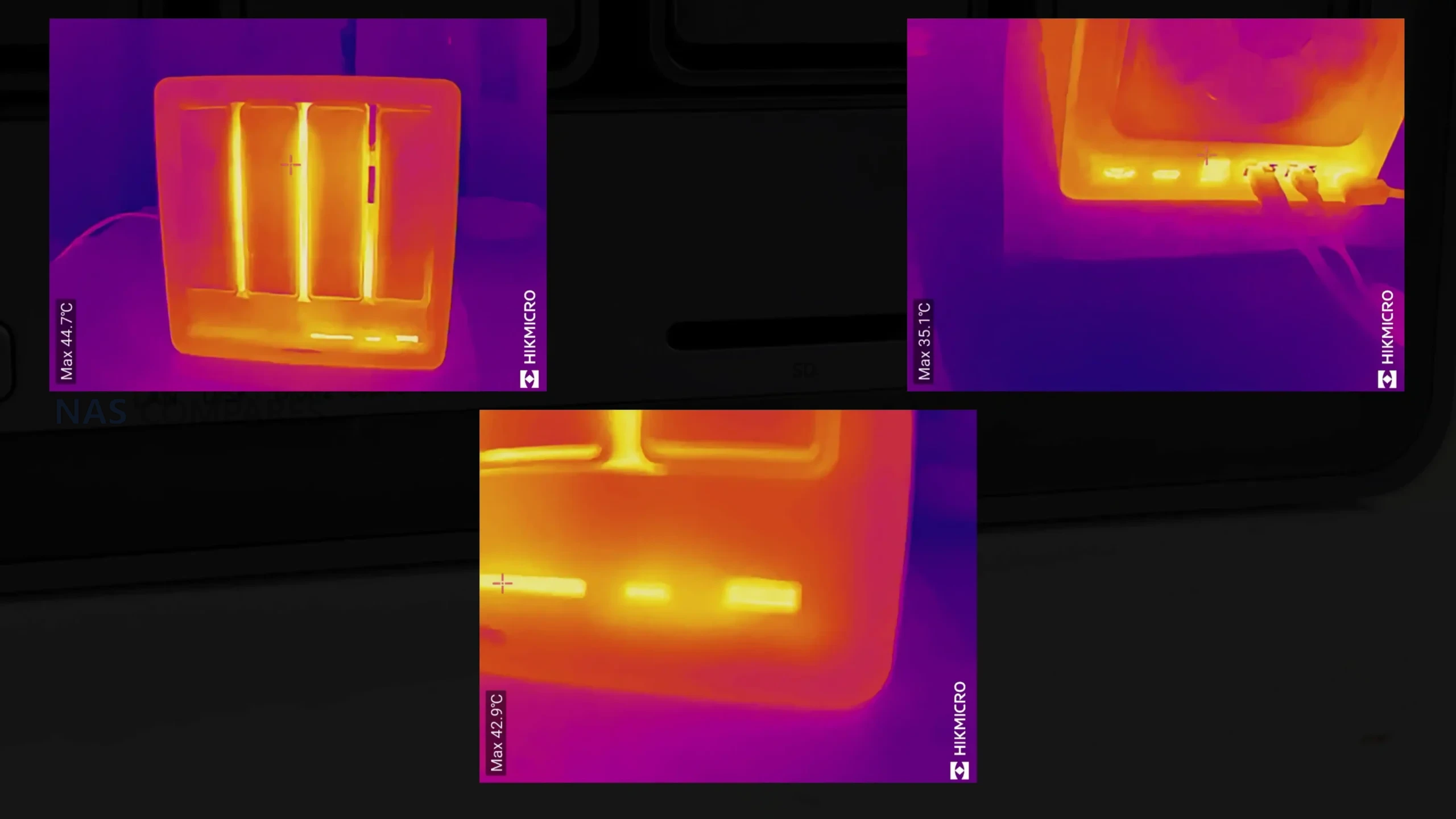
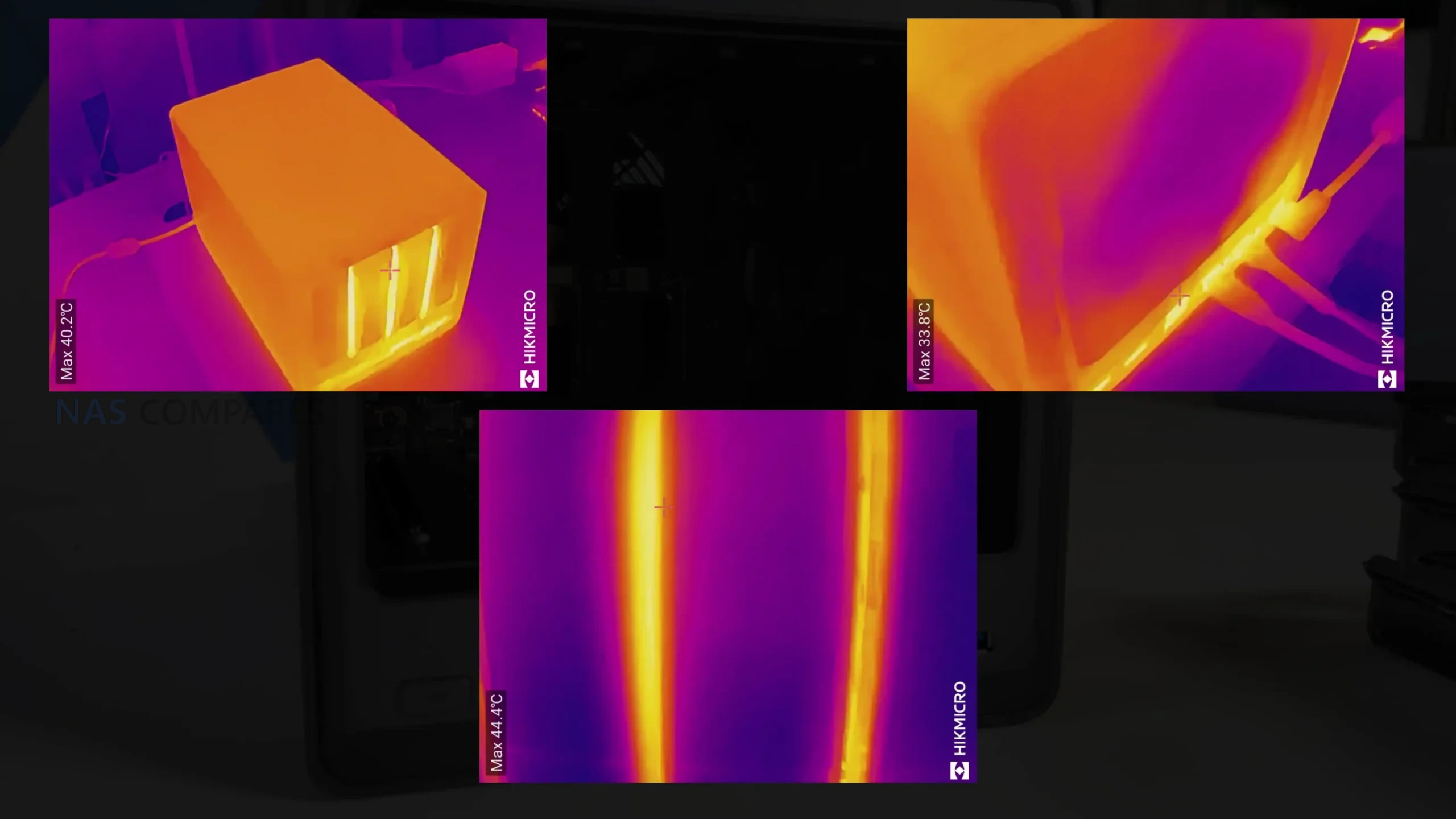
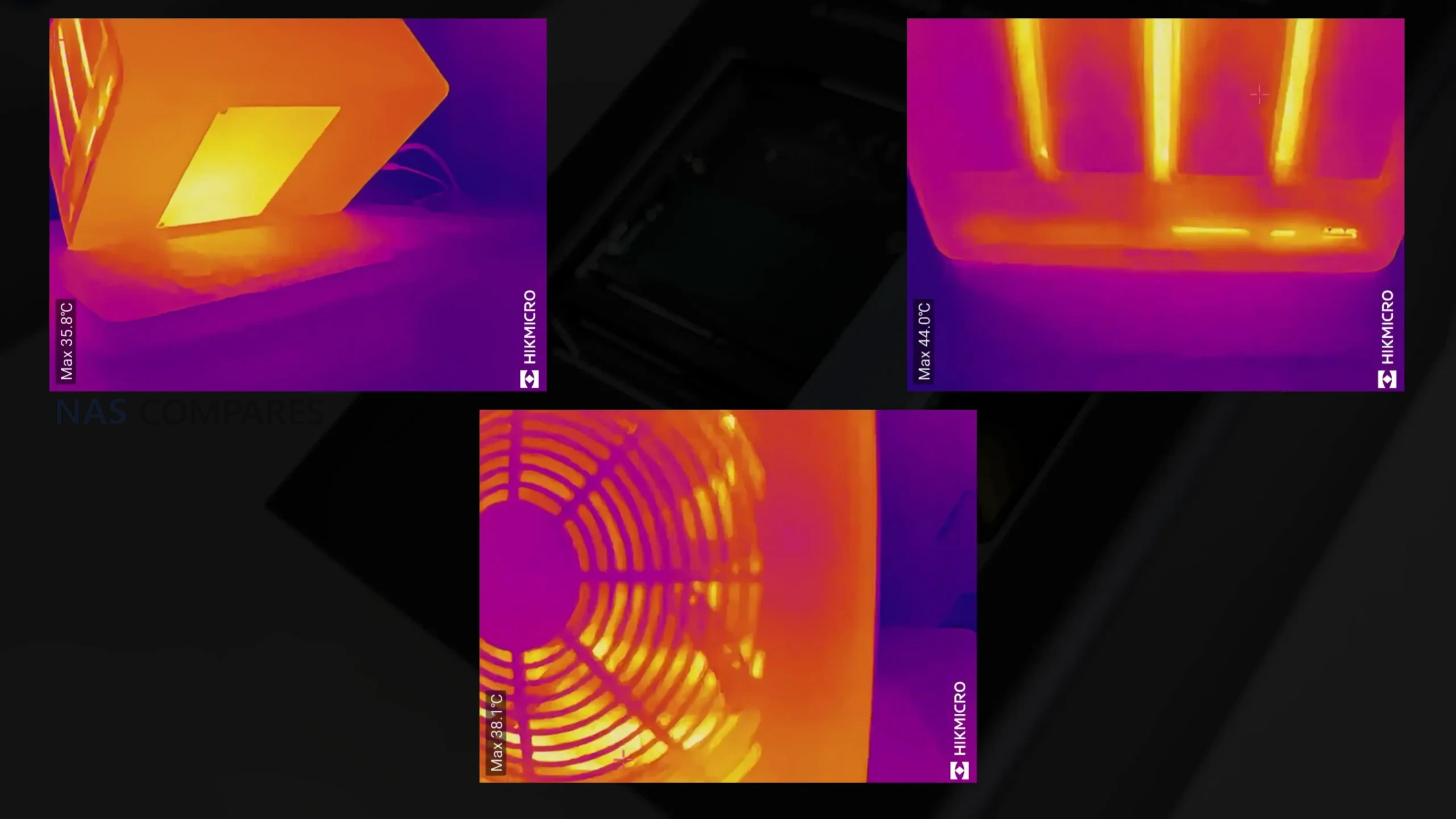
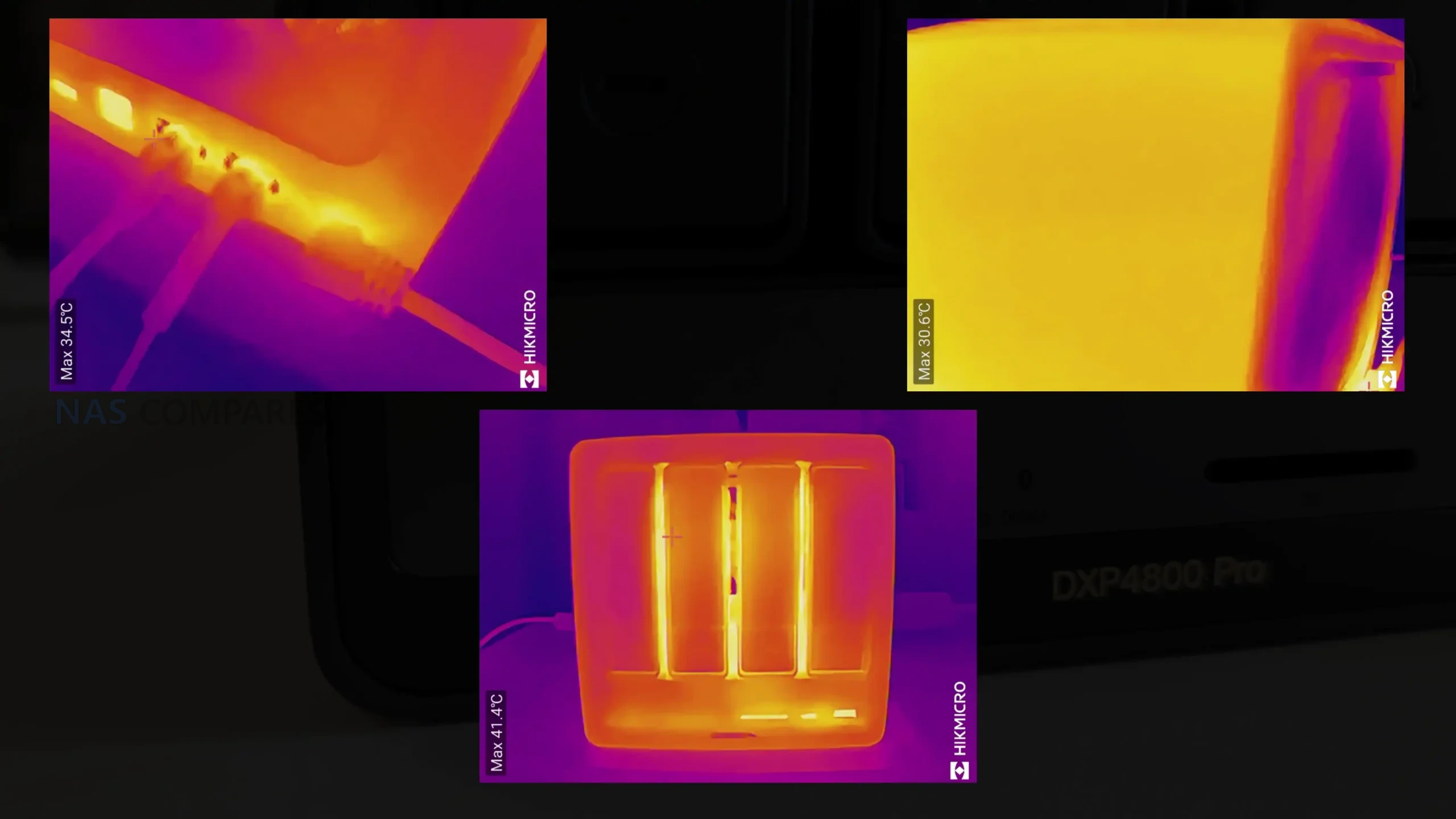
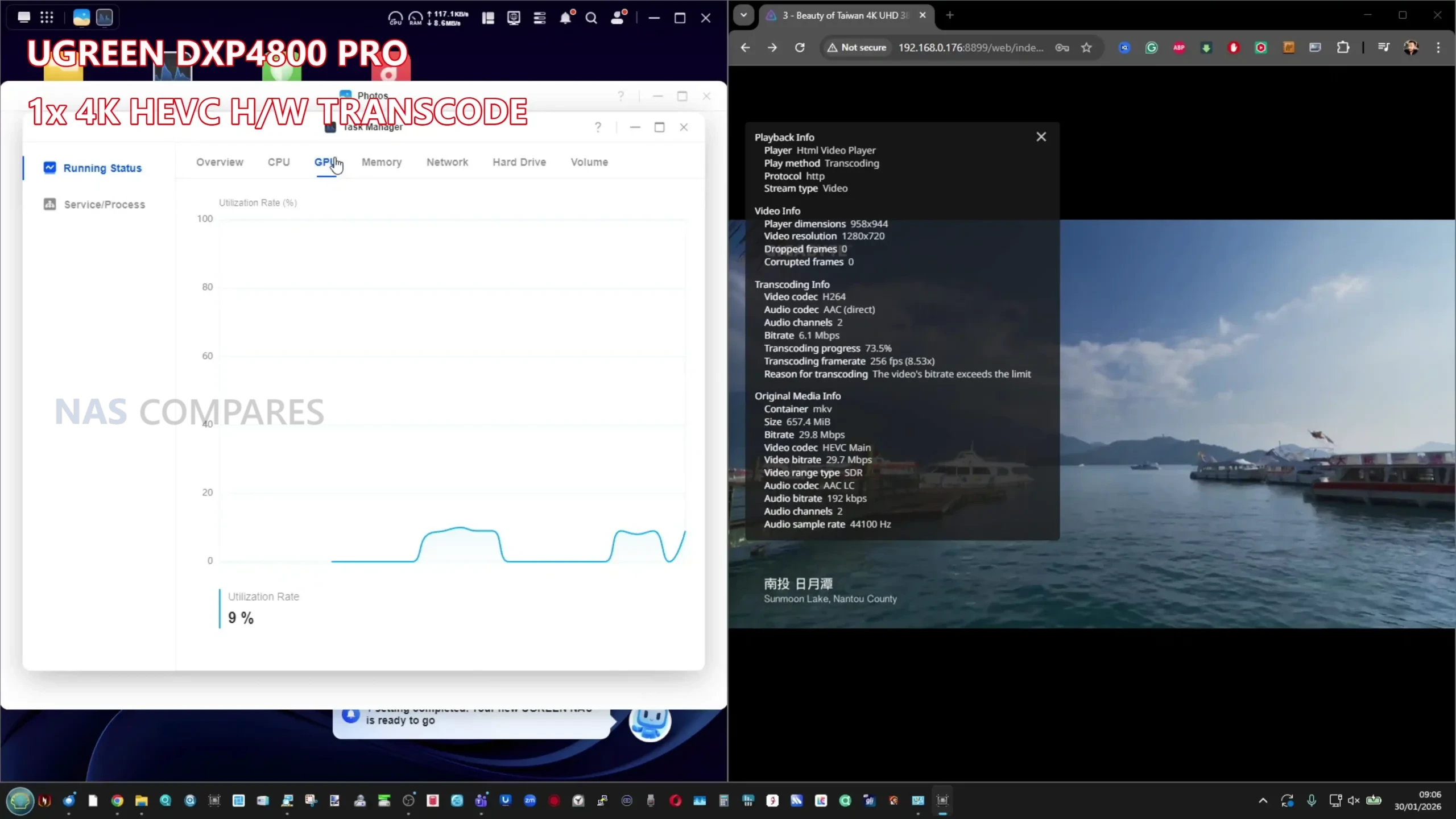
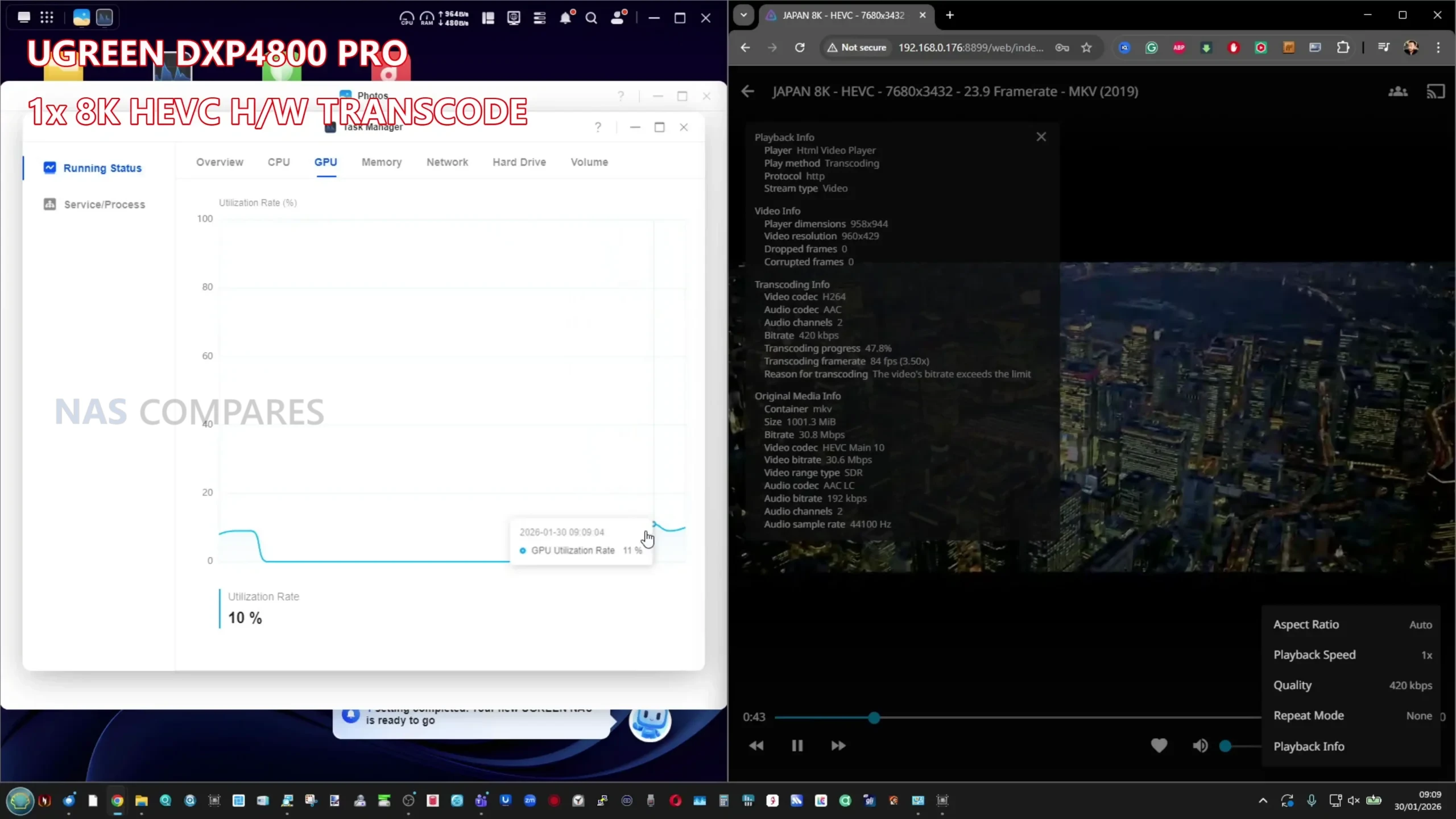
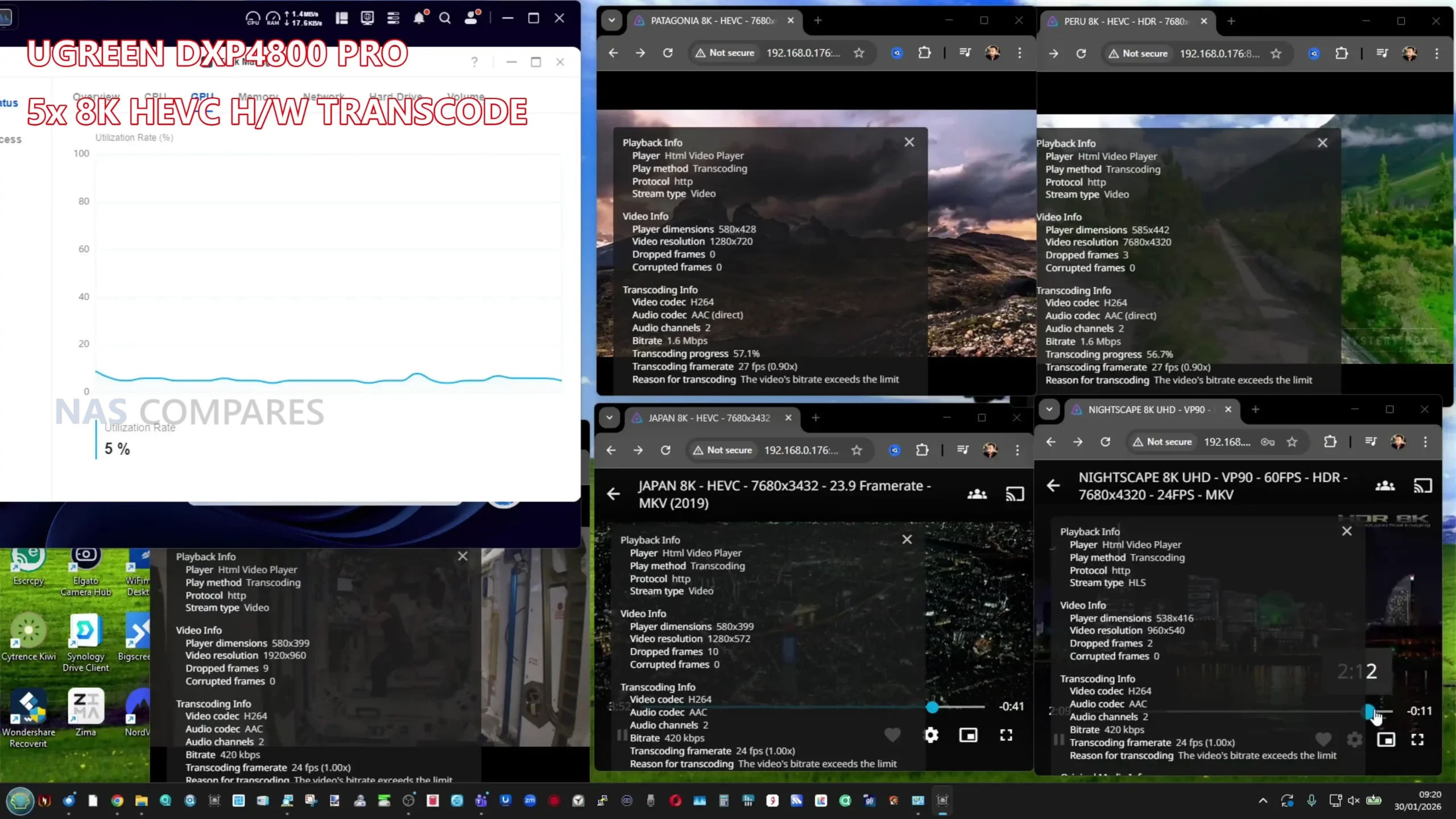
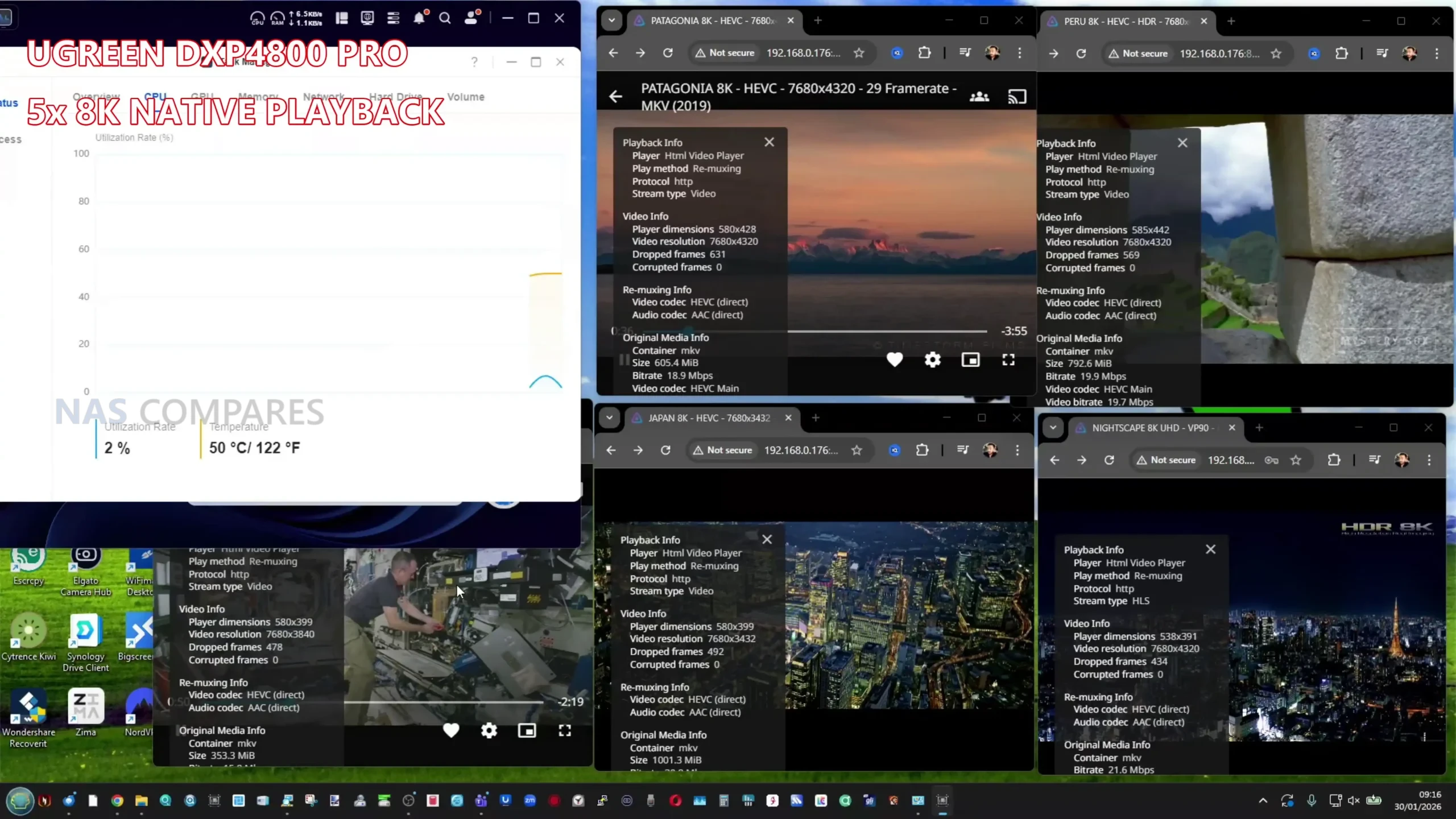
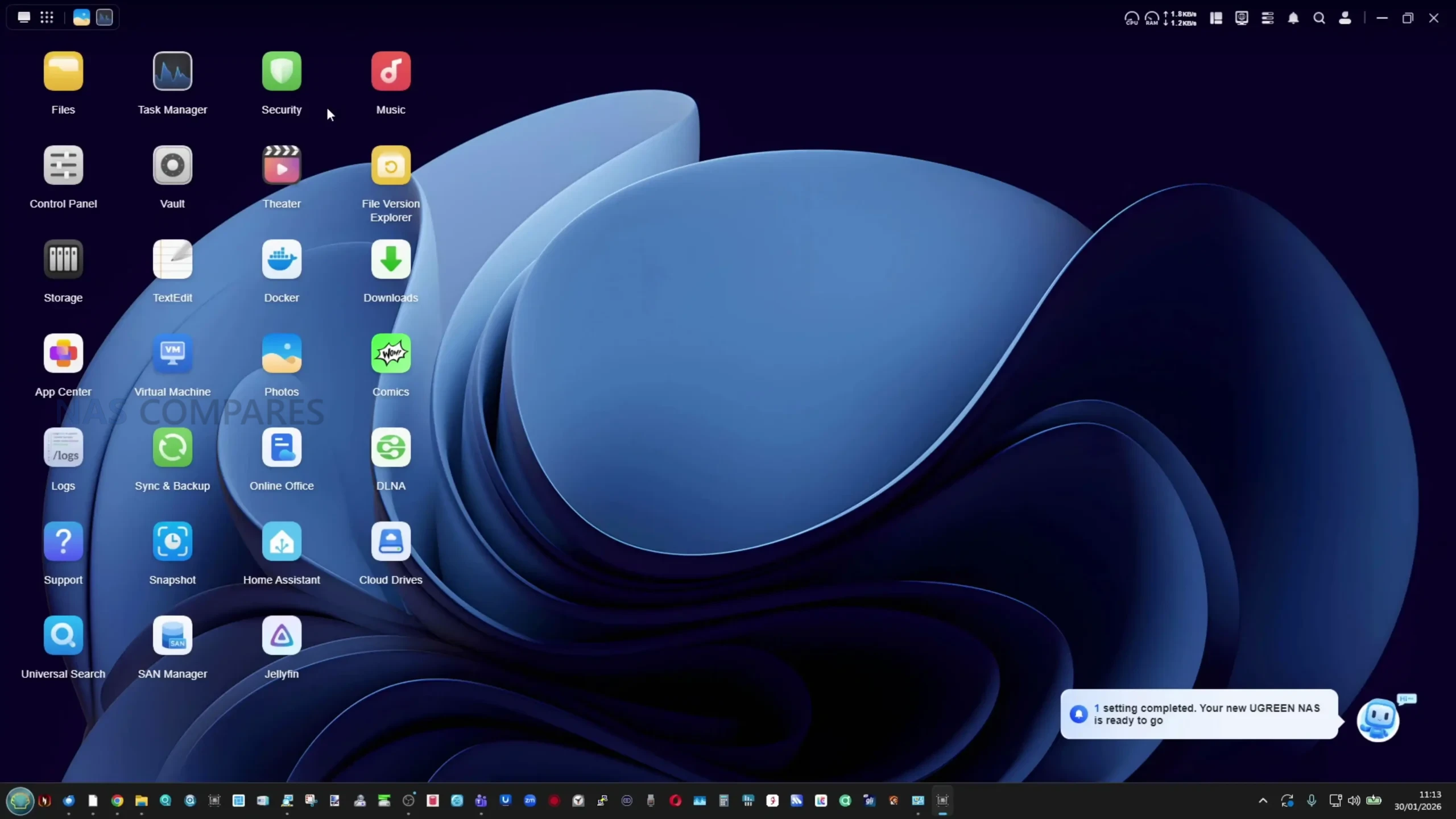
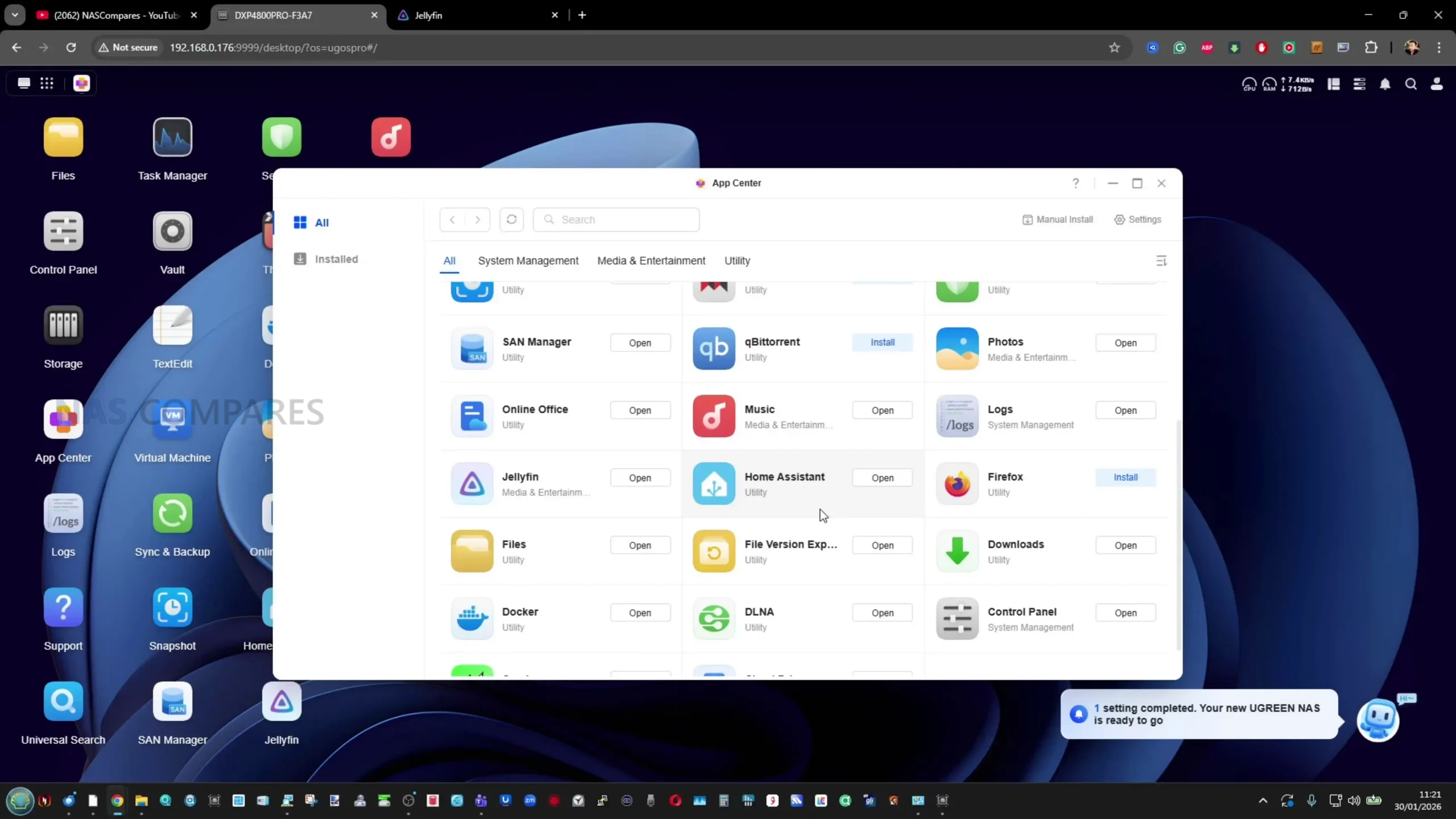
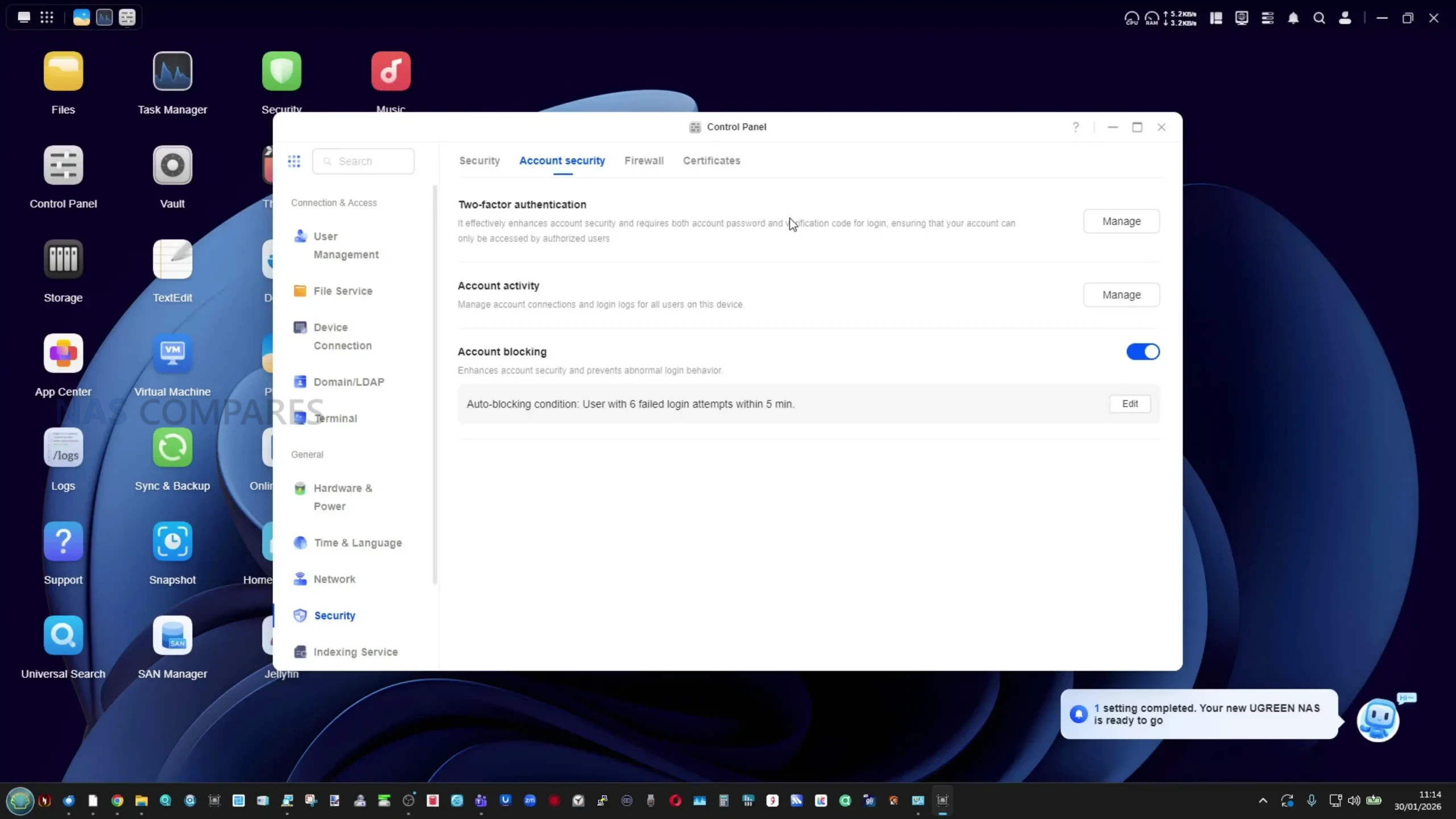
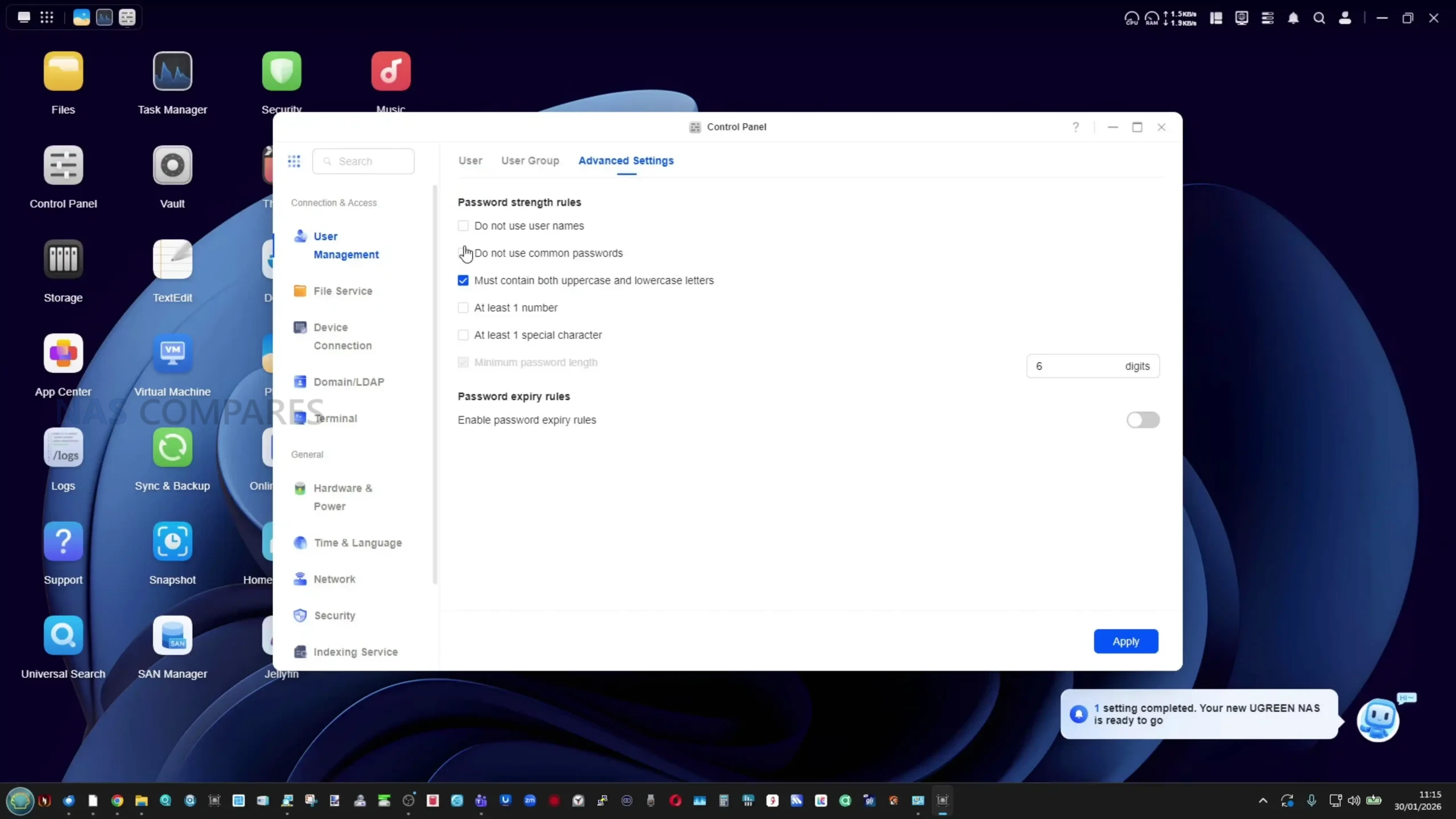
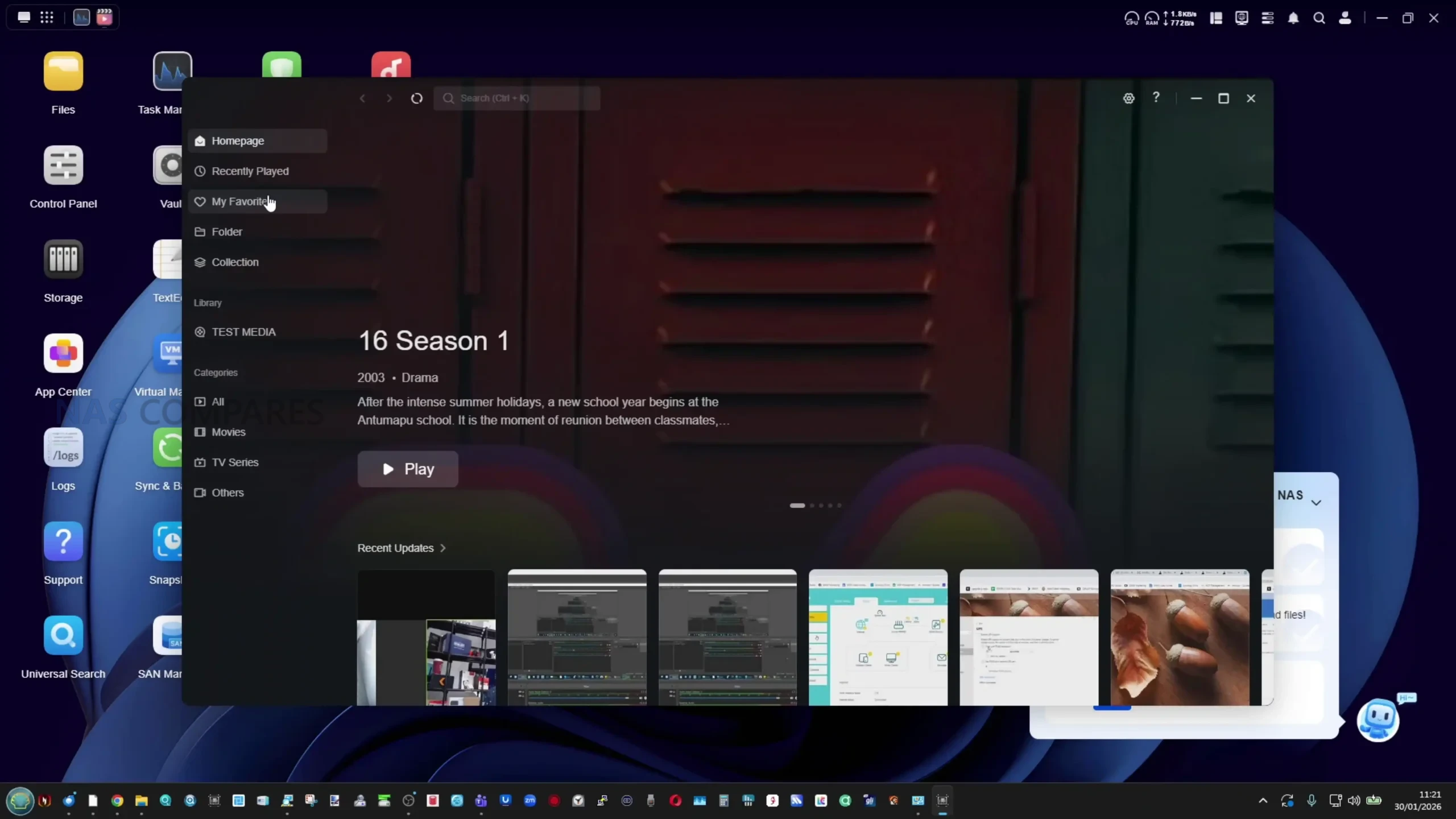
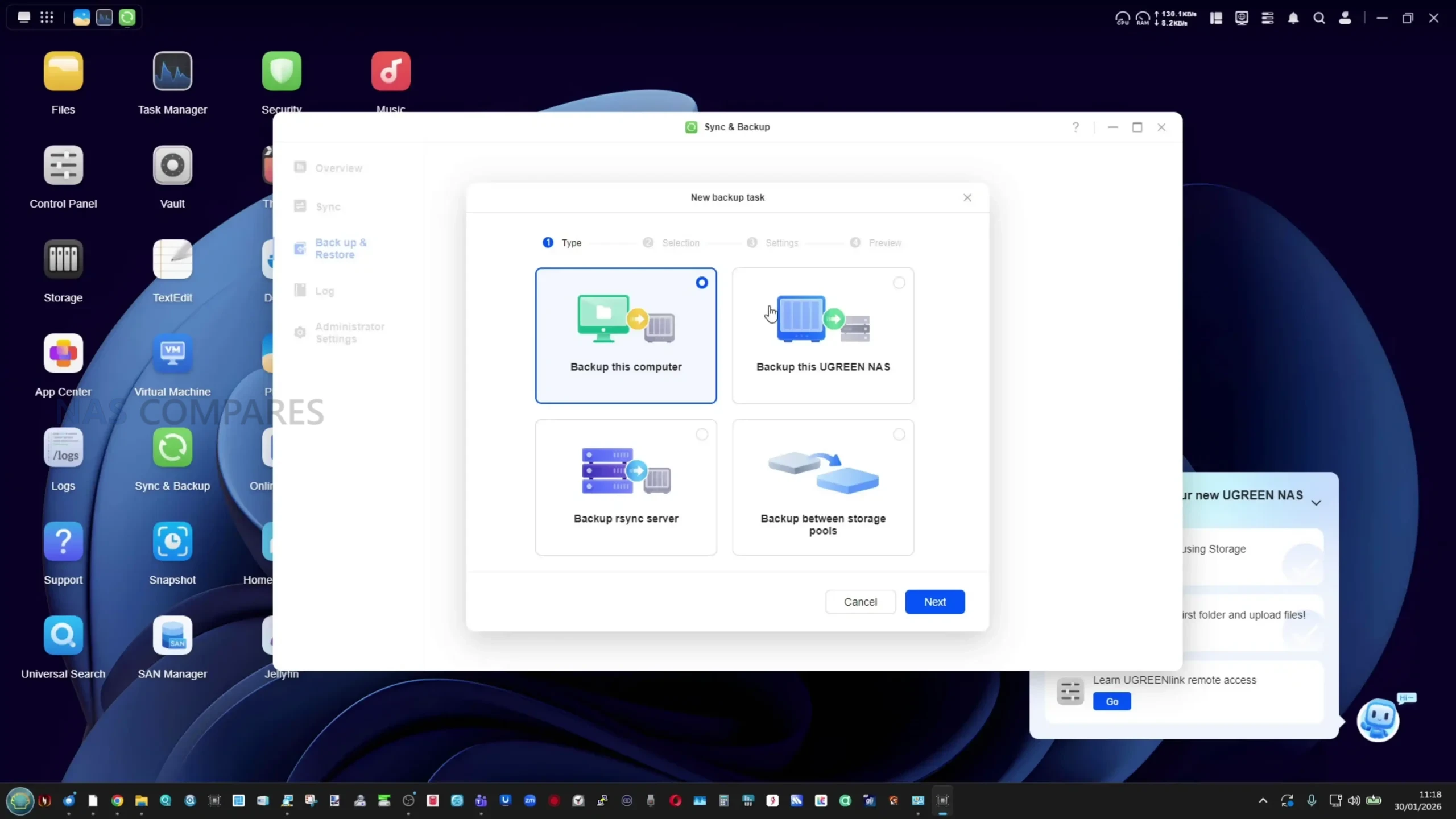
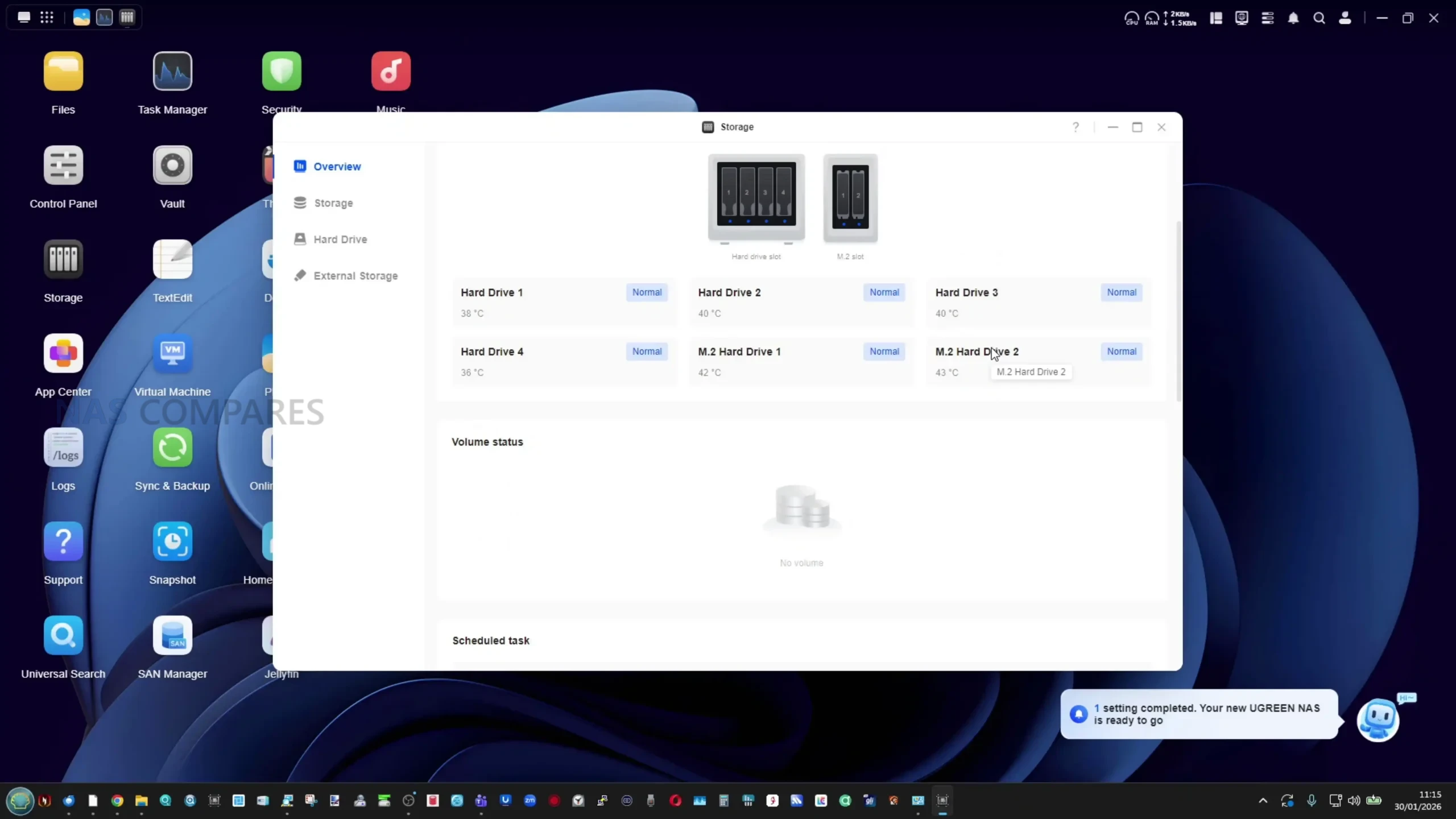
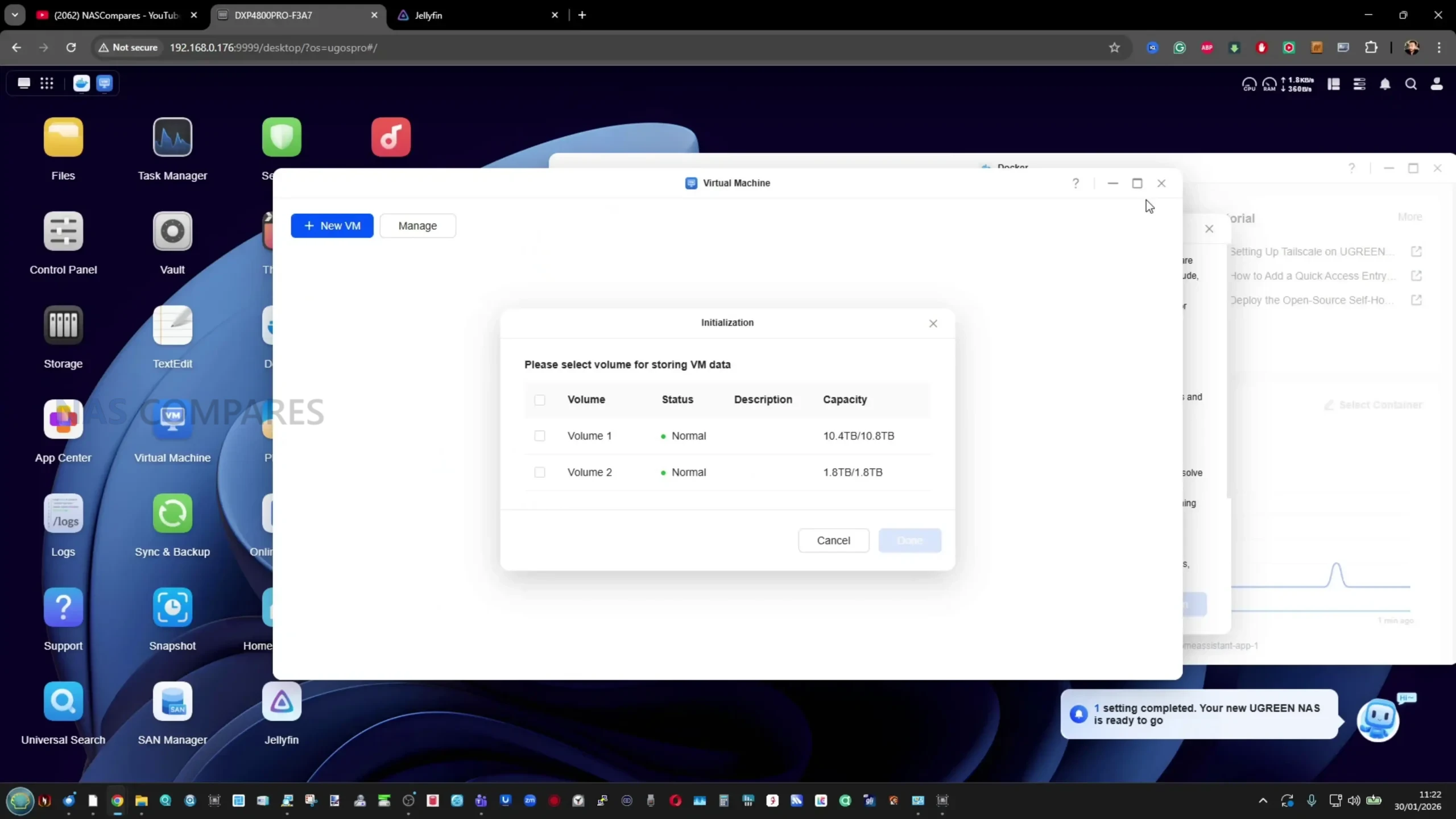
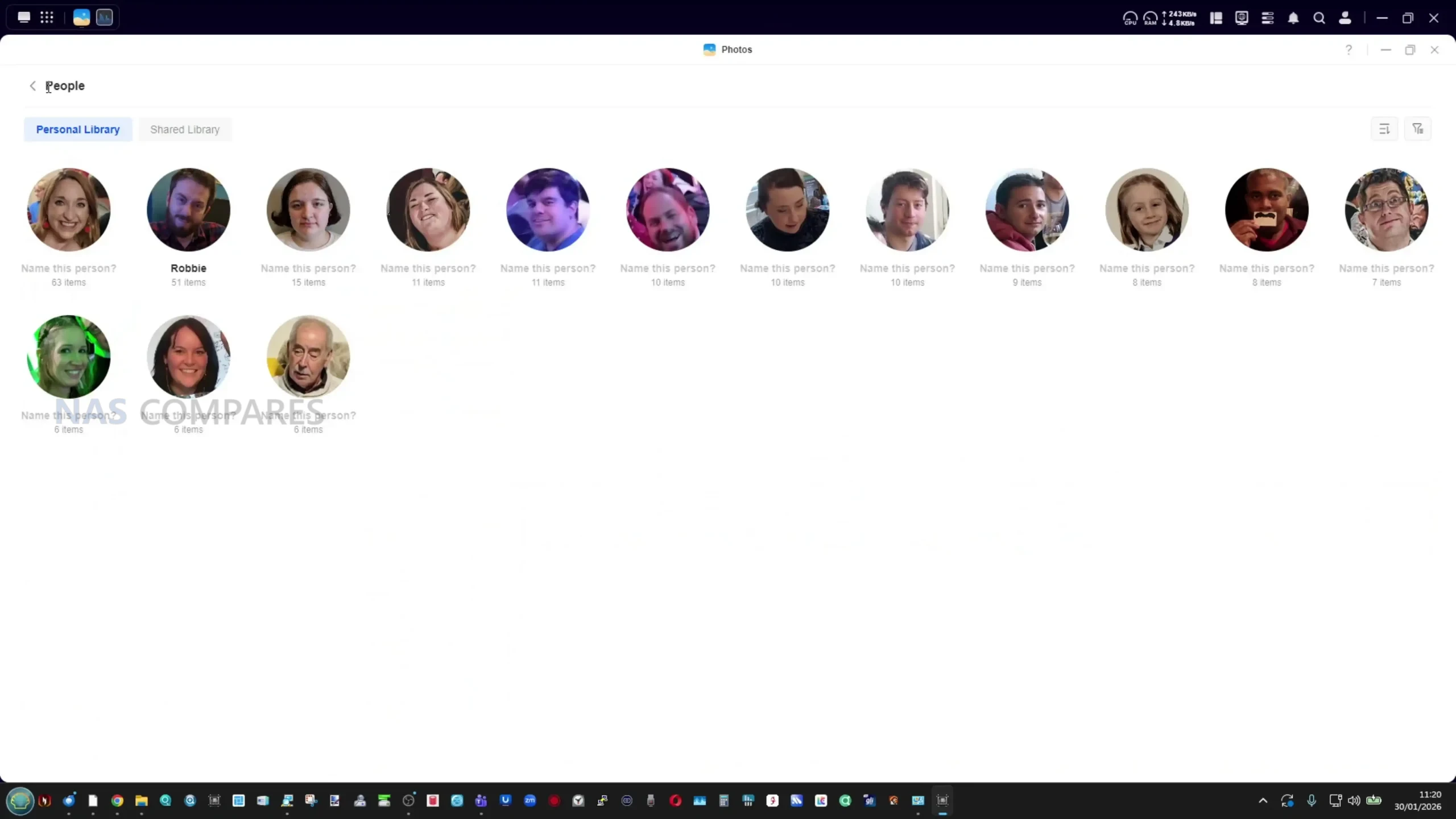
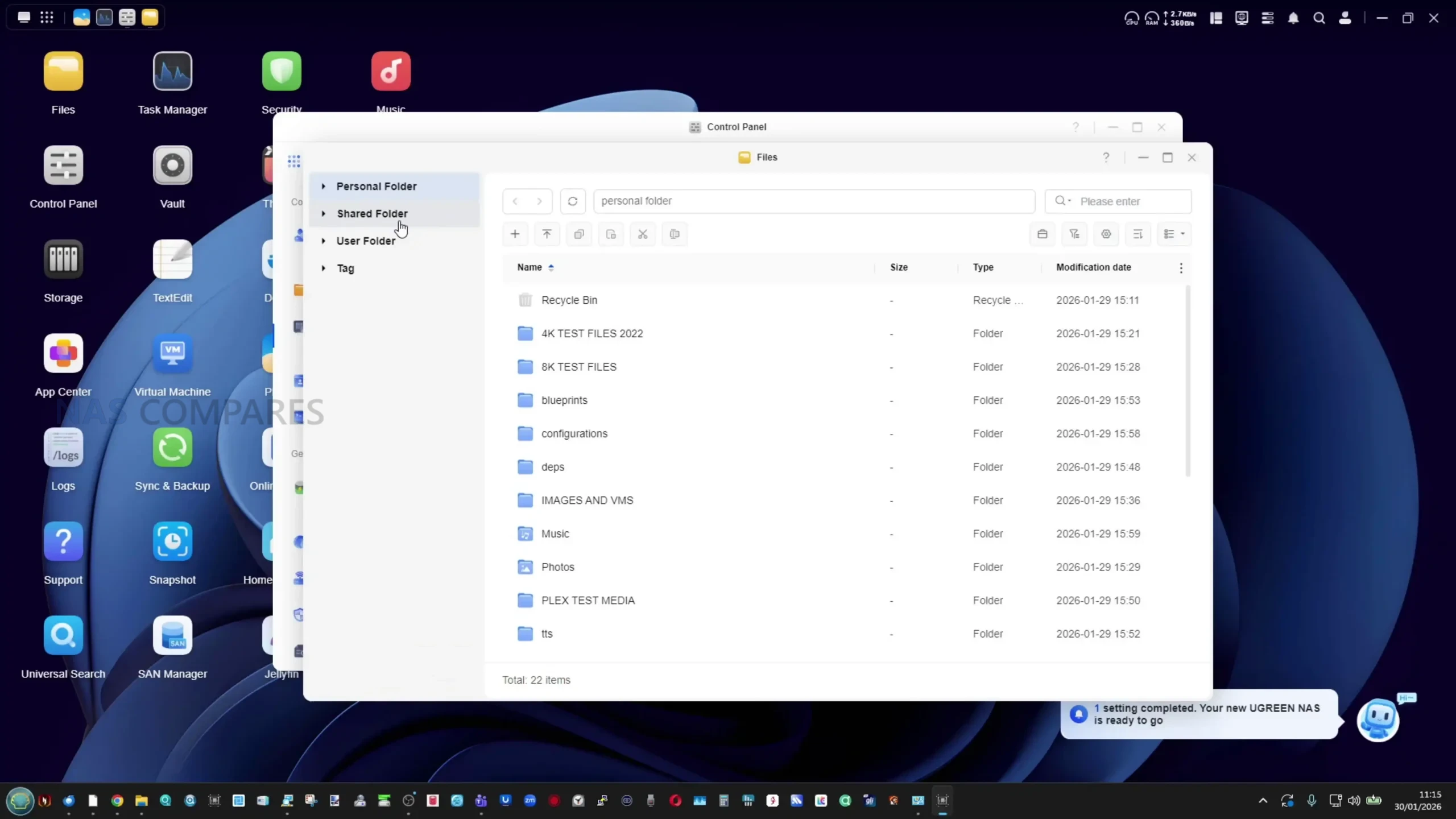
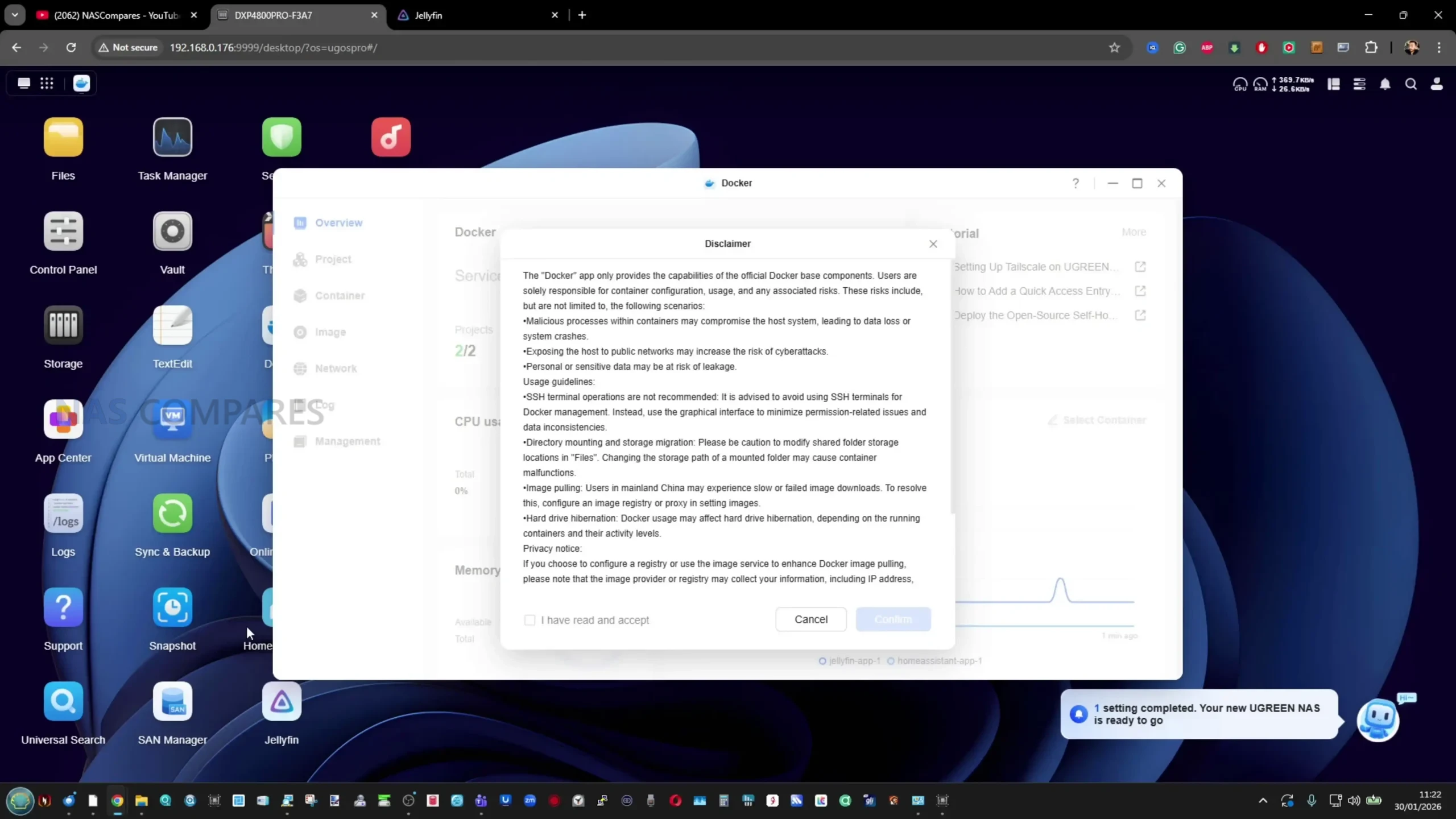
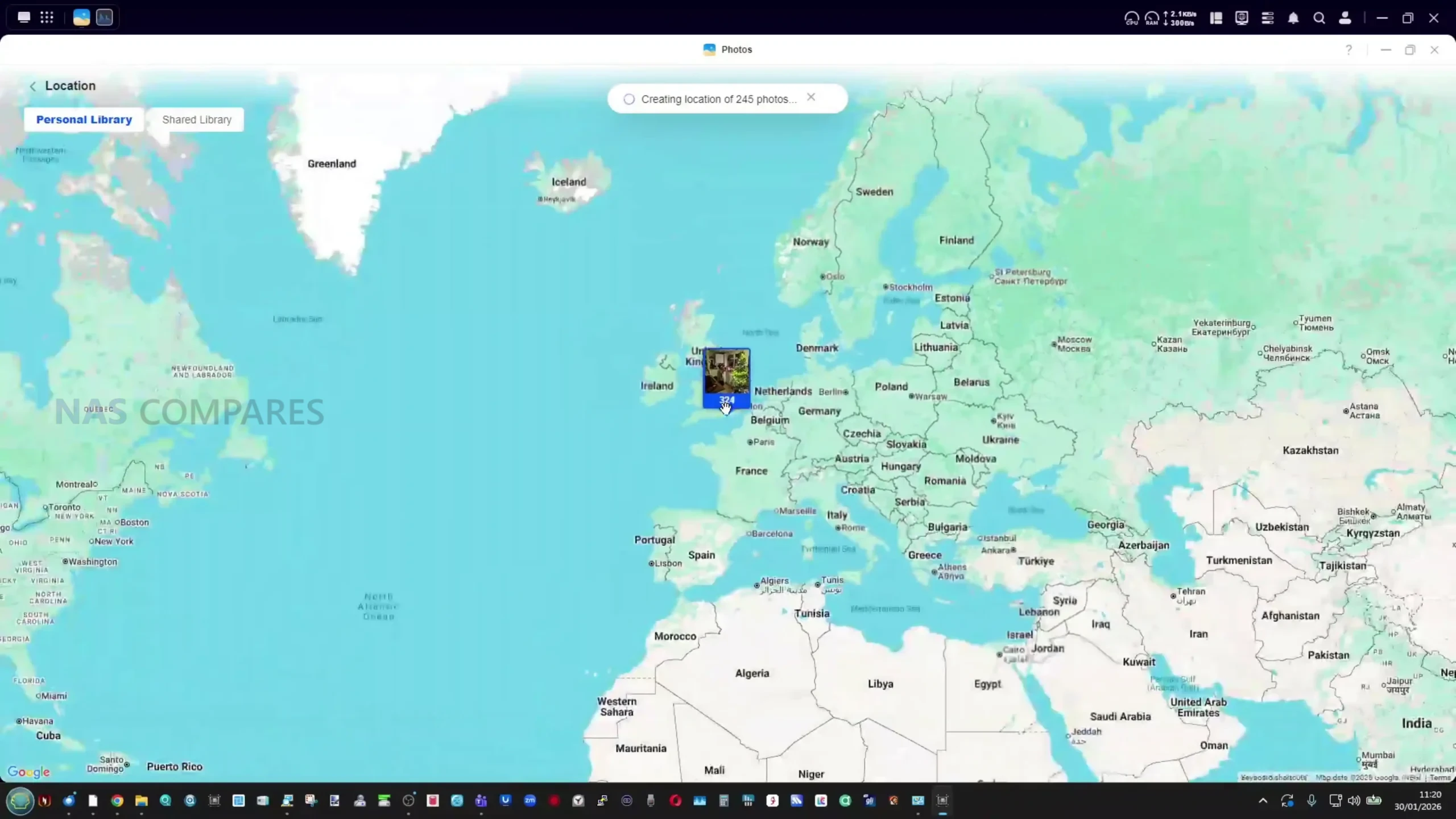
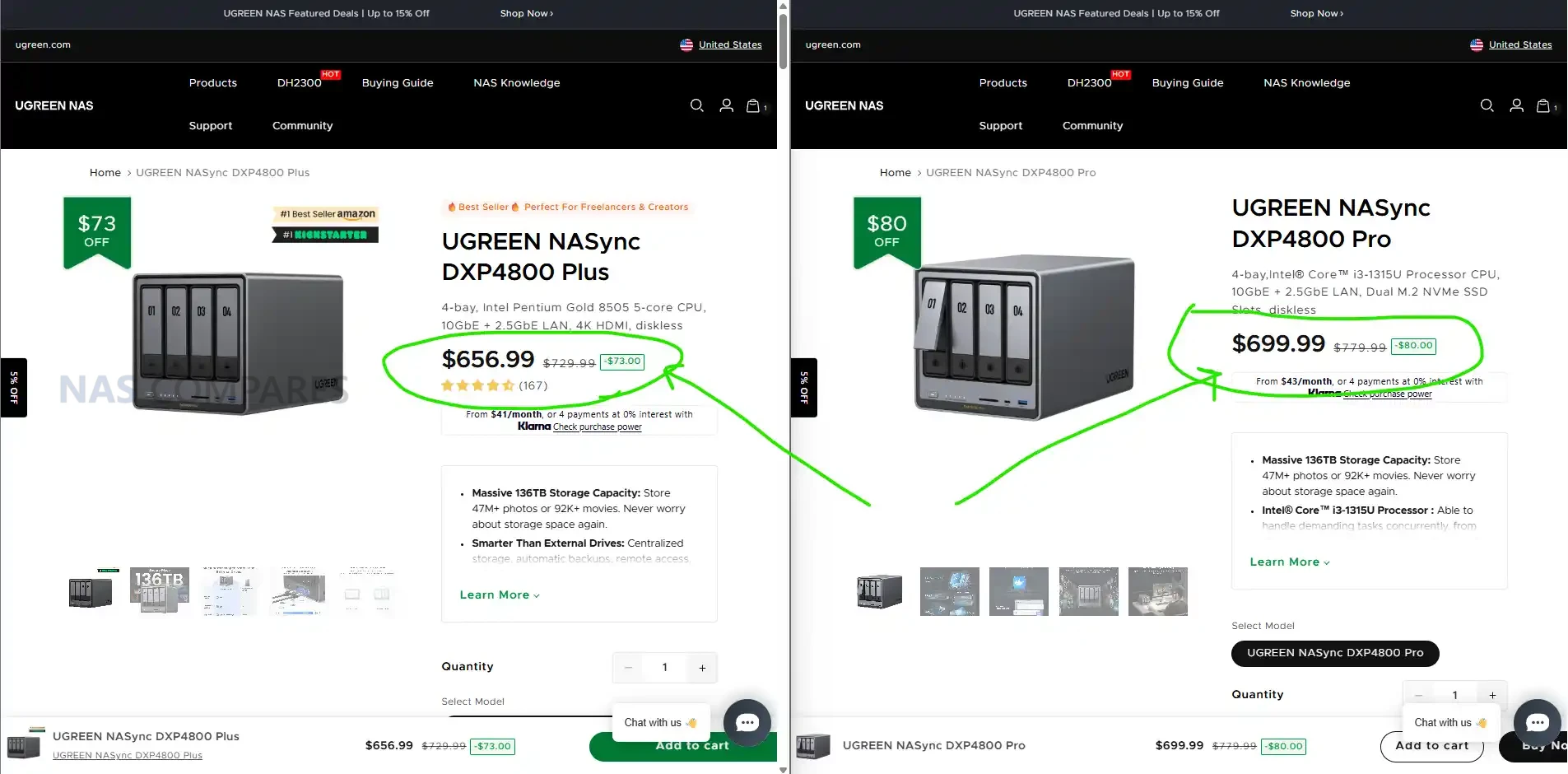
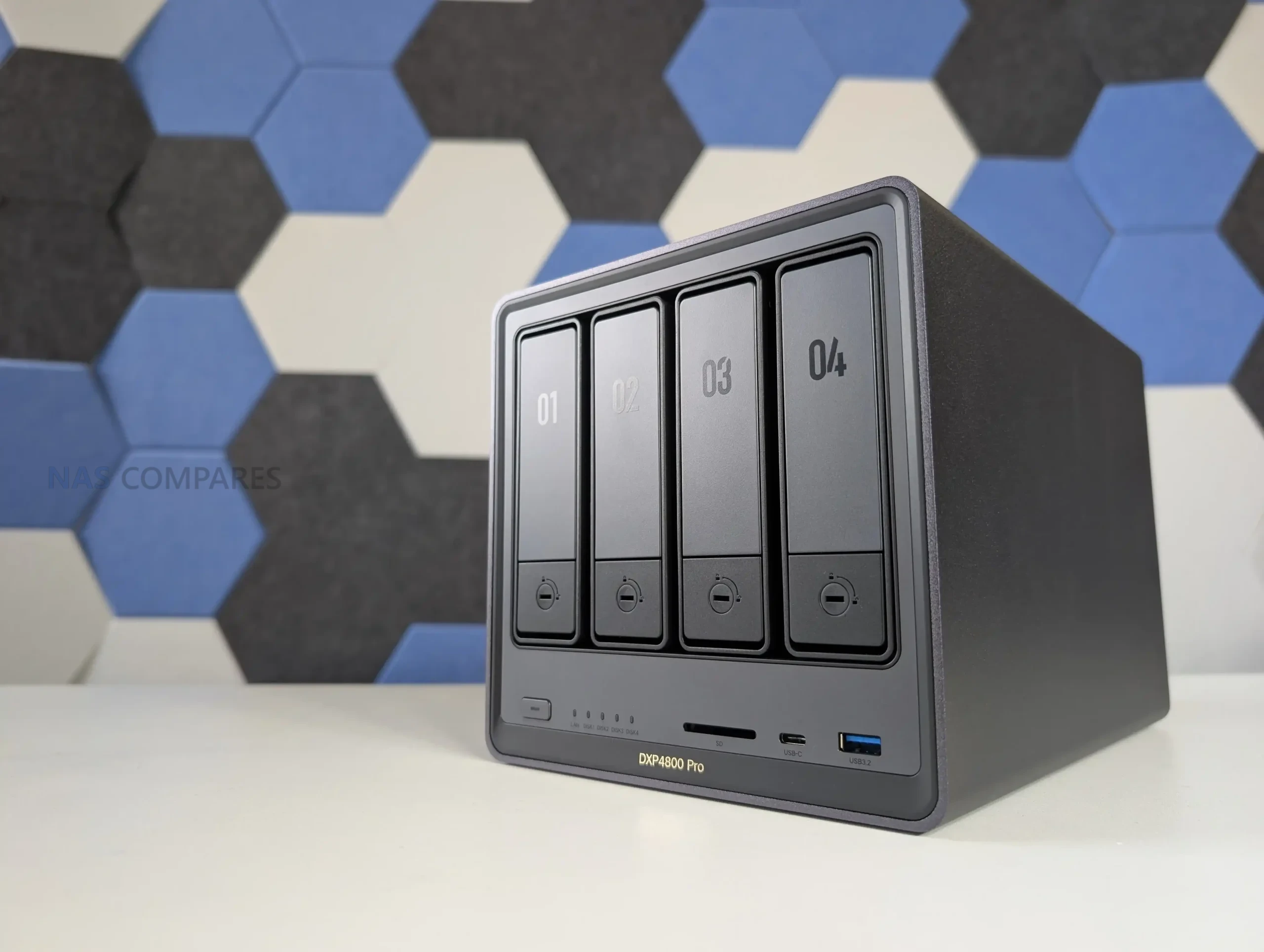
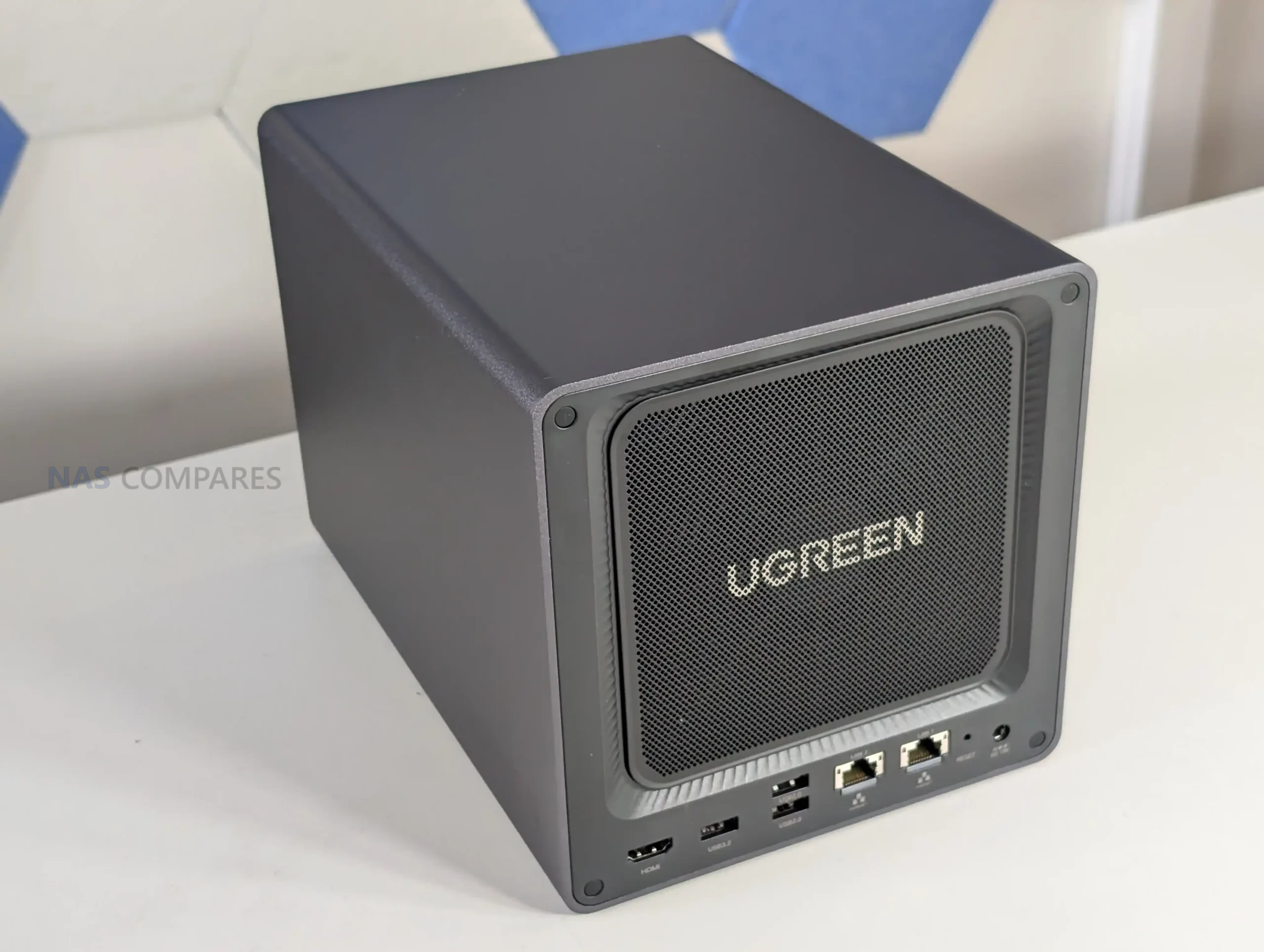
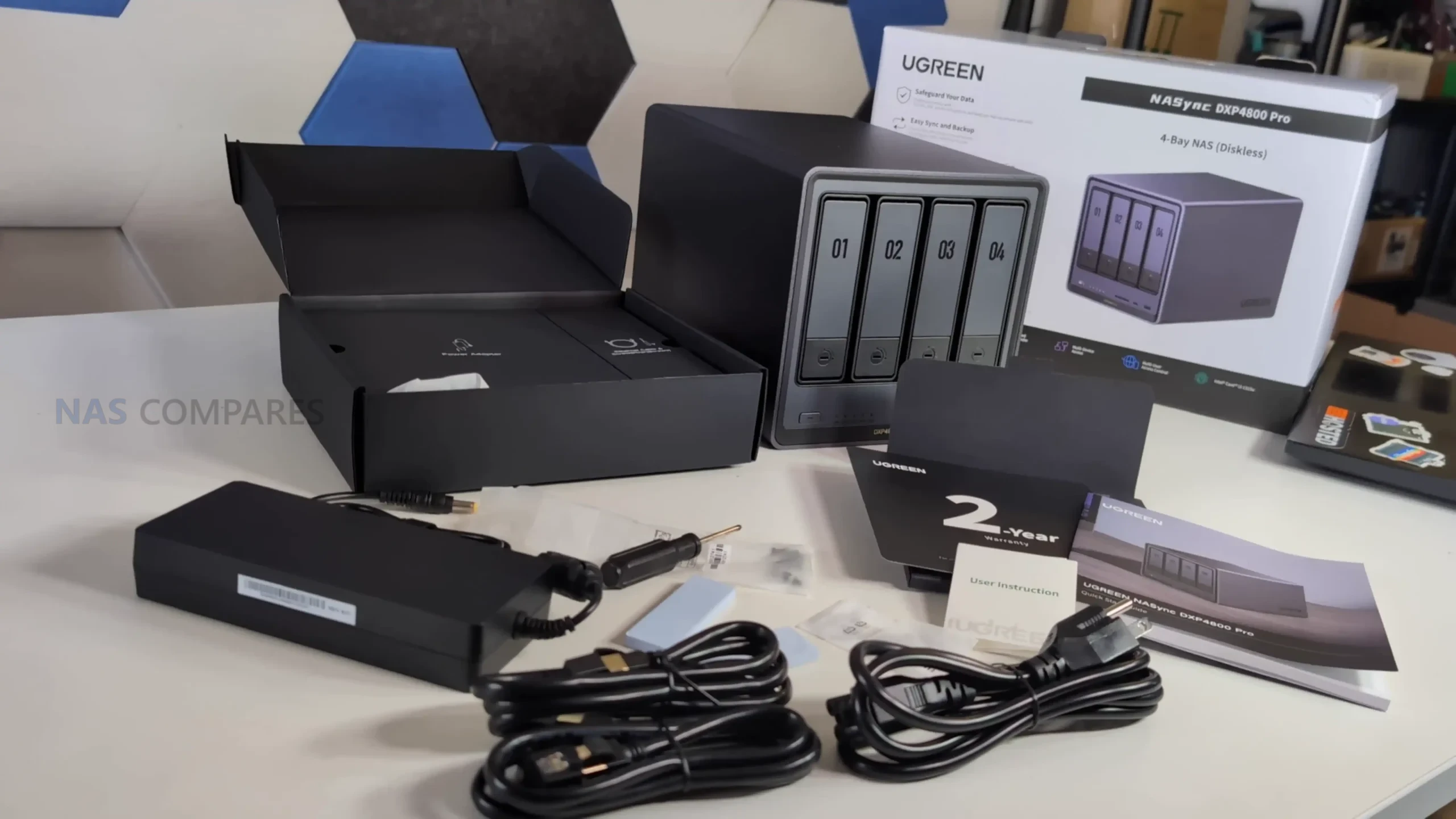


 NAS DIY en 2026 : quel système choisir ?